Reforming the Local Welfare State in Denmark:
The Geographical Paradox of Amalgamating
Municipalities
Ulrik
Kjaer
※Abstract
In 2007 the Danish municipal structure was changed, and the number of political/administrative units forming the local welfare state was reduced from 271 to 98. In the debate leading up to the reform, several arguments on municipal amalgamations, pro et contra, were deliberated. The article identifies the different arguments and assesses that professional sustainability was the key argument for larger municipalities, whereas the increased citizen per councilor ratio was the key argument against. It claims that the reform unleashed a struggle for economic resources among different geographical parts of the newly amalgamated municipalities and that the outcome of this redistributive game is important for the professionalization of the provision of local welfare services. It is too early to evaluate the consequences of the reform, but the article argues assessments of such reforms must include the potential consequences for the geographical distribution of welfare provision and of economic growth and development in more general terms.
Key Words: local welfare state, municipal amalgamations, professionalization, Denmark
1. INTRODUCTION – REFORMING THE LOCAL WELFARE STATE
In normal parlance the term welfare state is most often used in connection with public provision of services such as child care, primary and secondary schooling, social service, care for the elderly etc. However, in quite a lot of countries these policy areas are not exclusively handled by the state, as literally
※※ Ph.D., Professor, University of Southern Denmark
© The Policy Science Association of Ritsumeikan University: Journal of Policy Science, 2013. ISSN 1881-6703. vol. 7., pp.33-53
implied by the wording welfare state, but in collaboration between the central state level and the decentralized local level (municipal and/or provincial). In some countries the municipalities are actually the primary provider of welfare services such as schooling and social care. Even though central legislation often regulates the level of service to be provided (e.g. minimum standards), some of the specifics concerning the provision (e.g. school curriculums) and whom among the citizens should receive the service (e.g. non-discrimination rules), the municipalities provide the services. The councilors not only make a lot of the decisions concerning organization and delivery of welfare state services; they are to a large extent held accountable at the next local elections if the citizens are not satisfied with the specific welfare services they receive.
It would be going too far to suggest that the term welfare state is replaced by the term welfare municipality or welfare state/municipality but the above mentioned local element of welfare state services should at least lead to an acknowledgment of the existence of a local welfare state . This is especially true in countries where the welfare state is most localized , such as the Scandinavian countries where welfare service provided by the local level accounts for more than one fifth of the GNP (Mouritzen, 2003, p. 32). The extent to which the local level is included in welfare service production varies, but it is safe to say that the expansion of the welfare state during the past fifty years has been based on the parallel growth in the political/administrative organizations at the local political level, i.e. municipalities and counties. As Blom-Hansen writes: Today the Scandinavian welfare state is basically a local welfare state (Blom-Hansen, 2010, p. 52).
Recognition of the local level as the backbone of the welfare state in regard to welfare service provision is also important in respect to raising awareness of the trends and recent reforms at the local level. Since local governments are trusted with large parts of the welfare state, changes and reforms at the local government level can potentially impact the realization of welfare state policy. According to Kjellberg: Local government reorganization is endemic to the development of the Welfare State (Kjellberg, 1985, p. 236). And in many countries – including in Scandinavia – things are indeed changing. It is not that reforming local governments is the latest new thing – on the contrary local governments are probably constantly reforming and thereby transforming themselves. However, since [t]he expansion of the public sector and its mounting complexity involved
an increasing pressure on the existing institutional arrangements at the local and regional level (Kjellberg, 1985, p. 236), a number of countries have recently implemented quite ambitious reforms (Moisio, 2012).
For quite some time reforming local governments has meant including market-based initiatives, building political regimes involving a range of non-governmental players, creating governing networks, changing the form of government, introducing facilitative leadership, starting governing by objectives etc. (Stone, 1989; Berg & Rao, 2005; Svara, 1990). Some of these trends are part of the more general change within public administration labeled New Public Management (Hood, 1991) and all have been included under the general heading of governance (e.g. John, 2001). The trend in local governments has for years been a change from government to governance. However, in recent years the pendulum has swung back and in many countries (not least in Europe) the hot issue is now amalgamations, which is more government than governance (Kjaer, 2011). After several decades with governance as the buzzword it seems that something as old fashioned as structural reforms (which concern territorial division and organization and include the redrawing of boundaries and the amalgamation of municipalities (Kjellberg, 1985, p. 219)) has returned as the most favored potential solution to modernizing and tuning the local welfare state.
In the discussion of how to design a local governmental system the question of size is – and has continuously been – one of the classic dimensions of analysis. This is no mystery, because once you decide to establish (or retain) a local level in a country it follows that the country must be divided into a number of geographically defined units. However, it is not obvious how many units. The basic raison d être of local governments is that they offer a number of units larger than one – it is the sheer number of municipalities that opens up for the traditional decentralization arguments (and counterarguments). Since the local element of the welfare state is grounded on these arguments for decentralization – and since the question of size has these arguments as point of origin – they should be briefly summarized:
First, the argument of subsidiarity, which is a very normative claim that decisions are best taken by those who are closest to its consequences. Since liberty (from the state) is best nourished in smaller local settings, political power should be decentralized. This traditional localist argument has also evolved into a
general preference for the local: A metaphysical pathos for local autonomy – a moral empathy for the idea that what is local is good and what is central is bad (Page, 1982, p. 39). Second, the span of control argument, which claims that the state itself prefers to include local governments since the state has neither the capacity nor the ambition to go into each and every detail of the complex societal machinery: [N]o national government wants to cope with everything (Sharpe, 1970, p. 154). In the more sophisticated version the state needs the local governments as a unified service-providing agency at the local level to perform horizontal coordination of state level initiatives in different policy areas (Sharpe, 1970, p. 167). Third, a genius of place argument for decentralization (Laski quoted in Sharpe, 1970, p. 155) can be identified. Not only can the central state experience difficulties coping with the amount of decisions to be taken; it can also be difficult for the state to see through all local specifics and have local knowledge of the local context (history, topography, culture etc.) which can be advantageous in the decision making process: [C]entral government is not equipped to grasp the inimitable conditions of each locality (Sharpe, 1970, p. 155). Fourth, the argument of efficiency claims that if a wider variety of welfare services are provided (which is possible when more local units act as providers) a better match with (more) citizens preferences is obtained. This welfare economic argument is stronger if the mobility among citizens is high (so that the citizens can vote with their feet in a Tieboutian jargon (Tiebout, 1956)). In that case, the local authorities … will compete with each other in the services they provide and so raise the quality and effectiveness of these services (Sharpe, 1970, p. 158). Fifth, building on this competition among the local units, an innovation argument of decentralization can be identified. In their eagerness to attract citizens (and corporations) by offering better service than the neighbouring municipality, the municipalities will be more focused on improving their service and experiment and innovate more (Treisman, 2007, p. 14). Since local governments do not take out patents on new ways of providing welfare service, successful innovation can spread to other municipalities and an innovation/diffusion process can be created where good ideas flow. Sixth, there is also a school of democracy argument of decentralization. Local governments require local councilors and this provides broad opportunities for citizens to participate in public policy (Sharpe, 1970, p. 155). Several citizens are given the chance to participate in politics on this lower level and therefore local governments provide political education (Mill quoted in Pratchett, 2004, p. 360). In Tocqueville s solemn words: Local institutions are to liberty what primary schools are to science; they put it within people s reach; they
teach people to appreciate its peaceful enjoyment and accustom them to make use of it (quoted in Sharpe, 1970, p. 161). And finally, seventh, a diffusion of power argument can be used in favor of decentralization. From the school of democracy argument follows that more people are involved in the policy making processes, which means a potential for more power sharing (Treisman, 2007, p. 13). This also leads back to the argument of subsidiarity and not least to the conclusion that the seven arguments of decentralization are often quite intertwined.
There is a flipside to decentralization, and there are also arguments against decentralization. Decentralization can make macroeconomic policy more difficult, coordination between local governments can be troublesome, norms of equality can be violated, genius of place might also mean narrowminded etc. The counterarguments will be discussed in more detail in the next part of the article which focuses on the question of size of the municipal units in the local welfare state. This is a hotly debated issue at the moment and since the local level of the welfare state is indeed important for the understanding of the welfare state, the ongoing discussion of structural reforms of local governments is an important feature of the more general discussion of reforming the welfare state. As already pointed out, the question of size is neither trivial nor easy to answer, especially since the arguments can vary in presence and strength across time and space. The remainder of the discussion is therefore based on a specific case study.
We have chosen Denmark as a case, since it is one of the most localized welfare states and because the municipal structure recently – in 2007 – changed dramatically when 271 municipalities were reduced to 98 (Bundgaard & Vrangbæk, 2007; Andersen, 2008; Houlberg, 2010; Mouritzen, 2010; Blom-Hansen, 2010, 2012). We do not intend to evaluate the structural reform since it is probably too early to assess the full consequences (just as the economic crisis starting with the 2008 financial crash makes it difficult to isolate the consequences of the reform from the consequences of the other substantial changes in society). But in part 2 we will discuss the arguments that were used in the debate leading up to the structural reform. It will be argued that the geographical or spatial elements of the reform were somewhat overlooked. A lot of the debate focused on which municipalities should amalgamate, so geography was not absent from the discussions, but some of the important geographically based arguments for and against amalgamating municipalities were not always included in the public debate before the decision to amalgamate was made. In
part 3 we will therefore discuss geography and the tensions between different localities in contemporary politics. Part 4 sums up the lessons from the Danish case; it has been claimed that the structural reform establishes new rules and a new course for the future development of the Danish welfare state (Bundgaard & Vrangbæk, 2007, p. 491).
2. THE ARGUMENTS ON AMALGAMATING MUNICIPALITIES – PRO ET CONTRA
During the silly season of summer 2002 a discussion of municipal amalgamations started in Denmark. At the outset it was also a discussion of several dimensions of the local government structure, for instance whether to remove the regional government level (and only keep the municipal level) and whether to move responsibility for certain tasks from one political level to another. Some of these questions – including size of municipalities – are intertwined. Some tasks can be moved from the central government to the municipalities only if the municipalities have a certain size; the regional level is somewhat redundant if there are only very few (and very large) municipalities etc. Even though the question of the number of tiers in the Danish government structure was probably the most debated dimension in Denmark in the 1980s (the governing Conservative party argued for a two-tier system with abolishment of the regional level) and even though the question of which tasks each tier would handle was the most discussed in the 1990s (leading to a white paper on the matter (Opgavekomissionen, 1998)), the question of municipal size dominated the debate initiated in 2002.
Right after the issue was introduced in the public debate, the government appointed a working commission to produce a white paper on the local government structure. The white paper was published in January 2004 (Strukturkommissionen, 2004) and after some negotiations a parliamentary decision was taken in June 2004 to reform the structure of the governmental system (for an analysis of the decision making process see Bundgaard & Vrangbæk, 2007; Christiansen & Klitgaard, 2010). The regional level was maintained (although the number of regions was reduced from 14 to 5), a few tasks were moved from one level to another (tax collection from municipality to state; employment policy from state to municipality; advanced social service, special education and environmental protection from regions to municipalities),
and the number of municipalities was reduced from 271 to 98 (for a timeline see Bundgaard & Vrangbæk, 2007, p. 496).
As a consequense of the reform and the amalgamation of municipalities the average size of Danish municipalities rose from 19,900 to 55,200 inhabitants (Blom-Hansen, 2010, p. 54). But what were the arguments for and against amalgamating municipalities? By and large the discussion was formed around the very traditional opposition between efficiency and democracy (or what Newton denotes functional effectiveness and democracy (1982)). From the outset the discussion of these two dimensions followed the traditional lines, i.e., amalgamating municipalities is seen to improve efficiency and hurt democracy. In Dearlove s words: Small is to democracy as large is to efficiency (Dearlove, 1979, p. 60). This is the standard view, but in a seminal article Newton has questioned this simple correlation: Is small really so beautiful? Is big really so ugly? (Newton, 1982). Also in the Danish debate were the efficiency and the democracy arguments challenged, bringing a more nuanced understanding of the relationship between these dimensions and municipal size into the discussion. Equally important, the efficiency as well as the democracy argument was elaborated and specified in more detail in the debate and at least four more detailed dimensions of each argument could be identified. We will briefly introduce the eight arguments, including their counterarguments.
2-1. Matching preferences
As already stated, one of the main arguments for decentralization – and for the existence of a local government tier altogether – is that more units providing welfare services such as child care, primary schools, care for the elderly etc. allow for variation in the services. Since the citizens probably have different preferences it would be possible, ceteris paribus, to match these preferences better. However, the argument goes, establishing a local government tier does not in itself ensure that this preference matching mechanism functions – if the municipalities are very small they will probably not be entrusted with the responsibility of important welfare state tasks. Or if they are, such decentralized tasks would probably be accompanied by so many minimum standards, national legislation on specific procedures and control measures that the discretion of the local governments (and thereby the possibility to match local preferences) is correspondingly negligible. Therefore, a necessary prerequisite for exploiting the preference matching potential of local governments is that they have a size that
makes them so robust and potent in economic and professional terms that they can be entrusted with the increasingly complex tasks of the modern welfare state. In the debate it was claimed that the state was regulating small municipalities more and more and that amalgamations were needed to loosen the central government s grip on the municipalities. The counterargument here is that amalgamating municipalities will reduce the number of units at the local level and thereby the number of potentially different local solutions – and in more general terms different service/tax combinations. This consequence was discussed considerably; not so much in terms of the reduction of potentially different local service provisions but much more down to earth in regard to the immediate harmonization of the local welfare services in each of the amalgamated municipalities. Since Danish municipalities are not allowed to discriminate based on geography, amalgamating municipalities will lead to a harmonization of the level of service provided to the citizens. If a number of municipalities are amalgamated they have to give up their different ways of providing for instance care for the elderly and settle on a common level of service and a common policy on how this service is provided. If before the amalgamation one municipality tries to keep the elderly in their own home as long as possible (nursing assistants, physiotherapists, social assistants etc. come to the elderly s home) while another makes the elderly move into nursing homes, they have to harmonize and settle on a common policy. The level of service provided should also be harmonized in terms of budget. So in the short run the variation in the welfare service provided seems to be smaller due to the immediate service harmonization within each amalgamation. In the long run amalgamated municipalities might be entrusted with more tasks and not least more discretion in deciding how the service should be provided, expanding the policy areas for the preference matching mechanism to function. This could be labeled the efficiency dilemma. But let us turn to some of the intermediate mechanisms in the discussion of efficiency.
2-2. Economies of scale
One of the most simple and straightforward arguments in favor of amalgamating municipalities in the Danish debate as well in the academic literature is based on economies of scale. In the private sector the standard argument for larger companies and larger production facilities is economies of scale – the more units produced, the lower the average cost. This argument is not only the reason for merging companies but also for amalgamating municipalities – the more welfare service produced, the lower the cost per unit produced
(Newton, 1982). However, the opposing argument, that there is a limit to economies of scale, was also been used in the debate. In other words, if municipal size is taken beyond this limit, diseconomies of scale will kick in. According to the classic diseconomies of scale argument, larger municipalities will lead to bureaucratic expense and wastefulness (Newton, 1982, p. 194) but in Denmark the counter to the economies of scale was more developed. First of all it was claimed that larger municipalities would lead to more middle management – a larger organization requires more coordination and bureaucracy. Secondly, it was argued that larger bureaucracies base their operation on relatively more written than oral communication and caseworkers in larger municipalities would spend more of their time writing to each other. Finally, it was questioned if economies of scale would really work in welfare services such as child care and primary schools since the unit of production in many cases is not the municipality, but institutions like schools and day care centers. As long as these are not merged, economies of scale cannot be obtained.
2-3. Professional sustainability
Newton has said that [A]s urban-industrial society becomes larger and more complex, so must local government (Newton, 1982, p. 195). The argument goes that welfare service provision has become an increasingly complex business – not only have the professional dimensions of many welfare services multiplied, so have the legislators policy ambitions. This is all reflected in more and more detailed legislation and in the demand among legislators and citizens alike that local governments handle these often quite wicked problems professionally. Here the argument goes that small municipalities do not have the capacity to meet the demands for professionalization. As Newton explains: [I]t has been found that quite a large population is necessary for some rather specialized services such as residential children s homes, special educational institutions, temporary accommodation for the aged, and facilities for the physically and mentally handicapped (Newton, 1982, p. 195). In the Danish debate it was repeatedly mentioned that small municipalities were not professionally sustainable – they did not reach the critical mass of citizens required to handle the more specialized tasks professionally. The argument was that for instance case workers in social services could not specialize sufficiently to the required level of education to stay updated on the relevant legislation. In small municipalities each case worker has to deal with several different types of cases, which leaves less opportunity to develop specialized skills within a field. A widely discussed example in the Danish
debate originated from the white paper and described how case workers dealing with forcible removal of children from dysfunctional families (with drug addiction, violence or sexual abuse) only encountered this type of case once a year (Strukturkommissionen, 2004). It is of course fortunate that the municipalities seldom have to intervene in such tragic family events, but it is less fortunate that when such cases arise in small municipalities the social worker is not prepared. By amalgamating municipalities these cases can be concentrated on fewer case workers who then get the possibility to specialize and gain more experience and better skills in dealing with these cases. If several municipalities are amalgamated into one it might even be possible to concentrate these cases in so few administrations that more than one case worker works with them full time in the same amalgamated municipality. A milieu for professional discussions might be established and the administration becomes more robust – if one case worker is sick or on sabbatical leave, another can take over. It was often mentioned that creating professional milieus could have a self-reinforcing effect. The better case workers within a field would be attracted by the opportunity to cooperate and discuss with well qualified colleagues and larger municipalities would have the upper hand in the game of attracting the best qualified employees. Not everybody bought into the argument on professional sustainability, though. Not only was the argument that people working at city hall should have a better professional milieu hard to sell to ordinary citizens, who feared that the money spent on hiring another person with a law degree to work in the administration would be taken from for instance nurse assistants in the elderly care. Another counterargument was that municipal caseworkers could be too professional and overspecialized. Some citizens value having only one case worker, who is not be a specialist on everything, but a specialist on this specific citizen and be able to take all relevant information into consideration.
2-4. Reform effect
It was often argued – though not very openly – in the debate that amalgamation could in itself be a useful tool in service checking the municipal organization. An amalgamation is such a major restructuring and opens a window of opportunity to get rid of inefficient procedures and habits. The process of designing a new amalgamated municipality can be an opportunity to alter procedures that have so far been hard to change due to organizational inertia. On the other hand, a much more outspoken concern in the debate was that the reform in itself would constitute a source of inefficiency while pending. The
argument was that amalgamating municipalities involves a number of sunk costs ranging from the very obvious like moving expenses when administrative organizations are relocated geographically and development of a new common design line to more hidden costs like man power and organizational costs involved in planning and implementation. Also the more sophisticated version that amalgamating municipalities have an incentive to overspend in the last budgetary year before the amalgamation (the common pool problem – see Blom-Hansen, 2010) was mentioned as an argument against amalgamations.
2-5. Citizen inclusion
Arguments regarding democracy were also in the Danish case primarily used against amalgamations – the main argument in favor of status quo being that local democracy would suffer in larger municipalities. In its broadest and most general formulation the argument was that the citizens would be included less in the political decision making process if the municipalities became larger. The idea of small political communities where all citizens participate in political meetings was abandoned a long time ago – also at the local government level. Representative democracy has prevailed and dominates modern thinking on local democracy in Denmark. However, even in representative democratic settings size seems to matter, and it was repeatedly mentioned in the debate that the inclusion of ordinary citizens in local politics would suffer if municipalities were amalgamated. This is in line with Dahl and Tufte s argument in their seminal book Size and democracy (1973): Smaller democracies provide more opportunity for citizens to participate effectively in decisions (Dahl & Tufte, 1973, p. 12). Larger municipalities were often seen as enemies of democracy in the Danish debate; however, the argument was not that large municipalities were undemocratic, only that conditions for the local edition of representative d e m o c r a c y w e r e n o t a s g o o d a s i n s m a l l e r m u n i c i p a l i t i e s. A n o t h e r counterargument went that the supposedly better inclusion of citizens in small municipalities matters less if these municipalities are not left with important political decisions. The citizens may be more involved in the political process in small municipalities, but this is not an advantage if the smallness of the municipality leads the central government to centralize most political decisions. This argument was well in line with the important amendment that Dahl and Tufte included in their take on size and democracy quoted above: But: Larger democracies provide opportunities for citizens to participate, at least by voting in elections, in the decisions of a political system large enough to control all or most
of the major aspects of their situation that can be controlled (Dahl & Tufte, 1973, p. 13). This is the democracy dilemma in discussions about municipal amalgamations.
2-6. Participation
One of the more detailed arguments on citizen inclusion in the Danish debate was that citizens would participate less in local politics in the larger than in the smaller municipalities. The claim was that the main motivation for participating in local political discussions is that your voice is heard and they concern matters related to the locality where you live. Both motivations for participating are supposed to be affected negatively when municipalities are amalgamated. With more people living in the municipality your voice and/or vote count less than before and some of the political discussions in your municipality now concern mostly communities at some distance from where you live. The motivation for each citizen to participate in the political process – either by voting or by discussing with friends and neighbours – was, therefore, claimed to be lower in larger than in smaller municipalities. The counterargument said that organized political participation could actually increase after amalgamation. For instance, political parties would benefit from amalgamations as citizens would have more opportunities to participate in organized political activity. In many small municipalities only a few of the largest of the many Danish parties had a critical mass of supporters to form a local branch and many voters who lived there could not participate in local party activities. Amalgamation would mean enough supporters also of the smaller parties to establish a branch in most municipalities (see also Newton, 1982, p. 200).
2-7. Genius of place
A s m e n t i o n e d i n t h e i n t r o d u c t i o n o n e o f t h e m a i n a r g u m e n t s f o r decentralization is genius of place – that decision making processes taking place in close proximity to the specific problems will be more informed on the local specifics and therefore result in better decisions. In the Danish debate opponents of amalgamations repeatedly argued that increasing the size of the municipalities would also increase the distance between politicians and citizens. The chance of knowing a local politician personally would decrease, whether knowing means being related, living in the same street, having kids at the same school, playing soccer in the same club or doing the grocery shopping in the same shops. Of course, local democracy in its representative version does not necessarily imply a
thorough and continuous consultation between politicians and citizens between elections, or that such consultation should happen because they bump into each other at the local shopping mall or because some citizens have privileged access to certain councilors. However, the genius of place argument also builds on information flow, and fewer councilors in fewer municipalities were seen as a very serious problem in the debate. Some saw fewer councilors with less direct contact to individual citizens as advantageous to local democracy, and they counter-argued that in very small municipalities the councilors were sometimes too close to the citizens or at least to some groups. It can be difficult for the councilors to make unpopular decisions if they know they will meet the unhappy citizens next morning at the bakery or at the day care center. During the past years many municipalities have discussed changing the structure of the schools and closing a school in one part of the municipality often leads to massive critique of the councilors by the citizens living there. If councilors are close to these citizens it can be very difficult to close a school even if a decrease in the number of children suggests so. In larger municipalities, the argument went, the distance between politicians and citizens would make room for political professionalization.
2-8. Accountability
An argument against amalgamations was that larger municipalities would make the political/administrative systems less transparent and more difficult for citizens to gain insight in the local decision making process. This would again restrain the possibilities of holding the politicians accountable for their decisions at the next election – a cornerstone in representative democracy (Beetham, 1996). The larger and more professionalized municipalities makes it harder for the not so professionalized citizens to follow local politics and not least to decide whether to re-elect the incumbents. The counterargument was that small municipalities do not prevent closed political processes; actually professionalization of the bureaucracy could be a measure to identify political wrong doing.
2-9. The relative importance of the arguments
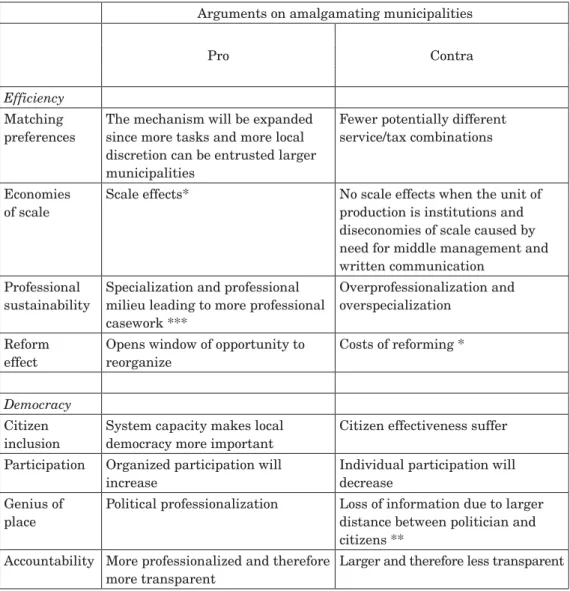
The arguments from the Danish debate described here are included in Figure 1. Asterisks mark which arguments are assessed to have played the most important and decisive role. Among the arguments against amalgamations, genius of place was by far the most frequent. It really raised a serious concern in most debates. Also the costs of reforming were a major concern among many local politicians and citizens alike. The two main arguments in favor of amalgamations
were economies of scale and professional sustainability. Economies of scale is usually the top argument for amalgamating, but it only came in second in the Danish debate, where the professional sustainability argument was very strong. The very short version of why the Danish municipalities were amalgamated in 2007 would actually be that it was done out of concern for the professional sustainability in the small municipalities.
FIGURE 1 Arguments for and against amalgamating municipalities mentioned in the Danish debate leading up to the 2007 Structural reform
Arguments on amalgamating municipalities
Pro Contra
Efficiency Matching preferences
The mechanism will be expanded since more tasks and more local discretion can be entrusted larger municipalities
Fewer potentially different service/tax combinations
Economies of scale
Scale effects* No scale effects when the unit of production is institutions and diseconomies of scale caused by need for middle management and written communication
Professional sustainability
Specialization and professional milieu leading to more professional casework ***
Overprofessionalization and overspecialization
Reform effect
Opens window of opportunity to reorganize
Costs of reforming *
Democracy Citizen inclusion
System capacity makes local democracy more important
Citizen effectiveness suffer Participation Organized participation will
increase
Individual participation will decrease
Genius of place
Political professionalization Loss of information due to larger distance between politician and citizens **
Accountability More professionalized and therefore more transparent
Larger and therefore less transparent *** Extremely important argument in the Danish debate
** Very important argument in the Danish debate * Quite important argument in the Danish debate
Note that even though most of the arguments are known from the literature, they are still mostly empirically unsettled. As Newton summarize the studies of efficiency: [W]e can conclude with confidence that, under certain not well understood circumstances, it may, or may not, be more, or less, economical to have larger, or smaller, local authorities (Newton, 1982, p. 193). In regard to democracy, Dahl and Tufte s claim that no single type or size of unit is optimal (Dahl & Tufte, 1973, p. 138) still has not been seriously challenged.
3. GEOGRAPHY MATTERS – ALSO IN THE LOCAL WELFARE STATE
One important lesson from the Danish case and from the debate leading to the structural reform of the local welfare state is that spatial arguments tended to play a far larger role than expected. For quite some time the general perception has been that place has lost significance – that different aspects of social life, including politics, have been deterritorialized (Appadurai, 1996; Tomlinson, 1999). Or at its most extreme: Geography has become irrelevant (Coupland, 2010, p. 9). Even though other scholars have claimed that the process of deterritorialization is not necessarily going that fast (Ghemawat, 2011), geography is no longer among the usual suspects when political discussions are analyzed and political cleavages are identified. Discussing municipal amalgamation by contrasting efficiency and democracy could have meant weighing the advantages of economies of scale against the disadvantages of less citizen participation in local politics. But as illustrated in Figure 1 the two leading arguments were professional sustainability (pro) and the larger distance between politicians and voters (contra), and they certainly have a spatial element to them.
As for professional sustainability, the argument for larger municipalities not only goes on creating a larger citizen base (and thereby facilitate specialization) but also on creating a better and more professional milieu for the employees. This is done by concentrating employees in fewer units – ultimately at one larger City Hall in the new amalgamated municipality – thereby taking advantage of the general power of agglomeration (Glaeser, 2011; Moretti, 2012). As for the larger distance between politicians and citizens, the spatial dimension is quite obvious; with a lower politician/citizen ratio there will, ceteris paribus, be less direct contact between the two groups and the voice of the more peripheral localities in the new amalgamated municipality will probably be lower at the new City Hall.
So the discussion of amalgamations in Denmark also touched upon the potential geographical consequences. Obtaining professional sustainability by concentrating the administration of the local welfare state in the center of the new amalgamated municipalities also means changing the patterns of the future economic development within them. Not that the municipal jobs are the only ingredient in determining mechanisms of growth but there would probably be a substantial spill-over effect from concentrating the local welfare state jobs in the c en t e r of the n e w m uni ci pa li t y. I n t h e Da n is h c a s e th e d is c u s s io n o f amalgamations therefore in many ways unleashed a more traditional redistributive game between geographical entities, in this case played out between what would become the center and the periphery, repectively, of the new amalgamated municipalities.
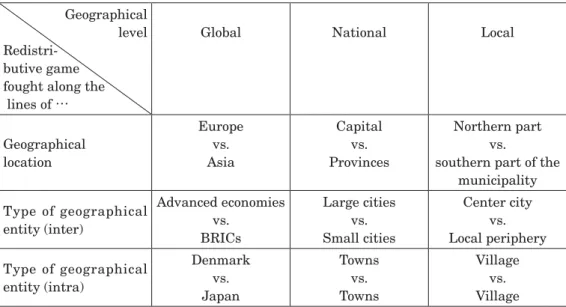
Such redistributive games where citizens and politicians from different geographical areas fight for economic growth and wealth are well known on the global and the national scenes, and most observers would probably agree that it has not been less intense in recent years – on the contrary. At the global level, for instance, North America, the EU and the strong Asian economies fight against each other in the global market place and in the game about future wealth and prosperity. In that case the fight is organized around geographic location, but sometimes the teams are made up of countries that are not geographically close, for instance traditional advanced economies (such as Denmark and Japan) against BRIC countries (such as Brazil and China). The redistributive game can also been fought between countries of the same type, for instance when Japan and Denmark fight for market shares in the same market. The same three patterns are found at the national level. In Denmark, there is an intense fight for investments between the capital of Copenhagen and the rest of the country, and among the large cities and the smaller cities/rural areas. Finally, there is a fight for tomorrow s growth between for instance the smaller cities – if a private company is relocating or a public institution has to be placed somewhere they all argue that their city would be the best locality.
The debate about the municipal structure in Denmark demonstrates that at least when status quo is altered such redistributive games are also played at the local level. For instance the northern part and the southern part of a new municipality fight about ressources and new investments; the center city and the periphery of an amalgamated municipality see each other as competitors and all
villages compete against each other (simultaneously teaming up against the large city). These geographically based redistributive games are complex and the complexity is further increased when the local level is added. The many different games are exemplified in Figure 2.
FIGURE 2 Examples of geographically based redistributive games at different
geographic levels
Geographical level
Redistri-butive game fought along the lines of …
Global National Local
Geographical location Europe vs. Asia Capital vs. Provinces Northern part vs.
southern part of the municipality Type of geographical entity (inter) Advanced economies vs. BRICs Large cities vs. Small cities Center city vs. Local periphery Type of geographical entity (intra) Denmark vs. Japan Towns vs. Towns Village vs. Village
These redistributive games are most often seen as zero-sum games – if China has huge growth rates, the U.S. suffers; if the capital of Copenhagen attracts new companies and citizens, fewer people will live in some of the peripheral cities, and if the school, the nursing home and the local government administration building are closed down in one village, the neighbouring village will probably experience more activity in its equivalent institutions (and thereby more jobs). These kinds of games are often self-perpetuating: If the school is closed in one village, the teachers might move to the neighboring village to teach, and then they will also buy their groceries there, which would mean that the shops in the first village might close, and with no shops, newcomers will not settle there but in the village with school and shops etc. It can be a vicious circle. And the other way around when a village or town attracts new public jobs, it will tend to grow even more as a consequence. It should be emphasized that we do not know how strong these self-perpetuating effects are at the local level in Denmark – or if they exist. But quite a lot of citizens and local politicians alike believed in them, and they were
often included in the debate leading up to the structural reform.
A lot of effort was put into discussing the geographic design of the new municipalities in terms of where to locate city hall, schools, nursing homes etc. Some of the decisions are path-dependent and cannot be changed overnight; others were left for the newly elected councilors in the amalgamated municipalities. Some municipalities chose a concentrated model where most of the activities are concentrated in the larger of the cities. Others chose a more deconcentrated model where for instance the municipal administration is distributed among several cities in the new municipalities (often by using the existing city halls of the old municipalities). Many municipalities probably have not yet found the final solution, but may have used a more deconcentrated model in the first years of the new municipality s life with more concentration coming up. The delay of the concentration might have been chosen for political reasons (too fast a concentration might have caused too much popular protest) or for practical reasons (it takes time to sell existing buildings and build new ones). We do not know yet how the redistribution game will end in each of the municipalities (see Bhatti et al., 2010), but the discussion of the municipal structure and the decision to amalgamate the Danish municipalities definitely unleashed an intense discussion about how to geographically design the new municipalities. The Danish case has demonstrated that geography matters at the local political level and has to be taken into account in the discussion of reforming local welfare states.
4. CONCLUSION – THE GEOGRAPHICAL PARADOX OF PROFESSIONALIZATION
The Danish case demonstrates that the traditional weighting of efficiency and democracy remains at the core in discussions about municipal size. However, while the efficiency argument is normally based on economies of scale and the democracy argument on the participation dimension, other dimensions of the two classic arguments took the lead in the Danish debate. The main efficiency argument for amalgamating municipalities was professional sustainability – by merging the municipal administration of local welfare services it is possible to increase the professional quality by exploiting the higher degree of specialization and the thicker professional milieu. The main democracy argument against amalgamating municipalities was the fear of increasing the distance between politicians and citizens, which not least for the more peripheral areas could mean
that they would be forgotten (less local community advocacy) in the redistributive game about the location of for instance the local administration and local welfare state institutions like schools and nursing homes.
The Danish case and the identified arguments also point to the fact that geography matters when we discuss reforms of local welfare states. This reflects the current geographical fights over wealth and growth at the global as well as at the national level. These geographically defined tensions in the political debate at the very local level have been sparked or at least magnified by the shock to the system which an amalgamation reform also forms. And the controversies seem to continue – even though we are now six years into the new municipal structure the old borders between the municipalities have not been forgotten. The global financial crisis and the economic problems it has created also for the public sector in many countries has intensified the fight over scarce economic resources. It is still too early to evaluate the reform (the central government is conducting a first prelimenary evaluation of selected issues) and we do not know what the final design of the new local welfare state will look like. We know the new municipal borders but we do not know how each of the new municipalities in the long run will arrange themselves in more detail, and therefore we do not know the long-term consequences in long-terms of professional sustainability and local community advocacy. But we can guess why it is so difficult for the local councilors to settle on these more detailed decisions – the new municipalities come with a built-in geographical paradox. To acquire the higher degree of professional sustainability for which the amalgamations have paved the way, the councilors have to concentrate the service-providing institutions and not least the local administration to the extent possible in the center city of the new municipality. However, the activities and the jobs linked to local welfare state service provision are so important for the more general patterns of economic growth in the different localities of an amalgamated municipality, and there will also in the democratic political process be advocates of a more deconcentrated solution where the municipal administration and institutions are more equally distributed among cities and villages.
One might think that since a reform was decided and implemented, amalgamating municipalities on the basis of the professional sustainability argument, there would be a preference for concentrating most of the municipal activities in the center city. However, the severe consequences for the general
economic well-being of the smaller cities and villages if the local welfare state is geographically concentrated (despite the potential increase in professional sustainability, which would benefit citizens from all geographical areas in the new municipality) have made some councilors hesitate. One lesson is that professional sustainability is a theoretical argument behind municipal amalgamations, but changing the municipal structure is not sufficient to obtain it. The professional milieus in the local administration would also have to be merged and that has not (yet) happened everywhere (see Bhatti et al., 2010).
But why are the councillors so hesitant? We do not know for sure, but one hypothesis is that they do not facilitate administrative professionalization because they are amateurs. In a Weberian sense councilors who do not live off politics are political amateurs (Weber, 1919) and Danish councilors serve on the board in their spare time on top of their paid work. The motivation for many councilors to go into local politics is not to be a local civil servant, but rather to take up for instance local community advocacy and perform geographical representation in favor of the specific locality where they live. So implementing a reform which aims at administrative profesionalization is no easy task in a system built on political amateurism. The Danish case demonstrates that reforming the local welfare state by amalgamating municipalities is a multifacetted business.
References
Andersen, H. T. (2008). Rescaling Government: Centralizing Decentralization – The Structural Reform of Danish Local Government. Urban Research & Practice, 1, 3-17.
Appadurai, A. (1996). Modernity at Large: Cultural Dimensions of Globalization. Minneapolis: University of Minnesota Press.
Beetham, D. (1996). Theorising Democracy and Local Government. In D. King & G. Stoker (Eds.), Rethinking Local Democracy (pp. 28–49). Houndmills, MacMillan Press,.
Berg, R., & Rao, N. (Eds.). (2005). Transforming Local Political Leadership. Houndsmill: Palgrave MacMillan.
Bhatti, Y., Olsen, A. L., & Pedersen, L. H. (2010). Keeping the lights on – Citizen service centres in municipal amalgamations. Administration in Social Work, 35, 3–19.
Blom-Hansen, J. (2010). Municipal Amalgamations and Common Pool Problems: The Danish Local Government Reform in 2007. Scandinavian Political Studies, 33, 51–73.
Blom-Hansen, J. (2012). Local Government in Denmark and the 2007 reform. In A. Moisio (Ed.), Rethinking Local Government: Essays on Municipal Reform (pp. 43–81). Helsinki: Government Institute for Economic Research.
Bundgaard, U., & Vrangbæk, K. (2007). Reform by Coincidence? Explaining the Policy Process of Structural Reform in Denmark. Scandinavian Political Studies, 30, 491–520.
in Institutional Reforms. Journal of Public Policy, 30, 183–200.
Coupland, D. (2010). Marshall McLuhan: You Know Nothing of My Work. New York: Atlas & Co. Dahl, R. A., & Tufte, E. R. (1973). Size and Democracy. Stanford: Stanford University Press. Dearlove, J. (1979). The Reorganisation of British Local Government. Cambridge: Cambridge
University Press.
Hood, C. (1991). A Public Management for All Seasons? Public Administration, 69, 3–19.
Ghemawat, P. (2011). World 3.0 – Global Prosperity and How to Achieve It. Boston: Harvard Business Review Press.
Glaeser, E. (2011). Triumph of the City – How Our Greatest Invention Makes Us Richer, Smarter, Greener, Healthier, and Happier. New York: Penguin.
Houlberg, K. (2010). Municipal Size, Economy and Democracy. In P. Swianiewicz (Ed.) Territorial Consolidation. Budapest, Local Government and Public Service Reform Initiative.
John, P. (2001). Local Governance in Western Europe. London: Sage.
Kjaer, U. (2011). Political Accountability in Local Representative Democracy – Experiences from Danish Local Governments. In X. Zhu, & S. Zhao (Eds.), Proceedings of 2011 International Conference on Public Administration (pp. 146–152). Chengdu: UESTC Press.
Kjellberg, F. (1985). Local government reorganization and the Development of the Welfare State. Journal of Public Policy, 5, 219–39.
Moisio, A. (Ed.). (2012). Rethinking Local Government: Essays on Municipal Reform. Helsinki: Government Institute for Economic Research.
Mouritzen, P. E. (2003). Kommunestyret I Danmark – bæredygtighed og demokrati. In U. Kjaer & P. E. Mouritzen (Eds.), Kommunestørrelse og lokalt demokrati. University of Southern Denmark Press.
Moretti, E. (2012). The New Geography of Jobs. New York: Houghton Mifflin Harcourt.
Mouritzen, P. E. (2010). The Danish Revolution in Local Government: How and Why? In H Baldersheim & L. E. Rose (Eds.), Territorial Choice. The Politics of Boundaries and Borders (pp. 21–41). Hampshire: Palgrave Macmillan.
Newton, K. (1982). Is Small Really so Beautiful? IS Big Really so Ugly? Size, Effectiveness, and Democracy in Local Government. Political Studies, 30, 190–206.
Opgavekommissionen (1998). Fordelingen af opgaver i den offentlige sektor - Betænkning nr. 1366. København, Indenrigsministeriet.
Page, E. (1982). The Value of Local Autonomy. Local Government Studies, 8, 21–42.
Pratchett, L. (2004). Local Autonomy, Local Democracy and the New Localism. Political Studies, 52, 358–375.
Sharpe, L. J. (1970). Theories and Values of Local Government. Political Studies, 18, 153–174. Stone, C. N. (1989). Regime Politics – Governing Atlanta 1946-1988. Lawrence, KS: University
Press of Kansas.
Strukturkommissionen (2004). Strukturkommissionens betænkning - Betænkning 1434. Copenhagen: Ministry of the Interior.
Svara, J. H. (1990). Official Leadership in the City. Patterns of Conflict and Cooperation. New York: Oxford University Press.
Tiebout, C. (1956). A Pure Theory of Local Expenditures. The Journal of Political Economy, 64, 416–424.
Tomlinson, J. (1999). Globalization and Culture. Chicago: University of Chicago Press.
Treisman, D. (2007). The Architecture of Government – Rethinking Political Decentralization. New York: Cambridge University Press.
Weber, M. (1919/1958). Politics as a vocation. In H. H. Gerth & C. W. Mills (Eds.), From Max Weber – Essays in Sociology. New York: Oxford University Press.