Welfare States Transformations and Immigrations
in Japan and Australia: A Comparative Perspective
Masatoshi KATO
*Abstract
Globalization and post-industrialization have great impacts on the welfare state. As a result, the pattern of social integration has been changing. To show the change in the dynamism of social exclusion/ inclusion, I analyze the development of social and immigration policy in Japan and Australia. First, I demonstrate change in policy objectives. While the re-commodification is emphasized in the field of social policy, the economic contribution is emphasized in the field of immigration policy. These changes are rooted in the rise of neoliberalism. Second, I dicuss the attempt to construct a new national identity in both countries. To construct the new pattern of social integration, governments refer to a new national identity (for example, republicanism, main stream culture, nationalism and so on). Finally, I consider the features and limitations of the new pattern of social integration and the possibilities for a free and fair order.
1. Introduction
2. Analytical Framework 3. Australia's Experience 4. Japan's Experience
5. Conclusion
1 Introduction
In the 1980s, advanced democratic societies faced two big changes. One was globalization. The other was post-industrialization. These changes eroded the economic, social, and political base of the welfare state. For example, intensified international trade put pressure on companies for cost cuts and increased the demand for skilled labor. In turn, these changes caused the demand for immigration to rise. Capital mobility restricted the discretion of the government to use fiscal policy measures. Moreover, rising service sector employment implied a rise in job precariousness, which increased the risk of unemployment and working poor. In addition, the ageing population caused new needs for care policy to emerge. The rise of female labor meant that it became difficult to sustain the dependence on family welfare. In short, these changes eroded the base of the welfare state. Now, advanced democratic society faces more difficult problems. That is, governments must not only improve national competitiveness, but also include the socially excluded. Therefore, they try to make a new pattern of social integration1).
In this paper, I want to show the change in the dynamism of social exclusion/ inclusion through comparative analysis of the development of social and immigration policy in Japan and Australia. First, I demonstrate the change in policy objectives. While re-commodification is emphasized in the field of social policy, the economic contribution is emphasized in the field of immigration policy. These changes are rooted in the rise of neoliberalism2). Second, I show the attempt to construct the new national identity in both countries. Because globalization and post-industrialization erode the old pattern of social
integration, governments need to make a new political consensus that keeps the new pattern of social integration sustainable. In this context, governments refer to the new national identity (e.g., republicanism, main stream culture, nationalism and so on). Finally, I consider the features and limitations of the new pattern of social integration and the possibilities for a free and fair order. I show new social segmentation and social exclusion. In addition, I examine the prospect of alternative model of social integration.
The argument proceeds in three stages. First, I outline a framework. I elucidate the concepts of the welfare state, globalization, and industrialization. I consider the impacts of globalization and post-industrialization on the welfare state. I demonstrate the policy options for the new challenge. Second, I briefly outline the development of social and immigration policy in Japan and Australia. I point out the change in policy objectives and the attempt to construct a new national identity. Finally, I consider the implications of this comparative analysis.
2 Analytical Framework
3)In this section, I start to elucidate the concept of the welfare state. Next, I show the impacts of globalization and post-industrialization on the welfare state. It implies that advanced democratic society faces a new challenge. Finally, I demonstrate the policy option for the new challenge.
2-1 What is the Welfare State?
There are many definitions of the welfare state in the academic debate (cf. Esping-Andersen 1990). Some define it as social policy supplied by the state. Others define it as political, economic, and social relations to reproduce social
integration. Because this paper is interested in the pattern of social integration, I chose the latter. Based on Jessop (2002) and Torfing (1998), I define the welfare state4) as the system in which the state tries to intervene in the economic process with the aim of achieving economic growth and full employment; to redistribute wealth to the national citizens through public policy with the aim of getting political support; and finally, to sustain social integration. In other words, the welfare state supposes liberal democracy, capitalist market economy, and nation-state5).
The definition that I employ implies some important points. First, there is a variety of the welfare state. Because there is diversity of public policies that redistribute wealth, the welfare state takes many forms (cf. Esping-Andersen's three welfare capitalism). Second, the welfare state has the economic, social, and political base. The economic base is the "embedded liberalism" (Ruggie 1982) and the Fordism (Jessop 2002, Torfing 1998). The "embeded liberalism" means the international economic situation which not only keeps international trade liberal, but also leaves room for governments to intervene in the national economy (IMF-GATT regime). In this context, governments can achieve economic prosperity from trade and protect the nations from fluctuation. Fordism means the establishment of mass production through the gain in productivity that comes from compromise between the labor class and the capitalist class. In this context, government can achieve economic growth. The social base is the breadwinner model (Lewis 1992). This means the social division of labor between male and female. That is, while the husbands get enough wages to keep a family, the wives take care of children and the elderly. In this context, governments mainly focus on de-commodification in the field of social policy. In other words, while pension, health, and unemployment benefits are expanded, family and care policy are not fully expanded in the age
of the welfare state. The political base is the political agreement about economic growth and redistribution. Mention Aboved, the compromise between the labor and capitalist classes over gains in productivity has emerged in class politics. In party politics, the left and right wings have agreed on the mix of liberal democracy and capitalist market economy. That is, political conflict is shifted from the choice of political and economic systems to the choice of degree and means of redistribution. In this context, governments can make social integration sustainable. However, because nation state supplies mainly public policy to national citizens, immigrants are socially excluded.
Finally and importantly, globalization and post-industrialization erode the base of the welfare state, which makes the pattern of social integration unsustainable. In the next section, I deal with this topic.
2-2 Globalization, Post-industrialization, and their Impacts
As with the definition of the welfare state, there are many definitions of globalization in the academic debate (cf. Held 2000, Steger 2003). However, many researchers agree on the rise of international integration in economic, political, social, and other dimensions. In this paper, I define globalization as the process of international integration in various fields. This implies the mobility of people, capital, goods, and ideas is increasing. Importantly, globalization has a great impact on the welfare state. For example, the
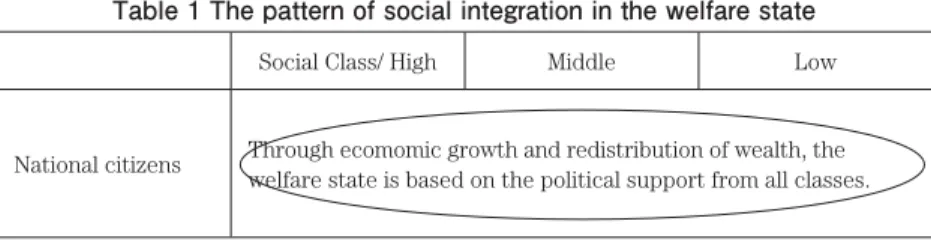
Table 1 The pattern of social integration in the welfare state
Social Class/ High Middle Low
National citizens Through ecomomic growth and redistribution of wealth, the welfare state is based on the political support from all classes.
intensified international trade puts the pressure of cost cuts on companies and increases the demand for skilled labor. In turn, these changes cause the demand for immigration and raise the risk of unemployment for workers. Moreover, capital mobility restricts the discretion of government in fiscal policy. This means governments do not have enough room to supply social policy. In addition, because of the possibility of exit, the capitalist class gains a voice in the decision making process. This implies that the power balance between the labor and capitalist class is changing and the latter has more advantages.
Post-industrialization is the shift from the manufacturing sector-centered economy to the service sector-centered economy. According to P. Pierson (2001, chapter 3), post-industrialization consists of four dimensions. That is, the rise of service sector employment, the maturation of the welfare state, the ageing population, and the rise of female labor. Importantly, post-industrialization has a great impact on the welfare state. For example, because of the lack of mass production, the service sector economy implies the low growth of productivity (and consequently low economic growth). The rise of service sector employment implies an increase in job precariousness which increases the risk of unemployment and working poor. Additionally, people must have professional skills to get good jobs in the knowledge based economy. Moreover, the ageing population causes the new needs for elderly care policy. In addition, the rise of female labor means the erosion of the dependence on family welfare and the needs for child care policy. In other words, post-industrialization puts great pressure on governments to supply new social policy in hard situations.
In short, globalization and post-industrialization erode the economic, social, and political base of the welfare state. Now, the "embedded liberalism" is
replaced by economic liberalism that pursues a more free economy and emphasizes the importance of market mechanisms. It is difficult to achieve economic growth and full employment in the service sector-centered economy. This means an increasing risk of unemployment and working poor. Moreover, because of the rise of job precariousness and female labor, it is difficult to sustain the breadwinner model. Finally, the power balance between the capitalist and labor classes is changing. That is, the pattern of social integration in the age of the welfare state is no longer sustainable.
More importantly, these changes create the needs for new social policy and the demand for immigration. For example, governments must provide an active labor market policy to reduce the number of unemployed and working poor; they must also supply the care policy for working mothers. To improve the competitiveness of the national economy, the demand for immigration (especially, skilled immigration for productivity gains and semi skilled immigration for cutting down the personnel cost) is rising. However, the rise in immigration which erodes the nation-state may require new policy (for example, social and educational service for adaptation). That is, governments must supply integration policy to remove the possibility of conflict between
Table 2 The type of citizens in the age of globalization and post-industrialization6)
Social Class/ High Middle Low
National citizens ① Eiite e.g. Capitalist, Manager, Professional, Expert ② Middle Class e.g. White collor, Skilled Blue collor, Public Officer ③ Other e.g. Farmer, Self-employed, Semi Skilled, Unemplyed Immigrants ④ Skilled people who contibute to competitiveness ⑤ Semi skilled people who don't need the
government support
③ Other
e.g. Family Reunion, Refugee
national citizens and immigrants.
In short, globalization and post-industrialization caused new challenges for governments. That is, while governments must improve competitiveness, governments have to accomplish the social inclusion of socially excluded people. In other words, governments try to construct the new pattern of social integration. In the next section, I will show the policy options for achieving it.
2-3 Policy Options for Social and Immigration Policy
As mentioned above, governments have a difficult challenge. That is, governments must improve competitiveness and achieve social inclusion. Importantly, there are many policy options to achieve it. For example, financial support for research and development(R&D) is very useful for improving competitiveness. The intake of skilled immigrant has the same effect. While active labor market policy is beneficial for the unemployed, the retrenchment of social policy may improve the fiscal base of the national economy, which contributes to competitiveness. In short, we have many policy options, from economic policy to social policy. In this paper, I focus on social and immigration policy.
In field of social policy, the policy objective7) is shifted from de-commodification to re-de-commodification (cf. Armingeon and Bonoli 2006, Taylor-Gooby 2004). The former includes policy that provides citizens with financial support when the breadwinner cannot work outside. The latter includes policy that aims at reducing the number of people who depend on social benefits. There are some options to encourage re-commodification. In this context, the typology of the workfare is very useful. Theodore and Peck (2000) show "the Labor Force Attachment (LFA) model" and "the Human Capital Development (HCD) model". While both models are supply side
strategies that aim at integrating the unemployed into the labor market, there are some differences in their means and ideals. LFA forces the unemployed to participate in the labor market by providing negative incentives. Therefore, LFA implies the retrenchment of social benefits. HCD emphasizes vocational education and training to get a good job. Therefore, HCD implies the provision of an active labor market policy. In addition, when we consider the social inclusion of the socially excluded, the concept of "Activation" is very useful. According to Jenson and Saint-Martin (2003), a new paradigm of social policy that emphasizes social investment is emerging. To accomplish social integration, this paradigm targets not only the unemployed, but also people facing new social risks that arise from post-industrialization. Therefore, Activation implies the provision of an active labor market policy, care policy, and work-life balance policy. In short, we have at least two options to encourage re-commodification. One is the LFA, the other is Activation.
In immigration policy, there is complexity. While the intake of semi- skilled immigrants is useful for cutting down personnel costs, the intake of skilled immigrants is also useful for improving productivity in the knowledge based economy. The rise of immigrants may, however, cause conflict between national citizens and immigrants. Therefore, governments have to provide some kind of integration policy to prevent the possibility of conflict. In this context, we should distinguish the external control of immigrants from the internal control of immigrants8) (cf. Tsuda and Cornelius 2004, p.465, Tarumoto 2012, p.76). The former means the regulation of immigration flows. The latter means the provision of basic services that which promote integration. In short, when we analyze the development of immigration policy, we should consider two aspects of immigration policy. One is external control and the other is internal control.
In this section, I show the framework of analysis. Because of globalization and post-industrialization, it is very difficult for the welfare state to keep social integration sustainable. Governments face new challenges. That is, while governments must improve competitiveness, governments also have to accomplish social inclusion of the socially excluded. In this context, the object of social policy is shifted from de-commodification to re-commodification. To improve competitiveness, the intake of immigrants is emphasized. Importantly, there are some policy options. For example, the LFA and Activation are useful for including the socially excluded. It is important to distinguish external control of immigration from internal control. In the next section, I will consider the development of social and immigration policy in Australia based on this framework.
3 Australia's Experience
9)In this section, I briefly demonstrate the development of Australian social and immigration policy. To offer a full narrative in detail is beyond my ability. I can only offer a snapshot to make the features of policy at that time clear. Below, I show the features of social policy first and go on to the features of immigration policy. Finally, I characterize the pattern of social integration.
3-1 The Post-War Australian Model (1940's ∼ 1973)
The Post-war Australian Model is characterized by the Wage-Earner Welfare State (WEWS) and the White Australia Policy.
Public social expenditure as percentage of GDP in Australia is lower than OECD countries. Social policy is targeted toward people who are in need through the means test. In addition, social policy is financed by general taxes.
Therefore, Australia is regarded as the backward welfare state. In fact, Australia is classified as a liberal regime in Esping-Andersen's typology (Esping-Andersen 1990, 1999). This may mean that social protection is not fully developed in Australia.
Castles (1985, 1988, 1994, 1996, 1997, Castles and Uhr 2007 ) criticized this view from the point of "the social policy through other means". According to Castles, while small states in Europe coped with the fluctuation of international economy through "the politics of domestic compensation", Australia dealt with it through "the politics of domestic defense". The politics of domestic compensation show that governments use industrial policy to improve competitiveness and social policy to compensate citizens for their cost (for example, change of job, unemployment). Thus, small states in Europe have the generous social policy. The politics of domestic defense mean that governments try to protect citizens from the impact of fluctuation through public policy. Castles pointed out the four features of public policy in the politics of domestic defense. That is, ① protection of the manufacturing sector through tariff protection and non-tariff barriers, ② wage regulation through Arbitration system, ③ control of immigration flows, ④ residual social policy. In other words, by the control of the supply of labor through restrictive immigration policy, and the protection of the manufacturing sector through tariff policy, governments accomplish full employment first. Next, governments provide laborers with relatively high wages through Arbitration system. Finally, social policy is just targeted to people in need. Castles calls the model based on this policy mix the Wage Earner Welfare State (WEWS)10). The important point is that governments provide national citizens with social protection not through social policy, but through protective public policy. Therefore, when we consider welfare state transformations, we analyze not only social policy but
also other policies (for example, tariff policy, wage regulation).
As mentioned above, the Australian governments had a restrictive immigration policy to control the supply of labor in Australia. This policy stance was called "White Australia Policy" (Castles and Vasta 2004, Collins 2008, Sekine 1988, Takeda et al. 2007). This was aimed at building the nation-state based on the settlers who had the same cultural backgrounds from the United Kingdom and Europe. In other words, people from other regions and indigenous people were socially excluded. For example, the Immigration Restrict Act was enacted to limit the intake of immigrants from Asia in 1901. According to previous studies (Castles and Vasta 2004, Sekine 1988, Takeda et al. 2007), there are the some backgrounds of "White Australia Policy". The rise of immigrants from Asia eroded the social, economic, and political orders that white settlers constructed. Because of the emergence of Australian national identity, the government adopted the hard stance. While the government amended the policy stance to meet the demand for labor, the White Australia Policy has survived. In other words, immigrants came from the United Kingdom, Northern Europe, and USA first. When immigrants from the above areas were short, the number of immigrants from Southern Europe was increased. However, governments tried to restrict the intake of non white immigrants. The important point is that the government tried to restrict the immigrants from Asia to build the nation-state based on settlers who have the same cultural backgrounds.
In short, the post-war Australian model is based on the WEWS and White Australia Policy. While governments can accomplish full employment through protective public policy and provide the male breadwinners with the relatively high wages through Arbitration system, governments are dependent on the family welfare supplied by females. Governments control the supply of labor
through restrictive immigration policy that keeps the social, economic, and political orders sustainable. Therefore, the pattern of social integration in this age is ① redistribution of wealth to national citizens and ② exclusion of the colored immigrants (which means quantitative control and intake of people who have same cultural backgrounds).Therefore, there is the social division between national citizens and immigrants.
Governments faced some problems intrinsic to this model in the late 1960's (Castles 1988, Bell 1997, Schwartz 2000). For example, the cost of the protective policy came to the surface. That is, tariff protection reached its limit. The Arbitration system stopped working effectively. This meant that the rise in wages was very high. In addition, residual social policy increased the number of poor people. Finally, the diversity of immigrants increased the need for integration policy. In the 1970's, governments tried to change the post-war model.
3-2 Modification of the Post-war Model (1973 ∼ 83)
The government tried to modify the post war model in the 1970's. These attempts are characterized by the social democratic turn and the adoption of
Table 3 The pattern of social integration in post-war Australia: the WEWS and the White Australia Policy
Social Status/ High Middle Low
National citizens
・For High, the profit from protective policy
・For Middle, full employment and a relatively high wage ・For Low, redistribution through social and protective policy
Immigrants ・The quantitative control of immigrants (especially from Asia) ・The intake of immigrants with same cultural backgrounds
Corporate Multiculturalism.
The Whitlam government (Australian Labor Party: ALP, 1972-75) and the Fraser Government (coalition of Liberal Party of Australia: Liberal, and National Party of Australia: National, 1975-83) modified the WEWS model (Castles 1988, Bell 1997, Schwartz 2000, Mendes 2003, 2008). The Whitlam government improved residual social policy. For example, they enacted the Child Care Act to support working mothers in 1972 and introduced the universal health care system in 1973, which was called Medibank. In addition, they expanded previous social benefits (for example, pension and, allowance for orphans and disabled people). These changes show the shift from residual social policy based on the means test to a more generous social policy based on the social democratic ideal. The Fraser government amended this shift. That is, they abolished the Medibank. The general trend, however, was to improve social policy. For example, they introduced the automatic consumer price indexation of pension and got rid of the asset test for pensions. Finally, they introduced the scheme of family support services to improve child care services. In economic policy, the Whitlam government decided to cut down the tariff by15%. The Fraser government adopted the monetarist financial policy to control consumer price. They also introduced deregulation and advanced the reduction of public expenditure. Neither governments introduced a big change in labor market policy. Arbitration system survived without change.
In short, both governments in the 1970's tried to modify the WEWS model. While they introduced deregulation and the tariff cut in the field of economic policy, which signaled the neoliberalism, they expanded and improved the residual social policy. They aimed at improving de-commodification.
In immigration policy, there was a big change in the 1970's. That is, the Whitlam government abolished the White Australia Policy and adopted
multiculturalism. In previous studies (Sekine 1994, 2000, Siobara 2005, 2010, 2012), multiculturalism in 1970's is characterized by "the Corporate Multiculturalism". This means that the government recognized the diversity of culture, and not only secured equal opportunity, but also expanded financial and legal support for ethnic minorities. For example, discrimination in acquiring nationality was removed in 1973. The Racial Discrimination Act was enacted in 1975. These implied the shift to multiculturalism. In addition, both governments introduced and expanded financial and legal support for ethnic minorities (for example, support in maintaining minority culture, programs facilitating social participation). This meant that the government provided minorities with the support to facilitate integration. The important point is the shift from the White Australia Policy to the Corporate Multiculturalism.
In short, attempts to modify the post-war model in the 1970's were characterized by the social democratic turn and the adoption of Corporate Multiculturalism. To deal with the problems of the WEWS, both governments adopted neoliberalism in the field of economic policy field and expanded social policy. In addition, both governments recognized the diversity of culture and adopted the Corporate Multiculturalism to facilitate integration.
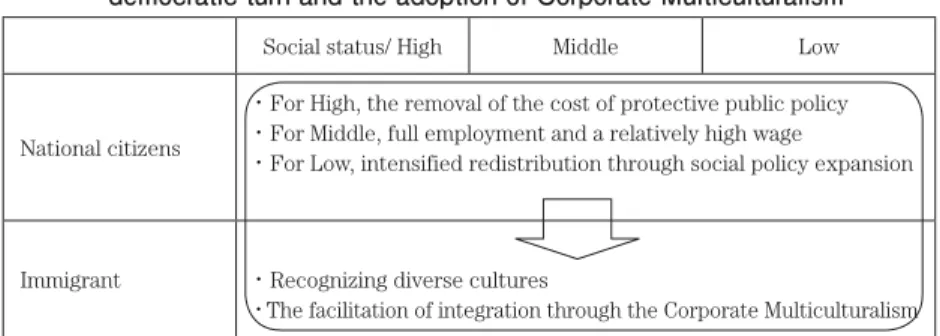
Table 4 The pattern of social integration in Australia in the 1970's: the social democratic turn and the adoption of Corporate Multiculturalism
Social status/ High Middle Low
National citizens
・For High, the removal of the cost of protective public policy ・For Middle, full employment and a relatively high wage
・For Low, intensified redistribution through social policy expansion
Immigrant ・Recognizing diverse cultures
Therefore, the pattern of social integration in the 1970's was ① recognition of immigrants and ② social inclusion of ethnic minority through financial / legal support. Therefore, social division between national citizens and immigrants was invisible. However, immigrants were regarded as being supported.
However, these attempts didn't work well. The economic performance deteriorated in the 1970's. The growth rate was declining. The consumer price and the unemployment rate were rising. These difficulties were rooted in globalization and post-industrialization. In other words, Australia faced difficult challenges that needed radical reform of WEWS. There were the problem intrinsic to the corporate multiculturalism. That is, the limit of financial resource and the national majority's complaint. In the 1980s, the governments tried to deal with the difficult challenges.
3-3 Radical Reform of the post-war model (1983-1996)
The government tried to reform the post-war model. The Hawke government (ALP, 1983-91) and the Keating government (ALP, 1991-96) were characterized by the adoption of the Activation and the emphasis on competitiveness in multiculturalism.
The ALP governments broke the WEWS and tried to construct the new welfare model based on the Activation (Mendes 2003, 2008, C. Pierson 2002, Johnson and Tonkiss 2002, Johnson 2000). First, they tried to expand a part of social policy. The agreement between the ALP and the trade union accomplished wage restraint and improved the social benefit. For example, the universal health care system (Medicare) was revived in 1984 and tax reform for the poor people was enforced. In addition, superannuation was introduced to improve the life of older people. To promote the participation of women in the labor market, social services were expanded. Second, the ALP
governments advanced the targeting of social policy. This meant the object of policy was limited to the people who were in need. For example, while the assets test for pensions was introduced in 1985, the means test on family allowance was enforced in 1987. Because of these changes, the rich lost access to some social policies. Third and importantly, the ALP governments linked social policy with labor market policy. This meant that the policy objective shifted from de-commodification to re-commodification. That is, to reduce the recipients of social policy and improve the financial base, the ALP governments provided them with the opportunity to participate in the labor market through an active labor market policy. For example, the policy report that aimed at combining social policy with labor market policy was submitted to the ALP government in 1988 (so-called Cass Report). The ALP government carried this policy report into effect (for example, the "New Start Program" for the long-term unemployed in 1991, the "Jobs, Education, and Training Program" for single parents in 1989, the "Disability Support Package" for disabled people in 1991). Further, the ALP government introduced a policy package called "Working Nation". While the government recognized that it was difficult to resolve unemployment through economic growth, the government supplied the activation policy. The relationship between government and the recipient was characterized by the "reciprocal obligation" (Goodin 2001, Harris 2001, Shaver 2002, Macintyre 1999, McClelland 2002). These policies show the shift of policy objectives from de-commodification to re-commodification.
In the field of economic policy, the ALP governments advanced neoliberal economic policy that was called "Economic Rationalism" in Australia (Pusey 1991). That is, the government adopted deregulation and liberalization as in the 70's. However, there are some difference between policy in the 70's and policy in the 80's. While the ALP governments adopted neoliberal economic
policy, they used industrial policy to cushion the costs of deregulation and improve competitiveness (Bell 1993, 1997, Capling and Galligan 1992, Castles 1988, Schwartz 2000, Ramsay and Battin 2005, Waring 2005). For example, the special industry plans aimed at facilitating the structural adjustment in the manufacturing sector in the 1980's. The government also supplied the financial support for R&D and innovation. As Arbitration system, the function was changing from setting the collective wage to improving competitiveness (Ramia and Wailes 2006, Goldfinch 2000). That is, Arbitration system facilitated the flexible wage setting and set the minimum line.
In short, the ALP governments tried to break the WEWS model. While they introduced the Activation which linked social policy with labor market policy, they advance not only neoliberal economic policy but also industrial policy to improve competitiveness. That is, they tried to construct a new welfare model based on the Activation.
In the field of immigration policy, ALP government emphasized competitiveness in multiculturalism11) (cf. Sekine 1994, 2000, Shiobara 2005, 2010, 2013, Tarumoto 2009). This stance shows that diversity of culture contributes to competitiveness and government actively helps the ethnic minority participate in the labor market. For example, the ALP governments announced the "National Agenda for a Multicultural Australia" in 1989, which aimed at respecting cultural identity, accomplishing social fairness, and pursuing efficiency. The government announced the "Creative Nations" in 1994. In this paper, the government insisted the diversity of culture contributed to the Australian economy. The multiculturalism of the ALP government is different from the corporate multiculturalism of the 1970's in emphasizing the economic contribution of immigrants thorough participation in the labor market. Therefore, this model looks like the Activation in the field of
social policy. In addition, because of the emphasis on competitiveness, this model has a close affinity with neoliberalism.
Importantly, the ALP governments tried to construct a new national identity (Takeda et al. 2007, K.Saito 2009. See also Johnson 2000, Jonson and Tonkiss 2002). It was the political movement that aimed at changing into a presidential system (Republicanism). Prime Minister Keating headed this movement. While many people supported this movement at the street level, the failure of political strategy that divided the supporters made this movement lose in referendum in 1999. This attempt is very important in political sense. That is, it aimed at legitimating and justifying the new model of social integration. In other words, the government tried to legitimate and justify the shift from the post-war model to the new model through the construction of a new national identity. The important point is that ALP governments emphasized the competitiveness in multiculturalism and tried to construct a new national identity to legitimate and justify the new model.
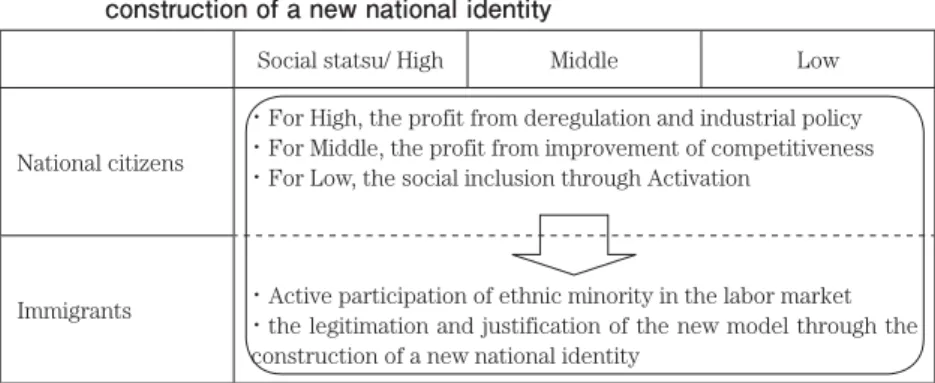
In short, the attempts to reform the post-war model by the ALP governments were characterized by the adoption of the Activation, the emphasis on competitiveness in multiculturalism, and the construction of a new national identity. To reform the WEWS model, governments introduced the Activation and advanced not only neoliberal economic policy but also industrial policy to improve the competitiveness. So, the social policy objective changed to re-commodification. In immigration policy, the governments emphasized the economic contribution of immigrants through participation in the labor market. In addition, governments emphasized the new national identity to legitimate and justify the new pattern of social integration. These reforms which focused on competitiveness had a close affinity with neoliberalism. Therefore, the pattern of social integration in the ALP
governments is ① social inclusion of the socially excluded through the Activation, ② active participation of ethnic minorities in the labor market, ③ legitimation and justification of the new model through the construction of a new national identity. Therefore, social division between national citizens and immigrants became more invisible. However, this new model was not friendly to people who were not able to participate in the labor market.
These attempts, however, had some problems. For example, economic performance did not fully recover. That is, social inclusion through the Activation did not work well. Deregulation and industrial policy also did not fully improve competitiveness. Importantly, the majority complained about multiculturalism. They felt that the ethnic minority wasted the financial resources of the government. In this context, the extreme right movement was emerging. Pauline Hanson and her party (One Nation Party), which that attacked the ethnic minority, were well known. In the 1990's, the government tried to deal with these problems.
Table 5 The pattern of social integration in the ALP government: the Activation, the emphasis on competitiveness in multiculturalism, and the construction of a new national identity
Social statsu/ High Middle Low
National citizens
・For High, the profit from deregulation and industrial policy ・For Middle, the profit from improvement of competitiveness ・For Low, the social inclusion through Activation
Immigrants ・Active participation of ethnic minority in the labor market ・the legitimation and justification of the new model through the
3-4 Amendment of the new model (1996-2007)
Governments tried to amend the new model. The Howard government (coalition of Liberal and National) was characterized by the turn to the LFA model and the adoption of Neoliberal Multiculturalism.
In the field of social policy, the Howard government introduced the market mechanism to make recipients participate in the labor market12) (Mendes 2008, Ryan 2005, Disney 2004). When Howard won the general elections, he decided to cut down the budget for social policy. The Howard government reformed the unemployment allowance. The relationship between government and the recipients was characterized by the "mutual obligation". While the obligation of recipients was enforced, the active role of government (such as the supply of an active labor market policy) was lightened. The government introduced the "Working for Dole" which aimed at making recipients participate in the labor market. The government introduced the "Job Network" to privatize job mediation services. These changes showed that the Howard government tried to retreat from the social policy field and rely on market mechanisms and self-help. Therefore, the Howard government tried to amend the new model through LFA.
In economic policy, the Howard government followed the ALP government (Quiggin 2004, Conley 2001, Mendes 2008, Takeda et al.2007). They adopted deregulation, liberalization, and industrial policy. For example, the Howard government introduced the Goods and Service Tax (GST) to broaden the tax base and reduce the burden of the personal income tax. They also privatized the Telstra to promote economic competition. However, the Howard government continued to use industrial policy to improve competitiveness (ex. the financial support for R&D). In labor market policy, the Howard government destroyed the Arbitration system and introduced market mechanisms. For
example, the government enacted the Workplace Relations Act in 1996 to reduce the role of Arbitration system. In addition, the government introduced the Work Choices Act in 2005 to facilitate the wage setting at an individual level and to restrict trade union activity. These changes meant the liberalization of the labor market.
In short, the Howard government amended the new model that was built by the ALP governments. They introduced the market mechanism into all policy fields. Therefore, their attempts had a close affinity with neoliberalism.
In immigration policy, the Howard government adopted the "Neoliberal Multiculturalism" (Shiobara 2005, 2010, 2012. See also Iizasa 2007, Tarumoto 2009). This means that government supplies services only for skilled immigrants or managers who contribute to competitiveness. In other words, the intake of immigrants who do not contribute to the competitiveness is strictly limited. For example, the government amended the criterion to attract skilled immigrants and managers. The Howard government cut down the integration policy which the unskilled or semi-skilled immigrants mainly used. The government emphasized on the self-help. In addition, the Howard governments tried to restrict the inflow of family immigrants and humanitarian immigrants. For example, the government reinforced the regulation of illegal immigrants and the border control. The government adopted a ruthless response to the boat people and refugees. In this context, the Tampa Affair was well-known.
Importantly, the Howard government tried to construct a new identity to legitimate and justify the new model (cf. Shiobara 2010, Iizasa 2007, Tarumoto 2009). They emphasized the mainstream culture that was based on western values. In other words, he gave precedence to western values and implicitly denied the diversity of culture. For example, the government announced the
"Australian Multiculturalism for a New Century" in 1999 that emphasized the citizenship and citizen's obligation (in the European meaning) . They also presented the "New Agenda for Multicultural Australia" which emphasized the western identity. The important point is that the Howard government adopted the Neoliberal Multiculturalism and emphasized the mainstream culture to legitimate and justify the new model.
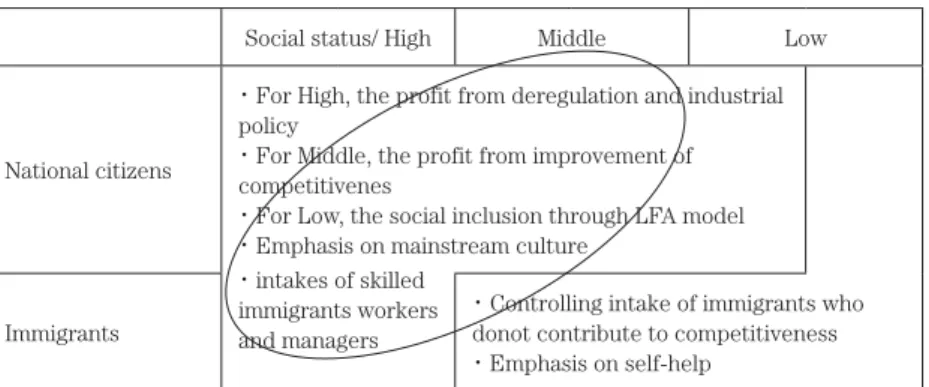
In short, the Howard government was characterized by the turn to the LFA model, the adoption of Neoliberal Multiculturalism, and the emphasis on the mainstream culture. To reform the new model that was built by the ALP governments, the Howard government introduced the market mechanism into all policy fields. In social policy, government tried to build the new model based on the LFA model that made the recipients participate in the labor market. In immigration policy, they adopted the Neoliberal Multiculturalism, which aimed at attracting skilled immigrants or managers. Howard emphasized the mainstream culture to legitimate and justify the new model. These reforms, relied on efficiency of the market mechanism, had a close affinity with
Table 6 the pattern of social integration in the Howard government: LFA model, the adoption of neoliberal multiculturalism, and the emphasis on the mainstream culture
Social status/ High Middle Low
National citizens
・For High, the profit from deregulation and industrial policy
・For Middle, the profit from improvement of competitivenes
・For Low, the social inclusion through LFA model ・Emphasis on mainstream culture
Immigrants
・intakes of skilled immigrants workers and managers
・ Controlling intake of immigrants who donot contribute to competitiveness ・Emphasis on self-help
neoliberalism. Therefore, the pattern of social integration in the Howard government is ① social inclusion of the socially excluded through LFA, ② selective intake of immigrants (only skilled immigrants or managers who contributed to competitiveness), ③ legitimation and justification of the new model through an emphasis on the mainstream culture. Therefore, new social division was emerging. That is, economic contribution to Australian economy is important.
In this section, I outlined the development of social and immigration policy in Australia. In social policy, the policy objective shifted from de-commodification to re-commodification. In immigration policy, the economic contribution was e m p h a s i z e d . B e c a u s e t h e s e c h a n g e s s u p p o s e d t h e i m p o r t a n c e o f competitiveness in the age of globalization and post-industrialization, they had a close affinity with neoliberalism. Importantly, the different governments all tried to construct a national identity to legitimate and justify their new models. In the next section, I turn to development in Japan.
4 Japan's Experience
13)In this section, I briefly demonstrate the development of social and immigration policy in Japan. To offer the full narrative in detail is beyond my ability, I can only offer a snapshot to make the features of policy at that time clear.
4-1 Post-War Japanese Model (1940's ∼ 1970's)
The post-war Japanese Model is characterized by the work protection- centered welfare state and restrictive immigration policy.
OECD countries (e.g. like liberal regime). The pension and health care systems are based on social insurance, which is segmented by the occupation (as in conservative regime). In addition, the unemployment rate is lower than in OECD countries (as in social democratic regime). It is very difficult to classify Japan into the Esping-Andersen model (Esping-Andersen 1990, 1999). Therefore, Japan is often regarded as a hybrid regime.
However, recent studies (Shinkawa 2005, Miyamoto 2008, Estevez-Abe 2008, Kasza 2006) examine the features of the Japanese model. The post-war Japan model was characterized by the work protection- centered welfare state. Governments put economic growth before the development of social policy. However, governments provided the citizens with social protections through the functional equivalents of social policy14). That is, work-protection for male breadwinner. For example, the government protected the primary sector with tariffs, subsidies and import restrictions. The government offered public works to secure jobs in local areas. However, governments used industrial policy for the manufacturing sector to improve competitiveness. This included long-term financial support through direct and indirect regulations, and the promotion of competition. Because of these policies, companies achieved lifetime employment and cooperative industrial relations. In addition, the commitment of companies to lifetime employment and cooperative industrial relations made employees invest their skills at the company level. In turn, this improved the competitiveness of the company, which contributed to economic growth. The mix of protection, regulation, and industrial policy underlay economic growth and full employment in post-war Japan.
The development of social policy was delayed. For example, the National Insurance in Health Care and the National Pension System were introduced in 1961. While the introduction of these systems was early, the following
development was delayed. These systems, based on social insurance, were segmented by the occupation. The level of benefits was unequal. Because governments offered functional equivalents to secure the jobs of male breadwinners and relied on the supply of care by females, the social policy for working mothers (e.g. care service) was delayed. However, some expansion of social policy happened in the 1970's. For example, the government expanded the benefits for pensions and introduced the child allowance. However, the Oil Shock stopped the expansion of social policy. In short, the post-war Japan model was characterized by the work protection- centered welfare state. This meant that governments put economic growth before the development of social policy.
Generally speaking, immigration policy in Japan was very restrictive (Tarumoto 2009, 2012, Akashi 2010, Kondo 2008, Tsuda and Cornelius 2004). While the control of immigrant flows was very severe, integration policy was not fully developed. When we consider the features of post-war immigration policy in Japan, three laws are important: the Nationality Act in 1950, the Immigration Control Act in 1952, and the Alien Registration Act in 1952. The Nationality Act adopted paternity jus sanguinis. Immigration Control Act deprived the "oldcomers" of their nationality. The "oldcomers" were the people who were forced to come to Japan from Korea and Taiwan during World War Ⅱ. The "oldcomers" were legally excluded from Japanese. This meant that they had no access to social security benefits. In 1965, the Bilateral Agreement with South Korea gave "permanent residence status". Finally, Alien Registration Act ordered the aliens to have a registration card and take their fingerprints. This policy mix was repressive for the immigrants. In short, postwar immigration policy was very restrictive.
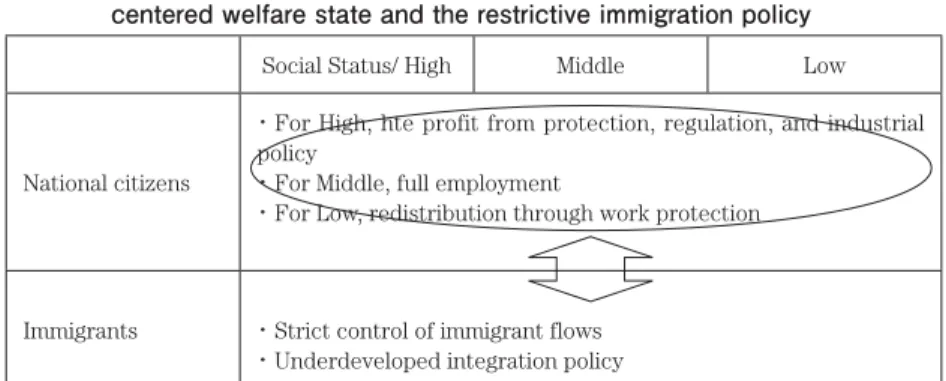
protection- centered welfare state and restrictive immigration policy. Governments put economic growth before the development of social policy. While they provided the national citizens with social protection through work protection, the development of social policy was delayed (especially, care policy and family allowance). In immigration policy, the control of immigrant flow was strict. The integration policy was not developed. Therefore, the pattern of social integration in post-war Japanese model is ① redistribution through the work protection and ② exclusion of the aliens (which meant the severe control of immigration flow and underdeveloped integration policy). Therefore, there was social division between national citizens and immigrants. Globalization and post-industrialization eroded this model in the 1980's. Governments tried to modify the post-war Japanese model.
4-2 Modification of Post-War Model (1980's)
Governments tried to modify the post-war Japanese model in the 1980's. This attempt was characterized by the maintenance of the work protection centered welfare state and a passive response to international pressures.
Table 7 the pattern of social integration in post-war Japan: the work protection- centered welfare state and the restrictive immigration policy
Social Status/ High Middle Low
National citizens
・For High, hte profit from protection, regulation, and industrial policy
・For Middle, full employment
・For Low, redistribution through work protection
Immigrants ・Strict control of immigrant flows ・Underdeveloped integration policy
The economic performance of Japan in the 1980's was better than the OECD countries. The governments did not face a hard challenge. However, this meant that there was no need to change. The government tried to modify the post-war model to sustain it (Shinkawa 2005, Miyamoto 2008, Estevez-Abe 2008). That is, they tried to control the expansion of social policy. For example, the copayment in National Health Insurance was increased in 1984. The government also introduced the cross-subsidization scheme into pension system to support the National Pension. In addition, the government emphasized the role of family and self-help in supplying welfare to relieve the role of state. As the functional equivalents of social policy, the company uses the flexible labor force (non-regular workers, the temporary transfer) to protect the core worker (i.e. male breadwinner). The government continued to protect the local areas through indirect means (for example, public works of local governments). In addition, the government used the special budget, which was called zaiseitoyushi. In short, the government introduced some initiatives to sustain the post-war model.
In immigration policy, governments face a severe problem in the late 1970's. That is, Indo-Chinese refugees were coming to Japan. There was no refugee policy in Japan at that time. International society pressured Japanese government to accept refugees. The government reluctantly decided to loosen the restrictive policy (Tarumoto 2009, 2012, Akashi 2010, Kondo 2008, Tsuda and Cornelius 2004). For example, the government ratified the Convention Relating to the Status of Refugees and the Protocol Relating to the Status of Refugees in 1981. They also enacted the Immigration Control and Refugee Reconciliation Act in 1982. However, these passive responses to international pressure did not change the actual conditions. This meant that governments hardly accepted refugees. Importantly, the responses to international pressure
caused unintended effects. Because the international agreements had the principle of equality among nationals, governments secured the access of foreign residents to social policy. In other words, foreign residents were included in the welfare system. Because the international agreements included the principle of equality among sexes, the government amended the Japanese Citizen Act in 1985 to accept matrilineal jus sanguinis. In short, the passive responses to international pressure improved the situation of ethnic minorities.
In short, the attempt to amend the post-war model in the 1980's was characterized by the maintenance of the work protection centered welfare state and a passive response to international pressures. In social policy, the governments introduced some initiatives to sustain the post-war model. This meant an attempt in the 1980's maintained the post-war model. In immigration policy, the passive responses to international pressure unintentionally improved the situation of ethnic minorities. However, the control of immigrant flow was restrictive. Therefore, the pattern of social integration in the 1980's is ① redistribution through the maintenance of the post-war model and
Table 8 the pattern of social integration in the 1980's in Japan: the maintenance of the work protection centered welfare state and the passive response to international pressures
Social Status/ High Middle Low
National citizens
・For High, the profit through the maintance of post war model ・For Middle, the full employment through the maintance of model ・For Low, redistribution through the maintance of post war model
Immigrants ・Unintended social inclusion of ethnic minority ・Strict control of immigrant flows
② unintended inclusion of ethnic minorities through a passive response to international pressure. In spite of uninteded improvement of ethnic minorities, there was social division.
The attempt in the 1980's faced big problems. Economic performance has been terrible since the 1990's. Globalization and post-industrialization made the post-war model, based on work protection, unsustainable. In immigration policy, the number of "newcomers" were rising. They include refugees, women with "entertainer visa", and the illegal immigrants. The government fundamentally tried to reform the post-war model in the 1990's.
4-3 Radical Reform of the Post-War Model (90's ∼ 00's)
The government tried to reform the post-war model in the 1990's. This radical reform was characterized by the turn to neoliberalism and the emphasis on the economic contribution of immigrants and references to nationalism.
While globalization and post-industrialization made government cut down social policy to improve financial conditions, they brought the need for a new social policy, which included care policy and an active labor market policy. In other words, government faced two challenges in the field of social policy (Shinkawa 2005, Miyamoto 2008, Estevez-Abe 2008). The radical reform in the 1990's had two features. One was the retrenchment of social policy to improve financial conditions. For example, government enforced the rise of copayment and the control of benefit level in pension and health care. The government emphasized self-help in social assistance and disability pension. Because these change made the recipients participate in the labor market to get money, they were based on the LFA model. The other was the introduction of new social policy to meet the needs that were rooted in globalization and
post-industrialization. For example, governments introduced the Long Term Care Insurance to provide elderly care in 1997. The Basic Law for a Gender-Equal Society was enacted in 1999 to remove the discrimination against women. As the functional equivalents of social policy, government did not sustain work protection through regulations and protections. In other words, the government advanced deregulation and liberalization. For example, the governments revised the laws to make labor market more flexible. While non-regular workers were increasing, the number of people who got lifetime employment was decreasing. In addition, government decided to cut down on public works, which increased hardship in the local areas. In short, while the government retrenched the preexistent social policy and introduced new social policy, it advanced deregulation and liberalization of the functional equivalents of social policy. These reforms emphasized the efficiency of the market mechanism. Therefore, they had a close affinity with the LFA model and neoliberalism.
In immigration policy, government faced hard challenges (Tarumoto 2009, 2012, Akashi 2010, Kondo 2008, Tsuda and Cornelius 2004). While the companies needed semi-skilled immigrants to cut down personnel costs, they needed skilled immigrants to improve productivity. People had the fear of the rise of illegal immigrants. In addition, the conflict between majority and ethnic minority occurred. In other words, while the government needed to accept immigrants who contributed to the economy, the government tried to remove the fear. The government revised the Immigration Control and Refugee Reconciliation Act in 1990 to deal with them. First, the government decided to accept skilled immigrants. Second, the regulation of illegal immigrants was reinforced. Third, government made informal routes to accept semi-skilled immigrants. These routes were called the "side-door" and "back-door". The
former included the corporate "trainee" program, the importing of "ethnic Japanese" from Latin America, and the importing of the "pre-college student". The latter included illegal immigrants. In short, the government loosened immigration policy to improve competitiveness, which had an affinity with neoliberalism.
The rise of legal and illegal immigrants brought new problems (Tarumoto 2009, 2012, Kondo 2008). First, the conflicts between majority and ethnic minority occurred. In other words, integration policy was needed. However, because of the official stance on immigration, the governments did not enact integration policy actively. The local governments in which ethnic minorities lived provided integration policy. Second, the fear of the rise of immigrants evoked nationalism in the street and political level. It was said that people who advocated nationalism in Japan were increasing (especially, young and poor people). Some political parties and politicians used it to get support in elections. The important point is that the rise of immigrants caused nationalism that was exploited by the right wing politicians.
Table 9 the pattern of social integration in the 1990 and the 2000s in Japan: the turn to neoliberalism and the emphasis on economic contribution of immigrants, and references to nationalism
Social status/ High Middle Low
National citizens
・For High, the profit from deregulation and liberalization
・For Middle, the profits from improvement of competitivenes
・For Low, the social inclusion through LFA model ・Emphasis on nationalism
Immigrants
・Intakes of skiled immigrant workers and managers
・Controlling intake of immigrants who don t contribute to competitiveness ・Emphasis on self-help
In short, the radical reform of the post-war model in the 1990's was characterized by the turn to neoliberalism and an emphasis on the economic contribution of immigrants and nationalism. While the government retrenched social policy and introduced new social policy, it also advanced deregulation and liberalization of the functional equivalents of social policy. The government partly loosened immigration policy to improve competitiveness. The main concern of these reforms is economic aspect of the policy. Therefore, they had an affinity with the LFA model and neoliberalism. Importantly, the rise of immigrants made the majority feel anxiety. In this context, political parties and politicians emphasized nationalism to legitimate and justify reform. In other words, references to nationalism were regarded as political strategies to rebuild national identity and social integration. Therefore, the pattern of social integration in the 1990's is ① improvement of economy through the removal of regulation and protection and the intakes of immigrants who contribute to competitiveness, ② social inclusion through LFA, and ③ legitimation and justification of radical reform through emphasis on nationalism. Therefore, new social division is emerging. The contribution to competitiveness is important.
In this section, I outlined the development of social and immigration policy in Japan. In social policy, the policy objective shifted from work protection to social inclusion through the LFA model, which implies re-commodification. In immigration policy, economic contribution was emphasized. Because the main concern of these changes is the economic aspect of the policy, they have a close affinity with neoliberalism. Importantly, governments try to legitimate and justify radical reform through an emphasis on nationalism. In conclusion, I next consider the features and limitations of the new pattern of social integration and the possibilities for a free and fair order.
5 Conclusion
In this paper, to show the change in dynamism of social exclusion/ inclusion, I analyze the development of social and immigration policy in Japan and Australia. In other words, the purpose of this paper is to demonstrate the features and dynamism of social integration in the age of globalization and post-industrialization. There are some important findings.
First, the pattern of social integration was transformed by globalization and post-industrialization. The old pattern of social integration relied on economic growth and the nation-state. That is, governments redistributed wealth, which was rooted in economic growth, to national citizens to get political support. Globalization and post-industrialization, however, made this pattern unsustainable. While the discretion of the government to introduce new policy is restricted, the government must offer a new social policy to include the socially excluded. Companies need to cut down personnel costs and/ or increase productivity gains to improve competitiveness. In turn, this causes the demand for semi-skilled immigrants (to cut down costs) and/ or skilled immigrants (to increase productivity gains). However, the rise of immigrants, which erodes the nation-state, makes the majority anxious and causes conflict between the majority and the ethnic minority. In other words, globalization and post-industrialization erodes two premises. Now, government faces a difficult challenge. That is, while they must improve competitiveness to achieve economic growth, they must include the socially excluded (long-term unemployment, recipients of social benefit, and immigrants who need the social services). In fact, there are many attempts to construct a new pattern of social integration in Australia and Japan.
emphasized re-commodification in social policy, and economic contribution in immigration policy. The important point is that these changes in policy objectives aim at improving the national economy with the market mechanism. In other words, they have a close affinity with neoliberalism. As mentioned above, governments must improve competitiveness and include the socially excluded in difficult situations. Thus, governments try to include them not by de-commodification (for example, the expansion of social benefits), but by re-commodification (for example, the participation in the labor market). Because the intake of immigrants has latent costs (for example, the possibility of conflict, the need for integration policy), government has an incentive to accept only immigrants who contribute to competitiveness.
Third, there are policy options to achieve competitiveness and social integration. In social policy, there are the LFA and the Activation. The former implies that government forces the unemployed to participate in the labor market through providing negative incentives. The latter implies that government provides public policy to improve the employability of the recipient. In immigration policy, we should distinguish the external control of immigrants from the internal control of immigrants. The former means the regulation of immigration flows. The latter means the provision of basic services that promote integration. In fact, governments in Japan and Australia use this diverse policy mix to construct a new social integration. In other words, there are some patterns of the new social integration. Policy choice of governments is very important.
Fourth, governments try to construct new national identities. The consolidation of the new pattern of social integration depends on the political consensus. The change in the objective of social policy and the intake of immigrants erode the political consensus of the old pattern. In other words,
governments need the new political consensus to stabilize the new policy mix. In this context, governments try to legitimate and justify the reform of the post-war model through the emphasis on the new national identity. Therefore, the important point is that the reference to national identity is regarded as a political strategy to construct a new political consensus. There are different strategies for constructing the new national identity. While some tried to build the new national identity based on the new political ideal (for example, the ALP governments), others tried to build it based on nationalism or the previous mainstream culture, values and traditions (for example, the Howard governments and Japan). In addition, it is seen that the latter exceeds the former in political feasibility. This implies that the nation-state is the foundation of our political thinking. In other words, it is very difficult to distance ourselves from the nation-state in conceiving the new national identity.
Fifth, there is new social segmentation and social exclusion, which is rooted in different political strategies for constructing national identity. As in the case of the Howard government and Japan, when government adopted LFA and n a t i o n a l i s m o r m a i n s t r e a m c u l t u r e , t h e e t h n i c m i n o r i t y w i t h n o competitiveness was socially excluded. In addition and importantly, the part of the majority with no competitiveness was socially excluded. In other words, this strategy has political feasibility, but bad effects on social integration. As in the case of the ALP governments, when government adopted Activation and republicanism, there might be no social exclusion directly. However, there is the possibility of an attack by the majority against the minority. In other words, this strategy does not have political feasibility, but does have good effects on social integration. It is important for us to recognize that the political strategies of constructing the new national identity are connected with social
exclusion. This implies the difficulties of and prospects for a free and fair order.
Finally, I consider the possibilities for a free and fair order. I define free and fair order as a situation in which there is no direct social exclusion and all people have universal access to social protection. As mentioned above, it is a very difficult task. However, there are some chances for realizing it. The important point is how to construct a new political identity. If we refer to the previous mainstream culture, values and traditions, we will exclude the ethnic minority. We must try to construct a national identity based on new political ideals that are liberal, democratic, and fair. We should, however, pay attention to the previous mainstream culture, values, and traditions to consolidate this identity. If we propose this identity as fully new, we may face an attack from the majority, like the ALP governments did. In other words, we propose this identity as part of the previous mainstream culture, values, and traditions. While we should defend the content of new political ideals that are liberal, democratic, and fair, we should embed this identity in a previous one. This corresponds with the emphasis that the political science places on the role of idea in politics (cf. Schmidt 2002, Blyth 2002, Campbell 2004, Hay 2002). If we succeed in this difficult task, we will achieve a free and fair order.
Notes
1) In this paper, I define social integration as the situations where people recognize that social order is meaningful, fair, and sustainable. About the concept of social integration, see J. Saito(2009, p.21).
2) In this paper, I define neoliberalism as the idea that emphasizes the efficiency of the market mechanism as the mode of coordination, and the attempt to introduce it into the public policy field. About the features of the neoliberalism, see Harvey (2005) and Steger and Roy (2011).
4) According to Jessop (2002, chapter 2), the postwar political-economic system is defined as the Keynesian Welfare National States (KWNS). Torfing (1998, p.166) define the welfare state as "the articulation of a socially responsible state, a thriving capitalist market economy, and an integrative civil society into a historical bloc".
5) We should see the welfare state as the political system that supposes the nation-state. This means the target of public policy is limited to mainly national citizens.
6) "Social status" in this table implies the degree of economic contribution to the state. The high status brings greater economic contribution to the state.
7) There is another policy objective in the age of globalization and post-industrialization. This is the de-familiarization that promotes a departure from the dependence on family welfare (Armingeon and Bonoli 2006, Taylor-Gooby 2004).
8) While Tsuda and Cornelius (2004, p.465) define the former as the immigration policy, they define the latter as immigrant policy. While Tarumoto (2012, p.76) defines the former as immigration flow policy, he defines the latter as immigration stock policy. 9) About welfare state transformations in Australia, see Kato(2012). About multiculturalism
in Australia Sekine(1988, 1994, 2000) and Shiobara(2005, 2010, 2012).
10) This model is based on the compromise between the labor class and the capitalist class of the domestic manufacturing sector. In other worlds, the capital class of export sector (for example, primary industry) is excluded (Castles 1988, Bell 1997, Schwartz 2000). 11) The previous studies (Shiobara 2005, 2010, 2012) define the attempts by the ALP
government as "the Middle Class Multiculturalism".
12) Previous studies (Mendes 2008, Ryan 2005, Disney 2004) point out that social policy in the Howard government had particular features: the emphasis on the market mechanism, the obligation of the individual, self-help, and mainstream culture.
13) About welfare state transformations in Japan, see Shinkawa(2005), Miyamoto(2008) and Estevez-Abe (2008). About the development of immigration policy see Tarumoto (2012) and Akashi (2010).
14) Japan and Australia use the functional equivalents to provide citizens with social protection. There is, however, important difference. While Australia uses a protective policy, Japan uses a protective policy for the primary sector and an industrial policy for the manufacturing sector. This causes difference in competitiveness. In turn, this causes difference in the capacity to sustain the post-war model.
【English】
Armingeon, Klaus and Giuliano Bonoli (eds.) 2006:The Politics of Post-industrial Welfare States, Routledge.