Investigations on the Development of Highly
Active Titanium Oxide Photocatalysts and their
Reactivity for the Oxidation of Organic
Compounds
著者
Sakai Shiro
内容記述
学位授与大学: Osaka Prefecture University(大阪
府立大学), 学位の種類: 博士(工学), 学位記番号:
論工第1249号, 学位授与年月日: 2010-03-31, 指導
教員: 安保正一.
Investigations on the Development of
Highly Active Titanium Oxide Photocatalysts
and their Reactivity for the Oxidation of Organic Compounds
(高活性な酸化チタン光触媒の開発と
有機化合物の酸化反応における反応性に関する研究)
Shirou SAKAI
酒井 史郎
2010
Contents
1. General Introduction2. Suppressed Recombination of Electrons and Holes and its role in the improvement
of the Photoreactivity of Flame-synthesized TiO2 Nanopowders
2.1. Introduction …16
2.2. Experimental …17
2.3. Results and discussion …20
2.4. Conclusions …24
2.5. References …32
3. Preparation of TiO2 nano-particle photocatalysts by a multi-gelation method: The effect of pH change 3.1. Introduction …35
3.2. Experimental …36
3.3. Results and discussion …38
3.4. Conclusions …43
4. Enhancement of the Photocatalytic Reactivity of TiO2 Nano-particles by Simple
Mechanical Blending with Hydrophobic mordenite(MOR) Zeolites
4.1. Introduction …56
4.2. Experimental …57
4.3. Results and discussion …59
4.4. Conclusions …64
4.5. References …71
5. Preparation of Visible Light-Responsive TiO2 Thin Film Photocatalysts by a RF-magnetron Sputtering Deposition Method 5.1. Introduction …75
5.2. Experimental …76
5.3. Results and discussion …79
5.4. Conclusions …86
5.5. References …97
6. General Conclusions …100
ACKNOWLEGMENTS …107
Chapter 1
1. General Introduction
1. Introduction
Environmental pollution on a global scale as well as the lack of natural energy resources have drawn much attention to the vital need for ecologically clean chemical technologies as one of the most urgent challenges facing chemists today. Since the photosensitization effect of a TiO2 electrode on water electrolysis was first discovered by
Honda and Fujishima in 1972 [1], pollution-free photocatalysis by TiO2 semiconductors
has been widely studied in order to achieve the efficient conversion of clean solar energy into useful chemical energy such as hydrogen [2-9]. New systems and processes powered by clean solar energy will not only resolve energy issues caused by the exhaustion of fossil fuels but can also be applied for the abatement of environmental toxins. Along these lines, photocatalysts which can operate under visible and/or solar light irradiation have been strongly desired for applications in the purification and sustenance of our living environment.
Various studies have also been carried out on TiO2 nano-particles as well as on various
Ti-oxide based binary oxides such as TiO2/SiO2, TiO2/Al2O3 and TiO2/B2O3 [10-13]. In
significant enhancement in photocatalytic reactivity under UV light irradiation. This phenomenon is due to an electronic modification of the TiO2 nano-sized semiconductors
as well as the close existence of the photo-formed electron and hole pairs and their efficient contribution to the photoreactions. These findings have provided new insights into the development of the highly dispersed transition-metal oxide species as single-site catalysts. Moreover, the application of an anchoring method enabled to prepare the molecular or cluster-sized photocatalysts on various supports such as SiO2, Al2O3, various
zeolites and mesoporous materials. Highly dispersed Ti-, Cr-, Mo-oxide species incorporated within the cavities or frameworks of zeolites are especially interesting due to their unique local structures such as the four-fold coordinated species and efficient photocatalytic properties for the reduction of CO2 with H2O, NO decomposition as well as
the selective photoepoxidation of alkene with O2, as compared with semiconducting
photocatalysts [14-24].
Recently, various air-cleaning systems equipped with TiO2 photocatalysts and UV light
sources that reduce volatile organic compounds (VOCs) which cause the so-called “sick house syndrome” are commercially available. However, the removal efficiency of air-cleaning systems still needs to be improved to be as simple and low-cost as possible for widespread applications. Although the deposition of small amounts of Pt particles on the
TiO2 surface is known to enhance their photocatalytic reactivity [25-29], Pt is too costly
for common use in home electrical appliances. Meanwhile, the hybridization of adsorbents such as zeolites or mesoporous materials [14-19, 30-34] with TiO2 particles has
been reported to show elevated photocatalytic reactivity. In the previous report [35], the TiO2 nano-particles hybridized with siliceous zeolites prepared by an impregnation
method as well as a simple mechanical blending method showed higher photocatalytic reactivity for the complete oxidation of gaseous acetaldehyde than TiO2 catalysts since the
siliceous zeolites can efficiently condense acetaldehyde thinly diffused in the gas phase and smoothly supply them onto the TiO2 photocatalyst surfaces.
The conversion of solar light energy into renewable clean energy is also one of the most challenging research topics in science and technology. The sunlight including near-infrared, visible and ultraviolet light provide tremendous energy of ca. 87 - 308 kJ mol-1 so that solar energy should be utilized as efficiently as possible [36-37, 60-64]. It will, thus, be of great importance to develop the effective systems able to convert abundant solar light energy into applicable and sustainable energy resources. At least two systems have been considered for the conversion of sunlight into other renewable energy sources: one is the design of solar cells to convert sunlight into electricity and the other is artificial photosynthesis for the conversion and storage of solar energy into safe
and useful chemical energy such as hydrogen. Although hydrogen is also the focus of much attention as a renewable clean energy alternative, at the moment, we do not have any highly efficient systems to produce hydrogen in an environmentally harmonious way without producing CO2. From this viewpoint, the photocatalytic or photoelectrochemical
decomposition of water to produce hydrogen under solar light irradiation is now of utmost importance.
In this thesis, the development of highly functional Ti-oxide based photocatalysts, i.e., (i) the tetrahedral Ti-oxide species incorporated within the framework of zeolites and mesoporous materials as single-site photocatalysts; (ii) the TiO2 nano-particles hybridized
with hydrophobic zeolite adsorbents in practical applications for photocatalytic air-cleaning systems; and (iii) the TiO2 thin films to photocatalytically decompose H2O
into H2 and O2 under solar light irradiation will be discussed. Chapter2
The synthesis, characterization and photocatalytic performance of the TiO2
nanopowders prepared by a flame-synthesis method were investigated. The photo-excited states of TiO2 nanopowders under UV-light irradiation were directly observed by an in-situ
NEXAFS (Near Edge X-ray Absorption Fine Structure) study. It was found that the anatase/rutile phase boundary works as an electron trapping site. By the combination of
TEM images, the enhancement of the photoreactivity of the TiO2 nanopowders was
attributed to both the changes in the particle shape and the existence of an anatase/rutile phase boundary, on which the excited electrons have long lifetimes and suppress the recombination of the photo-formed electrons and holes.
Chapter3
TiO2 photocatalysts were prepared by a multi-gelation method and the effect of the
changes in the pH of the pH swing method, on the morphology of the TiO2 particles was
investigated. The photocatalytic properties of the TiO2 nano-powder prepared by the
controlled pH swing method were compared with the TiO2 particles prepared without
adjusting the pH value during the swing times. The photocatalytic performances of these TiO2 nano-powders were investigated by comparing the photocataliyic degradation
reaction of 2-propanol under UV light irradation. The experimental results showed that the TiO2 photocatalysts prepared without adjusting the pH showed better performance in
controlling the important parameters of the catalysts such as the particle size, surface area, anatase/rutile phase ratio, the pore size as well as pore volume than the TiO2
photocatalysts prepared by a controlled pH swing method.
Chapter4
The photocatalytic oxidation of gaseous acetaldehyde with O2 on the commercial TiO2
siliceous mordenite (MOR) zeolite, which showed highly hydrophobic surface. When the TiO2 nano-particles of ca. 5 - 20 wt% were mixed with the MOR zeolite powders in an
agate mortar for only 5 min, the blended TiO2/MOR samples showed higher photocatalytic
reactivity as compared with the pure untreated TiO2 nano-particles. Since the siliceous
zeolite powders are highly transparent in UV-VIS light regions, the incident UV light is effectively irradiated onto the whole part of the TiO2 nano-particles without any loss of
light intensity. Furthermore, the hydrophobic MOR zeolite powders effectively adsorb the gaseous acetaldehyde molecules and supply them onto the surfaces of the blended TiO2
nano-particles, resulting in the enhancement of the photocatalytic reactivity.
Chapter5
TiO2 thin film photocatalysts which could induce photoreactions under visible light
irradiation were successfully developed in a single process by applying an ion engineering technique, i.e., a RF magnetron sputtering deposition method. The TiO2 thin films
prepared at higher than 773 K showed the efficient absorption of visible light, on the other hand, the TiO2 thin films prepared at around 473 K was highly transparent. This clearly
means that the optical properties of the TiO2 thin films, which absorb not only UV but also
sputtering deposition method. These visible light responsive TiO2 thin films were found
to exhibit effective photocatalytic reactivity under visible light irradiation (λ > 450 nm) at 275 K for the reductive decomposition of NO into N2 and N2O. From various
characterizations, the orderly aligned columnar TiO2 crystals could be observed only for
the visible light responsive TiO2 thin films. This unique structural factor is expected to
modify the electronic properties of TiO2 semiconductor, enabling the efficient absorption
of visible light.
Chapter6
These conclusions obtained from the investigations covered in this thesis have been summarized in this chapter.
References
[1] K. Honda, A. Fujishima, Nature 238 (1972) 37.
[2] T. Inoue, A. Fujishima, S. Konishi, K. Honda, Nature 277 (1979) 637. [3] T. Kawai, T. Sakata, Nature 286 (1980) 31.
[4] G. N. Schrauzer, A. J. Bard, J. Am. Chem. Soc. 99 (1977) 7189.
[5] A. Heller, A. A. Shalom, W. A. Bonner, B. Miller, J. Am. Chem. Soc. 104 (1982) 1688.
[6] M. A. Fox, Acc. Chem. Res. 16 (1983) 314.
[7] S. Sato, J. M. White, J. Am. Chem. Soc. 102 (1980) 7206. [8] H. Courbon, J. M. Herrmann, P. Pichat, J. Catal. 72 (1981) 129.
[9] M. Anpo, in: G. Ertl, H. Knözinger, J. Weitkamp (Eds.), Handbook of Heterogeneous Catalysis, Wiley-VCH, Weinheim, 1997, and references therein.
[10] M. Anpo, T. Shima, Y. Kubokawa, Chem. Lett. (1985) 1799.
[11] M. Anpo, H. Nakaya, S. Kodama, Y. Kubokawa, K. Domen, T. Onishi, J. Phys. Chem. 90 (1988) 1633.
[12] M. Anpo, T. Kawamura, S. Kodama, K. Maruya, T. Onishi, J. Phys. Chem. 92 (1988) 438.
Phys. Chem. B 102 (1998) 5870.
[14] M. Anpo, H. Yamashita, K. Ikeue, Y. Fujii, S.G. Zhang, Y. Ichihashi, D.R. Park, Y. Suzuki, K. Koyano, T. Tatsumi, Catal. Today 44 (1998) 327.
[15] H. Yamashita, Y. Fujii, Y. Ichihashi, S.G. Zhang, K. Ikeue, D.R. Park, K. Koyano, T. Tatsumi, M. Anpo, Catal. Today 45 (1998) 221.
[16] S.G. Zhang, Y. Fujii, H. Yamashita, K. Koyano, T. Tatsumi, M. Anpo, Chem. Lett. (1997) 659.
[17] M. Anpo, H. Yamashita,Y. Ichihashi, Y. Fujii, M. Honda, J. Phys. Chem. B, 101 (1997) 2632.
[18] M. Matsuoka, M. Anpo, J. Photochem. Photobiol. C: Photochem. Rev. 3, (2003) 225.
[19] M. Anpo (Ed.), Photofunctional Zeolites, NOVA, 2000. [20] A. Corma, Chem. Rev. 97 (1997) 2373.
[21] T. Maschmeyer, F. Rey, G. Sankar, J. M. Thomas, Nature 378 (1995) 159.
[22] L. Marchese, T. Maschmeyer, E. Gianotti, S. Coluccia, J. M. Thomas, J. Phys. Chem. B 101 (1997) 8836.
[23] C. Lamberti, S. Bordiga, D. Arduino, A. Zecchina, F. Geobaldo, G. Spano, F. Genoni, G. Petrini, A. Carati, F. Villain, G. Vlaic, J. Phys. Chem. B 102 (1998)
6382.
[24] H. Yamashita, K. Yoshizawa, M. Ariyuki, S. Higashimoto, M. Che, M. Anpo, J. Chem. Soc. Chem. Commun. (2001) 435.
[25] S. Sato and J. M. White, Chem. Phys. Lett. 72 (1980) 83.
[26] M. Grätzel (Ed.), "Energy Resources through Photochemistry and Catalysis" Academic Press, New York (1983).
[27] M. Anpo, T. Shima, S. Kodama, Y. Kubokawa, J. Phys. Chem. 91 (1987) 4305. [28] M. Anpo, K. Chiba, M. Tomonari, S. Coluccia, M. Che, M. A. Fax, Bull. Chem.
Soc. Jpn. 64, 543 (1991).
[29] M. Takeuchi, K. Tsujimaru, K. Sakamoto, M. Matsuoka, H. Yamashita, M. Anpo, Res. Chem. Intermed., 29, 6, 619 (2003).
[30] N. Takeda, T. Torimoto, S. Sampath, S. Kuwabata, H. Yoneyama, J. Phys. Chem. 99 (1995) 9986.
[31] V. Durgakumari, M. Subrahmanyam, K.V. Subba Rao, A. Ratnamala, M. Noorjahan, K. Tanaka, Appl. Catal. A Gen. 234 (2002) 155.
[32] M. Anpo, M. Che, Adv. Catal., 44 (2000) 119.
[33] K.D.M. Harris, P. Edwards (Eds.), "Turning Points in Solid-State, Materials and Surface Science", RSC Publishing, Cambridge (2008).
[34] H. Yamashita, S. Kawasaki, S. Yuan, K. Maekawa, M. Anpo, M. Matsumura, Catal. Today, 126 (2007) 375.
[35] M. Takeuchi, T. Kimura, M. Hidaka, D. Rakhmawaty, M. Anpo, J. Catal., 246 (2007) 235.
[36] M. Matsuoka, M. Kitano, M. Takeuchi, M. Anpo, J. M. Thomas, Topics Catal., 35 (2005) 305.
[37] M. Kitano, K. Tsujimaru, M. Anpo, Topics Catal., 49 (2008) 4. [38] H. Yamashita, M. Anpo, Surf. Sci. Jpn. 17 (1996) 30.
[39] S. G. Zhang, Y. Ichihashi, H. Yamashita, T. Tatsumi, M. Anpo, Chem. Lett. (1996) 895.
[40] M. Anpo, S. G. Zhang, S. Higashimoto, M. Matsuoka, H. Yamashita, Y. Ichihashi, Y. Matsumura, Y. Souma, J. Phys. Chem. B 103 (1999) 9295.
[41] J. Zhang, M. Minagawa, M. Matsuoka, H. Yamashita, M. Anpo, Catal. Lett. 66 (2000) 241.
[42] J. Zhang, M. Matsuoka, H. Yamashita, M. Anpo, J. Synchrotron Radiat. 8 (2001) 637.
[43] J. Zhang, M. Minagawa, T. Ayusawa, S. Natarajan, H. Yamashita, M. Matsuoka, M. Anpo, J. Phys. Chem. B 104 (2000) 11501.
[44] M. Anpo, M. Kondo, S. Coluccia, C. Louis, M. Che, J. Am. Chem. Soc. 111 (1989) 8791.
[45] S. G. Zhang, M. Ariyuki, H. Mishima, S. Higashimoto, H. Yamashita, M. Anpo, Micropor. Mesopor. Mater. 21 (1998) 621.
[46] S. G. Zhang, S. Higashimoto, H. Yamashita, M. Anpo, J. Phys. Chem. B 102 (1998) 5590.
[47] K. Ikeue, H. Yamashita, M. Anpo, Chem. Lett. (1999) 1135.
[48] K. Ikeue, H. Yamashita, M. Anpo, J. Phys. Chem. B 105 (2001) 8350. [49] K. Ikeue, S. Nozaki, M. Ogawa, M. Anpo, Catal. Lett. 80 (2002) 111.
[50] D. R. Park, J. Zhang, K. Ikeue, H. Yamashita, M. Anpo, J. Catal. 185 (1999) 114. [51] M. Ogawa, K. Ikeue, M. Anpo, Chem. Mater. 13 (2001) 2900.
[52] K. Ikeue, H. Yamashita, M. Anpo, T. Takewaki, J. Phys. Chem. B 105 (2001) 8350. [53] M. Takeuchi, J. Deguchi, M. Hidaka, S. Sakai, K. Woo, P. Choi, J. Park, M. Anpo,
Appl. Catal. B: Environ., (in print) (2009).
[54] Y. Paz, Z. Luo, L. Rabenberg, A. Heller, J. Mater. Res., 10, 11, (1995) 2842. [55] A. Heller, Acc. Chem. Res., 28, (1995) 503.
[56] N. Negishi, T. Iyoda, K. Hashimoto and A. Fujishima, Chem. Lett., (1995) 841. [57] N. Negishi, K. Takeuchi and T. Ibusuki, J. Mater. Sci., 33, (1998) 1.
[58] M. Takeuchi, H. Yamashita, M. Matsuoka, T. Hirao, N. Itoh, N. Iwamoto and M. Anpo, Catal. Lett., 67, (2000) 135.
[59] M. Takeuchi, H. Yamashita, M. Matsuoka, T. Hirao, N. Itoh, N. Iwamoto and M. Anpo, Catal. Lett., 66, (2000) 185.
[60] M. Kitano, M. Tsujimaru, M. Anpo, Appl. Catal. A: Gen., 314 (2006) 179.
[61] H. Kikuchi, M. Kitano, M. Takeuchi, M. Matsuoka, M. Anpo, P.V. Kamat, J. Phys. Chem. B, 110 (2006) 5537.
[62] M. Kitano, K. Funatsu, M. Matsuoka, M. Ueshima, M. Anpo, J. Phys. Chem. B, 110 (2006) 25266.
[63] M. Matsuoka, M. Kitano, M. Takeuchi, K. Tsujimaru, M. Anpo, J.M. Thomas, Catal. Today, 122 (2007) 51.
[64] M. Kitano, M. Takeuchi, M. Matsuoka, J.M. Thomas, M. Anpo, Cat. Today, 120 (2007) 133.
[65] S. A. Bilmes, P. Mandelbaum, F. Alvarez, and N. M. Victoria, J. Phys. Chem. B, 104, (2000) 9851.
Chapter 2
Suppressed Recombination of Electrons
And Holes And its role in the improvement of
2. Suppressed Recombination of Electrons and Holes and its role in the
improvement of the Photoreactivity of Flame-synthesized TiO
2Nanopowders
2.1. Introduction
Titanium dioxide (TiO2) is well-known as an effective photo-functional material which
exhibits photocatalytic properties for ractions in environmental purification, hydrogen production from water, and superheydrophilic properties under UV-light irradiation. Many researchers have, thus far, endeavoured to improve its photocatalytic efficiency by different synthetic techniques. TiO2 photocatalysts have been fabricated using such
methods as sol-gel, hydrothermal treatment, and other physical methods [1-3]. Among them, the flame synthesis approach is one of the most effective in preparing TiO2
nanopowders with high photocatalytic performance [4-6]. In general, the flame synthesis of TiO2 nanopowders is carried out at high temperatures above 900℃, affording TiO2
nanoparticles with very high degrees of crystallinity. Therefore, no additional calcination at high temperature is necessary to improve the crystallinity [7-12]. This fabrication method results in a low degree of agglomeration of the TiO2 nanoparticles, which is
area. Moreover, the properties of a synthesized TiO2 nanopowder can be modified by
post-treatments such as surface etching in acid solution [13] and heat-treatment at elevated temperatures in a controlled atmosphere [4, 14]. However, such post-treatments of a TiO2
nanopowder are not always effective since the physico-chemical properties of TiO2
nanopowders such as the lattice defects inside the bulk and anatase-to-rutile phase ratios are often controlled by the synthesis method.
Along these lines, we report on the effect of heat-treatment of TiO2 nanopowders
prepared by the flame-synthesis method. In particular, attention is focused on the relationship between the photo-excited structure and the photocatalytic performance of the TiO2 nanopowders.
2.2. Experimental
2.2.1. Preparation of the Photocatalysts
The TiO2 nanopowders were synthesized by a flame synthesis method using titanium
tetra-isopropoxide (TTIP, Aldrich, 97 %) as a precursor. The TTIP was vaporized in an oil bath and delivered to the burner nozzle along with nitrogen gas as a carrier gas. The TTIP vapor was mixed with oxygen gas (an oxidizer) and methane gas (a fuel) in a burner and
combusted. The resultant TiO2 nanoparticles loaded in the flowing product gas were
transported to the collection chamber and separated from the product gas by filtration through a High Airflow Particulate Air (HAPA) filter. The obtained TiO2 nanopowder
(hereafter referred to as the as-synthesized TiO2 nanopowder) was heat treated at 400, 500,
600, 700, 800 or 900℃ for 1 h in air. Hereafter, the heat-treated powders are referred to as HTxxx, where xxx indicates the treatment temperature in Celsius degrees.
2.2.2. Characteriztaion of crystalline and electronic structures
The as-synthesized and heat-treated TiO2 nanopowders were characterized using X-ray
diffraction to identify the constituent phase(s) and particle size (XRD; Bruker D8 Advance), [17] and transmission electron microscopy to determine the shape and size of the particles (TEM; FEI Technai G2.)
The photo-excited structures of the TiO2 nanopowders under UV light irradiation were
directly observed by NEXAFS (Near-Edge X-ray Absorption Fine Structure; 7B1 KIST B/L at the Pohang Accelerating Laboratory (PAL), Korea). The powder samples were compacted into thin disks without using any polymer binder in order to prevent surface changes and additional effects associated with polymer binders. Two kinds of 8W UV-lamps, radiating UVA (λ= 320 - 400 nm) and UVB (λ= 280 - 320 nm), were installed
together in the NEXAFS chamber. The compacted disk was mounted on the specimen holder and positioned vertically beneath the UV lamp. The UV lamp was located at a distance of 50 cm from the disc, forming an angle of 15 degrees from the normal line. Prior to data acquisition, the NEXAFS chamber was evacuated to 10-9 Torr. The incident beam was irradiated perpendicular to the substrate surface and the resultant photo-currents were recorded. The oxygen K-edge spectra were recorded for every sample under the same normal NEXAFS conditions prior to turning on the UV lamp. Additional oxygen K-edge spectra were obtained twice for every sample under sequential irradiation with UVA followed by UVB and these NEXAFS spectra are referred to as UVA and UVB. Just after turning off the UVB lamp, two additional scans of the compacted disk (called OFF1 and OFF2) were performed.
2.2.3. Photoctalytic performance
The photoreactivity of the TiO2 nanopowders was analyzed for the photo-degradation
of 2-propanol into CO2 on the TiO2 photocatalysts under UV light irradiation. An amount
of 50 mg of the TiO2 nanopowder was suspended in a quartz cell containing an aqueous
solution of 2-propanol (2.6 x 10⁻³ mol·dm-3, 25 mL). Prior to UV light irradiation, the suspension was stirred for 30 min under oxygen atmosphere in the dark. The suspension
was then continuously stirred under oxygen atmosphere at 295 K and simultaneously irradiated with UV light (λ> 254 nm) emitted from a 100 W high-pressure Hg lamp. An amount of 2 mL of the suspension was taken at regular intervals, filtered through a Millipore filter to separate the TiO2 particles from the solution, and then analyzed by gas
chromatography.
2.3 Results and discussion
2.3.1. Characterization of the TiO2 photocatalysts
The morphology of the TiO2 was investigated by TEM spectroscopy and TEM images
of the as-synthesized and heat-treated TiO2 nanopowders are shown in Fig. 2.1. The shape
of the as-synthesized TiO2 nanopowder is spherical, while that of HT500 changes to
euhedral (Fig. 2.1b), while that of HT600, HT700, HT800 and HT900 change to an octagonal structure and/or cuboidal, as shown in Fig. 2.1c-f. The inset of each image shows the detailed morphologies of the TiO2 particles in high magnification. It is clearly
shown that inter-particle boundaries are evident on the TiO2 after heat treatment above
700℃. Thus, heat treatment of the TiO2 nanopowders was observed to lead to changes in
diffusion with the assisted mobility of the atoms.
Figure 2.2 shows the XRD patterns of the TiO2 nanopowders as a function of the heat
treatment temperatures. It is observed that the XRD patterns apparently change from an anatase to rutile phase at a heat treatment temperature of 800℃. The particle size of the anatase and rutile phase of TiO2, which was calculated by the Scherer equation and the
content of the rutile phase in each TiO2 nanopowder are shown in Fig. 2.3. The
as-synthesized TiO2 involves ca. 98 % anatase phase together with ca. 2 % rutile phase.
The transition state from anatase to rutile takes place at above 700℃ and is completed at 900℃. The ratio of the rutile/anatase phase change was ca. 5 % at 700℃, ca. 23 % at 800℃, and ca. 99 % at 900℃. On the other hand, the particle size of the anatase phase slightly increases from 50 nm to 55 nm by heat treatment up to 800℃, while that of the rutile phase is estimated at ca. 67.5 nm at 900℃.
In order to identify the presence of the anatase-rutile phase boundary in the HT800 powder, several dumbbell-type particles were closely observed by TEM analysis. Figure 2.4 shows the image of the HT800 powder dispersed in ethanol with ultrasonic treatment. A grain boundary composed of the anatase-rutile phase on the HT800 which chemically interact with each other is clearly observed.
2.3.2. Evaluation of the photocatalytic activity
Figure 2.5 shows the photocatalytic reactivity for the degradation of 2-propanol on the as-synthesized and heat-treated TiO2 nanopowders. It is observed that the degradation of
2-propanol takes place in proportion to the irradiation time on the TiO2 photocatalysts
under UV-light irradiation. The degradation rate of 2-propanol increases with an increase in the heat-treatment temperature up to 800℃, as shown in Fig. 2.5. Furthermore, the degradation rate of 2-propanol drastically decreased on HT900 due to the rutile phase, showing poor photocatalytic activity [17].
2.3.3. Photo-excited state of TiO2 under UV-light irradiation
NEXAFS was applied to investigate the photo-excited structure of TiO2. The electronic
structures are affected in its photo-excitation energy by the wavelength of the incident light and such influences are assumed to change the NEXAFS spectra [18-20]. Figure 2.6 shows the NEXAFS spectra of the oxygen K-edge of the TiO2 nanopowders. As can be
seen, peaks at ca. 531-533 eV and 529-530.5 eV can be observed and they are attributed to the transitional absorption of the t2g and eg states of oxygen on TiO2 having an anatase
structure, respectively. In the present study, we determined the variations in the relative peak intensity between the t2g and eg levels as well as the peak position as a function of the
heat-treatment temperature. It should be noted that spectral quality during photo-irradiation showed serrated curves, irrespective of the samples. The as-synthesized TiO2 nanopowder shows almost no change in the relative peak intensity of t2g and eg under
different conditions (Fig. 2.6a). On the other hand, it was observed that UV-light irradiation of T600, T700 and T800 induces an increase in the peak of t2g, whose height is
close to that of eg. Subsequently, T700 and T800 retained relative peak intensity at Stage
OFF1 (over 30 min.). These results suggest that the recombination of the electrons with holes in the valance band is significantly suppressed, as shown in Fig 2.7. Furthermore, the phenomenon observed in HT900 is similar to that of the as-synthesized TiO2 sample
(data not shown).
2.3.4. Relationship between photo-excited structures of TiO2 and their photocatalytic
performance
The rate of photocatalytic degradation increases in temperatures up to 700℃ despite no significant differences in phase transition among HT500, HT600 and HT700, as shown in Fig. 2.2. From the TEM images, it is observed that an improvement in the photocatalytic degradation on the TiO2 heat-treated up to 700℃ is due to the changes in the particle
attributed to the presence of the anatase/rutile phase boundary [15-16], as shown in Figs. 2.2 and 2.3, since the boundary between the anatase and rutile phases at 800℃ causes effective trapping of the photo-induced electrons, with a long lifetime in their excited states. On the other hand, drastic deactivation on HT900 is attributed to the dominant rutile phase.
2.4. Conclusions
Anatase phase-rich TiO2 nanopowders containing small amounts of the rutile phase
were fabricated by the flame method. The photoexcited states of the TiO2 nanopowders
were directly determined by in-situ NEXAFS measurements under UV light irradiation. The present findings provide unprecedented direct experimental evidence by in-situ NEXAFS analysis showing that the electrons trapped in the anatase/rutile grain boundary suppress the recombination of electrons and holes, and in turn, this suppression of recombination directly contributes to an improvement in the photocatalytic reactivity for the decomposition of 2-propanol.
Figure 2.1. TEM images of TiO2 nanopowders: (a) as-synthesized, (b) HT500, (c) HT600,
Figure 2.3. Variations in TiO2 particle size and content in the rutile phase for powders
Figure 2.4. Photocatalytic degradation of 2-propanol under UV irradiation by various
Figure 2.5. TEM images showing the anatase-rutile phase boundary in the TiO2
Figure 2.6. Variations in oxygen K-edge spectra of TiO2 nanopowders under UV
(a)
(b)
Figure 2.7. NEXAFS O K-edge spectra of: (a) HT700, (b) HT800 (part of Figs. 6(c) and
2.5. References
[1] C. H. Cho, M.H. Han, D.H. Kim and D.K. Kim, Mater. Chem. Phys. 92 (2005) 104. [2] T. Ohno, K. Sarukawa and M. Matsumura, J. Phys. Chem. B 105 (2001) 2417.
[3] K. Nakaso, K. Okuyama, M. Shimada and S. Pratsinis, Chem. Eng. Sci. 58 (2003) 3327.
[4] S. U. Khan, M. U. M. Al-Shahry and W. B. Ingler Jr, Science 297 (2002) 2243.
[5] B. Neppolian, H. S. Jie, J. P. Ahn, J. K. Park and M. Anpo, Chem. Lett. 33 (2004) 1562.
[6] H. Park, B. Neppolian, H. S. Jie, J.P. Ahn, J. K. Park, M. Anpo and D. Y. Lee, Curr. Appl. Phys 7 (2007) 118.
[7] C. B. Almquist and P. Biswas, J. Catal. 212 (2002) 145. [8] J-H. Lee and Y-S. Yang, Mater. Chem. Phys. 93 (2005) 237.
[9] H. Wang, Y. Wu and B-Q. Xu, Appl. Catal. B: Environ. 59 (2005) 139.
[10] C.K. Chan, J.F. Porter, Y-G. Li, W. Guo and C-H, Chan, J. Am. Ceram. Soc. 82 (1999) 566.
[11] C.H. Cho, D.K. Kim and D.H. Kim, J. Am. Ceram. Soc. 86 (2003) 1138. [12] J.F. Porter, Y. Li and C.K. Chan, J. Mater. Sci. 34 (1999) 1523.
(2003) 1304.
[14] S. Yang and L. Gao, J. Am. Ceram. Soc. 88 (2005) 968.
[15] T. Miyagi, M. Kamei, T. Mitsuhashi, T. Ishigaki, and A. Yamazaki, Chem. Phys. Lett. 390 (2004) 399.
[16] D. C. Hurum, A. G. Agrios, K. A. Gray, T. Rajh and C. Thurnauer, J. Phys. Chem. B 107 (2003) 4545.
[17] Yu. V. Kolen, B. R. Churagulv, M. Kunst, L. Mazerolles and C. Colbeau-Justin, Appl. Catal. B : Environ. 52 (2004) 51.
[18] J. G. Chen, Surf. Sci. Rep. 30 (1997) 1.
[19] G. S. Herman, Z. Dohnalek, N. Ruzycki and U. Diebold, J. Phys. Chem. B 107 (2003) 2788.
Chapter 3
Preparation of TiO
2nano-particle photocatalysts
3. Preparation of TiO
2nano-particle photocatalysts by a multi-gelation
method: The effect of pH change
3.1. Introduction
TiO2 catalysts can be applied for various purposes, e.g., as photocatalysts for pollution
abatement [1-3], use in pigments [4], water splitting reactions [5], and solar cells [6], etc. They have been used extensively in environmental remediation processes due to their potential in oxidizing toxic organic compounds into CO2 and water. However, continuous
efforts to improve their reactivity are essential in order to realize their large scale global application and, presently, various methods are being investigated for the development of such highly efficient photocatalysts. Thus far, various preparation methods in which the photocatalytic activity of the TiO2 particles depend on the preparation conditions have
been reported [7-16]. In line with such work, we have prepared TiO2 photocatalysts by
employing various approaches such as the pH swing method [5, 11-16]. The pH swing method enables control of the intrinsic as well as extrinsic properties of the TiO2
photocatalysts by a simple change in the pH of the reaction mixture during preparation [14]. An earlier pH swing method followed the principle of alternating the addition of TiCl4 (as an acid solution) and aqueous ammonia (as a basic solution) to water at regular
intervals without adjusting the pH of the reaction mixture [14]. In the present study, the pH of the solution was kept constant at around 2 using HCl acid and at 8 using aqueous ammonia during preparation. The effect of the change in pH by a controlled pH swing method on the morphology of the TiO2 particles as well as its application in the
photocatalytic degradation ability of 2-propanol were investigated and compared with the photocatalytic properties of TiO2 catalysts prepared by an uncontrolled pH swing method.
3.2. Experimental
Catalyst preparation
A TiCl4 solution was prepared by mixing equal weights of TiCl4 (obtained from Wako
Chemicals, Japan) with crushed ice made from distilled water. TiO2 catalysts were
prepared by continuous heating and stirring of the TiCl4 solution (500 mL) with an
aqueous ammonia solution (14 wt%, 710 mL) under different pH swings at 353 K. A white precipitate of TiO2 was prepared, filtered and dried at 393 K for 15 hrs. The dried TiO2
was calcined at various temperatures with an electric furnace under a flow of air. Similarly, TiO2 photocatalysts were prepared by a controlled pH swing method. In this method, 1 M
HCl acid was used to bring down the pH to around 2 at each swing time and aqueous ammonia was used to adjust the pH to around 8.
Catalyst characterizations
The diffuse reflectance absorption spectra of the photocatalysts were recorded with a Shimadzu UV-2200A spectrophotometer at 297 K. X-ray diffraction patterns of the photocatalysts were obtained with a Rigaku RDA- ٧A X-ray diffractometer using Cu Kα radiation with a Nickel filter. The N2 BET surface area of the TiO2 catalysts was also
determined. The pore volume and pore diameter were determined by a BET analyzer (Micromeritics, ASAP 2020, USA)..
Photocatalytic activity measurements
The photocatalytic activity was investigated by comparing the reaction rates for the oxidative degradation of 2-propanol in which 2-propanol was seen to be completely oxidized into CO2 and water on the TiO2 photocatalysts under UV light irradiation in the
presence of water and oxygen. The photocatalyst (50 mg) was suspended in a quartz cell with an aqueous solution of 2-propanol (2.6 x 10―3 mol dm―3, 25 mL). Prior to UV light irradiation, the suspension was stirred for 30 min under oxygen atmosphere in dark conditions. The sample was then irradiated at 297 K using UV light (λ > 250 nm) from a 100 W high-pressure Hg lamp with continuous stirring under oxygen atmosphere in the
system. At periodic intervals, 2 mL aliquots were taken from the system, centrifuged, and then filtered through a Millipore filter to remove the TiO2 particles. The products were
then analyzed by gas chromatography.
3.3. Results and discussion
The XRD patterns of the TiO2 photocatalysts showed the existence of well crystalline
particles prepared by both uncontrolled pH swing (hereafter denoted as the flexible pH method) and controlled pH swing (hereafter denoted as the fixed pH method) and calcined above 450 °C (Fig. not shown). Figure 3.1 shows the anatase phase content of the TiO2
particles prepared by both methods and calcined at 650°C. The catalysts calcined at 650°C under both preparation methods were comparable in terms of their catalytic properties. Thus, samples calcined at 650°C were used as the representative catalysts for a comparative study of both methods. Figure 3.1 clearly shows that the photocatalysts prepared by the fixed pH method (pH Fix) is able to prevent a phase transition, i.e., from anatase to rutile, irrespective of an increase in the number of pH swings and with calcination treatment at 650°C, whereas, in the flexible pH method (pH Fle), the anatase phase gradually increased with an increase in the number of pH swings [14]. For example, at 5 times pH swing, a 3 % anatase phase was formed for the pH Fle method calcined at
650°C, whereas a 75 % anatase phase was obtained for 20 times pH swings at the same calcination temperature. However, an 85 % anatase phase was observed in TiO2
photocatalysts prepared by the pH Fix method at 800°C calcination up to 10 times pH swings. Thus, the pH Fix method could retain the anatase phase of the TiO2 catalysts,
irrespective of an increase in the number of pH swings and the calcination temperature, a significant observation of this study. The formation of the rutile phase for TiO2 was
observed only after 750°C calcination for pH Fix, as shown in Table 3.1. Photocatalysts prepared by the pH Fle method was reported to retain more of the anatase phase up to 600°C and 30 times pH swing [14], whereupon the anatase phase of TiO2 changed to the
rutile phase. When the catalysts were subjected to calcination above 600°C with the pH Fix method, a more anatase phase became evident up to a temperature of 750°C with up to 15 times pH swing (Table 3.1).
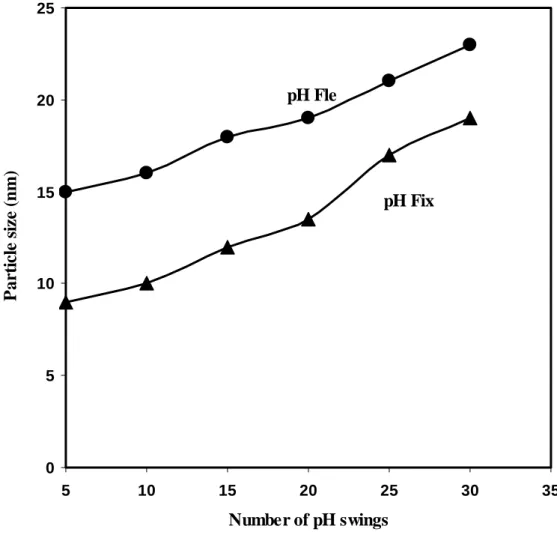
The particle size of the TiO2 photocatalysts prepared by both methods increased with
an increase in the number of pH swings (Fig. 3.2 and Table 3.1). This is due to the alternate addition of acid TiCl4 and base aqueous ammonia during preparation of the TiO2
catalysts at each swing time, in which small particles were dissolved by the acid solution and only large particles with high surface areas were retained. However, the average particle size of the catalysts prepared by pH Fix was found to be less than that by pH Fle,
as shown in Fig. 3.2. This is due to the dissolution of not only the smaller particles but also the large particles of TiO2 by the high concentration of the HCl acid, resulting in the
formation of only small TiO2 particles with pH Fix. For pH Fle, the pH of the reaction
mixture gradually became neutral when the number of pH swings increased to around 15 times. The effect of acid and alkaline was not very pronounced with pH Fle after a certain amount of pH swings, i.e., after a neutral pH was attained, however, the particles grew steadily with an increase in the pH swing numbers. It is worth noting that the surface area of the TiO2 particles prepared by the pH Fle method increased with an increase in the pH
swing numbers [Fig. 3.3], whereas, the reverse trend was observed for TiO2 prepared by
the pH Fix method. Although the particle size gradually increased with an increase in pH swings for both methods, not much influence was observed on the surface area for the particles prepared by pH Fix. This may be due to the existence of a small particle pore size and pore volume as well as the formation of a rutile phase at higher calcination temperatures. The rutile particles are aggregated larger particles responsible for a decrease in the surface area at higher calcination temperatures (Table 3.1), while at the same time, the pore volume and pore diameter have a strong influence on the morphology of the TiO2
particles. Figures 3.4 and 3.5 clearly show that both the pore volume and pore diameter of the TiO2 particles increased tremendously with an increase in the pH swing numbers with
the pH Fle method, whereas, only a slight increase in the pore volume and diameter of the TiO2 particles were observed for the pH Fix method. The high pore volume and pore
diameter of the particles were, thus, seen to be responsible for the high surface area of the particles prepared by pH Fle and the smaller pore volume and pore diameter were attributed to the smaller surface area of TiO2 particles prepared by pH Fix. Well-crystalline
TiO2 particles were formed when the number of pH swings increased from 5 to 30. This is
also another reason for the decrease in the surface area of TiO2 particles prepared by the
pH Fix method (Fig. 3.3).
The results of 2-propanol oxidation were investigated for the photocatalytic degradation ability of the catalysts prepared by these two methods and the results are shown in Fig. 3.6. The photocatalytic activity of the TiO2 catalysts prepared by 20 times
pH swings and calcined at 650°C showed a higher rate for the degradation of 2-propanol in comparison with other catalysts prepared by pH Fle with different pH swing numbers and calcination temperatures. Similarly, the catalysts prepared by 25 and 30 pH swing times and calcined at 650°C showed high activity for the degradation of 2-propanol using the pH Fix method, although it was still found to be less than the catalysts prepared by the pH Fle method, as shown in Fig. 3.6. A combination of both anatase and rutile phases have been reported to enhance the reaction rate for the degradation of organic pollutants to a
certain extent [17-19]. In this study, the catalysts prepared by 15 pH swing times by pH Fix and calcined at 750°C possessed a mixture of anatase and rutile phases in a ratio similar to the P-25 catalyst (Table 3.1). However, the catalytic activity was found to be less than the catalysts prepared by 30 times pH swings and calcined at 650°C which consisted of 94 % anatase. With pH Fle, the catalysts calcined at 650°C possessed an anatase/rutile ratio of around 75/25 with high pore volume and pore diameter, showing a high efficiency for the degradation of 2-propanol (78 %) (Fig. 3.6 and Table 3.2). The TiO2
catalysts possessing an anatase/rutile ratio of around 70/30, with less pore volume and pore diameter than the catalysts prepared by 20 times pH swings, did not show high activity for the degradation of 2-propanol (58 %) (Table 3.2). Moreover, less pore volume and pore diameter were observed for the catalysts prepared with 5 times pH swings than with 20 times pH swings (Table 3.2). An anatase/rutile ratio of around 70/30, thus, had no effect on the photocatalytic activity for the degradation of organic compounds. This is clearly shown in Table 3.2 in which TiO2 particles with a high pore volume and pore
diameter showed excellent activity for the degradation of 2-propanol. These results reveal not only that the anatase/rutile phase is an important parameter for the catalytic reactions but also that other important parameters such as pore volume and pore diameter are equally important for the photocatalytic degradation reactions. The pH Fle method enabled
the preparation of more efficient TiO2 photocatalysts comparable to P-25 (Fig. 3.6) than
the pH Fix method, especially for photocatalytic degradation reactions as well as control of the morphology of the particles. With pH Fix, the particle size increased at a calcination temperature of 750ºC (Table 3.1), although the surface area did not increase proportionally and the pore size as well as pore volume were found to be less than the catalysts calcined at 650 and 700ºC. These results indicate that in addition to the anatase/rutile phase ratio, the particle size and surface area of the particles, and the pore volume and pore diameter are major factors in realizing the efficient photocatalytic degradation of organic compounds.
3.4. Conclusions
TiO2 photocatalysts prepared by a controlled pH swing method could retain the anatase
phase even at calcination temperatures of 750°C at high pH swing numbers. However, other important parameters such as particle size, surface area, pore volume, pore size as well as the anatase/rutile phase ratio could not be controlled well by this method. The addition of HCl acid during preparation showed detrimental effects on the morphology of the particles. On the other hand, TiO2 catalysts prepared by an uncontrolled pH swing
The results of 2-propanol oxidation showed that control of the anatase/rutile ratio, the pore volume as well as pore diameter of the TiO2 nano-particles are important factors in
Table 3.1.
Physicochemical properties of TiO2 photocatalysts prepared by the fixed pH method
Calcination temperature (°C) Number of pH swings Surface area (m2/g) Particle size (nm) Anatase:rutile Pore volume (cc/g) Pore diameter (nm) 700 700 700 700 750 750 750 750 15 20 25 30 15 20 25 30 31 32 33 38 20 16 15 15 14 18 20 22 19 25 26 27 93:07 90:10 89:11 93:07 85:15 55:45 60:40 50:50 0.139 0.151 0.154 0.200 0.102 0.099 0.066 0.100 19 20 21 23 22 24 25 26
Table 3.2.
Physicochemical properties of TiO2 photocatalysts prepared by the flexible pH method
Number of pH swings Calcination temperature ( ºC) Anatase:rutile Pore-volume (cc/g) Pore-diameter (nm) 2-propanol degradation (%) 5 10 15 20 550 600 650 650 70:30 60:40 67:33 75:25 0.135 0.293 0.515 0.513 13 31 57 64 58 64 77 78
0 20 40 60 80 100 5 10 15 20 25 30 3 Number of pH swings A n at ase p h a se co n ten t ( % ) pH Fle pH Fix 5
Figure 3.1. Effect of the number of pH swings on the anatase phase content of TiO2
particles calcined at 650°C when prepared by the flexible (pH Fle) and fixed pH swing (pH Fix) methods.
0 5 10 15 20 25 5 10 15 20 25 30 Number of pH swings P a rt ic le s iz e ( n m ) pH Fle pH Fix 35
Figure 3.2. Particle size of photocatalysts calcined at 650°C versus the number of pH
0 20 40 60 80 5 10 15 20 25 30 3 Number of pH swings S u rf ace ar ea ( m 2 /g ) pH Fix pH Fle 5
Figure 3.3. Specific surface area of photocatalysts calcined at 650°C versus the number of
0 0.1 0.2 0.3 0.4 0.5 5 10 15 20 25 30 3 Number of pH swings P o re v o lu m e ( c m 3 /g ) pH Fle pH Fix 5
Figure 3.4. Pore-volume of photocatalysts calcined at 650°C versus the number of pH
0 20 40 60 80 5 10 15 20 25 30 3 Number of pH swings P o re d iam et er ( n m ) pH Fle pH Fix 5
Figure 3.5. Pore-diameter of photocatalysts calcined at 650°C versus the number of pH
0 20 40 60 80 100 Fix Fle P-25
Name of the catalysts
D e gr a da ti on of 2 -pr op a no l (% )
Figure 3.6. Comparison of the oxidative degradation of 2-propanol into CO2 and H2O
(UV irradiation for 4 hrs at 297 K) using catalysts prepared by the flexible (pH Fle) & fixed pH swing (pH Fix) methods and P-25 TiO2.
3.5. References
[1] M. Anpo, Bull. Chem. Soc. Jpn. 77, 1427 (2004), and references therein. [2] J. M. Herrmann, C. Guillard, J. Disdier, C. Lehaut, S. Malato and J.
Blanco, Appl. Catal. B: Environmental, 35, 281 (2002).
[3] C. Y. Wang, J. Rabani, D. W. Bahnemann and J. K. Dohrmann, J. Photochem. Photobiol. A Chem. 148, 169 (2002).
[4] C. Morterra, G. Cerrato, M. Visca and D. M. Lenti, J. Mater. Chem. 2, 341 (1992).
[5] M. Matsuoka, M. Kitano, M. Takeuchi, M. Anpo and J. M. Thomas, Topics Catal. 35, 305 (2005).
[6] N. G. Park, J. V. D. Lagemaat and A. J. Frank, J. Phys. Chem. B, 104, 8989 (2000). [7] X. Z. Le, H. Liu, L. F. Cheng and H. J. Tong, Environ. Sci. Technol., 37, 3989
(2003).
[8] Y. V. Kolenko, B. R. Churagulov, M. Kunst, L. Mazerolles and C. C. Justin, Appl. Catal. B: Environmental, 54, 51 (200).
[9] S. Bakardjieva, J. Subrt, V. Stengl, M. J. Dianez and M. J. Sayagues, Appl. Catal. B: Environmental, 58, 193 (2005).
[11] H. Yamashita, Y. Ichihashi, M. Harada, G. Stewart, M. A. Fox and M. Anpo, J. Catal. 158 (1996) 97.
[12] M. Anpo and H. Yamashita, Catal. Surv. Asia 8, 35 (2004), and references therein. [13] M. Anpo and M. Takeuchi, J. Catal. 216, 505 (2003).
[14] B. Neppolian, H. Yamashita, Y. Okada, H. Nishijima and M. Anpo, Catal. Lett. 105, 111 (2005).
[15] J. F. Zhu, J. L. Zhang, F. Chen, K. Iino and M. Anpo, Topics Catal. 35, 261 (2005). [16] B. Neppolian, H. S. Jie, J. P. Ahn, J. K. Park and M. Anpo, Chem. Lett.
33, 1562 (2004).
[17] D. C. Hurum, A. G. Agrios, K. A. Gray, T. Rajh and M. C. Thurnauer, J. Phys. Chem. B, 107, 4545 (2003) .
[18] T. Ohno, K. Tokieda, S. Higashida and M. Matsumura, Appl. Catal. A: General, 244, 383 (2003).
Chapter 4
Enhancement of the Photocatalytic Reactivity of TiO
2Nano-particles
4. Enhancement of the Photocatalytic Reactivity of TiO
2Nano-particles
by Simple Mechanical Blending with Hydrophobic MOR Zeolites
4.1. Introduction
TiO2 photocatalysts have been widely studied for the purification of air, water, and soil
polluted with organic compounds for their potential to completely decompose harmful organic compounds into CO2 and H2O under UV light irradiation.[1-4] Various
air-cleaning and deodorization systems equipped with TiO2 photocatalysts and UV light
sources that reduce volatile organic compounds (VOCs) such as aldehydes, carboxylic acids and aromatic compounds which can cause the so-called “sick house syndrome” are now commercially available. However, the removal efficiencies of air-cleaning systems for odorant compounds in the home environment still needs improvement, preferably by as simple and low-cost a method as possible. Although the deposition of small amounts of Pt on TiO2 catalyst surfaces is generally known to enhance the photocatalytic reactivity,[5-9]
Pt compounds are too costly for common use in home electrical appliances. On the other hand, the hybridization of adsorbents such as zeolites [10-12] and activated carbon [13-15] with TiO2 particles has been reported to show elevated photocatalytic reactivity, especially
shown that hybridized TiO2/MOR catalysts prepared by a simple impregnation method
also exhibit high photocatalytic reactivity for the complete oxidation of gaseous acetaldehyde as compared to pure untreated TiO2 catalysts since MOR zeolite powders are
able to efficiently adsorb acetaldehyde molecules diffused in wide spaces and then smoothly supply them onto the TiO2 photocatalyst surfaces.
In this work, TiO2 nano-particles were mechanically blended with the hydrophobic
MOR zeolite in a simple preparation method in order to maximize the photocatalytic performance of commercial TiO2 powders as well as reduce the preparation cost. The
photocatalytic reactivity of the blended TiO2/MOR systems were then evaluated for the
complete oxidation of gaseous acetaldehyde with O2 under UV light irradiation.
4.2. Experimental
TiO2 nano-powdered photocatalysts (SSP-25, anatase phase, SSABET = ca. 270 m2/g)
and the highly siliceous H+-type MOR zeolite (HSZ-HOA890, SiO2/Al2O3 = ca. 1880,
SSABET = ca. 370 m2/g) were purchased from Sakai Chemical Industry Co., Ltd. and
Tosoh Co., Ltd., respectively. TiO2/MOR photocatalysts having different TiO2 content
were obtained by a simple mechanical blending of these two powder samples in an agate mortar for 0 - 60 min [referred to as TiO2/MOR(A)]. For comparison, a different type of
TiO2/MOR photocatalysts was also prepared by the ultrasonic aqueous suspension of these
two powder samples [referred to as TiO2/MOR(B)]. The TiO2 nano-powders blended with
the MOR zeolites were then characterized by XRD (Shimadzu, XRD-6100) and diffuse reflectance UV-vis absorption (Shimadzu, UV-2200A) measurements at room temperature.
The photocatalytic reactivity of the blended TiO2/MOR samples was evaluated for the
decomposition of gaseous acetaldehyde in the presence of O2 under UV light irradiation.
The TiO2/MOR catalysts (50 mg) were placed onto a flat bottom quartz cell (volume, ca.
33 cm3). The volume of the reaction area including the cell volume was ca. 100 cm3. Before photoreactions were carried out, the catalysts were degassed at 723 K for 2 h, treated in sufficient amounts of O2 (ca. 6.7 kPa) at the same temperature for 2 h, and then
degassed at 373 K for 2 h up to a 10-5 kPa range. A gas mixture of CH3CHO (0.27 kPa), O2
(1.07 kPa), and H2O (0 - 1.33 kPa) was then introduced into the reaction cell. The amount
of acetaldehyde introduced into the reaction cell was calculated as ca. 8 μmol (ca. 1500 ppm). After an adsorption equilibrium was reached, UV light was irradiated at 275 K by a 100 W high-pressure Hg lamp (Toshiba, SHL-100UVQ-2) through a cutoff filter (Toshiba Glass, UV-27, λ>270 nm, ca. 1-2 mW/cm2). To avoid the heating effect from the UV lamp, the photocatalysts in the quartz cell were cooled in ice water during the photoreactions. The amount of CO2 produced and acetaldehyde decomposed were analyzed by TCD and
FID by gas chromatography (Shimadzu, GC-14A).
4.3. Results and Discussion
Figure 4.1 shows the XRD patterns of the TiO2 nano-powders blended with MOR
zeolites of different TiO2 contents. The TiO2 nano-powders showed typical diffraction
patterns attributed to the (101) phase of an anatase structure at around 26 degrees. The primary particle size of the TiO2 nano-powder (SSP-25) could be estimated at ca. 8 nm by
the Scherre's equation. On the other hand, all diffraction patterns for the MOR zeolite which could be assigned to a MFI structure much sharper than the TiO2 nano-powder,
showing largely grown zeolite crystals. When small amounts of TiO2 nano-powders were
mechanically blended with such largely grown zeolite particles even for only 5 min, it became difficult to observe the diffraction patterns attributed to the TiO2 nano-powders.
However, as the TiO2 content increased up to 20 wt%, a broad diffraction peak attributed
to the anatase (101) phase could be observed at around 26 degrees.
The diffuse reflectance UV-vis absorption spectra of the TiO2 nano-particles
mechanically blended with the siliceous MOR zeolite and non-porous pure SiO2 powder
nano-powders blended with the MOR zeolites were observed at around 380 - 400 nm. When smaller amounts of TiO2 powders than 5 wt% were blended with the siliceous MOR
or SiO2 powders, some portion of the incident light was found to pass through the powder
samples of several millimeters thickness due to the high transparency of the MOR and SiO2 powders. When the amount of TiO2 nano-powders blended with the zeolite powders
reached about 10 - 20 wt%, the incident light could not penetrate the mixed powder samples, suggesting efficient irradiation of UV light onto the entire TiO2 nano-particles.
However, since the absorption coefficient of the TiO2 powder in UV light regions is
known to be very high, as the fraction of the TiO2 powders to the zeolite powders
increased, the incident light could not be irradiated onto the backside of the TiO2 particles.
These results clearly indicate that an important role of the siliceous MOR zeolite or SiO2
powders is the efficient irradiation of incident UV light onto all of the TiO2 nano-particles
without any loss of light intensity.
The oxidation of gaseous acetaldehyde on TiO2 photocatalysts hardly proceeded in the
absence of a H2O vapor, however, the photocatalytic reaction was dramatically enhanced
by adding small amounts of H2O vapor [16]. The photocatalytic oxidation reactions of
gaseous acetaldehyde with O2 under UV light irradiation (λ>270 nm) over the TiO2
evaluated in the presence of a H2O vapor. At first, the effect of the mechanical mixing
times of these two different powder samples on the photocatalytic reactivity of TiO2/MOR(A) was evaluated from the viewpoint of the dispersion of the TiO2
nano-particles within the zeolite powders. As shown in Fig. 4.3, although the increased dispersion of the TiO2 nano-particles onto the powders after mixing up to 60 min could be
confirmed by SEM observations (not shown), the photocatalytic reactivity could hardly be enhanced. For comparison, the mixed TiO2/MOR(B) powders were prepared from an
ultrasonically aqueous suspension. However, as shown in Fig. 4.4, the photocatalytic reactivity of TiO2/MOR(B) was almost equivalent to the TiO2/MOR(A) prepared by a
simple mechanical blending method. Moreover, it is notable that the TiO2 and zeolite
powders without mixing in an agate mortar showed slightly less photocatalytic reactivity as compared to the mechanically blended TiO2/MOR(A). These results clearly indicate
that the photocatalytic reactivity of the TiO2 nano-particles is easily improved by simple
mechanical blending with a hydrophobic zeolite powder as an adsorbent material.
Figure 4.5 shows the effects of the TiO2 content on the photocatalytic reactivity of the
mechanically blended TiO2/MOR(A) for the complete oxidation of gaseous acetaldehyde
with O2 in the presence of H2O vapor under UV light (λ > 270 nm) irradiation. TiO2
hydrophobic character showed almost twice as high photocatalytic reactivity as compared to the pure untreated TiO2 nano-particles. Also, as reported in a previous work, the
siliceous MOR zeolite can work as a good adsorbent to concentrate gaseous acetaldehyde in hydrophobic cavities.[16] Since the siliceous zeolite does not have Brönsted acid sites, which work as strong adsorption sites for polar molecules such as H2O molecules,[17] the
acetaldehyde molecules concentrated within the zeolite cavities could smoothly diffuse on the catalyst surfaces. In addition, as mentioned from the results of UV-vis absorption measurements, the incident UV light was efficiently irradiated on the entire TiO2
photocatalyst of ca. 5 - 15 wt% blended with the MOR zeolite due to the high transparency of the zeolite powders in UV-vis light regions. In order to verify the role of the zeolite powders, the photocatalytic reactivity of the TiO2 nano-particles mechanically blended
with non-porous silica powders were also investigated. Although the non-porous silica (SSABET = less than 10 m2/g) adsorbed only small amounts of gaseous acetaldehyde
molecules as compared to the MOR zeolite, transparent silica powders can work as an efficient diluting material for the TiO2 nano-particles. In this case, the non-porous silica
powders did not show any condensation effect for the acetaldehyde molecules. Small amounts of the TiO2 nano-particles blended with the non-porous silica powders, thus,
hydrophobic MOR zeolite to enhance the photocatalytic reactivity of TiO2 nano-particles
can be concluded to be: (i) the condensation effect for gaseous acetaldehyde molecules near the TiO2 photocatalytic sites; and (ii) the appropriate diluent effect of the TiO2
photocatalysts as an intense absorber of UV light with highly transparent zeolite powders. For further verification of the condensation of gaseous acetaldehyde molecules, the photocatalytic oxidation reaction of different initial concentrations of acetaldehyde over the TiO2 nano-particles and TiO2/MOR(A) were compared. As shown in Fig. 4.6, when
only TiO2 nano-particles were applied for the photocatalytic oxidation of gaseous
acetaldehyde, the total conversion of acetaldehyde into CO2 and H2O was found to
decrease with a decrease in the initial pressure of acetaldehyde. On the other hand, TiO2
nano-particles mechanically blended with the hydrophobic zeolite powders were found to show high and efficient photocatalytic reactivity for rather lower concentrations of acetaldehyde molecules. These results clearly indicate that the non-porous TiO2
nano-powders cannot condense low concentrations of gaseous acetaldehyde molecules on their surfaces in spite of their large surface area (ca. 270 m2/g), while the acetaldehyde molecules concentrated within the hydrophobic cavities of the MOR zeolites quickly diffused onto the TiO2 nano-particles, resulting in the efficient photocatalytic oxidation of
gaseous acetaldehyde from home environments is generally at most 50 ppm, TiO2
nano-particles mechanically blended with MOR zeolite powders are good candidates for the continuous removal of lower and more dilute concentrations of harmful organic compounds.
4.4. Conclusions
The photocatalytic properties of conventional TiO2 nano-particles (SSP-25, Sakai
Chemical Industry Co., Ltd.) could be enhanced by simple mechanical blending with hydrophobic MOR zeolite powders. The optimum amount of the zeolite powders as an adsorbent for the enhancement of the photocatalytic reactivity of the blended TiO2/MOR
system was estimated to be ca. 80 - 95 wt% since the incident UV light was effectively irradiated onto the entire TiO2 nano-particles due to the high transparency of the siliceous
zeolite powders. Furthermore, the hydrophobic zeolite powders efficiently gathered the gaseous acetaldehyde molecules within their cavities and supplied them onto the TiO2
Figure 4.1. XRD patterns of TiO2 nano-particles mechanically blended with MOR
(SiO2/Al2O3 = 1880) zeolite powders.
Figure 4.2-A Diffuse reflectance UV-Vis absorption spectra of TiO2 nano-particles
mechanically blended with MOR zeolite powders.
TiO2 content (wt%): (a) 100, (b) 50, (c) 20, (d) 10, (e) 5, (f) 1, and (g) 0.
Figure 4.2-B Diffuse reflectance UV-Vis absorption spectra of TiO2 nano-particles
mechanically blended with non-porous pure SiO2 powders.
Figure 4.3 Effect of the mixing time for the TiO2 and zeolite powders (TiO2/MOR ratio =
10/90) in an agate mortar on the photocatalytic reactivity for the oxidation of gaseous acetaldehyde with O2 under UV light irradiation.
Figure 4.4 Photocatalytic reactivity (UV light irradiation: 1 h) of the blended TiO2/MOR
samples (TiO2/MOR ratio = 10/90) prepared by: (A) mechanical blending, (B) an
Figure 4.5 Photocatalytic reactivity (UV light irradiation: 3 h) of the TiO2 nano-particles
Figure 4.6 Effect of different initial pressures of acetaldehyde on the photocatalytic
reactivity of: (A) the TiO2 nano-particles, and (B) the TiO2 nano-particles mechanically
4.5. References
[1] N. Serpone, E. Pelizzetti (Eds.), "Photocatalysis fundamentals and applications", Wiley, New York (1989).
[2] D.F. Ollis, H. Al-Ekabi (Eds.), "Photocatalytic Purification and Treatment of Water and Air", Elsevier, Amsterdam (1993).
[3] A. Fujishima, K. Hashimoto, T. Watanabe (Eds.), "TiO2 Photocatalysis Fundamentals
and Applications", BKC, Tokyo (1999).
[4] M. Anpo, H. Yamashita, in: M. Schiavello (Ed.), "Heterogeneous Catalysis", Wiley, London (1997).
[5] S. Sato and J. M. White, Chem. Phys. Lett. 72, 83 (1980).
[6] M. Grätzel (Ed.), "Energy Resources through Photochemistry and Catalysis" Academic Press, New York (1983).
[7] M. Anpo, T. Shima, S. Kodama, Y. Kubokawa, J. Phys. Chem. 91, 4305 (1987). [8] M. Anpo, K. Chiba, M. Tomonari, S. Coluccia, M. Che, M. A. Fax, Bull. Chem. Soc. Jpn. 64, 543 (1991).
[9] M. Takeuchi, K. Tsujimaru, K. Sakamoto, M. Matsuoka, H. Yamashita, M. Anpo, Res. Chem. Intermed., 29, 6, 619 (2003).
9986 (1995).
[11] V. Durgakumari, M. Subrahmanyam, K.V. Subba Rao, A. Ratnamala, M. Noorjahan, K. Tanaka, Appl. Catal. A Gen. 234 (2002) 155.
[12] M. Anpo (Ed.), "Photofunctional Zeolites", NOVA, New York (2000). [13] T. Ibusuki, K. Takeuchi, J. Mol. Catal. 88, 93 (1994).
[14] H. Uchida, S. Itoh, H. Yoneyama, Chem. Lett. 1995 (1993).
[15] H. Yamashita, M. Harada, A. Tanii, M. Honda, M. Takeuchi, Y. Ichihashi, M. Anpo, N. Iwamoto, N. Itoh, T. Hirao, Catal. Today 63, 63 (2000).
[16] M. Takeuchi, T. Kimura, M. Hidaka, D. Rakhmawaty, M. Anpo, J. Catal., 246, 235 (2007).
Chapter 5
Preparation of the Visible Light Responsive TiO
2Thin
5. Preparation of Visible Light Responsive TiO
2Thin Film Photocatalysts
by a RF-magnetron Sputtering Deposition Method
5.1. Introduction
In recent years, TiO2 photocatalysts have been intensively investigated in various
fields and particularly TiO2 thin films coated on various substrates have shown potential
for applications as photofunctional materials not only for their high photocatalytic reactivity but also for their highly wettable properties under UV light irradiation [1-3]. Although various products using TiO2 thin film photocatalysts have already been
commercialized, they do not allow the absorption of visible light and, therefore, necessitates the use of a UV light source. However, in order to realize clean and safe chemical processes as well as the use of abundant solar energy, photocatalysts able to operate even under visible light irradiation are strongly desired. Since an important consideration for widespread and practical applications of high performing TiO2
photocatalysts is the preparation cost, various methods such as the sol-gel [4-7], chemical vapor deposition (CVD) [8-10], and plasma-enhanced CVD methods [11-13] have been intensively investigated. Among these, the RF (radio frequency) magnetron sputtering deposition method described here was found to be suitable for practical applications since
it enables not only high speed deposition but also deposition of thin films on various substrates with large areas.
We have previously reported on metal ion-implantation into TiO2 semiconductor
powders and thin films, resulting in an effective modification of their electronic properties to enable the absorption of visible light [14-16]. However, this method necessitates two processes: (i) ionized cluster beam (ICB) deposition to prepare the transparent TiO2 thin
films; and (ii) modification of the electronic properties of the TiO2 semiconductors by a
highly advanced metal ion implantation procedure. Since such complexity in the preparation processes impedes mass production at low cost, much easier preparation methods for visible light responsive TiO2 thin films are strongly desired in order to realize
widespread applications.
In this paper, a more practical alternative preparation process, i. e., a RF magnetron sputtering (RF-MS) deposition method has been successfully applied for the development of transparent TiO2 thin films which can induce various significant photocatalytic
reactions effectively under UV and visible light irradiation.
5.2. Experimental