• 検索結果がありません。

Design of Escaping Trajectory from Mars by Using a Halo Orbit as Hub and a Method of Delta V Reduction

N/A
N/A
Protected

Academic year: 2021

シェア "Design of Escaping Trajectory from Mars by Using a Halo Orbit as Hub and a Method of Delta V Reduction"

Copied!
6
0
0

読み込み中.... (全文を見る)

全文

(1)

Design of Escaping Trajectory from Mars by Using a Halo Orbit as Hub and a Method of Delta V Reduction

Yu Tanaka (Waseda University, Graduate School), Yasuhiro Kawakatsu (ISAS/JAXA), Hiroaki Yoshimura (Waseda University)

Abstract: This paper proposes a new method to design low-energy transit trajectories, in which a halo orbit is regarded as hub, for deep space missions such as JAXA’s Martian Moons eXploration (MMX). First, we consider the Sun-Mars-Spacecraft system and compute a halo orbit in the context of Circular Restricted three-Body Problem (CR3BP). In order to use invariant manifolds, we attempt to make use of eigenvectors of the halo orbit and give them as perturbations to a reference point, which is each state vector on the halo orbit.

By propagating the reference point with perturbations in backward and forward time, we search trajectories so that a spacecraft can depart from the vicinity of Mars and go through a neighborhood of Sun-Mars Lagrange point. As a result, we realize to design the trajectories escaping from the vicinity of Mars to Sun-side region in low-energy. In addition, we consider a method to reduce a Delta V, which is an amount of impulsive velocity maneuver at departing point, for practical use.

ハロー軌道をハブとした低エネルギー輸送軌道の設計 と増速量低減化手法

田仲 悠(早大院),川勝 康弘(ISAS/JAXA),吉村 浩明(早大)

摘要:本研究では,JAXA

MMX

ミッションのような深宇宙探査機に適用し得る,ハロー軌道をハ ブとした低エネルギー輸送軌道の新しい設計手法を提案する.初めに,太陽—火星—宇宙機系の円制限

3

体問題の枠組みでハロー軌道を計算する.次に,ハロー軌道の各点を基準点とし,基準点における ハロー軌道の固有ベクトルを摂動として基準点に与える.その状態量を前後の時間に軌道伝播するこ とで,火星近傍を出発して太陽—火星系のラグランジュ点近傍を通るような軌道を探索する.その結果 として,火星近傍を脱出して太陽側の領域へ輸送される低エネルギーの軌道設計を実現する.また,

より実用的な軌道のために,出発時の増速量∆𝑉を低減化する手法について検討する.
I. Introduction

In a trajectory design for deep space missions, a lot of fuel and large rockets are needed when all of energy is provided by chemical propulsion. It causes an increase in spacecraft’s weight and launch costs. In particular, a sampling return mission needs energy to escaping from gravity of a target planet and energy to transfer a round-trip. Therefore, trajectory using the Hohmann transfers or swing-by trajectories in two-body problem has been studied in order to make fuel smaller. On the other hand, since it is not sufficient to approximate by two-body problem in a case of considering an influence of multiple planetary gravity, trajectory design in the context of three-body or four-body problem has been also studied.

The merit to enable to design a low-energy transit trajectory by using these multi-body problems has been revealed. As a study of trajectory design from a point of view of low-energy transit, a trajectory design method based on the tube dynamics by Koon et al. [1] is well familiar. This method proposes a low-energy trajectory design by coupling the planer circular restricted three-body problems using a property of invariant manifolds called as tube. In other words, this method connects trajectories so that the two tubes of a stable manifold and an unstable manifold can link together on an arbitrary connecting plane. On this occasion, a velocity modification maneuver ∆𝑉 is necessary, since each state vector of a spacecraft in two tubes is different on the connecting plane in general. Recently, regarding a whole system as a coupling system of the three-body problems considering two perturbations in the context of planer bi-circular four-body problem, a method connecting with nulling velocity modification maneuver at the connecting point has been proposed. [2] On the other hand, though it is necessary to consider the tube dynamics in three dimensions for more practical trajectory design, it is hard to reveal a dynamical behavior at a boundary of the tube because of the existing of quasi-halo orbit.

Besides, a grid search has been also studied as a different design method from the tube dynamics. [3] This

method can be used in a case of escaping from a target planet of a sampling return mission, and propagates

(2)

various initial conditions at an escaping point. However, this is not a systematic method because this just changes the initial conditions globally, and it is not clear whether a spacecraft can escape from a target planet, without propagating the trajectory in advance.

Namely, the tube dynamics has problems to eliminate necessity of maneuver at a connecting point and to expand to the three-dimensional system, and it is a neck that the grid search is not a systematic method.

Therefore, this paper proposes a new trajectory design method to overcome these problems. This is a method to realize low-energy transit trajectory with no-maneuver, which takes a reference point on a halo orbit to make the halo orbit as hub and uses local invariant manifolds on the reference point. As a validation model, this paper attempts to design transit trajectories escaping from the Martian moon “Phobos” with low-energy and a short time of flight in the context of three-dimensional Sun-Mars-Spacecraft circular restricted three-body problem. In addition, a method to reduce a departing ∆𝑉 is also considered for designing more practical trajectories.

II. Dynamics in CR3BP A. Equations of motion

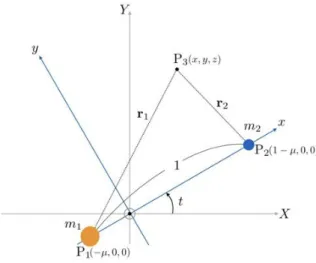
As shown in Fig.1, we assume the system, which the two bodies, 𝑃 1 and 𝑃 2 are regarded as particles moving around the barycenter under each of gravitational influences, and the 𝑃 3 of negligible mass as a spacecraft or an asteroid is influenced by other two bodies. The model, adding an assumption that the motions of the two bodies are circular to this system, is called Circular Restricted Three-Body Problem (CR3BP). We refer to 𝑃 1 as the primary with its mass 𝑚 1 and 𝑃 2 as the secondary with its mass 𝑚 2 . We assume that the two bodies have circular orbits about the barycenter with its period 𝑇 respectively, and that the 𝑃 3 cannot influence of its own gravity on other bodies. Then, let us introduce the mass parameter 𝜇 representing the system as 𝜇 = 𝑚 2 /(𝑚 1 + 𝑚 2 ), and we make the system non-dimensional in the following manner: the sum of mass is 1, i.e., 𝑚 1 + 𝑚 2 = 1, the distance between the two bodies is 1, and the period 𝑇 = 1. Representing a position of 𝑃 3 as (𝑥, 𝑦, 𝑧) ∈ ℝ 3 , the equations of motion of 𝑃 3 in the rotational frame as Fig.1 are given by

𝑥̈ − 2𝑦̇ = − 𝜕𝑈 ̅

𝜕𝑥 , 𝑦̈ + 2𝑥̇ = − 𝜕𝑈 ̅

𝜕𝑦 , 𝑧̈ = − 𝜕𝑈 ̅

𝜕𝑧 , where

𝑈 ̅(𝑥, 𝑦, 𝑧) = − 1

2 (𝑥 2 + 𝑦 2 ) − 1 − 𝜇 𝑟 1

− 𝜇 𝑟 2

− 1

2 𝜇(1 − 𝜇)

is the effective potential, and each distance between 𝑃 3 and the two bodies are 𝑟 1 = √(𝑥 + 𝜇) 2 + 𝑦 2 + 𝑧 2 , 𝑟 2 = √(𝑥 − 1 + 𝜇) 2 + 𝑦 2 + 𝑧 2 respectively.

Fig. 1 CR3BP model B. Lagrange point, halo orbit, and invariant manifold

The energy of 𝑃 3 , E is defined as a function of positions and velocities by 𝐸(𝑥, 𝑦, 𝑧, 𝑥̇, 𝑦̇, 𝑧̇) = 1

2 (𝑥̇ 2 + 𝑦̇ 2 + 𝑧̇ 2 ) + 𝑈 ̅(𝑥, 𝑦, 𝑧),

(3)

which preserves constant along the solution curve. The CR3BP is a conservative system and able to define the Hill region (region of possible motion) by the projection of the constant-energy surface onto position space, while there are forbidden regions in which a spacecraft cannot enter. Moreover, the five equilibrium points called Lagrange points are well known in three-body problem, 𝐿 1 , 𝐿 2 , 𝐿 3 exist on the 𝑥-axis and 𝐿 4 , 𝐿 5

exist on the point make an equilateral triangle with 𝑃 1 and 𝑃 2 . In particular, 𝐿 1 , 𝐿 2 , 𝐿 3 each have a local topology with the saddle×center×center structure, and halo orbits, which are an unstable periodic orbit, exist in that vicinity. Furthermore, the existence of invariant manifolds called tube approaching to a halo orbit asymptotically is known. Fig.2 shows the invariant manifolds in two-dimensional CR3BP, which the red lines are stable manifolds attracting to the periodic orbit asymptotically in forward time and the blue lines are unstable manifolds attracting to the periodic orbit asymptotically in backward time, i.e., repelling to it in forward time. A trajectory existing in the tube is regarded as a transit trajectory, which can pass two regions isolated by a neck region around the Lagrange point.

Fig. 2 Invariant manifolds in 2D CR3BP

III. Trajectory Design Method Using a Halo Orbit as Hub A. State transition matrix and monodromy matrix

The state transition matrix (STM) Φ is used to gain the linear approximation between small initial displacement 𝛿𝑥̅ 1 and small finial displacement 𝛿𝑥̅ 0 by

𝛿𝑥̅ 1 = Φ𝛿𝑥̅ 0 .

The STM of one lap around a halo orbit is called monodromy matrix, whose eigenvalues are 𝜆 1 > 1, 𝜆 2 = 1

𝜆 1 , 𝜆 3 = 𝜆 4 = 1, 𝜆 5 = 𝜆̅ 6 , |𝜆 5 | = 1

in the context of CR3BP. The eigenvectors corresponded with 𝜆 1 , 𝜆 2 are associated with stable and unstable motion of a halo orbit respectively.

B. Transit trajectory design

In the context of CR3BP, a linear approximation of the invariant manifolds can be obtained by using the eigenvectors of the monodromy matrix as perturbations. As shown in conceptual figure Fig.3, let 𝒗 𝑠 ∈ 𝑅 6 , 𝒗 𝑢 ∈ 𝑅 6 be the stable and unstable eigenvector respectively, and let 𝑿 0 ∈ 𝑅 6 be a state on a halo orbit to define the initial states of the stable and unstable manifold by

𝑿 𝑠 = 𝑿 0 + 𝜀𝒗 𝑠 , 𝑿 𝑢 = 𝑿 0 + 𝜀𝒗 𝑢

respectively, where 𝜀 is a small displacement from 𝑿 0 and this makes the eigenvectors into perturbations.

Fig.3 Conceptual figure of generating the manifolds

(4)

Propagating these local manifolds along with the equation of motion can generate the approximation of global invariant manifolds such as Fig.2. Furthermore, propagating the combination of the stable and unstable local manifold as

𝑿 −𝑠+𝑢 = 𝑿 0 − 𝜀 𝑠 𝒗 𝑠 + 𝜀 𝑢 𝒗 𝑢

can obtain a transit trajectory as shown in Fig.4. Note to be careful to choose the appropriate sign of perturbations so that the trajectory can look like a transit one.

Fig.4 Transit trajectory (left one is looked by x-y plane, right one is by x-z plane)

C. Design of Mars escaping trajectory

In this study, we try to design trajectories escaping from Martian moon “Phobos” and passing the vicinity of 𝐿 1 in the context of Sun-Mars-Spacecraft CR3BP by following procedure. We define the size of halo orbit by its maximum amplitude of z-direction 𝐴 𝑧 .

1. Take a reference point at each point of a halo orbit divided by 100 segments.

2. Give the stable and unstable perturbations to the state on the reference point.

3. Search trajectories crossing the Phobos orbit around Mars by propagating in forward and backward time with changing the size of perturbations.

4. Calculate a velocity vector and time of flight for escaping from Mars vicinity.

5. Repeat above processes for each size of halo orbits from 𝐴 𝑧 = 0.8 × 10 −3 to 𝐴 𝑧 = 1.5 × 10 −3 by 0.1 × 10 −3 step.

The each of planetary parameters is cited from NASA Planetary Fact Sheet [4]. The definition of the time of flight is from departing Phobos to a connecting point [5], in which we can see the system as the context of Sun-Spacecraft two-body problem. In addition, we assume the Phobos orbit is circular and co-planar with Mars orbit.

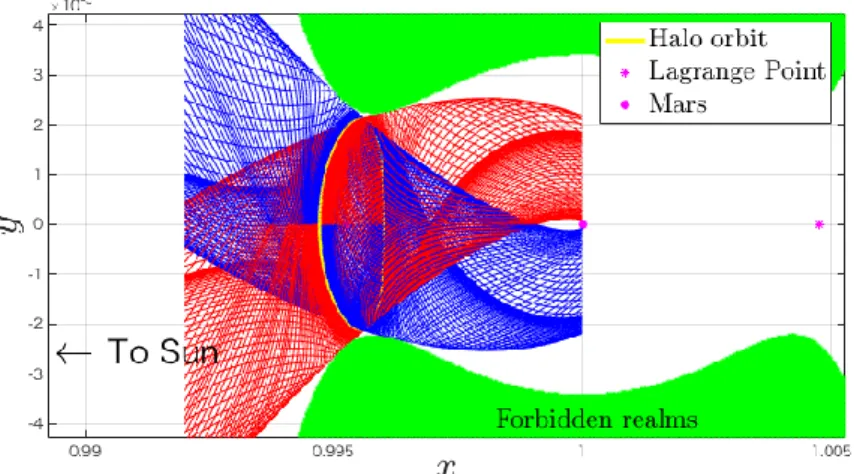
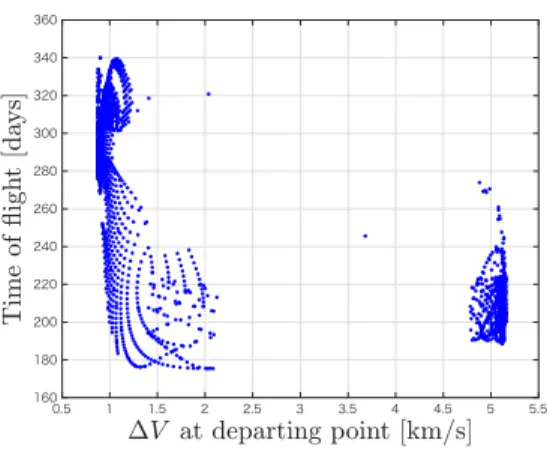
Fig.5 shows the result of the relationship between ∆𝑉 and time of flight (𝐴 𝑧 = 1 × 10 −3 ), and Fig.6 shows the behavior of the trajectory picked in Fig.5. From this figure, we can see that we could design the transit trajectories escaping from Mars vicinity. By researching of this design method with all size of 𝐴 𝑧 from 𝐴 𝑧 = 0.8 × 10 −3 to 𝐴 𝑧 = 1.5 × 10 −3 , we can see that ∆𝑉 becomes lower, the smaller 𝐴 𝑧 is. From this result, we try to design with 𝐴 𝑧 = 1.0 × 10 −9 , which is nearly lied on the x-y plane. Fig.7 shows the result of this, and we can get lower ∆𝑉 trajectories.

Fig.5 ∆𝑉 v.s. TOF (𝐴 𝑧 = 1 × 10 −3 ) Fig.6 Example of Mars escaping trajectory

(5)

Fig.7 ∆𝑉 v.s. TOF (𝐴 𝑧 = 1 × 10 −9 )

IV. ∆𝑽 Reduction Method

In a view of practical use, small ∆𝑉 is better for actual missions. Therefore, we confirm a method to reduce ∆𝑉 of the designed trajectories. For ∆𝑉 reduction, we apply the Fixed Time Arrival method (FTA method), which is used to modify an actual trajectory of a spacecraft to a planned trajectory at a designated time using two times of ∆𝑉.

Fig. 8 Conceptual figure of ∆𝑉 reduction

In this study, we give the perturbations to the reference point instead of ∆𝑉, and we use two constraints; the departing point at Phobos is not changed for simplification and 𝑣 𝑧 at departing is equal to zero. Fig.8 shows its conceptual figure. The relationship between the both of displacements at the departing point and at the reference point is given by

( 0

𝛿𝒗 2 ) = Φ ( 𝛿𝒓 1 𝛿𝒗 1 ),

where Φ is a STM from the reference point to the departing point in backward time. The displacement at the reference point is given by

( 𝛿𝒓 1

𝛿𝒗 1 ) = 𝛼𝒗 𝑎 + 𝛽𝒗 𝑏 + 𝛾𝒗 𝑐 + 𝜅𝒗 𝑑 + 𝜏𝒗 𝑒

where 𝒗 𝑎 , 𝒗 𝑏 , 𝒗 𝑐 , 𝒗 𝑑 , 𝒗 𝑒 are arbitrary vectors and 𝛼, 𝛽, 𝛾, 𝜅, 𝜏 are small constants to make perturbations.

Therefore, the displacement at the departing point is expressed by following formula.

( 0

𝛿𝒗 2 ) = 𝛼Φ𝒗 𝑎 + 𝛽Φ𝒗 𝑏 + 𝛾Φ𝒗 𝑐 + 𝜅Φ𝒗 𝑑 + 𝜏Φ𝒗 𝑒 .

Since we have three constraints formulae from the constraint of fixed departing point and one constraint

formula from the constraint of 𝑣 𝑧 = 0, we can reduce the five parameters of above formula, i.e., 𝛼, 𝛽, 𝛾, 𝜅, 𝜏,

into one parameter so that we can do one-parameter study briefly. Fig.9 shows the result of ∆𝑉 reduction for

the trajectories with 𝐴 𝑧 = 1 × 10 −9 . The smallest ∆𝑉 of ∆𝑉 reduction is still larger than that of original

trajectories. However, we can see the ∆𝑉 reduction of individual trajectory as shown in Fig.10, which is a

magnification of Fig.9.

(6)

Fig.9 Result of ∆𝑉 reduction (𝐴 𝑧 = 1 × 10 −9 ) Fig.10 A magnification of Fig.9

V. Conclusion

In this study, we confirmed that we could design transit trajectories departing from Phobos and passing the 𝐿 1 point by the design method using a halo orbit as hub in the context of Sun-Mars-Spacecraft CR3BP. In addition, though we couldn’t obtain the minimum ∆𝑉 by the ∆𝑉 reduction method, we could confirm the availability of the ∆𝑉 reduction method for individual trajectories.

Acknowledgments

This study is partially supported by JSPS Grant-in-Aid for Scientific Research (16KT0024), Waseda University (SR 2018K-195), and the MEXT “Top Global University Project" at Waseda University.

References

[1] W. S. Koon, M. W. Lo, J. E. Marsden, S. D. Ross, Dynamical Systems, the Three-Body Problem and Space Mission Design, Springer-Verlag New York Ink., pp.95-122, 2009.

[2] K. Onozaki, H. Yoshimura, and S. D. Ross, Tube dynamics and low energy Earth-Moon transfers in the 4-body system, Advances in Space Research, 60-10, pp.2117-2132, 2017.

[3] K. Takemura, Y. Kawakatsu, H. Yoshimura,Escape Trajectory for the Martian Moon Sample Return Mission Using Tube Dynamics in Three-Body Problem, 27th AAS/AIAA Space Flight Mechanics Meeting, Kissimmee, the U.S., 2017.

[4] D. R. Williams, Planetary Fact Sheet – Metric, NASA, (https://nssdc.gsfc.nasa.gov/planetary/factsheet/).

[5] M. Horikawa, Y. Kawakatsu, H. Yoshimura, Low Energy Escape Trajectory for the Mars Moon Sample

Return Mission, 26th AAS/AIAA Space Flight Mechanics Meeting, Napa, the U.S., 2016.

Fig. 1 CR3BP model    B.  Lagrange point, halo orbit, and invariant manifold
Fig. 2 Invariant manifolds in 2D CR3BP
Fig. 8 Conceptual figure of  ∆

参照

関連したドキュメント

This paper proposes a method of enlarging equivalent loss factor of a damping alloy spring by using a negative spring constant and it is confirmed that the equivalent loss factor of

Therefore, we developed a method to construct hazard maps of playground equipment, calculated from simulations, by using computer models of children falling on a playground slide..

Although the point data for the compressor configuration were converted to four Bezier curves; two for the flow passage at the hub and shroud, and the other two for the impeller

Standard domino tableaux have already been considered by many authors [33], [6], [34], [8], [1], but, to the best of our knowledge, the expression of the

The answer, I think, must be, the principle or law, called usually the Law of Least Action; suggested by questionable views, but established on the widest induction, and embracing

A major challenge involved in orbit design within the context of the circular restricted three-body problem CR3BP is the organization of the vast set of options that is available

The volumes of the surfaces of 3-dimensional Euclidean Space which are traced by a fixed point as a trajectory surface during 3-parametric motions are given by H..

We show that a discrete fixed point theorem of Eilenberg is equivalent to the restriction of the contraction principle to the class of non-Archimedean bounded metric spaces.. We