• 検索結果がありません。

A Critical Analysis of the Jet Programme

N/A
N/A
Protected

Academic year: 2021

シェア "A Critical Analysis of the Jet Programme"

Copied!
40
0
0

読み込み中.... (全文を見る)

全文

(1)

著者名(英) Nicola Galloway journal or

publication title

The journal of Kanda University of International Studies

volume 21

page range 169‑207

year 2009‑03‑31

URL http://id.nii.ac.jp/1092/00001265/

(2)

Nicola Galloway Abstract

 Many people have remarked upon the benefits of having native English speaking teachers (NESTs) in a country such as Japan, and the Japan Teaching and Exchange Programme (JET) has been continually praised. This study presents a preliminary investigation into the impact of these native Assistant Language Teachers (ALT), and examines student and Japanese Teachers’ attitudes towards them in detail.

Questionnaires were used in Japanese Senior High Schools throughout Gunma Prefecture, and results reveal positive attitudes towards English and the ALTs, that ALTs have increased students’ exposure to English and cultural knowledge and reveals a number of benefits to be had from Team Teaching.(TT) However, the main conclusion to be drawn is that, while ALTs are promoting cultural knowledge, there is a possibility that they are, in fact, strengthening stereotypes as opposed to reducing them and, due to the pre-occupation with America, there is a possibility that the JET Programme will fail to promote ‘mass internationalisation’ as much as ‘mass Americanisation’.

Introduction

 The Japan Exchange and Teaching Program (JET) was set up in 1987 to promote

and deepen mutual international understanding through co-operation between native

English speaking Assistant Language Teachers (ALTs) and Japanese people, as well

as, through the ALTs, in helping to improve the communicative English ability of

(3)

Japanese students. There are currently 5057 ALTs throughout Japan (CLAIR, 2006) and with an annual budget approaching $500 million, the JET program is now the centrepiece of top-down effort to create ‘mass internationalisation’ (McConell, 2000:

x). Advertisements throughout Japan advertise for ‘Native Teachers of English’, justifying themselves that that is what English learners desire (Ahmar, 2004: 122).

Lee’s (2004: 23) comments on the power balance of native and non-native teachers in Hong Kong, Ahmar (2004) and Cook (2000) looked at attitudes, yet few studies have concentrated on the students’ perceptions of and preferences for ‘nativeness’ in a teacher. Research is required to investigate the attitudes of Japanese high school students towards ‘JETs’. Therefore, this article represents a preliminary investigation into the impact of native English speaking ALTs in Japanese Senior High Schools and an analysis of student and Japanese English teachers’ (JTE) attitudes towards them.

The JET Programme

 The purpose of the JET program is to deepen mutual international understanding through cooperation between the ALTs and the local citizens in Japan, as well as through the ALTs helping teach English to the general public (Ministry of Foreign Affairs, 2000). Thus, in a sense ALTs can ‘empower’ students, providing more exposure to English than their traditional classes and increasing their opportunities to use English and learn about foreign cultures. However, there is evidence to suggest that the impetus arose due to trade tensions (Reesor, 2002: 46; Inoguchi, 1987;

McConell, 1996: 447) and was presented ‘as a gift’ to the American government.

Thus, one may argue that the lack of success in ‘improving the communicative

ability of Japanese students’ is therefore no surprise as this was never the true

intention.

(4)

ALTs as a learning tool

 Koike and Tanaka (1995: 20) note that, “overall, the JET program has been very successful.” Students enjoy team taught classes, and Team Teaching (TT) has made classes more effective and challenging. McConell (2000: 214) found most students were thrilled to hear native pronunciation, approved of the ALT coming to their school and preferred TT classes to normal English classes. ALTs have also increased student use of English and Taguchi (2002: 5) found that in OC classes 40% of the time was spoken in English, although this increased to 80-100% in TT classes. Sakui (2004: 158) also notes that Japanese Teachers of English (JTEs) classes consisted of teacher-fronted grammar lessons, although Oral Communication (OC) classes with an ALT included much more English and the use of communicative activities.

Furthermore, Japan remains a ‘closed society’ (McConell, 2000: x), and ALTs give students a chance to meet foreigners and a realization that they can to learn the language communicate with foreigners which in turn may increase motivation.

Who are the ALTs?

 However, while ALTs may be ‘much needed medicine for an outdated system’, they may also be viewed as ‘more like a virus whose potentially deleterious effects have to be controlled at all costs’ (McConell, 2000: 8). It has been suggested that the English language teaching (ELT) industry carries with it imperialistic influences (Canagarajah, 1999; Modiano, 2001; Phillipson, 1992; Pennycook, 1994). ‘Native speakers’ are seen as the new colonial administrators through the teaching of

‘Standard English’ (Pennycook, 1998: 19). Japan has a pre-occupation with Western

nations, particularly the USA. English is the only option in most schools and, thus

has been elevated to a status of ‘marvellous tongue’ (Pennycook, 1998). There is,

therefore, an inherent fear that, instead of promoting international understanding,

(5)

the JET Program is reinforcing the value attached to English and may, in fact, be enforcing stereotypes that the ‘West is best’. Matsuda (2000), for example, found that, for many students, ‘foreign countries’ means the West, particularly the USA, which may be heightened by the fact that ALT’s are predominantly from what Kachru (1992: 356) calls the ‘Inner Circle’. Of the 5,057 ALTs in 2006, about 55%

were from the USA, 14% were from England (Scotland, Wales and Northern Ireland were not mentioned), and 13% from Canada. Among other Inner Circle countries, 6.7% were from Australia and 5% from New Zealand (Clair, 2006). Thus, the majority of ALTs represent not only native Englishes, but also Western culture as an ideal to be emulated by Japanese learners (Yoshida, 2003: 292). Furthermore, while 6% of ALTs were from Singapore in 2006 (Clair, 2006), who could become instrumental in raising awareness of World Englishness (Kubota, 2000: 21), there is a clear lack of exposure to different varieties of Englishes despite the rhetoric of learning English for international/intercultural communication and, despite the fact that most students will use English to communicate with other non native speakers.

Moreover, preferences appear to prevail within the Inner Circle, as Kubota (2002:

22) noted how some Australian participants were asked to reduce their accent by listening to tapes or to use only American English while teaching.

ALTs and Culture

 In recent years, particularly after the influx of ALTs, there has been a variety of

discussions about the social and linguistic implications of English, as well as the

construction of Japanese people’s ambivalent view of language, race, and culture

(Kubota, 1998: 297). Some find this dependence on English threatening to their

traditions, culture, and even identity (Kachru and Smith, 1995:1). Not all JTEs

welcome ALTs and view ‘their communicative teaching methods as a virus that

could potentially harm the intellectual development of students and traditional

(6)

cultural virtues’ (Kubota, 2002: 26).

NESTs

 Never theless recruitment figures show that the ideal speaking partner in Japan appears to be ‘white middle class Americans’, and there is, thus, a possibility that hierarchies are set up within departments, as ‘native speakers’ are given preferential treatment in the eyes of many students and administrators (Tang, 1999: 577).

ALTs are in heavy demand despite a growing number of influential voices who are questioning the notion that native speakers represent the ideal teacher (Phillipson, 1992: 195; Scovel, 1994: 208; Tang, 1997; Tuitama-Roberts and Iwamoto, 2003:

9). ALTs in Japan have been criticised numerous times due to their lack of Teaching

English as a Foreign Language (TEFL) related qualifications (Conel, 2003; Crooks,

2003:3; Helgeson, 1991: 8; McConell 2000: 57; Shishin, 1999: 47) as table 1.1

shows. Despite in-service training (JET Programme: Looking Towards the Future

after 15 years, March 2002: 118) it is clear that most JET participants are under

qualified in TEFL. Training is clearly required, particularly since all public

elementary schools are now given the option of English instruction, which has

resulted in the placement of many more ALTs in elementary schools (MEXT,

2003). throughout Japan.

(7)

Table 1.1: Characteristics of Assistant Language Teachers, 1991

TEFL CERTIFICATION

Country Yes No

U.S 73 851

U.K 38 292

Australia 17 56

New Zealand 9 80

Canada 61 247

Ireland 7 20

France 0 4

Germany 1 1

Total 206 1,551

Total (%) 11.7 88.3

Source: McConelll (2000: 59)

 The relative merits of NNESTs and NESTs have been extensively discussed (Davies: 1991; Widdowson:1994; Medgyes: 1992; and Boyle:1997) in recent years.

Medgyes (1992, 340) argues that NNESTs are not only more qualified, but also have the experience of acquiring English as a second language, have an insight into the linguistic and cultural needs of their learners, can be trained in other things such as idiomatic expressions etc., may represent a more achievable model and can resort to the L1 when necessary. Nevertheless, Braine (2004: 21-22) states that NESTs are capable of creating an ‘English-rich environment’ to enhance student motivation.

 Cook’s (2000: 331) study found that ‘nowhere is there an overwhelming

preference for NESTs. Being a NS is only one among many factors that influence

students’ views of teaching. Cook (2000) further states that while program

administrators believe that students prefer native speaker teachers, students in

various countries themselves do not have an ‘overwhelming preference’ (Cook,

2000: 231). Ahmar’s (2004: 122) study on ESL students’ attitudes towards NESTs

(8)

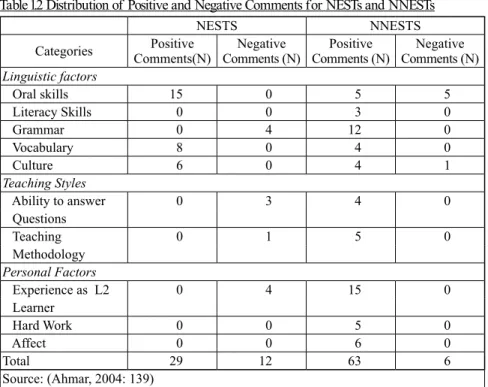
and NNESTs using essay responses revealed that while NESTs are seen as good at teaching oral skills, NNESTs are seen as good at teaching literacy skills and grammar. Table 1.2 also shows how NNESTs experience of having studied the language themselves is perceived as their strongest characteristic.

Table 1.2 Distribution of Positive and Negative Comments for NESTs and NNESTs

NESTS NNESTS

Categories Positive

Comments(N) Negative

Comments (N) Positive

Comments (N) Negative Comments (N) Linguistic factors

Oral skills 15 0 5 5

Literacy Skills 0 0 3 0

Grammar 0 4 12 0

Vocabulary 8 0 4 0

Culture 6 0 4 1

Teaching Styles

Ability to answer 0 3 4 0

Questions

Teaching 0 1 5 0

Methodology Personal Factors

Experience as L2 0 4 15 0

Learner

Hard Work 0 0 5 0

Affect 0 0 6 0

Total 29 12 63 6

Source: (Ahmar, 2004: 139)

The Japanese English Teacher

 Despite the fact that students in Ahmar’s (2004) study (table 1.2) reported language learning history as a benefit of NNESTs, Connel (2003) noted the

‘appaling command` of English of many JTEs and many are not confident about

(9)

their own communicative skills and, because the majority have been ‘schooled in rote memorization and grammatical expertise, their own conversational skills are quite limited’ (McConell, 1996: 451). Furthermore, Browne and Wada (1998:101) found in their study that only between 3% and 8% of respondents reported majoring in TESL or TEFL at university. Many hate the language (Shishin, 1999: 46), teach in Japanese, rarely stray from the front of the room and do not encourage student initiation (McConell, 2000: 216). Furthermore, 58% of high school teachers in Hughes’ study (1999: 562) evaluated their English instruction in Japan negatively.

ALTs, therefore, might be necessary to motivate JTEs to use English (McConell, 2000: 216) and to create an English speaking classroom (Helgeson, 1991: 8) and as Medgyes points out (1992: 347) both teachers clearly have strengths and weaknesses, and can ‘balance each other out.’

Different cultures, different methodologies.

 The introduction of ALTs has gone hand in hand with a push towards more communicative language teaching (Fox, 2001: 3; Lo Castro, 1996: 40; Reesor, 2002:

48; Cardew and Leedham, 1994: 24; Duppenthaler et al, 1989: 90), a methodology largely unfamiliar to Japanese students.

  ‘The arrival of reform-minded native speakers into an exam-orientated school environment’ (McConell, 1996: 450) creates a variety of dilemmas for many JTEs who have to give up class time to conduct communicative activities and games ‘which they perceive as having very little relevance to the entrance exams’ (McConell, 1996:

450). The teachers are from different cultures, the JTE, as part of East Asian culture,

which generally values collectivism, harmony and discourages individual self-

expression, creativity, and critical thinking, whereas the ALT’s culture displays the

opposite characteristics. Students are likely to be used to teacher-fronted classrooms

(10)

(Duppenthaler et al, 1989: 95; Holiday, 1994: 54; Koike and Tanaka, 1995: 24), grammar-translation methods, a focus on accuracy over fluency, receptive over productive skills and may often be highly dependent on their teacher and other learners. Howerer, such teaching methods are still felt to be necessary to pass the outdated university entrance examinations (Brown, 1995: 277; Lo Castro, 1996:

47; Morrow, 1995: 87) which along with textbooks (Browne and Wada, 1998:

105; Reesor, 2002: 49) do not reflect curriculum change. In addition , while JTEs’

teaching methodologies may not be approved by those advocating pushes towards CLT, Ahmar’s (2004) study of students attitudes (Table 1.2) shows that students prefer NNESTs’ teaching methods compared to NNESTs’ which are more likely to be communicative in nature. This further highlights the need to investigate students' learning needs.

The Present Study

 The present study is, therefore, an attempt to examine the impact of the JET Programme and attitudes towards ALTs. However, the study into the impact of the programme can be seen as preliminary in nature, and it concentrates more on the actual attitudes towards ALTs. Several questions have been constructed, particularly to answer gaps in the literature and previous research:

 1.What are the attitudes of ALTs?

 2.Are ALTs a useful learning tool?

 3.Are ALTs influencing attitudes towards English?

 4.Are ALTs having a cultural influence on students?

 5.Are NESTs ‘good’ teachers?

 6.How do JTE and ALT teaching methodologies and styles differ?

 These questions were converted into corresponding questionnaireitems.

(11)

Methodology

 Data was collected in Gunma prefecture, Japan throughout the period May 16 to June 16, 2005. Gunma was chosen as the site for research due to the researcher’s previous teaching experience as a JET participant.

 1.428 student questionnaires.

 2.14 ALT questionnaires.

 3.31 JTE questionnaires.

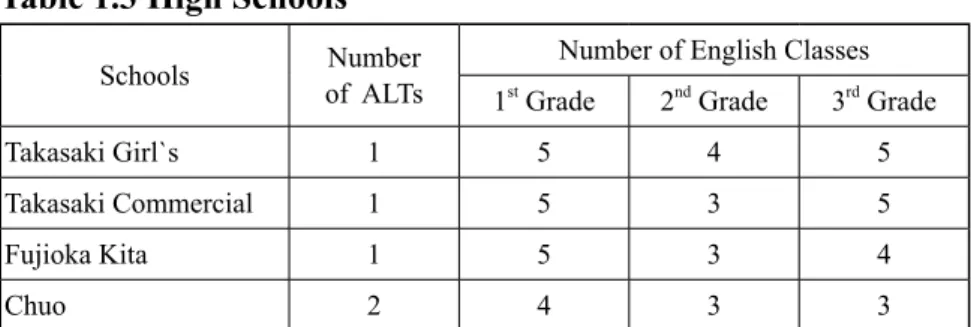
 Questionnaires were distributed in four Senior High Schools (table 1.3), and one class from each grade (1st, 2nd and 3rd grade) was given a questionnaire to be completed during regular class time. They were administered by their Japanese homeroom teacher and were given between 15 and 20 minutes to complete them.

The collection of a completely random sample is rather difficult (Munn and Drever, 1999: 12), particularly in a small study like this, although by using one class from each grade in four different schools, it is hoped that the sample is as representative as possible. In addition, all JTEs in the four schools were given a questionnaire, of which 31 were collected overall. 21 questionnaires were sent out by post to all ALTs in Gunma prefecture, and 14 were returned.

Table 1.3 High Schools

Schools Number

of ALTs

Number of English Classes 1

st

Grade 2

nd

Grade 3

rd

Grade

Takasaki Girl`s 1 5 4 5

Takasaki Commercial 1 5 3 5

Fujioka Kita 1 5 3 4

Chuo 2 4 3 3

(12)

Procedure

Student Questionnaire

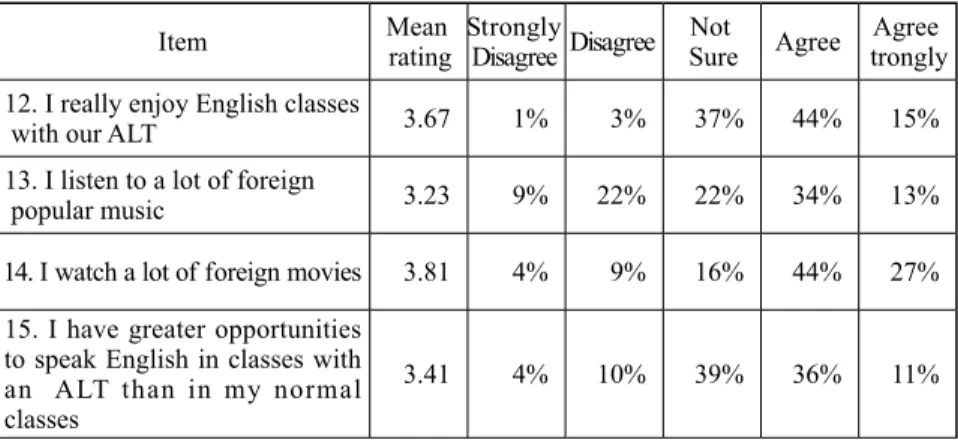
 The results for the ‘nominal’ variables showed that a large number of students have no classes with an ALT, yet an ALT is present in all schools, causing possible problems of interpretation of questions relating to classes with an ALT. Table 1.5 shows the distribution of responses and the mean ratings for individual attitudinal items on the questionnaire using a Likert scale and students clearly have a generally positive attitude. Although 39% of respondents were `Not Sure` in relation to question 15, in the open ended responses seventy-one students reported having more opportunities to talk in English in the ALT’s class, of which twenty-eight directly compared with the JTE, who focused on grammar and exams. One student, for example, noted ‘In normal English class we feel I learn how to write in English. In the ALT’s class I feel I can learn how to speak in English’. Many also commented on English being the main method of instruction in the ALT’s class, as opposed to Japanese in the JTE’s class and that ALTs use games and had pronunciation differences.

The mean rating for item 17 suggests that the generally positive attitude is not reflected in a high level of confidence in speaking English, although in students`

open-ended responses, cultural information was noted in ALTs’ classes and grammatical information from JTEs; as one mentioned, ‘I think English classes with an ALT are an opportunity to communicate with foreign culture. And in normal classes we have to increase our knowledge about English for entering exam for university’. A few students also noted the chance to offer their opinions and one commented on the interactive nature of the ALT’s class.

 Question 12 had a mean response of 3.67, yet in their open-ended responses,

twenty-four students reported disliking the subject and the most popular response

(13)

for why they liked it was ‘to speak to foreigners’ and ‘make friends with people all over the world’ (eighty-four students), particularly Americans. Many also simply enjoyed the subject, that they want to travel or live abroad, that they want to understand the meaning of movies and songs and that it is useful due to the fact that it is an international or standard language (29 students). However, two hundred and ninety reported that communicative activities, such as games, conversation, self introductions, watching movies, pronunciation practice, and answering questions were the most popular activities conducted in TT classes. These activities were also the most enjoyed activities in these classes and two hundred and forty-six students reported this as their favourite activity, sixty reported that they enjoyed learning about foreign countries and foreign cultures, and twenty enjoyed not using the textbook, the relaxed atmosphere, the chance to offer their opinion and the ability to study different things to normal class.

Table 1.5 Frequency distribution in % and mean rating for Likert scale items (Student attitudinal variables) (N=420)

Item Mean

rating Strongly

Disagree Disagree Not

Sure Agree Agree trongly 12. I really enjoy English classes

with our ALT 3.67 1% 3% 37% 44% 15%

13. I listen to a lot of foreign

popular music 3.23 9% 22% 22% 34% 13%

14. I watch a lot of foreign movies 3.81 4% 9% 16% 44% 27%

15. I have greater opportunities to speak English in classes with an ALT than in my normal classes

3.41 4% 10% 39% 36% 11%

(14)

16. My Japanese English teacher speaks more English in classes with an ALT than in normal English classes

3.19 4% 13% 50% 26% 7%

17. English classes with an ALT have greatly improved my

confidence in speaking English 2.86 7% 19% 58% 13% 3%

18. My cultural knowledge of foreign countries has improved greatly as a result of classes with an ALT

3.48 1% 95% 38% 43% 8%

19. English classes with an ALT are extremely valuable in my

education 3.60 1% 5% 36% 46% 11%

20. ALTs should study Japanese 3.32 9% 22% 22% 34% 13%

21. I enjoy having an opportunity

to speak English in class 3.27 4% 9% 16% 44% 27%

Factors influencing student attitude towards English

 A reliability analysis of these variables in Table 1.5 produced an alpha value

(Cronbach’s reliability coefficient) of 0.80 providing justification for the creation of a

new variable ‘attitude’, calculated as the arithmetic mean of the ratings for the items

in the scale (items 12,13,14,15,17,18,19,21, and 22 were included). An independent

samples t-test shows that gender was not a statistically significant predictor of scores

(t(422) = 0.982, p>0.05). The mean attitude score of those who have spent no time

abroad is 3.39, whereas the mean for those who have spent some time abroad is 3.53,

and the difference is statistically significant (t(389)=2.274, p<0.05). The attitude of

the students with British ALTs is markedly lower than that of the other students, but

the sample size is too small with only three British ALTs. Those who speak another

foreign language (n=7) have a higher mean attitude score (M=3.92) than those who

(15)

don’t (n=414, M=3.43) and the difference is statistically significant (t(419)=2.261, p<0.05). Statistical significance tests adjust for the different sample sizes to a certain degree.

Correlations among attitudinal items

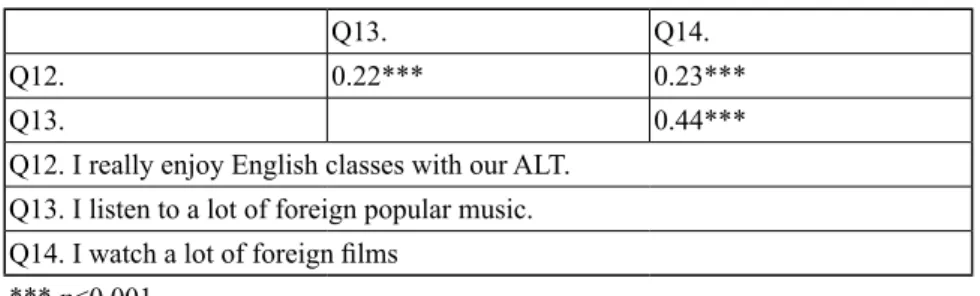
 In order to examine the relationship between motivation and general interest in English, correlation coefficients were calculated (Table 1.6). However, the relationship between professed enjoyment of foreign films and music (motivation) and enjoyment of English classes were not particularly high, 0.23 and 0.22, respectively, indicating a weak relationship, although they are all statistically significant (p<0.001). However, watching foreign movies may not be a very valid indicator of attitude towards English, since the majority are dubbed, suggesting that students have limited interests in foreign cultures.

Table 1.6: Value of Pearson's correlation coefficient for attitudinal variables "enjoy",

"music" and "movies"

Q13. Q14.

Q12. 0.22*** 0.23***

Q13. 0.44***

Q12. I really enjoy English classes with our ALT.

Q13. I listen to a lot of foreign popular music.

Q14. I watch a lot of foreign films

*** p<0.001

 Furthermore, a negative correlation (-.153) was calculated between the variables

‘enjoy’ and ‘speak Japanese’, suggesting that the more the student is likely to agree

with the statement ‘ALTs should study Japanese’, the less he/she is likely to enjoy

classes with the ALT. In fact, in open-ended responses, the most popular difference

(16)

in relation to teaching styles was the language used for instruction. Most (fifty- three) commented on the ALT’s use of English and non-use of Japanese, while twenty-seven noted that the ‘JTE teaches in Japanese’, of which four said the ‘JTE seldom speaks English’. Fifty-four also commented on pronunciation differences.

Responses (twenty-four) also included the fact that the JTE focuses on grammar, of which fourteen directly compared with the ALT who focuses on conversation.

Comments were also made on the friendly and enjoyable nature of the ALT, the increased opportunities to speak English in class, the fact that the textbook isn’t used, and the fact that the ALT seldom writes on the blackboard. In relation to the most difficult aspects of ALT led classes, an overwhelming amount (three hundred and six students) displayed an element of anxiety in their responses, including comments such as ‘When I cannot express what I want to say in English’; ‘Don’t understand what the teacher says’ and ‘All explanations are in English, so I think it a little difficult for everyone in the class to understand’. Nine referred to the cognitive challenge of the subject, including references to spelling and writing as well pronunciation difficulties. A few also reported having difficulties with the nature of the class, such as those activities when they have to move around the class.

 The present study reveals mixed feelings in relation to increased exposure and use of English, reflected in student’s different responses to open and closed questions.

However, they did report that ALT classes provide an opportunity to speak English unlike JTE led grammar classes and that they have a communicative focus. Such findings are in line with Sakui’s (2004: 158) noted differences between TT and JTE led classes. Questionnaire responses support previous claims that the presence of the ALT increases opportunities to speak in English (Taguchi, 2002: 5; Sakui, 2004:

158), although once more, interviews or observations are clearly needed. Students

do not agree strongly that their JTE speaks more English when TT with an ALT,

contradicting Helgesson’s (1991: 8) claims. JTEs disagree, however, stating that TT

(17)

encourages them to use more English. Thus, it is hoped that ALTs are encouraging the use of English and thus increasing opportunities for comprehensible input (Krashen, 1981:2), speaking (Swain, 1995) and interaction (Long, 1981) to promote students’ SLA. However, the results suggest that students may not actually have increased chances to speak English, which may also explain their lack of confidence, although they did report being able to offer their opinion.

JTE Questionnaire

 While there is generally a very positive attitude, the group is very homogenous in terms of their attitudes or did not want to offend the researcher or ALT system.

There are more experienced teachers in the sample than inexperienced, which may influence attitudes, more teachers work with American ALTs , and most rate their English ability as Intermediate.

 The positive responses in Table 1.7 suggest that the JTEs have a genuinely

positive attitude toward or that they are responding in the way they think they

ought to respond. 81% see ALTs as important for students, 65% think that students

should be exposed to native accents, 87% think that they have cultural benefits

and that TT encourages them to use more English in the classroom. In their open-

ended responses, the majority of JTEs stated that highlighting their own culture and

showing cultural differences was the most important way the ALT enhances mutual

understanding and cultural knowledge, ‘Japanese know a lot about American culture

through TV or other things. But don’t know about British, Canadian, New Zealand

and other English areas. ALTs from such countries helps us a lot to know about their

cultures.’ The second most popular response related to giving students and JTE’s

a chance to communicate with foreigners. In addition, when asked to comment on

the main ways ALTs have helped them in some aspect of English education, five

reported with students writing and three with explaining foreign culture, as one JTE

(18)

commented, ‘Students are really interested in high school life in foreign countries.

However, I’ve never experienced that. My ALT could answer the questions about it from my students. That was really helpful to me.’ Furthermore, six commented that ALTs have helped them with correct expressions.

58 % of JTEs agreed with Question 13, although in their open-ended answers, ten teachers did not respond and six did not appear to understand the question, although the most popular response (twelve) was American English. One, for example, commented ‘American English because I’d like students to be exposed to typical (?

Common?) English first’. Furthermore, five of these teachers commented that British English was also preferable, ‘because they are common English in Japan’. Two teachers however, did have preferences for a wide variety of Englishes.

In relation to teaching methods, the majority (six) reported the grammar focused nature of JTE classes, ‘I tend to have students to read English and translate it. I tend to explain English words themselves rather than the background of the text. An ALT tries to make students speak English’.

Table 1.7:Distribution of responses in %, and mean ratings, for individual JTE attitudinal items using a Likert scale. (N=31)

Rating Mean Strongly

Disagree Disagree Not

sure Agree Strongly Agree 9. ALTs are extremely valuable

members of staff 4.13 0% 0% 13% 61% 26%

10. Teaching with an ALT encourages me to use more

English in the classroom. 4.17 0% 6% 6% 52% 35%

11. I use a lot more English when teaching with an ALT than I do

when teaching along 4.13 0% 10% 10% 37% 43%

(19)

12. It is very important that Japanese students be exposed to native English accents, such as those of the ALTs

4.60 0% 0% 3% 32% 65%

13. Students would benefit more if ALTs represented more varieties of English such as those spoken in parts of Asia

3.50 0% 16% 26% 48% 10%

14. Students learn valuable

cultural information from ALTs 4.20 0% 3% 10% 52% 35%

15. English classes with an ALT give students more confidence in communicating with foreigners than normal English classes

4.17 0% 3% 13% 47% 37%

16. I think ALTs are given special treatment by the school management in Senior High Schools

3.43 0% 13% 42% 39% 6%

17. I think ALTs are poorly trained in Teaching English as a

Foreign Language 2.87 0% 35% 42% 23% 0%

18. My knowledge of English grammar is superior to that of the

ALT 2.73 3% 32% 55% 10% 0%

19. I prefer working with an ALT

with a TEFL qualification 3.77 0% 0% 26% 71% 3%

20. Classes with an ALT are very important for students studying

English 4.03 0% 6% 13% 52% 29%

21. The culture represented by an ALT gives students an accurate

account of that culture 3.70 0% 6% 19% 71% 3%

22. The ALT represents a valuable resource in our English

department 3.60 0% 13% 26% 52% 10%

23. Classes with an ALT are

'westernising' Japanese students 2.60 16% 23% 45% 16% 0%

24. It would be helpful if ALTs

could speak Japanese 3.50 0% 0% 13% 61% 26%

(20)

 An ‘attitude’ scale (including items 9,10,11,12,14,15,19,20,21,and22) from Table.

1.7 represents a positive attitude towards the ALTs with a perfectly acceptable Alpha value of 0.84.

Factors Influencing JTE attitude towards English

 Several factors were examined to investigate whether they influenced JTE attitudes towards ALTs. Results show that experienced staff’s attitudes are more positive than those with less experience. The mean attitude scores of those with 12+

(n=17) years experience were 4.16 and those with less than 12 years of experience (n=14), 3.91, which may be related to English proficiency, teaching experience and familiarity TT. The difference is not, however, statistically significant (t(29)=0.322, p>0.05), although the teacher with the least experience (subject id=28) also has the lowest general attitude score. The mean attitude score of the male teachers (M=4.07) is marginally higher than that of the female teachers (M=4.02), but the difference is not statistically significant (t(29)=0.322, p>0.05) .The mean attitude score of teachers who were working with ALTS from countries other than America (n=2) was markedly higher (M=4.35) than teachers (n=15) working with ALTs from America (M=4.07), but the difference is not statistically significant. Teachers who rate themselves as "Beginners" in English have a lower attitude (M=3.65) than that of those who rate themselves as "intermediate" (M=4.11) or "advanced/fluent"

(M=4.09). A one-way ANOVA shows, however, that this difference is statistically non-significant (F(2,228)=1.682, p>0.05).

 In addition, there is a small (r = 0.37) positive and statistically significant correlation (p = .042) between those that think "ALTs are poorly trained in TEFL’

and ‘My grammatical knowledge is superior to that of the ALT’, indicating that the

more that JTEs agree that ALTs are poorly trained, the more they tend to think that

(21)

their knowledge of English grammar is superior to that of the ALT. Furthermore, eighteen JTEs agree or strongly agree that ‘ALTs should study Japanese’ and thus clearly feel that it is a useful quality.

The results clearly revealed positive attitudes, particularly from JTEs unlike previous studies (Kubota, 2002: 26). Moreover, despite previous research, this study revealed general approval with ALT teaching styles. Interestingly younger teachers were more negative suggesting a possible nervousness with teaching, particularly since previous research (McConelll, 1996: 451) indicates limited conversational skills.

Furthermore, JTE’s who rate their English proficiency as ‘Beginner’ were also more negative.

ALT Questionnaire

 Results show that in Gunma prefecture there are more American ALTs and newer teachers; only one ALT graduated in English literature and Education, three in English literature and one in Education; and only one has a TEFL qualification and only three have had previous experience. Furthermore, most rate their Japanese proficiency as ‘Beginner’. Table 1.8 reveals a positive attitude towards the role of the ALT, particularly in giving students more chances to communicate in English.

However, they clearly do not feel they are regarded as highly valuable members of staff.

 78% agreed with Question 9 and when asked the ways in which the presence of an

ALT enhances mutual understanding and cultural knowledge, the majority (twelve)

reported on explaining foreign culture, reducing stereotypes and raising cultural

awareness. Three commented on being the only foreigner in contact with students,

as one mentioned, ‘I am the only foreigner that most of my students have a chance

to speak to. Because most of the textbooks focus on American culture, I am able to

(22)

introduce British culture too. My students are also very keen to tell me about their culture and to learn to do this in English’.

 93% agreed with Question 10 and the most popular difference reported with JTE classes was the focus on OC and student-centred communicative activities. They commented that they spoke to the students ‘In English’ and involved students in the class.

 The attitude scale consisting of items 9, 10, 14 and 16, gave an Alpha value of 0.81 and a new variable ‘attitude’ was created to be used as the dependent variable.

Factors influencing ALT’s attitude

 In order to examine whether ALT’s nationality effects attitudes towards their role

in Japan, this variable was used. Results reveal that the attitudes of the British ALTs

(n=3) are markedly more positive than those of the American (n=9) or Canadian (n=2)

ALTs, with mean attitudinal scores of 4.25 and 3.49 respectively. Sample sizes were

too small to conduct a one-way ANOVA to examine any significant differences in

attitude among these groups and, thus, the Canadians and British ALTs were grouped

together to conduct a t-test to see if there was a difference in attitude with American

ALTs. The mean attitude score of the American ALTs is 3.48 and that of the others

is 4.05, quite a substantial difference, but not statistically significant (t(12)=1.629,

p>0.05) . No obvious trend was found with levels of experience and only one held

TEFL qualifications so valid comparisons could be made, and sample sizes were too

small to reach clear conclusions.

(23)

Table 1.8: Distribution of responses in %, and mean ratings, for individual ALT attitudinal items using a Likert scale. (N=14)

Mean Rating Strongly

Disagree Disagree Not sure Agree Strongly Agree 09. ALTs have a valuable role in

Japan 3.86 0% 7% 14% 64% 14%

10. My presence gives students more chances to communicate in

English 4.50 0% 0% 7% 36% 57%

11. ALTs should represent more varieties of English, such as

different parts of Asia 3.93 0% 7% 21% 43% 29%

12. I encourage students to discuss Japanese culture in my

English classes 4.14 0% 7% 7% 50% 36%

13. ALTs are an important part of promoting international

understanding 4.00 0% 7% 14% 50% 29%

14. I am regarded as a highly valuable member of staff by my

school management 2.93 14% 0% 36% 43% 0%

15. My Japanese teacher's English ability is sufficient to

teach English 3.65 0% 14% 14% 64% 7%

16. The Japanese English Teachers in my school are highly enthusiastic about TT with an ALT

3.21 7% 14% 29% 50% 0%

17. Students enjoy my classes 3.93 0% 0% 14% 79% 7%

Correlations between attitudinal variables

Correlations were obtained between attitudinal variables in Table 3.4 and the

correlation matrix below shows the significant correlations. From Table 1.8 it is clear

that the more the ALT reports that the students enjoy his/her lessons ( indicating a

Pearson correlation to show the relationship), the less highly regarded he/she is by

(24)

the school staff. Similarly, the more the students enjoy the lessons, the lower his/her opinion is of the JTE's English ability, suggesting a possible JTE disapproval of ALT teaching methods. The strongest correlation is between ‘I am regarded as a valuable member of staff’ and ‘My JTE’s English ability is sufficient to teach English’, meaning that the more the ALT reports that he/she is highly regarded by the school staff, the more he/she is likely to report that the JTEs are enthusiastic about TT.

Table 1.8: Correlation matrix of significant correlations between attitudinal variables

Q10 Q 13 Q 14 Q 15 Q 16

Q9 0.614* .569* .632* .556*

Q14 .766**

Q17 -.608* -.646*

Q9. ALTs have a valuable role in Japan

Q10. My presence gives students more chances to communicate in English Q13. ALTs are an important part of promoting international understanding Q14. I am regarded as a highly valuable member of staff by my school

management

Q15. My Japanese teacher's English ability is sufficient to teach English

Q16. The Japanese English Teachers in my school are highly enthusiastic about TT with an ALT

Q17. Students enjoy my classes *p<0.05, **p<0.01, ***p<0.001

 Furthermore a chi-square test revealed a significant positive association was found

between ‘I am a valuable member of staff’ and ‘My JTEs are enthusiastic about TT’,

0.4 X(squared)=16.917; df=9; p<0.01.

(25)

Questionnaire Comparison

 While ALTs displayed similarities in both types of questions, students reported in their open-ended responses that they have increased opportunities to speak English in ALT classes, yet they were not overly positive in the attitudinal statement which elicited a mean response of 3.41, suggesting a possible misinterpretation or that students were not being as frank in closed questions. Furthermore, ‘I enjoy having an opportunity to speak English in class’ elicited a response of only 3.27, possibly reflecting high anxiety levels in open-ended responses at the ‘All English’ nature of the classes. Students reported that they enjoy learning English to enable them to communicate with foreigners and enjoy the communicative nature of ALT classes, yet they rejected the statement ‘English classes with an ALT have greatly improved my confidence in speaking English’, which, again, may be reflected in anxiety levels.

 JTE responses reveal similar differences. A large number commented on the importance of non-American ALTs, those with non-American ALTs had more positive ‘general attitudes’ (although this was not found to be statistically significant) and the mean attitude score was 3.50 regarding the representation of more varieties of English. Nevertheless, open-ended results show a preference for American English, which is either due to misinterpretation of the question, or that they were not as ‘frank’ in the closed questions. It is also interesting that students with an American ALT have more positive attitudes, possibly reflecting this ‘existing knowledge’ and familiarity noted by the JTEs.

Discussion

Overall attitudes towards ALTs.

 While a number of ALTs feel they have an important role, a lesser amount feel

(26)

regarded as a valuable member of staff. However, classroom observations are needed to assess whether this was due to under utilisation in the classroom as McConnell (1996: 453) suggests. Student responses also support McConnell’s (2000: 214) claims that they enjoy hearing native pronunciation and approve of the ALT visits, although ALTs are over optimistic and clearly need to re-evaluate their lessons.

Furthermore, students do think TT classes and ALT led activities are valuable, although this may equate the country’s pre-occupation with the acquisition of communication skills and not actual enjoyment. It is also interesting that those with experiences abroad do not hold more positive attitudes, although sample sizes were small.

ALTs as a learning tool

 Students clearly feel that classes with an ALT had increased their cultural knowledge. JTE’s were also positive; in fact, JTE responses reflect a sense of

‘insecurity’ and their relatively low self-rating proficiency also suggests a lack of confidence. However as Lee (2004: 234) points out in the case of the Hong Kong NEST scheme similar to JET, this lack of confidence may be simply due to the fact that schools ask NESTs to teach ‘oral skills’ as opposed to NNESTs. It is therefore clear that JTEs would benefit from participation in a similar scheme to JET and schools placed less emphasis on the importance of NESTs.

 It cannot be denied that the presence of an ALT in the Japanese classroom is beneficial for Japanese students. As previous research (McConelll, 2000: x) and ALTs in the present study have suggested the ALT is often the students’ only ‘foreign’

contact, and they can reduce stereotypes and raise cultural awareness. However, students would clearly benefit if ALTs represented more nationalities as JTE’

s mentioned, students already have a great knowledge of America and American

(27)

culture. This may also explain the more positive attitudes towards the role of an ALT held by British participants, who, as a minority, may see their role in Japan as more valuable.

Who are the ALTs?

 There is certainly a clear over-representation of American ALTs and students reported desires to speak with foreigners, particularly Americans and to travel abroad, particularly to America, support previous claims (Matsuda, 2000) that foreign countries mean the West, especially America. Many also enjoyed studying English because it is an international or standard language and, thus, English, particularly American English, has clearly been elevated to the status of ‘marvellous tongue’ (Pennycook, 1998). While it is true that this may also be due to the over- representation of Inner Circle Englishes in the majority of Japanese high school textbooks (Yamanaka, 2006), the unbalanced make-up of the JET programme is also influencing attitudes. Kachru (1992) also suggests that preferences prevail within the inner-circle, and the open-ended results revealed that JTEs prefer American English and thus American teachers, leading to the possibility that the JET Programme may only promote international understanding and awareness between America and Japan. This is particularly worrying at a time when research on World Englishes is growing as is the recognition that English has transformed from being the language of a few powerful nations to becoming the international language of communication.

There are now more second language users of English around the world (Llurda,

2004: 314), and the importance of raising students awareness to other varieties of

English to prepare them for international communication is essential. Some may say

that JET participants are serving as the new colonisers in the new age of Linguistic

Imperialism, strengthening stereotypes that ‘America is Best’. While this area clearly

(28)

requires further investigation, this study has revealed that more varieties of English are clearly needed to promote the goals of the JET Programme and to reduce such a pre-occupation with America.

ALTs and Culture

 The possible ‘Westernisation’ of Japanese students was a further issue that arose in the literature. However, JTE’s were largely unsure on the subject and, thus, unlike the literature suggests do not view ALTs as a threat to their traditions, culture and identity, nor do they fear ‘Americanisation’, but may desire it based on their opinions of preferred varieties. Furthermore, most JTEs feel that ALTs represent an accurate account of their culture and a large number of ALTs reported that they encourage students to discuss Japanese culture in English, although this may be attributed to textbook restrictions.

The Native English Speaking Teacher

 The present study supports much of the previous research that ALTs are under- qualified in TEFL. While JTEs rejected this claim, it may be due to the fact that they themselves are poorly trained (Browne and Wada,1998: 101). Many students also want ALTs to study Japanese and displayed high levels of anxiety due to the ‘all English’ nature of TT classes, which may also have been a factor in why Ahmar’s (2004) subjects preferred NNEST’s teaching styles. JTEs also felt that ALTs should study Japanese, which is in direct contrast to claims in the literature that the Japanese have a ‘desire…to preserve these native speakers’ pure Anglophone identity, which the Japanese worship’ (Nakamura, 1989; Tsuda, 1990; Oishi, 1990, 1993).

Furthermore, contrary to previous research (Connel, 2003; McConelll, 1996: 451;

Shihsin, 1999: 46; Hughes, 1999: 562) a large number of ALTs reported that their

(29)

JTE’s English ability was sufficient to teach English and 50% agreed that their JTEs were enthusiastic about TT.

 It will be interesting to monitor the developments of attitudes towards NESTs in Japan as literature grows on the growth of English as an International Language for global communication and the need to educate students on various varieties of English. The globalization and internationalization of Japanese students’ lives, coupled with increasing recognition of the importance of NNESTs (Medgyes, 1994;

Braine’s, 1999), is likely to affect the employment of NESTs in Japan..

Teaching methodologies

 The last question addressed the attitudes towards the compatibility of ALT’s communicative methods with Japanese culture. Students clearly saw a difference in approaches and answers reflect a notion of intrinsic motivation. Students seemed to enjoy the difference to normal classes, although such motivation does not necessarily equate with approval of ALT’s teaching methods. The main difference reported was the language of instruction and the more communicative nature of the classes.

Conclusion

 As mentioned previously there are many limitations to the present study and several issues that should have been examined in more detail. Nevertheless, it has provided some interesting conclusions on the impact of the JET Programme in Japanese Senior High Schools and attitudes towards ALTs. It makes clear that students and JTEs generally have a fairly positive attitude towards English and towards the ALT and, despite claims made in the literature, JTEs welcome ALTs.

Furthermore, ALTs have certainly increased students’ exposure to English and,

having two teachers to instruct, explain and monitor, undoubtedly makes input

(30)

more comprehensible. However, it is doubtful that students are offered increased opportunities to speak English, negotiate its meaning and be productive, hindering their SLA and keeping their confidence levels low and their anxiety levels high, although without observations it is difficult to conclude on this. These ‘valuable’

ALTs are highly unqualified in the field of TEFL, and would benefit from TEFL training. They do, however, increase cultural knowledge, and perhaps reduce stereotypes and therefore promote international awareness and, understanding, particularly in a country where foreigners are so scarce. JTEs, however, rely heavily on ALTs for such information and would benefit from a period of study abroad. Furthermore, despite their potential, there is a strong possibility that the very presence of ALTs from the ‘inner circle’ are serving to strengthen stereotypes, particularly that the US is the embodiment of ‘Western’ culture and ‘American English’ is the most desirable form. In fact, JTE attitudes show there does not appear to be a fear of ‘Westernisation’ in the present study, but a desire for ‘Americanisation’

and without a change in recruitment policy, there is a high possibility that the JET Programme will create ‘mass Americanisation’ as opposed to ‘mass internationalisation’.

 The JET Programme clearly has a lot of potential to educate students in a

variety of ways, although many improvements are needed. While it appears on

the surface to represent a deep commitment to improved foreign language study,

its success, based on this study, is questionable. Until entrance examinations are

made more communicative, ALTs are offered further TEFL training, JTEs are

made more ‘culturally aware’ and ALTs are recruited from more diverse countries,

the programme is not likely to meet its stated goals. I am hopeful that these

improvements will be met in the future, however, and that future research will

provide more detailed and explanatory results.

(31)

References

Allwright, R.W. & Bailey, K. M. (1991). Focus on the language classroom: an introduction to classroom research for language teachers. Cambridge University Press: Cambridge.

Boyle, J. (1997). Imperialism and the English Language in Hong Kong. Journal of Multilingual and Multicultural Development, 18 (3), 169-181.

Berns, M. (1990). Contexts of Competence: Social and Cultural Considerations in Communicative language Teaching. Plenum Press: New York.

Braine, G. The Nonnative English-Speaking Professionals’ Movement and Its Research Foundations. (2004). In L.D. Kamhi-Stein (Eds.), Learning and teaching from experience: Perspectives on Nonnative English-speaking professionals. (9-24).

AnnArbor. MI: University of Michigan Press.

Browne, C.M. and Wada, M. (1998). Current Issue sin High School English Teaching in Japan: An Exploratory Survey. LANGUAGE, CULTURE AND CURRICULUM, 11 (1), 97-112.

Canagarajah, A. S. (1993). Critical Ethnography of a Sri Lankan Classroom:

Ambiguities in Student Opposition to Reproduction Through ESOL. TESOL QUARTERLY, 27 (4), 601-626.

Canagarajah, A.S. (1999). Resisting Linguistic Imperialism in English Teaching.

Oxford University Press: Oxford.

(32)

Cardew, S., & Leedham, M. (1994). Attitudes towards Communicative Language Teaching. In K. Gray (Ed.), The Japanese Learner: Context, Culture and Classroom Practice. Anthony Rowe Ltd: Chippenham.

Council of Local Authorities for International Relations (CLAIR), (2006). 2006-2007 JET Programme Participant Numbers.Retrieved 12/01/2006, from http://www.

jetprogramme.org/e/introduction/stats.html.

Crooks, A. (2000). Strengthening the Role of AETs in Japan: A View from Sendai.

TESOL Placement Bulletin, 10 (8) 3-5.

Davies, A. (1991). The native speaker in applied linguistics. Edinburgh, Scotland:

Edinburgh University Press.

Duppenthaler, C., Viswat, L., and Onaka, N. (1989). Learning Strategies of Japanese Learners of English. In V. Bickley (Eds.), Language Teaching and learning Styles within and across cultures. (90-99). Institute of Language in Education: Hong Kong Education Department.

Fox, T.R. (2001) TEFL as Imperialism or Empowerment? A Report on Trends in Language Education as Seen at the Fifth English in South East Asia Conference.

Hwa Kang Journal. Retrieved 16/02/04, from

http://geocities.com/CollegePark/Classroom/1930/Journal/May2001/Fox-5Ease

Helgeson, M. (1991). Teaching in Japan. TESOL JOURNAL, 1, 8.

(33)

Hinenoya, K. & Gatbonton, E. (2000). Ethnocentrism, Cultural Traits, Beliefs, and English Proficiency: A Japanese Sample. The Modern Language Journal, 84 (2), 225-240.

Hughes, H.J. (1999). Cultivating the Walled Garden: English in Japan. English Studies, 80 (6), 556-569.

Ike, M. (1995). A Historical review of English in Japan. World Englishes, 14 (1), 3-11.

Inoguchi, T. (1987). Japan’s failing grade in English. Japan Echo, 26 (5), 8.

Jenkins, J. (2003). World Englishes: A Resource Book for Students. Routledge:

London.

JET Programme 2003-2004. Council of Local Authoritiies for International Relations (CLAIR).

JET Alumni Activities Around the World. (2003). Council of Local Authorities for International Relations (CLAIR).

JET Programme: Looking Towards the Future after 15 years (March 2002). JET Alumni Activities Around the World. ( 2003).

Kachru, B.B. (1992). The Other Tongue. English Across Cultures. Urbana:

University of Illinois Press

(34)

Kachru, B.B & Smith, L.E. (1995). Introduction. World Englishes, 14 (1), 1-2.

Kachru, B.B. (2000). Past Imperfect: The other side of English in Asia. World Englishes, 14, 68-89

Katchen, J. E. (1989). Teaching English – American style – at a Chinese University.

(pp 381-89) In V. Bickley (Eds.), Language Teaching and learning Styles within and across cultures. Institute of

Krashen, S. (1981). Second language acquisition and second language learning.

Oxford: Pergamon Press.

Krashen, S.D. (1985). The Input Hypothesis. London:Longman

Kubota, R. (1998) Ideologies of English in Japan. World Englishes, 17(3), 295-306.

Kubota, R. (1999). Japanese Culture Constructed by Discourses: Implications for Applied Linguistics Research and ELT. TESOL QUARTERLY, 33(1), 9-35.

Kubota, R. (2002). Impact of Globalization on Language Teaching in Japan. In D.

Block and D. Cameron (Eds.), Globalization and language teaching (pp. 13-28).

Routledge.

Koike, I. & Tanaka, H. (1995). English in foreign language education policy in Japan: Toward the twenty-first century. World Englishes, 14 (1),13-25.

Lasagabaster, D. & Sierra, J.M. (2002). University students’ perceptions of native

(35)

and non-native speaker teachers of English. Language Awareness ( 11) 2, 132-143

Lazaraton, A. (2003). Incidental Displays of Cultural Knowledge in the Nonnative- English-Speaking Teacher’s classroom. TESOL QUARTERLY, 37 (2), 213-245.

Lee, I. Preparing Nonnative English Speakers for EFL Teaching in Hong Kong..

(2004). In L.D. Kamhi-Stein (Eds.), Learning and teaching from experience:

Persepectives on Nonnative English-speaking professionals. (9-24). AnnArbor, MI:

Universty of Michigan Press.

Llurda, E. (2004). Non-native speaker teachers and English as an International Language. Interntaional Journal of Applied Linguistics. 14 (3), (314-323).

Lo Castro, V. (1996). English language Education in Japan. In H. Coleman, ed., Society and the Language Classroom. CUP: Cambridge.

Long, M. (1981) Input, interaction, & SLA. ANNALS OF THE NEW YORK ACADEMY OF SCINCES, 37(9), 259-78.

Long, M. H. (1996). The role of the linguistic environment in second language acquisition. In Ritchie, W. C., & Bahtia, T. K (Eds.), Handbook of second language acquisition (413-68). New York: Academic Press.

Long, M. H. & Porter, P.A. (1985) Group Work, Interlanguage Talk, and Second

Language Acquisition. TESOL QUATERLY, 19(2), 207-226.

(36)

Mahboob, Ahmar. (2004). Native or Nonnative: What Do Students Enrolled in an intensive English Program Think? In L.D. Kamhi-Stein (Ed.), Learning and teaching from experience: Persepectives on Nonnative English-speaking professionals. (9-24).

AnnArbor, MI: Universty of Michigan Press.

Aya, Matsuda. (2003) .The Ownership of English in Japanese Secondary Schools.

World Englishes 22 (4), 483–496.

Matsuda, Aya (2003). The Ownership of English in Japanese Secondary Schools.

World Englishes 22 (4), 483-496.

McConell, D.L. (1996). Education for global integration in Japan: a case study of the JET Program. Human organization, 55 (4), 446-53.

McConell, D.L. (2000). Importing Diversity: Inside Japan’s JET Program.

University of California Press: London.

Medgyes, P. (1992). Native or non-native: who’s worth more? ELT Journal, 46 (4), 340-349.

Ministry of Education, Culture, Sports, Science and Technology (MEXT), 2003.

Regarding the Establishment of an Action Plan to Cultivate “ Japanese with English Abilities (31/03/03)’. Retrieved 25/11/05 from http://www.mext.go.jp/english/

topics/03072801.htm

Minoru, I. (1995). A historical review of English in Japan (1600-1880). World

(37)

Englishes, 14 (1), 3-11.

Modiano, M. (2001). Linguistic Imperialism, cultural integrity, and EIL. ELT Journal, 55 (4), 339-346.

Morrow,P. R. (1995). English in a Japanese company: The case of Toshiba. World Englishes, 14 (1), 87-98.

Mulvey, B. (2001). The Role and Influence of Japan’s University Entrance Exams: A Reassessment. The Language Teacher, 25 (7), 11-15.

Nakamura, K. (1989) Eigo wa donna gengo ka. Sanseido

Oishi, S. (1990) Eigo ideorogi o tou: deio seishin to no kakuto. Kaibunsha.

Pennycook (1994). The Cultural Politics of English as an International Language.

Longman Group Ltd: Harlow.

Pennycook, A.(1995). English in the world/ The world in English. In J.W.Tollefson (Eds.), Power and Inequality in Language Education. (34-58).Cambridge: CUP,

Pennycook, A. (1998). English and the discourses of Colonialism. Routledge:

London.

Phillipson, R. (1992). Linguistic Imperialism. Oxford University Press. Oxford.

(38)

Phillipson, R. (1992). ELT: the native speaker’s burden? ELT Journal, 46(1), 12-19

Phillipson, R. (2001). English for Globalisation or for the World’s People?.

International Review of Education, 47 (3-4), 185-200.

Reesor, M. (2002). The Bear and the Honeycomb: A History of Japanese English Language Policy. NUCB. Journal of Culture and Communication, 4 (1), 41-52.

Sakui, K., & Gaies, S.J. (1999). Investigating Japanese learner’s beliefs about language learning. System, 27, 473-492.

Sakui, K. (2004). Wearing two pairs of shoes: language teaching in Japan. ELT Journal, 58 (2), 155-163.

Shishin, A. (1999). Why Can’t Taro Speak English?. The East (Tokyo), 34 (6), 44-49.

Scovel, T. (1994). The Role of Culture in Second Language Pedagogy. System, 22 (2), 205-219.

Swain, M. (1995) Three functions of output in second language learning. In G. Cook and B. Seidlhofer (Eds.), For H.G. Widdowson: Principle and Practice in the Study of Language. Oxford University Press.

Taguchi, N. (2002). Implementing Oral Communication Classes in Upper Secondary

Schools: A Case study. The Language Teacher, 26 (12), 3-9.

(39)

Tanaka, S. O. (1995). The Japanese media and English. World Englishes, 14 (1), 37-53.

Tang, C. (1997). The Identity of the Nonnative ESL Teacher: On the power and Status of Nonnative ESL Teachers. TESOL Quarterly, 31 (3), 577-579.

Tang, C. (1997). The Identity of the Nonnative ESL Teacher: On the Power and Status of Nonnative ESL Teachers. TESOL Quarterly, 31 (3), 577-583.

Tsuda, Y. (1990) Eigo shihai no kozo. Daisan shokan.

Tsuda, Y (2000). Hegemony of English vs. Ecology of Language: Building Equality in International Communication. World Englishes, 14, 21-31

Tsuda, Y (2000). The hegemony of English and Strategies for Linguistic Pluralism:

Proposing the Ecology of the Language Paradigm.

Tuitama-Roberts, O & Iwamoto, J. (2003). A Reflective Study of High School EFL Classes: Utilizing Native and Non-Native Speakers Most Effectively. The Language Teacher.

Yamanaka, N. (2006). An Evaluation of English Textbooks in Japan from the Viewpoint of Nations in the Inner, Outer, and Expanding Circles. The JALT Journal, 28 (1), 57-76.

Yoshida, K. (2003). Language Education Policy in Japan – The Problem of Espoused

(40)

Objectives versus Practice. The Modern Language Journal, 87 (2), 290-291.

Widdowson, H.G. (1994). The ownership of English. TESOL Quarterly, 28 (2),

377-389.

Table 1.1: Characteristics of Assistant Language Teachers, 1991 TEFL CERTIFICATION Country Yes No U.S 73 851 U.K 38 292 Australia 17 56 New Zealand 9 80 Canada 61 247 Ireland 7 20 France 0 4 Germany 1 1 Total 206 1,551 Total (%) 11.7 88.3 Source: McConelll
Table 1.2 Distribution of Positive and Negative Comments for NESTs and NNESTs
Table 1.3 High Schools
Table 1.5 Frequency distribution in % and mean rating for Likert scale items (Student  attitudinal variables) (N=420)
+4

参照

関連したドキュメント

This paper presents an investigation into the mechanics of this specific problem and develops an analytical approach that accounts for the effects of geometrical and material data on

While conducting an experiment regarding fetal move- ments as a result of Pulsed Wave Doppler (PWD) ultrasound, [8] we encountered the severe artifacts in the acquired image2.

Examples of directly refinable modules are semisimple modules, hollow modules [1], dual continuous modules [2], and strongly supplemented modules [6].. In [B, lroposition

Wro ´nski’s construction replaced by phase semantic completion. ASubL3, Crakow 06/11/06

I think that ALTs are an important part of English education in Japan as it not only allows Japanese students to hear and learn from a native-speaker of English, but it

Some natural operators transforming functions, vector fields, forms on some natural bundles F are used practically in all papers in which problem of prolon- gation of

Finally, we apply the theory to involutive PDE systems whose symbol equals zero and to systems of two second–order PDE’s in two independent variables and one unknown function,

Amount of Remuneration, etc. The Company does not pay to Directors who concurrently serve as Executive Officer the remuneration paid to Directors. Therefore, “Number of Persons”