東北公益文科大学総合研究論集第40号 抜刷 2021年3月30日発行
An analysis of the Lingua Franca Core from the perspective of teaching pronunciation at Japanese universities
Edmund FEC
An analysis of the Lingua Franca Core from the perspective of teaching pronunciation at Japanese universities
Edmund FEC
Abstract
The purpose of this paper is to examine aspects of the Lingua Franca Core (LFC) – guidelines for Pronunciation Instruction created by Jenkins (2000, 2002) from her research on Non-Native Speaker interactions – and assess how they can be applied to the teaching of pronunciation at universities in Japan. This paper analyses features of the LFC, including consonants, vowels and stress, and compares Jenkins’s findings to other research conducted on Japanese learners of English. The paper concludes that although parts of the LFC should be adapted depending on the needs of the students, the guidelines in general are recommended for use by university teachers in Japan who want to provide pronunciation instruction.
Keywords: Pronunciation instruction, EFL learners, intelligibility
1. Introduction
The explicit teaching of pronunciation in English language classes has seen something of a resurgence in recent times. In the wake of Communicative Language Teaching approaches led by Celce-Murcia and others in the mid-1980s to 1990s, the last few decades have witnessed an expansion in the amount of empirical research into pronunciation, looking to answer questions such as what phonological features should be taught and what are the most effective ways to teach them (Murphy & Baker, 2015).
One such researcher, Jennifer Jenkins, created the Lingua Franca Core (Jenkins, 2000,
2002) – a set of guidelines for teaching pronunciation in an EIL (English as an
International Language) context. Reflecting the fact that Non-Native Speakers (NNS)
greatly outnumber Native Speakers (NS) (Crystal, 1995), the Lingua Franca Core
研究論文(hereafter, LFC), provides recommendations for pronunciation instruction for students who do not want or require a specific accent, such as General British or General American (Dauer, 2005). In this essay I will examine the features of the LFC and compare them to other research undertaken in this area which focuses specifically on Japanese learners of English. The aim of this essay is to establish which features of the LFC are most relevant and practicable for Japanese learners at the university level.
2. The LFC
The LFC is based on research undertaken by Jenkins who studied the interactions of NNS and the causes of their communication breakdowns. The subjects of the research were high intermediate to low advanced learners of different nationalities. The data “was collected over a period of three years in classroom and social settings, with the aim of establishing the extent to which miscommunication in ILT
1is caused primarily by problems at the phonological level.” (Jenkins, 2002, P. 87). The results of her research led Jenkins to conclude that the majority of communication breakdowns were caused by segmental rather than prosodic errors, and the analysis of these errors led her to create core guidelines for pronunciation instruction.
2.1 Core features of the LFC
The main features of the LFC (Jenkins, 2002) are summarized as follows:
Consonants
• All consonants important, except /θ/ and /ð/ which can be substituted • rhotic ‘r’ instead of non-rhotic ‘r’
• British English /t/ between vowels in words such as ‘water’ instead of the American English flapped [r]
• British English /nt/ between vowels in words such as ‘winter’ instead of the American English deletion of /t/
1
‘interlanguage talk’
• aspiration for /p/, /t/ and /k/ to distinguish them from /b/, /d/ and /g/
• attention to vowel length before fortis or lenis consonants (such as the contrast between the length of /æ/ in ‘sat’ and in ‘sad’)
• no omission of sounds in word-initial clusters (such as ‘promise’ or ‘string’) • addition of sounds is acceptable, such as /pərɒdʌkʊtɔ/ for ‘product’
Vowels
• contrast between long and short vowels, such as in ‘live’ and ‘leave’
• regional variations are acceptable, provided that they are consistent, except substitutions for /ɜː/ (as in ‘bird’)
Tonic/Nuclear stress
• contrastive stress is important to signal meaning, such as the difference between ‘I came by TAXi and ‘I CAME by taxi’.
Jenkins states that features not included here either have little or no impact on intelligibility or are too difficult for teachers to teach, so can be left for students to try to acquire outside of the classroom.
2.2 Arguments against the LFC
The publication of the LFC has had a profound impact on the field of pronunciation instruction. As well as providing practical advice for teachers on what areas of pronunciation to focus on, it has also highlighted the needs of many students of English who, unlike ESL
2learners (for example, those who move to an English-speaking country as immigrants), use English primarily for interaction with other NNS. There are, however, a number of researchers who have questioned the LFC guidelines. Dauer (2005) criticizes the absence of word stress from the LFC, claiming that not only is it
‘teachable’ but that it is important for teaching other aspects of pronunciation, such as
2
English as a Second Language
vowel length or nuclear stress. Dauer also advocates teaching more prosodic elements, such as linking or using reduced vowels and weak forms, which are all absent from the LFC. Levis (2005) raises the point that the interlanguage talk – students of different nationalities self-modifying their language or pronunciation – from which Jenkins drew her conclusions does not happen in most EFL classrooms where the learners share the same L1. Nishio & Tsuzuki (2014) note what they call two discrepancies concerning suprasegmentals. The first is that although nuclear stress is included in the LFC, pitch movement is excluded, even though “as Wells (2006) explains, on the basis of an acoustic analysis, nuclear stress should involve a change of pitch” (p. 58). The second is that stress in phrases is included in the LFC, but word stress is not, despite its importance for intelligibility.
3. Analysis of LFC features in relation to Japanese learners
Next, I will examine aspects of the LFC in relation to Japanese learners. As Dauer (2005) says, Jenkins’s data is based on a small number of relatively advanced learners in an EIL setting. Therefore, her results may not be applicable to EFL classes at Japanese universities in which almost all students share the same L1. As well as differences in the learning contexts (such as EFL or ESL), learning goals, and proficiency levels of students, it is also necessary for pronunciation teachers to take into account specific problems that learners of a language have (Murphy, 2017). So, for teachers in Japan, it is important to look at which aspects of the LFC are relevant to Japanese learners of English. In the next section I will examine different features of the LFC, compare them to other research on Japanese learners and attempt to define what parts of the LFC should be adopted for classes at Japanese universities.
3.1 Analysis of LFC features: consonants
Jenkins states that all consonants, except for /θ/ and /ð/, which can be replaced by /
f/ or /v/ (Dauer, 2005) are important and therefore should be taught. In this section I
will look at three issues which affect Japanese speakers: the consonants /θ/ and /ð/, the
liquids /r/ and /l/ and the epenthesis of vowels into consonant clusters.
3.1.1 Analysis of LFC features: consonants - /θ/ and /ð/
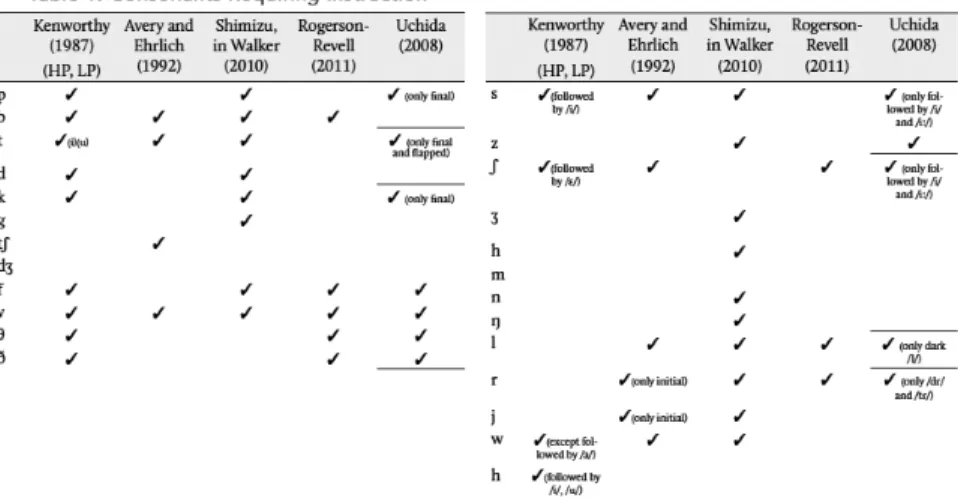
The omission of /θ/ and /ð/ from the LFC has caused some controversy. Deterding (2005), in a study in which Singaporean students were unable to understand so-called NS ‘Estuary English’ pronunciation of words such as ‘three’ or ‘through’ due to the substitution of /f/ for /θ/, stated in response to Jenkins that, “the data presented here clearly show that replacing a dental fricative with another sound does sometimes cause misunderstandings.” (P. 437). In Figure 1 (below), Chujo (2015) lists consonants requiring instruction compiled from different research into Japanese learners. While all consonants except /dʒ/ appear in at least one of the lists, it is interesting to note that three studies include /θ/ and /ð/. As these phonemes are absent from Japanese phonology, they are difficult for Japanese learners to reproduce and are often substituted with /s/ or /z/. In Chujo’s own research (2015), in which NSs and NNSs tried to identify words pronounced by Japanese students, the words ‘weather’ and
‘theater’ scored lower than 50% intelligibility with both NS and NNS groups, and
‘thirteen’ scored lower than 50% intelligibility with NNSs. ‘Theater’ was misheard as
‘shelter’, ‘shatter’, etc. and ‘thirteen’ was misheard as ‘searching’, ‘certain’, etc. This shows that the substitution of /s/ or /ʃ/ for /θ/ clearly affected intelligibility.
Figure 1: Consonants requiring instruction. Source: Chujo (2015)
3.1.2 Analysis of LFC features: consonants - /r/ and /l/
Jenkins (2002) gives some examples of communication breakdowns due to the mispronunciation of /r/ as /l/ by a Japanese speaker (‘red’ pronounced /let/; ‘grey’
pronounced /gleɪ/), and her core guidelines include the use of the rhotic ‘r’ instead of the non-rhotic ‘r’. Such examples are no surprise to teachers of English in Japan. In Chujo’s 2015 research, words involving the /r/ or /l/ phonemes such as ‘real’,
‘volunteer’, ‘locker’ and ‘vanilla’ were ranked among the least intelligible when pronounced by Japanese students. Nishio & Tsuzuki (2014, P. 65) found that [l]-[r]
errors “accounted for about 50% of all consonant substitution errors” in their research.
Few would argue therefore that /r/ requires instruction for Japanese learners, but one question is whether in cases such as ‘water’ it is practicable to teach the rhotic ‘r’
commonly used in General American (GA) in place of the non-rhotic ‘r’ associated with Received Pronunciation (RP). Riney, Takagi & Inutsuka (2005) note that as the rhotic ‘r’ is much harder for Japanese, and other Asian, speakers to reproduce, it makes little sense to adopt it as a standard for EIL. In the absence of any internationally recognized substitutions for the English liquids /r/ and /l/, these phonemes remain a major challenge for Japanese learners. Nishio & Tsuzuki (2014, P. 74) state, “English teachers should try to ensure that learners pronounce [l]-[r] more clearly, especially [l]- [r] at the second positions in consonant clusters, such as fr or pr, as these are problematic.”
3.1.3 Analysis of LFC features: consonants – epenthesis
One interesting conclusion of Jenkins (2002) was that, while omission of sounds, especially in consonant clusters, led to communication breakdowns, the addition of sounds – epenthesis – did not greatly affect intelligibility. Due to the moraic structure of the Japanese language, Japanese speakers often use vowel epenthesis when speaking English (Nishio & Tsuzuki, 2014), especially in the case of foreign loanwords such as
“drive” (which becomes /doraibu/) or “strike” (which becomes /sutoraiku/) (Koike,
2014). This feature, often called ‘katakana English’, is, unsurprisingly, often heard in
Japanese classrooms where L1 transference is more common than in, for example, EIL
settings. Nishio & Tsuzuki’s 2014 analysis of errors in speech of 9 Japanese graduate students found only a few occurrences of epenthesis in words like products [pɾodakutsu] and free [fuɾiː], but concluded that epenthesis can affect word segmentation and stress assignments, so teachers should stress the need for students “to avoid the insertion of extra vowels between consonant clusters and coda.” (P. 74).
3.2 Analysis of LFC features: vowels
Jenkins recommends teaching vowel length, but states that regional variations of vowels are acceptable as long as they are consistent, with the proviso that there should be no substitution for the vowel /ɜː/. There are 11 simple vowels in English, but there are wide regional differences among native speakers in the number and use of vowels.
For example, while General American has 14 stressed vowel sounds (Celce-Murcia et al, 2010), General British has 20 distinctive vowels (Cruttenden, 2014). In comparison, Japanese has only 5 simple vowels; /a/ /e/ /i/ /o/ and /u/ (Kanazawa, 2019) with no lax vowels (Koike, 2014). Kanazawa (2019), in an analysis of Japanese Junior College Students found that students made errors involving vowel length, particularly of /i/ and /iː/, and substituted /ɑː/ for /ɜː/ (in ‘university’). In my own classes, I have observed student errors involving /i/ and /i:/ (bins / beans); /ɜː/ and /æ/ or /ɑː/ (first / fast; bird / bad); and /u/ and /uː/ (look / loop) (Fec, 2020). Nishio & Tsuzuki (2014) found that although vowel quality more than vowel length was problematic, with errors such as [ɑːr] changing into [əː] for art and [ɑːr] changing into [aː] for are (P. 69), these errors did not greatly impact intelligibility, and they agreed with Jenkins that “vowel length was very important” (P. 72). Although they conclude that suprasegmental factors are also important for intelligibility, in terms of segmentals “consonants such as [l]-[r], fricatives, and plosives are more important to intelligibility than vowels” (P. 74).
3.3 Analysis of LFC features: tonic (nuclear) stress
The main suprasegmental feature in Jenkins’s (2002) LFC syllabus is her recommendation to teach the “appropriate use of contrastive stress to signal meaning”
(P. 97). Many other researchers advocate teaching what can be variously called tonic,
nuclear or sentence stress or prominence (Murphy, 2017; Celce-Murcia et al, 2010), but usually along with other prosodic features, such as weak forms, word stress or pitch movement, features which Jenkins regards as either unhelpful to intelligibility or unteachable. Nishio & Tzuzuki (2014) found that segmentations and stress are important for intelligibility and concluded that “For suprasegmentals, proper stress assigned to a word, compound words, and phrases is particularly important” (P. 71).
Other Japanese researchers such as Koike (2014) emphasize the importance of teaching suprasegmentals due to phonological differences such as English stress compared to Japanese pitch accent, or the differences in the vowel system.
4. Discussion
For any pronunciation teacher there are decisions to be made on what and how to teach. In the Lingua Franca Code, Jenkins presents a syllabus for teachers whose aim is to prepare NNS for using English as an international language. As Jenkins (2002) herself says, a basic problem for this kind of EIL teaching is that most English language teaching is conducted in same-L1 classrooms. This is likely the case for most university teachers in Japan.
One important question is whether the needs of the students are best met by
following the LFC or by using teaching materials which focus on either General
American or RP. Japanese children study English for 6 years in junior high school and
high school and the school teaching materials usually feature General American
accents. Therefore, it could be argued that for the sake of consistency in terms of
English vowel sounds (something rated as important by Jenkins), university students
should be taught General American pronunciation. Teachers who have different accents
(whether native or non-native) may prefer the LFC guidelines however. Assessing
whether students are more likely to use English in an EIL setting in future is a difficult
question. Many students at the author’s university choose to study abroad where they
interact with NSs (university teachers, homestay families and local people) and often
interact with learners with different L1s. Some students also want to use English after
they graduate and actively seek work using English. If they use English after
graduation it may be as a Lingua Franca in Japan with other NNS or it may be with NS either in Japan or abroad. In either case, it is important that students’ pronunciation is intelligible to both NNS and NS of different countries. Following the LFC pronunciation guidelines should help students achieve greater intelligibility.
This does not mean, of course, that the LFC must be used exactly as Jenkins describes. There are specific problems for Japanese speakers arising from the differences between the phonology of English and Japanese which should be addressed.
Emphasis should therefore be given to the phonemes absent from Japanese, such as: /l/
/r/ /θ/ /ð/ /f/ /v/ /ɜː/ and aspiration for /p/, /t/ and /k/, and also to other phonemes which are difficult for Japanese speakers and affect intelligibility such as: /s/ and /ʃ/ especially when followed by /ɪ/ or /iː/ (Uchida (2008) in Chujo (2015)) , /z/, /ʒ/ /w/, /æ/ and the contrast of /ɪ/ and /iː/. Although Jenkins finds that errors with /θ/ and /ð/ do not affect intelligibility, these findings are challenged somewhat by the results of Chujo (2015), especially when these phonemes are in initial or middle positions, so I think it is worth including them in pronunciation practice.
It is important to note that some of the suprasegmental features that Jenkins discounts, such as weak forms and linking, are common features of NS speech which students should be aware of even if they do not need to reproduce them in their own speech. Whether they should be included in pronunciation practice in Speaking classes might depend then on whether these are covered in other classes
3. Word stress, another feature which Jenkins rejects as ‘unteachable’, is generally taught with new vocabulary in Japanese schools. While there are some words in which the stress differs depending on the variety of English or even the speaker’s personal preference (such as the words address, ballet or controversy), most words have only one possible position of primary stress, and about 90% of content words in English speech are monosyllabic or have lexical stress on their first syllable (Cutler & Carter, 1987, in Field, 2005). Field (2005) found that misplacing of lexical stress reduced intelligibility for Native Listeners and Non-native Listeners and suggests that it should be ranked as medium importance for
3