• 検索結果がありません。

Changes in complexity, accuracy and fluency in a Japanese first year university student’s oral production after Study Abroad

N/A
N/A
Protected

Academic year: 2021

シェア "Changes in complexity, accuracy and fluency in a Japanese first year university student’s oral production after Study Abroad"

Copied!
17
0
0

読み込み中.... (全文を見る)

全文

(1)

Changes in complexity, accuracy and fluency in a Japanese first year university

student’s oral production after Study Abroad

Aaron DODS

ABSTRACT

In this paper the researcher sought to evaluate the changes that occurred in the complexity, accuracy and fluency of the oral production of a female first-year Japanese university student who spent nine months on a Study Abroad ïSAð program in Sydney, Australia. He then sought to assess how the observed changes compared with those discussed in current existing SA literature. His results largely reflected the findings in the literature with an increase in natural exposure to the L2 through an SA experience seeming to contribute more to fluency and naturalness of speech through a higher speech rate, fewer disfluencies and greater use of native-like filled pauses and colloquial non-pause fillers.

Changes in overall accuracy and complexity of speech, while evident, were less pronounced although AS-unit analysis did reveal improvements in accuracy in smaller, less complex AS- units.

1. INTRODUCTION

One would be hard pressed to find a stakeholder-be it a would-be participant, a teacher, a parent or a tertiary educational institution-that does not believe in the language benefits that SA programs can deliver to participants’ L2 proficiency. As learners who participate in SA programs usually enroll in language courses in the L2 country, it is this combination of analytical learning ïi.e., in the classroomð combined with the multiple opportunities for experiential learning ïi.e., out-of- classð that appeals to all stakeholders. As Tanaka and Ellis state, “A common belief among language learners and educators is that the best way to learn a language is to live in a country where the language is used” ï2003; p. 64ð.

To be sure, research into SA language gains frequently bears the sentiment of the above- mentioned stakeholders out. Statistically significant data, most notably in terms of development in oral fluency among lower level learners, points to language gains for participants in an SA context.

Some of the earliest research into the benefits of SA was conducted by Carroll ï1967ð, who

performed a large-scale study into changes in language proficiency among American college seniors

(2)

majoring in French, German and Russian. She was able to observe a statistically significant correlation between time spent abroad and improvements in language proficiency. Willis ï1977ð found that British participants in an SA program where the L2 was German or French made language gains across all four language skills. These gains were especially significant in speaking and listening. Dyson ï1988ð reached similar conclusions in his research into 229 British learners of French, German and Spanish in a one year SA program. Möehle and Raupach ï1983ð found that German learners of French who participated in an SA program were able to improve their speaking proficiency in terms of the number of words per minute and the length of time between utterances.

However, they found no significant improvement in terms of frequency of grammatical errors, sentence length or syntactic complexity.

Studies utilizing the ACTFL ïAmerican Council on the Teaching of Foreign Languagesð Oral Proficiency Interview ïOPIð in pre- and post-test interviews also reliably indicate language gains.

Veguez ï1984ð and O’Connor ï1988ð found that American university students learning French and Spanish tended to advance one level or more on the OPI scale as a result of a semester or year abroad. Milleret ï1990: cited in Freed 1998ð observed similar gains ïone level or moreð on the ACTFL Simulated Oral Proficiency Interview ïSOPIð for American learners of Portuguese on a six week SA program in Brazil.

1.1 Language Gains from Study Abroad (SA) courses versus At Home (AH) L2 courses A significant amount of research exists examining how SA and AH learning settings impact on language gains. In comparing SA vs. AH contexts, Tanaka ïet al.ð states “a general assumption is that natural settings involving informal learning through out-of-class contact with the L2 leads to higher levels of proficiency than educational settings where instruction is provided” ï2003; p. 66ð.

Such research, where language gains between SA participants and ïAHð learners is compared, is perhaps more valuable than research focused solely on language changes occurring in the SA context as it allows a more nuanced understanding of the relative benefits of SA and AH contexts.

Fluency

Most research into SA-induced language gains has focused on oral fluency since it is in this area

that learners in an SA context are believed to make the most language gains. Folz ï1991ð

determined that American learners in Spain on a semester abroad out-performed their counterparts

in the United States in terms of their OPI scores. Freed ï1995ð found similar results for learners of

French. In her study, native-speaker judges typically rated learners who had studied abroad higher

in terms of oral fluency in their Oral Proficiency Interviews than learners who had not studied

(3)

abroad. These ratings also correlated with data that indicated that learners who studied abroad produced more words per minute with fewer pauses than AH learners. DeKeyser ï1986ð found that SA learners in Spain appeared more fluent than AH learners, largely due to their more native-like use of pause-fillers such as pues and bueno.

Freed, Segalowitz and Dewey ï2004ð compared several oral fluency variables in their study of 40 native English speakers studying Spanish as an L2 in both SA and AH contexts. They found that the SA group outperformed the AH group in terms of hesitations ïthey produced fewer and shorter pauses, either silent or filledð and tempo phenomena ïdelivering more words per minute and demonstrating an overall faster speech rateð. In a study of learners of French, Freed, So and Lazar ï2003ð found that native-speaker judges regularly rated samples of speech from learners who had been abroad as more fluent than samples from those who had not been abroad.

Lennon ï1990ð, in a study into the oral fluency development of four students on a six month SA program, concluded that the SA context helped participants improve some variables such as speech rate, filled pauses per T-unit

1

and percentage of T-units followed by a pause. Additionally, a panel of trained judges perceived these participants to be more fluent post-SA. Likewise, Llanes and Muñoz ï2009ð examined the oral development of 24 Catalan/Spanish learners of English who spent 3 or 4 weeks abroad, and found that even after such a short period of time, participants improved on most of the variables examined.

Vocabulary

Several studies have found that SA learners can make greater language gains on measures of vocabulary knowledge than AH learners. In DeKeyser’s ï1986ð study, vocabulary growth was the one noteworthy difference in linguistic development between American SA learners of Spanish and their AH counterparts. Milton and Meara ï1995ð reported that learners from Germany, Spain, Italy and France on SA programs in the United Kingdom acquired English vocabulary five times faster than AH counterparts.

However, other data has shown that while SA can facilitate vocabulary acquisition, the difference between SA and SH settings is not as clear-cut as when comparing fluency. Other oral interview data ïCollentine 2004; Freed et al. 2004ð indicated benefits in terms of vocabulary acquisition and usage for AH learners that was not apparent in SA learners’ data. Additionally,

1
Developed by Kellogg W. Hunt in1964, a T-unit, or minimal terminable unit of language, is defined as the “shortest

grammatically allowable sentences into which writing can be split. Often, but not always, a T-unit is a sentence.

(4)

Freed, So and Lazar ï2003ð found no significant differences in vocabulary growth over time between pre- and post-study essays written in French between SA and AH learners.

Tanaka ïet al. 2003ð provided a summary of Freed’s ï1993, 1995, 1998ð and Coleman’s ï1997ð previous studies on the effects of SA programs on L2 learning. It is as follows:

1. Accuracy and complexity, measured in terms of frequency of mistakes, sentence length or syntactic complexity in oral production, did not change in any noticeable way.

2. Gains in fluency, in terms of the speaking rate ïsyllables per minuteð or phonation/time ratio ïpercentage of total time spent speakingð, were strong.

3. Overall oral proficiency scores, measured by the ACTFL Oral Proficiency Interview ïOPIð, were higher in learners in SA programs than those who did not participate.

4. Gains in overall proficiency scores were stronger than gains in test scores on grammar, listening, and reading.

5. Vocabulary gains, measured by vocabulary tests, were stronger than those of comparable students who did not participate in an SA program.

6. The higher the student’s initial level of proficiency, the lower the gains in proficiency as a result of participation in an SA program.

1.2 Predictors of Language Gains from SA

This range of individual variables, frequently referred to as “predictors”, determine the types of language gains that can accrue to an individual participant in an SA context. Freed ï1995ð and Regan ï1995ð have claimed that these variables appear to have a greater impact on participants studying an L2 in an SA context as compared to an AH one.

Most research into predictors of language gain as a result of SA focus on student personality,

gender, age, length of stay in the L2 country and initial proficiency level as playing an important

roles in second language learning in an SA context ïFreed 1998; Huebner 1998; Engle and Engle

2004ð.

(5)

Personality has the potential to affect the acquisition of an L2 in an SA context in terms of how much contact with native L2 speakers is sought ïDeKeyser 1991; Kinginger 2008ð. Gender may also be a variable that affects language acquisition in the SA context. Some studies have reported that women make less progress than their male counterparts in countries where the women’s role is different from that in the L1 country, as in the case of American women in Russia ïBrecht et al.

1995; Polanyi 1995ð. Students’ age can also be an influential factor. In a study of the performance of Americans learning Russian in Russia over several years, Brecht et al. found that younger learners tended to make more progress than older learners. A number of studies focusing on length of stay found positive correlations between lengths of stay with lexical development and overall proficiency ïIfe et al. 2000; Sasaki 2009; Baró and Serrano 2011ð.

The initial level of L2 proficiency is another predictor of L2 gains in an SA context. Several studies have found that it is harder for advanced learners to make progress through an SA experience than it is for intermediate learners. In their study of the acquisition of Russian by American students, Brecht et al. found that those with the highest initial level of Russian were less likely to make gains after staying abroad. Additionally, in her analysis of fluency of in French in the SA context, Freed ï1995ð reported that students that were rated as less fluent before the SA experience were perceived as having made the most progress in this area in the post-test. In an earlier study, Freed ï1990ð also reported that intermediate students who studied French in an SA context made more progress than their advanced counterparts. Moreover, she found that interactive out-of-class contact helped the students improve their French skills more than non-interactive contact. It has also been suggested that lower proficiency students demonstrate a higher improvement in vocabulary acquisition than advanced learners in the SA context ïMilton and Meara 1995ð. With regards to oral performance, ïLlanes and Mūnos ï2009ð found that SA par- ticipants with a lower initial L2 proficiency level experienced greater gains in oral fluency and accuracy. In addition to the initial L2 proficiency, Brecht et al ï1995ð also found previous non-L2 foreign language learning experience to be a facilitating factor in L2 learning in a SA context.

2. RESEARCH QUESTION

Through pre- and post-test ïT1 and T2 respectivelyð oral interviews with a female first-year Japanese university student who spent nine months participating in an SA program in Sydney, Australia, this research seeks to address the following research questions:

1. What changes were observed to have occurred in the complexity, accuracy and fluency of

the subject’s oral production?

(6)

2. How do the changes that were observed in the subject’s oral English production align with findings in current existing SA literature related to complexity, accuracy and fluency?

3. METHOD

3.1 The Subject and her Study Abroad Experience

The subject of this study is a 20-year-old university student majoring in international relations at a private university in Tokyo. “Ami” ïnot her real nameð was born and raised in Meguro ward, Tokyo. Her father works in the securities industry and her mother is a hairdresser. Her father agreed to finance her SA experience ïon the condition that she would abstain from alcoholð while in Australia. Without being able to make any inquiries into her family’s financial status, it would appear that her family is at the very least middle-class. Before entering university she had been on overseas holidays four times with her family for a total of around two weeks. In addition to the family holidays, as a high school student she also spent two months in Adelaide, Australia on a study abroad program. Before her SA experience she had never experienced living separate from her mother, father and elder sister.

She neither speaks nor has studied any foreign language other than English. She took the TOEIC test of her own volition four months before her SA experience and scored 525 ï350 for the listening component and 175 for the readingð. One month after returning from Australia she again took the test and obtained a score of 815 ï425 for listening and 390 for readingð.

She would have been entering her second year of study if not for participation in the SA program. She spent 9 months in Sydney, Australia on the SA program organized through her university. She was involved in formal classroom learning, studying General English and English for IELTS, for a total of six months. The General English class focused on conversational English for daily life ïmainly speaking and listeningð while her IELTS class focused on the skills of reading and writing in addition to speaking and listening. Her initial class was categorized as a pre-intermediate class and consisted of 13 students originating from a variety of countries in Asia, Eastern Europe and South America. Her second class, an upper-intermediate one, consisted of 10 students from countries from the same regions as her pre-intermediate class with the addition of one student from the Middle East. She received no credits in recognition of her formal study in Australia and, as a result, was a year behind her peers upon her return to Japan.

She spent the first two weeks of her SA living with a homestay family and the remainder of her

time living with several other female flat mates. Once her formal learning was completed, she

(7)

worked at a café and also travelled around southeastern Australia and New Zealand with some of her former classmates.

In terms of her personality, she describes herself as outgoing, sociable and willing to try new things. Her regular posts on social media sites, mainly photos of parties and excursions with friends would appear to support this. According to the subject, she says that her biggest weaknesses are quickly losing interest or motivation in things that require effort as well as not taking her university studies seriously enough. Having been a member of this researcher’s first-year class for reading and writing, the researcher can attest that the subject ’ s observations of herself match his own impressions of her. After graduation she says that she would like to have the opportunity to use English in some kind of service industry capacity, ideally as a cabin attendant for one of the two main Japanese international airlines.

3.2 Procedure and Instruments

This study has a pre-test ïT1ð/post-test ïT2ð design. The subject was administered the pre-

test oral interview in a tutorial room at her university in Japan the week prior to departure and the

same post-test interview was carried out in the same room one week after her return to Japan. For

practical reasons, the pre- and post-tests could not be administered the day before or after her

departure/arrival. However, this is unlikely to have affected the measures in the study, since the

gains observed in these areas can be reasonably assumed to endure for at least a week after leaving

the L2 country. The subject was not informed of the kind of language assessment that she would be

undertaking for either of the pre- or post-tests but it is possible that her pre-test experience may

have allowed her to reasonably imagine the nature of the post-test. Nevertheless, given the

researcher’s understanding of the subject’s personality, as well as her demeanor and comments that

she made in the post-test, it is reasonable to assume that she did not prepare or rehearse for the

post-test. In both pre-test and post-test the researcher began with some small talk about the

subject’s day and her feelings about the SA experience she was either about to embark upon or had

just completed. Given the fact that the researcher was already familiar with the subject, this small

talk was a natural result of the familiarity between the researcher and the subject ïas mentioned

earlier, she had been a student in my class for a year a year earlierð. However, it also served the

purpose of facilitating a more ‘vernacular style’ of speech. Labov ï1970ð suggests that this style of

speech occurs when speakers are communicating spontaneously and easily and, as a result, are not

consciously focusing on form. The researcher then asked the subject the same set of six questions in

the same order in both pre- and post-tests. These questions related to the subject’s family, her

hometown, her university studies, her career ambitions, the most difficult things about studying

(8)

English, and cultural differences between Japan and Australia

Before responding to each of the above questions, the subject was given one minute to consider her answer and, if she wanted, to take some notes. This may have some impact on the authenticity of the language produced since oral language production, by its very nature, is more often than not spontaneous, with very little time given to allow the speaker to consider and prepare their language.

However, the researcher felt that it was more important to generate a larger sample of learner output and wanted to facilitate this as best he could. Additionally, the researcher also believes that the provision of this one-minute preparation time means that it is more likely that any disfluencies ïe.g., pauses, false starts, or fillersð in the subject’s speech are the result of language-related issues rather than confusion in the subject’s mind about what exactly she wants to say.

Both tests lasted for 37 minutes ïpurely by happenstanceð, including time given for the subject to prepare. Audio recordings were made for the purpose of transcription. A video recording was also made using non-intrusive camera-enabled PC monitors ïalready present in the roomð as a back- up recording in case technical issues occurred with the audio recorder. The video recording also had the additional benefit of allowing further study into paralinguistic or other non-verbal communication factors ïe.g., eye contact or kinesicsð.

4. RESULTS

In order to compare changes in the subject’s oral production in the pre- and post-tests, the researcher employed AS-units or “Analysis of speech units ”. AS-units, first proposed by Foster, Tonkin, and Wigglesworth ï2000ð, are defined as “a single speaker’s utterance consisting of an independent clause or sub-clausal unit, together with any subordinate clauseïsð associated with it”

ï2000; p. 365ð. However, as McCarthy ï1998; p. 79ð states, informal spoken data is typically characterized by a lack of “well-formed” sentences that include both a main and subordinate clause.

Instead, McCarthy et al ï2006; p. 170ð found that speaker turns, especially those of L2 learners, tend

to contain “sequences of clauses linked by coordinating conjunctions… or by simple subordinating

conjunctions”. McCarthy’s data matched those of this researcher. Data at both T1 and T2 showed

only a handful of what could be called genuine subordinate clauses but a large number of clauses

connected by either coordinating conjunctions ïe.g., and and butð or subordinating conjunctions ïe.g.,

because and soð. In such cases, the researcher included the second clause as part of the AS-unit

when each of the clauses was related to the same idea or topic. In cases where the clauses were

related to different topics or ideas, or extensions of those topics/ideas, the researcher created a new

AS-unit at the point of the conjunction.

(9)

As can be seen in table 1, the subject produced 2402 words at T1 compared to 1461 at T2.

Given that the total length for each of the interviews was 37 minutes, this finding alone hints at improvements in the subject’s fluency and narrative depth. A transcription of both audio recordings was made and used for analysis of complexity, accuracy and fluency.

4.1 Complexity

Complexity refers to the extent to which learners are willing to use more difficult language as well as to the range of different structures evident within their production. For the purposes of this research, it also refers to the lexical items that the subject used in her oral production.

Table 1

Table 2

(10)

Table 2 shows the AS-unit breakdown by words per AS-unit. Skehan and Foster ï2005ð noted that errors in L2 learner speech tend to become more prevalent as learners seek to produce longer units that stretch their processing capabilities. Moser ï2010ð, in analyzing his own set of spoken data from Japanese L2 learners, found that errors and dysfluencies increased significantly in number in AS-units ranging from six to nine words. As a result, he decided to set a benchmark for complexity at AS-units of seven words or more. The same approach has been followed in this analysis. The number of AS-units of seven words or more as a percentage of the total number of AS- units in the subject’s oral production jumped from 34% at T1 to 58% at T2. What is more, the learner produces 29 AS-units of 20 words or more at T2 as compared to just 1 at T1. The complexity of the subject’s oral production, as measured by the number of longer AS-units, appears to have improved substantially.

Other factors also support the AS-unit basis for evaluating an improved complexity in the subject’s oral production. These include an increase in the mean turn length from 7.7 words at T1 to 10.7 words at T2 as well as the presence of a number of longer-syllabled or more advanced level lexical items at T2 where which were nor present in T1. Examples include the verbs impressed, recommend, complain, concentrate, the adjectives organic, handmade, and nervous, and the nouns transportation and religion.

4.2 Accuracy

According to Skehan ï1996; p. 23ð, accuracy refers to “how well the target language is produced in relation to the rule system of the target language.

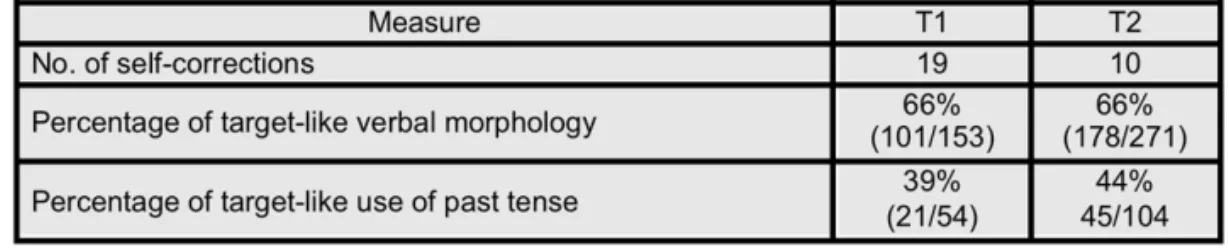
Table 3 shows measures that relate to the accuracy of the subject’s speech. While the number of self-corrections does not necessarily act as a measure of how accurately a learner uses the L2, it does give some indication of the extent to which the subject is focusing on accuracy viz-à-viz conveyance of her message. However, the two measures related to verb morphology show little or no improvement in the subject’s ability to produce verb formations in a similar way to an L2 native

Table 3

(11)

speaker. At T2 the subject was only able to use the past tense in 44% of the occasions where she was obliged to. This observation is certainly striking for two reasons. Firstly, forming the past tense in English is, in most cases, relatively simple. Secondly, the subject’s L1 also makes use of the past tense in a similar way to English to refer to actions that occurred in the past.

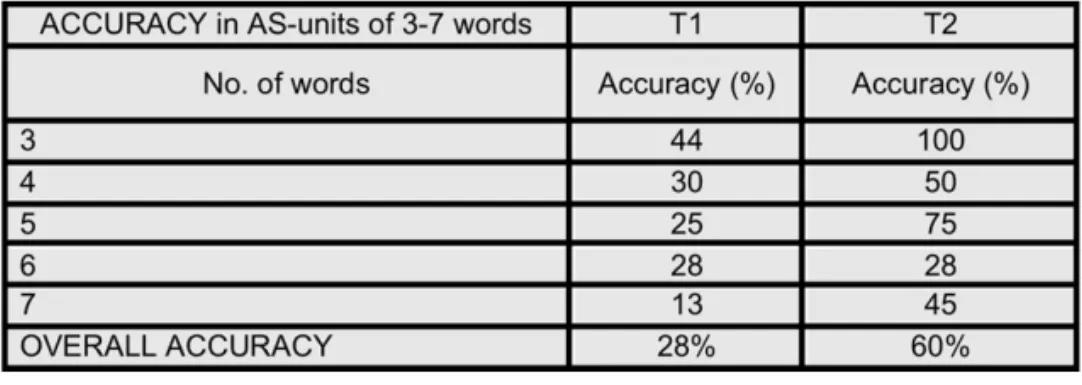
Table 4 focuses in on the accuracy of AS-units produced by the subject of between three and seven words that have a basic clause structure of subject-verb-object. This limited range was selected because it allows observation of how the introduction of adjectives, adverbs and negation to a basic clause structure impacts on spoken accuracy. What is more, it is unreasonable to expect an L2 learner, even one that has recently returned from SA, to consistently and accurately produce AS- units of more than 8 words.

Table 4 shows how accuracy deteriorates as more sentential elements are added to an AS-unit.

This is not unexpected. What is of interest is that previously unobservable improvements in accuracy have become evident at T2-overall accuracy within 2-7 word AS-units with a basic clause structure increased from 28% to 60%. Nevertheless, this improvement in accuracy is obscured by the subject’s increased use of coordinating and subordinating conjunctions to create a larger number of longer AS-clauses. The longer an AS-unit produced by an L2 learner, the more unlikely it is that it will conform to native L2 speaker notions of accuracy.

Some improvement in lexical accuracy was also observed. Words that had been used inaccurately at T1 ïcountry, salaryman, international relationships, foreign country people and delay were replaced at T2 with the more accurate countryside, businessman, international relations, foreigner, and late. Additionally, the subject was able to produce words at T2 such as hairdresser, atmosphere and World War II where at T1 she was able to only produce these words partially or without any sense of confidence.

Table 4

(12)

4.3 Fluency

Fluency refers to the production of language in real time, specifically relating to rate of speech and hesitation phenomena such as false starts, repetition, reformulation and replacements. Repetition refers to words, phrases or clauses that are repeated without any modification whatsoever, reformulation to phrases or clauses that are repeated with some modification and replacement to lexical items that are immediately replaced by an alternative lexical item.

According to Wiese ï1984ð and Lennon ï1990ð fluency can be categorized into two types;

temporal variables relating to speed and hesitation phenomena relating to dysfluency. Several measures that fitted into these two categories were employed.

All of the temporal variables in Table 5 demonstrated significant improvement in the subject’s fluency. Not only did her rate of speech double she also produced half the number of pauses at T2 compared to T1. The mean pause length also fell from 2.1 seconds at T1 to 1.0 second at T2.

Analysis of hesitation phenomena in the subject’s production also shed light on improvements in the subject’s fluency. The total number of dysfluencies fell from 63 to 32 as a result of significant reductions is the incidence of repetition and replacement. However, the number of reformulations only showed a minor decrease. Upon closer analysis this appears to be a result of a new post-SA tendency of the subject to repeat and modify word collocations even though the original collocation was not in error. Examples include reformulating “just business man” to “normal businessman”,

“really hard” to “very hard”, and “market” to “organic market” and, eventually, “organic food market”.

This last example in particular illustrates efforts by the subject to impart more detail to her speech.

Table 5

(13)

The subject produced only one false start in either T1 or T2. This may be a result of the one minute that she had before answering each question allowing her to prepare what she was going to say. It may also be due to the fact that the sentence structures she employed in her production were not overly difficult.

Another change observed in the subject’s oral production was the very native-like usage of “you know” and “like”. “You know”, which is a kind of filled pause, enables L2 speakers to plan their speech without pausing and, as a result, avoid losing either the attention of their interlocutorïsð or the speaker’s own turn. It occurred within the subject’s speech seven times. “Like” was used nine times by the subject in order to illustrate examples ïe.g., “for example like “American Eagle”” or “so can see a lot of like Arabic restaurant or Chinese restaurantð. Additionally, a second usage of “like”

frequently utilized by the subject was as a kind of colloquialism or non-pause filler. Examples include

“she is kind of person like not care too much”, “Umm I don’t know how I can say in English” and “he’

s always like give me advice”. These uses of “like” and “you know” added to the naturalness of the subject’s oral production and imparted a colloquial strand to her speech. It is likely that their usage was unconscious and a result of experiential language learning rather than analytic language learning.

5. DISCUSSION AND CONCLUSION

Observations related to the complexity, accuracy and fluency in the subject’s oral production at T2 reflected to varying degrees the existing literature on the impact of SA on the of an L2 learner’s oral production.

The biggest change in the subject’s oral production occurred within the measures of fluency and naturalness of speech-the subject’s rate of speech doubled, hesitation halved and new native-like filled pauses and non-pause fillers proliferated. These results were consistent with the observations described by DeKeyser ï1986ð in terms of the use of more naturalized pause-fillers and Lennon ï1990ð in terms of speech rate. As Ellis ï2005; p. 156ð states, it is clear spending a period of time in a country where the L2 is spoken can enable learners to improve their speech rate markedly.

In terms of complexity, the subject was found to be using much longer AS-units at T2 as compared to T1. Superficially, this would point to greater complexity in the subject’s oral production.

However, the longer AS-units can be accounted for by the increased use of coordinating or

subordinating conjunctions that simply link clauses. These clauses present within T2 were not that

much more complex than those produced at T1. Put another way, there were no obvious examples

(14)

of more complex grammatical structures existing within individual clauses. In terms of the complexity of the lexis observed at T2, some isolated improvements appeared but their significance in terms of the overall complexity of the oral production was limited.

Similarly, improvements in accuracy were less than clear-cut. While accuracy was seen to improve in smaller AS-units of three to seven words, the larger number of longer, inaccurate AS- units at T2 had the effect of obscuring these improvements. What is more, there was virtually no improvement in usage of target-like morphology, especially with reference to use of the past tense on occasions where it was obliged.

In a post-SA survey conducted as part of this research, the subject indicated that the two most important things that she wanted to achieve from her nine month SA experience were “improving spoken English ability ” and “ enjoying time with friends from other countries ” The two least important things for the subject were “improving English for reading” and “improving English for writing”. She also indicated that she felt that experiential-type language learning such as part-time jobs and living with flatmates was much more useful in learning an L2 than analytic language learning ïi. e., in a classroomð. These two factors, combined with the subject ’ s clearly outgoing character, would have contributed to the significant improvements made in oral fluency. A conscious effort by the subject to improve productive accuracy as well as produce more complicated structural or lexical items would seemingly be required in order to unlock commensurate improvements in complexity and accuracy.

This study was the first that this researcher has conducted into the language impacts of SA. In future investigations of complexity, accuracy, fluidity, this researcher would like to introduce the use of expert native L2 evaluators to collaborate findings gained through the use of AS-units ïrelated to complexity and accuracyð and temporal and hesitation phenomena ïrelated to fluencyð.

This research was a case study involving only one subject and, as a result, limited any possibility for assessing how individual variables such as personality, accommodation circumstances and learning preferences ïe.g., experiential versus analyticð might impact on language gains. Future investigations involving multiple subjects would allow for evaluation and comparison of how differences in these individual variables can impact on participants’ oral production.

Also, in any future study, the researcher would like to depart from the question-answer

interview method used to elicit language from the subject. This method seems overly subject-

(15)

centric and, as a result, may limit the range of language produced. As an alternative, having the subjectïsð narrate a story by looking at a series of pictures may yield a different set of data.

Due to space limitations, the transcripts of the pre-test and post-test interviews can be found at the following links.

https://www.dropbox.com/s/nfruw6v06eocuw1/Kiyo%202017%20Appendix%20A-pre-test%

20interview%20transcript.pdf?dl = 0

https://www.dropbox.com/s/ju7hpqbocwtewev/Kiyo%202017%20Appendix%20B%20post-test%

20interview%20transcript.pdf?dl = 0

References

Baró, A.L. and Serrano, R.S., ï2011ð. Length of stay and study abroad. Language gains in two versus three months abroad. Spanish Journal of Applied Linguistics 24, p. 95-110.

Brecht, R., Davidson, D. and Ginsberg, R. ï1995ð. Predictors of foreign language gain during study abroad.

Second Language Acquisition in a Study Abroad Context. Ed. Freed, B. Amsterdam: John Benjamins. p. 37- 66.

Carroll, J.B., ï1967ð. Foreign language proficiency levels attained my language majors near graduation from college. Foreign Language Annals ï1ð, p. 131-151.

Coleman, J. ï1997ð. Residence abroad within language study. Language Teaching, 30, 1-20.

Collentine, J., ï2004ð. The effects of learning contexts on morphosyntactic and lexical development. Studies in Second language Acquisition ï26ð, p. 227-248.

Cubillos, J., Chieffo and Fan, C., ï2008ð. The impact of short-term study abroad programs on L2 listening comprehension skills. Foreign Language Annals 41 ï1ð, p. 157-185.

DeKeyser, R., ï1986ð. From learning to acquisition? Foreign language development in a U.S. classroom and during a semester abroad. Ph. D. Diss, Stanford University.

DeKeyser, R. ï1991ð. Foreign language development during a semester abroad. Foreign Language Acquisi- tion Research and the Classroom. Ed. Freed, B. Lexington, MA; D.C. Heath. 104-199.

Díaz-Campos, M., ï2004ð. Context of learning in the acquisition of Spanish second language phonology. Studies in Second Language Acquisition 26, p. 249-273.

Dyson, P., ï1988ð. The year abroad: Report for the Central Bureau for Educational Visits and Exchanges.

Oxford: Oxford University Language Teaching Center.

Ellis, R., Barkhuizen, G., ï2005ð. Analysing Learner Language. Oxford: Oxford University Press.

Engle, L. and Engle, J., ï2003ð. Study abroad levels: Toward a classification of program types. Frontiers: The Interdisciplinary Journal of Study Abroad IX: 1-20.

Foster, P., Tonkyn, A. and Wigglesworth, G., ï2000ð. Measuring spoken language: A unit for all reasons.

Applied Linguistics 21: p. 354-75.

Folz, D., ï1991ð. A study of the effectiveness of studying Spanish overseas. Paper presented at the annual meeting of the Pennsylvania State Modern Language Association, Pittsburgh, Pennsylvania.

Freed, B. F., ï1990ð. Language learning in a study abroad context: The effects of interactive and non-

interactive out-of-class contact on grammatical achievement and oral proficiency. In J. Atlatis ïEd.ð,

Georgetown University round table on languages and linguistics 1990 ïp. 459-477ð. Washington D. C.:

(16)

Georgetown University Press.

Freed, B. F. ï1993ð. Assessing the linguistic impact of study-abroad: What we currently know-what we need to learn. Journal of Asian Pacific Communication, 4, 151-161.

Freed, B. F., ï1995ð. What makes us think that students who study abroad become fluent? in Freed B. F., ïed.ð Second Language Acquisition in a study abroad context p. 123-148. Amsterdam: John Benjamins.

Freed, B. F., ï1998ð. An overview of issues and research in language learning in a study-abroad setting.

Frontiers: The Interdisciplinary Journal of Study-abroad, 4, 21-60.

Freed, B. F., Segalowitz, N., and Dewey, D., ï2004ð. Context of learning and second language fluency in French. Comparing regular classroom study, study abroad, and intensive domestic immersion programs.

Studies in Second Language Acquisition 26: p. 275-301.

Freed, B.F., So, S., and Lazar N.A., ï2003ð. Language Learning Abroad: How do gains in written fluency compare with gains in oral fluency in French as a second language? ADFL Bulletin 34 ï3ð: p. 34-40.

Huebner, T., ï1995ð. The effects of overseas language programs: Report on a case study of an intensive Japanese course in Freed B. F., ïed.ð Second Language Acquisition in a study abroad context p. 171-193.

Amsterdam: John Benjamins.

Ife, A., G. Vives and Meara, P. ï2000ð. The impact of study abroad on the vocabulary development of differ- ent proficiency groups. Spanish Applied Linguistics 4 ï1ð: 55-84.

Kinginger, C. ï2008ð. Language learning in study abroad: case histories of Americans in France. Modern Language Journal Monograph Series 1.

Llanes, À. and Muñoz, C., ï2009ð. A short stay abroad: does it make a difference? System 37 ï3ð, p. 353-365.

Labov, W., ï1970ð. The study of language in its social context. Studium Generale 23: p. 30-87.

Lennon, P., ï1990ð. Investigating Fluency in EFL: A Quantitative Approach. Language Learning 40 ï3ð, p.

387-417.

McCarthy, M.J., ï1998ð. Spoken Language and Applied Linguistics. Cambridge: Cambridge University Press.

McCarthy, M.J. and Carter, R.A,. ï2006ð. Cambridge Grammar of English: Comprehensive Guide to Spoken and Written English Grammar and Usage. Cambridge: Cambridge University Press.

Milleret, M., ï1990ð. Assessing the gain in oral proficiency from summer foreign study. Paper presented at the summer meeting of the American Association of Teachers of Spanish and Portuguese.

Milton. J, and Meara, P., ï1995ð. How periods abroad affect vocabulary growth in a foreign language. ITL Review of Applied Linguistics, 107/108 p. 17-34.

Möehle, D., and Raupach, M., ï1983ð. Planen in der Frendsprach. Frankfurt: Peter Lang.

Mora, J.C., ï2008ð. Learning context effects on the acquisition of a second language phonology. A Portrait of the Young in the New Multilingual Spain. in ïed.ð C. Pérez-Vidal, Juan-Garau, M., and Bel. Clevedon, A, Multilingual Matters. p. 241-263.

Moser, J., ï2010ð. Using an AS-unit complexity benchmark to measure beginner learner oral production in communicative tasks. Osaka Shoin Women’s University Collection of Essays 47 p. 191-201.

O ’ Connor, N., ï1988ð. Oral proficiency testing of junior year abroad: Implications for the undergraduate curriculum. Paper presented at the annual meeting of the Modern Language Association.

Regan, V. ï1995ð. The acquisition of sociolinguistic native speech norms: Effects of a year abroad on second language learners of French. Second Language Acquisition in a Study Abroad Context. Ed. B. Freed.

Amsterdam: John Benjamins. 271-292.

Tanaka, K., Ellis, R., ï2003ð. Study-abroad, Language Proficiency, and Learner Beliefs about Language Learning. JALT Journal, 25 ï1ð, p. 63-85.

Sasaki, M., ï2009ð. Changes in English as a foreign language students ’ writing over 3. 5 years: A socio-

cognitive account. Writing in Foreign Language Contexts: Learning, Teaching, and Research. Ed. R.

(17)

Manchón. Clevedon: Multilingual Matters. p. 49-76.

Skehan, P. and Foster, P., ï2005ð. Strategeic and on-line planning. the influence of surprise information and task time on second language performance. In Ellis, R. ïed.ð Planning and Task Performance in a Second Language. Amsterdam. John Benjamins.

Veguez, R., ï1984ð. The Oral Proficiency Interview and the junior year abroad: Some unexpected results.

Paper presented at the Northeast Conference on the Teaching of Foreign Language, New York, New York.

Willis, F. et al., R., ï1977ð. Residence abroad and the student of modern languages: A preliminary study.

Bradford: Modern Language Centre, University of Bradford.

Table 2 shows the AS-unit breakdown by words per AS-unit. Skehan and Foster ï2005ð noted that errors in L2 learner speech tend to become more prevalent as learners seek to produce longer units that stretch their processing capabilities
Table 4 focuses in on the accuracy of AS-units produced by the subject of between three and seven words that have a basic clause structure of subject-verb-object

参照

関連したドキュメント

In this, the first ever in-depth study of the econometric practice of nonaca- demic economists, I analyse the way economists in business and government currently approach

In Section 3 the extended Rapcs´ ak system with curvature condition is considered in the n-dimensional generic case, when the eigenvalues of the Jacobi curvature tensor Φ are

We present sufficient conditions for the existence of solutions to Neu- mann and periodic boundary-value problems for some class of quasilinear ordinary differential equations.. We

Then it follows immediately from a suitable version of “Hensel’s Lemma” [cf., e.g., the argument of [4], Lemma 2.1] that S may be obtained, as the notation suggests, as the m A

[Mag3] , Painlev´ e-type differential equations for the recurrence coefficients of semi- classical orthogonal polynomials, J. Zaslavsky , Asymptotic expansions of ratios of

p≤x a 2 p log p/p k−1 which is proved in Section 4 using Shimura’s split of the Rankin–Selberg L -function into the ordinary Riemann zeta-function and the sym- metric square

The various structure results used above together imply that if G is an almost connected group, then G contains a closed amenable subgroup H such that G/H with the quotient topology

- Parts of the foregoing machinery, apparatus or equipment Plates, cylinders and other printing components; plates, cylinders and lithographic stones, prepared for printing purposes