• 検索結果がありません。

Effects of platelet-derived growth factor on bone augmentation beyond the skeletal envelope in rat calvaria

N/A
N/A
Protected

Academic year: 2021

シェア "Effects of platelet-derived growth factor on bone augmentation beyond the skeletal envelope in rat calvaria"

Copied!
25
0
0

読み込み中.... (全文を見る)

全文

(1)

Effects of platelet-derived growth factor on bone augmentation beyond the skeletal envelope in rat calvaria

Noriko Tsuchiya

Nihon University Graduate School of Dentistry, Major in Periodontology

(Directors: Prof. Bunnai Ogiso and Assoc. Prof. Shuichi Sato)

(2)

Table of Contents

Page

1 Abstract

3 Chapter 1: Effects of platelet-derived growth factor on enhanced bone augmentation beyond the skeletal envelope within a plastic cap in the rat calvarium

8 Chapter 2: Effect of a chitosan sponge impregnated with platelet-derived growth factor on bone augmentation beyond the skeletal envelope in rat calvaria 12 Conclusions

12 Acknowledgements 13 References

16 Tables

17 Figures

(3)

1

Abstract

Platelet-derived growth factor (PDGF) induces angiogenesis and enhances osteoblast cell function with type I collagen synthesis, resulting in bone regeneration. PDGF has been applied to bone defect at various concentrations using different types of scaffold. An absorbable collagen sponge (ACS) is a biocompatible substitution of extracellular matrix and often loaded with various growth factors for bone regeneration. Alternatively, the use of an absorbable chitosan (poly-N-acetyl glucosaminoglycan) sponge, a biodegradable and nontoxic natural biopolymer, has several biomedical applications for bone regeneration. In addition, collagen or chitosan sponges allow slow release of bioactive agents and growth factors. The objective of this study was to evaluate effects of PDGF, which was loaded a collagen sponge or a chitosan sponge scaffolds on the vertical bone augmentation in rat calvaria.

In the first chapter, the effect of 0.03% and 0.01% PDGF with ACS on bone augmentation were examined in rat calvaria. A circular groove (5 mm) was made on each side of sagittal suture using a trephine drill. Five small holes were drilled with #2 dental round bur. A cylindrical plastic cap (diameter: 4.4 mm, height: 1.5 mm) was placed on both sides. Before placement, the plastic cap was filled with 0.03% or 0.01% PDGF in a collagen sponge for the experimental site, or with saline for the control site. In vivo computed tomography (micro-CT) and histological sections were used to access the amount of bone-like tissue within the plastic cap. Bone volume (BV) was calculated using a BV-measuring software.

Results of the micro-CT analysis indicated that the radiopaque contrast increased gradually in both the experimental and control groups. The layer of radiopacity reached the top of the plastic cap in the 0.03% PDGF group at 4 weeks and in the 0.01% PDGF group at 8 weeks.

The layer of radiopacity reached one third of the plastic cap in the control group at 12 weeks.

BV of in the 0.03% PDGF group was significantly higher than the control group after 4 weeks, and higher of in 0.01% PDGF group after 6 weeks. Histological analysis showed that the amount and height of newly generated bone in the 0.03% and 0.01% PDGF groups were significantly higher than those of control group.

In the second chapter, the effect of 0.03% PDGF with a chitosan sponge on bone

augmentation was examined in rat calvaria. Experimental designs and data analyses were

carried out as described in the chapter 1. The plastic cap was pre-filled with 0.03% PDGF in a

chitosan sponge for the PDGF group and with saline for the control group. Results of

micro-CT analysis showed that the layer of radiopacity reached the top of the plastic cap in

the PDGF group at 8weeks, but up to only, one third of the plastic cap in the control group at

12 weeks. BV values were significantly different between the PDGF group and the control

group after 4 weeks. Histological analysis showed that the amount and height of newly

generated bone in PDGF group was significantly higher than those of control group. These

(4)

2

results indicate that 0.03% PDGF in a chitosan sponge promote vertical bone augmentation in rat calvaria.

Within the limitation of the present study, 0.03% PDGF in a collagen sponge scaffold and a

chitosan sponge scaffold enhanced vertical bone augmentation in rat calvaria. An absorbable

collagen sponge scaffold and an absorbable chitosan sponge scaffold are useful for PDGF

local delivery in bone augmentation.

(5)

3

Chapter 1: Effects of platelet-derived growth factor on enhanced bone augmentation beyond the skeletal envelope within a plastic cap in the rat calvarium

Noriko Tsuchiya, Shuichi Sato, Risa Kigami, Tomohiro Yoshimaki, Yoshinori Arai, Koichi Ito Journal of Hard Tissue Biology 22, 2013, 221-226.

Introduction

Guided bone augmentation (GBA) involves creating new bone by guiding bone cells to an area beyond the original, outer or inner skeletal envelope. Although the effect of various regenerative factors and biomaterials on GBA in rat calvarium have been investigated, it was difficult to accurately measure the amount and height of newly generated bone in every instance (1-3).

Platelet-derived growth factor (PDGF) is a potent mitogen and chemotactic factor for mesenchymal cells, exerting cell proliferation (4), chemotaxis (5-8) and matrix apposition (9).

In addition to its action on osteoblasts, this factor is trapped in the bone matrix. Furthermore, PDGF regulates the maturation and remodeling of newly formed blood vessels (10).

There are some animal studies on the effects of PDGF in cranial and alveolar ridge defect models (11-19). However, the results conflicted in terms of whether new bone formation was promoted. In these studies, PDGF was applied at various concentrations using different types of scaffold systems. An absorbable collagen sponge loaded with various growth factors was used to induce bone formation.

The aim of the present study was to evaluate the effect of PDGF concentrations on GBA within plastic caps placed on in rat calvarium.

Materials and Methods

Animals

Fourteen male Fischer rats (12-weeks old, 200-250 g) were included in the study. The animals

were kept in plastic cages in an experimental animal room (temperature 22°C, 55% humidity,

12/12-h light/dark cycle) with access to food and water ad libitum. This study was approved

by the Animal Experimentation Committee of Nihon University School of Dentistry, Japan

(AP11D005).

(6)

4

Preparation of ACS impregnated PDGF

Freeze-dried recombinant rat PDGF-BB (PDGF, R&D systems Inc. Minneapolis, USA) with absorbable collagen sponge (ACS, Teruplug

R

, Terumo Co. Tokyo, Japan) was used as a scaffold. ACS impregnated with 0.01% and 0.03% PDGF and ACS without PDGF were prepared similarly except for the use of aseptic saline solution (20 µl). ACS with or without PDGF was implanted into each plastic cap.

Experimental design

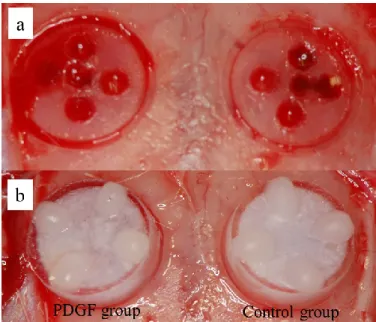
The animals were anesthetized by intraperitoneal injection of 0.5 ml of a 1 : 8 dilution of lidocaine (Xylocaine; Astra Zeneca, Osaka, Japan). The dorsal part of the cranium was shaved and prepared aseptically for surgery. An incision 20 mm in length was made in the scalp along the sagittal suture. In each rat, a circular groove was made on each side of the midline using a trephine drill with a diameter of 5 mm under profuse irrigation with sterile saline. Five small holes were drilled with #2 dental round bur to induce bleeding within each circle. A circular groove was made and five holes were drilled (Fig. 1a).

A cylindrical plastic cap (standardized column shape measuring 1.5 mm in height and 4.4 mm in diameter) was placed on both sides of the midline, and composite resin landmarks were fixed on the plastic caps. During the surgical procedure, care was taken not to damage the dura mater or to puncture the superior sagittal sinus. Before placement, the plastic cap was filled with 0.03% or 0.01% PDGF in a ACS for the PDGF group, or with saline for the control group (Fig. 1b).

Micro-CT analysis

The micro-CT (R_mCT, Rigaku, Tokyo, Japan) was used. Rats were anesthetized with sodium pentobarbital and placed on the stage, and images of the areas of interest were captured. Repeated micro-CT was performed from 1 to 12 weeks after surgery.

The exposure parameters were 90 kV and 100 µA. The images were reconstructed on a personal computer using i-View software (Kitasenjyu Radist Dental Clinic, i-View Image Center, Tokyo, Japan). The relative CT values of cortical bone and soft tissue were measured by micro-CT. The bone volume (BV) within the plastic cap was measured using a BV measurement software (Kitasenjyu Radist Dental Clinic, i-View Image Center, Tokyo, Japan).

Using this software, the gray values and number of voxels with the corresponding gray value were calculated in regions of interest (ROIs) (Fig. 2). A histogram showing the X-ray absorption rate on the x-axis and CT voxel numbers on the y-axis was calculated for the field of the CT imaging area. The histograms of the X-ray absorption rates showed peaks for hard and soft tissues. The threshold was then set at the value for the trough between these peaks.

The number of voxels for the X-ray absorption rates exceeding the threshold was counted.

(7)

5

Finally, the BV was calculated and the number of voxels was multiplied by the voxel volume.

The BV was measured on the first postoperative day in the ROIs and again each week under the same conditions. Then, the increase in BV was calculated by subtracting the BV on day 1 from each of the subsequent values. The increase in bone was considered to be new bone.

Histomorphometric analysis

The rats were killed with an overdose of pentobarbital at 12 weeks after the last micro-CT scan. The calvarial bone with the plastic cap was resected, fixed in 10% neutral buffered formalin, dehydrated, embedded in paraffin, and processed into 5-µm-thick sections for hematoxylin and eosin staining. The sections were assessed histologically and morphometrically under a light microscope equipped with a morphometric system connected to a personal computer. The histomorphometric data for the central section obtained from each specimen were recorded using a computerized image analysis system. Images taken at 40× magnification were digitized using a scanner and a charge-coupled device linear photodiode array interfaced to the computer. Measurements were extracted from the digital images using an interactive image-processing software package.

For each central histological section, the percentages of new bone-like tissue areas in the plastic cap spaces and parent bone were calculated; this area was designated 100%. The cross-sectional area of new generated bone-like tissue was expressed as a percentage of the height and total area of a representative histological section selected and compared with the appropriate CT image, taking care to match specific homologous anatomical features in the bony anatomy (Fig. 3). The histological sections were evaluated by a single examiner blind to the study.

Statistical analyses

Means and standard deviations were calculated for BV, height, and percentages of areas of newly generated bone under the plastic caps after 12 weeks. Wilcoxon’s rank test was used to evaluate differences between the experimental and control groups, and between the 0.03%

PDGF group and the 0.01% PDGF group. In all analyses, P < 0.05 was taken to indicate statistical significance.

Results

Micro-CT analysis

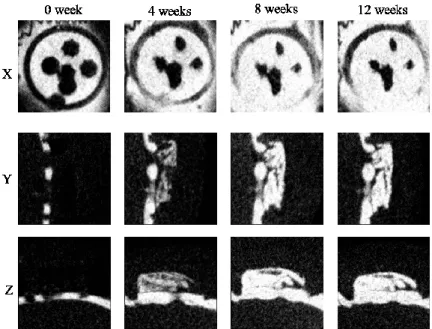
The micro-CT analysis indicated that the radiopaque contrast increased gradually in both the

experimental and control groups. The layer of radiopacity reached the top of the plastic cap in

the 0.03% PDGF group at 4 weeks. However, in the 0.01% PDGF and control groups, the

(8)

6

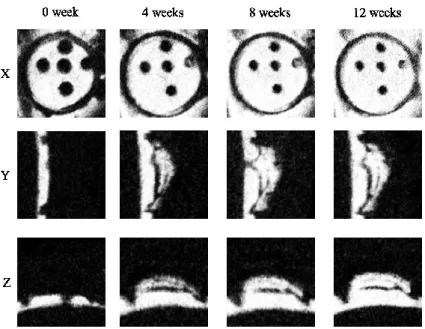
radiopacity reached only half of the height of the plastic cap. At 12 weeks, the thin layer of radiopacity reached the top of the plastic cap in both PDGF groups; it reached one third of the plastic cap in the control group (Figs 4, 5 and 6).

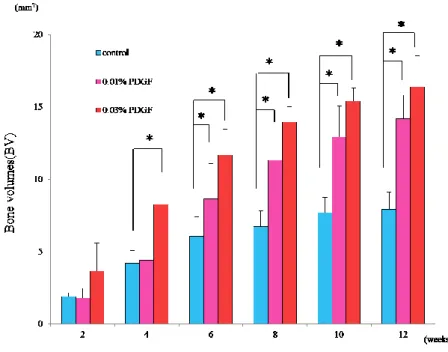
The BV increased in a time-dependent manner in both the PDGF and control groups. The change in BV was significantly different between the PDGF and control groups after 6 weeks.

However, the 0.03% PDGF group showed a significant change in BV after 4 weeks. There were no significant differences between the 0.03% and 0.01% PDGF groups at 12 weeks (Fig.

7).

Histological observation and histomorphometric analysis

The lamellar bone in the lower part and adjacent parent bone was thicker in the PDGF group than in the control group. The new bone-like tissue reached approximately to the top of the plastic cap in the PDGF groups; it reached one third of the plastic cap in the control group (Fig. 8).

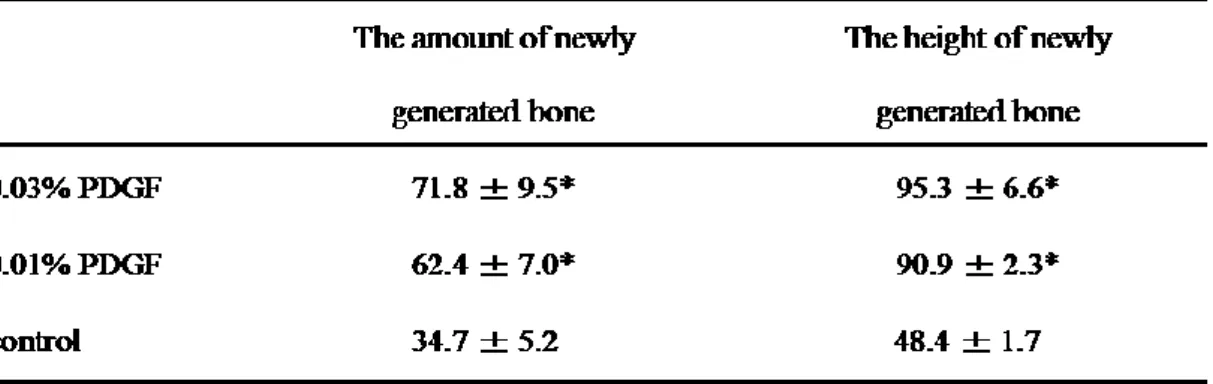
Histomorphometric analysis revealed that the amount and height of new bone-like tissue were significantly higher in the PDGF groups. No significant difference was observed between the 0.03% and 0.01% PDGF groups (Table 1).

Discussion

The effects of PDGF with ACS on GBA were evaluated in rat calvarium. The design of the skeletal envelope in the calvarium was according to the surgical procedure reported by us previously (3). The advantages of the experimental used in this study model include a lack of spontaneous regeneration and a standardized defect size defined by the plastic caps. However, it is difficult to augment bone within an occlusive space under various conditions (1-3).

The PDGF groups had a significantly increased amount of new BV at 4 to 12 weeks, as

determined by micro-CT analysis. Bone regeneration in the plastic cap was significantly

higher in the PDGF groups than in the control group. The histological observations confirmed

these results. Lee et al. (15) evaluated bone regeneration using a dome-shaped, 3-mm-tall,

molded poly/tricalcium phosphate (TCP) membrane containing PDGF-BB in rabbits and

found that new bone filled the space at 4 weeks. Schwarz et al. (17) stated that biphasic

calcium phosphate with PDGF may support the initial stages of guided bone augmentation in

chronic lateral ridge defects. Simion et al. (16) evaluated the outcome of vertical ridge

augmentation in a standardized dog model by combining purified rhPDGF-BB with a

deproteinized block of bovine bone. rhPDGF-BB used in combination with a deproteinized

block without the use of a membrane resulted in regeneration of significant amounts of new

(9)

7

bone. Al-Hazmi et al. (19) reported that bone volume and height were significantly higher in the xenograft with rhPDGF-BB group than in the control group.

Previous animal studies reported application of over 10 µg/ml of PDGF-BB to treated sites.

A study in humans showed that 0.3 mg/ml PDGF-BB improved radiographic bone formation at a statistically level in advanced periodontal osseous defects. The present study suggested that 0.03% and 0.01% (0.3 and 0.1 mg/ml) PDGF with ACS resulted in marked bone formation in the plastic cap, although the difference was not statistically significant. An important consideration in use of growth factors in bone augmentation is the mode and duration of delivery. Unfortunately, the ideal scaffold for rhPDGF-BB are as yet unknown. A collagen scaffold was used in the present study. rhPDGF-BB delivered with chitosan sponge has been shown to induce bony filling of large rat calvarial defects (14). Similarly, Nash et al.

(12) reported that rhPDGF-BB delivered in a collagen or β-TCP collagen matrix can stimulate long-bone healing in rabbits. Vikjaer et al. (13) reported that a single dose of rhPDGF-BB stimulates bone formation in critical calvaria defects in rabbits. rhPDGF-BB has also been shown to increase the restoration of bone lost as a result of advanced periodontal disease in humans.

Results of the present study showed that greater volume of new bone-like tissue was

formed in the cap space treated with PDGF. Additionally, the PDGF groups had thicker

lamellar bone than the control group did. These results are consistent with those of studies

conducted by Vikjaer et al. (13) and Schwarz et al. (17). Because PDGF is involved in the

maturation and remodeling of newly formed blood vessels, angio- and vasculogenic cells may

act as important targets that are the initial responders to this mitogenic factor. However,

further studies are necessary to verify this finding. Data of the present study indicated that the

quantity of bone-like tissue decreased compared to the parent bone. Simion et al. (16)

revealed histologically a lack of bone formation in the center of the bovine block, indicating

that the bone regenerates from parent bone. There was a significant difference in the amount

of BV between both PDGF groups and the control group at 4 to 8 weeks, but a more rapid

PDGF effect was anticipated.

(10)

8

Chapter 2: Effect of a chitosan sponge impregnated with platelet-derived growth factor on bone augmentation beyond the skeletal envelope in rat calvaria

Noriko Tsuchiya, Shuichi Sato, Risa Kigami, Eisuke Kawano, Masatoshi Takane, Yoshinori Arai, Koichi Ito, Bunnai Ogiso

Journal of Oral Science 2014 (in press)

Introduction

Guided bone augmentation (GBA) is the process of creating new bone by guiding bone cells to an area beyond the original outer or inner skeletal envelope. The effects of various regenerative factors and biomaterials on GBA in rat calvaria have been investigated but found it difficult to accurately measure the amount and height of newly generated bone in all specimens (1-3).

Platelet-derived growth factor (PDGF) is a potent mitogen and chemotactic factor for mesenchymal cells and has a role in proliferation (4), chemotaxis (5-8), and matrix apposition (9). In addition to its action on osteoblasts, it is trapped in the bone matrix.

The effects of PDGF have been studied in animal models of cranial and alveolar-ridge defects (11-19). However, these studies yielded conflicting results regarding promotion of new bone formation. In those studies, PDGF was applied at various concentrations using different scaffold systems. In the chapter 1, it was demonstrated that PDGF delivered via a collagen scaffold enhanced bone formation in rat calvaria (20).

The use of chitosan (poly-N-acetyl glucosaminoglycan) in bone regeneration has attracted considerable interest. A absorbable chitosan sponge loaded with various growth factors was used to induce bone formation. This biodegradable and nontoxic natural biopolymer has several biomedical applications: it enhances bone formation in vitro (21) and in vivo (22, 23). In addition to these biomedical applications, chitosan regulates release of bioactive agents, including growth factors (24).

In the present study, the effects of PDGF with absorbable chitosan sponge on GBA were evaluated in rat calvaria within plastic caps.

Materials and methods

Animals

Seven male Fischer rats (age, 12 weeks; 200-250 g) were included in the study. The animals

housed same condition in the chapter 1. The Animal Experimentation Committee of the

(11)

9

Nihon University School of Dentistry approved the present study.

Preparation of chitosan sponges impregnated PDGF

Absorbable chitosan sponges (HemCon Dental Dressing; Hakuho Co., Tokyo, Japan) were used as scaffolds for freeze-dried recombinant rat PDGF-BB (R&D Systems, Inc.

Minneapolis, MN, USA). Sponges impregnated with 0.03% PDGF and sponges without PDGF were prepared similarly, except for the use of aseptic saline solution. Aseptic saline solution (20 µL), with or without PDGF, and a chitosan sponge were implanted into each bone defect.

Experimental design

The experimental design was carried out as described in the chapter 1 (Fig. 9a). Before placement, each plastic cap was filled with a chitosan sponge (diameter, 4 mm; height, 2 mm) impregnated with either 0.03% PDGF (PDGF group) or saline (control group; Fig. 9b).

Micro-CT analysis

Micro-CT analysis was used as described in the chapter 1 (Fig. 2).

Histomorphometric analysis

Histomorphometric analysis was evaluated as described in the chapter 1 (Fig. 3).

Statistical analysis

The same statistical analysis was carried out as described in the chapter 1.

Results

Micro-CT analysis

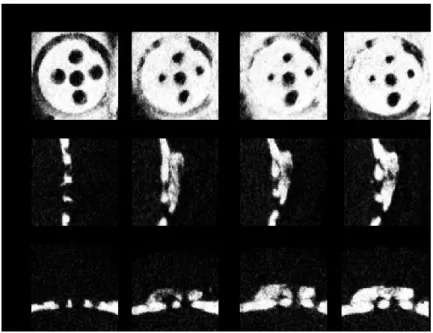
Results of micro-CT analysis showed a gradual increase in radiopacity over time in the experimental and control groups. At 12 weeks, the layer of radiopacity reached the top of the plastic cap in the 0.03% PDGF group and one third of the plastic cap in the control group (Figs. 10 and 11).

BV increased in a time-dependent manner in the PDGF and control groups. The increase in

BV in the PDGF group was significantly greater (by 1.8- to 2.1-fold) than that in the control

group at 4 weeks (Fig. 12).

(12)

10

Histological observation and histomorphometric analysis

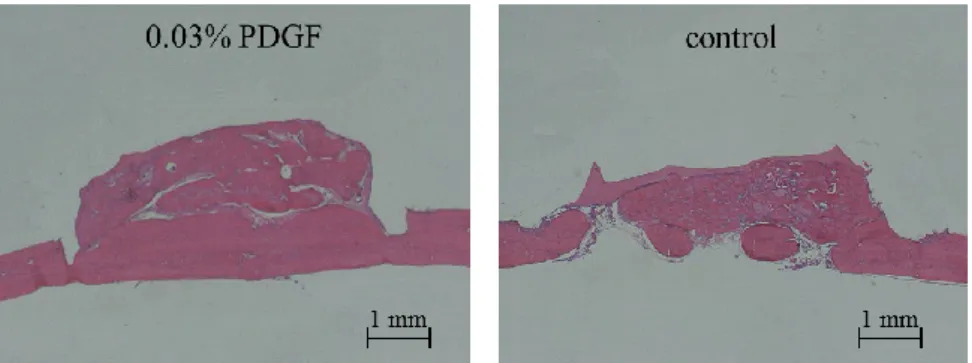
Lamellar bone in the lower part of the ROIs and adjacent parent bone were thicker in the PDGF group than in the control group. The new bone-like tissue reached approximately to the top of the plastic cap in the PDGF group specimens; it reached one third of the plastic cap in the control group (Fig. 13).

Histomorphometric analysis revealed that the height of new bone-like tissue was significantly greater in the PDGF group (Table 2).

Discussion

The effects of PDGF on GBA beyond the skeletal envelope were evaluated in rat calvaria.

The skeletal envelope in the calvaria was designed according to the previously reported surgical procedure (3). Advantages of the model include lack of spontaneous regeneration and use of uniform plastic caps to ensure standardization of defect size. However, vertical bone augmentation was difficult in a variety of experimental conditions within an occluded space (1-3).

At 4–12 weeks, the amount of bone regeneration within the plastic cap was significantly greater in the PDGF group than in the control group, which was confirmed by histological analysis. Lee et al. (15) evaluated bone regeneration using a dome-shaped, 3-mm-tall, molded TCP membrane containing PDGF-BB in rabbits and found that new bone filled the space at 4 weeks. Schwarz et al. (17) found that biphasic calcium phosphate with PDGF supported the initial stages of GBA in chronic lateral ridge defects. Simion et al. (16) evaluated the outcome of vertical ridge augmentation in a standardized dog model by combining purified recombinant human rhPDGF-BB with a deproteinized block of bovine bone. This combination resulted in the regeneration of significant amounts of new bone without the use of a membrane. Al-Hazmi et al. (19) reported that BV and height were significantly greater in a group treated with xenografts and rhPDGF-BB than in a control group.

Previous animal studies reported application of >1 µg/mL PDGF-BB to treated sites (10).

A study in humans showed that 0.3 mg/mL PDGF-BB significantly improved radiographic

bone formation in advanced periodontal osseous defects (25). Results of the present study

showed that 0.03% (0.3 mg/mL) PDGF with absorbable chitosan sponge produced significant

bone like tissue formation within the plastic caps. The mode and duration of delivery are

important considerations in the use of growth factors for bone augmentation. In the chapter 1

(20), as compared with 0.01% PDGF in collagen scaffold, 0.03% PDGF with collagen

scaffold resulted in better bone formation and was thus used in the present study. However,

the ideal scaffold for rhPDGF-BB remains unknown. In the present study, a chitosan scaffold

(13)

11

used. The delivery of rhPDGF-BB via a chitosan sponge induced bony filling of large rat calvarial defects (14). Similarly, Nash et al. (12) reported that rhPDGF-BB delivered in a collagen or β-TCP collagen matrix stimulated healing in long bones in rabbits. Vikjaer et al.

(13) reported that a single dose of rhPDGF-BB stimulated bone formation in critical calvarial defects in rabbits. In addition, rhPDGF-BB increases restoration of bone lost due to advanced periodontal disease in humans. Change in BV did not significantly differ between the present study, which used a chitosan sponge, and a previous study, which used a collagen sponge.

This suggests that bone augmentation is similar with chitosan and collagen sponges.

In the present study, a greater amount of bone formed in defects treated with PDGF than in control defects. In addition, lamellar bone was thicker in the PDGF group than in the control group. These results are consistent with those of Vikjaer et al. (13) and Schwarz et al. (17).

Because PDGF is involved in the maturation and remodeling of newly formed blood vessels, angiogenic and vasculogenic cells may be important initial responders to this mitogenic factor.

However, this hypothesis needs to be tested in future studies. In the present study, it was indicated that the quantity of bone-like tissue decreased with distance from the parent bone and that no such tissue formed within the plastic caps. In a histological analysis, Simion et al.

(16) observed a lack of bone formation in the center of a bovine block, indicating that bone

regenerates from parent bone. BV differed significantly between the PDGF group and control

group at 4 weeks in the present study, but a more rapid PDGF effect was anticipated. Due to

differences in experimental design, animal model, vehicle scaffold system, and PDGF

concentration, it may not be appropriate to compare the findings of Simion et al. (16) with the

results of the present study.

(14)

12

Conclusions

Within the limitation of the present study, 0.03% PDGF in a collagen sponge scaffold and a chitosan sponge scaffold enhanced vertical bone augmentation in rat calvaria. An absorbable collagen sponge scaffold and an absorbable chitosan sponge scaffold are useful for PDGF local delivery in bone augmentation.

Acknowledgements

I would like to express my deepest gratitude to directors Prof. Bunnai Ogiso, Prof. Koichi Ito and Assoc. Prof. Shuichi Sato for their support and guidance throughout the research. I would also like to express my deep appreciation to Prof. Yoshinori Arai as a technical advisor on micro-CT analysis.

This doctoral work was supported by Grant from Dental Research Center, Nihon

University School of Dentistry for 2011, 2012 and 2013 to RK, and supported in part by a

Grant-in-Aid for Scientific Research C (Grant No. 22592197 to SS) from the Ministry of

Education, Culture, Sports, Science, and Technology of Japan and by a grant from the Dental

Research Center, Nihon University School of Dentistry (2011), (Grant No. 25463056) from

the Japanese Society for the Promotion of Science and by a Grant-in-Aid for Scientific

Research B from the Dental Research Center, Nihon University School of Dentistry.

(15)

13

References

1. Hasegawa Y, Sato S, Takayama T, Murai M, Suzuki N, Ito K (2008) Short-term effects of rhBMP-2-enhanced bone augmentation beyond the skeletal envelope within a titanium cap in rabbit calvarium. J Periodontol 79, 348-354.

2. Min S, Sato S, Saito M, Ebihara H, Arai Y, Ito K (2008) Micro-computerized tomography analysis: dynamics of bone augmentation within a titanium cap in rabbit calvarium. Oral Surg Oral Med Oral Pathol Oral Radiol Endod 106, 892-895.

3. Kochi G, Sato S, Ebihara H, Hirano J, Arai Y, Ito K (2010) A comparative study of microfocus CT and histomorphometry in the evaluation of bone augmentation in rat calvarium. J Oral Sci 52, 203-211.

4. Ross R, Raines EW, Bowen-Pope DF (1986) The biology of platelet-derived growth factor. Cell 46, 155-169.

5. Tsukamoto T, Matsui T, Fukase M, Fujita T (1991) Platelet-derived growth factor B chain homodimer enhances chemotaxis and DNA synthesis in normal osteoblast-like cells (MC3T3-E1). Biochem Biophys Res Commun 175, 745-751.

6. Davidai G, Lee A, Schvartz I, Hazum E (1992) PDGF induces tyrosine phosphorylation in osteoblast-like cells: relevance to mitogenesis. Am J Physiol 263, e205-209.

7. Hughes FJ, Aubin JE, Heersche JN (1992) Differential chemotactic responses of different populations of fetal rat calvaria cells to platelet-derived growth factor and transforming growth factor β. Bone Miner 19, 63-74.

8. Lind M, Deleuran B, Thestrup-Pedersen K, Søballe K, Eriksen EF, Bünger C (1995) Chemotaxis of human osteoblasts. Effects of osteotropic growth factors. APMIS 103, 140-146.

9. McCarthy TL, Centrella M, Canalis E (1989) Effects of fibroblast growth factors on deoxyribonucleic acid and collagen synthesis in rat parietal bone cells. Endocrinology 125, 2118–2126.

10. Risau W (1997) Mechanisms of angiogenesis. Nature 386, 671-674.

11. Marden LJ, Fan RS, Pierce GF, Reddi AH, Hollinger JO (1993) Platelet-derived growth factor inhibits bone regeneration induced by osteogenin, a bone morphogenetic protein, in rat craniotomy defects. J Clin Invest 92, 2897-2905.

12. Nash TJ, Howlett CR, Martin C, Steele J, Johnson KA, Hicklin DJ (1994) Effect of platelet-derived growth factor on tibial osteotomies in rabbits. Bone 15, 203-208.

13. Vikjaer D, Blom S, Hjørting-Hansen E, Pinholt EM (1997) Effect of platelet-derived growth factor-BB on bone formation in calvarial defects: an experimental study in rabbits.

Eur J Oral Sci 105, 59-66.

14. Lee YM, Park YJ, Lee SJ, Ku Y, Han SB, Klokkevold PR, Chung CP (2000) The bone

regenerative effect of platelet-derived growth factor-BB delivered with a

(16)

14

chitosan/tricalcium phosphate sponge carrier. J Periodontol 71, 418-424.

15. Lee SJ, Park YJ, Park SN, Lee YM, Seol YJ, Ku Y, Chung CP (2001) Molded porous poly (L-lactide) membranes for guided bone regeneration with enhanced effects by controlled growth factor release. J Biomed Mater Res 55, 295-303.

16. Simion M, Rocchietta I, Kim D, Nevins M, Fiorellini J (2006) Vertical ridge augmentation by means of deproteinized bovine bone block and recombinant human platelet-derived growth factor-BB: a histologic study in a dog model. Int J Periodontics Restorative Dent 26, 415-423.

17. Schwarz F, Sager M, Ferrari D, Mihatovic I, Becker J (2009) Influence of recombinant human platelet-derived growth factor on lateral ridge augmentation using biphasic calcium phosphate and guided bone regeneration: a histomorphometric study in dogs. J Periodontol 80, 1315-1323.

18. Moore DC, Ehrlich MG, McAllister SC, Machan JT, Hart CE, Voigt C, Lesieur-Brooks AM, Weber EW (2009) Recombinant human platelet-derived growth factor-BB augmentation of new-bone formation in a rat model of distraction osteogenesis. J Bone Joint Surg Am 91, 1973-1984.

19. Al-Hazmi BA, Al-Hamdan KS, Al-Rasheed A, Babay N, Wang HL, Al-Hezaimi K (2013) Efficacy of using PDGF and xenograft with or without collagen membrane for bone regeneration around immediate implants with induced dehiscence-type defects: a microcomputed tomographic study in dogs. J Periodontol 84, 371-378.

20. Tsuchiya N, Sato S, Kigami R, Yoshimaki T, Arai Y, Ito K (2013) Effect of platelet-derived growth factor on enhanced bone augmentation beyond the skeletal envelope within a plastic cap in the rat calvarium. J Hard Tissue Biol 22, 221-226.

21. Klokkevold PR, Vandenark L, Kenney EB, Bernard GW (1996) Osteogenesis enhanced by chitosan (poly-N-acetyl glucosaminoglycan) in vitro. J Periodontol 67, 1170-1175.

22. Muzzarelli RA, Zucchini C, Ilari P, Pugnaloni A, Mattioli-Belmonte M, Biagini G Castaldini C (1993) Osteoconductive properties of methylpyrrolidinone chitosan in an animal model. Biomaterials 14, 925-929.

23. Muzzarelli RA, Mattioni-Belmonte M, Tiettz C, Biagini R, Ferioli G, Brunelli MA, Fini M, Giardino R, Ilari P, Biagini G (1994) Stimulatory effect on bone formation exerted by a modified chitosan. Biomaterials 15, 1075-1081.

24. Berscht PC, Nies B, Liebendorfer A, Kreuter J (1994) Incorporation of basic fibroblast growth factor into methylpyrrolidone chitosan fleeces and determination of the in vitro release characteristics. Biomaterials 15, 593-600.

25. Nevins M, Giannobile WV, McGuire MK, Kao RT, Mellonig JT, Hinrichs JE,

McAllister BS, Murphy KS, McClain PK, Nevins ML, Paquette DW, Han TJ, Reddy MS,

Lavin PT, Genco RJ, Lynch SE (2005) Platelet-derived growth factor stimulates bone fill

(17)

15

and rate of attachment level gain: results of a large multicenter randomized controlled trial.

J Periodontol 76, 2205-2215.

(18)

16

Table 1 Histomorphometric analysis of ACS impregnated with PDGF at 12 weeks

Table 2 Histomorphometric analysis of a chitosan sponge impregnated with PDGF at 12

weeks

(19)

17

Fig 1. a: A circular groove (5 mm) was cut with a trephine, and five small holes were drilled using a round bur. b: The plastic cap was pre-filled with either 0.03% or 0.01% PDGF in a collagen sponge (for the PDGF group) or with saline alone in a collagen sponge (for the control group). A plastic cap was fixed to each groove.

Fig 2. Schematic of the plastic cap, the area visualized (ROIs) using micro-CT, and the

measurements taken.

(20)

18

Fig 3. Measurement of histological sections.

Newly generated bone was calculated using the formula A/(A + B) × 100(%). The height of newly generated bone was calculated using the formula (Cc/CC´+ Dd/DD´+ Ee/EE´)/3 × 100(%).

Fig 4. Micro-CT images of the plastic cap in the 0.03% PDGF (ACS) group.

(21)

19

Fig 5. Micro-CT images of the plastic cap in the 0.01% PDGF (ACS) group.

Fig 6. Micro-CT images of the plastic cap in the control (ACS) group.

(22)

20

Fig 7. BV in the PDGF (ACS).

Fig 8. Representative histological results in the PDGF (ACS) at 12 weeks.

(23)

21

Fig 9. a: A circular groove (5 mm) was cut with a trephine, and five small holes were drilled using a round bur. b: The plastic cap was pre-filled with either 0.03% PDGF in a chitosan sponge (for the PDGF group) or with saline alone in a chitosan sponge (for the control group).

A plastic cap was fixed to each groove.

Fig 10. Micro-CT images of the plastic cap in the 0.03% PDGF (chitosan sponge) group.

(24)

22

Fig 11. Micro-CT images of the plastic cap in the control (chitosan sponge) group.

Fig 12. BV in the PDGF (chitosan sponge).

(25)

23

Fig 13. Representative histological results in the PDGF (chitosan sponge) at 12 weeks.

Table 1 Histomorphometric analysis of ACS impregnated with PDGF at 12 weeks
Fig 1. a: A circular groove (5 mm) was cut with a trephine, and five small holes were drilled  using a round bur
Fig 4. Micro-CT images of the plastic cap in the 0.03% PDGF (ACS) group.
Fig 5. Micro-CT images of the plastic cap in the 0.01% PDGF (ACS) group.
+5

参照

関連したドキュメント

Various attempts have been made to give an upper bound for the solutions of the delayed version of the Gronwall–Bellman integral inequality, but the obtained estimations are not

H ernández , Positive and free boundary solutions to singular nonlinear elliptic problems with absorption; An overview and open problems, in: Proceedings of the Variational

At Geneva, he protested that those who had criticized the theory of collectives for excluding some sequences were now criticizing it because it did not exclude enough sequences

An easy-to-use procedure is presented for improving the ε-constraint method for computing the efficient frontier of the portfolio selection problem endowed with additional cardinality

Keywords: Convex order ; Fréchet distribution ; Median ; Mittag-Leffler distribution ; Mittag- Leffler function ; Stable distribution ; Stochastic order.. AMS MSC 2010: Primary 60E05

In particular, we consider a reverse Lee decomposition for the deformation gra- dient and we choose an appropriate state space in which one of the variables, characterizing the

Then it follows immediately from a suitable version of “Hensel’s Lemma” [cf., e.g., the argument of [4], Lemma 2.1] that S may be obtained, as the notation suggests, as the m A

We study the classical invariant theory of the B´ ezoutiant R(A, B) of a pair of binary forms A, B.. We also describe a ‘generic reduc- tion formula’ which recovers B from R(A, B)