• 検索結果がありません。

福島県立医科大学 学術機関リポジトリ

N/A
N/A
Protected

Academic year: 2021

シェア "福島県立医科大学 学術機関リポジトリ"

Copied!
5
0
0

読み込み中.... (全文を見る)

全文

(1)

Fukushima Medical University

福島県立医科大学 学術機関リポジトリ

This document is downloaded at: 2021-11-07T23:44:51Z

Title Evacuation effect on excess mortality among institutionalized elderly after the fukushima daiichi nuclear power plant accident

Author(s) Yasumura, Seiji

Citation Fukushima Journal of Medical Science. 60(2): 192-195

Issue Date 2014

URL http://ir.fmu.ac.jp/dspace/handle/123456789/436

Rights © 2014 The Fukushima Society of Medical Science

DOI 10.5387/fms.2014-13

Text Version publisher

(2)

Vol. 60, No. 2, 2014

[Fukushima Symposium 2013]

EVACUATION EFFECT ON EXCESS MORTALITY AMONG

INSTITUTIONALIZED ELDERLY AFTER THE FUKUSHIMA DAIICHI NUCLEAR POWER PLANT ACCIDENT

SEIJI YASUMURA

Department of Public Health, Fukushima Medical University School of Medicine, Radiation Medical Science Center for the Fukushima Health Management Survey, Fukushima Medical University

(Received May 27, 2014, accepted May 29, 2014)

Abstract : The Great East Japan Earthquake hit Fukushima Prefecture on March 11, 2011, just over 3 years ago and it continues to affect our lives. In Fukushima, many people are confirmed dead or still missing due to the earthquake and/or tsunami. Additional “disaster

-

related deaths”

have been attributed to the Fukushima Daiichi Nuclear Power Plant (NPP) accident. Mortality among the institutionalized elderly rates after the NPP accident were exceptionally high during the first 3 months, and persisted at a lower level for 9 months, in comparison with similar periods before the accident. This study demonstrates the great impact of evacuation on mortality of institutional- ized elderly, excluding inpatients. We need to pay special attention to evacuation of the elderly, re- gardless of whether voluntary or forced.

Key words : relocation, transfer, Fukushima Health Management Survey, Public Health

INTRODUCTION

The Great East Japan Earthquake was quickly followed by a nuclear accident at Tokyo Electric Power Company’s Fukushima Daiichi Nuclear Power Plant (NPP). The Japanese government decided that all residents within a 20 km radius of the NPP needed to evacuate from their houses just after the accident in order to minimize radiation effect on their health. Within a 20 km radius of the NPP, there were 7 hospitals and 34 institutions for the el- derly with 1,240 and 1,770 people staying there, re- spectively 1,2) . They were also forced to move to other places regardless of their own will.

It is well known that relocation after disaster is harmful to vulnerable people, for example, patients and the elderly 4

-

6) . To my knowledge, there are no reports from Japan on long - term mortality change among elderly residents following transfer to other places in response to disasters. We investigated excess mortality among relocated institutionalized elderly and found that it persisted for 8 months post - disaster 2) .

The purpose of this report is to explore wheth- er excess mortality still continued or not after 1 year of evacuation among institutionalized elderly in Fu- kushima.

SUBJECTS AND METHODS

We previously reported excess mortality for 8 months among relocated institutionalized elderly af- ter the Fukushima nuclear disaster 2) . As data col- lection of the subjects and analytical methods for the data were previously described, they are summa- rized briefly here. The subjects were 1,770 institu- tionalized elderly persons who were staying at 34 community facilities including special nursing homes, general nursing homes, geriatric health ser- vice facilities and group homes in the evacuation area when the disaster occurred.

Fukushima prefecture had been routinely col- lecting mortality data for each facility. Age and mortality data on those elderly who transferred out- side the prefecture after the disaster were also col- lected. Age, gender and location of death were in- Corresponding author : Seiji Yasumura, MD, DMSc E

-

mail : [email protected]

https://www.jstage.jst.go.jp/browse/fms http://www.fmu.ac.jp/home/lib/F

-

igaku/

192

(3)

193 EVACUATION EFFECT AFTER FUKUSHIMA NPP ACCIDENT

cluded in the reports from the facilities. As a member of the “Promotion Committee for Health and Welfare Policy for the Elderly in Fukushima Pre- fecture”, I could access and analyze data of March 2011 to February 2012 in order to advance local poli- cy in a meaningful way.

In this paper, mortality data per month and the quarterly mortality ratio of 1 year were calculat- ed. Quarterly mortality ratios after Fukushima NPP accident were compared with corresponding periods before the accident.

RESULTS

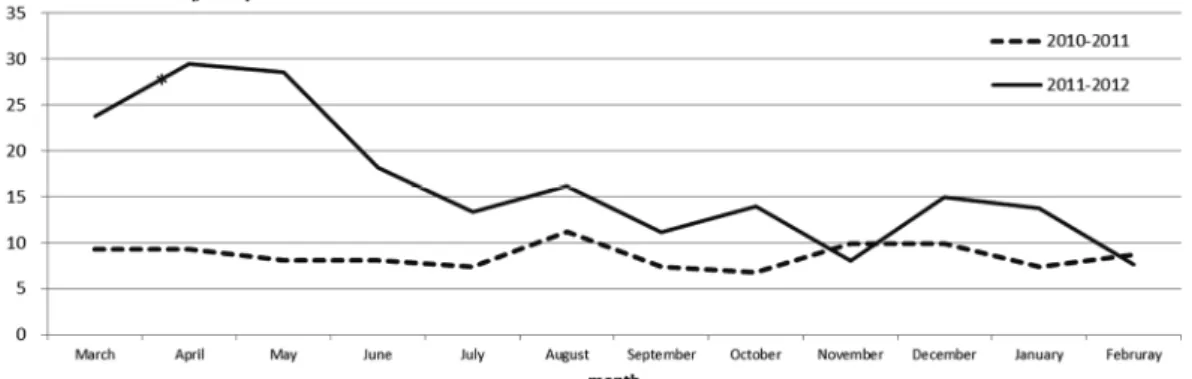
Total number of deaths over 1 year before the Fukushima NPP accident was 141 and increased by a factor of 2.5 to 349 after the accident. Changes of mortality rates for each month among the institu- tionalized elderly between before Fukushima NPP accident and after the accident appear in Fig. 1. 

Mortality for each month sharply increased just after the accident compared with that before the accident and continued almost one year.

Table 1 shows monthly average quarterly mor- tality rates (/1,000) and quarterly mortality ratios before and after the disaster. The quarterly mortal- ity ratio for the first 3 months after the disaster was 3.1, followed by 1.8 for next 3 months, and 1.4 for 6 months.

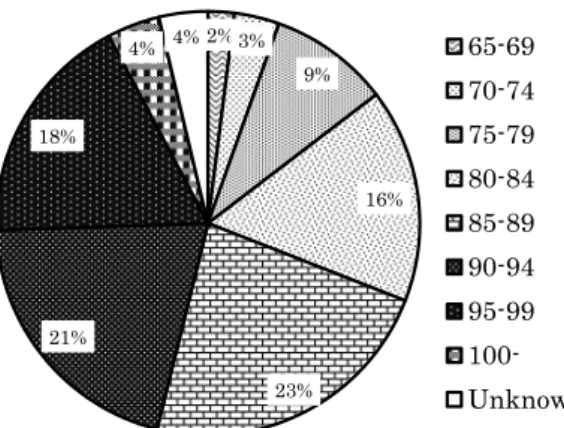
Females accounted for 71% of deaths after the disaster, and 94.9% of deaths occurred in people

aged ≥75 years (but with age unknown in 33 cas- es). Comparing death reports by facility type, those from special nursing homes were 170 before the accident versus 207 after ; those from geriatric service facilities were 17 before and 108 after.

DISCUSSION

In Japan, “persons in need of assistance on oc- casions of disaster” include the elderly, the handi- capped, babies and infants, pregnant women and for- eigners. Among the elderly, those living in institutions are thought to be more frail than those living in the community. Prior knowledge about all persons in need of assistance on occasions of disas- ter is an essential element of Japanese social policy that facilitates prompt action, such as evacuation to shelters.

In Iwate, 4,671 people have been confirmed dead and 1,688 people remain missing, in Miyagi, 9,512 are dead and 1,688 are missing ; in Fukushi- ma, 1,605 are dead and 214 are missing as a direct consequence of the Great East Japan Earthquake and tsunami (as of March 11, 2012). In Fukushima, 761 casualties have been designated as “Disaster - related death caused by the Great East Japan Earth- quake” (disaster - related death). Likewise, 193 in Iwate and 636 in Miyagi have been designated as di- saster - related deaths. These numbers are small in comparison with direct earthquake or tsunami deaths, but point to matters of serious concern.

Table 1. Comparison of quarterly mortality ratios before and after the disaster

March to May June to Aug. Sep. to Nov. Dec. to Feb.

2010

-

2011(a) # 8.87 8.87 8.04 8.66

2011

-

2012(b) # 27.19 15.90 11.07 12.16

Quarterly mortality ratio (b/a) 3.1 1.8 1.4 1.4

# : monthly average quarterly mortality rate (/1,000)

Fig. 1. Changes of mortality rates among the institutionalized elderly before and after the Fukushima NPP accident.

- 12 -

Figure 1. Changes of mortality rates among the institutionalized elderly between before and after the Fukushima NPP accident. and after the accident

(4)

Most of Fukushima’s disaster - related deaths are thought to be from evacuation mandated by the Gov- ernment 2) . In contrast, there have been no deaths caused by radiation in this disaster.

Per the evacuation order of March 12, all resi- dents within 20 km of Fukushima Daiichi were forced to evacuate. Most residents successfully evacuated on the 13th, but about 840 inpatients were left behind. Despite intensive transport efforts, 12 people died in transit and 50 people died as refugees immediately after transport 1) . This shows that in the very early stages of evacuation, transportation itself is very harmful to vulnerable persons.

In another study conducted among nursing home residents in Minamisoma City, located outside the 20 km evacuation zone, all elderly residents were voluntarily evacuated. In three of 5 facilities, initial evacuation significantly elevated mortality af- ter the disaster 3) .

Results of previous studies 1,3) are consistent with our data.

The fact that most people who died by evacua- tion in our study were elderly means that evacuation is a potent risk factor for them. We don’t have de- tailed information on the cause and course of death. 

However, a previous report 2) mentioned that poor living conditions (low temperature and poor nutri- tion) during relocation affected the elderly greatly, with their most common cause of death being pneu- monia.

On the other hand, people who continue to live as refugees in other prefectures were 62,038, versus 102,180 who evacuated within Fukushima as of May 2012. In total, 164,218 people including voluntary evacuees were not living in their own house. New- est data show that the total number of evacuees out- side Fukushima has decreased gradually. However, Yabe et al. revealed that the nuclear accident after

the Great East Japan Earthquake caused psychologi- cal distress among residents in Fukushima prefec- ture, according to results of a mental health and life- style survey through the Fukushima Health Manage –

ment Survey 7,8) .

There are some limitations in this study. First, we don’t have enough data to analyse other risk fac- tors relating to mortality. Second, we didn’t refer to the cause of death, because most of causes 1 year after the accident were not verified. Third, data on shelter or other facilities where evacuees were transported were not obtained. We cannot yet pro- pose effective and specific evacuation planning ad- vice to national and local governments and facilities for the aged.

This study shows that relocation of institution- alized elderly increased mortality and this higher mortality continued over 1 year after the Great East Japan Earthquake. We need to pay special attention to evacuation of the elderly, regardless of whether voluntary or forced. I would like to reiterate that

“Concrete efforts among local and national govern- ments, and among healthcare professionals and epi- demiologists, are needed to turn this tragic disaster into an opportunity to improve elderly care in Ja- pan”.

ACKNOWLEDGEMENT

Ethics approval : This report is in accordance with the Ethical Guidelines for Epidemiological Studies established by the Japanese government.

Conflict of interest : None declared.

I thank Professor Kenneth E. Nollet (Director, Office of International Cooperation, Radiation Medi- cal Science Center for the Fukushima Health Man- agement Survey, Fukushima Medical University) for helpful comments.

REFERENCES

1. Tanigawa K, Hosoi Y, Hirohashi N, et al. Loss of life after evacuation : lessons learned from the Fu- kushima accident. Lancet, 379 : 889

-

891, 2012.

2. Yasumura S, Goto A, Yamazaki S, et al. Excess mortality among relocated institutionalized elderly after the Fukushima nuclear disaster. Public Health, Feb ; 127(2) : 186

-

188, 2013.

3. Nomura S, Gilmour S, Tsubokura M, et al. Mor- tality risk amongst nursing home residents evacu- ated after the Fukushima nuclear accident : a ret- rospective cohort study. PLOS ONE, 8(3) : e60192. doi:10.1371/journal.pone.0060192. 2013.

- 14 -

Figure 2. Age distribution of the elderly who died after the disaster 2% 3%

9%

16%

23%

21%

18%

4% 4% 65-69

70-74 75-79 80-84 85-89 90-94 95-99 100- Unknown Fig. 2. Age distribution of the elderly who died after

the disaster.

(5)

195 EVACUATION EFFECT AFTER FUKUSHIMA NPP ACCIDENT

4. Clough JD, Kay R, Gombeski Jr WR, Nickelson DE, Loop FD. Mortality of patients transferred to a tertiary care hospital. Cleve Clin J Med, 60 : 449

-

454, 1993.

5. Bernard AM, Hayward RA, Rosevear J, Chun H, McMahon LF. Comparing the hospitalizations of transfer and non

-

transfer patients in an academic medical center. Acad Med, 71 : 262

-

266, 1996.

6. Gordon HS, Rosenthal GE. Impact of interhospi- tal transfers on outcomes in an academic medical center. Med Care, 34 : 295

-

309, 1996.

7. Yabe H, Suzuki Y, Mashiko H, et al. Psychological Distress after the Great East Japan Earthquake and Fukushima Daiichi Nuclear Power Plant Accident : Results of a mental health and lifestyle survey through the Fukushima Health Management Sur- vey in FY2011 and FY2012. Fukushima J Med Sci, 60 : 57

-

67, 2014.

8. Yasumura S, Hosoya M, Yamashita S, et al. Study

protocol for the Fukushima Health Management

Survey. J Epidemiol, 22 : 375

-

383, 2012.

Table 1 shows monthly average quarterly mor- mor-tality rates (/1,000) and quarterly mormor-tality ratios  before and after the disaster
Figure 2. Age distribution of the elderly who died after the disaster 2% 3%9%16%23%21%18%4% 4%65-6970-7475-7980-8485-8990-9495-99100-UnknownFig

参照

関連したドキュメント

Reactor automatically trip (scram) Electrical power supplied by transmission lines Power provided by generator operating with diesel fuel (emergency diesel generator) Cooling by

September 22, 2021 TEPCO Power Grid formed a consortium together with three other companies including Tokyo Electric Power Services Co., Ltd and World Business Associates, and signed

‹ New Entrants (Power Producer and Supplier: PPS) became able to provide power to eligible customers by using “wheeling service,” offered by Electric Utility Companies, to

Wholesale Electricity Sales Volume is the total (excluding indirect auctions) of TEPCO Energy Partner consolidated, and TEPCO Power Grid (including inter-regional), and TEPCO

 The following measures were implemented and it has been confirmed that the total amount of accumulated radioactive water has been reduced by processing the accumulated

2:20 am As the radiation dose over 500μSv/h was measured near the main gate (751μSv/h), it was determined that a specific incident stipulated in article 15, clause 1 of Act on

○   While trying to respond to situations at multiple reactor units due to lack of information about the cooling water injection status of Unit 2 since receiving information about

To develop a rubble removal plan for the upper part of the Unit 3 Reactor Building, the conditions around the Reactor Building operating floor was surveyed (7/11)..  Unit 1