AL-RAFIDAN Vol. XIV 1993 141
STUDIES ON IDENTIFICATION OF THE NATURAL DYES ON THE TEXTILES FROM AT-TAR CAVES
Mitsuo KIMURA*, Kazuko SAKAMOTO**
and Hideo FUJII***
1. Introduction
The natural dyes are defined as the mixed aq. solution of natural pigments (glucosides and/or aglycones) which were extracted from dye plants or animals. But, many parts of these natural pigments are decomposed gradually by the extraction from their own cells in plants or animals.
Therefore, the identification of natural dyes on old fibers very often get into difficulties by the decomposition or color change of containing natural pigments.
In this paper, results of experiments on the identification of natural dyes on textiles from at-Tar Caves, which were dyed about 2000 years ago, are reported.
2. Textiles used
2.1. Sample yarns for identification:
As shown in Table 1, 10 reddish purple wool weft yarns in fabrics and 3 reddish purple wool yams were used for experiments on identification. As these yarns seem to be dyed with Tyrian purple, the following dyed textiles were used as references, on the experiments of identification in this paper.
2.2. Textiles used for references:
(a) Old sample dyed with Tyrian purple: a silk fabric dyed in 1983.
(b) New sample dyed with Tyrian purple: a wool fabric dyed at this time.
(c) New sample dyed with kermes: a wool fabric dyed at this time.
3. Experiments
3.1. Microscopic observation:
The structure of sample yarns was observed under the microscope (Olympus kk, model SZ-60, x60).
3.2. Measurements of the color difference:
Color differences of each yam were measured as positions on the chromaticity diagram by the micro color computer (Tokyo denshoku kk, model TR3001MX, measuring spot: 0.2 mm). Results are shown in Fig. 1.
Professor, Faculty of Education, Mie University, Tsu and Visiting Scholar of the ICSAI Visiting Scholar of the ICSAI and Visiting Specialist of the Ancient Orient Museum, Tokyo
Professor/Director, the Institute for Cultural Studies of Ancient Iraq (ICSAI), Kokushikan University, Tokyo
Table 1 Textile Samples Used
No.
» 1 m 2
« 3
« 4
« 5 iS 6 7 8 9 10 11 A12 A13
cave No.
F-4 C-16 C-16 C-16 C-16 C-16 C-16 C-16 C-16 C-16 C-16 C-12 C-12
textile No.
T-1 T-9 T-10 T-ll T-12 T-13 T-15 T-29 T-38 T-42 T-43 T-13 T-14
specimen No.
C-31 V-68-4 V-9O-3b
V-68-8 V-126-3 V-W-59 V-71-1 V-85-2 V-21-13 V-41-15 V-73-4 IV-OH-124 IV-OH-368-13
state of textile sample Shade
reddish purple reddish purple reddish purple reddish purple reddish purple reddish purple reddish purple reddish purple reddish purple reddish purple reddish purple reddish purple reddish purple
appearance v. plain weave fabric piece v. plain weave fabric piece plain weave fabric piece v. plain weave fabric piece v. plain weave fabric piece v. plain weave fabric piece v. plain weave fabric piece
weft yam piece weft yarn piece v. plain weave fabric piece
plain weave fabric piece plain weave fabric piece
weft yam piece
structure
2 warps ,'1 weft 2 warps/1 weft 1 warp/1 weft 1 — 2 warps/1 weft
2 warps/1 weft 2 warps/1 weft 4 warps/I weft
—
—
2 warps/1 weft 1 warp/1 weft 1 warp/1 weft
—
Concerning the textile features, Samples with marks ig are only reported in "Textiles from at-Tar Caves Part li-(3): Cave 16, Hill C" (pp. 109-133 of this volume), those with A were reported in Al-Rafidan Vol. X [1989], and Samples without any mark (Nos. 7-11) will be reported in the next volume alAI-Rafiddn (Vol. XV). v.: variation of.
T-1 1 (yel low part)
T-ll(blue part)
T - 43(yelIon part) T-11 (red part)
T-14 (C-1
T-43(blue part) T-43(red part)
T-29 T-10
Tynan purnle(old)
Tyrian purple(new)
Fig. 1 Chromaticity Diagram
STUDIES ON IDENTIFICATION OF NATURAL DYES 143
3.3. Methods of extraction and measurement of absorption spectra:
Natural pigments were extracted from each weft yam of samples as follows.
hot DMF weft yarn
of sample (2-10 mg)
+ 10%NaOHaq.
(0.2 ml)
70~80°C
solution [1]
(0.05 ml)
-solution [2]
(0.05 ml)
Absorption spectra (300—650 nm) of these solution [1] (DMF = dimethylformamide) and solution [2]
(DMF-f-NaOHaq.) were measured by the spectrophotometer (Beckmann kk, model DU-70).
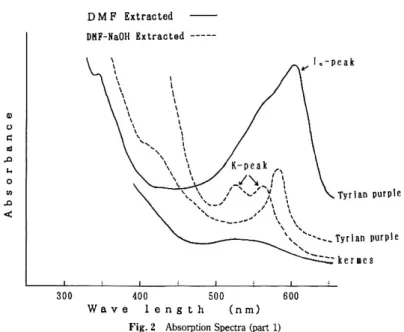
From these extraction and measurements of absorption spectra, if the weft yam of sample was dyed with Tyrian purple or indigo, natural pigment (6,6'-dibromoindingo or indigo) should be observed on the absorption spectrum of solution [1] and give the Ia-peak of 6,6'-dibromoindigo in Tyrian purple or the Ib-peak of indigo at 600—620 nm.
But, the weft yarn of sample was dyed with kermes, the natural pigment (kermesic acid in kermes) should not be extracted by hot DMF. This natural pigment is observed on the absorption spectrum of solution [2] and gives two K-peaks at 550—600 nm.
The Ia-peak of 6,6'-dibromoindigo and K-peaks of kermesic acid were shown in Fig. 2. And results obtained by measurements of absorption spectra are shown in Table 2.
4. Results and discussions
From results of experiments, natural dyes on each textile sample were estimated as follows.
(D T-l (F-4), T-9 (C-16), T-29 (C-16) and T-14 (C-12):
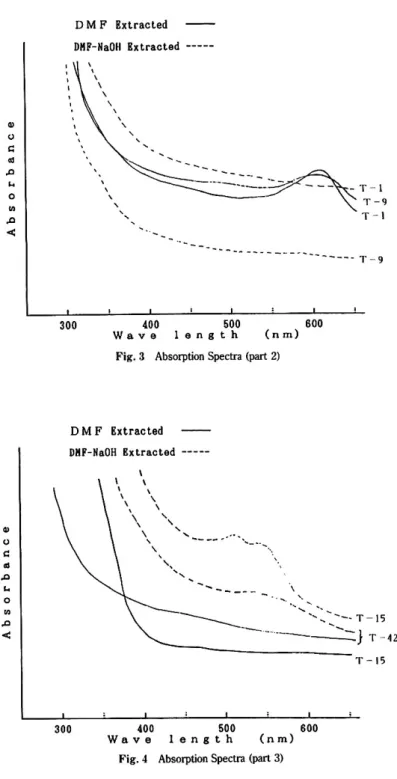
As shown in Fig. 3 (absorption spectra of solutions extracted from weft yam of T-l) and Table 2, natural dyes on T-l and T-9 textile samples have the Ia-peak and have not the K-peaks. Therefore, it is certain that these weft yams were spun by the loose fiber dyed with Tyrian purple. T-29 is rather insufficient in experimental samples, which did not enable us to take its measurement by absorption spectra. Judging from chromaticity diagram (Fig. 1) showing that it is positioned close to T-l, however, T-29 also seems to have been dyed with Tyrian purple, just like T-14 (Table 2).
"*) T-15 (C-16), T-38 (C-16) and T-42 (C-16):
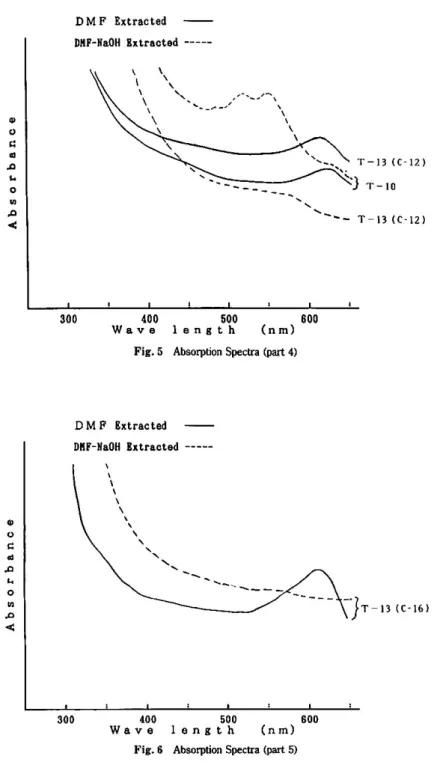
As shown in Fig. 4 (absorption spectra of solutions extracted from weft yam of T-15 and T-42) and Table 2, natural dyes on these textile samples have the K-peaks and have not the Ia-peak. Therefore, it is certain that these weft yams were spun by the loose fiber dyed with kermes.
© T-10 (C-16) and T-13 (C-12):
From results of the microscopic observation and measurements of absorption spectra (extracted solution of both samples have Ia-peak and K-peaks, Fig. 5), it can be considered that these samples were spun by the mixtures of the loose fiber dyed with Tyrian purple and the loose fiber dyed with kermes.
© T-13 (C-16):
From result of the microscopic observation (weft yam of sample consisting of the reddish purple yarn and
DMF Extracted DHF-NaOH Extracted
Tyrian purple
""---_Tyriati purple
300 400 500 600
Wave length (nm)
Fig. 2 Absorption Spectra (part 1)
Table 2 Results of Examination
No.
1 2 3 4 5
6
7 8 9 10 11 12 13
cave
No.
F-4 C-16 C-16 C-16 C-16 C-16 C-16 C-16 C-16 C-16 C-16 C-12 C-12
textile No.
T-l T-9 T-10 T-ll T-12 T-13 T-l 5 T-29 T-38 T-42 T-43 T-13 T-14
specimen No.
C-31 V-68-4 V-90-3b V-8-8 V-126-3 IV-W-59 V-71-1 V-85-2 V-21-13 V-41-15 V-73-4 IV-OH-124 IV-OH-368-13
microscopic observation warp
undyed yam undyed yarn undyed yarn undyed yam undyed yam undyed yam
undyed yam
—
—
blue dyed yam undyed yarn undyed yam
—
weft reddish purple dyed yam reddish purple dyed yarn reddish purple dyed yarn cnix spun of red, blue and yellow dyed yarn mix spun of red, blue and yellow dyed yam mix spun of reddish purple and blue dyed yam
reddish purple dyed yarn reddish purple dyed yam reddish purple dyed yam reddish purple dyed yam mix spun of red, blue and yellow dyed yarn mix spun of red and reddish purple dyed yam reddish purple dyed yam
absorption spectra*' Ia-peak
o o o
X
X
A
X
—
—
X X
O A
Ih-peak X X X A
A
A
X
—
—
X A
X
X
K-peak X X
o
A
A
X
O
—
-
o
A
o
X
Ia-peak: peak by Tyrian purple; Vpeak: peak by indigo; K-peak: peak by kermes; O: distinct peak; A: slight peak; x: no peak
STUDIES ON IDENTIFICATION OF NATURAL DYES 145
DMF Extracted DMF-HaOH Extracted
300 400
Wave 500 600
t h (n m)
Fig. 3 Absorption Spectra (part 2)
DMF Extracted DHF-NaOH Extracted
,} T~42
300 400 500 600
Wave length (nm)
Fig. 4 Absorption Spectra (part 3)
DMF Extracted DHF-NaOH Extracted
300 400 500 600
Wave length (nm)
Fig. 5 Absorption Spectra (part 4)
DMF Extracted DHF-NaOH Extracted
300 400 500 600
Wave length (nm)
Fig. 6 Absorption Spectra (part 5)
STUDIES ON IDENTIFICATION OF NATURAL DYES 147
the blue yarn) and the absorption spectrum (extracted solution has only I-peak. Fig. 6), it can be considered that this sample was spun by the mixture of the loose fiber dyed with Tyrian purple and the loose fiber dyed with indigo.
© T-ll (C-16), T-12 (C-16) and T-43 (C-16):
From result of the microscopic observation and spots on the chromaticity diagram (these weft yarns consisted of the purplish red loose fiber, blue loose fiber and yellow loose fiber) and the absorption spectra (extracted soltuions of these samples have lb-peak, K-peak and another peak at 400 nm which correspond to the yellow loose fiber, Fig. 7), it can be considered that these samples were spun by the mixtures of the loose fiber dyed with kermes, the loose fiber dyed with indigo and the loose fiber dyed with yellow natural dye (not yet defined).
DMF Extracted ■
DMF-KaOH Extracted
l\ \ \
300 400 S00 600
Wave length (nm)
Fig. 7 Absorption Spectra (part 6)
5. Conclusion
In this paper, the identification of natural dyes on those sample textiles (dyed wool weft yarns) were tried with the microscopic observation, measurements of color differences and measurements of absorption spectra of solvents extracted solutions from each weft yarn.
By these examinations, 6,6'-dibromoindigo, indigo and kermesic acid could be observed in reddish purple colored yarns which look like the same color. Therefore, these samples can be classified into the following four:
Group (1): yarns dyed with Tyrian purple only.
Group (2): mix spun yams which consist of the loose fiber dyed with Tyrian purple and the loose fiber dyed with kermes or indigo for volume-up.
Group (3): mix spun yams which consist of the loose fiber dyed with kermes, the loose fiber dyed with indigo and the loose fiber dyed with yellow natural dye (not yet defined), for using in place of the yam dyed with Tyrian purple.
Group (4): yarns dyed with kermes only.
The analytical results given above are very interesting to us. At-Tar caves are located in the borderland of the Mesopotamian Southwestern Desert, which is an important place for traffic open to the East Mediterranean coastal areas and the Gulf areas through the caravan routes cleared along oases and artesian wells [Jones: 1966, VII, pp. 233-235, Strabo: XVI, C748].
Thus, Group (1) the yams dyed with Tyrian purple only must have been carried in from the East Mediterranean coastal areas or the Gulf areas [Murakawa: 1946, pp. 102-103]. As a matter of fact, Alexander the Great expected that the Gulf area would become no less rich in natural resources than the Phoenician area. Thus, in order to prepare himself for his conquering expedition, Alexander actually employed a large number of Phoenicians who had been working in their homeland as professional gatherers of 'murex' so that they might be engaged in the work on board his armada [Omuta, 1987: p. 78]. It is presumed that the above record not only suggests the possibility that 'murex' lived in the Gulf area in those days but also proves the value of Tyrian purple dyeing.
As for Group (2) the mix spun yams with Tyrian purple loose fiber and kermes loose fiber or indigo loose fiber, Tyrian purple loose fiber had also been carried in from the East Mediterranean coastal areas or the Gulf areas, and Tyrian purple loose fiber seems to have been mix spun into yams with kermes loose fiber or indigo loose fiber at at-Tar or thereabouts. In the case of Group (3), 3 kinds of loose fiber may have been mix spun into yams at at-Tar or thereabouts. (4) As Yadin mentions [Yadin, 1963: pp. 182- 183), it seems that the color effect of the yam dyed with kermes only is almost identical with that of the yam dyed with Tyrian purple only, thus resulting in the presumption that the yam dyed with kermes only was highly valued, next to the yam dyed with Tyrian purple only.
As for the matter that the above (2), (3) and (4) were actually devised, the following suggestion may be taken into consideration: In those days, dyeing with tyrian purple was in high repute as bright reddish purple dyeing, so that lack of its material made it more difficult to obtain tyrian purple. That is why such substitutes came to be devised to meet the demand for the dye of the reddish purple color line.
Therefore, as stated in the conclusions of Al-Rafiddn Volumes X, XI, XII and XIII, it seems likely that a considerable scale of society had been formed at at-Tar and its neighborhood, allowing the existence of some textile workshop including dyeing, with some authorities kept in the background.
Reference cited Jones, H.L.
1966 The Geography of Strabo VII, Harvard University Press.
Murakawa, K. (Japanese translation)
1946 Periplus Maris Etythraei, Seikatsu Sha, Tokyo.
Omuta, A. (Japanese translation]
1987 Flavii Arriani quae exstant omnia edidit A.G. Roos Vol. VII: Alexandri Anabasis. Studies and Essays (History) No. 7.
Faculty of Letters of Kanazawa University.
Yadin, Y.
1963 The Finds from the Bar-Kokkba Period in the Cave of Letters, The Israel Exploration Society, Jerusalem.