― ― 4
HBx contributes to the oncogenic conversion of human immortalized cells with active RAS by overcoming oncogene-induced senescence
1.
Oishi T, Masutomi K, Khurts S, Nakamoto T, Kaneko S, Murakami S.HBx has been long suspected to be oncogenic although it remains still controversial.
Pathological roles of HBx in the carcinogenic process have been previously examined only with rodent systems. Therefore we addressed effect of HBx on the immortalization and transformation abilities in human primary cells.
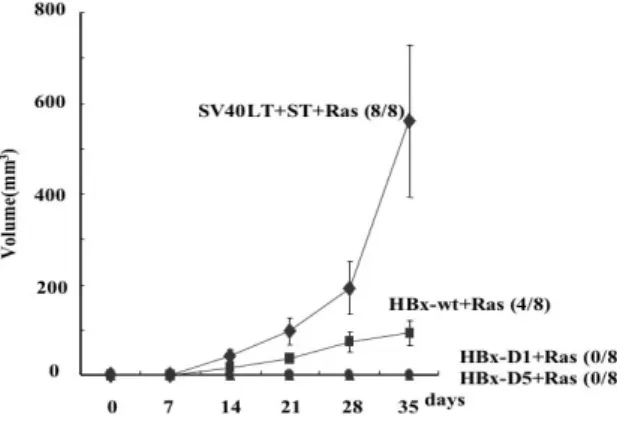
As HBx alone failed to immortalize human primary cells, BJ and TIG3 cells, nor to transform the hTERT-introduced immortalized BJ cells, we next examined HBx overcomes active RAS-induced cellular as oncogene-induced senescence (OIS) has been recently regarded as one of the antitumor processes of cells. The immortalized BJ cells expressing active RAS and HBx proliferate more than 80 population doublings and could form colonies in soft agar and tumors in nude mice (Figure) although RAS alone actually induced senescence of the immortalized BJ cells. A truncated mutant, HBx-D1 (aa 51-154), had the ability to overcome OIS in a population doubling analysis, but failed to exhibit colonigenic and tumorigenic abilities. These observations indicate that HBx-D1, which harbors the coactivation domain is not equivalent to full-length HBx in the ability to overcome active RAS-induced senescence, strongly suggesting that HBx can contribute to carcinogenesis by overcoming OIS in human cells.
Reference 1: Oishi N, et al., (2005) International Meeting on the Molecular Biology of Hepatitis B Viruses, Heidelberg, Germany, Sep. 18-21, 2005
Figure illustrates tumor formation in nude mice. Each point on the graph represents the average volume of tumors. SV40 LT+ST+RAS is a positive control.