Planning Review: Application of Vertical Greening for Landscape Beautification in Taipei
著者 Chien‑Yuan Lin, Yin‑Ling Huang journal or
publication title
International Review for Spatial Planning and Sustainable Development
volume 1
number 4
page range 43‑49
year 2013‑10‑15
URL http://hdl.handle.net/2297/40897
doi: 10.14246/irspsd.1.4_43
43
International review for spatial planning and sustainable development, Vol.1 No.4 (2013), 43-49 ISSN: 2187-3666 (online)
DOI: http://dx.doi.org/10.14246/irspsd.1.4_43
Copyright@SPSD Press from 2010, SPSD Press, Kanazawa
Planning Review: Application of Vertical Greening for Landscape Beautification in Taipei
Chien-Yuan Lin
1*and Yin-Ling Huang
11 Graduate Institute of Building and Planning, National Taiwan University
* Corresponding Author, Email: [email protected] Received 3 Feberuary 2013; Accepted 31 July 2013
Keywords: Vertical Greening, Landscape, Construction Fences, Environmental Benefit
Abstract: For the improvement of city landscape, vertical greening by plantation is one of the effective approaches. In the past few years, vertical greening has gained significant progress in both technological development and practical application. Thanks to the 2010 Flora Expo, vertical greening has made significant contribution to the landscape beautification in Taipei. Among various applications, temporary greening of fences surrounding construction sites has developed a unique landscape for Taipei city. In this paper, potential environmental benefits and application experience of vertical greening in Taipei city will be reviewed and discussed.
1. INTRODUCTION
Vertical greening is sometimes called as three-dimensional afforestation, perpendicular greening, and greening wall, etc. In horticulture, it is also often called as vertical gardening (Perini, K., Ottelé, M., et al., 2011).
Usually, vertical greening is applied on vertical surfaces such as wall surface, fence, bar fence, vertical column and flower frames. It is regarded as one of the effective ways in the development of green buildings and eco- cities. To achieve effects of heat insulation, greening and beautification, vertical greening can either be cling plants or pending plants in practical applications. Broadly speaking, any form of greening on vertical structures can be named as vertical greening. Vertical greening can not only be applied to beautify city landscape, but also to promote the development of sustainable environment (Maas, J., Verheij, R.A., et al., 2006). In recent years, vertical greening has achieved significant progress in both technology development and practical applications in Taiwan. In this paper, the application experience of vertical greening for the landscape beautification in Taipei city, particularly the beautification program of fences surrounding construction sites by vertical greening, will be reviewed and discussed.
2. APPLICATION OF VERTICAL GREENING IN CITY LANDSCAPE IMPROVEMENT
Despite the scale of space, city landscape provides people visual
perception of a place on a particular time. However, “time” factor is often
neglected in landscape planning and management (Bolan, R.S., 2009).
44 IRSPSD International, Vol.1 No.4 (2013), 43-49 Because of the difference in temporal scope and individual experiences, a temporary scene unusually experienced by a visitor may be just a usual phenomenon for local people (Temel, R., 2006). For instances, a local cultural event provides temporary experience for tourists, it is the only once for the tourists’ whole life, but the annual event is actually just a regularly seasonal landscape for local residents. To provide impressive visual experience for tourists, a city has to design and manage landscape from the viewpoint of tourists. Therefore, the application of vertical greening is regarded as an effective way to create unique landscape experience for tourists.
In a densely developed city such as Taipei, where population and buildings are concentrated in limited area, horizontal expansion of greening space is very difficult. The application of vertical greening has become relatively more flexible for practical uses because plants can be attached on either the wall surface of buildings or other vertical surfaces.
Table 1 shows that vertical greening can be applied in different ways according to variables in time (temporary or permanent) and space (Indoor or outdoor). For instance, the National Music Hall in Taipei has used vertical greening to decorate indoor space for ordinary use, while many other business buildings have widely applied vertical greening to beautify outdoor spaces for permanent outlook. Fences surrounding construction sites are examples of temporary application in outdoor space, while many cultural events use vertical greening to decorate venue for temporary visual effect.
In this paper, we will focus on the temporary outdoor application of vertical greening on construction sites.
Table 1. Types of Vertical Greening Application Place
Time Indoor Outdoor
Permanent Use Musician Hall Shopping Center
Business Building Government Building
Temporary Use Special Event or Activity Fence surrounding Construction site
In terms of location, construction sites can be grouped into two types, namely, roadway and building. Different applications of vertical greening bring different impacts on surrounding environments. While the roadway construction projects bring significant traffic and visual impacts on wide areas, building sites have generated social and visual impacts on neighbors within relatively limited area. In either case, the application of vertical greening has resulted significant effects on the improvement of visual impacts. Traditionally, due to the nature of temporary use, ugly fences of various construction sites are taken for granted. Because of the application of vertical greening technology, better landscape with greening can be created now.
To develop an eco-city, any approach that which has potential
contribution to environmental sustainability should be attempted in modern
city planning and management. As a matter of fact, we have witnessed that
vertical greening technology has become widely applied by more and more
architects in the design of green buildings and landscapes. In most cases,
they are applied to conserve energy consumption by insulating building
walls from solar heat. In Taiwan, it has been applied on the walls of various business buildings and government buildings. It not only beautifies the building outlook, but also establish brilliant and unique image for the building. The left of Figure 1 shows the first outdoor application of vertical greening on private business building in Taichung City that which has become the attractiveness of the bookstore located in that building. The right of Figure 1 shows the application of vertical greening on campus entrances of National Taipei University of Technology. It was once reported by TV Discovery program globally. In fact, thanks to its strategic location, it has well demonstrated the visual effects in landscape beautification and environmental design education.
Figure 1. Outdoor Application of Vertical Greening on Business Building (left) and UTUT Campus (right)
3. VERTICAL GREENING OF CONSTRUCTION FENCES IN TAIPEI
Due to the visual beautification effect, vertical greening technology is often used for temporary occasions such as event decoration and landscape beautification. Among various recent applications, the compulsory vertical greening of fences outside construction sites along main roads in Taipei is the most significant case. Traditionally, fences surrounding construction sites are made of irons for the sake of security to prevent outside interruption. Visual impact on city landscape has never been considered in the process of design and installation. To prepare for the 2010 Flora Expo in Taipei, all kinds of vertical greening were designed and established in many places from 2009 in order to establish unique image of 2010 Flora Expo.
Meanwhile, to take advantage of the big event, the Taipei City Government initiated the so-called “Taipei Beautiful Program” in 2009 to beautify the landscape of Taipei city, for at least during the time of Flora Expo. “Taipei Beautiful Program” was actually a composition of 8 action series and 3 integrated action series. Among those action series, Series 3 was aimed at the application of greening technology to beautify the city landscape.
Therefore, the Department of Urban Development of Taipei City
Government established a new rule for their management of construction
sites. The rationale is that all new construction sites are responsible for the
visual quality of city landscape and each construction site should make
contribution to beautify their fences during construction period. For those
construction sites along main streets (width > 10m), they should adopt
vertical greening for at least half of the fence surfaces. For those
46 IRSPSD International, Vol.1 No.4 (2013), 43-49 construction sites along small roadways (width < 10m) should be painted or attached with approved posters. Figure 2 are examples of vertical greening applications on construction site fences in Taipei.
Figure 2. Example of vertical greening on construction fences in Taipei
Figure 3. Example of vertical greening on construction fences in Taipei
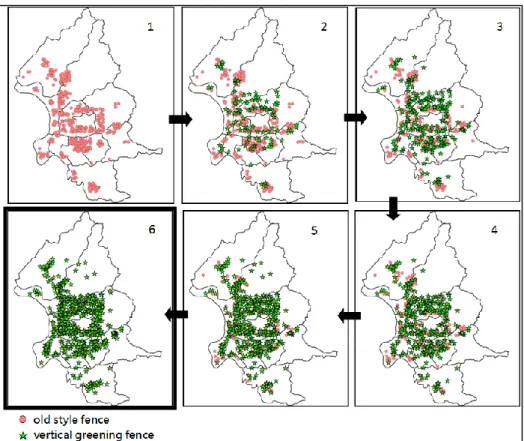
Note: Red circle stands for old construction sites with iron fence, green star stands for new construction site with vertical greening fence.
According to Taipei city government, about 250 construction permits are
issued annually in average, and each construction site usually takes about 4
years to complete. By and large, about 1000 construction sites distributed
within Taipei city although their locations are partly varied every year
because of the closure of old ones and the opening of new ones. The
compulsory vertical greening program of construction fences was initiated
from 2009, every year about 250 new constructions were added with vertical
greening fences, while another 250 old construction sites with traditional
iron fences were completed and closed in the city. By the end of 2012,
almost all construction sites along main streets in Taipei city are decorated with vertical greening fences. Through such progressive changing process, the city landscape is gradually transformed and construction site with vertical greening fence has now become a regular landscape, despite the fact that vertical greening fences are just temporary installations for each construction sites.
Figure 3 shows the temporal changing process of city landscape because of the vertical greening required for construction site fences in Taipei. In Figure 3, the red circle stands for old construction sites with iron fence, while the green star dot stands for new construction site with vertical greening fence. Because of the life cycle of 4 years for a construction site, it takes about four to six years to change the city landscape for permanent effects.
In order to encourage construction sites to design and adopt beautiful vertical greening fences, the Taipei City Government also conducted a competition program every year to recognize and award those sites with significant contribution to city beautification. The first competition was conducted in 2009, and the most recent competition was conducted in December of 2012. Every year, more than 50 construction sites registered for competition. Figure 2 are examples of winners in 2012 vertical greening competition. Winners are very proud of their recognitions received, especially for those estate developments luxury houses. The success of the vertical greening competition is partly contributed by the cooperation of the Chamber of Real Estate Developers in Taipei city.
In recognition of the visual contribution of vertical greening, based on Taipei experience, more and more other cities in Taiwan adopt similar programs in their management of construction site fences.
4. ENVIRONMENTAL BENEFITS OF VERTICAL GREENING FENCES
Integration of vertical greening technology into construction industry has become a trend of environmental management in Taiwan. A vertical wall covered by green plantation will not only beautify the landscape, but also improve air quality and energy conservation in cities. If vertical greening is properly installed and integrated with surrounding environments, it can generate environmental benefits in various ways. Based on the experience of Taipei city, benefits of vertical greening application on fences surrounding construction sites are summarized as follows:
A. Visual experience quality
In contrast to traditional beautification of fences by painting, vertical gardening offers the city an excellent opportunity to enjoy diversified plantation color and shapes for landscape beautification.
B. Environment impacts
When plantations of vertical greening are chosen according to local ecological environmental features and constraints, it can produce counter- effect to mitigate the impact of traffic emission and ash particles on air quality.
C. Horticultural education benefits
48 IRSPSD International, Vol.1 No.4 (2013), 43-49 The application of vertical greening in construction fences offers opportunities for construction workers to cooperate and take care of environmental maintenance in order to keep plants alive.
D. Better social relationships
A good design of construction fence is not only helpful to city landscape, but also provides a friendly environment for pedestrians. Figure 2 shows the vertical greening fence for a construction site in Neihu of Taipei that which not only provides comfortable space for pedestrians, but also keeps the raining water flowing toward inside of construction. In some cases, plants on construction fences are offered as gifts to neighbors for better community relationship.
E. Development of horticulture industry
The wide application of vertical greening has also stimulated the development of horticulture industry. Large quantity of flowers and plants are demanded and used by many construction sites. Meanwhile, demand of fence maintenance also creates another business opportunity for horticulture skills.
In summary, both living environment and life quality of people in the city are improved because of the aforementioned benefits. However, the Taipei experience also shows that a well-operated system for plant maintenance is critically needed. A poorly maintained plantation will be a disaster to the city landscape.
5. SUMMARY
For the development of low-carbon city, landscape greening by plantation is widely regarded as one of the effective approaches. The application of vertical greening technology for greening building and sustainable city development has thus become widely adopted globally. In this paper, we have demonstrated how vertical greening technology can be an effective approach for local cities to improve city landscape. The vertical greening fences adopted for construction sites not only make contribution to better environmental quality, but also establish a more beautiful landscape of Taipei city. In fact, more and more cities began to follow the practical applications in Taipei city. Horticulture industry for applications of vertical greening has grown up steadily in Taiwan.
In addition to the benefits for environmental air quality and visual landscape, the Taipei experience also demonstrated the benefits of better social relation and environmental education resulted from the vertical greening fence program. However, it should be noticed that vertical greening of construction fences can be a visual disaster to city image if plants on vertical fences are not properly cared. Maintenance and quality management of vertical greening is thus a critical task for constructors, especially in summer time under hot temperature. Another challenge for vertical greening of construction fences is the way of disposal after use. Hundreds and thousands of pots of plants are to be discarded when construction work completed. If they are not properly disposed, it will be a waste of plants and a disaster to the development of sustainable environment.
From the experience of construction fence management in Taipei, we
have learned that progressive accumulation of temporary beautification on
different sites has made up a unique city landscape. It has demonstrated that the improvement of city landscape needs efforts in all possible ways, including temporary landscape, in order to create significant change.
Looking into future, In order to gain more public support for vertical greening application, evaluation of significant economic benefits is needed.
We need to actively promote green infrastructure systems to secure the funding to build and maintain green space systems (Benedict, M.A. and McMahon, E.T., 2003). To develop appropriate software to calculate all kinds of social benefits (Barbosa, O., Jamie, A., et al., 2007), methodologies for quantitative assessment of social benefits from the application of vertical greening is thus another important task for future research (Abkar, M., Kamal, M., et al., 2011).
REFERENCES
Abkar, M., Kamal, M., et al. (2011). “Determining the Visual Preference of Urban Landscapes”, Scientific Research and Essays, 6(9), 1991-1997.
Barbosa, O., Jamie, A., et al. (2007). “Who Benefits From Access to Green Space? A Case Study from Sheffield, UK”, Landscape and Urban Planning, 83, 187-195.
Benedict, M.A. and McMahon, E.T. (2003) “Green Infrastructure: Smart Conservation for the 21st Century”, Renewable Resource Journal, 20 (3), 12-17.
Bolan, R.S. (2009). “Saving Time-Losing Ground”, Journal of Architectural and Planning Research, 26(2), 136-144.
Maas, J., Verheij, R.A., et al. (2006). “Green space, Urbanity, and Health: How Strong is the Relation?”, Journal of Epidemiology and Community Health, 60(5), 87-92.
Perini, K., Ottelé, M., et al. (2011). “Greening the Building Envelope, Façade Greening and Living Wall Systems”, Open Journal of Ecology, 1(1), 1-8.
Temel, R. (2006). “The Temporary in the City”, in Hadyn, F. and Temel, R. (eds.), Temporary Urban Spaces: Concepts for the Use of City Spaces, Birkhauser, Berlin, 55-62.