Implementing the Schoology Learning Management System in Japanese Higher Education: A Preliminary Report
Adrienne JOHNSON
*
2018 年 11 月 30 日受付
* 江戸川大学 基礎・教養教育センター非常勤講師 カルチュラルスタディーズ
Introduction
Schoology
(1)is an online Learning Management System (hereafter LMS) that is openly accessible to both educators and students (“Learning Management System | LMS | Schoology,” n.d.). The LMS is introduced with the following text on their Higher Education “tour” page:
… students and faculty are more connected to the world than ever before, and yet most LMSs confine them to their courses. Schoology is the only LMS that enables them to connect, communicate, and share easily with their peers across campus and around the world. (“The Next Step in LMS Evolution | Higher Ed,” n.d.)
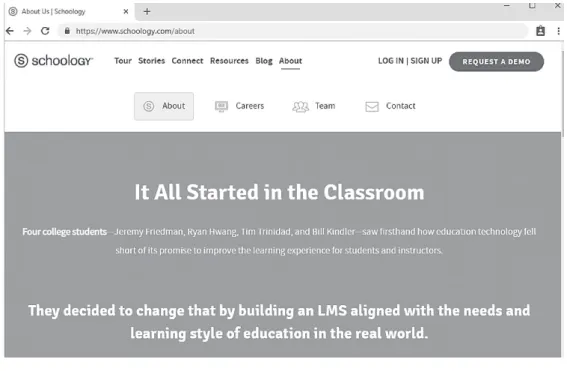
Figure 1 Schoology's "About Us" Page
Further explanation on the same page suggests that Schoology can “expand opportunities for learning,” “connect your institution,” and provide the opportunity to “collaborate on a global scale.”
The broader aim of the service, as stated on the “About Us” page (see Figure 1), is “… to change [shortcomings in education technology] by building an LMS aligned with the needs and learning style of education in the real world;” Schoology further emphasizes their development team's
“passion” to help “instructors and students have the best education experience possible” (“About Us,” n.d.). Overall, Schoology suggests that it can provide a wide array of resources and functionality for educators on a broad scale to enhance their students’ learning experience, with a particular focus on connectivity and mobility.
Support for these claims can be found in outside sources. Manning et al. (2011, p. 26), for example, state that Schoology “not only … [keeps] our teaching styles updated to the twenty-first century, but it also provides a bridge for teachers to learn new ways to connect to students’ learning styles.” They add that the LMS helps “students to be more involved in their schooling,”
encouraging more open conversations between students and educators and “promoting the community of the classroom hand-in-hand with the academic motives behind its use” (Manning et al., 2011, p. 26). Gonzalez specifically points to Schoology's “social-media-like style”
(2)as being particularly user-friendly for students who are typically already experienced with other social media services (2014, p. 36), which likely contributes to the increased student involvement noted by Manning et al. above.
Sicat finds Schoology to be an effective tool in the classroom, specifically when employed “as a supplement to the traditional method,” or in a “blended learning” environment (2015, pp. 174–175)
—broadly defined as an environment that “combine[s] face-to-face instruction with computer- mediated instruction” (Graham, 2005). Ardi explicitly “recommends that Schoology be incorporated in English language learning and teaching” based upon the results of their study, which demonstrates that Schoology helped provide “students with greater control over their [English for Academic Purposes] learning beyond the classroom, both in terms of the process and content of their learning” (2017, p. 74). Based on this brief literature review, Schoology appears to have demonstrated noteworthy value as a tool to be used within higher education, and thus merits further investigation.
Furthermore, with the recent push for the use of educational technology within Japanese university campuses and the increasingly vital need for students to become comfortable with information technology more broadly, Schoology may be particularly useful to educators working in Japan today. Indeed, the Ministry of Education, Culture, Sports, Science and Technology specifically cites “information-technology literacy” as one of the key example “competencies to be acquired through bachelor's degree” under the broader heading of “General-purpose Skills”
(MEXT, 2012), suggesting a concrete need for increased implementation of technology-based learning methodologies within the classroom. Given the sometimes reticent nature of Japanese educators to employ these methodologies—such as those reported by Imoto and Horiguchi (2015, p.
76)—this need competes with a preference for traditional practices, necessitating further research
actively detailing the uses and benefits of various learning technologies. The aim of this paper is to
make a preliminary step towards this end, ideally promoting further investigation into Schoology
and other LMSs for implementation in Japanese higher education.
Foundations for the Report
After being introduced to the service by a colleague, the author began implementing Schoology in order to manage their large number of students and courses in the 2018 academic year. On top of providing a potential management system that allows access to all courses and students relatively quickly and easily (see Figure 2)—a significant benefit especially for adjunct lecturers working in multiple university settings—Schoology also offers the possibility of a relatively paper- free classroom environment, adding ecological motivation to its original implementation by the author.
The author is currently implementing Schoology in five English courses at two private Japanese universities, encompassing a total of 85 students over two semesters. Students are primarily Japanese (64), with international students
(3)also represented (21). The author also uses the LMS in a further three courses, but due to these courses’ relatively informal nature and the small number of students in each (less than ten total), their data is not included in this report.
All of the English courses covered within this report focus primarily on Listening Skills, Speaking Skills, or a combination of the two. Reading and Writing skills are also engaged in the majority of these courses—Reading in all five, and Writing in three. Schoology was employed from the second week of the 2018 Spring Semester in all institutions and classes, respectively.
Primary Use
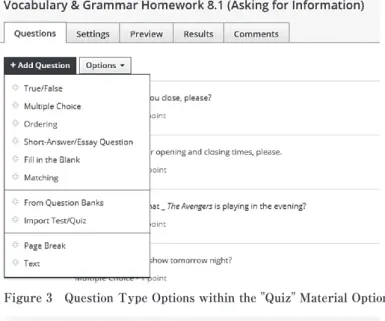
At present, Schoology is primarily used for homework assignments (see Figures 3 and 4); take- home quizzes and teacher-student communication functionality are also implemented to a limited degree. While analogue methods are employed as a failsafe, attendance functionality is also used.
Classroom work is carried out in a traditional manner based on textbook resources and analogue tools. Schoology is thus primarily used to fulfill the “assessment” and “feedback” components of
Figure 2 Schoology's Teacher Homepage with Course Access
the “electronically enhanced classroom” as detailed by Draper et al. (2002, p. 14), although mainly outside of the classroom in a review context, thus likely not achieving a truly “blended learning”
environment in which there is “effective integration of the two main components (face-to-face and Internet technology) such that [educators] are not just adding on to the existing dominant approach or method” (Garrison & Kanuka, 2004, p. 97).
Homework assignments are primarily assigned with the “quiz” functionality (see Figures 3, 4, and 5), and students are generally given multiple attempts to complete the homework, allowing and encouraging repeated attempts to master the material. The number of attempts possible is shown at the beginning of each assignment, as is the number of attempts that the student has already made (see Figure 5).
Figure 3 Question Type Options within the "Quiz" Material Option
Figure 4 An Example of a Homework Assignment on Schoology
Schoology seems particularly well-suited for English education in the Japanese setting based on preliminary data. The system is available both in English and Japanese (to a limited extent), making it accessible to Japan-based students with a variety of English ability levels. Furthermore, the quiz and assignment functionalities are readily adaptable to the needs of English education based on the author's experience. Reading, Writing, and Listening skills are all measurable and able to be practiced using the variety of assessment options available. While Speaking-based assignments may not yet be fully integrated with the present system due to a lack of explicit sound-recording functionality, the use of secondary systems, including students’ own personal software, can arguably be used to supplement this shortcoming. At present, however, the author relies entirely on face-to-face teaching in order to assess and assist with Speaking skills.
Preliminary Response
Based on this preliminary study, the author recommends the use of Schoology, primarily due to its ease and speed of feedback, the potential of individually-oriented assignments, and its high level of portability. This section reports on the author's experience with Schoology over the course of two semesters and provides a number of anecdotes concerning student engagement with the LMS, demonstrating its practical functionality and possibilities. While the scope of this preliminary report does not encompass a formal, wide-spread survey of students using Schoology, the author references events which appear to illustrate a variety of preliminary student response, and are thus useful for future reference.
Firstly, feedback to the majority of homework is immediate within Schoology, based upon a system in which answers are compared to an answer key provided when creating the assignment.
This allows students to see their scores without delay, providing quick confirmation as to whether or not they have understood the material (see Figure 6). This further saves the educator time which would otherwise be spent grading individual assignments, which is especially important for junior teachers without access to Teaching Assistants. Writing assignments—in the author's case, generally short-answer, open-ended questions focused on the implementation of grammar points and vocabulary covered throughout a lesson or unit—require manual grading, but still provide a more immediate feedback system, allowing students to see their results as soon as the educator has finished assessment instead of waiting until the next class period to receive a physically corrected assignment.
With the above-mentioned ability to allow students to repeat assignments, this immediate
Figure 5 A Preview of the Student's View of an Assignmentfeedback appears to inspire a certain degree of motivation in students who are determined to either (a) obtain good grades, (b) understand the material, or (c) both. As the author's decision to employ the
“Use Highest Grade” option within assignments allows multiple attempts while only recording the best score, it is possible that some students might take advantage and repeat assignments until they earn all perfect scores, a concern most prevalent in multiple-choice based assignments. However, the author works on the assumption that repetition, even inspired by the desire for higher grades instead of further learning, still serves the purpose of establishing patterns and fixing information within memory (Hintzman & Block, 1971, p. 297), thus ultimately, hopefully, promoting learning regardless of the students’ motivations.
(4)While not all students are willing to repeat assignments, a number of those involved in this study regularly make multiple attempts on their homework—
presumably based upon their recognition of a failure to understand the material provided by the immediate feedback allowed by the Schoology system. Therefore, the student response to the immediate feedback and related repeat-functionality of Schoology can be said to be generally positive.
Also of importance is Schoology's individually-oriented assignment functionality, which offers the possibility of student-based learning and the potential to incorporate students who must be absent from class. In the case of one student, extra assignments were used when they had to leave class early due to an unavoidable engagement. The author created an assignment based on the classwork the student would miss, and used the Schoology system to assign it individually. This functionality suggests a number of possibilities, particularly for make-up work, extra practice, and students who have multiple absences due to unavoidable circumstances such as illness or family concerns. Further study is required to ascertain the full variety of possibilities and practical use of this type of individually-oriented functionality.
Finally, the portability offered by the Schoology LMS is perhaps its greatest asset, for both
Figure 6 An Example of Feedback on Homework Assignmentsstudents and teachers alike. For students, given the widespread necessity of commuting in contemporary Japan, the portability of the overall Schoology system—primarily through its smartphone and application-based functionality—provides much-needed flexibility. While time at home may be limited due to part-time work and/or long commutes, students are still able to complete assignments and study when it otherwise would have been difficult due to the practicalities of completing written assignments or using bulky physical materials on public transportation. Although the author hesitates to suggest that students should be encouraged to be constantly engaged with their education, the portability of Schoology does provide opportunities for students who actively desire further engagement with the material or, perhaps more practically, students who realize belatedly on the way to a class that they have forgotten to complete their assignments. Furthermore, given that Schoology can be accessed through smartphones, students do not have to keep track of multiple physical assignments, diminishing the possibilities of “lost” or misplaced homework, or the inability to complete assignments due to having forgotten the physical copies at home or at the university. It further offers the possibility of completing any given assignment at any time, without the necessity of carrying each item individually.
For teachers, this portability allows for quick and easy assignment editing, grade confirmation, and student messaging, regardless of physical location. This further allows for the system to move with the educator between institutions, a feature particularly helpful for teachers working simultaneously at multiple universities. Furthermore, portability is not only a feature of the Schoology LMS as a whole, but also of the assignments created within it. Homework assignments and quizzes are easily duplicated and transferred between courses, making every assignment fully portable within the system once it has been created. This allows for easy re-use of successful assignments within classes covering similar topics, which provides the teacher with more time to develop new material and engage with students. Given the above, it is arguable that portability is Schoology's greatest asset for students and teachers alike.
There are also, however, negative responses to be taken into account. One student, in explaining why they had forgotten to complete their homework, suggested that online work is not as adept in promoting the “incentive” (yaruki, やる気 ) to complete assignments as compared to paper-based work. Another temporarily refused to complete assignments online, insisting that they would only complete paper assignments. This is an issue that needs to be addressed, especially with students who have previously only dealt with analogue work.
It must be noted, however, that these issues may not necessarily be LMS-based, but rather the LMS in these instances is being used to excuse tendencies that would manifest regardless of learning format. A related issue is that an LMS does not remedy a lack of student incentive in general, and many students require repeated prompting to complete homework assignments.
Again, however, this is not limited to LMS use, but is instead an issue that involves higher education as a whole. Further work to address these drawbacks is recommended.
Recommendations to Educators
Based on experience with Schoology over the course of two semesters, there are two explicit
recommendations the author proposes for educators looking to implement this system.
First, it is highly recommended that educators spend time both explaining and demonstrating how to use Schoology to students. This is especially relevant in many Japanese classrooms, where students are not necessarily familiar with the use of personal computers or smartphones for non- application-based functionality.
(5)This would ideally go beyond a basic introduction of how to sign up for the service and register to a specific course, and also involve how to set up smartphone and e-mail notifications (to remind students to complete assignments, and further notify them of updates or announcements, see Figure 7), how to complete assignments of varying styles, and how to send messages to the educator should problems arise.
Second, it is recommended that the educator also spend time becoming familiar with Schoology and its various functionalities. To a certain extent, this may be limited by educators’ schedules, but a basic understanding of a majority of the features is desirable before an educator attempts to utilize Schoology within the classroom. This extends to all LMSs, including those that are institution-based.
Due to the preliminary nature of this report, this is an incomplete list. Further study and experience with Schoology will undoubtedly yield further recommendations.
Preliminary Conclusions
While this is only a preliminary study, the author concludes that the Schoology LMS has demonstrable use within the Japanese higher education system. Although an early learning-curve and the issue of student “incentive” may provide problems to educators and students, the overall benefits of Schoology, including ease and speed of feedback, individually-oriented possibilities, and portability, combined with an increasing need for students to become comfortable with information technology, serve to outweigh these weaknesses overall. The author tentatively recommends wider usage of Schoology as one possible LMS within the Japanese higher education system, particularly within English-language courses.
Figure 7 Notification Settings on Schoology
Recommendations for Future Study
There remains a great deal to be explored concerning the implementation of LMSs such as Schoology in the Japanese higher education environment. Two concrete recommendations for future study are as follows.
First, it is recommended that future studies involve more direct surveys of students currently using LMSs in a variety of contexts, such as those implemented by Banditvilai for student feedback on a different system incorporated within a blended learning environment (2016). While an educator's experience is valuable, the experience of the students is perhaps paramount for an assessment of the actual value of LMSs within Japanese universities.
Second, it would be useful to compare Schoology with other LMSs, including those which are institution-based, in order to ascertain the relative value of the Schoology system in comparison to others. This would potentially lead to the possibility of a more universal LMS—whether Schoology or collaboratively institution based—and an increased ease of implementation for educators and students alike.
References
About Us. (n.d.). Retrieved June 30, 2018, from https://www.schoology.com/about
Ardi, P. (2017). Promoting Learner Autonomy through Virtual Learning Environments. Teaching English with Technology, 17(11), 55–76.
Banditvilai, C. (2016). Enhancing Students’ Language Skills through Blended Learning. The Electronic Journal of E-Learning, 14(3), 223–232.
Draper, S., Cargill, J., & Cutts, Q. (2002). Electronically enhanced classroom interaction. Australian Journal of Educational Technology, 18(1), 13–23. https://doi.org/10.14742/ajet.v18i1.1744
Garrison, D. R., & Kanuka, H. (2004). Blended learning: Uncovering its transformative potential in higher education.
Internet and Higher Education, 7(2), 95–105. https://doi.org/10.1016/j.iheduc.2004.02.001
Gonzalez, A. (2014). Strategies to Get Started with Blended Learning. Voices from the Middle, 22(2), 34–38.
Graham, C. R. (2005). Blended Learning Systems: Definition, Current Trends, and Future Directions. In The Handbook of Blended learning: Global Perspectives, Local Designs. San Francisco: Pfeiffer.
Hintzman, D. L., & Block, R. A. (1971). Repetition and Memory: Evidence for a Multiple-Trace Hypothesis. Journal of Experimental Psychology, 88(3), 297–306.
Imoto, Y., & Horiguchi, S. (2015). Bringing a European Language Policy into a Japanese Educational Instution: The Contested Field of Institutional Foreign-Language Education Reform. In S. Horiguchi, Y. Imoto, & G. S. Poole (Eds.), Foreign Language Education in Japan: Exploring Qualitative Approaches (pp. 65–84). Rotterdam: Sense Publishers.
Learning Management System | LMS | Schoology. (n.d.). Retrieved June 30, 2018, from https://www.schoology.com/
Manning, C., Brooks, W., Crotteau, V., Diedrich, A., Moser, J., & Zwiefelhofer, A. (2011). Tech Tools for Teachers, By Teachers: Bridging Teachers and Students. Wisconsin English Journal, 53(1), 24–28. Retrieved from http://
journals.library.wisc.edu/index.php/wej/article/viewFile/379/444
MEXT. (2012). Higher Education in Japan. Tokyo, Japan. Retrieved from http://www.mext.go.jp/en/policy/
education/highered/title03/detail03/__icsFiles/afieldfile/2012/06/19/1302653_1.pdf
Sicat, A. S. (2015). Enhancing college students’ proficiency in business writing via Schoology. International Journal of Education and Research, 3(1), 159–178. Retrieved from http://www.ijern.com/journal/2015/January-2015/14.pdf The Next Step in LMS Evolution | Higher Ed. (n.d.). Retrieved June 30, 2018, from https://www.schoology.com/higher-ed (1) https://www.schoology.com/ Note
(2) Gonzalez specifically compares Schoology to Facebook, although the similarities appear to have decreased as of 2018.
(3) East Asian, Southeast Asian, South Asian, and Eastern European.
(4) This is why the author assigns relevant homework after the content has been taught in class, in the hopes that students understand the premise of all assignments given based on face-to-face instruction before attempting them.
(5) Based on an overall lack of technological literacy encountered over the course of this study, a class covering general technological literacy is recommended for all university students, ideally in their first semester. This is not limited to students whose educators plan on using LMSs.