8
Trends in French Science, Technology, and Innovation Policy
— The MINATEC Industry-Academia-Government Nanotechnology Innovation Center Project —
ATSUSHI OGASAWARA
Information and Communications Research Unit
8.1 Introduction
In recent years, Europe has joined the United States and Japan as an active base for nanotechnology research and development.
Among the Europeans, France determined its basic science and technolog y policy within an inter minister ial committee on science and technology created in July 1998 and chaired by then-Prime Minister Lionel Jospin. In October, The National Science Council was for med with representatives of industr y, academia, and government. Since then, France has seen rapid development of fields of emphasis, budgeting, and large-scale refor ms of its public research institutions.
In June 1999, the government determined the following fields as high priority.
1) Life sciences
2) Information and communications technology (ICT)
3) Humanities and social science 4) Energy and transportation
5) Earth/environmental sciences, space
Within these fields, nanotechnology receives great emphasis as a base technology for the life sciences and ICT.
The passa ge of the Law on Innovation and Research loosened regulations restricting the commercial activities of researchers at public research institutions. At the same time, the National Center for Scientific Research (CNRS) underwent reforms including stronger ties with universities, the National Science Fund (FNS) was
established to provide funding, the Research and Technology Fund (FRT) was upgraded, and a committee was set up to oversee the high-priority areas.
The Center for Innovation in Micro and Nanotechnology-MINATEC (Pole d'Innovation en Micro et Nanotechnologies) is a joint industry- academia-government project connected with this trend of major reforms in science, technology, and innovation policy.
Centered around CNRS (National Center for Scientific Research), CEA-LETI (Atomic Energy Commission-Electronics and Infor mation Technology Laboratory), INPG (Institut National Polytechnique de Grenoble), and department government agency AEPI (Agence d'Etude et de Promotion de l'Isere), the project is creating an international research and development base cover ing a broad ar ray of micro and nanotechnologies for industr y, academia, and government.
With a 150 million Euro budget for the five years 2001-2005 (note that that is the budget for construction of the Innovation Center, not the total research budget), seven facilities will be built on a 60,000 m2 site within the Grenoble national research park in southeastern France (total area:
80,000 m2).
This project features an inside strategy that integrates basic and applied research with business startups through industr y-academia- gover nment cooperation. This has included advanced nanotechnolog y such as carbon nanotube devices and single electron devices, as well as microtechnology such as MEMS, biochips, semiconductors, and optics.
Since 1998, France has strengthened cooperation
among industr y, academia, and government, reformed its national research institutes, made a strategic shift away from nuclear power in its physics research, and added a vision of regional growth. MINATEC is thus also worthy of attention as a microcosm of France's new policies on science, technology, and innovation.
8.2 Background:
Characteristics of Grenoble
A number of European and French national research institutes are located in the Grenoble area, which is also home to numerous joint
projects between corporations and the research centers of scientific and technical universities.
Seventeen thousand researchers are employed at industr y, academic, and government research organs in the area. (Four thousand of them are in the private sector and 13,000 in the public sector.
Seven thousand work in applied research, while 10,000 work in basic research.)
Looking at the details of public sector research institutions, international research institutes such as ESRF (European Synchrotron Radiation Facility) and EMBL (European Molecular Biolog y Laboratory) employ 1,150 people, while French national research organs such as CEA (French
Table 1:Employees of public research institutions in Grenoble
International Centers National Centers University research
ESRF 500 CEA 3,000 UJF 2,300
ILL 400 CNRS 1,400 INPG 1,230
GHFML 100 INSERM 2,970
EMBL 55 F.T. R&D 350
IRAM 90 CRSSA 300
INRIA 330
Total 1,145 8,350 3,530
*Abbreviations:
International Centers
ESRF European Synchrotron Radiation Facility ILL Institut Laue-Langevin
GHFML Grenoble High Magnetic Field Laboratory EMBL European Molecular Biology Laboratory IRAM Institute of Millimetric Radioastronomy National Centers
CEA Atomic Energy Commission
CNRS National Center for Scientific Research INSERM French Institute of Health and Medical
research
F.T. R&D France Telecom Research and Development
CRSSA Research Center of the Army Health Services
INRIA National Institute for Research into Information Technology and Automation University Research
UJF Joseph Fourier University
INPG Institut National Polytechnique de Grenoble Source: Pole University - data for 2000
Table 2:Researchers in private corporations in Grenoble
Enterprises Jobs Nationality Activity
ST Microelectronics 1,000 France, Italy Semiconductor
Schneider Electric 450 France Electric Equipment
Hewlett-Packard 400 USA IT
Lafarge 350 France Cement
Pechiney 300 France Aluminum
Bull 230 France IT
Sun Microsystems 200 USA IT
Air Liquid 150 France Chemicals
Xerox Research Center Europe 120 USA IT
. . . . . .
~ 4,000
Note: Includes only corporations with at least 100 employees.
Source: Author’s compilation on the basis of AEPI materials.
Atomic Energy Commission) and CNRS (National Center for Scientific Research) employ 8,350, and university research facilities employ 3,500.
College and univer sity students in the area number 52,000, including those attending four universities that include INPG (Institut National Polytechnique de Grenoble), one of MINATEC's core institutions, and Joseph Fourier University, which focuses primarily on science and medicine, as well as business and teacher-training schools.
8.3 The perspective of regional scientific and technical policy
France is organized into 22 regions, which are further subdivided into 96 departments. Grenoble is located in the department of Isere in the region of Rhone-Alpes. Populations are as follows (see Table 3).
At 43,700km2, the area of Rhone-Alpes is equivalent to that of Switzerland, Belgium, or the Netherlands, while the population equals that of Denmark or Ireland.
Within the Rhone-Alpes region, the department of Isere, with its concentration of research institutes, demonstrates extremely high growth in innovation. Table 4 shows the number of international patents received.
The number of international patents in Isere grew rapidly between 1998 and 1999. This can be seen as a result of the loosening of regulations preventing publicly-employed researchers at public institutions from starting businesses or
working on the side, as mentioned Section 8.1.
While this result can be seen as peculiar to Grenoble with its concentration of public research institutes, the skillful joining of industry, academia, and government has been vital in making it a driving force of the local economy.
8.4 The system for accelerating industry-academia-
government cooperation
National policy had already concentrated government and academic research institutions in the Grenoble area, but simply locating facilities near each other was not sufficient to promote industry-academia-government cooperation. Many of France's major corporations were operated by the government. Cultural traditions included little awareness of entrepreneurism, and a sudden change to a U.S.-style environment was not possible. While there were many major differences, the environment was rather similar to that of Japan.
To promote industr y-academia-gover nment cooperation under such conditions, it is considered important to provide motivation within the project system for voluntar y cooperation. For example, systems were put in place to cause corporations to feel the necessity of cooperation with university and government research institutes, to instill an entrepreneurial spirit in students, and to provide early returns on investment so that investor s could act with confidence.
We will examine each of these perspectives in turn.
— Investors
MINATEC under takes not only futur istic nanotechnology research, but also research on microtechnolog y that is cur rently being commercialized.This enables investors to diversify risk across short-term and long-term research.
MINATEC also offers the advantages of investment that holds a high probability making a transition from microtechnology to nanotechnology and that of fer s an early retur n on investment in microtechnology.
Table 3:Population France 60.42 million Rhône-Alpes 5.68 million Isére 1.10 million
Source: AEPI materials
Table 4:International Patents
Patents Fields 1998 1999 Growth rate
France 13,251 13,592 2.6%
Rhône-Alpes 1,512 1,536 1.6%
Isére 235 314 33.6%
Source: AEPI materials
— Corporations
Similarly, by positioning research agendas not only in futuristic nanotechnology but also in current microtechnology, those in areas that do not initially require the advanced physics background of semiconductor miniaturization, for example, can still obtain the necessary advanced physics background for nanoscience as generations are replaced. Engaging in joint research with national laboratories at the micro stage can enable a smooth transition to nanotechnology in the future.
(This is because the transition to the nano level will not be linear, but will be a non-linear process based on technological breakthroughs.)
For universities, the concentration of outstanding science and engineering undergraduates and graduate students enables them to establish a pool of human resources.
— Universities
From the per spective of univer sities, a concentration of corporations simplifies the search for research par tner s. Because many European funding sources require corporate par tner s for applied research, this is quite necessary. While exploratory research does not necessarily require a partner, such funding often has one-year time limits or other restrictions.
Showing students the entrepreneurial process up close is considered to be a vital task for universities. As mentioned above, unlike the USA,
France has had a history of nationalized industry, and the entrepreneurial mindset has yet to fully f lower. Having students obser ve venture companies formed through spin-offs from large corporations and star t-ups from national laboratories will help to foster such a mindset.This will stimulate spontaneous start-ups.
In addition to the creation of the above systems to motivate industr y-academia-gover nment cooperation, consideration was also given to construction of buildings.
Currently, national laboratories, universities, and research parks where corporations are concentrated are all located in separate buildings in different areas, although they can all be reached within 10 minutes by trams running between them. Even 10 minutes, however, is considered too distant to facilitate industry-academia-government cooperation, and a system is being constructed that will combine the buildings themselves into a single location.
As is shown in Figure 1, MINATEC itself will be sur rounded by wings for national research institutes, for university engineering departments, and for corporate research, with per sonnel allowed to pass freely among them. Provisions are made so that meetings and seminar s among industry, academia, and government can be held at any time.
Locating these research facilities near the center
Source: Based on CEA-LETI materials Figure 1:MINATEC building layout
of the city not only facilitates free interaction among the research institutions and universities, it creates a very congenial living environment for researcher s through integration with their lifestyles.
While in Japan new facilities are generally constructed outside of city centers, MINATEC is being built on the site of old CEA facilities that have been torn down.
To attract and retain outstanding researchers, it is considered vital to provide not only for the convenience of the researchers, but also for the comfort of their families.
Grenoble is a highly accessible city. Lyon, France's second city, is less than an hour away by train, while Paris can be reached in three hours on the TGV. International airports in Lyon and Geneva, Switzerland, are only an hour's drive away.
There is much to be learned from the structure of these systems for attracting researcher s, corporations, and investors and leading them naturally and inevitably towards industr y- academia-government cooperation.
The positioning of such cooperation not as an end in itself but as a means leading inevitably to the promotion of research and development is vital.
8.5 The role of
international researchers
Along with the series of reforms to its science and technology policy (fields of emphasis, reform of national research institutions, loosened regulations for researchers, strengthened industry-academia- government cooperation) it implemented in 1998 and 1999, France has made active efforts to attract international researchers through steps such as an expanded plan to accept post-doctoral researchers.
The role of inter national researcher s and exchange students at MINATEC is also a very important one. Currently there are approximately 6,000 researchers and students from foreign countries in the Grenoble area, and they are an impor tant motivating force for fur ther ing research.
While there are concerns about technology outflow, the benefits are believed to far outweigh any possible losses through such outflow. These
benefits include not only the diversification and vitalization of research accompanying researchers from other cultures, but also, from a more utilitarian point of view, access to the management techniques and entrepreneurial expertise of countries such as the USA that are as advanced in business as they are in research and development.
Various steps are taken to retain international researchers. A language school teaching in six languages is located at Grenoble's national railway train station, so that those who have not already studied French may begin doing so.The families of researchers may also take advantage of primary school instr uction in four langua ges and secondary school instruction in six at no charge.
8.6 Attracting
foreign corporations
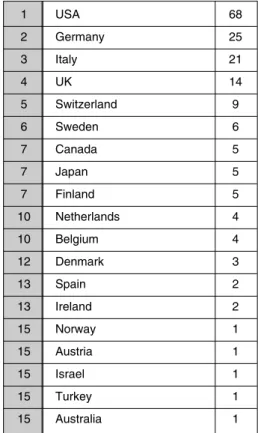
As shown in Table 2, 3 of the top 10 private sector corporate laboratories in Grenoble belong to American corporations. Hewlett-Packard, Sun Microsystems, and Xerox are all leading companies in the USA.
International developments in Grenoble are not limited to France and Europe. US corporations
Table 5:Foreign corporations in Grenoble
Source: AEPI materials
1 USA 68
2 Germany 25
3 Italy 21
4 UK 14
5 Switzerland 9
6 Sweden 6
7 Canada 5
7 Japan 5
7 Finland 5
10 Netherlands 4
10 Belgium 4
12 Denmark 3
13 Spain 2
13 Ireland 2
15 Norway 1
15 Austria 1
15 Israel 1
15 Turkey 1
15 Australia 1
have been actively making use of Grenoble's research resources.
This not only shows the importance the French government attaches to foreign direct investment (FDI) in research and development in France, it also demonstrates the active efforts made to recruit international researchers and an awareness of the importance of international resources.(see Table 5)
8.7 Alliances with
foreign research institutions
In addition to utilizing international research resources by recruiting international researchers and attracting foreign corporations, MINATEC has also for med alliances with several research institutions outside of France.
Particularly noteworthy are links with IMEC in Belgium, SEMATEC in the USA, and CSEM (Swiss Center for Electronics and Micro Technology) in Switzerland.
Cooperation with IMEC and SEMATEC focuses on research into next-generation semiconductor and device technologies. ASML (Netherlands), which along with Nikon and Canon is the leader in lithography technology, the key to semiconductor micromachining, has a laboratory in Grenoble. No doubt they, as well as the Americans and Japanese, are engaged in advanced research. They bear continual watching.
CSEM is a leader in the MEMS and micromachining technologies that are garnering so much attention now. The y have been contracted to build micromachines for NASA's Mars exploration satellite.They also cannot be overlooked.
8.8 Research at CNRS
Having given an overview of the MINATEC project and the foundations of research in Grenoble, in this section we will discuss research at CNRS, a major player in MINATEC.
CNRS operates MINATEC along with CEA-LETI, another core national research laboratory, but their research agendas differ somewhat. While CEA-LETI focuses more on relatively applied fields such as electronic devices, CNRS is involved with the more academic fields of nanoscience.
The CNRS research agenda includes:
* Carbon nanotubes
* Single-electron transistors
* Nanomagnetics
* Nano-optics
* Nanomanipulation
* Microrobotics
* Microfluidics
Currently the most attention is being given to carbon nanotubes. CNRS carries out research into interconnection through the self-organization of carbon nanotubes and other areas closely related to their basic physical properties. They are also engaged in advanced research in fields adjacent to nanomeasurement, such as the utilization of synchrotron radiation.
8.9 Research at CEA-LETI
As noted above, CEA-LETI research tends to be in applied fields such as:
* Silicon device technology
* Optical device technology
* Information and communications technology
* MEMS technology
* Biotechnology (DNA chip technology, nano- biodevice technology)
* Molecular device technology
* Carbon nanotube devices
In the same field of carbon nanotube technology, for example, they are working on turning them into actual devices. The y have already demonstrated an emitter for field emitting displays (FEDs).
The y are researching not only ICT-related nanotechnologies, but also a broad range of fields combining biotechnology with nanotechnology, from DNA chips to nanobiology.
8.10 Conclusion
Having thus introduced the MINATEC project, two things stand out above all else. They are its consistency with the reforms in science and technology and innovation policies, and the logical
and dynamic way in which the planned project is being run.
As far as research standards are concerned, Japan leads France in more areas than not. France longs for the participation of Japanese researchers, laboratories, and corporations in the carbon nanotube field it is paying so much attention to.
However, having once lagged alongside Japan in industry-academia-government cooperation to promote research and development, France is now rapidly developing high-tech ventures start-ups and distancing itself from Japan in that area.
That is because moving research and development forward depends not only on research standards, but also ver y much on project and research management.
France is steadily implementing policies to form a
base for research by loosening the restrictions preventing national laboratory researchers from doing other work or starting companies, by utilizing international researchers, by seeking FDI, by forming alliances with research institutions in other countries, by forming partnerships, and by providing tax incentives for pr ivate-sector corporate research and development. Details of motivation and synergies are being studied and considered, and dynamic systems are being constructed.All of this is very meaningful.
What is important is that industr y-academia- government cooperation is not an end in itself. It is a means of promoting research and development through a dynamic system that naturally leads to such cooperation.
(Original Japanese version: published in March 2002)