HETEROCYCLES, Vol. 101, No. 1, 2020, pp. 339 - 346. © 2020 The Japan Institute of Heterocyclic Chemistry Received, 21st June, 2019, Accepted, 16th July, 2019, Published online, 7th August, 2019
DOI: 10.3987/COM-19-S(F)26
INTRAMOLECULAR OXA-MICHAEL REACTIONS OF ALDOLS GENERATED FROM ENONES AND ISATINS TO AFFORD SPIROOXINDOLE TETRAHYDROPYRANS
Maira Pasha, Muhammad Sohail, and Fujie Tanaka*
Chemistry and Chemical Bioengineering Unit, Okinawa Institute of Science and Technology Graduate University, 1919-1 Tancha, Onna, Okinawa 904-0495, Japan. E-mail: [email protected]
Abstract – Spirooxindole derivatives are found in bioactive natural products and are used in drug discovery and related research. Here, acid-catalyzed diastereoselective intramolecular oxa-Michael cyclization reactions of
-hydroxyenones generated from enones and isatin derivatives that afford spirooxindole tetrahydropyrans are reported. The major diastereomers of the products of these reactions were previously difficult to access by the amine-catalyzed hetero-Diels-Alder reactions of enones with isatins. With the use of enantiomerically enriched forms of the starting materials in the reactions, enantiomerically enriched spirooxindole tetrahydropyrans that retained the enantiopurities of the starting materials were obtained.
Spirooxindole derivatives are found in bioactive natural products and pharmaceuticals,1 and the development of methods for the synthesis of spirooxindole derivatives is of interest in drug discovery efforts.1-4 To address this demand, we have recently developed oxa-hetero-Diels-Alder reactions of enones and isatins catalyzed by amine-based catalyst systems to afford functionalized spirooxindole tetrahydropyran derivatives (Scheme 1a).3-5 With the use of the enantioselective versions of the catalyst systems, the hetero-Diels-Alder reaction products were obtained with high diastereo- and enantioselectivities when the enones were alkyl enones or substituted-alkyl enones.3-5 Using these reactions, however, only the spirooxindole tetrahydropyran derivatives with the same relative stereochemistries were accessible as the major products. Here we report a route to synthesize the previously minor diastereomers as the main products. We report the development of intramolecular oxa-Michael reactions of -hydroxyenones or aldols generated from enones with isatin derivatives that
HETEROCYCLES, Vol. 101, No. 1, 2020 339
afford sprooxindole tetrahydropyrans in which the major product diastereomers have relative stereochemistries different from those of the major product diastereomers in the previously reported hetero-Diels-Alder reactions of enones with isatins3-5 (Scheme 1b).
Scheme 1. (a) Previously reported oxa-hetero-Diels-Alder reactions of enones with isatins catalyzed by amine-based catalyst systems.3-5 (b) Intramolecular oxa-Michael reactions of -hydroxyenones or aldols generated from enones with isatin derivatives reported here.
In our previously reported oxa-hetero-Diels-Alder reactions of enones with isatins (Scheme 1a), various amine-based catalysts were tested during the development.3-5 In these previous oxa-hetero-Diels-Alder reactions (Scheme 1a, R1 = alkyl and substituted-alkyl groups), the diastereoselectivities were ranged from >20:1 to 1:1.3-5 To synthesize diastereomers with relative stereochemistry different from that of the major product diastereomers of the previous oxa-hetero-Diels-Alder reactions of enones with isatins, we tested a two-step route involving an aldol reaction and an acid-catalyzed intramolecular oxa-Michael cyclization reaction.6 Because aldol reactions of enones with isatins and with isatin derivatives have been reported,3,7,8 including enantioselective versions,7 we focused on the development of the intramolecular oxa-Michael reactions of the -hydroxyenones that are obtained from aldol reactions of enones with isatin derivatives (Scheme 1b).
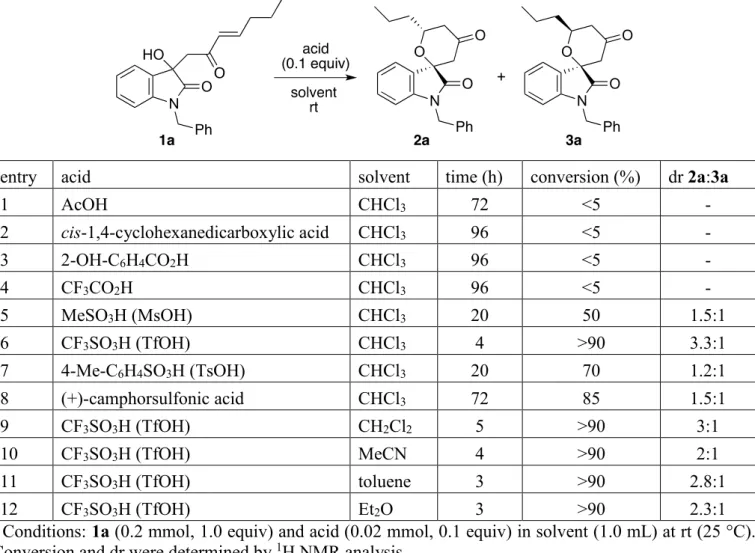
First, the intramolecular oxa-Michael reaction of aldol 1a was evaluated using various acidic conditions to afford spirooxindole tetrahydropyran derivative 2a (the desired diastereomer) and its diastereomer 3a3,4
340 HETEROCYCLES, Vol. 101, No. 1, 2020
(Table 1). Previously reported catalysts used for intramolecular oxa-Michael reactions of
-hydroxyenones (non-oxindole derivatives) via 6-endo-trig cyclization include Pd-based catalysts, Ag-based catalysts, amberlyst, BF3·Et2O, and Me3SiSO3CF3.6 We started our search for acid catalyst systems for the reaction of 1a to give 2a without the use of metals.
Table 1. Evaluations of the acid catalysts and conditions for the reaction of 1a to form 2aa
entry acid solvent time (h) conversion (%) dr 2a:3a
1 AcOH CHCl3 72 <5 -
2 cis-1,4-cyclohexanedicarboxylic acid CHCl3 96 <5 -
3 2-OH-C6H4CO2H CHCl3 96 <5 -
4 CF3CO2H CHCl3 96 <5 -
5 MeSO3H (MsOH) CHCl3 20 50 1.5:1
6 CF3SO3H (TfOH) CHCl3 4 >90 3.3:1
7 4-Me-C6H4SO3H (TsOH) CHCl3 20 70 1.2:1
8 (+)-camphorsulfonic acid CHCl3 72 85 1.5:1
9 CF3SO3H (TfOH) CH2Cl2 5 >90 3:1
10 CF3SO3H (TfOH) MeCN 4 >90 2:1
11 CF3SO3H (TfOH) toluene 3 >90 2.8:1
12 CF3SO3H (TfOH) Et2O 3 >90 2.3:1
a Conditions: 1a (0.2 mmol, 1.0 equiv) and acid (0.02 mmol, 0.1 equiv) in solvent (1.0 mL) at rt (25 °C).
Conversion and dr were determined by 1H NMR analysis.
Carboxylic acid derivatives, such as acetic acid, salicylic acid, and trifluoroacetic acid, did not catalyze the formation of 2a and/or 3a from 1a in CHCl3 at room temperature (25 °C) (Table 1, entries 1-4). In the presence of sulfonic acid derivatives, such as methanesulfonic acid (MsOH), trifluoromethanesulfonic acid (TfOH), and p-toluenesulfonic acid (TsOH), 2a was obtained as the major diastereomer (Table 1, entries 5-8). Solvents were also evaluated for the reaction (Table 1, entries 9-12). As the result, the TfOH-catalyzed reaction in CHCl3 provided the best results among those tested with respect to the diastereoselectivity (dr 2a:3a = 3.3:1) (Table 1, entry 6). NMR analysis of 2a indicated that product 2a has the same relative stereochemistry as the minor diastereomer derived from the previously reported oxa-hetero-Diels-Alder reaction of the enone and isatin.3,4
HETEROCYCLES, Vol. 101, No. 1, 2020 341
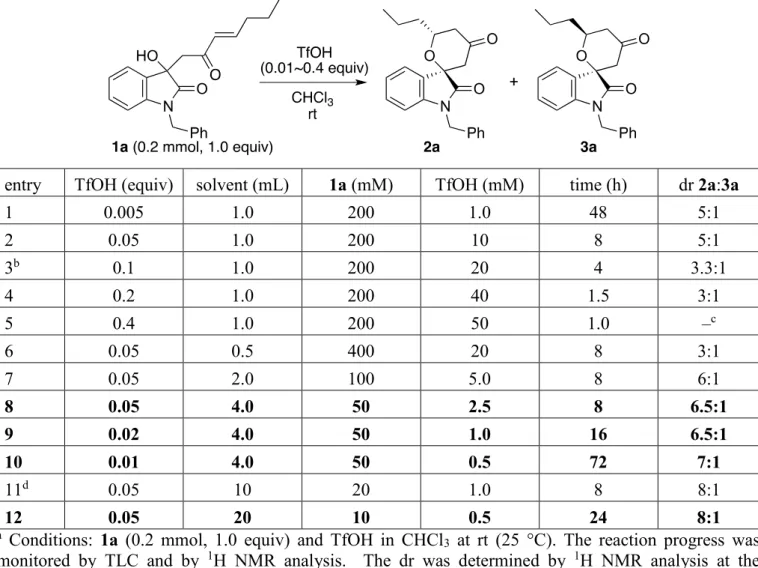
Table 2. Evaluations of conditions for the TfOH-catalyzed reaction of 1a to form 2aa
entry TfOH (equiv) solvent (mL) 1a (mM) TfOH (mM) time (h) dr 2a:3a
1 0.005 1.0 200 1.0 48 5:1
2 0.05 1.0 200 10 8 5:1
3b 0.1 1.0 200 20 4 3.3:1
4 0.2 1.0 200 40 1.5 3:1
5 0.4 1.0 200 50 1.0 –c
6 0.05 0.5 400 20 8 3:1
7 0.05 2.0 100 5.0 8 6:1
8 0.05 4.0 50 2.5 8 6.5:1
9 0.02 4.0 50 1.0 16 6.5:1
10 0.01 4.0 50 0.5 72 7:1
11d 0.05 10 20 1.0 8 8:1
12 0.05 20 10 0.5 24 8:1
a Conditions: 1a (0.2 mmol, 1.0 equiv) and TfOH in CHCl3 at rt (25 °C). The reaction progress was monitored by TLC and by 1H NMR analysis. The dr was determined by 1H NMR analysis at the conversion was >80%, except as noted. b Data from Table 1, entry 6. c Not determined; 1H NMR analysis indicated formation of byproducts. d Conversion 70%.
To improve the diastereoselectivity for the formation of 2a in the reaction of 1a, effects of loading of TfOH and of concentrations of 1a and TfOH were evaluated (Table 2). Under the conditions with the same concentration of starting material 1a, the reaction with higher loading (and thus higher concentration) of TfOH was faster than the reaction with lower loading (lower concentration) of TfOH;
however, the reaction with lower loading of TfOH yielded the product with higher diastereoselectivity than did the reaction with higher loading of TfOH (Table 2, entries 1-5, and entries 8-10). With respect to the diastereoselectivity, reaction rate, and solvent amount, conditions used in Table 2, entries 8-10 were optimal to obtain 2a.
Next, the scope of the acid-catalyzed intramolecular oxa-Michael reactions of 1 to afford 2 was evaluated (Table 3). In the presence of TsOH (0.01~0.05 equiv), various spirooxindole tetrahydropyran derivatives 2 and the minor products 3 were obtained. Although the diastereoselectivity of the reaction
342 HETEROCYCLES, Vol. 101, No. 1, 2020
depended on conditions and the structure of 1, based on the comparison of the NMR chemical shifts of the major diastereomers 2 and the minor diastereomers 3 with those of 2a and 3a and of 2b and 3b, the relative stereochemistries of major diastereomers 2c-2k were assigned as shown in Table 3.
Table 3. Scope of the TfOH-catalyzed intramolecular oxa-Michael reaction of 1 to afford 2a
a Conditions: 1 (0.2 mmol) and TfOH (0.01, 0.05, or 0.02 equiv as indicated) in CHCl3 (4.0 mL) at rt (25 °C); dr (2:3) was determined by 1H NMR analysis before purification; isolated yield of 2 is shown except where noted. b TfOH (0.01 equiv). c TfOH (0.05 equiv). d TfOH (0.02 equiv). e 1 (0.1 mmol) in CHCl3 (2.0 mL). f The dr was not determined.
HETEROCYCLES, Vol. 101, No. 1, 2020 343
A 1.0 mmol-scale reaction of 1a in the presence of TfOH (0.01 equiv) also afforded the result (96 h, 2a 82%, 3a 9%) similar to that of the 0.2 mmol-scale reaction of 1a shown in Table 3, suggestting that the reactions of 1 to afford 2 are readily scaled up.
When products 2a, 2a/3a (3:1), and 3a were respectively treated with TfOH in CHCl3 under the reaction conditions used for the formation 2a from 1a, no changes such as isomerization between the diastereomers, the formation of aldol 1a, or the formation of dienone derivatives8,9 (water-eliminated products from 1a) were detected (see Supporting Information). These results indicate that products 2a and 3a are kinetically formed from 1a in the presence of TfOH under the oxa-Michael reaction conditions and that the products are stable under the conditions.
To obtain enantiomerically enriched products 2, reactions of enantiomerically enriched starting materials 1 were examined. When an enantiomerically enriched form of 1a (er 94:6) was used as the starting material in the TfOH-catalyzed reaction, product 2a was obtained with retaining the enantiopurity (er 94:6) (Scheme 2). Similarly, the reaction of 1b (er >99.5:0.5) afforded 2b (er >99.5:0.5) (Scheme 2).
These results indicate that there is no racemization of 1 or of 2 under the TfOH-catalyzed reaction conditions. With the use of enantiomerically enriched 1, products 2 retaining the same enantiopurity were obtained.
Scheme 2. Intramolecular oxa-Michael cyclization reactions of enantiomerically enriched forms of 1
In summary, we have developed intramolecular oxa-Michael reactions that afford spirooxindole tetrahydropyran derivatives, in which the relative stereochemistry of the major diastereomer is different
344 HETEROCYCLES, Vol. 101, No. 1, 2020
from that of the major diastereomer accessed by previously reported amine-catalyzed oxa-hetero-Diels-Alder reactions. Enantiomerically pure forms of the products were obtained when enantiomerically pure aldol was used as the starting material. With the intramolecular oxa-Michael reactions described here and with the previously reported oxa-hetero-Diels-Alder reactions of enones and isatins, both of each diastereomer of the spirooxindole tetrahydropyran derivatives can be selectively synthesized.
EXPERIMENTAL
General procedure for the reaction of 1 to afford 2 in the presence of TfOH (0.05 equiv). To a solution of 1 (0.2 mmol) in CHCl3 (4.0 mL), TfOH (0.57 M in THF, 17.6 µL, 0.01 mmol) was added at rt (25 °C), and the mixture was stirred at the same temperature until 1 was completely or almost completely consumed as monitored by TLC. A portion from the mixture was diluted with CDCl3 and analyzed by
1H NMR to determine the dr. The entire reaction mixture was directly purified by silica gel flash column chromatography (hexane/EtOAc) to give 2.
ACKNOWLEDGEMENTS
We thank Dr. Michael Chandro Roy, Research Support Division, Okinawa Institute of Science and Technology Graduate University for mass analyses. This study was supported by the Okinawa Institute of Science and Technology Graduate University.
Supporting Information Available: Experimental procedures, product characterizations, NMR spectra, HPLC chromatograms.
REFERENCES AND NOTES
1. G. S. Singh and Z. Y. Desta, Chem. Rev., 2012, 112, 6104; N. R. Ball-Jones, J. J. Badillo, and A. K.
Franz, Org. Biomol. Chem., 2012, 10, 5165; F. Vetica, P. Chauhan, S. Dochain, and D. Enders, Chem. Soc. Rev., 2017, 46, 1661; D. Cheng, Y. Ishihara, B. Tan, and C. F. Barbas, III, ACS Catal., 2014, 4, 743; N. Ye, H. Chen, E. A. Wold, P.-Y. Shi, and J. Zhou, ACS Infect. Dis., 2016, 2, 382.
2. M. P. Castaldi, D. M. Troast, and J. A. Porco, Jr., Org. Lett., 2009, 11, 3362; R. Shintani, S. Hayashi, M. Murakami, M. Takeda, and T. Hayashi, Org. Lett., 2009, 11, 3754; J. Wang, E. A. Crane, and K.
A. Scheidt, Org. Lett., 2011, 13, 3086; X. Xie, C. Peng, G. He, H.-J. Leng, B. Wang, W. Huang, and B. Han, Chem. Commun., 2012, 48, 10487; B. Zhu, W. Zhang, R. Lee, Z. Han, W. Yang, D. Tan, K.-W. Huang, and Z. Jiang, Angew. Chem. Int. Ed., 2013, 52, 6666; T.-P. Gao, J.-B. Lin, X.-Q. Hu, and P.-F. Xu, Chem. Commun., 2014, 50, 8934; J. Zheng, L. Lin, K. Fu, Y. Zhang, X. Liu, and X.
HETEROCYCLES, Vol. 101, No. 1, 2020 345
Feng, Chem. Eur. J., 2014, 20, 14493; K. Damera, B. Yu, and B. Wang, J. Org. Chem., 2015, 80, 5457; J.-L. Wu, B.-X. Du, Y.-C. Zhang, Y.-Y. He, J.-Y. Wang, P. Wu, and F. Shi, Adv. Synth. Catal., 2016, 358, 2777; G. Muller, T. Berkenbosch, J. C. J. Benningshof, D. Stumpfe, and J. Bajorath, Chem. Eur. J., 2017, 23, 703; S. R. Kandimalla and G. Sabitha, Adv. Synth. Catal., 2017, 359, 3444;
J.-L. Han, Y.-D. Tsai, and C.-H. Chang, Adv. Synth. Catal., 2017, 359, 4043; T. Wurm, B. W. H.
Turnbull, B. R. Ambler, and M. J. Krische, J. Org. Chem., 2017, 82, 13751; K. Kobayashi, T.
Ohshiro, H. Tomoda, F. Yin, H.-L. Cui, P. V. Chouthaiwale, and F. Tanaka, Bioorg. Med. Chem.
Lett., 2016, 26, 5899.
3. H.-L. Cui and F. Tanaka, Chem. Eur. J., 2013, 19, 6213.
4. H.-L. Cui, P. V. Chouthaiwale, F. Yin, and F. Tanaka, Org. Biomol. Chem., 2016, 14, 1777.
5. H.-L. Cui, P. V. Chouthaiwale, F. Yin, and F. Tanaka, Asian J. Org. Chem., 2016, 5, 153.
6. Intramolecular oxa-Michael reactions of -hydroxyenones (non-oxindole derivatives) via 6-endo-trig cyclization to form tetrahydropyran derivatives: C. Baker-Glenn, N. Hodnett, M. Reiter, S. Ropp, R. Ancliff, and V. Gouverneur, J. Am. Chem. Soc., 2005, 127, 1481; M. Reiter, H. Turner, and V. Gouverneur, Chem. Eur. J., 2006, 12, 7190; L. D. S. Yadav, S. Singh, and V. K. Rai, Synlett, 2010, 240; H. Fuwa, K. Mizunuma, S. Matsukida, and M. Sasaki, Tetrahedron, 2011, 67, 4995.
7. Q. Guo, M. Bhanushali, and C.-G. Zhao, Angew. Chem. Int. Ed., 2010, 49, 9460.
8. J.-R. Huang, M. Sohail, T. Taniguchi, K. Monde, and F. Tanaka, Angew. Chem. Int. Ed., 2017, 56, 5853.
9. A. S.-Y. Lee, L.-S. Lin, and Y.-T. Chang, Tetrahedron, 2012, 68, 3915.
346 HETEROCYCLES, Vol. 101, No. 1, 2020