• 検索結果がありません。

WebCT Usage and Its Impact in the Accounting Classroom: An Empirical Study for the Effect of Language Background

N/A
N/A
Protected

Academic year: 2021

シェア "WebCT Usage and Its Impact in the Accounting Classroom: An Empirical Study for the Effect of Language Background"

Copied!
23
0
0

読み込み中.... (全文を見る)

全文

(1)

Classroom: An Empirical Study for the Effect of Language Background

Gregory Boland Satoshi Sugahara Shirley Gregor

(Received on October 5, 2005 )

ABSTRACT

The use of online learning environments such as WebCT for e-learning in universities is now commonplace. Though there has been considerable research interest in educational technology for many years, there is limited research on how on-campus students engage in e-learning and whether usage varies among different groups of students. This paper reports a survey-based study of WebCT usage by undergraduate accounting students at a large Australian university. It was found that students with English as a second language (ESL) made significantly greater use of WebCT in their studies than those without ESL. In addi- tion, it was found that students who use WebCT frequently had less confidence in their own ability with computers but possessed a more positive attitude toward computer use.

Keywords: Accounting Education, WebCT, First Language, Attitude, Perception, Infor- mation Technology, E- Learning.

INTRODUCTION

Technological support for teaching and learning takes many forms, including computer-assisted instruction by drill and practice, intelligent tutoring systems, multimedia simulations and electronic games. With the development and wide- spread use of the Internet and the World Wide Web since 1995, the use of one form of educational technology has become increasingly common in universities.

This form is online learning, or e-learning. Although e-learning was

(2)

perhaps originally envisaged primarily as a means of providing educational materials to distance and off-campus students, it is now also used extensively within universities as supplementary support for on-campus students.

Software suppliers have developed sophisticated online learning environments to underpin e-learning. Examples of these systems are TopClass

1)

, WebCT

2)

and Blackboard

3)

. Typical functions provided in these learning environments include:

publication of HTML versions of course textual material, administrative details, lecture notes, on-line quizzes, self-tests, surveys, bulletin boards, internal e-mail, chat facilities, student progress and social networking. Although adding to their workload, these learning environments facilitate the provision of teaching mate- rials on the Web for students with relative ease.

Interest in the effectiveness of educational technology has been a research topic for many years (e.g. Laurillard, 1993), particularly in distance education.

However, research into the effectiveness and appropriate use of online learning environments with on-campus students is less common. The research into the use of on-campus e-learning with accounting students is particularly sparse. An indi- cator of this situation was the study by Bryant and Hunton (2000) that reviewed and provided advice for accounting educators on the use of educational technol- ogy. The study omitted online learning environments as a category of interest.

Given that many educators now spend time providing materials for students in e-learning environments, it is appropriate to ask how these materials are valued and used by students and whether some students gain more value from their use than others. It is mandatory in some universities for lecturers to publish some aspects of their course online; in others it is at the discretion of the staff member.

Where staff have a choice, it would be of benefit for them to have some evidence

1) http://www.wbtsystems.com/

2) http://www.webct.com/

3) http://www.blackboard/

(3)

An Empirical Study for the Effect of Language Background

of students’ relative needs for online course material.

Thus, the aim of this study is:

to investigate whether usage of online learning materials (in WebCT) for accounting courses varies with a student’s language background, attitudes and personal characteristics.

The motivation for the paper arose from the authors’ experience teaching both accounting and information technology students in the tertiary sector in Australia and Japan and their exposure to online learning environments. In addition, a pilot study in 2003 with 72 undergraduate accounting students alerted the authors to differences among students from different countries in their use of online materi- als. Many accounting classes in Australia have a proportion of overseas students greater than 30 percent. Thus, it is important to understand how these students, from many different cultures, perceive and utilize web based learning resources. The expected outcomes of better understanding of student differences and needs is the provision of more appropriate learning materials that better match student needs.

The current study surveyed 170 students in a first-year accounting course and investigated the relationship between students’ first-language, attitudinal and demographic variables and the degree of use of online WebCT study materials.

The next section of the paper reviews relevant prior studies in this area. This is followed by our hypotheses that we used for testing. The paper then concludes with details of our research methodology; results of statistical analysis and con- clusions drawn.

LITERATURE REVIEW

The reason for integrating computer-aided learning (CAL) into an accounting

(4)

course is to enhance the quality of learning, particularly in terms of accounting education (Boyce, 1999). CAL is believed to enhance student outcomes in ac- counting and also enhance students’ general education skills. Computer-aided tools used to assist learning and teaching of accounting is not new. A number of computer-based learning (CBL) forms exist and there are many studies research- ing their use in accounting education. For example, Evans (1998) investigated the effect of the use of custom-made videocassettes in accounting. Parker and Cunningham (1998) and Lane and Porch (2002) reported on the usefulness of computer-aided learning software packages.

WebCT is an example of a CBL form that is referred to as an online learning environment, which supports e-learning. These online environments have become more popular since graphic user interface browsers for the Internet were developed in 1994 and led to wide-scale use of what became known as the World Wide Web (WWW). Web CT can be used on a university intranet to provide a number of tools for the support and management of student learning. Bryant and Hunton (2000), who review the current state of use of educational technology in accounting education, classify educational technology studies into nine catego- ries. Among them, one category of studies relates to the usefulness of websites, the Intranet and the WWW, and is given the label “hypermedia studies”. Their discussion of studies in this category, however, does not include discussion of online learning environments, such as WebCT.

There have been some studies into the effectiveness of online educational

materials and aids. Online course materials can provide students with network

access to journals and other online data sources, or support textbook studies

(Debreceny et al., 1999/2000). Lont (1999) focused on the integration of com-

puter technology such as intranets with accounting education. Student feedback

in this study was favorable with regards to the usefulness of the WWW and the

accessibility of the intranet. Although not accounting specific, Gilliver et al.

(5)

An Empirical Study for the Effect of Language Background

(1998) also found that an experimental group of students with Internet access to detailed lecture notes, tutorials, and other instructional support materials per- formed better in the final exam than a control group that did not have access to such material.

Besides many descriptive reports, somewhat fewer empirical studies have con- cerned CBL. Empirical studies have examined contributing factors affecting the frequency and type of computer use (Davis et al.,1989; Thompson et al., 1991;

Schiffman et al., 1992; Winter et al., 1998). Computer use is measured in terms of frequency of general computer usage within a specific time period. Other empirical studies (for example, Schumacher and Morahan-Martine, 2001) have investigated the influence of a particular type of technology such as the Internet, WWW or e-mail on a person’s general computer experience or perceptions.

From an accounting educational perspective, Bhattacharjee and Shaw (2001) empirically explore technological abilities such as Internet use and perceptions toward technology. Their paper concluded that incorporating the computer or the Internet in studies can improve students computing skills and perceptions towards technology. Basile and D’Aquila (2002) conducted empirical studies on course management software in financial accounting. Their study examined dif- ferences in student computer use and attitudes towards computer-mediated instructional methods compared with traditional teaching methods. Findings from this study showed that students who used the computer (e.g. for WebCT) on a daily basis had a more positive attitude toward course delivery, regardless of the instructional method.

There appears, however, to be a lack of research focusing on the effects of educational technology in accounting courses that actually investigates individual student differences and attitudes towards this.

Differences among different countries and attitudes to technology use have

been found in more general studies. Straub et al. (1997) used the Technology

(6)

Acceptance Model (TAM) to compare behavior in workplaces in different coun- tries: the United States, Japan and Switzerland. The TAM, which was developed by Davis et al. (1989), links users’ perceptions of the usefulness and ease-of-use of various technologies with intention to use and system usage. The results of Straub et al. (1997) showed that the TAM model explained findings in the United States and Switzerland, but not in Japan.

Straub et al. (1997) concluded that the differences in computer use between the countries was due to cultural differences in: (a) uncertainty avoidance, (b) power distance, (c) individualism and (d) assertiveness. Though this study is per- suasive, it examines the general workplace across specific countries and the results may not be applicable within a purely accounting educational environ- ment.

Thus, unlike previous qualitative and quantitative studies that investigate more general situations, the focus for our current empirical research is specifically on the tertiary accounting sector – an environment where internal undergraduate stu- dents are exposed to e-learning with WebCT.

HYPOTHESES DEVELOPMENT

In developing hypotheses to be investigated, factors that could influence WebCT use were grouped under the headings:

1) Language background;

2) Student attitudes and perceptions;

3) Other interpersonal differences.

Each of these categories with their resultant hypotheses is discussed below.

1) Language background

As mentioned previously, prior research has investigated the effects on web

usage in general and educational situations from a cross- country perspective

(7)

An Empirical Study for the Effect of Language Background

(Straub et al., 1997; Jiang et al.,1999). Straub et al. (1997) for example, studied different populations within different countries. Our research on the other hand focuses on the international diversity within a single population in an Australian university.

The results of our pilot study indicated that overseas students preferred a com- puter-aided learning environment when compared to those students who learned their computer skills in Australia. This pilot study surveyed linkages between stu- dents’ preferences for a computer environment and their demographic back- ground, including their place of learning computer skills and their job experi- ences – but not perceptions or attitudes. The pilot study also suggested that there was a difference between students who had English as a First Language (EFL) and students who had English as a Second Language (ESL) in regard to their usage of WebCT.

There are several reasons for using “first language” as an indicator of differ- ences among domestic and international student populations rather than the country of origin itself. One’s first language is likely to indicate the degree of proficiency in that language. Language background is of major importance in acquiring information from websites. The ability to read English is essential for users at the Australian universities where websites (including WebCT) are avail- able only in English.

Further, language appears to be strongly related to computer education.

Assuming a student has good English literacy skills, then access to the virtual world could be considered as borderless. This means that students with such skills could accumulate computer experience even from a very early educational stage. Difficulty in reading and disseminating information in English would trap ESL student in a limited sphere where only their native language is of use. This restriction would prevent such students from accessing the “world” via the web.

As the result of the above, we developed the following hypothesis:

(8)

H 1: Language background has a significant effect on the frequency of student use of WebCT.

2) Attitudes and perceptions

Many studies continue to report significant relationships between perceptions and computer usage. For example positive perceptions of one’s technological ability are seen to be essential to the successful utilization of computers (Igabaria et al.,1990; Mills, 1997). Contrary to this, negative perceptions may prevent an individual from gaining access to or effectively using computers in the workplace (Walters and Necessary, 1996).

The question arises, however, as to what are these “perceptions.” Bhattacharjee and Shaw (2001) in examining perceptions, defined self-confidence as a percep- tion, based on previous studies of Stone et al. (1996), Davis et al. (1989) and Igabaria et al. (1990). Although Davis et al. (1989) and Stone et al. (1996) dis- tinguished between perception and attitude (emphasizing that perception is the predictor or driver of attitude), much of the accounting literature combines both concepts in order to simplify research models. As Mills (1997) pointed out, per- ception overlaps attitude and is defined as the anxiety, confidence and prefer- ences that one may have. In relation to accounting education, the studies of Friedlan (1995), Marcheggiani et al. (1999), Basile and D’Aquila (2002) did not distinguish between the concepts of perception and attitude.

In terms of what affects student computer usage, we have concentrated on four perceptual factors:

(1) perception of computer technology (2) perception of accounting,

(3) attitude towards computer technology and

(4) attitude towards computer usage in an accounting course.

(9)

An Empirical Study for the Effect of Language Background

Stone et al. (1996), defined perception as confidence and anxiety. We applied their method, which distinguished between one’s perception of computers and perceptions of accounting in general. Preference for computer-aided tools is examined as an attitude toward computer use within the selected accounting course. A student’s opinion of future computer technology is investigated indi- vidually because this factor also seems to be affected by the student’s country/

language background factors.

As discussed previously, the frequency of computer usage becomes the driver of perceived abilities. For example, we can assume that students who use English as a first language have no hesitation in accessing the borderless virtual world, so that EFL students may have stronger confidence in and attitudes toward com- puter use compared to ESL students. On the other hand, according to Necessary and Parish (1996), overseas students tend to use personal computers and the Internet more frequently than English students. If this is correct, then ESL stu- dents may have stronger perceptions and attitudes towards computers. The results of Necessary and Parish (1996) indicate that increased frequency of weekly com- puter use are related to reduced levels of computer-related anxiety, greater com- puter knowledge and therefore enhanced computer confidence and satisfaction.

The above considerations give rise to the following hypotheses:

H 2: Students’ confidence with computer technology in an introductory ac- counting course has a significant effect on their frequency of use of WebCT.

H 3: Students’ confidence in accounting has a significant effect on their fre- quency of use of WebCT..

H 4: Students’ attitude toward the importance of computer technology has a significant effect on their frequency of use of WebCT.

H 5: Students’ attitude towards an online learning environment in an intro-

(10)

ductory accounting course has a significant effect on their frequency of use of WebCT.

3) Other interpersonal differences

Although our study has a focus on language background, we realize that there are other contributing factors that could influence a student’s behavior (e.g. fre- quency of use) toward WebCT. According to previous studies, there is evidence that gender may affect the uptake and frequency of computer usage. Within a general education context Schumacher and Morahan-Martin (2000) concluded that females have less experience and a more negative attitude toward computers compared with males. Similarly, Bhattacharjee and Shaw (2001) investigated linkages between a student’s perceptions of technology and gender. They con- cluded that female students showed greater improvement than did male students in their perceived ability to use a computer.

It terms of the age of students, previous research supports the notion that age has a significant negative impact on performance (Bartlett et al., 1993; Koh and Koh, 1999; Lane and Porch, 2002). Although we could not find a study that examined the relationship between age and computer usage, we regard this as potentially an important factor. Older students are often observed to be more dedicated and motivated students, compared with school leavers, and are expected to use more fully all the resources available to them, including online materials.

It is also thought that a student’s educational background with computers might be related to use of online resources. This aspect is particularly important.

For example, if we compare the time when students started acquiring computer

skills we may find that by starting earlier students gain an advantage in acquiring

higher perceived abilities, because it might be easy for youngsters to acquire such

new skills. Similarly, developing computer skills earlier might encourage a

(11)

An Empirical Study for the Effect of Language Background

student’s motivation to use a computer, because they have had a comparatively longer time period to dispose of their awkward skills. Schumacher and Morahan- Martin (2000) also examined the link between the Internet and computer experi- ences, skills and attitudes. Their results showed a significant relationship between these factors. Thus, we assume that more experience with computers over a longer period will lead to greater use of online resources. Accordingly, we also developed the following hypotheses;

H 6: Gender has a significant effect on the frequency of student use of WebCT.

Female students will use WebCT less than male students.

H 7: Age will have a significant effect on the frequency of student use of WebCT. Older students will use WebCT more.

H 8: Greater prior experience with computer technology will lead to greater use of WebCT

RESEARCH METHOD

Data collection

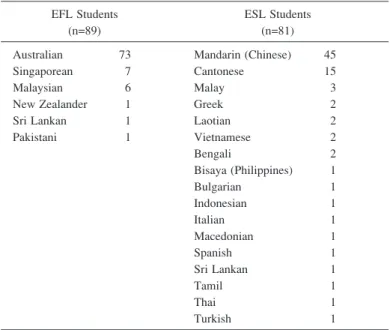
A prominent aspect of our investigation is the diversity of student nationalities and backgrounds. Undergraduates in our study came from over 40 different coun- tries. Table 1 shows the diversity of nationalities in the sample. Backgrounds were established after surveying their different schooling and career experiences.

It was considered that these factors were sufficiently variable to examine the ele- ments affecting computer assisted technology and learning.

The data used in our model was collected from a questionnaire

4)

administered to 176 first year undergraduate students at an Australian university. The effective sample was 170 students. Table 2 shows demographic details of our samples.

4) Available from authors on request

(12)

The survey was conducted during a week 10 lecture in a semester course titled

“Accounting Processes and Systems” (BUSN 1002). The course covers introduc- tory accounting concepts and theory, and is studied by many students from a variety of disciplines. The data collection technique was anonymous with respon- dents not required to record their name or ID number. The surveys were admin-

Table 1: Diversity of nationalities shown by different languages

EFL Students ESL Students

(n=89) (n=81)

Australian 73 Mandarin (Chinese) 45

Singaporean 7 Cantonese 15

Malaysian 6 Malay 3

New Zealander 1 Greek 2

Sri Lankan 1 Laotian 2

Pakistani 1 Vietnamese 2

Bengali 2

Bisaya (Philippines) 1

Bulgarian 1

Indonesian 1

Italian 1

Macedonian 1

Spanish 1

Sri Lankan 1

Tamil 1

Thai 1

Turkish 1

Table 2: Demographic Data

EFL Students ESL Students Total

(n=89) (n=81)

Gender

Male 52 58.4% 38 46.9% 90 52.9%

Female 37 41.6% 43 53.1% 80 47.1%

Age

17–21 71 79.8% 71 87.7% 142 83.5%

22–25 14 15.7% 10 12.3% 24 14.1%

over 25 4 4.5% 0 0 4 2.4%

(13)

An Empirical Study for the Effect of Language Background

istered by researchers who were not responsible for the course delivery. The respondents were given class time to complete their questionnaire with forms col- lected upon completion.

The questionnaire comprised seven sections. The survey asked for general information on student personal details, their use of computer technology; use of computer technology in accounting; perceptions towards accounting and com- puter technology; attitudes towards general computer technology; attitudes towards the use of computer technology in their accounting class and attitudes towards accounting as a profession. Apart from section 1 (general information), a five-point Likert scale was used for each item.

Dependent variable

The dependent variable in the study is the student’s behaviour in using WebCT and the course website for BUSN 1002. Course material was put online progres- sively throughout the semester. The questionnaire (administered toward the end of the unit) focussed on the three major areas of the WebCT usage. These were:

1. Obtaining course/administration details and notices;

2. Downloading lecture notes; and 3. Downloading workshop solutions.

The mean of the items in these three categories was used as the dependent variable (WEBUSE).

Independent valuable:

The main independent variable was the student’s first language (LANG). Other

contributing factors which are likely to influence the students’ use of WebCT

were also included. These variables were confidence in using computer technol-

ogy in the accounting course (CONFPC), confidence toward accounting

(CONFAC), attitude towards computer technology (ATTPC), attitude towards

(14)

the online learning environment in the accounting course (ATTAC), gender (GEN), age (AGE), and experience using a computer (EXP).

Statistical Analysis:

The regression model used to investigate students’ computer usage was:

WEBUSE = a + b

1

LANG + b

2

CONFPC + b

3

CONFAC + b

4

ATTPC + b

5

ATTAC + b

6

GEN + b

7

AGE + b

8

EXP+e

i

Where -

WEBUSE = Frequency of WebCT usage in the accounting course, calcu- lated as the mean of the items for:

Obtain course/admin. details and notice on a 5 point scale

where 1= None/rarely and 5=Very Frequently with 0=Don’t Know

Downloading lecture notes on a 5 point scale where 1=

None/rarely and 5=Very Frequently with 0=Don’t Know Downloading workshop solutions on a 5 point scale where

1= None/rarely and 5=Very Frequently with 0=Don’t Know

LANG = 0 for English (EFL) and 1 for other languages (ESL) CONFPC = Confidence in PC usage, calculated as the mean of the items

for:

Confidence of using computer on a 5 point scale where 1 =

Strongly Disagree and 5=Strongly Agree with 0=Don’t Know

Confidence in Searching the Internet on a 5 point scale

where 1 = Strongly Disagree and 5=Strongly Agree with

0=Don’t Know

(15)

An Empirical Study for the Effect of Language Background

Anxious about computer technology on a 5 point scale

where 1 = Strongly Agree and 5=Strongly Disagree with 0=Don’t Know

CONFAC = Confidence in Accounting, calculated as the mean of the items for:

Confidence of accounting on a 5 point scale where 1=

Strongly Disagree and 5=Strongly Agree with 0=Don’t Know

Anxious about accounting on a 5 point scale where 1 =

Strongly Agree and 5=Strongly Disagree with 0 = Don’t Know

ATTPC = Attitudes to computer use, on a 5 point scale where 1 = Strongly Disagree and 5=Strongly Agree with 0 = Don’t Know.

ATTAC = Attitudes toward computer use for accounting course on a 5 point scale where 1 = Strongly Disagree and 5=Strongly Dis- agree with 0 = Don’t Know

GEN = 0 for male and 1 for female

AGE = 0 for 17–21 years old, 1 for 22–25 years old and 2 for over 25 years old

EXP = 1 for After Secondary School, 2 for Secondary School, 3 for Primary School, 4 for Kindergarten/Infant School and 0 for Never Learned before commencing University

RESULTS

Regression Results

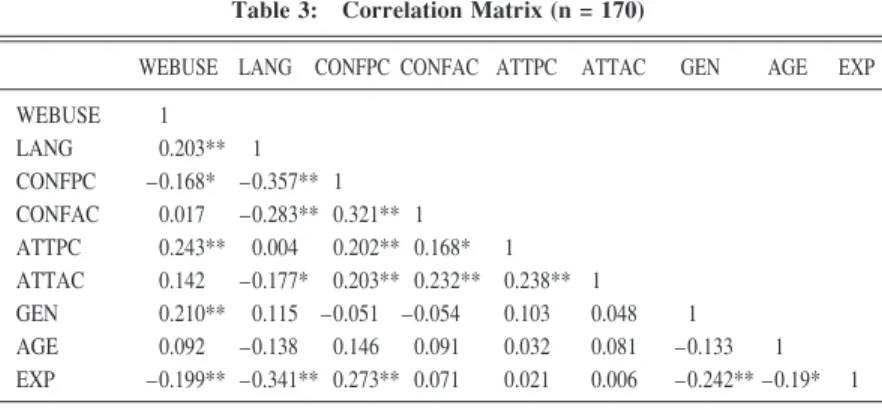
Table 3 is a matrix showing the correlations between all variables. If indepen-

dent variables are highly correlated (i.e. multicollinearity), then the regression

(16)

coefficients can become unstable and the significance test and interpretation of the individual variables are small or moderate, with the largest correlations being -0.357 between CONFPC and LANG, and -0.341 between EXP and LANG.

These numbers are small enough to indicate that multicollinearity is not of con- cern.

Table 3: Correlation Matrix (n = 170)

WEBUSE LANG CONFPC CONFAC ATTPC ATTAC GEN AGE EXP

WEBUSE 1

LANG 0.203** 1

CONFPC –0.168* –0.357** 1 CONFAC 0.017 –0.283** 0.321** 1 ATTPC 0.243** 0.004 0.202** 0.168* 1 ATTAC 0.142 –0.177* 0.203** 0.232** 0.238** 1 GEN 0.210** 0.115 –0.051 –0.054 0.103 0.048 1 AGE 0.092 –0.138 0.146 0.091 0.032 0.081 –0.133 1 EXP –0.199** –0.341** 0.273** 0.071 0.021 0.006 –0.242** –0.19* 1

** indicates that correlation is significant at the 0.01 level (2-tailed).

* indicates that correlation is significant at the 0.05 level (2-tailed).

Table 4 reports the results of the regression analysis. The regression coeffi- cients, beta coefficients, t-statistics and p-value are given for each independent variable. The model shows an F-value of 4.631 (p-value = 0.000). The R square for the model is 0.187.

The results indicate that ATTPC has less than 1% p-value (0.004), LANG and CONFPC have less than 5% p-value (0.043 for LANG and 0.028 for CONFPC).

CONFAC, ATTAC GEN, AGE and EXP show their p-values as all non-signifi-

cant. This indicates that our hypothesis regarding attitudes toward computer tech-

nology (H 4) can be rejected at the 99% significance level. The hypotheses that

first language and confidence of computer technology in the accounting course

(H 1 and H 2) have a significant effect on students’ WebCT use can be affirmed

at the 95% significant level.

(17)

An Empirical Study for the Effect of Language Background

In addition to the above results, the positive coefficients for LANG, CONFAC and ATTPC indicate that the students’ use of WebCT is likely to be greater if they have English as a second language and if they possess a positive attitude towards computer technology. On the other hand, the negative coefficient of CONFPC shows that students’ confidence in their own computer abilities is negatively related to greater use of WebCT.

Table 4: Regression results for usage of WebCT

WEBUSE = a + b

1

LANG+ b

2

CONFPC+ b

3

CONFAC+ b

4

ATTPC+ b

5

ATTAC+ b

6

GEN + b

7

AGE+ b

8

EXP+ e

i

n = 170 R Square = 0.187 Adjusted R Square =0.147 ANOVA

Sum of Square Df Mean Square F p-value

Regression 20.171 8 2.521 4.631 0.000

Residual 87.660 161 0.544

Total 107.831 169

Coefficient t-statistic p-value

Intercept 2.579 3.963 0.000

LANG 0.270 2.042 0.043

CONFPC – 0.191 – 2.216 0.028

CONFAC 0.055 0.722 0.471

ATTPC 0.234 2.941 0.004

ATTAC 0.114 1.662 0.098

GEN 0.218 1.805 0.073

AGE 0.229 1.680 0.095

EXP 0.059 – 0.522 0.602

Comparison of EFL and ESL student groups

Table 5 displays statistical results of comparison between means for the depen-

dent variables and independent variables for students using different languages.

(18)

There are significant differences between EFL and ESL students in WebCT us- age in their accounting course (WEBUSE), in confidence of computer use in their accounting course (CONFPC), in confidence of accounting (CONFAC), in attitude toward computer use in accounting subject (ATTAC) and the time when they start learning computers (EXP).

Table 5: Results of paired-sample t-test

EFL ESL t-statistic p values Conclusion of t-test (n=89) (n=81)

WEBUSE 3.34 3.68 -2.780 0.006 ESL students use WebCT more frequently

CONFPC 4.31 3.77 4.946 0.000 EFL students have a stronger confidence with computers CONFAC 3.89 3.43 3.831 0.000 EFL students have stronger

confidence in accounting ATTPC 4.31 4.32 -0.055 0.956 No significant difference ATTAC 3.97 3.65 2.335 0.021 EFL students prefer PC use for

accounting courses GEN 0.42 0.53 -1.503 0.135 No significant difference AGE 0.25 0.12 1.809 0.072 No significant difference EXP 4.01 3.62 4.697 0.000 EFL students start learning PC

technology earlier One-tailed t-test is applied for p-value.

CONCLUSION

The results of the regression analysis indicate that language background is a

significant determinant of student use of WebCT. Students with English as a sec-

ond language use WebCT resources more than native English speakers. Non-

native English speakers are often more comfortable reading materials in English

than they are attending aurally to spoken English. Online materials can allow

them to narrow the disadvantage of the language gap in the classroom. The writ-

ten English on the web site includes not only lecture notes but administrative and

(19)

An Empirical Study for the Effect of Language Background

other information and is more reliably gained from this source. It should be noted that both groups of students (EFL) and (ESL) give favorable ratings to WebCT use (above the mid-point on a five point scale).

The conclusion is that accounting educators are justified in expending effort to place materials online, especially where accounting classes have a high propor- tion of ESL students. With government policy pushing for the recruitment for more overseas students in Australian universities (Weber, 2002) this issue will be of growing importance.

Students’ confidence in their own abilities with computer technology was related negatively to their use of online materials. That is, the more confident a student was in his/her computer ability, the less likely he or she was to use WebCT. Although other authors found that perceptions of competence positively influence computer usage (Igabaria et al., 1990; Mills, 1997; Walters and Neces- sary, 1996) our results did not confirm these findings. The more technology-con- fident students were also the native-English students. An explanation is that the need to acquire written English learning materials by the students who need them most (ESL students) overrides their comparative lack of confidence in their com- puter abilities.

In contrast, attitude to computers was significantly and positively correlated with use of online resources. The regression analysis cannot tell us the causal direction in this relationship. It is possible that higher use of online materials, presumably because they are seen as valuable, leads to a more favorable attitude towards the use of technology support in an accounting class.

Confidence in accounting abilities had no effect on WebCT usage. It could be

expected that students who felt less confident in their studies would use as many

avenues as possible for learning, but this was not the case. Leaving aside the

question of language difficulties, poorer students possibly feel they gain greatest

value from face-to-face contact in lectures and tutorials. This issue is something

(20)

that is worthy of further investigation.

Age, gender and length of previous experience with computers were not sig- nificantly related with use of online materials. The finding that it did not appear to matter how much previous experience with computers students had is interest- ing, because it suggests that even those with less experience are capable of using the web site if they feel a need to do so.

Though gender and age were not significant predictors at the .05 level, the p value was less than .10, which suggests a weak relationship could exist. Further research with a larger sample size and more power in the statistical tests is war- ranted. Both of these relationships were positive, meaning that women and older students used WebCT more.

To conclude, the study has some important messages for accounting educators.

Students make use of online materials in accounting courses if available, presum- ably because they find them valuable. This is the case even with materials that are relatively straightforward to provide, such as the administrative material, lec- ture notes and solutions provided to students in this study. In addition, the online materials are used significantly more often by students who have English as a second language compared with native-English speakers. With this evidence available, accounting educators should find it difficult not to make use of an online learning environment like WebCT if it is available. This message is espe- cially salient for educators who have large proportions of non-native-English speakers in their classrooms.

ACKNOWLEDGEMENT

In providing financial support for this research project, the authors wish to

acknowledge the assistance of the research budget awarded by the Institute Ad-

vanced Research of Hiroshima Shudo University, 2004.

(21)

An Empirical Study for the Effect of Language Background

REFERENCES

Basile, A. and J. M. D’Aquila (2002) “An Experimental Analysis of Computer-Mediated Instruction and Student Attitudes in a Principles of Financial Accounting Course,”

Journal of Education for Business, Vol. 77, No. 3, pp. 137–143.

Bartlett, S., M. J. Peel and M. Pendlebury (1993) “From fresher to finalist: a three year study of student performance on an accounting degree programme,” Accounting Education, Vol. 2, No. 2, pp. 111–122.

Bhattacharjee, S. and L. Shaw (2001) “Evidence that independent research projects improve accounting students’ technology-related perceptions and skills,” Account- ing Education, Vol. 10, No. 1, pp. 83–103.

Boland, G. and S. Sugahara (2003) “The Impact of Electronic Learning among Accounting Students from Different Cultures,” Papers of Research Society of Commerce and Economics: Hiroshima Shudo University: Japan, Vol. 44, No. 2, pp. 180–196.

Boyce, G. (1999) “Computer-assisted teaching and learning in accounting; pedagogy or product?,” Journal of Accounting Education, Vol. 17, No2-3, pp. 191–220.

Bryant, S. M. and J. E. Hunton (2000) “The Use of Technology in the Delivery of Instruc- tion: Implications for Accounting Educators and Education Researchers,” Issues in Accounting Education, Vol15, No. 1, pp. 129–162.

Davis, F. D., R. P. Bagozzi and P. R. Warshaw (1989) “User Acceptance of Computer Technology: A Comparison of Two Theoretical Model,” Management Science, Vol.

35, No. 8, pp. 982–1003.

Debreceny, R. S., A. Lymer, G. S. Smith and C. E. White (1999/2000) “Accounting Edu- cation in the New Millennium: The Internet Challenges,” Pacific Accounting Review, Vol. 11, No. 2, pp. 67–75.

Evans, P. (1998), “A Self-Learning Project With Undergraduate Accountancy Students Using Videos and Computer Technology,” Issues in Accounting Education, Vol. 13, No. 3, pp. 729–746.

Friedlan, J. M. (1995) “The effect of different teaching approaches on students’ perceptions of the skills needed for success in accounting courses and by practicing accoun- tants,” Issues in Accounting Education, Vol. 10, No. 1, pp. 47–65.

Gilliver, R. S., B. Randall and Y. M. Pok (1998) “Learning in cyberspace: Shaping the future,” Journal of Computer-Assisted Learning, No. 14, pp. 212–222.

Igabaria, M., S. Parasuraman and F. Pavri (1990) “A path analytic study of the determi- nants of microcomputer usage,” Journal of Management Systems, Vol. 2, No. 2, pp.

1–14.

(22)

Jiang, J. J., J. Motwani, W. Cheung and C. H. Cheng (1999) “Attitudes toward the Internet / WWW: A Comparison of Students in U.S., France, and Hong Kong,” Journal of Computer Information Systems, Vol. 39, No. 3, pp. 1–5.

Koh, M. Y. and H. C. Koh (1999) “The determinants of performance in an accountancy degree course,” Accounting Education, Vol. 8, No. 1, pp. 13–29.

Lane, A. and M. Porch (2002) “Computer Aided Learning (CAL) and its impact on the per- formance of non-specialist accounting undergraduates,” Accounting Education, Vol.

11, No. 3, pp. 217–233.

Lont, D. (1999) “Using an internet to facilitate student-centered learning,” Journal of Ac- counting Education, Vol. 17, No. 2-3, pp. 293–320.

Marcheggiani, J., K. A. Davis and J. F. Sander (1999) “The Effect of Teaching Methods on Examination Performance and Attitudes in an Introductory Financial Accounting Course,” Journal of Education for Business, Vol. 74, No. 4, pp. 203–210.

Mills, T. A. (1997) “An examination of the relationship between accountants’ scores on field independence and use of and attitude toward computers,” Perceptual and Motor Skills, Vol. 81, pp. 715–720.

Necessary, J. R. and T. S. Parish (1996) “The relationships between computer usage and computer-related attitudes and behaviors,” Education, Vol. 116, No. 3, pp. 384–387.

Parker, J. E and B. M. Cunningham (1998), “Using an Electronic Tutorial to Enhance Stu- dents’ Knowledge of Advanced Tax Accounting,” Issues in Accounting Education, Vol. 13, No. 2, pp. 395–407.

Schiffman, S. J., L. C. Meile, M. Igbaria (1992) “An examination of end-user types,”

Information and Management, Vol. 22, No. 4, pp. 207–215.

Schumacher, P. and J. Morahan-Martin (2001) “Gender, Internet and computer attitudes and experiences,” Computers in Human Behavior, Vol. 17, No. 1, pp. 95–110.

Stone, D. S., V. Arunachalam and J. S. Chandler (1996) “An Empirical Investigation of Knowledge, Skill, Self-Efficacy and Computer Anxiety in Accounting Education,”

Issues in Accounting Education, Vol. 11, No. 2, pp. 345–376.

Straub, D., M. Keil and W. Brenner (1997) “Testing the technology acceptance model across cultures: A three country study,” Information and Management, Vol. 33, No.

1, pp. 1–11.

Thompson, R. L., C. A. Higgins, H. M. Howell (1991) “Personal computing: Toward a conceptual model of utilization,” MIS Quarterly, Vol. 15, No. 1, pp. 125–143.

Walters, J. E. and J. R. Necessary (1996) “An Attitudinal Comparison toward Computers between Underclassmen and Graduating Seniors,” Education, Vol. 116, No. 4, pp.

623–630.

(23)

An Empirical Study for the Effect of Language Background Winter, S. J., K. M. Chudoba and B. A. Gutek (1998) “Attitudes toward computers: when

do they predict computer use?,” Information & Management, Vol. 34, No. 5, pp.

275–284.

Weber, R. (2002), Do Good Things Only Come In Small Class?, Plenary Session 2, 2002

AAANZ Conference, Perth WA, Australia.

Table 1: Diversity of nationalities shown by different languages
Table 3: Correlation Matrix (n = 170)
Table 5: Results of paired-sample t-test

参照

関連したドキュメント

To this aim, we propose to use categories of fractions of a fundamental category with respect to suitably chosen sytems of morphisms and to investigate quotient categories of those

Standard domino tableaux have already been considered by many authors [33], [6], [34], [8], [1], but, to the best of our knowledge, the expression of the

In the second section we summarize several properties of the equivariant cohomology groups that we have found and which we consider of sufficient interest to be pointed out in

The edges terminating in a correspond to the generators, i.e., the south-west cor- ners of the respective Ferrers diagram, whereas the edges originating in a correspond to the

The inclusion of the cell shedding mechanism leads to modification of the boundary conditions employed in the model of Ward and King (199910) and it will be

(Construction of the strand of in- variants through enlargements (modifications ) of an idealistic filtration, and without using restriction to a hypersurface of maximal contact.) At

Then it follows immediately from a suitable version of “Hensel’s Lemma” [cf., e.g., the argument of [4], Lemma 2.1] that S may be obtained, as the notation suggests, as the m A

The proof uses a set up of Seiberg Witten theory that replaces generic metrics by the construction of a localised Euler class of an infinite dimensional bundle with a Fredholm