control design for uncertain systems with disturbances
March, 2018
Mengyang Li
The Graduate School of Engineering (Doctor’s Course)
TOKYO UNIVERSITY OF
AGRICULTURE AND TECHNOLOGY
i
Acknowledgements
After an intensive and unforgettable period of pursuit of the Ph.D. de- gree, the dissertation is now finished. It has been the most challenging and rewarding experiences for me, not only in the science area, but also on a personal level. I would like to thank the people who have supported and helped me so much throughout this period. Without their advices and en- couragements, a successful outcome-dissertation would be unimaginable. I sincerely appreciate their priceless help and support.
First and foremost, my deepest gratitude gives to my supervisor Pro- fessor Mingcong Deng, who always shares his constant encouragement and guidance. I would like to give my sincere appreciate to Professor Mingcong Deng for excellent support and for all of the opportunities. Without his important guidance and patient instruction, this dissertation could not be successfully completed in the present form.
I would like to express my thanks to my supervisor Professor Toshiaki Iwai, thanks to his instructive advices and useful suggestions on my research.
Professor Toshiaki Iwai provides many useful comments and suggestions, which strongly influences me on writing this dissertation.
I would like to express my appreciation to my supervisor Professor Ken Nagasaka, who alway helps me with his patient communication and valuable suggestions during my study in Tokyo University and Agriculture and Tech- nology. I am deeply grateful of his help in the completion of this dissertation.
I would like to express my appreciation to my supervisor Associate Profes- sor Toshihisa Tanaka, for his valuable advices and constant encouragements in writing this dissertation. He provides me with many constructive com- ments and useful help in improving my writing skills.
I would like to express my gratitude to my supervisor Associate Professor Kenta Umebayashi, for offering me valuable suggestions and expert guidance
in my dissertation. His constructive comments in writing this dissertation and useful help in improving the quality of my dissertation are appreciated.
Thanks to my colleagues and friends at Tokyo University of Agriculture and Technology who have supported me and offered help in various ways.
Especially thanks give to Assisstant Professor Noge Yuichi, Dr. Fanzhan Tao, Dr. Yanfeng Wu, Mr. Xudong Gao and Mr. Guang Jin. Besides these persons, I would like to express my appreciation to Mr. Fujita, Mr. Suzuki, Mr. Masaki and Mr. Matsumori for helping me during my life of Tokyo University of Agriculture and Technology.
Last but not the least, I would like to express my especial thanks to my beloved family for unconditional love and positive regard and great confidence all through these years. I am deeply indebted to my parents and sister, who shared me all of love and have provided material support on every period of my life, especially the long years of my education, as well as kept me away from family responsibilities and encouraged me to concentrate on my research.
iii
Summary
This dissertation considers robust nonlinear control design for uncertain systems with disturbances using operator-based right coprime factorization method, which complements the theoretical analysis and control design of nonlinear systems. That is, by using operator theory a unified control design scheme is provided for rejecting nonlinear systems with uncertainties and disturbances as well as robustly bounded input bounded output stable is realized.
With the increasing complexity requirement of the modern technology, a great number of systems possess nonlinear property and multivariable char- acteristic. Therefore, researches on the nonlinear systems have attracted many researchers’ attention due to the important role they have played in real application. Especially, these issues, for instance, robust analysis, out- put tracking problem and uncertainties as well as disturbances reduction which are belong to the nonlinear systems still remain challenging owing to their complex structures and the nonlinear characteristics. Meanwhile, the uncertainties almost exist in many kinds of systems where the uncertain- ties are major concern of two types in the control of uncertain nonlinear systems-parametric perturbations, general perturbations yielding from mod- eling errors and external disturbances which are central considered in this dissertation due to making a tremendous affection within the control systems, hence, it is necessary to reduce the adverse effects from the uncertainties as well as disturbance.
In this dissertation, firstly, by introducing a nonlinear operator controller, operator-based right coprime factorization is employed to consider the non- linear system with disturbances. Then, based on the proposed feasible design schemes, adverse effect resulting from disturbance in nonlinear system is re- duced. Secondly, the nonlinear systems with uncertainties and disturbances
are considered by redesigning the feedback controller, which can deal with a broader class of nonlinear systems. Further, three cases respectively for il- lustrating the relationship between the proposed conditions and the internal uncertainties or disturbances. Meantime, by the proposed design scheme, both of robust stability and tracking performance are realized, which can get better performances. Thirdly, besides the above contributions, in this dissertation, bilinear operator-based right coprime factorization for a class of nonlinear systems with disturbance and perturbation is considered from the input-output view of point, which provides a quantitative analysis method for the appearing uncertainty and disturbance. The merit of the proposed method lies in that it utilizes the characteristic of bilinear operator to design two stable integral controller such that the disturbance can be reduced and meantime output maintains. Then, robust stability of the considered non- linear systems is guaranteed using reset control method, which enriches the coprime factorization methods. Finally, simulation examples are provided to illustrate effectiveness of the proposed design scheme.
Contents
1 Introduction 1
1.1 Background . . . 1
1.2 Developments of operator-based nonlinear control . . . 3
1.3 Motivations of the dissertation . . . 8
1.4 Contributions of the dissertation . . . 10
1.5 Organization of the dissertation . . . 12
2 Mathematical preliminaries and problem statement 15 2.1 Introduction . . . 15
2.2 Mathematical preliminaries . . . 16
2.2.1 Definitions of spaces . . . 16
2.2.2 Definitions of operators . . . 20
2.2.3 Definition of right coprime factorization . . . 26
2.2.4 Definition of robust right coprime factorization . . . 28
2.3 Problem statement . . . 31
2.4 Conclusion . . . 33
3 Operator-based nonlinear systems with unknown disturbance rejection 35 3.1 Introduction . . . 35
3.2 Construction on the considered nonlinear systems based on operator theorem . . . 38
v
3.2.1 Construction on the considered nonlinear systems . . . 38
3.2.2 Robust stability . . . 43
3.3 Nonlinear systems with unknown disturbances rejection . . . 45
3.3.1 The admissible class of compensator . . . 45
3.3.2 Rejection scheme analysis . . . 49
3.3.3 Simulation examples . . . 53
3.4 Conclusion . . . 62
4 Operator-based nonlinear uncertain systems with external disturbance rejection using robust right coprime factoriza- tion 67 4.1 Introduction . . . 67
4.2 Robust stability of nonlinear uncertain systems with disturbance 70 4.2.1 Problem statement . . . 70
4.2.2 Three cases of robustly stable conditions . . . 71
4.2.3 An example for showing the necessity of the proposed method . . . 76
4.3 Rejection scheme analysis and output tracking issue . . . 78
4.3.1 Equivalent problem . . . 78
4.3.2 The admissible class for controller design . . . 80
4.3.3 Internal perturbation and external disturbance rejec- tion and output tracking issue . . . 82
4.3.4 Simulation example . . . 86
4.4 Conclusion . . . 92
5 Operator-based nonlinear robust control and sensitivity anal- ysis of uncertain nonlinear systems 95 5.1 Introduction . . . 95
5.2 Bilinear operator-based nonlinear robust control . . . 97
5.2.1 Problem statement . . . 97
CONTENTS vii
5.2.2 Bilinear operator . . . 98
5.2.3 Robust stability and control . . . 101
5.3 Insensitivity analysis for perturbed nonlinear system . . . 102
5.3.1 Insensitivity property of perturbed system . . . 103
5.3.2 Tracking performance . . . 106
5.3.3 Simulation example . . . 109
5.4 Reset control and robust stability analysis . . . 114
5.4.1 Simulation example . . . 119
5.5 Conclusion . . . 120
6 Conclusions 123 Bibliography 127 A Proof 139 A.1 Proof of Lemma 2.1 . . . 139
A.2 Proof of Lemma 2.2 . . . 140
A.3 Proof of Lemma 2.4 . . . 140
A.4 Proof of Lemma 2.5 . . . 140
B Publications 143
List of Figures
2.1 An operator diagram . . . 21
2.2 A nominal operator diagram . . . 26
2.3 A nonlinear system with right coprime factorization . . . 27
2.4 A nonlinear system with bounded perturbations . . . 29
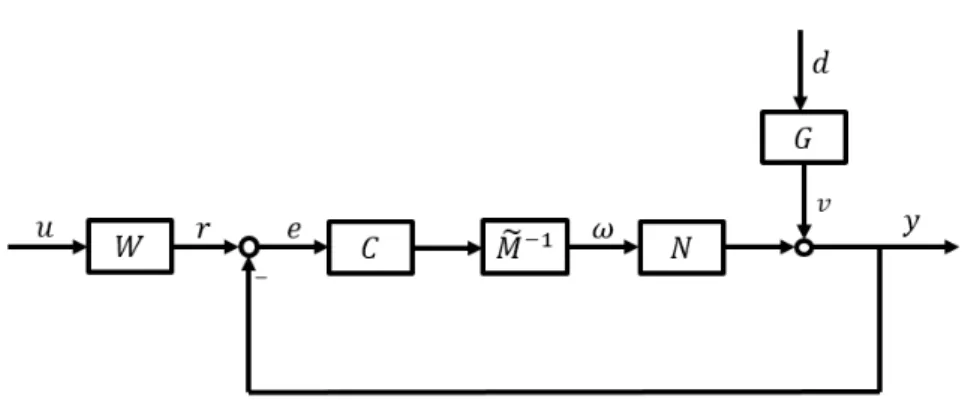
3.1 The nonlinear system with unknown disturbance . . . 42
3.2 The proposed nonlinear system with unknown disturbance . . 43
3.3 The equivalent system with unknown disturbance . . . 45
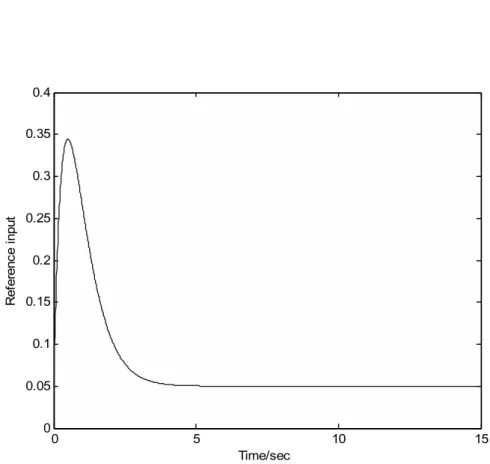
3.4 Reference input . . . 56
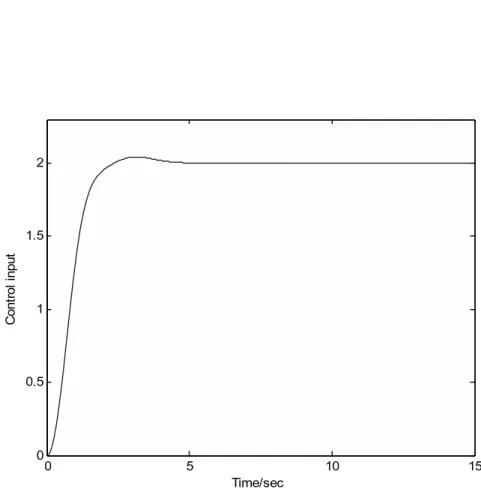
3.5 Control input . . . 57
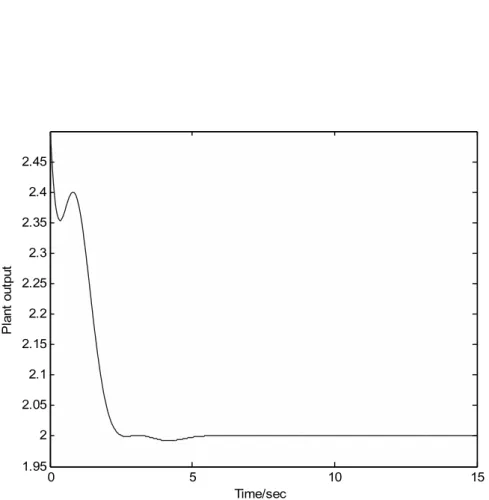
3.6 Plant output with Q . . . 58
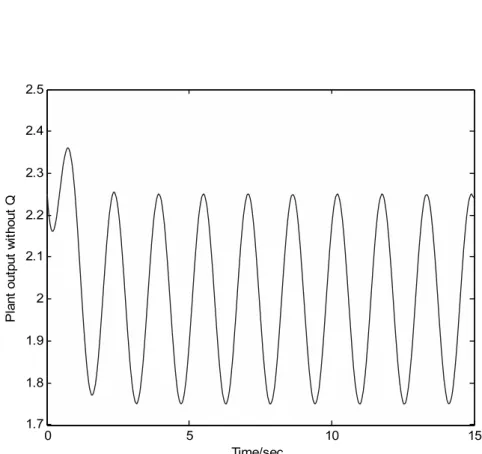
3.7 Plant output without Q . . . 59
3.8 Random disturbance . . . 60
3.9 Plant output with control . . . 61
3.10 Control input with Q . . . 63
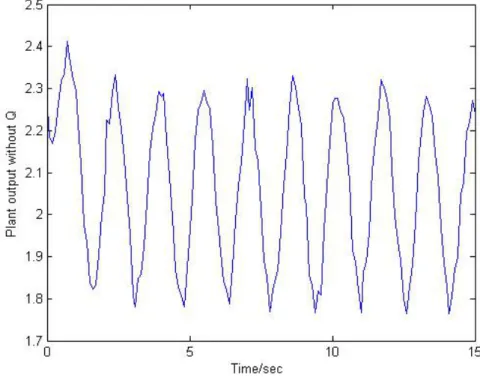
3.11 Plant output without Q . . . 64
3.12 Plant output with Q . . . 65
4.1 The nonlinear system with internal perturbation and external disturbance . . . 70
4.2 The proposed nonlinear system with perturbation and distur- bance . . . 72
ix
4.3 Equivalent system . . . 79
4.4 The design diagram of controllerC . . . 84
4.5 Effectiveness of robust condition . . . 89
4.6 Control input . . . 90
4.7 Reference inputr & plant outputy . . . 91
5.1 Considered nonlinear feedback system . . . 99
5.2 Transformed nonlinear feedback control system . . . 107
5.3 Control input of the considered nonlinear plant with uncertainty111 5.4 Output of the considered plant with perturbation and distur- bance by former method . . . 112
5.5 Tracking performance of the considered plant with the pro- posed controller . . . 113
5.6 The proposed nonlinear system with unknown bounded dis- turbance . . . 115
5.7 Equivalent system . . . 118
5.8 Reference input . . . 121
5.9 Reset control output . . . 122
Chapter 1 Introduction
1.1 Background
Considering development of modern design engineering and control techno- logical requirement on comfort creatures, reliability and safety for practical manufacture, simple and effective control method and design scheme in or- der to improve performance of systems and meet demand of customers are greatly necessary and rapidly over the past decades, leading to that much attentions focusing on simple and effective control design scheme are received from engineers and researchers [1]−[17],[41]−[48],[59]−[68].
Concerning control design of systems, there have been significant develop- ments from various perspectives for both linear and nonlinear control systems over the last four decades. Although the linear systems thanks to its inher- ent characteristic on simple structure which has obtained greatly advance- ments, in practice, a great number of systems possess nonlinear property and multivariable characteristic. That is, in practical application, most of dynamic systems posses nonlinear characteristics since the unavoidable fac- tors exists. Therefore, for dealing with difficulties that linear control method cannot work, the nonlinear control and design methods have attracted many researchers’ attention due to the important role they have played in real ap-
1
plication [38]−[58], and [69]−[87]. In particular, these issues, robustness, output tracking, perturbation and disturbance belonging to the nonlinear systems still remain challenging owing to their complex structures and non- linear characteristics [15],[37],[59],[61],[88]−[93]. Meanwhile, perturbation and disturbance phenomenons almost exist in a great number of systems where disturbance has major concern of two types in the control of unknown disturbance and estimated disturbance. General perturbation and distur- bance yielding from modeling errors and external environment are central considered in this dissertation due to making a tremendous affection within the control systems, hence, it is necessary to reduce the adverse effects from them.
For considering control design for nonlinear systems with perturbation and disturbance to guarantee robust stability of the overall systems, a great number of control methods have been proposed from different viewpoints such as Lyapunov-based control method, model predictive control method, gain scheduling method, fuzzy control method, adaptive control method, feedback linearization design method, sliding mode control method and so on [13] − [20],[32] − [45],[88] − [93]. Among these methods, all of them are proposed based on ordinary differential equations expression of nonlinear systems or linear systems, which are of rather difficulty to measure state vec- tors directly on-line measurements, leading to some restrictions on applying these approaches [50]−[54]. For dealing with robust phenomenons always appearing in systems and avoiding the existing unnoticeable and unavoid- able adverse effect of real systems, one promising method, operator-based right coprime factorization control method, has been proposed on robust con- trol design thanks to a convenient framework established using this method from input-output view of point according to operator theory [32]−[37] and [55]−[93].
As to operator-based right coprime factorization method, there are com-
1.2. DEVELOPMENTS OF NONLINEAR CONTROL 3 parative and main merits, although each control design method for nonlinear systems has its own inherent merits and limitations on studying nonlinear systems. We summarized the main merits of operator-based right coprime factorization from the following aspects. Firstly, operator-based right co- prime factorization is proposed for dealing with general cases, which merely requires input-output mapping function. Moreover, the input-output rela- tionship can be a relatively easy work using directly methods like taking experimental data. On this point, compared to other techniques aforemen- tioned of nonlinear systems, it is not necessary to get all the states informa- tion of systems and build ordinary differential equations. Therefore, it gives a convenient framework to consider nonlinear systems. Secondly, control de- sign using opertor-based right coprime factorization is easy comparatively, whose requirement lies in building a Bezout identity based on the internal signal of systems in order to guarantee stability in context of bounded in- put bounded output stable definition. Finally but not least, for studying robustness of uncertain nonlinear systems, the operator-based right coprime factorization method has a great advantage over the other control methods.
A simple and effective description for the uncertain nonlinear systems can be given based on this method, which avoids difficulties in analyzing uncer- tainties quantitatively.
In the following statements, a detailed and systematic summary on his- tory of the operator-based nonlinear control with disturbances method is proposed [18]−[80].
1.2 Developments of operator-based nonlin- ear control
In recent decades, there have been significant developments from various perspectives for both linear and nonlinear systems [21]−[35],[59]−[63],[88].
As well known, the linear coprime factorization theory has being increas- ingly perfected. Particularly, in practice, almost all systems possess non- linear property and multivariable characteristic, which have been attracting researchers’ attention due to important role. For nonlinear systems, robust control, sensitivity and tracking issues [59], [63] still remain challenging due to inevitable factors appearing in systems, such as parametric perturbations, modeling errors and uncertainties. For dealing with these issues, a great number of effective methods are proposed, such as the adaptive control, the sliding mode control method, operator-based right coprime factorization method, the geometric approach and so on.
Since the early 1970s, Rosenbrock [18] was the first person who introduced the coprime factorization method into the multivariate system, which has played a decisive role in the study of control system on stabilization as well as robustness. The author considered an optimization controller on the basis of parameterizing all stable controllers by utilizing polynomial matrix expres- sion defined in the linear time invariant setting. In [19], the authors proposed an available method based on a least-square Wiener-Hopf minimization of an appropriately chosen cost functional in which the method is so-called Youla‒ Kuˇcera parametrization (aslo simply called as Youla parametrization) which is a formula that describes all possible stabilizing feedback controllers for a given plant, as function of a single parameter based on the physical as- sumptions. This formula greatly facilitates the study of robust stability and adaptive control throughout the viewpoint of left and right coprime factor- ization for the given plant and controllers. Further, in 1984, Nett took the attention on the class of elements for the existence of coprime fractional rep- resentations which from the Bezout domain as well as given the expression on left or right coprime factorization of the given plant. After that, in the aspect of linear control system, Mcfarlance [20] made a significant development on state space expression based on the introduced definition of normalization of
1.2. DEVELOPMENTS OF NONLINEAR CONTROL 5 mutual factor decomposition, which method could provide a convenient ex- pression using normalization coprime factorization in the research of robust stability issues. Besides, some sufficient conditions for existence of a dou- bly coprime factorization belonging to a large class of infinite-dimensional systems have been proposed in [21]. Moreover, there were many practical methods on dealing with linear control system for reaching robust stability or robustness as well. However, in practical almost all the actual control systems are non-linear systems, the researchers have payed more and more attentions on it.
Recently, the results on coprime factorization method of nonlinear control system can be summarized into two categories, one is to study the relation- ship between factorization and composure by means of input-output opera- tor, the other is to study the left and right coprime factorization from the viewpoint of state space. There many researchers have made great contri- butions on coprime factorization method, such as Hammer, Verma, Moore, Paice, Tay and Guanrong Chen and so on[21]−[37]. Most of them provided a convenient framework to research the nonlinear systems based on the idea of coprime factorization from a viewpoint of the input-output stability. Ham- mer [21] −[25] who was the first person considered the robustness of the nonlinear coprime factorization based on operator theory method from the factorization technology of input-output operator with set theory method defined in nonlinear discrete time system. Later in 1994, Hammer [25] in- vestigated the internal stability of a class of discrete nonlinear systems with output interference taking advantage of the right coprime factorization, in which from the input or the interference to the output response is parameter- ized as well as combined with the fixed controller for stabilizing the internal system. During the decade Hammer has made a great improvement in co- prime factorization, however, it was very difficulty to get the solutions on coprime factorization based on Bezout identity defined on the discrete-time
system. In order to overcome the above issues, the author in [26],[27] re- defined the continuous system based on the concept of construction from the view of input-output point, so that made right coprime factorization independent of the solution with Bezout identity. Verma had popularized right and left coprime factorizations into all of nonlinear system described by input-output viewpoint and made much more convenient application on stabilizing nonlinear system using coprime factorization. Later, concerning the state-space characterization with Youla-Kucera parameterization so as to generalize the Youla-Kucera parameterization into normal nonlinear control system, Paice, Moore and Tay el. [28]−[31] have done a lot of attempts both right coprime factorization and left coprime factorization for nonlinear system. In [31], the authors considered the intention of constructing analytic tools for the solution of stabilizing a nonlinear system to construct a class of stable controllers to realize the whole stable system based on left coprime factorization method as well proposed a necessary and sufficient conditions for stabilizing the nonlinear system. Over the next few years, the formula of Youla parameterization which is completely consistent with the linear system is given by the left coprime factorization [28], that is for a given nonlinear plant, if it has a bound stable left coprime factorization, then for any bound input there exists a stable feedback-compensator, and parameterizing a class of such stabilizers in the context of a bounded-input bounded-output (BIBO) stable. On this basis, the robust stability of the system is studied using this parametric formula[30]. Further, this robust stability result was of great significance for the study of nonlinear adaptive control and simultaneous stabilization problems [29].
In 1993, Figueriedo and Chen [35] payed much more attention to robust control and robust stabilization of the nonlinear system based on operator right coprime factorization of nonlinear system which emphasized qualitative properties analysis rather than design as well as the left coprime factorization
1.2. DEVELOPMENTS OF NONLINEAR CONTROL 7 can be done in the same manner. In [35], the author considered in a general operator-based setting which can be regards as to be linear or nonlinear, fi- nite dimensional or infinite dimensional, and can be either in the frequency domain or in the time domain. First, there two main mathematical back- ground the classical nonlinear Lipschitz operator and the generalized nonlin- ear Lipschitz operator theory have been proposed by Chen which served as a foundation for the research topics in systems theory. Proceeding to the next step, the authors provided that main idea of right coprime factorization for nonlinear feedback systems from input-output state space based on operator theory. The original idea of right coprime factorization can be addressed as follows [37]: to factorize a given plant operator P as a composition of two different operators N and D such that P = N D−1, where N is stable and Dis stable and invertible; then, to design two suitable stable operatorsA, B satisfying the Bezout identityAN+BD=M, whereM is an unimodular op- erator. Then, according to operator theory, the given plantP is said to have right coprime factorization, and the system is said the be stable. Based on the right coprime factorization approach, more and more attentions have been payed on robust and tracking control for the nonlinear system with unknown bounded perturbations in [37], [61], [63], and [69]. In [37], the authors inves- tigated robust right coprime factorization to conduct the nonlinear systems with perturbation, which provided a fairly general operator-theoretic setting for system analysis, control and design. A sufficient condition for guarantee- ing robust stability of nonlinear systems with perturbation is proposed using robust right coprime factorization. Later, in [62], a new condition was pro- posed based on a Lipschitz norm inequality to consider robust stability, whose merit lies in that the proposed design scheme of this dissertation could deal with a broader class of nonlinear system compared with the former method in [37]. Based on the robust sufficient condition of [63], in [70], the authors provided an operator-based isomorphism method to obtain factorization of
nonlinear systems quantitatively. In 1989, the author Figueired and Chen who are the first introduced the disturbance rejection under the viewpoint of coprime factorization aspect. In [74], the authors proposed an internal model control to analyze effects from uncertainties of nonlinear systems. In real application, the robust right coprime factorization method has also been developed, such as robust controller design of uncertain discrete time-delay systems with input saturation and disturbance in [89], employed low-order modes to design the control scheme using the operator-based approach in [67] and so on.
As for the development of reset control, much attention has been given to focus on design and control aspects on linear systems or nonlinear systems [94] and [95]. In [94], a reset adaptive observer is considered, including an adaptive observer and a reset law that resets the output of an integrator depending on a predefined condition. In [95], a class of square continuous- time nonlinear controllers are designed based on a suitable resetting rule, which proves that the arising hybrid system with temporal regularization is passive in the conventional continuous-time sense. Moreover, based on the passivity property, the finite gain stability of the nonlinear systems is in- vestigated. Reset control can achieve sensor noise suppression performance without degrading disturbance rejection, which makes reset control an im- portant technique for performance improvement.
1.3 Motivations of the dissertation
Although it is simple and effective using the operator-based robust right coprime factorization method in the aspect of controlling and designing for nonlinear systems, and a great number of results are proposed in many fields.
However, there are still some points worthy being studying, not only the purpose of enriching and refining the operator-based robust right coprime
1.3. MOTIVATIONS OF THE DISSERTATION 9 factorization method, but also dealing with more issues using it.
In this dissertation, main motivated concepts based on operator-based right coprime factorization are stated from the following three aspects. First, when it comes to that the operator-based right coprime factorization ap- proach is used to deal with robust stability of uncertain nonlinear systems, the basic idea lies in how to guarantee robust Bezout identity. However, there is little research that authors consider the issue of reducing the ad- verse effect resulting from the existing uncertainties such that stability of the nominal system still remain. Based on this idea, in this dissertation, the Chapter 3 address an effective design scheme of combing operator-based right coprime factorization with a new nonlinear operator controller to deal with nonlinear systems with unknown disturbance for guaranteeing robust stability and reducing adverse effects. That is, with the framework estab- lished by using operator-based right coprime factorization, both of robust stability and reduction of disturbances are obtained by using the proposed nonlinear operator controller. Second, meantime with this issue, other mo- tivated idea for dealing with both perturbation and disturbance is proposed in Chapter 4. Most traditional researches were aiming at one interference object in control system design, either internal perturbation or external dis- turbance, as has been stated above. However, in most practical nonlinear control systems there are a number of different kinds of external disturbance and internal perturbation subjected to the circumstance, temperature, cou- pling between different systems and so on. Therefore, in Chapter 4, for removing the adverse effect resulting from the external disturbance and in- ternal perturbation, a feasible framework is proposed based on the designed scheme, which provides a convenient structure to consider the nonlinear sys- tem with external disturbance and internal perturbation. Moreover, based on the proposed design scheme, the adverse effects of internal perturbation and external disturbance are reduced, and output tracking performance is
realized simultaneously. However, in Chapter 4, the quantitative analysis for the existing perturbation and disturbance is not considered. Therefore, in Chapter 5, a bilinear operator-based right coprime factorization for non- linear system with perturbation and disturbance is introduced, which can consider adverse effect resulting from perturbation and disturbance quanti- tatively. Based on the proposed method, a feasible framework is established for considering robust control, sensitivity and tracking performance, which not only separates perturbation and disturbance, but also provides a fun- damental base to design a controller for the considered system. After that, operator-based reset control for nonlinear systems with unknown bounded disturbance is addressed. That is, in the context of operator-based right co- prime factorization, reset control is realized and robust stability of nonlinear systems with unknown bounded disturbance is guaranteed.
1.4 Contributions of the dissertation
The proposed nonlinear control scheme on uncertain nonlinear systems en- rich the operator-based coprime factorization method. Meanwhile, bilinear operator-based right coprime factorization for nonlinear systems with per- turbation and disturbance are discussed, providing a quantitative analysis method for the appearing perturbation and disturbance. The proposed con- trol design scheme employs operator theory setting formulated under ex- tended norm linear space, which is suitable for stability, causality, robust- ness, uniqueness of internal control signals as well as coprime factorization in nonlinear systems control theory and application. Extended norm linear space is important since all control signals in engineering are supposed to be time-limited. However, in the study of a control processing we do not know the time the process stops. That is the reason for providing the extended norm linear space definition, which can deal with the practical issue from
1.4. CONTRIBUTIONS OF THE DISSERTATION 11 mathematical theory, and many useful techniques and results can be carried over from the standard Banach space to the extended norm linear space, which is fundamental for a realizable physical control system.
Robust stability and tracking performance are necessary and critical for nonlinear systems, due to the fact that uncertainties always exist in the real systems, making an bad effect in the nonlinear systems. Based on operator- based right coprime factorization method, main principle of robust control is to design feedback controllers such that robust Bezout identity is satisfied even in the cases where the considered nonlinear systems exist uncertainties.
Comparing to general control methods in nonlinear systems, such as lin- ear matrix inequality, sliding mode control, adaptive control, operator-based right coprime factorization method is more simple and effective thanks to the simple framework obtained based on robust Bezout identity. This is one of the merits of operator-based right coprime factorization. Meantime, it is one main contributions of the proposed design schemes in this dissertation as well.
This dissertation is mainly focusing on considering the uncertain nonlin- ear systems by using operator-based right coprime factorization method. In detail, by introducing a nonlinear operator controller, opeartor-based right coprime factorization is employed to consider the nonlinear system with dis- turbance. Then, based on the proposed feasible design schemes, adverse effect resulting from disturbance in nonlinear system is reduced. Next, the nonlinear systems with perturbation and disturbance are considered by re- designing the feedback controller, which can deal with a broader class of nonlinear systems. Three cases respectively for illustrating the relationship between the proposed conditions and the internal perturbations or distur- bances, that means which kind of cases would be corresponding to which conditions is shown respectively. Meantime, by the proposed design scheme, both of robust stability and tracking performance are realized, which can get
better performances. Besides the above contributions, in this dissertation, bilinear operator-based right coprime factorization for a class of nonlinear systems with disturbance and perturbation is considered from the input- output view of point. Robust stability of the considered nonlinear systems is guaranteed, which enriches the coprime factorization methods.
In summary, this dissertation considers robust nonlinear control design for uncertain systems with disturbances using operator-based right coprime factorization, which complements the theoretical analysis and control design of nonlinear systems.
1.5 Organization of the dissertation
This dissertation is organized as follows. In Chapter 2, the mathematical preliminaries and problem statement are provided. Mathematical prelimi- naries will be recalled as the theoretical foundation for the research and also as the cornerstone leading to the following chapters in this dissertation.
Chapter 3 is devoted to investigate an effective design scheme of com- bining right coprime factorization with a new nonlinear operator controller to deal with nonlinear systems with unknown disturbance for guaranteeing robust stability and reducing the adverse effects of unknown disturbance.
That is, with the robust right coprime factorization method, the equivalent framework of nonlinear systems is obtained, which provides a convenient viewpoint; then based on operator theory, a new nonlinear operator is pro- posed for dealing with the unknown disturbance of nonlinear systems to reduce adverse effects on nonlinear systems. Finally, a simulation example is provided to illustrate effectiveness of the proposed design scheme.
In Chapter 4, both internal perturbation and external disturbance of the nonlinear systems are considered together using a new design scheme based on redesigning the feedback controller. In detail, from error signal point of
1.5. ORGANIZATION OF THE DISSERTATION 13 view, the adverse effects resulting from external disturbance and internal perturbation of the nonlinear systems are removed by the designed nonlinear operator. Three cases respectively for illustrating the relationship between the proposed conditions and the internal perturbations or disturbances, that means which kind of cases would be corresponding to which conditions, re- spectively is shown. Simultaneously, output tracking performance is realized using the proposed design scheme. Finally, a simulation example is provided to illustrate effectiveness of the proposed design scheme.
In Chapter 5, the bilinear operator-based right coprime factorization for nonlinear system with perturbation and disturbance is introduced, which can consider adverse effect resulting from perturbation and disturbance quanti- tatively. Based on the proposed method, a feasible framework is established for considering robust control, sensitivity and tracking performance, which not only separates perturbation and disturbance, but also provides a fun- damental base to design a controller for the considered system. In terms of the insensitivity property, it is addressed for the case where perturbation and disturbance both exist in nonlinear systems. After that, operator-based reset control for nonlinear systems with disturbance is addressed. That is, in the context of operator-based right coprime factorization, reset control is realized and robust stability of nonlinear systems with disturbance is guar- anteed. Finally, a simulation example is provided to illustrate effectiveness of the proposed design scheme.
In Chapter 6, the proposed design methods in this dissertation for uncer- tain nonlinear systems are summarized, including operator-based nonlinear systems with unknown disturbance rejection using right coprime factoriza- tion, operator-based perturbed nonlinear systems with external disturbance rejection using right coprime factorization and bilinear operator-based right coprime factorization for robust control and sensitivity analysis of uncertain nonlinear systems.
Chapter 2
Mathematical preliminaries and problem statement
2.1 Introduction
In this chapter, the mathematical preliminaries and problem statement are provided. Mathematical preliminaries will be recalled as the theoretical foun- dation for the research and also as the cornerstone leading to the following chapters in this dissertation [32]−[37].
In Section 2.2, firstly, the definitions of spaces as the basis of the research including linear space, normed space, Banach space, Hilbert space, extended linear space which are all associated with Banach space are defined. Secondly, the definition of operator and some important operators are provided such as linear and nonlinear operator, invertible operator, stable operator, unimodu- lar operator, Lipschitz operator and generalized Lipschitz operator which are all defined in Banach space. Based on the generalized Lipschitz operator, the causality is discussed about the relationship within the generalized Lipschitz operator. Thirdly, a special topic of factorization for nonlinear mappings which always shows the description on control systems will be provided. Co- prime factorization as a basic tool for linear mapping has been well developed
15
into nonlinear control systems. In here, as a key point, we recommended the right coprime factorization which has been an important techniques in the study of robust stabilization of the nonlinear system. Fourthly, the definition of robust right coprime factorization will be recalled, which are used to im- prove reference tracking and to enhance the rebustness of the compensated system in the face of plant uncertainties. Based on the operator theory, a simple necessary and sufficient condition on the existence of a right coprime factorization will be formulated to guarantee the coprimeness of the factor- ization for the nonlinear systems as well as to guarantee robust stability of the nonlinear systems with perturbations by a sufficient robust condition.
In Section 2.3, the main problem statements in this dissertation are dis- cussed in order to develop the main results of this dissertation. In details, the extended robust right coprime factorization conditions associated to each kind of framework of nonlinear control systems with different form of uncer- tainties are described. At the same time, for separating the appearing inter- nal perturbation and external disturbance in the systems, bilinear operator controller is proposed such that a feasible framework is established aiming to design and control of robust stability, sensitivity and tracking performance.
2.2 Mathematical preliminaries
In this section, the fundamental definitions and notations on kinds of spaces and operators are clarified throughout this dissertation aiming to enhance understanding the method that proposed in this control systems. Moreover, some important results are listed.
2.2.1 Definitions of spaces
In modern mathematics spaces are defined as sets with some added struc- ture. They are frequently described as different types of manifolds, which
2.2. MATHEMATICAL PRELIMINARIES 17 are spaces that locally approximate to Euclidean space, and where the prop- erties are defined largely on local connectedness of points that lie on the manifold. There are however, many diverse mathematical objects that are called spaces. For example, vector spaces such as function spaces may have infinite numbers of independent dimensions and a notion of distance very different from Euclidean space, and topological spaces replace the concept of distance with a more abstract idea of nearness. In here, first, there are two basic space will be introduced: linear space that is also called vector space, and topological space. A vector space (also called a linear space) is a collec- tion of objects called vectors, which may be added together and multiplied by numbers, called scalars. Moreover, in the number sense, the linear space is made up of real linear spaces what over the field of real numbers, complex linear spaces what over the field of complex numbers and more general linear spaces over any field. A topological space may be defined as a set of points, along with a set of neighbourhoods for each point, satisfying a set of axioms relating points and neighbourhoods. In this dissertation, the used space is based on linear space that is also named vector spaces which played as a fundamental role during the research.
Linear spaces
A nonempty set V that is an arbitrary field is called a linear space if there exist any pair of elementsf, g ∈ V can satisfy:
(1) added together by an operation can get an element f+g ∈ V that is called the property of addition;
(2) f +g =g+f;
(3) f + (g+h) = (f+g) +h, such that, for any elements f, g, h∈ V are hold;
(4) for all f ∈ V, such that f + 0 = f always hold, since there exists a unique element 0∈ V;
(5) for each elementf ∈ V such thatf+ (−f) = 0, if and only if−f ∈ V; (6) multiplied by any coefficient α of a field R of real numbers can get an element α·f ∈ V that is called the property of multiplication;
(7) α(f+g) =αf +αg;
(8) (α+β)f =αf +βf, where β ∈ R; (9) (αβ)f =α(βf);
(10) 1×f =f.
Moreover, a complex vector space is a vector space whose field of scalars is the complex numbers. A nonempty subset U of a linear space V is called a subspace of V if it is satisfied with the addition and scalar multiplication in V from (1)−(10), which can be expressed in the form of U ⊂ V.
Normed linear spaces
A normed linear space (also called normed vector space) is a vector space which defined in norm from the viewpoint of mathematics. A normed linear space is a pair V,∥ · ∥ where V is a vector space and ∥ · ∥ is a norm on V.
∥ · ∥ is called the length of vector, that has the following properties in such a vector space:
(1) ∥x∥≥0; and ∥x∥= 0 if and only if x= 0;
where x is any elements in V, 0 is the zero vector associated to zero length; every other vector has a positive length.
(2) ∥ax∥=|a |∥x∥, for any scalar a;
in which a vector multiply by random positive number just changing its length without changing its direction.
(3) ∥x+y∥≤∥x∥+∥y∥ ;
whenever x, y ∈ V; which is called the triangle inequality. That is the distance from point A through B to C is never shorter than going directly from A to C, or the shortest distance between any two points is a straight line.
2.2. MATHEMATICAL PRELIMINARIES 19 Banach space
In mathematics, a Banach space is a complete normed vector space more specifically in functional analysis. In details, a Banach space is a vector space over the field R of real numbers which is respect to a norm, or a Banach space is a vector space over the fieldC of complex numbers, which is complete associated to norm. From the view of geometrical point, a Banach space is a vector space with a metric that allows the computation of vector length and distance between vectors.
From the view of sequence point, in the sense that a Cauchy sequence of vectors always converges to a well defined limit which is within the space.
That is, for every Cauchy sequence xn belongs to a vector space X, there always exists an element x∈X such that
nlim→∞xn =x ⇐⇒ lim
n→∞∥xn−x∥X= 0.
Extended linear space
In general, an extended linear space also called an extended normed linear space is not complete in norm indicating that it is determined by a relative Banach space [35]. LetM be a linear space which is the family of real-valued measurable functions defined on [0, ∞). Let FT be the projection operator mapping from M toMT which is another linear space defined in measurable function, for each constant T ∈[0, ∞), such that
fT(t) :=FT(f)(t) =
{ f(t), t≤T 0, t > T
wherefT(t)∈MT is called the truncation of f(t) associated to T. Then, for any given Banach spaceX of measurable functions, set
Xe ={f ∈M :∥fT ∥<∞ for all T <∞} (2.1) Obviously,Xeis a linear subspace ofX. The spaceXeis called the extended linear space related to the Banach space.
It is worth mentioning that the extended linear space is usually not com- pleteness in norm. As a matter of fact, there only is local norm boundedness corresponding to an element in Xe, such that even a norm cannot be well defined in Xe. The reason for considering extended linear space is that all the control signals are time-limited in practical as well as many useful ap- proaches and results can be bring from the standard Banach space X to the extended space Xe if the norm is defined in a suitable way.
2.2.2 Definitions of operators
Let U and Y be linear spaces defined in the field of scalar numbers, and let Us and Ys be two normed linear spaces, called the stable subspaces ofU and Y, respectively, defined suitably by two normed linear spaces under certain norm denoted Us ={u∈U :∥u∥<∞} and Ys={y∈Y :∥y∥<∞}[61].
Operator
In mathematics, an operator S : U → Y is generally a mapping that acts on the elements of input space U to produce other elements of the output space Y. And the framework of the operator S can be shown in Figure 2.1, moreover, its expression form can be written as
y(t) =S(u)(t)
form the viewpoint of mathematical, where u(t) and y(t) are the element of U and Y denoted the input single and output single, respectively.
Linear and nonlinear operator
Let S : U → Y be an operator mapping from input space U to the output space Y denoted by D(S) and R(S) as the domain and range of S, respec- tively. Provided that S is satisfied with the following condition (Addition
2.2. MATHEMATICAL PRELIMINARIES 21
Figure 2.1: An operator diagram
Rule and Multiplication Rule)
S :au1+bu2 →aS(u1) +bS(u2)
for all u1, u2 ∈ D(S) and all a, b ∈ R, then S is said to be linear operator;
otherwise, it is called to be nonlinear operator. According to the definition of linear operator, it is noted that a linear operator is satisfied with addition rule and multiplication rule for different elements belonging to domain space.
It can be found that linearity is a special case of nonlinearity. In what follows, nonlinear will always mean not necessarily linear unless otherwise indicated.
Bounded input bounded output (BIBO) stability
LetS be a nonlinear operator that acts on its domain D(S)⊆ U and range R(S)⊆Y. Sis said to be input-output stable, ifS(U)⊆Y. Another crucial definition is bounder input bounded output (BIBO) stability [61]. From the viewpoint of signal processing, the BIBO is form of stability for linear signals and systems with taking inputs. If S maps all input functions from Us into the output space Ys, such that S(Us) ⊆ Ys, then operator S is said to be bounded input bounded output (BIBO) stable or simply, stable. That is, the
output will be bounded for every input to the system. Otherwise,S is said to be unstable, whenS maps some inputs fromUstoYe\Ys (if not empty). For any stable operators defined here and later, in this dissertation they always mean BIBO stable.
Invertible
An operator S is called invertible if there exists an operator P such that S◦P =P ◦S=I
where I denotes the identity operator, P is said to be the inverse of S ex- pressed in the form of P−1, in which ◦ denotes the operation defined in the operator theory which can be simple presented as SP.
Unimodular operator
Let S(U, Y) be the set of stable operators from U to Y. Then U(U, Y) is a subset which defined under S(U, Y) in the form of
U(U, Y) ={F :F ∈ S(U, Y),
F is invertible withF−1 ∈ S(U, Y)}.
Hence, every elements of U(U, Y) are said to be unimodular operators [37].
Lipschitz operator
Let L(Xs, Ys) denote the family of two normed linear operators over the complex numbers from Xs to Ys, where Xs and Ys are two normed linear spaces. LetN(Xs, Ys) be the family of all nonlinear operators mapping from Xs into Ys, obviously, L(Xs, Ys)⊆ N(Xs, Ys). In the case that Xs =Ys, we use the notation L(Xs) and N(Xs), respectively, instead of L(Xs, Ys) and N(Xs, Ys) for simplicity.
2.2. MATHEMATICAL PRELIMINARIES 23 LetF(Us, Ys) be the family of operatorsS, whereUsis a subset ofXs, and F(Us, Ys)∈ N(Xs, Ys). LetLip(Us, Ys) be the subset ofF(Us, Ys) with all its elements S satisfying ∥S ∥<∞. Each S ∈Lip(Us, Ys) is called a Lipschitz operator mapping fromUs toYs, and the number ∥S∥is introduced by
∥S∥:= sup
x1,x2∈Us
x1̸=x2
∥S(x1)−S(x2)∥Ys
∥x1−x2∥Xs
is called the Lipschitz semi-norm of the operatorS onUs [35].
Note that, in general,∥S ∥= 0 does not necessarily implyS = 0. In fact,
∥S ∥= 0 if and only ifSis a constant-operator (need not be zero) that maps all elements fromUs to the same element in Ys.
For any fixed x0 ∈Us, the number
∥S ∥Lip:=∥S(x0)∥Ys + sup
x1,x2∈Us
x1̸=x2
∥S(x1)−S(x2)∥Ys
∥x1−x2 ∥Xs
(2.2)
defines a norm for allS ∈Lip(Us, Ys). Then, ∥S ∥Lip is called the Lipschitz norm of S defined by x0 ∈ Us. It is worth reminding that, it amounts to showing that ∥ S ∥Lip= 0 implies S = 0, which called zero operator. It is also evident that a Lipschitz operator is both bounded and continuous on its domain.
Generalized Lipschitz operator
LetL(X, Y) denote the family of two normed linear operators over the com- plex numbers from X to Y. Let N(X, Y) be the family of all nonlinear operators mapping fromX intoY, which are two Banach spaces. Obviously, L(X, Y) ⊆ N(X, Y). In the case that X = Y, we use the notation L(X) and N(X), respectively, instead of L(X, Y) and N(X, Y) for simplicity.
Let Xu and Yu be two extended linear spaces, which are associated with two given Banach spacesXandY of real-valued measurable functions defined
on the time domain [0,∞), respectively. Let U be a subset of Xu. If there exists a constant L such that
∥[S(x1)]T −[S(x2)]T ∥Yu≤L∥[x1]T −[x2]T ∥Xu (2.3) for allx1, x2 ∈U and for allT ∈[0;∞). The nonlinear operatorS :U −→Yu is called a generalized Lipschitz operator on U, and its actual norm can be given by
∥S ∥g−Lip =∥S(x0)∥Yu +∥S∥=∥S(x0)∥Yu
+ sup
T∈[0,∞)
sup
x1,x2∈U x1̸=x2
∥[S(x1)]T −[S(x2)]T ∥Yu
∥[x1]T −[x2]T ∥Xu
(2.4) for any fixedx0 ∈U.
Note that the least such constants Lshown in (2.3) is given by
∥S ∥:= sup
T∈[0,∞)
sup
u1,u2∈De u1̸=u2
∥[Q(u1)]T −[Q(u2)]T ∥
∥[u1]T −[u2]T ∥ (2.5) which is a semi-norm for general nonlinear operators.
There are some remarks need to be mentioned, it is since that the standard Lipschitz operator and generalized Lipschitz operator have different domains and ranges, so that the family of standard Lipschitz operator and generalized Lipschitz operator are not comparable. However, it can be verified that many standard Lipschitz operators are also extended Lipschitz. And it can be also verified that generalized Lipschitz operator is more widely useful than standard Lipschitz operator for nonlinear systems in the aspects of control design and engineering such as stability, robustness, uniqueness of internal control signals. For any operator defined throughout this section always assumed to be generalized Lipschitz operator.
Causal
Let Ue be the extended linear space depended on a given Banach space U, and let S :Ue → Ue be a nonlinear operator defined on a nonlinear control
2.2. MATHEMATICAL PRELIMINARIES 25
system. Then, S is called causal if and only if PTSPT =PTS
for all T ∈[0,∞), where PT is a projection operator.
Form the viewpoint of physical the definition of causality is addressed as follows. The idea that the outputs of the systems at any time depends only on the present and past values of the corresponding system inputs, then we have SPT(u) = Q(u) for all input signals u belonging to the domain of S, so that PTSPT = PTS. Conversely, if PTSPT = PTS for all T ∈ [0, ∞), then we have PTS(I−PT)(u) = 0 for all input u in the domain of Q, which implies that any value of a system input in the future, (I−PT)(u), does not affect the present and past values of the corresponding system output given byPTS(·), or in other words, system outputs depend only on the present and past values of the corresponding system inputs.
Lemma 2.1 A nonlinear operator S : Ue → Ue is causal if and only if for any x1, x2 ∈Ue and T ∈[0,∞) , x1T =x2T implies [S(x1)]T = [S(x2)]T .
Proof.The proof is given in Appendix A.1 [35].
Lemma 2.2If S :Ue →Ue is a generalized Lipschitz operator, then S is causal.
Proof.The proof is given in Appendix A.2 [35].
Lemma 2.3A nonlinear generalized Lipschitz operator produces a unique output from an input, that is, if the input x and output y are related by a generalized Lipschitz operator S such that y = S(x), then xT = ˜xT implies that yT = ˜yT for all T ∈[0, ∞).
It is worth mentioning that a nonlinear operator may produce nonunique outputs from an input for a set-valued mapping. It is clear that from Lemma 2.2 and Lemma 2.3 imply that the uniqueness requirement can be guaranteed by introduced the generalized Lipschitz operator. That is, in real systems, the internal signals of the systems are required to be unique.
2.2.3 Definition of right coprime factorization
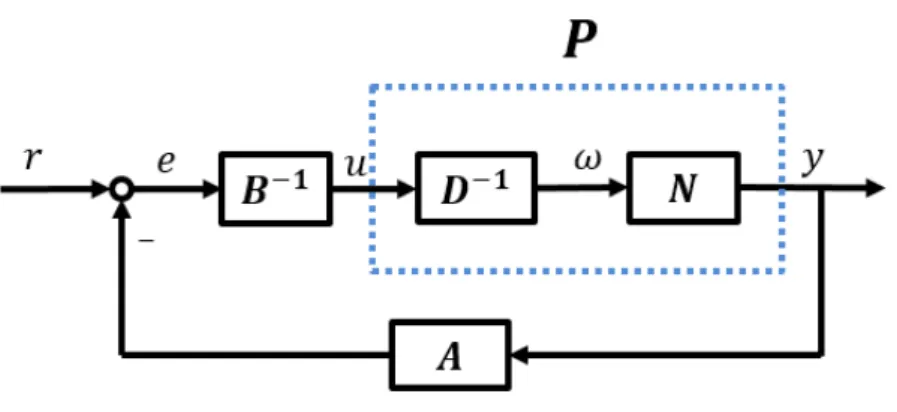
A nominal operator based nonlinear control system is shown in Figure 2.2, in which the given plantP :U →Y is from the input spaceU to the output space Y, where the signals u and y denote the control input and system output, respectively.
Figure 2.2: A nominal operator diagram
Right factorization
For the given normal system operator P : U → Y shown in Figure 2.3, where U and Y are the input space and the output space [61]. If there exist a linear space W and two stable operators N and D, such that the operator P as a composition of N and D in form of P =N D−1, where N : W → Y and D : W → U is invertible, then the operator P is said to have a right factorization, the linear space W is called a quasi-state space ofP .
Right coprime factorization
Provided that P exists a right factorization (N, D), furthermore, the two stable operatorN andDsatisfy the Bezout identityAN+BD=M, for some
2.2. MATHEMATICAL PRELIMINARIES 27 stable operators A and B, where A : Y → U and B : U → U is invertible, Bezout identity as shown in the form of
AN +BD=M, for M ∈ U(W, U),
whereM is unimodular, then the factorization is said to be coprime, that is, operatorP is said to have a right coprime factorization [61]. Generally,P is unstable and (N, D, A, B) are stable to be determined to be design in the system issue.
Figure 2.3: A nonlinear system with right coprime factorization
We remake that the transformative Bezout identity introduced here is defined on the linear space X. Moreover, if X = U, the M can be usually replaced by the identity operatorI. Note that the initial state should be con- sistent with the Bezout identity, that is,AN(w0, t0)+BD(w0, t0) =M(w0, t0) should be satisfied. Furthermore, in this dissertation, we select t0 = 0 and w0 = 0 without loss of generality.
Well-posedness
The nonlinear control system shown in Figure 2.3 is said to be well-posed, if for every input signal r∈U determine an unique corresponding signals in the system (i.e. e, u, w, b and y) are uniquely determined.
Overall stable
The nonlinear system shown in Figure 2.3 is said to be overall stable, provided that r∈U, implies that u∈U, y ∈Y, w ∈W, e∈U and b∈U.
Lemma 2.4 Assume that the system shown in Figure 2.3 is well-posed and the system has a right factorization in the form of P = N D−1. Then the system is said to be overall stable if and only if the operator M in Bezout identity is a unimodular operator.
Proof. The proof is given in Appendix A.3 [35].
2.2.4 Definition of robust right coprime factorization
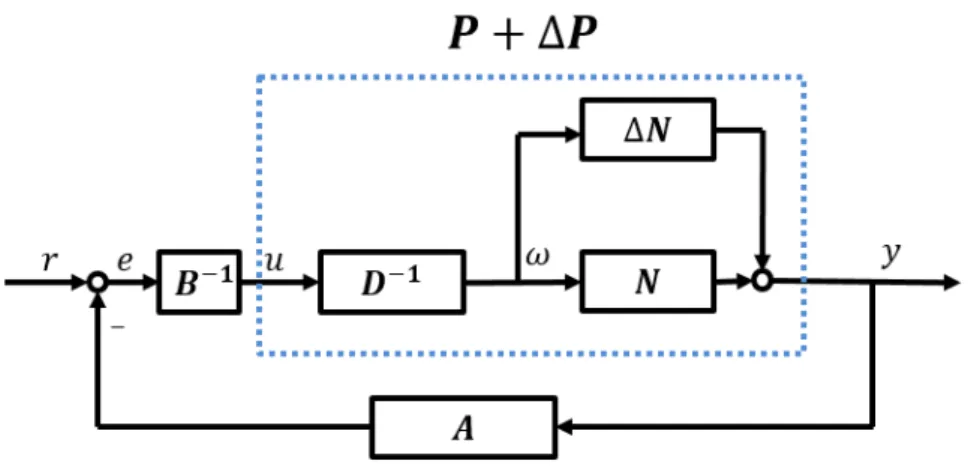
Considering the nonlinear system with perturbation show in Figure 2.4. Sup- pose that the system is denoted as P =P + ∆P, in which P is denoted the normal system and the perturbed system are given as P. ∆P denotes the case N → N + ∆N, in other words, the perturbation can be considered as the results caused by ∆N. The right factorization of the nominal system P and the overall system P can be rewritten as
P =N D−1 and
P + ∆P = (N + ∆N)D−1
respectively, whereN andD are stable operators,D is invertible and ∆N is denoted as the bounded perturbations.
2.2. MATHEMATICAL PRELIMINARIES 29
Figure 2.4: A nonlinear system with bounded perturbations
It is worth mentioning that under what conditions the nonlinear system with unknown bounded perturbations is said to have a robust right coprime factorization, when the perturbed nonlinear system still remains a right co- prime factorization, that is, what conditions can guarantee the nonlinear system still having the robust stability property.
In the discussion of this problem, according to the definition of null set, in [37], if and only if the following condition is satisfied, so as to guarantee the nonlinear system with unknown bounded perturbations to be robustly stable,
A(N+ ∆N)−AN = 0. (2.6)
under the condition of satisfaction of R(∆N) ⊆ N(A), where N(A) is the
null set defined by
N(A) ={x: x∈ D(A) and A(x+y) =A(y) for ally ∈ D(A)} Based on the proposed sufficient condition, the fact that
A(N + ∆N) +BD=AN +BD=M
is obtained, which guarantee the robust stability of the nonlinear systems with unknown bounded perturbations.
However, because of the condition in [37] is harsh to satisfy, so that the proposed design scheme for the nonlinear systems with unknown bounded perturbations is crucial to realize. Therefore, a generalized sufficient condi- tion is proposed in [35] which compared with [37] in order to improve and extend the condition.
Lemma 2.5 Let De be a linear subspace of the extended linear space Ue associated with a given Banach space U, moreover denoted (A(N + ∆N)− AN)M−1 ∈Lip(De). Denote the Bezout identity of the nominal system and the perturbed system respected to ∆N in the form of AN+BD=M, A(N+
∆N) +BD= ˜M, respectively. If the condition as follows
∥(A(N + ∆N)−AN)M−1 ∥<1
is satisfied, then the system shown in Figure 2.4 is robust stable Proof. The proof is given in Appendix A.4 [35].
Then remarking the above Lemma, considering the system shown in Fig- ure 2.4, assume that right factorization of the unstable system is given as P + ∆P = (N+ ∆N)D−1, where N+ ∆N is an unimodular operator. Then M in the nominal Bezout identity can be equivalent otM + ∆M as a result ofN →N+ ∆N. If two designed operatorsAandB satisfy the Bezout iden- tity A(N+ ∆N) +BD=M+ ∆M, moreover, (N+ ∆N)(M+ ∆M)−1 =I, then the output can track to the reference input while the nonlinear system is overall stable.