• 検索結果がありません。

Comparative Research of Rural Gentrification in Derbyshire Dales, England

N/A
N/A
Protected

Academic year: 2021

シェア "Comparative Research of Rural Gentrification in Derbyshire Dales, England"

Copied!
132
0
0

読み込み中.... (全文を見る)

全文

(1)

Tokyo Metropolitan University

Comparative Research of Rural Gentrification in Derbyshire Dales, England

Doctoral Dissertation Submitted to

The Graduate School of Urban Environmental Sciences in Partial Fulfilment of the Requirement for

the Degree of Doctor of Tourism Science

Department of Tourism Science

by

Ryo Iizuka

February 2015

(2)

iii

Contents

List of Figures v

List of Tables vii

Acknowledgements viii

Abstract x

1. Introduction 1

1.1. Background of the study 1

1.2. Aims and Objectives 3

2. Related Articles 4

2.1. Definition of gentrification 4

2.1.1. Social structure change 4

2.1.2. Refurbishment of houses 5

2.1.3. Displacement 6

2.2. Positive or negative gentrification 6

2.3. Stage models of gentrification 7

3. Methodology 13

3.1. Capturing social class 13

3.2. Questionnaire survey 17

4. Rural Gentrification in Derbyshire Dales District 18

4.1. Study area 18

4.2. Peak District National Park 18

4.3. Internal migration 21

4.4. Service class distribution 22

4.5. Working class distribution 23

4.6. Summary 24

5. Case Study Villages 25

(3)

iv

5.1. Grindleford 25

5.2 Youlgrave 27

5.3. Monyash 29

6. Process of Rural Gentrification in the Case Villages 31

6.1. Population and Household Change 31

6.1.1. Grindleford 31

6.1.2. Youlgrave 32

6.1.3. Monyash 33

6.2. Social class change 33

6.2.1. Grindleford 34

6.2.2. Youlgrave 36

6.2.3. Monyash 38

6.3. Income characteristics 39

6.3.1. Grindleford 40

6.3.2. Youlgrave 41

6.3.3. Monyash 41

6.4. Housing refurbishments 42

6.4.1. Grindleford 43

6.4.2. Youlgrave 44

6.4.3. Monyash 45

6.5. Process of rural gentrification 45

7. Social Capital in Gentrified Village 51

7.1. Social capital 51

7.2. Social capital in the case villages 53

7.2.1. Social capital in Grindleford 54

7.2.2. Social capital in Youlgrave 55

7.2.3. Social capital in Monyash 56

7.2.4. Discussion 57

8. Conclusion 60

(4)

v

List of Figures

Figure 1. Example of Standard Occupational Classification Figure 2. Location of Derbyshire Dales District

Figure 3. Distribution of In-migrants in Derbyshire Dales (1971-1981: ED) Figure 4. Distribution of In-migrants in Derbyshire Dales (1981-1991: ED) Figure 5. Distribution of In-migrants in Derbyshire Dales (1991-2001: OA) Figure 6. Distribution of service classs in Derbyshire Dales (1991: ED) Figure 7. Distribution of service classs in Derbyshire Dales (2001: OA) Figure 8. Distribution of service classs in Derbyshire Dales (2011: OA) Figure 9. Distribution of working class in Derbyshire Dales (1991: ED) Figure 10. Distribution of working class in Derbyshire Dales (2001: OA) Figure 11. Distribution of working classs in Derbyshire Dales (2011: OA) Figure 12. Gentrification model in Derbyshire Dales

Figure 13. Location of the case villages

Figure 14. Population and household in Grindleford Figure 15. Population and household in Youlgrave Figure 16. Population and household in Monyash Figure 17. Social class change in Grindleford

Figure 18. Social class distribution by length of residence in Grindleford Figure 19. Social class change in Youlgrave

Figure 20. Social class distribution by length of residence in Youlgrave

Figure 21. Social class change in Monyash

(5)

vi

Figure 22. Social class distribution by length of residence in Monyash

Figure 23. Distribution of annual household income by length of residence in Grindleford Figure 24. Distribution of annual household income by length of residence in Youlgrave Figure 25. Distribution of annual household income by length of residence in Monyash Figure 26. Number of housing refurbishments by length of residence in Grindleford Figure 27. Number of housing refurbishments by length of residence in Youlgrave Figure 28. Number of housing refurbishments by length of residence in Monyash Figure 29. Stage model of rural gentrification in Derbyshire Dales District

Figure 30. Distribution of close friends outside the village by social class in Grindleford Figure 31. Distribution of close friends inside the village by social class in Grindleford Figure 32. Distribution of participation in local social clubs by social class in Grindleford Figure 33. Frequency of using local pubs by social class in Grindleford

Figure 34. Distribution of close friends outside the village by social class in Youlgrave Figure 35. Distribution of close friends inside the village by social class in Youlgrave Figure 36. Distribution of participation in local social clubs by social class in Youlgrave Figure 37. Frequency of using local pubs by social class in Youlgrave

Figure 38. Distribution of close friends outside the village by social class in Monyash Figure 39. Distribution of close friends inside the village by social class in Monyash Figure 40. Distribution of participation in local social clubs by social class in Monyash Figure 41. Frequency of using local pubs by social class in Monyash

Figure 42. Social capital transition with rural gentrification

(6)

vii

List of Tables

Table1. Classification of social class by SEG

Table 2. Classification of social class by NS-SEC

(7)

viii

Acknowledgements

I am deeply indebted to my dissertation supervisor, Professor Toshio Kikuchi. At times he guides me with great kindness; at times he is strict. But when things did not go so smoothly, he always gave me useful advice and cheered me up. Without him, I could not have accomplished such a big project.

Special appreciation goes to Professor Martin Phillips at the Department of Geography, University of Leicester. He always treated my research thoughtfully and gave me important advice on my empirical investigation. In addition, he introduced me to useful literature on rural gentrification, helping me develop the background of this study.

I also would like to thank all the villagers in Grindleford, Youlgrave, and Monyash who participated in my study. They were patient with my questionnaire survey, answering questions that must have been sometimes awkward. Sometimes they gave me precious kindnesses, not only answers to the questionnaire but a cuppa and a pint or a fun chat! It was a great, exciting experience for a student like me, who was ignorant of the lives of people in this region.

Thanks must also go out to all my examiners, Professor Takashi Kosaki and Associate Professor Shinya Numata for their comments on an earlier draft of this article.

Their suggestions made this thesis more sophisticated.

In addition, I would like give thanks to my fellow graduate students in the

Department of Tourism Science, Tokyo Metropolitan University and the Department of

(8)

ix

Geography, University of Leicester. They always gave me good advice and a warm welcome when I came back to see them.

Finally, I would like to express my sincere thanks to my family: Masae, Kazuko,

Taeko, and Haruka. It is because of their support and patience that I was able to do

long-term research abroad with my mind at ease.

(9)

x

Abstract

Rural gentrification is a phenomenon of change in rural areas caused by the inflow of middle-class people mainly from urban areas. To examine the phenomenon, this study captures the social class change and its impacts inside rural areas from the integrated perspective of social, economic, and cultural aspects. In previous studies, rural gentrification has generally been seen from negative aspects, as causing the displacement of lower-income and young residents due to the rapid increase of property prices, as is often the case in the gentrification of urban areas. However, positive impacts of gentrification, such as an increase of revenue and emergence of new culture due to change in social class structure, are effective for the development of rural areas, where the scale of economy is smaller than in urban areas. These positive impacts also lead to sustain village communities. This study aims to establish a stage model of rural gentrification which explores the process of and seeks to capture the impacts of rural gentrification to rural communities from the view of social capital. Additionally, Derbyshire Dales, which is located in the middle of England, is selected as a research area because it has seen a flow of population to rural areas due to its proximity to large cities such as Sheffield and Manchester.

First, demographical changes and changes in structure of social class were

analysed quantitatively from the UK Census data in order to examine geographical

distribution and the development process of rural gentrification all over the Derbyshire

Dales. As a result, it was revealed that population movements were affected by factors

(10)

xi

such as proximity to cities and existence of market towns. In addition to this, the preference of service-class people, who can cause rural gentrification, to quiet environments for living contributed to the geographical expansion of rural gentrification in Derbyshire Dales. Thus, Derbyshire Dales was divided into three areas, which are

‘mature gentrification area’, ‘developing gentrification area’, and ‘establishment gentrification area’, based on the difference of development in rural gentrification in the view of the proportion of service-class people and the situation of displacement of working-class people.

Second, the processes of rural gentrification were examined in each selected case village of those areas: Grindleford as a maturing gentrified village, Youlgravea as a developing gentrified village, and Monyash as an establishing gentrified village.

Specifically, indicators related to rural gentrification such as social class distribution of residents, annual household income, and situation of housing refurbishments were selected from the data of the UK Census and questionnaire survey for the villagers.

Then, those indicators were analysed from the cohorts, which are based on the length of

residence in the village, in order to discuss the development of rural gentrification

chronologically. Rural gentrification had progressed from the 1970s in Grindleford, and

the symptom of rural gentrification had been observed in and rapidly progressed since

the 1980s. On the other hand, in Monyash, rural gentrification has mildly progressed

since the 1970s. Therefore, although the speed of the progress of rural gentrification

was different among the villages, the characteristic four phases, which are ‘mature

(11)

xii

phase’, ‘developing phase’, ‘establishment phase’ and ‘emerging phase’, were established, extracted from variations in indicators such as proportion of social classes and number of housing refurbishments as well as historical backgrounds of the villages and stage model of rural gentrification based on those phases.

Finally, the impacts of rural gentrification on the communities of the case villages studied are investigated from the perspective of social capital. Indicators related to social capital which are residents’ social activities inside or outside the village, including communication with neighbours, participation in local social clubs, and frequency of going to pubs, were extracted from the data of the questionnaire survey.

Therefore, the difference of social capital between cohorts based on social class was analysed. As a result, it was revealed that the character of social capital has changed from bridging to bonding as rural gentrification has progressed. Thus, social capital works more positively in the state of developing a gentrified village. Additionally, in the mature gentrified village, social capital tends to have characters of bridging, which strengthen ties outside of the village community.

As previously described, rural gentrification progresses from an emerging phase to

a mature phase through a fixed process. In that process, the character of social capital

changes from bridging to bonding, then returns to bridging. Such changes of social

capital make impacts of gentrification positive or negative. The originality of this study

is in the point of not only grasping rural gentrification in the form of a stage model, but

also demonstrates the changes in character of social capital. That is to say that changes

(12)

xiii

in social class structure and positive impacts caused by an inflow of population which

has not been discussed much in previous studies of rural geography and rural tourism

are revealed in this study. Therefore, new information of this study contributes to

restructuring communities and making them socially sustainable in the rural society

under complication and diversification.

(13)

1

1. Introduction

1.1. Background of the study

In the last few decades, rural areas have changed dramatically. After World War II, agriculture in Western countries has been affected by productivism, which pursues efficiency and the increase of production, and which values economic prosperity. Rural areas which depend on agriculture also have been changed by productivism. The problems of depopulation and community decline arose because mechanisation in farming and functional differentiation between rural and urban led to the outflow of population into urban areas (Woods 2005). However, since the late 1970s, the concept of multifunctionality in rural areas was controversial as the reflection of productivism and rural areas came to be seen as areas with noneconomic, qualitative value. Therefore, the paradigm in agriculture and rural areas has gradually shifted to post-productivism (Butler et al. 1998; Cloke 1992; Ilbery 1998).

In a post-productivist era, some rural areas are not only outlets of population to urban areas, but inlets from urban and the other rural areas. Such an inflow of population socially, economically, and culturally changed the structure in rural areas, which were strongly bound to agriculture (Murdoch and Marsden 1991; Sutherland 2012). The increase of middle classes was especially seriously affected (Bourdieu 1984;

Eder 1993; Benett et al. 2009). Middle-class individuals tend to live in rural areas to escape from urban bustle and pursue their ideal ‘rural’ lifestyle (Cloke et al. 1991;

Heley 2014). These demographic movements of middle classes are captured as ‘rural

(14)

2

idyll’ (Bunce 2003; Dirksmeier 2008; Horton 2008; Little and Austin 1996; Matthews et al. 2000; Stockdale 2014), ‘counterurbanisation’ (Chaney and Sherwood 2000;

Halfacree 2001, 2008; Spencer 1995, 1996), and ‘rural gentrification’ (Parsons 1981;

Phillips 1993, 2004, 2005).

These three concepts are related to each other. ‘Counterurbanisation’ is the concept which captures the inflow of population and structural change in rural areas more

‘purely’ (Halfacree 2001) from a perspective of demographic change. ‘Rural idyll’ is the concept which captures people’s aspirations to live in rural areas. On the other hand,

‘rural gentrification’ is the concept which includes the two previous concepts.

Researchers consider that rural gentrification is a more political concept, because it involves winners and losers in rural areas. Thus, rural gentrification can figure one fact of rural areas. Today, the concept of rural gentrification is focused on phenomenon of rural areas in a post-productivist era.

It is critical for the rural change today to involve the discussion of rural

gentrification. According to progress of globalisation, phenomena of gentrification are

diffused in rural areas all over the world (Hines, 2010). However, researches about rural

gentrification are limited to developed and capitalist countries, especially the UK, the

US (Ghose 2004; Nelson et al. 2010) and Australia (Costello 2007). That is why it is

valuable to research rural gentrification in other contexts, including post-socialist

countries and Asia.

(15)

3 1.2. Aims and objectives

This study will explore and compare the processes and impacts of rural gentrification in different situations in England. Essentially, the phenomenon of rural gentrification will be captured in this study. After defining some terms, such as

‘gentrification’ and ‘displacement’, rural gentrification in research is examined

empirically from census and quantitative data. Then, this study will assess the impacts

of rural gentrification in the process. In this phase of research, the ‘stage model’ (Clay

1979; Hackworth and Smith 2001) will be used to explain this process. Further, to

assess the impacts of rural gentrification, perspectives of ‘social capital’ (Lin 1999,

2001; Putnam 1995, 2000; Putnam et al. 1993) will be applied. Finally, this study will

compare case studies in three different situations in the Peak District villages. To

compare these different case studies, more generalised impacts of gentrification will be

revealed. To reveal the phenomenon of rural gentrification is important for today’s rural

areas, which are restructured dynamically.

(16)

4

2. Related Articles

2.1 Definition of gentrification

In the research of gentrification and rural gentrification, there are many definitions of these terms. Rose (1984) used the term ‘chaotic concepts’, and Hamnett (1991) described a ‘theoretical and ideological battle ground’, to describe that the concept of gentrification can be criticised easily. However, these critics obscure the fact that a multiplicity of processes is involved in and important to gentrification (Phillips, 2009).

That is why I set three factors of gentrification on the basis of Phillips’s research (1993, 2002, 2009, 2014). Based on those three factors, this research will be explored.

2.1.1. Social structure change

The inflow of middle classes is an important factor in gentrification. These inflows occur not only in urban but also rural areas, where people have once moved out to cities (Cloke and Thrift 1987). Middle classes moving into rural areas cause rural gentrification, making their ideal rural lives come to fruition (Cloke et al. 1995, 1998;

Urry 1995). According to diversification of middle classes, however, it is believed that an increase of ‘service classes’ is more important to capture the social structure change in rural areas (Hoggart 1997). Hoggart examined changes between 1971 and 1991 in the size of three middle-class groups made up of professionals and managers, namely the

‘service class’, clerical workers, and small-scale proprietors. He found that especially in

(17)

5

that period, the number of professionals and managers was increased. Thus, in my research, the increase of the service class in rural areas will be examined.

2.1.2. Refurbishment of houses

In the gentrification process, gentrifiers refurbish their properties’ interiors and exteriors (Caufield 1989, 1994; Glass 1964). In rural areas, those refurbishments are reflections of gentrifiers’ rural idyll. For example, typical refurbishments in rural areas are barn conversions (Phillips 2002). Further, the extension and establishment of conservatories are also important signs of gentrification. Thrift (1987) mentioned:

Members of the service class have a strong predilection for the rural ideal/idyll that lies at the centre of the values ….more than other classes, they have capacity to do something about predilection.

Thrift’s comment implies not only that service-class people prefer rural areas, but

refurbishments in rural areas are also related to the increased presence of service-class

people. In my research, the change of refurbishments will be examined both

quantitatively and qualitatively in the view of the service class rural idyll.

(18)

6 2.1.3. Displacement

Displacement is the most negative aspect in gentrification. The inflow of service classes causes the outflow of working classes (Freeman and Braconi 2004; Smith 1996).

Butler (2007) described that process as one in which ‘a winner is often at the expense of creating a loser’. However, this political process in gentrification is different from

‘counterurbanisation’. That is why it is important to capture displacement in rural gentrification research.

When these three movements are captured, gentrification is defined in my research.

That is to say, rural gentrification is ‘the phenomenon of structural change in rural areas caused by inflow of service classes’.

2.2 Positive or negative gentrification

Generally, the phenomenon of gentrification has both positive and negative aspects (Lees et al. 2008, 2012). Although positive aspects are more important to sustain rural areas, in today’s rural gentrification research, positive aspects are seldom emphasised.

In an urban context, Cameron (2003) defined ‘positive gentrification’ as the distribution

of social capital from the rich to the poor in the process of gentrification, and examined

a housing policy in Newcastle, ‘Going for Growth’. ‘Going for Growth’ is designed to

attract middle classes living in suburban areas into city centres, and to revitalise

run-down working class areas in city centres. However, he found that positive

gentrification did not occur, because policy itself failed.

(19)

7

Therefore, successful cases of positive gentrification are not yet revealed. Further, in Cameron’s research (2003), the policy factor is well considered, but internal factors such as community are examined insufficiently. In the rural context, the relationship between community and gentrification is especially important, because community takes deep roots into everyday life in rural settings. That is why I agree with Cameron’s (2003) ‘positive gentrification’ and its definition as the increase of social capital.

However, in my research, positive gentrification will be captured in a more community-based view.

2.3 Stage models of gentrification

The stage model of gentrification emerged from the 1970s to capture the process of gentrification. Some researchers attempted to establish the stage model of gentrification (Bourne 1993; Clay 1979). Clay (1979) produced one of the early stage models of gentrification on the basis of observations and data from a number of cities in the US.

His model contains four stages, from Stage 1 ‘pioneer gentrification’ to Stage 4

‘maturing gentrification’. The model is as follows:

Stage 1

A small group of risk-oblivious people, who are often design professionals or artists,

renovate properties for their own use by sweat equity and private capital.

(20)

8

Displacement does not occur often, because gentrifiers live in vacant houses.

Further, the area influenced by gentrification is small.

Stage 2

More and more such professional people come into the area. Some realtors who acknowledge the potential of the area emerge and begin to promote it. Some displacement can occur, but it is a slow change.

Stage3

Stage 3 is the heaviest stage of change. Not only individual gentrifiers but also developers intrude in the area. Some houses are bought for investment. Promotions by the media and realtors are developed, and displacement continues and strengthens. Physical improvements become more visible and property prices begin to jump rapidly. Tensions between old working-class residents and newcomers are serious. Motions of protestation against gentrification occur.

Stage4

A large number of properties is gentrified, and the middle class continues to come

in. However, the middle class begins to include the business and managerial middle

class. For the middle class, small, specialised retail and professional services begin

to emerge. Homeowners as well as renters are displaced.

(21)

9

Clay’s model is easy to understand and reasonable. However, it is too simple and not suitable for today’s situation and other occasions outside of US cities, because it is based on Glass’s (1964) classical gentrification. Today, gentrification becomes more diversified and complicated. For example,‘re-gentrification’ and ‘super gentrification’

cannot be captured by Clay’s model, thus the long-time criticism of his model. However, that does not mean that his model is useless. Lees et al. (2010) says:

All of these critiques are valuable and important. Yet they also miss the point. Even as the simplicity of the early stage models gives way to the intricate plurality of contemporary contingency, the fundamental essence – the idea that there are discernible stages, phases, or alignments of particular causes and effects related to particular trajectories – has gained even more widespread acceptance. The details of everyone’s account of a particular neighborhood will differ. But nearly everyone subscribes to the same assumptions and metaphors of stages: direction, speed, motion, momentum. For many people concerned with the past, present, and future of their neighborhood, the essence of early stage models is as relevant today as it was for residents debating the same issues 30, 40 or even 50 years ago.

Inspired by Clay’s model, Hackworth and Smith (2001) established a new 3-wave

(stage) model from research in New York considering rent gap. Their model is as

follows:

(22)

10 First-wave

Sporadic gentrification: Prior to 1973, this process is mainly isolated in small neighbourhoods in northeastern US and Western Europe.

Transition 1

Gentrifiers buy property: In New York and other cities, developers and investors used the downturn in property values to consume large portions of devalorized neighbourhoods, thus setting the stage for the 1980s gentrification.

Second-wave

The anchoring of gentrification: The process becomes implanted in hitherto

disinvested central city neighbourhoods. In contrast to the pre-1973 experience of

gentrification, the process becomes common in smaller, non-global cities during the

1980s. In New York City, the presence of the arts community was often a key

correlation of residential gentrification, serving to smooth the flow of capital into

neighbourhoods such as SoHo, Tribeca, and the Lower East Side. Intense political

struggles occurred during this period over the displacement of the poorest residents.

(23)

11 Transition 2

Gentrification slows: The recession constricts the flow of capital into gentrifying and gentrified neighbourhoods, prompting some to proclaim that a ‘degentrification’

or reversal of the process was afoot.

Third-wave

Gentrification returns: Prophesies of degentrification appear to have been overstated as many neighbourhoods continue to gentrify while others further from the city centre begin to experience the process for the first time. Post-recession gentrification seems to be more linked to large-scale capital than ever, as large developers rework entire neighbourhoods, often with state support.

As Lees et al. (2008) explained, this model is one of the best recent attempts at explaining model gentrification and its particular fluctuations and mechanisms.

However, Lees et al. (2008) also described that:

It is six years now since Hackworth and Smith (2001) designed their schematic

history of gentrification in New York City, and well over a decade since the third

wave of post-recession gentrification first began.

(24)

12

Hackworth and Smith (2001) produced the Fourth-wave after the Third-wave. In

the Fourth-wave, gentrification is effected by national and global markets, and national

policies become far more important than ever before. However, the Fourth-wave

gentrification ignores low-income, working-class people, because these policies are

designed for people with higher incomes.

(25)

13

3. Methodology

This study aims to reveal the process and impacts of rural gentrification from a socio-economical approach. Thus, statistical data from a national census were analysed for capturing the phenomenon of rural gentrification. In addition, a framework of social capital was applied to explore the impacts of rural gentrification on the village community.

3.1. Capturing social class

In order to capture rural gentrification, it is important to consider social classes, because gentrification itself is a concept involving change in the structure of social class in the neighbourhood. Generally, the gap of social class still remains in Britain today.

However, it becomes more and more difficult to find differences between social classes apparently due to diversification in occupation and work styles. Therefore, in this study it proved a challenge to grasp social classes of residents systematically.

I extracted social classes from the UK Census data for statistical analysis. However,

the style of classification is different between the UK Census before and after 2001,

because the National Statistics Socio-economic Classification (NS-SEC) has been

available for use in all official statistics and surveys since 2001 (ONS, 2010) instead of

former Socio-economic Groups (SEGs). Therefore, it is necessary to convert the data

standardised in order to compare.

(26)

14

In this study, Wheway’s (2011) classifications for SEG and Hoggart’s (1997) and ONS’s (2005) classification for NS-SEC are applied. Wheway (2011) classified SEG into three social groups: the ‘service class’, ‘intermediate class’, and ‘working class’. As shown in Table 2, Wheway (2011) allocated SEGs to those three social classes based on census data instruction by ONS. Thus, he explained, ‘(The) SEGs were the best way to compare with the newer NS-SEC classification scheme used to identify social class in the 2001 GB census’ (Wheway 2011). However, this does not mean that there is no problem with this conversion. Wheway mentioned that SEG 5.1 with ancillary workers and artists and SEG 6 with junior non-manual occupations tend to ‘inflate whichever class category they are allocated’, and this makes it difficult to compare directly from the NS-SEC data (2011). However, as he described, the accuracy of the conversion is said to be 87% by ONS (2005). We believe that that figure is enough to apply to this study.

On the other hand, we took an integrated classification of Hoggart’s (1997) and

ONS’s (2005) classifications for NS-SEC. In Hoggart’s study, he classified groups

which were generally called the ‘middle class’ into three groups: the ‘service class’,

who are professionals and managers, ‘petite bourgeoisie’ who are clerical workers, and

small-scale proprietors and the ordinal ‘middle class’. His classification is based on

Goldthorpe’s (1972, 1987, 1995) classification, which is ‘widely used in pure and

applied research, known as the Goldthorpe Schema’ (ONS, 2010), and developed to

NS-SEC classification. Therefore, Phillips (2007) integrated those classifications and

(27)

15

discussed social class distribution quantitively in rural areas of Britain. The result of his study aside, Table 2 is his classification of social class for NS-SEC. Phillips (2007) identified 3 groups, the ‘service class’, ‘intermediate class’, and ‘working class’, and one sub-group, the ‘petite bourgeoisie’, in NS-SEC based on ONS (2005). According to ONS (2005), NS-SEC Classes 1 and 2, which are both classified as a ‘service class’ in the works of Hoggart (1997) and Phillips (2007) are described as follows:

service relationship: the employee renders service to the employer in return for compensation, which can be both immediate rewards (for example salary) and long-term or prospective benefits (for example assurances of security and career opportunities). The service relationship typifies Class 1 and is present in a weaker form in Class 2.

Moreover, NS-SEC Classes 5, 6, and 7, which are each classified as a ‘working class’ in Phillips’s work (2007), are defined as follows:

labour contract: the employee gives discrete amounts of labour in return for a wage

calculated on the amount of work done or time worked. The labour contract is

typical in Class 7 and, in weaker forms, in Classes 5 and 6.

(28)

16

As for NS-SEC Classes 3 and 4, which are both classified as an ‘intermediate class’ in the work of Phillips (2007), are indistinctly defined by elimination:

intermediate: these forms of employment regulation combine aspects from both the service relationship and labour contract, and are typical in Class 3.

According to Phillips (2007), in addition to this argument, ONS itself warns that the aggregation of NS-SEC Classes 3 and 4 is ‘not appropriate … because the self-employed are distinctive in their life chances and behaviour’, and it is necessary to

‘accept the theoretical and measurement principles of NS-SEC’. Therefore, Phillips (2007) deprived the ‘petite bourgeois’, an NS-SEC Class 4 group, from the intermediate class, and which is also the same as Goldthorpe’s ‘petite bourgeois ’. The petite bourgeois stands for ‘Small employers and own workers’, and is often identified as the

‘traditional middle class’, made up of mainly local farmers, in order to distinguish from the ‘new middle class’, who are the so-called ‘service class’ (Hoggart, 1997; Phillips, 2007; Savage et al., 1992).

Some researchers like Savage et al (1992) pointed out the importance of the

existence of the petite bourgeois. However, in this study, I applied three group

classifications in order to exaggerate the ‘new middle class’ individuals, who generally

cause rural gentrification, for the convenience of discussion.

(29)

17 3.2. Questionnaire survey

In order to capture the impacts of rural gentrification in consciousness for rural living and lifestyles of residents, a questionnaire was distributed in the case villages.

The questionnaire was composed of forty questions, which asked questions regarding

outlook on the village, personal situation of communication and social networks,

housing, everyday life, occupation, and personal data (see Appendix). It was conducted

by visiting distribution and collection. In Grindleford, the survey was conducted from 6

to 13 July 2014, and received 92 answers, 40% of all distributed questionnaires. In

Youlgrave, the survey was conducted from 15 to 26 July 2013, and received 152

answers, 36.2% of all distributed questionnaires. Then, in Monyash, the survey was

distributed in October 2013 and received 38 answers, 36.5% of distributed

questionnaires. The data from the questionnaire surveys are used in chapters 6 and 7 of

this study.

(30)

18

4. Rural Gentrification in Derbyshire Dales District

4.1. Study area

In this study, we selected Derbyshire Dales District as a research area (Figure 2).

Derbyshire Dales District is one of the districts in Derbyshire County, which is located in the centre of England. Near Derbyshire Dales District, there are large cities such as Sheffield, Nottingham, Derby, and Manchester. Besides a proximity to those cities, almost half of the area is designated Peak District National Park land, and is thus made up of a natural, preserved environment. That is why the Derbyshire Dales District is a good location for commuters who want to live in the countryside while working in the city.

4.2. Peak District National Park

Peak District National Park, established in 1951, is the first national park in Britain.

The area of the park lies mainly in northern Derbyshire and partly in Cheshire, Greater Manchester, Staffordshire, South Yorkshire, and West Yorkshire. The park has an area of about 1,440 square kilometres. In British national parks, planning restrictions are set by the Park Authority, which manages the preservation of the park areas. Thus, the land of the park can be owned privately, and people may live inside the park. In the Peak District National Park, there are approximately 40,000 inhabitants.

The main current industries in the area are quarrying, agriculture, and tourism

(PDNPA, 2001). Traditionally, lead mining and agriculture were the main industries in

(31)

19

the Peak District since the 16th century, and went into the golden age in the 17th and 18th centuries. However, in the 19th century, the lead mining industry started to decline because of veins drying up, an increase of production costs, and the importing of cheaper foreign stuffs. This caused a closure of major mines which held vast labour forces, as was the case with the Magpie Mine in 1925 and the Millclose Mine at Darley Bridge in 1939 (Bull, 2012).

Instead of lead mining, limestone and quarry had become important minerals in the area, and were used for building stone and making mortar since the middle of the 19th century (PDNPA, 2010). In addition to limestone, some gritstone was also quarried for housing uses. In 1925 near Buxton, before the mechanisation of quarrying, many workers who often lived in nearby villages were greatly needed to contribute to the mining industry. However, many workers in quarries today are lorry drivers who send products all over Britain, which is why many workers who lived in the villages were moving out from the Peak District. Although quarrying industries were also declining in terms of jobs because of a reduction in operations by strengthened natural resource planning and progress of efficiency, they still remain in this century. Illustrative of this reality is the existence of the largest quarry in Europe, near Buxton, and as of 2008, there are 47 active quarries in the area (PDNPA, 2010).

Today, tourism is quite a significant industry in the area (PDNPA, 2014). Before

set as the national park in 1951, the area of the Peak District was a major tourism

destination for urban residents as a beautiful landscape with good accessibility. The

(32)

20

development of tourism in the Peak District began in the Victorian era. Tourists had been increasing rapidly due to the construction of a railway, which provided casual access to the Peak District. However, at that time, open spaces in the Peak District were occupied by a small number of gentries, and were not open for walking around. In the Kinder Scout area in the Peak District, 1932 marked the Kinder Mass Trespass, an act of protest by a large crowd of ramblers who wanted the rights to access such open country fields. This incident had a political effect, leading to the establishment of national parks in the area.

Since the designation of lands for national parks, tourism has become a more important industry in the Peak District due to the development of leisure time according to structural changes in industries. Many tourists who want to escape from urban bustle have been coming into the area and enjoying walking on footpaths and trails. The economic impact of tourism in the Peak District National Park is 540.62 million pounds in 2013 (PDNPA, 2014). Those developments of tourism make the Peak District more famous and prestigious. That is to say that people’s image of the Peak District is promoted by tourism.

This kind of promotion also affects the housing in the area. In the last few decades,

people not only visit the area but have also started to live there based on the same

motivation as that encouraging tourism. The area is near the large cities of Manchester

and Sheffield, and preserves nature and a healthy environment as a national park. It

therefore has great potential to cause rural gentrification in the Peak District.

(33)

21 4.3. Internal migration

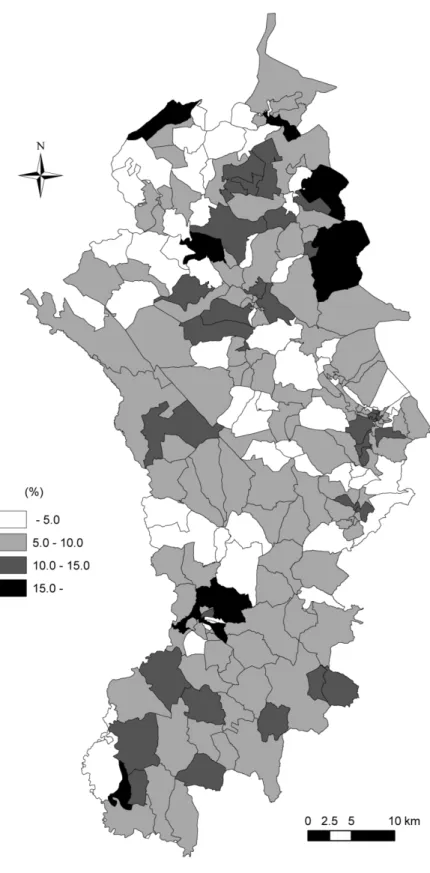
In the last few decades, Derbyshire Dales District saw an intensive migration from all over Britain. Some areas become a destination for migrants. Figure 3 illustrates the proportion of incomers in the period between 1971 and 1981. A population increase of over 5% by incomers are seen in many Enumeration Districts (EDs) on the eastern side of Derbyshire Dales. The proportion is especially high in the former council house areas around market towns such as Matlock, Bakewell, and Ashbourne. Those EDs are in close proximity to the town centre and convenient access to the cities such as Sheffield, Chesterfield, and Derby. On the other hand, the proportion is still low in the western side of Derbyshire Dales.

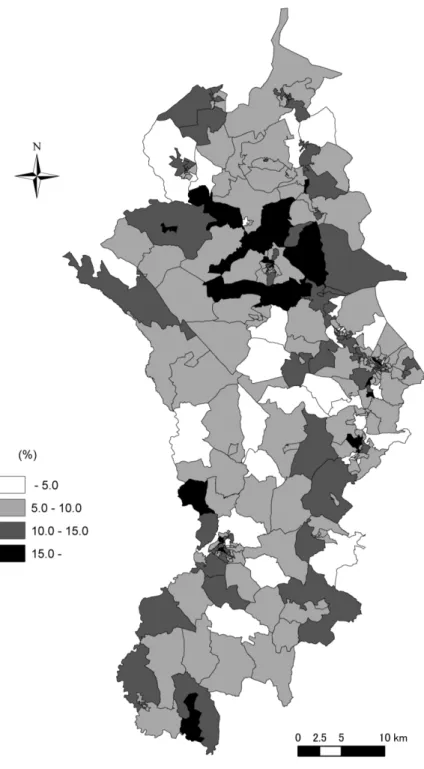
In the period between 1981 and 1991 (Figure 4), the tendency of population increases by incomers in EDs around market towns was the same rate as that of the period between 1971 and 1981. However, in the northern and southern sides of Derbyshire Dales, the inflow of population into some EDs occurred at a rate of 10 to 15 percent. Moreover, a high proportion of EDs expand to the western side of Derbyshire District.

In the period between 1991 and 2001 (Figure 5), the expanding of areas that

experience a high rate of incomers has continued. This means that more and more

incomers flow in to the north and south sides of Derbyshire Dales. Especially

significant is the fact that the proportions are marked at over 15% Output Areas (OAs)

such as Great Longstone and Over Haddon around Bakewell. Further, in the western

(34)

22

side of Derbyshire Dales, including Hartington Middle Quarter and Moyash, an inflow of incomers is still progressing.

On the whole, more and more incomers move into the area. However, we should reveal whether such a population movement in Derbyshire Dales is related to social demographic change, which is a key factor of rural gentrification. Therefore, in the following sections, we discuss the demographical change by social classes.

4.4. Service class distribution

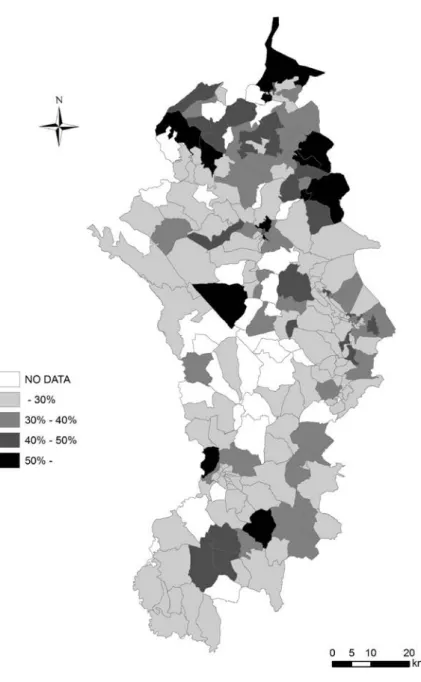
I compared the distribution of service class people in the area from 1991 to 2011 in order to capture the change of social demography. Figure 6 shows the distribution of service class people in 1991. From this figure, one can find that the proportion of service class individuals is relatively high in EDs which are located in the eastern side of the area. It especially seems that a high proportion of EDs are concentrated in the northeast area. This tendency is linked to the distribution of incomers and reflects that these EDs are good locations for residents who want to commute to cities.

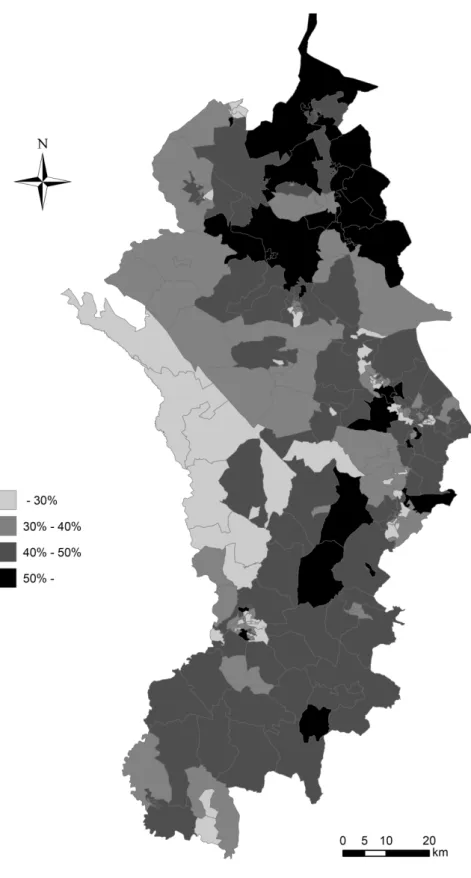
In 2001, the situation has changed dramatically (Figure 7). The proportion of

service class people increases in the whole area, especially in the west side. Considering

that incomers increased in the same period, service class individuals migrated to the

western side of Derbyshire Dales. On the background of the movement of service class

people, it seemed that a change of preference for living areas exists among them. They

(35)

23

prefer to live in quieter and more rural areas in order to escape from the bustle in urban areas, even in market towns which are the centre of rural areas.

The tendency of the presence of service class individuals to increase was strengthened in 2011 (Figure 8). It is especially prominent in OAs on the southern side of the area and north of Bakewell. However, those OAs are relatively close to market towns and cities.

4.5. Working class distribution

The distribution of working class people is significant to capture ‘displacement’, which is one of the important factors of rural gentrification. Figure 9 shows the proportion of working class people in 1991. The EDs with higher proportions tended to distribute in the central and western areas of Derbyshire Dales, while EDs in the eastern side indicated lower proportions. This tendency reflects that those areas include more traditional, rural villages where quarries survived as local industry.

However, in 2001, the proportion of working class people in those areas was also decreased (Figure 10). Considering the increase in proportion of service class people, the decrease of working class people indicates displacement. An exact difference of census tracks between EDs and OAs exists. However, it is easy to note the possibilities of rural gentrification in those areas.

More recently, in 2011 the tendency of displacement progressed the proportion of

working class people, with a rate in most OAs at under 30% (Figure 11). This indicates

(36)

24

that gentrification is progressing in all rural areas of Derbyshire Dales. Especially in the western side of the area, gentrification seems to be strict because of the massive displacement of working class people. However, in council house areas near market towns, working class people still remain. This seems to indicate that working class people like to live near their working places.

4.6. Summary

From the view of social demographical change, the situation of rural gentrification in Derbyshire Dales has been strict in the eastern side of the area from the 1990s. On the other hand, in the western side, the tendency of rural gentrification has been strengthened with the displacement of working class people in the 2000s, and seems to expand gentrified areas from east to west in Derbyshire Dales. This means that different stages of rural gentrification exist.

Figure 12 illustrates a distribution model of rural gentrification in Derbyshire Dales

which is derived from socio-demographic change. The difference of census track

disturbs the simple chronological comparing of tendencies of rural gentrification in the

area. On the basis of expansion from the east to west, I designated three gentrification

areas which range from established and intensified to generalised. The established

gentrification areas are those wherein a population influx and the increase of service

class individuals occurred relatively recently. The intensified gentrification area is one

in which an increase of incomers has progressed, but the proportion of service class

(37)

25

people is becoming high. Finally, the generalised gentrification area is one in which the proportion of incomers and service class people has been high, and the displacement of working class people has progressed.

Therefore, in order to reveal different stages of rural gentrification more concisely, three case study areas were chosen. These study areas are Grindleford as a maturing area, Youlgrave for a intensified area, and Monyash as an established area. Thus, in the next chapter outline, these three areas will be explained.

5. Case Study Villages

5.1. Grindleford

Grindleford is a large-sized village located about 2 miles south of Sheffield (Figure 13). Grindleford is an agglomerated parish created in 1987 from the integration of 4 parishes: Stoke, Eym Woodlands, Nether Padley, and Upper Padley. However, the settlement itself dates back to at least the 13th century (Grindleford Women’s Institute, 2001). The name of ‘Grindleford’ derives from a ‘ford’ where people may easily cross the River Derwent carrying ‘gritstones’ mined around the area.

Until the 19th century, Grindleford was a practical ‘Peak Village’ in which

industry was characterised by agriculture, mills, and quarries. However, when Totley

Tunnel, the second longest inland railway tunnel, opened in 1893 and started passenger

services in 1894, the situation of the village changed (Grindleford Women’s Institute,

2001). Tourists came there to see a beautiful landscape of woodlands and valleys,

(38)

26

because the railway linked the large cities of Sheffield and Manchester. Moreover, the availability of commute by train attracted people who built up their fortune in the steel industry of Sheffield. They wanted to live in the countryside, where a far better environment than industrialised cities was preserved, but they still had to work in the city. This explains why they built splendid houses in the late 19th and early 20th centuries.

The opening of the railway brought industrial benefits to the village (Grindleford Women’s Institute, 2001). The amount of gritstones dug up increased, and they were carried from the quarry by train to all over Britain. This caused the population to grow rapidly. However, with the decline of agriculture and change of industrial structure, especially the decline of the steel industry in Sheffield after WWII, the population increase was stagnated. When the village was designated to the Peak District National Park in 1951, its close proximity to Sheffield, access to public transportation, and reserved nature began to attract commuters who worked in new industries. The population structure had changed from old industry gentry to new white-collar groups, but the character of the village as attracting commuters has not changed.

According to the UK Census in 2011, the population is 909, and Grindleford

possesses 389 households. For commercial facilities, there are two public houses which

are gastronised and one gallery which sells landscape pictures of the Peak District. In

addition to these facilities, one small community shop run by volunteering villagers

which opened in 2014 is located in the parish church.

(39)

27 5.2 Youlgrave

Youlgrave is located about three miles south of Bakewell between Bradford Dale and Lathkill Dale (Figure 13). The usage of the name ‘Youlgrave’ is bit complicated these days, because they have many alternative spellings in that area. According to J. W.

Shimwell, a former teacher at Youlgrave School and a local historian, there were over 60 types of spelling (Youlgrave Parish Website). Today, Youlgreave or Youlgrave is used officially. Both of these spellings stand for ‘yellow grove’, derived from lead mining which was an important industry in the village. Today, on Ordnance Survey, the spelling ‘Youlgreave’ is used. However, people living in the village usually say

‘Youlgarave’, and the Youlgrave Parish Council and Peak District National Park Association use this spelling. On the basis of local usage, I chose ‘Youlgrave’ for this study.

Youlgrave was established as an agricultural settlement. However, the

development of the village was significant in the 17th century, because lead mines had

been found around the village. Miners were coming into the village from all over

Britain, and the population increased at a remarkable rate. The flourish of those

industries had brought benefit to the village. In the golden age of lead mining, wealthy

merchants and traders began to build large houses and different sorts of shops such as

pubs, bakeries, butcheries, and co-operative shops were opened in the village. However,

the prosperity from lead mining did not last very long. Because of the decline of lead

mining in the latter half of the 19th century, as well as the explosion disaster that killed

(40)

28

8 men at the Mawstone Mine in 1932, all of the lead mines in Youlgrave were shut down by the middle of the 20th century. Instead of lead mines, limestone and gritstone quarrying had become important industries in the village from the end of the 19th century due to a housing boom in the Victorian era. In 1951, the population of Youlgrave reached its peak at 1,485.

After WWII, council house developments were prominent in Youlgrave. These kept working-class people in the village. However, the decline of the quarrying industry due to industrial structure changes displaced many workers who could not live in council houses. Thus, cottages for workers of quarries became vacant, and some of them were then changed to second houses and holiday cottages. On the background of this change, an increase of demand as a tourism destination due to the designation to the National Park system in 1951 was also related. In addition, in the 1980s, the ‘Right to Buy’ scheme under the Thatcher Administration which encouraged the privatisation of council housing stock made council houses affordable for urban residents. Therefore, the population structure has been changing in Youlgrave.

According to the UK Census of 2011, the population in Youlgrave is 1,018 and the household number is at 467. This means that Youlgrave is quite a large village in the Peak District area. In the village, there are currently three pubs with accommodations, a post office, and a grocery and butcher shop. Moreover, one youth hostel, which was originally a co-operative shop in the 19th century, is located at the middle of the village.

Tourism-based facilities such as B&Bs and holiday cottages also exist.

(41)

29 5.3. Monyash

Monyash Village is a small village located 7 miles west of Bakewell (Figure 13).

The history of the village started in 2000 BC as an important ceremonial point. This is illustrated by the large Neolithic stone circle, ‘Arbor Low’, which is located at the southwest edge of the village. Today’s settlement was originally a farming community in medieval times, and developed as a marketplace which is one node of four important routes to Buxton, Bakewell, Derby, and Leek (Johnston and Johnston, 2010). From the middle of the 14th century, the village had prospered as a centre for lead mining in the High Peak area. Limestone quarrying was also a significant industry, as well as lead mining. Both industries produced housing stone and marble for public buildings (Johnston and Johnston, 2010). In that time, most of the villagers worked on the farm, mines, and quarries.

The lead mining industry in Monyash reached its golden age in the 19th century.

The flourish of the industry led to a rapid population increase. In 1851, the population

peaked at 473 with approximately 100 houses (Johnston and Johnston, 2010). However,

as was the case with other villages in the Peak District, the population declined with the

closure of lead mines in the latter half of the 19th century. Due to the industrial decline,

many workers living in Monyash had moved out to other mining villages or cities in

order to get a job. This generated abundant vacant dwellings in the village and became

potential housing for gentrifiers later on.

(42)

30

Today, Monyash is a quiet farming village. However, the village is also a tourism

destination in the Peak District National Park. This is why B&Bs, which were originally

used as farm houses and holiday cottages, exist. In addition to the tourism destination,

many incomers seeking good living spaces with natural environments and easy access

to their jobs came from all over Britain to live in the village. This eases the decrease in

population, and the village currently has a population of 294 with 128 households (2011

UK Census). There are no general shops in the village. For the commercial facilities,

only one pub and one café stand in the centre of the village. The café was converted

from a former blacksmith’s workshop. The pub and café are good stopping points for

tourists such as hikers and cyclists.

(43)

31

6. Process of Rural Gentrification in the Case Villages

In this chapter, I capture rural gentrification as a phenomenon in the three case villages of Grindleford, Youlgrave, and Monyash in Derbyshire Dales. In order to grasp rural gentrification, several indicators such as population, social structure, and household income were examined. To begin, I investigated demographic dynamics in the three villages.

6.1. Population and Household Change

6.1.1. Grindleford

Figure 14 shows the transition of population and households in Grindleford.

Population change in Grindleford has been related to transportation to and industry in Sheffield. When the railway between Sheffield and Manchester opened in 1894, it became possible to commute to Sheffield easily. Due to this accessibility, the population increased rapidly in the early 19th century as shown in Figure 14. In 1921, the population once peaked at 740, but levelled off during both World Wars. The efflux of population due to war, as well as the decline of lead mining which started in the early 19th century, were both related. Therefore, the tendency of population decrease progressed after WWII and the population number was down to 644 by 1971. However, after that, the population increased again due to an influx from outside of the village.

On the other hand, the households increased constantly. It is remarkable that the

number either increased or remained almost static in the period from 1951 to 1971,

(44)

32

when the population had decreased. This indicates that the population influx into the village was striking, and the possibility of development of rural gentrification began to be evident during that period, because rural gentrification often involves the intrusion of elderly couples whose children are already independent, or young couples who have not yet had children.

However, from 1991 to 2011, an increasing rate of households was far gentler than that of the population. This indicates that relatively large families flowed into the village, or former young gentrifers grew to have their children. As for the former council house development, this is located at the western side of Grindleford. Those houses are affordable for young families, and indeed seem to be permanent settlements for raising families for young gentrifers.

6.1.2. Youlgrave

The population in Youlgrave had been increasing until 1951, which saw the maximum number at 1,485 due to a flourish of limestone quarries from the 18th century (PDNPA, 2010b; Figure 15). After 1951, the population decreased constantly.

Especially from 1961 to 1971, the degree of decrease was more rapid, and the number ranged from 1,442 to 1,265. This decrease of population was derived from both the decline and mechanisation of local quarrying industry, and continues in 2011.

Despite a decreasing population, the number of households increased after 1951.

This indicates that the population inflow from outside of the village has been increasing.

(45)

33

Thus, the situation was similar to the case of Grindleford from 1951 to 1971. However, it must be noted that this decrease of population after 1971 is different from the case of Grindleford. The decline of local industry after WWII was serious in Youlgrave.

6.1.3. Monyash

The situation of population and household in Monyash is a bit different from the other villages (Figure 16). As for the population, from 1901 to 1991, the tendency to decrease was generally strong. It was especially obvious in the pre- and post-war periods. The reason for this decrease was due to a decline of mineral industry from the middle of the 19th century, as was the case with the other two villages, but the impact of mine closures was relatively small due to Monyash’s farming land and small population size.

On the other hand, the households have remained at almost the same level until 1981. In Monyash, it is interesting that the number of households increased while the population decreased between 1981 and 1991. This indicates that not only the average household-size shrank, but also that the inflow of population had been clear in that period. After that, the population has increased in the same way as Grindleford.

6.2. Social class change

To comprehend rural gentrification, it is important to view the situation of social

class (Guimond and Simard, 2010; Phillips, 1993). The concept of gentrification is

(46)

34

essentially defined as demographic change accompanied by the escalation of social class in the neighbourhood, and gentrifiers are generally middle-class individuals, especially service-class people who work in professional occupations. In addition to the intrusion of service-class people, local working-class individuals are displaced from the neighbourhood, and this is indirectly caused by such intrusions. In this section, I explore social class change and its relation to rural gentrification in the case of the three villages.

6.2.1. Grindleford

Figure 17 shows a transition of social class proportion in Grindleford. For Grindleford, the data of social class exists from 1991, because EDs corresponded to Grindleford parish areas in the UK Census before 1981, and this data is quite difficult to extract.

In Grindleford, the escalation of the social class by an increase of population was

obvious from 1991 to 2001, while the proportion of the social class structure has not

changed so drastically from 2001 to 2011. The proportion of service-class individuals

increased dramatically from 1991 to 2001. Such an increase in the service class can be

captured as a symptom of rural gentrification. Because chronological differences in

census data exist, it is a bit difficult to determine the situation before 1991. Still, at least

from 1991 to 2001, the tendency of rural gentrification had been strong.

(47)

35

On the other hand, the proportion of working-class people has remained at a low level through this period. However, considering the existence of affordable houses, population change seems to occur within the working-class population, and can involve their potential displacement.

In order to fully understand how gentrifiers, who are mostly middle-class individuals, cause gentrification, Figure 18 illustrates the proportion of the social class in Grindleford. Although the proportion of working-class people is relatively low through all cohort categories, it is relatively high in the cohorts of over 50 years and 5-10 years. Besides that, it is characteristic in Grindleford that working-class people are diminished in 40-50 years cohorts, but they exist in 5-10 years, 10-20 years, 20-30 years, and 30-40 years cohorts. Those differences of the proportion reveal the chronological, socio-demographic change.

That is to say that in Grindleford, the wave of rural gentrification, which was

indicated by an increase of the service class and a decrease of the working class,

occurred in the relatively early period of the 1960s, when 40-50 years cohorts were

coming into the village. After the 1970s, the progress of rural gentrification had

stabilised. However, that resulted in the decline of rural gentrification, considering the

high proportion of middle-class people including those in the service class and the low

proportion of working-class individuals in 10-20 years, 20-30 years, and 30-40 years

cohorts.

(48)

36

In the 5-10 years cohorts, who were moving into the village in the 1990s and 2000s, the proportion of working-class people was quite high due to the existence of affordable houses which were built for young families. That tendency seems to contradict with the tendency of social class change, but indicates that the displacement of working-class people was stronger than the inflow of new working-class people during that period, especially considering the proportion increase of service-class people.

Thus, in Grindleford, rural gentrification caused by socio-demographic change has progressed through some phases.

6.2.2. Youlgrave

In Youlgrave, the rate of service-class people has constantly increased from 6.7% in 1971 to 36.6% in 2011 (Figure 19). Contrarily, the proportion of working-class people has decreased from 81.0% in 1971 to 37.4% in 2011. Thus, an obvious displacement of the working class was found from this figure, revealing that the possibility of rural gentrification has been evidenced in Youlgrave.

However, changes in the proportion of intermediate-class individuals are characteristic in Youlgrave. The proportion once increased between 1971 and 1991, and then decreased in 2011. This swing in intermediate class proportion seems to be related to a change of structure of the intermediate class itself. The intermediate class includes own account farmers and often means retaining family farms (Savage et al. 1992).

Before 1971, many farmers seemed to be included in the intermediate class. According

(49)

37

to an increase of incomers from urban areas in the 1970s, the proportion of intermediate workers other than farmers increased, because most of those incomers were from the middle class, and were working in clerical and administrative occupations or engineering occupations.

On the other hand, the progress of concentration in agriculture to create small numbers of larger farm units after WWII resulted in the decrease of own account farmers (Woods, 2005). The decrease of the intermediate class after 1991 has affected those agricultural changes in addition to a relativistic increase of service-class people. In Youlgrave, the structural shift of the main middle class from including intermediate- to service-class individuals has reflected the concentration of agriculture.

Those social, structural movements were illustrated in Figure 20, which shows the

social class structure by the duration of residence. On the whole, the tendency exists

that the longer the duration of residence is, the greater the proportion of working-class

people. This indicates that the size of the working class was relatively high in

longer-term residents, including natives. On the contrary, the proportion of service-class

people is high in shorter-term residents, especially in the 5-10 cohorts. When the

intermediate class is included in the middle class, the proportion including service class

is increased as the duration of residents becomes shorter. This indicates that

gentrification had progressed in the village, and the displacement of working-class

people is found easily in younger or short-term residents from the decrease in the size of

the working class.

(50)

38 6.2.3. Monyash

In Monyash, the change in social class was somewhat mild. During the period of 1971 to 2011, the proportion of working-class people has remained to some extent (Figure 21). On the other hand, the proportion of service-class people has slightly increased. Considering the population increase from 1991 to 2001, this increase is derived from the influx of service-class individuals from outside the village, considering the inflow of population revealed in Figure 5. Moreover, the displacement of working-class people due to the inflow of service-class people is not evident in the figure, and this is a characteristic of rural gentrification in Monyash.

As for the intermediate class, the proportion decreased rapidly between 1991 and 2001, although the proportion was relatively high through 1971 to 1991 (Figure 21). In Monyash, there have been some active farms (Johnston and Johnston, 2010). Thus, traditionally the proportion of intermediate-class individuals, which included own account farmers

, s

eemed to be high. However, given the increase of service-class individuals and the remaining of working-class people as previously mentioned, the displacement of intermediate-class people has occurred instead of the displacement of working-class people.

Figure 22 reveals social class distribution in Monyash by years of residence. It merely functions as a reference, because the statistical population is small (n=32).

However, Figure 22 easily shows that the proportion of service-class people tends to

increase as years of residence are short without in 1-5 years cohorts. The high

Figure 3. Distribution of In-migrants in Derbyshire Dales (1971-1981: ED)  Source: UK Census 1981
Figure 4. Distribution of In-migrants in Derbyshire Dales (1981-1991: ED)  Source: UK Census 1991
Figure 5. Distribution of In-migrants in Derbyshire Dales (1991-2001: OA)  Source: UK Census 2001
Figure 6. Distribution of service classs in Derbyshire Dales (1991: ED)  Source: UK Census 1991
+7

参照

関連したドキュメント