平 成 3 0 年 度
京 都 大 学 大 学 院 理 学 研 究 科
D C 3 回 生 研 究 発 表 会 要旨集
2018年11月26日(月)
物 理 学 第 一 分 野
物理学第一分野DC3回生研究発表会
場所:理学研究科5号館 5階・第四講義室 発表:20分(別に質問10分程度)
2018年11月26日(月)9:00~ 開始
目 次
1.Topological quantum phase transition in an SU(N)-invariant spin chain
Kazuhiko Tanimoto( 9:00)・・・・・ 1
2.Photoluminescence dynamics of lead-halide perovskite single crystals
Takumi Yamada( 9:30)・・・・・ 2
3.Superconductivity in Sr2RuO4 micro-rings
Yuuki Yasui(10:00)・・・・・ 3
4.Enhancement of Spin-Triplet Superconductivity by Pressure- Induced Critical Ferromagnetic Fluctuations in UCoGe
Masahiro Manago(10:30)・・・・・ 4
11:00~11:10 休憩
5.The interface motion in the Ising model with heat transfer Yusuke Masumoto(11:10)・・・・・ 5
6.Anomalous diffusion of microspheres in a cell-sized actomyosin droplets
Masahiro Makuta(11:40)・・・・・ 6
7.Emergence of spatially-localized nonlinear agents in a simple 2D Navier-Stokes model
Yoshiki Hiruta(12:10)・・・・・ 7
12:40~13:40 昼休み
8.Inelastic X-ray Scattering Study of Plasmons in liquid Rb at elevated temperatures
Toru Hagiya(13:40)・・・・・ 8
9.Statistical mechanical expressions of slip length
Hiroyoshi Nakano(14:10)・・・・・ 9
10.Semiclassical non-equilibrium dynamics after a quench of ultracold Bose gases in optical lattices Kazuma Nagao(14:40)・・・・・10
11.Quantum many-body dynamics of the Bose-Hubbard system with artificial and intrinsic dissipation
Takafumi Tomita(15:10)・・・・・11
12.Nonequilibrium phenomena and controlsin strongly correlated quantum systems driven by AC and DC electric fields
Kazuaki Takasan(15:40)・・・・・12
16:10~16:20 休憩
13.Dark exciton in monolayer transition metal dichalcogenides
Satoshi Kusaba(16:20)・・・・・13
14.Generalization of Jordan-Wigner transformation and exact solution of Majorana-spin coupled model
Yukihisa Imamura(16:50)・・・・・14
15.Time-resolved exitonic Lyman spectroscopy in diamond
Tomoaki Ichii(17:20)・・・・・15
16.Magnetic-field and dimensionality effects on superconductors with strong attractive interaction between electrons
Kyosuke Adachi(17:50)・・・・・16
Topological quantum phase transition in an SU(N)-invariant spin chain
Physics of Matter: Condensed Matter Physics (YITP) Kazuhiko Tanimoto
Abstract We study the topological and entanglement aspect of SU(N)-invariant spin chain. We calculate numerically the ground state wave function, entanglement spectrum and string order parameter. As a result, we classify the ground states as topologically trivial or nontrivial and also determine phase boundary between them.
© 2018 Department of Physics, Kyoto University
In traditional condensed-matter physics, high symmetries like SU(N) are realized in rather idealized situations and have been used mainly as mathematical convenience. With the development of experimental techniques, however, SU(N)-symmetric fermion systems were recently realized using ultracold alkaline-earth atoms and their cousins, such as ytterbium (173Yb) and strontium (87Sr), trapped by optical lattices [1,2]. The SU(N) symmetry comes from the nuclear spin I (N = 2I + 1) decoupled from the electronic angular momentum J. Furthermore, a metastable excited state 3P0 which is coupled to the ground state 1S0 through an ultranarrow doubly forbidden transition serves as an additional SU(N) degrees of freedom thereby enriching SU(N)-symmetric systems. When we take the strong-coupling limit, the low-energy physics of an SU(N)-symmetric fermion system is described by an SU(N)-symmetric spin model.
Since a variety of novel quantum phases related to SU(N) symmetry are expected [3,4], theoretical understanding of quantum phases in the SU(N)-symmetric fermion systems is urgent. Symmetry-protected topological (SPT) phases are among such novel quantum phases. For example, the Haldane phase in one-dimensional spin systems and topological insulators belong to the SPT phases. SPT phases are characterized by short-range entanglement and the necessity of protecting symmetries. It is known that Gapped (bosonic) phases with SU(N)-symmetry are classified into one trivial and N - 1 nontrivial topological classes [5]. Topological edge mode emerges reflecting nontrivial bulk state and can be probed by from the entanglement property [6].
In this study, to classify the nature of the bosonic SPT phases predicted for an SU(4) cold-fermion system [3,4], we consider a variant of the SU(4) Heisenberg spin chain with quadratic and cubic terms and investigate a quantum phase transition out of the topological phase. First, we numerically obtained the infinite-size ground state wave function. Then, we calculate the string order parameter and the entanglement spectrum to show that the ground state of the SU(4) Heisenberg model, which is the low-energy effective Hamiltonian of the original fermion system, is adiabatically connected to that of the solvable model. Using them, we also identify the ground state as one of the three topological classes
predicted for SU(4) spin systems [6]. Finally, to study the quantum phase transition between the SPT phase and the dimer phase, we control a parameter of the Hamiltonian and determine the phase boundary between them.
References
[1] A. V. Gorshkov, et al., Nature Phys, 6, 289 (2010).
[2] S. Taie, R. Yamazaki, S. Sugawa, and Y. Takahashi, Nature Phys. 8, 825 (2012).
[3] H. Nonne, et al., Europhys. Lett. 102, 37008 (2013).
[4] V. Bois, et al., Phys. Rev. B 91, 075121 (2015).
[5] K. Duivenvoorden and T. Quella, Phys. Rev. B 87, 125145 (2013).
[6] K. Tanimoto, K. Totsuka, arXiv:1508.07601.
Fig. 1. The exact ground state of the solvable model. The boxes denote Young tableau.
Photoluminescence dynamics of lead-halide perovskite single crystals
Nanophotonics Group Takumi Yamada
Abstract Photoluminescence (PL) properties of lead-halide perovskite MAPbX3 (MA = CH3NH3, X = I, Br, Cl) single crystals have been investigated. Time-resolved two-photon excitation PL microscopy revealed that photon recycling plays an important role in the PL dynamics of thick single crystals. One- and two-photon absorption spectra of the perovskite single crystals were determined in consideration of the photon recycling effect. Furthermore, we found the efficient phonon-assisted anti-Stokes PL at room temperature.
© 2018 Department of Physics, Kyoto University
Organic-inorganic hybrid perovskites MAPbX3 (MA = CH3NH3, X = I, Br, Cl) are drawing considerable attention as a new class of optical device materials. Despite its easy fabrication by simple solution methods, they show the excellent optical and electronic properties such as highly efficient photoluminescence (PL), sharp absorption spectra resulting from low defect densities, and the long carrier lifetime. However, the exciton and carrier recombination processes determining optical and transport properties have not been fully understood yet.
Therefore, it is inevitable to clarify fundamental optical responses of these perovskite single crystals in order to understand their superior properties.
In this work, we found that the PL dynamics of the perovskites are quite different between the polycrystalline thin film and single crystal. The high-efficiency PL was observed in both forms but the redshift of PL appeared only in thick single crystals [1]. Considering the spatial carrier distribution and efficient PL with no Stokes shift, we conclude that this difference is caused by photon recycling effect (repeated light emission and reabsorption).
Using time-resolved two-photon excitation microscopy, we measured the excitation depth dependence of PL spectra to confirm the influence of photon recycling on the PL dynamics of the perovskite single crystals [2]. As the excitation depth increased, the shape of the PL spectrum changed from symmetrical to asymmetrical and the PL lifetime increased. These changes can be quantitatively explained by taking into account the excited carrier profile and the photon recycling effect.
In MAPbI3 and MAPbBr3 single crystals, where free carries govern their optical properties, and the dynamics of these free carriers are strongly affected by photon recycling [1,2]. Interestingly, photon recycling was clearly observed even in wide gap perovskite MAPbCl3 where excitons dominate optical properties at room temperature [3]. This means that photon recycling is a common feature of halide perovskites. In consideration of the photon recycling effect, we determined the accurate band gap and exciton binding energy, which are fundamental optical properties of materials, based on one- and two-photon PL excitation spectra.
In addition, when focused on one-photon excitation energy below the band gap, phonon-assisted anti-Stokes PL (AS-PL) was clearly observed in thick single crystals. From the excitation energy dependence of AS-PL and Stokes PL (S-PL) spectra, we obtained the up-conversion gain spectrum [4]. The broad shape of the up-conversion gain spectrum suggests that unique phonon dynamics, such as large anharmonicity and polaron formation, play an essential role in the efficient up-converted PL.
References
[1] T. Yamada et al., Adv. Electron Mater. 2, 1500290 (2016).
[2] T. Yamada et al., Phys. Rev. Applied 7, 014001 (2017).
[3] T. Yamada, T. Aharen, and Y. Kanemitsu, Phys. Rev. Lett. 120, 057404 (2018).
[4] T. Yamada, T. Aharen, and Y. Kanemitsu, submitted for publication.
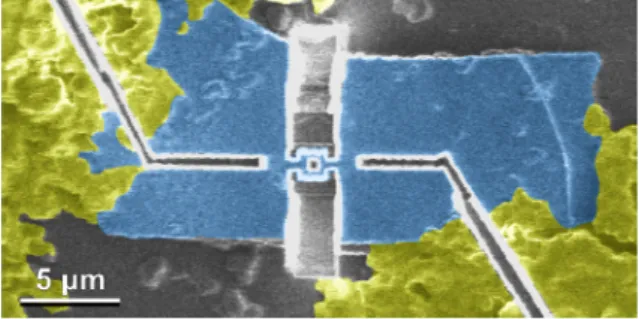
Fig. 1. False-color scanning ion microscope image of a Sr2RuO4 micro-ring. The blue region is a Sr2RuO4 single crystal, and the yellow regions are the electrodes made with silver paint.
Superconductivity in Sr
2RuO
4micro-rings
Quantum Materials Laboratory Yuuki Yasui
Abstract We report transport properties of Sr2RuO4 micro-rings fabricated by using the focused ion beam technique. In the magnetoresistance of some micro-rings, we found features of half-quantum fluxoid, which is unique in spin-triplet superconductivity. Besides, in other rings, unexpected quantum interference is observed, suggesting interference across chiral domain walls.
(48/50 words)
© 2018 Department of Physics, Kyoto University
A number of experiments and theories support that the superconductivity of Sr2RuO4 is in a chiral spin-triplet state with an equal-spin pairing, while some experiments cannot be explained within this scenario [1].
In a spin-triplet equal-spin pairing state, due to the spin degree of freedom of the Cooper pair, the fluxoid state accompanying a half of the flux quantum can be realized. This is called the half-quantum fluxoid (HQF).
Although the observation of HQF in Sr2RuO4 micro-rings using magnetic torque has been reported [2], detection with other experimental technique is still desired. For a chiral state, the time-reversal symmetry is broken in the orbital section of the wave function, and the ground states are two-fold degenerate between states with clockwise and anti-clockwise orbital angular momenta. With an analogy to ferromagnets, such chiral superconductors are expected to form domains of the degenerate ground states. Therefore, detection of the HQF and chiral domains strongly progress the understanding of spin and orbital information of the superconductivity in Sr2RuO4.
To achieve this goal, we micro-structured Sr2RuO4 single crystals using the focused ion beam technique and measured their transport properties down to 300 mK under magnetic fields applied using a tri-axial vector magnet. We observed magnetoresistance oscillations that is in good agreement with the Little-Parks oscillations for the conventional fluxoid state. To our knowledge, this is the first report of the Little-Parks oscillations using any bulk single crystals. We further investigated their transport properties with additional in-plane magnetic fields and observed splitting of magnetoresistance oscillation peaks. This suggest the unconventional fluxoid state, namely the HQF, is stabilized by the in-plane magnetic field [3].
In contrast, some other Sr2RuO4 micro-rings show magnetoresistance oscillations with unexpectedly large amplitudes. Such behavior was previously reported in the same system [4]. Hence, to search for its origin, we further investigated their current-voltage characteristics. Then, we found that the critical current also oscillates with magnetic field with the same period as the magnetoresistance oscillations. Such critical current oscillations is known to occur in the superconducting quantum interference device (SQUID). A SQUID requires a pair of “weak links” in the ring. However, artificial junction structures are not visible in scanning electron microscope images.
In addition, other transport properties do not show behavior of artificial junction structures. Therefore, the formation of “weak-links” should originate from its superconducting state and most naturally attributable to domain walls separating different ground states [5].
References
[1] A. P. Mackenzie et al., npj Quantum Materials 2, 40 (2017).
[2] J. Jang et al., Science 331, 186 (2011).
[3] Y. Yasui et al., Rhys. Rev. B 96, 180507(R) (2017).
[4] X. Cai et al., Phys. Rev. B 87, 081104(R) (2013).
[5] Y. Yasui et al., submitted to npj Quantum Materials.
Enhancement of Spin-Triplet Superconductivity by Pressure- Induced Critical Ferromagnetic Fluctuations in UCoGe
Quantum Materials Laboratory Masahiro Manago
Abstract 59Co nuclear magnetic resonance (NMR) and nuclear quadrupole resonance (NQR) were performed on a ferromagnetic superconductor UCoGe to investigate the relationship between the pressure-induced ferromagnetic quantum criticality and superconductivity.
Superconductivity remains robust as ferromagnetic fluctuations are enhanced by pressure, leading to the reinforcement of spin-triplet superconductivity.
© 2018 Department of Physics, Kyoto University
Superconductivity is often induced around a quantum critical point (QCP) of an ordered state, namely, the second-order phase transition at absolute zero. This phase diagram is widely seen in antiferromagnets including heavy-fermion and iron-based superconductors. The ferromagnetic QCP has been also expected to induce the superconductivity [1]; however, no clear example of this was reported so far. This is because the spontaneous magnetic field destroys the superconductivity, and the metallic ferromagnetic phase transition generally exhibits first-order behavior at low temperatures as Curie temperature TCurie is nearly zero [2]. Thus, the superconductivity by ferromagnetic QCP is rare despite the fact that these phases are familiar in condensed matter physics.
Coexistence of these is realized in the family of the uranium-based systems UGe2, URhGe, and UCoGe [3].
Among them, UCoGe has the lowest TCurie and relatively high superconducting transition temperature TSC. The ferromagnetism is suppressed by the hydrostatic pressure, while the superconductivity survives in the paramagnetic phase without discontinuity [4]. This feature differs from the other systems, and the superconductivity has been believed to have relationship with ferromagnetic quantum criticality.
59Co NQR measurement was performed to reveal the relationship between the ferromagnetic quantum criticality and superconductivity in UCoGe. The nuclear spin-lattice relaxation rate divided by temperature 1/T1T enhanced where the ferromagnetism is suppressed by pressure (~ 1 GPa). The slight increase of TSC suggests the scenario that the ferromagnetic fluctuations are pairing glue. The NQR spectrum at intermediate pressure indicates a weak first-order ferromagnetic transition, but the behavior of TCurie is similar to the case of the second-order one. Thus, UCoGe is a clear example of superconductivity induced by the ferromagnetic quantum criticality.
The 59Co NMR measurement was performed to investigate the superconducting properties at the paramagnetic side at 1.09 GPa. The Knight shift, corresponding the spin susceptibility, did not decrease drastically below TSC, consistent with the spin-triplet pairing. The small decrease is ascribed to the pinning of the Cooper-pair spin and is suppressed as the field increases. This suggests the rotation of the Cooper-pair spin by the field to avoid the Pauli-paramagnetic effect, as expected from the large upper critical field [4].
References
[1] D. Fay and J. Appel, Phys. Rev. B 22, 3173 (1980). [2] M. Brando et al., Rev. Mod. Phys. 88, 025006 (2016).
[3] D. Aoki and J. Flouquet, J. Phys. Soc. Jpn. 83, 061011 (2014).
[4] E. Slooten et al., Phys. Rev. Lett. 103, 097003 (2009). [5] MM et al., submitted.
Fig. 1. Temperature dependence of 59Co nuclear spin-lattice relaxation rate divided by temperature (1/T1T) at some pressures on UCoGe [5].
Fig.3 Diffusion constant in 3d Ising model
Fig.1 Snapshot of an interface
The interface motion in the Ising model with heat transfer
Nonequilibrium Dynamics Group Yusuke Masumoto
AbstractIt is clarified that heat conduction generates a drift force toward the higher-temperature side on the interface motion in the two dimensional Ising model. For the three dimensional case, changes of dynamical properties of the interface near the roughening transition temperature are discussed.
© 2018 Department of Physics, Kyoto University
Recently heat transport in spin systems is intensively investigated. Besides experiments on magnetic materials, there are a lot of theoretical studies on quantum spin chains and on the origin of diffusive behavior. However, the role of interface motion in heat transport has not yet been well studied. The existence of an interface may enhance or reduce heat transport. Conversely, heat transfer may affect the dynamics of an interface. In fact, the domain wall motion towards the higher temperature side is reported in a nanowire [1]. We examine such interrelationship between the interface and heat transport using the Ising model, because it is the simplest example.
Because the Ising model does not have its own dynamics, various time evolution rules have been proposed in the literature to simulate nonequilibrium behavior. One example is Creutz cellular automaton, where kinetic energy is added to each site and a spin is flipped if it can be done without changing total energy. However, it has a problem that the spins freeze in low temperature. To circumvent the problem,
we have devised a new dynamical rule (KSC dynamics) for bulk spins. Spins near one end of x direction are in contact with a hot reservoir and those near the other end are in contact with a cold reservoir. Those spins are evolved by Glauber dynamics. Furthermore, spins at the both ends of x or z direction are fixed in opposite directions to each other. Thus, the moving interface under heat-conduction conditions is realized if temperatures of the both reservoirs are below the critical temperature (Fig.1).
As a result, it is clarified that the interface motion in the Ising model is a
random walk with a drift force toward the higher-temperature side. It is well known in one-dimensional systems that the power spectrum of a time sequence of spin values at a site shows the power law with exponent −1.5 due to the diffusion of the interface [2]. We have extended it to two dimensions and analytically calculated the power spectrum for the case where the interface has a finite width and is subjected to a drift force. It is numerically verified that the power spectrum for the column-averaged magnetizations
agrees with the analytical one (Fig.2) and that the drift force is proportional to the temperature difference between the heat reservoirs [3].
In the three-dimensional Ising model, the roughness of the interface changes at the roughening transition temperature 𝑇𝑅. We have observed that the diffusion constant of the interface rapidly decreases below 𝑇𝑅 as shown in Fig. 3. We also discuss the possibility of change of 𝑇𝑅 in nonequilibrium conditions.
References
[1] D. Hinzke and U. Nowak, Phys. Rev. Lett. 107, 027205 (2011).
[2] S. Takesue, T. Mitsudo and H. Hayakawa, Phys. Rev. E 68, 015103(R) (2003).
[3] Y. Masumoto and S. Takesue, Phys. Rev. E 97, 052141 (2018).
Fig.2 Power spectrum
Anomalous diffusion of microspheres in a cell-sized actomyosin droplets
Dissipative structure and Biological physics laboratory Masahiro Makuta
Abstract We studied active fluctuation induced by actomyosin encapsulated in a micrometer-sized sphere through the motions of the interface and the microbeads. Fluctuation properties of the microbeads correlate with phases of the interface motion. Diffusion coefficients along the radial and the tangential directions suggest anisotropic structural forming of actomyosin bundles and their dynamics.
© 2018 Department of Physics, Kyoto University
Actin filament is one of the cytoskeletons, which plays a major role in force generation of living cells. For example, muscle actin generates contraction force in cooperation with the motor protein myosin. Actomyosin, which is a composite material of actin and myosin also works in deformation and maintenance of the cell shapes. We have performed in vitro experiments by using artificial cells to clarify the primitive mechanism of the deformation induced by actomyosin [1,2]. These works figured out the dynamic interface deformation and analyzed their statistical features, however, it has not yet examined internal dynamics inside the artificial cells correlated with the interfacial deformations.
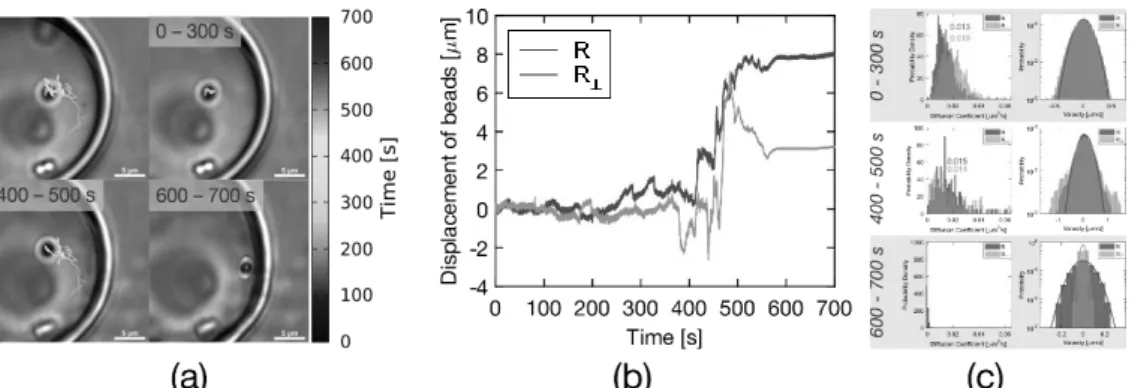
We here studied active fluctuation induced by actomyosin through the motion of probe beads encapsulated in the actomyosin droplet [3]. The basic behaviors of the interface were consistent with the results of previous studies, i.e., induction, nonperiodic oscillation, and winkling phases were emerged in order. Through the experiments, fluctuation of microbeads accompanied with motion transition of the interface exhibited correlations as shown in Figs. 1. (a) and (b). In induction phase (0-300 s), microbeads fluctuated around the initial position, and the motion became larger in the nonperiodic oscillation phase (400 – 500 s). In the early winkling phase (600 – 700 s), the microbead was fallen into the interface where the actomyosin cortex formed. The trapped bead at the interface was slightly moved with the winkling of the interface. In the former phases, anisotropic fluctuation was observed as shown in Fig 1(c), e.g., diffusion coefficient in the tangential direction was approximately 1.5 times larger than that of radial direction. The result suggests anisotropic formation of actomyosin bundles and their force network due to the small spherical boundary condition.
References
[1] H. Ito, Y. Nishigami, S. Sonobe, M. Ichikawa, Phys. Rev. E 92, 062711 (2015).
[2] Y. Nishigami, H. Ito, S. Sonobe, M. Ichikawa, Sci. Rep. 6, 18964 (2016).
[3] H. Ito, M. Makuta, Y. Nishigami, M. Ichikawa, J. Phys. Soc. Jpn 86 (2017).
Fig. 1. (a)Trajectory of microsphere in actomyosin droplet. (b)Displacement of microsphere from initial position. R represents the displacement in the radial direction, and R⊥ represent the displacement in the tangential direction. (c)Distribution of diffusion coefficient and velocity of microsphere.
Emergence of spatially-localized nonlinear agents in a simple 2D Navier-Stokes model
Fluid Physics Group Yoshiki Hiruta
Abstract Spatially-localized turbulent states, widely observed in wall-bounded flows, are reproduced in a simple 2D Navier-Stokes model in a periodic box. Moreover, it is confirmed that laminar-turbulence transition which is regarded as a non-equilibrium phase transition, occurs for some suitable parameters.
The origin of the locality is discussed for Kolmogorov flow. c 2018 Department of Physics, Kyoto University
Near the onset of the subcritical laminar-turbulence transition in wall-bounded flows such as pipe flow[1,2] and Couette flow[3], a whole flow state is composed of a calm laminar state and spatially-localized turbulent states[2,3].
On such wall-bounded systems, the transition from the laminar state observed in experiment occurs at a finite non-dimensionalized flow rate, called Reynolds number, that is much less than critical values estimated by linear instability theory. In that case, because it is usually difficult to identify dominant modes governing transition, the flow often is modeled as complex excited agents embedded in a calm background[4]. Such localized excited agents should play a key role to understand statistical behavior for subcritical Reynolds number[2,4].
From the point of view of the governing equations, though Navier-Stokes (NS) equations
∂ui
∂t +uj∂ui
∂xj =−∂P
∂xi +ν∂2ui
∂x2j +fi, (1)
∂ui
∂xi = 0, (2)
have been established, a spatial coexistence of the laminar state and turbulent states is still shrouded in mystery. Characteristics of solutions of NS equations depend strongly on the way to be driven and boundary condition as well as spatial dimension.
We try to answer the questions: ”Why are spatially-localized turbulent states widely observed in wall- bounded flow?” or ”What are the condition for spatially-localized turbulent states to exist?”. In generally, as a solution of NS equations, a realized laminar state is not unique, and hetero-clinic kink easily breaks the locality of the dynamics. Theoretically the boundary conditions that restrict the velocity field are shown to be significant, that is, imposing stick (non-slip) boundary condition or adding a linear drag (frictional) force is sufficient condition for the unique local laminar state to exist.
In this talk, the stability of the laminar state and the locality of the dynamics are discussed for a class of Kolmogorov flow wherefi = sin(ny)δix −ν0ui[5,6]. Numerical experiments show a linear drag force with the periodic boundary condition is sufficient to observe spatially-localized agents which realizes the non-equilibrium phase transition.
References
[1] O.Reynolds, Phil. Trans. R. Soc. Lond.174, 935 (1883) [2] K.Avilaet.al, Science333, 192 (2011)
[3] D.Coles, Journal of Fluid Mech.21, 385 (1965) [4] D.Barkley, Phys.Rev.E84, 016309 (2011)
[5] V.I.Arnol’d and L.D.Meshchalkin, Uspekhi Mat. Nauk15, 247 (1960) [6] Y.Hiruta and S.Toh, Phys.Rev.E92, 063025 (2015)
Inelastic X-ray Scattering Study of Plasmons in liquid Rb at elevated temperatures
Physics of Disordered Systems Group Toru Hagiya
Abstract Inelastic X-ray scattering measurements have been performed to investigate the plasmons in liquid Rb at elevated temperatures. We have experimentally determined the density dependence of the plasmon energy and linewidth and found that the electron-ion interaction is essential for describing the plasmon at high temperatures.
© 2018 Department of Physics, Kyoto University
The electronic state in liquid metals are deeply connected with the ionic structure and the electron density, which varies with the thermodynamic state [1]. The electronic state with a variety of the thermodynamic state has been investigated by ab initio MD simulation studies. They provide information about the ground state property, however, little is known about the electronic excited state.
In order to reveal the relation between the excited state and ionic structure, we focus on the plasmon, which is a fundamental electronic excitation in the electron gas. It has been pointed out that plasmons in liquid metals are affected by the electron-ion interaction, which is closely related to ionic structure [2]. However, plasmons in liquid metals were investigated only near the melting point and the relation between the plasmon and ionic structure has not been sufficiently clarified yet.
In this study, we have performed inelastic X-ray scattering (IXS) experiments on liquid Rb at higher temperatures than the melting point [3]. The temperature dependence of the plasmon behavior gives information on the effect of structural change on the plasmon behavior in liquid metals. From the IXS spectra, we determined the momentum transfer dependence of the plasmon energy and linewidth.
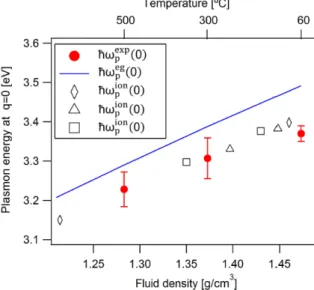
Fig. 1 shows the experimentally obtained plasmon energy at 0 in liquid Rb. We have experimentally determined the density dependence of the plasmon energy by controlling the thermodynamic condition. This density dependence is qualitatively consistent with the prediction of
the electron gas 0 , but the absolute value is lower than this prediction. We demonstrate that this discrepancy is resolved by calculating the plasmon energy 0 , which includes the effect of the ionic structure. Furthermore, we found that the effect of ionic structure on the plasmon energy is correlated with the shape of the structure factor, which describes the ionic structure of liquid. We also calculated the plasmon linewidth with the effect of ionic structure, and compared them with the experimental values.
The inclusion of the effect of ionic structure greatly improves the agreement with the experimental values. This shows that the effect of ionic structure is essential for describing plasmons in high-temperature liquid Rb.
References
[1] F. Hensel, W.W. Warren, Jr., “Fluid Metals: Liquid-Vapor Transitions of Metals”, (Princeton Univ. Press, 1999).
[2] K. Kimura et al., Phys. Rev. B 89, 014206 (2014).
[3] T. Hagiya et al., J. Phys. Soc. Jpn. 87, 084703 (2018).
Fig. 1. Density dependence of plasmon energy at 0 in liquid Rb. The experimental results
0 are compared with the calculated results.
0 is the calculated result of the electron gas and 0 is that with the effect of ionic structure. 0 is represented by different symbols depending on the references data for the calculation.
Statistical mechanical expressions of slip length
Nonlinear Dynamics Group Hiroyoshi Nakano
Abstract We study the microscopic foundation of partial slip boundary conditions on the basis of microscopic dynamics and linearized fluctuating hydrodynamics. By developing two linear response theories from the microscopic dynamics, we obtain two statistical mechanical expressions of slip length.
Then, by exactly calculating these expressions from the linearized fluctuating hydrodynamics, we confirm that these expressions provide the different expressions for the same quantity.
© 2018 Department of Physics, Kyoto University
Behaviors of a fluid near a solid surface are different from those in a bulk. In hydrodynamics, these behaviors are described as boundary conditions (BCs) on the hydrodynamic equations. Since the 19th century, there have been wide discussions about the nature of BCs. These studies focused on whether or not the fluids may slip on the solid surface [1]. In the 19th century, by employing a kinetic theory, it has been revealed that rarefied gases have finite slip velocities. Recently, there were remarkable developments of experimental techniques in the field of microfluidics. Thanks to these developments, the slips were experimentally observed for Newtonian liquids confined in the small-scale systems [2].
The purpose of our study is to reveal the behavior of the fluid near the solid surface from the microscopic viewpoint. In particular, this presentation focuses on a partial slip BC, which was introduced as a special BC so as to describe slip phenomena from the phenomenological viewpoint. Under the partial slip BC, slip velocity of the fluid is linearly proportional to a shear rate at the solid surface (Figure 1). The proportional constant is called as a slip length. Some of experimental results reported in the past two decades are accurately described by the partial slip BC.
In this presentation, we derive the partial slip BCs based on the underlying microscopic theories and the linearized fluctuating hydrodynamics (Figure 2). Concretely, we consider the fluid enclosed between two parallel walls. First, we develop two linear response theories for the microscopic systems under the assumption of separation of scales between the microscopic behavior, such as collision of particles, and macroscopic behavior, such as relaxation to global equilibrium. The first linear response theory describes behaviors in an early stage of the macroscopic motion of fluid, specifically, the relaxation of fluid. The second one describes the steady state of the fluid. Next, we demonstrate that these two linear response theories lead to the partial slip BCs. Then, we obtain two statistical mechanical expressions of the slip length. Finally, by exactly calculating these expressions from the linearized fluctuating hydrodynamics with the partial slip BC, we confirm the validity of these
expressions. Furthermore, we show that these two expressions provide different expressions for the same quantity.
References
[1] C. L. M. H. Navier, Mem. Acad. Sci. Inst. Fr. VI, 389-440 (1823) [2] Y. Zhu and S. Granick, Phys. Rev. Lett. 88(10), 106102 (2002)
Figure 2 Diagram illustrating the relationship between two linear response theories
Figure 1 Schematic illustration of partial slip BC
Semiclassical non-equilibrium dynamics after a quench of ultracold Bose gases in optical lattices
Physics of Matter: Condensed Matter Physics (YITP) Kazuma Nagao
Abstract We analyze redistribution dynamics of the kinetic and on-site energies of the three-dimensional Bose-Hubbard model using the truncated-Wigner approximation. Our numerical result agrees well with the experimental one. We further study density-density correlation spreading after a quench in two dimensions and reveal qualitatively different dynamics depending on the initial state.
© 2018 Department of Physics, Kyoto University
The high controllability and cleanness of ultracold atoms trapped in optical lattices make it possible to realize an analog quantum simulator for exploring various quantum many-body phenomena [1]. An interesting target of such quantum simulators is non-equilibrium quantum dynamics of macroscopic many-body systems, which is hard to treat using currently available numerical tools on classical computers due to the exponential growth of the Hilbert space with system size and the minus-sign problem in quantum Monte-Carlo simulations. In recent years, the quantum optics group in Kyoto University has explored non-equilibrium dynamics of Bose-Hubbard systems arising after a sudden quantum quench from singly-occupied Mott insulator states [2]. In the experiment, the group observed redistribution of the kinetic and onsite-interaction energies of Bose gases in a three-dimensional optical lattice at an early time after a quench. An immediate usage of such quantum simulation results is to examine or develop numerical methods for computing quantum many-body dynamics by taking them as an accurate reference. Nevertheless, any quantitative approach that can recover the experimental results at three dimensions has not been established thus far.
In this study, aiming to simulate the energy redistribution dynamics quantitatively, we perform a numerical calculation utilizing the truncated-Wigner approximation (TWA), which is a semiclassical approximation formulated in a phase space representation of quantum dynamics [3]. This method allows one to obtain quantitative descriptions of short-time dynamics of the quantum averages even for macroscopic quantum systems, to which exact diagonalization methods are inaccessible. Applying the TWA to the Bose-Hubbard model on a cubic lattice, we simulate a short-time evolution after a rapid ramping down of the lattice depth from a singly-occupied Mott insulator state into a weakly-interacting regime. It is shown that our numerical result of the semiclassical analysis agrees well with the experimental one with no fitting parameter [2, 4].
As a further application of our method, we also study non-local spreading of density-density correlations at equal time after a sudden quench from several initial states in the two-dimensional Bose-Hubbard model. We focus on dynamics inside a semiclassical regime where the interaction is relatively weak and the filling factor is sufficiently large. Our analysis reveals that when the system is initially prepared in a coherent state, then a propagation velocity of the correlation wave packet in the correlation function strongly depends on the final interaction strength, and it is bounded by twice the maximum group velocity of the elementary excitations, i.e., the Bogoliubov excitations [4]. In contrast, when the system is initially in a Mott-insulator state, the propagation velocity of the wave packet is approximately independent of the final interaction strength [4].
References
[1] I. Bloch, J. Dalibard, and S. Nascimabéne, Nat. Phys. 8, 267 (2012).
[2] Y. Takasu, T. Yagami, H. Asaka, Y. Fukushima, Y. Takahashi, K. Nagao, S. Goto, and I. Danshita, in preparation.
[3] A. Polkovnikov, Ann. Phys. 325, 1790 (2010).
[4] K. Nagao, M. Kunimi, Y. Takasu, Y. Takahashi, and I. Danshita, arXiv:1810.04347 (submitted).
Quantum many-body dynamics of the Bose-Hubbard system with artificial and intrinsic dissipation
Quantum Optics Group Takafumi Tomita
Abstract We report on an experimental investigation of the Bose-Hubbard system with dissipation using ultracold ytterbium (Yb) atoms in an optical lattice. We implement two-body particle loss in two different manners and reveal the effect of the dissipation on the atom loss behavior and the quantum phase transition.
© 2018 Department of Physics, Kyoto University
Thanks to their exquisite controllability, cold-atom quantum simulations have been successfully used for engineering various Hamiltonians of intensive theoretical interest [1]. For these well isolated and closed quantum many-body systems various quantum phases are realized and the transitions among those phases are successfully observed. In addition, several recent experiments have extended the applicability of the quantum simulators to Liouvillian dynamics of open quantum systems by introducing coupling to environment, namely, dissipation [2, 3].
We experimentally study a Bose-Hubbard system with the dissipation of particle losses using ultracold Yb atoms in the three dimensional optical lattice. Firstly, we investigate the dissipative Bose-Hubbard system with two-body inelastic atom loss with controllable strength, which is implemented by introducing a single-photon photo-association (PA) process [4].
The inelastic collision rate, which characterizes the strength of the dissipation, can be controlled by varying the intensity of the PA beam. In the dynamics subjected to a slow ramp-down of the optical lattice, we find that strong on-site dissipation favors the Mott insulating state: the melting of the Mott insulator is delayed and the growth of the phase coherence is suppressed by the strong dissipation (Fig. 1). This can be understood as the quantum Zeno effect, that is, the strong dissipation suppresses the unitary dynamics of the system.
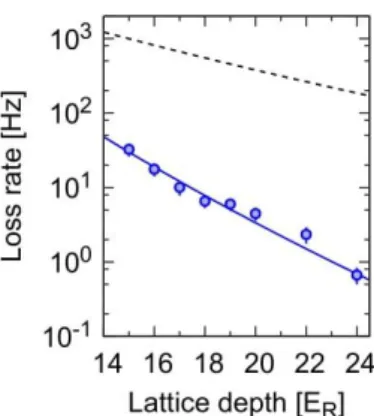
Secondly, we realize the dissipative Bose-Hubbard system with the Yb atoms in the metastable 3P2 state [5]. Because the collision between two metastable atoms induces the change of the internal degree of freedom, the Yb atoms in the 3P2 state has intrinsic large inelastic collision rate, which induces the dissipation. In this study, we investigate the atom loss behavior with the unit-filling Mott insulator as the initial state. We find that the atom loss is suppressed by the strong correlation between atoms (Fig. 2) and reveal that the inelastic interaction contributes to the formation of the correlation in addition to the elastic interaction.
References
[1] I. Bloch et al., Rev. Mod. Phys. 80, 885 (2008).
[2] A. J. Daley, Adv. Phys. 63, 77 (2014).
[3] M. Müller et al., Adv. At. Mol. Opt. Phys. 61, 1 (2012).
[4] T. Tomita et al., Sci. Adv. 3, e1701513 (2017).
[5] T. Tomita et al., arXiv: 1809. 09989 (2018).
Fig. 1. Absorption images of the atoms. γ characterizes the dissipation strength. As γ increases, the interference pattern becomes unclear in the shallow lattice regime, which indicates the suppression of the growth of the coherence.
Fig. 2. Two-body loss rate of the atoms in the 3P2 state as a function of the lattice depth.
Because of the strong correlation, the measured loss rate is much smaller than the tunneling rate (dashed line) which naively characterizes the loss rate.
Nonequilibrium phenomena and controls in strongly correlated quantum systems driven by AC and DC electric fields
Condensed Matter Theory Group Kazuaki Takasan
Abstract We investigated nonequilibrium phenomena in strongly correlated systems irradiated by laser light (AC electric fields) or DC electric fields and proposed new control scheme utilizing these nonequilibrium phenomena.
Our study paves a new way to control the quantum states of strongly correlated materials.
© 2018 Department of Physics, Kyoto University In recent years, various interesting nonequilibrium phenomena are observed in solids and gathering great attention.
For example, it has been reported that applying strong laser fields induces transient superconductivity above the equilibrium critical temperature Tc [1]. Topological states of matter can also be changed with laser light. This has been theoretically proposed [2] and already experimentally observed [3]. It has been revealed that not only the laser light(AC field), but also the DC-field also induces quite interesting phenomena recently. For instance, it has been reported that DC electric field induces a finite current in Mott insulators, giving rise to very strong diamagnetism in the nonequilibrium steady states [4]. Furthermore, based on the study of these nonequilibrium phenomena, the possibility of controlling states of matter with nonequilibrium phenomena has also been investigated. It is expected that some important controls which are impossible or difficult in equilibrium become available in nonequilibrium. In fact, a control using periodic driving with external fields is called “Floquet engineering” and this has been established as one of the useful experimental techniques to realize desired quantum states in the field of cold atomic systems [5]. As shown above, nonequilibrium phenomena and their controls in condensed matter systems are forming a rapidly growing research field in recent years.
On the other hand, theoretical understanding of these nonequilibrium phenomena still has been a challenging problem. In particular, nonequilibrium phenomena in strongly correlated systems are difficult to treat theoretically and proposing nonequilibrium control in strongly correlated systems is more tough problem because we have to treat the effect of interaction and nonequilibrium dynamics at the same time. However, the various interesting and exotic phases of matter (e.g. unconventional superconductivity and quantum spin liquid) mostly appear in strongly correlated materials and thus it is an important task to investigate strongly correlated systems.
Motivated by this situation, we have studied the nonequilibrium phenomena in strongly correlated systems and proposed possible schemes to control the states of matter using nonequilibrium phenomena. In this talk, after explaining my motivation and backgrounds, I would like to introduce several studies by us in this direction [6-8].
Brief summaries of these studies are shown below.
i.) Laser-induced topological superconductivity in d-wave superconductors [6]
Topological superconductivity (TSC) has attracted much attention because it can host Majorana fermions that are expected to be applied to quantum computation. However, the experimental realization of TSC is very limited and strongly desired. In this study, we proposed a possible scheme to realize TSC in laser-irradiated d-wave superconductors such as cuprate superconductors. Our calculation based on Floquet theory revealed that the laser-induced effective Zeeman-field plays an important role to realize TSC.
ii.) Control of Kondo effect and topological phases in heavy fermion systems with laser light [7]
In heavy fermion systems, interplay between Kondo effect and RKKY interaction plays an important role and realizes various quantum phase transitions. In this study, we investigated how this interplay is affected by the application of laser fields and how we can control the quantum phase transitions. We found that either of enhancement and suppression of Kondo effect can occur depending crystalline structure and systematically studied the effect on the phases of matter including topological phases (e.g. topological Kondo insulators).
iii.) Control of insulating magnets with DC electric fields or THz laser fields [8]
In this study, we considered the application of DC electric fields or slow AC fields (such as THz fields) to insulating magnets and investigated how the exchange interaction is modified with electric fields. We found that the coupling in the direction of electric fields is enhanced and this is very useful to control the anisotropy of magnetic interactions. Based on this idea, we proposed exotic phases of matter induced by electric fields, e.g.
electric-field-induced quantum spin liquids and electric-field-induced topological phases.
[1] M. Mitrano, et al. Nature 530, 461–464 (2016).
[2] T. Oka and H. Aoki. Phys. Rev. B 79, 081406 (2009).
[3] Y. H. Wang et al. Science 342, 453-457 (2013).
[4] C. Sow, et al. Science 358, 1084-1087 (2017).
[5] G. Jotzu et al. Nature 515, 237-240 (2014).
[6] KT, A. Daido, N. Kawakami, and Y. Yanase, Phys. Rev. B 95, 134508 (2017).
[7] KT, M. Nakagawa, and N. Kawakami, Phys. Rev. B 96, 115120 (2017).
[8] KT and M. Sato, arXiv:1802.04311.
Fig.1 (a) Schematic diagram of the experimental setup. We also show the direction of the PL polarization (TE and TM) and each dipole moment. (b) Polarization-resolved PL spectra of monolayer WSe2 normalized at L2 peak.
The excitation photon energy is 2.33eV. (c) Their difference spectrum.
Dark exciton in monolayer transition metal dichalcogenides
Solid State Spectroscopy Group Satoshi Kusaba
Abstract We investigated dark exciton states by prism-coupled photoluminescence (PL) measurements and observed strong nonlinear saturation behavior of dark exciton PL. We revealed that exciton-exciton annihilation is an influential dark exciton relaxation mechanism.
© 2018 Department of Physics, Kyoto University
Monolayer transition metal dichalcogenides (TMDs) are promising materials for “valleytronics.” They have bandgaps at energy-degenerate K and K’ valleys with opposite spins. Due to the lack of inversion symmetry, excitons or electron-hole pairs can be selectively created at K or K’ valleys by circularly polarized light. Exciton plays an important role in photoluminescence (PL) in TMDs because of its large binding energy. Some of the exciton states in monolayer TMDs have a zero in-plane (Fig.1(a)) transition dipole moment, so this is often called dark excitons. Very recently, one of the dark exciton states with the electric dipole moment perpendicular to the crystal layer have been confirmed in WSe2 through the observation of perpendicularly polarized PL by a unique optical configuration [1] or using designed coupling with surface plasmon polaritons [2]. Since this dark exciton is lower excited state, it should play a key role in the relaxation dynamics. However, although bright excitons have been much studied, the detailed dark exciton dynamics has not been clarified.
In this study, we performed polarization-resolved PL spectroscopy of monolayer WSe2 using prism coupling method as shown in Figure 1(a). The mechanically exfoliated monolayer WSe2 was transferred on the slant of a right-angle glass prism. PL was collected from the direction of an angle of 45 degrees. Prism coupling method enables us to collect PL with large in-plane wavevector efficiently. Figure 1(b) shows polarization-resolved PL spectra (TM and TE) at 7 K normalized at 1.67 eV. We observed four pronounced peaks: neutral A exciton at 1.76 eV, trion at 1.73 eV, and other two peaks at 1.69 eV (L1) and 1.67 eV (L2) which were attributed to localized excitons in the previous report [3]. It is clear that a large difference
exists around L1 peak between TE and TM polarizations. Since TM spectrum includes PL from both in-plane and out-of-plane dipole components and TE spectrum includes only in-plain dipole moment, one can extract an out-of-plane polarized PL by subtracting TE spectrum from TM spectrum. Figure 1(c) shows the difference spectrum. Two peaks exist at 50meV and 65meV below neutral A exciton peak. We assign these peaks to dark exciton and dark trion by comparing the energy differences between each peak and neutral A exciton to the previous reports [1,2,4].
Then we investigated excitation-photon-energy dependence and excitation-intensity dependence. Excitation-intensity dependence shows strong nonlinear saturation behavior under low excitation power regimes caused by exciton-exciton annihilation [5] due to their higher density and longer lifetime than the bright excitons. Our results reveal that exciton-exciton annihilation is an influential dark exciton relaxation mechanism.
References
[1] G. Wang et al., Phys. Rev. Lett. 119, 047401 (2017).
[2] Y. Zhou et al., Nat. Nanotech. 12, 856 (2017).
[3] J. Huang et al., Sci. Rep. 6, 22414 (2016).
[4] X. X. Zhang et al., Nat. Nanotech. 12, 883-889 (2017).
[5] S. Mouri et al., Phys. Rev. B 90, 155449 (2014).
Generalization of Jordan-Wigner transformation and exact solution of Majorana-spin coupled model
Physics of Matter: Condensed Matter Physics (YITP) Yukihisa Imamura
Abstract We study the bond-algebraic generalization of Jordan-Wigner transformation. We apply its method to Majorana-spin coupled model on one dimensional lattice and find that it can be exactly solved by the transformation.
© 2018 Department of Physics, Kyoto University
Duality is one of the most important concepts in theoretical physics. When we have several different theoretical descriptions for the same physical phenomenon, there are dualities among them. Dualities can provide reliable quantitative information about system. For example, it is well known that the strong coupling region of a model is often transformed into the weak-coupling region of another model (or vice versa) by duality and we can use perturbation theory for investigating the original system in the strong- coupling region. One of the simplest examples which has that kind of duality would be the transverse-field Ising model on a one-dimensional lattice (also known as “Kitaev chain”). Its boson-to-boson (spin-to-spin) duality is self-duality and so we can find the exact critical point of the ferromagnetic-to-paramagnetic quantum phase transition.
The transverse-field Ising model has another duality, boson-to-fermion duality. It is widely known that spin-1/2 variables on a one-dimensional lattice can be transformed into Majorana fermions by a non-trivial and non-local transformation, the Jordan-Wigner transformation. Its transformation changes the transverse - field Ising model into the spinless p-wave superconductor[1], and so it is boson-fermion duality. It is the point to notice that the Hamiltonian of the superconductor becomes a sum of fermion-bilinears and that we can exactly find the energy eigenvalues. In this case, the duality transformation enables us to solve the system exactly.
In this study, we demonstrate that it is possible to generalize the standard Jordan-Wigner transformation and we can apply it for a Majorana-spin coupled model. We first reconsider the Jordan-Wigner transformation for the transverse-field Ising model[2] and introduce the method of bond algebra[3]. When Hamiltonian is described as a sum of local Hamiltonians, bond algebra is an algebra generated from the local Hamiltonians. It enables us to generalize the usual Jordan-Wigner transformation and to wider its range of applicability, beyond the boson-fermion duality. After introducing the foundations of the method, we then introduce another example, Majorana-spin coupled model[4]. This model is fermion-boson mixture model which is constructed from Majorana fermions and spin-1/2 variables on a one-dimensional lattice. It has different algebraic structure from the bond algebra of the transverse Ising model. However, we can also construct Majorana fermionic operators from the Majorana-spin bond algebra and transform the fermion- boson mixture system into the system which has
only fermions. It is a generalization of the Jordan- Wigner transformation. Moreover, we find that the transformed Hamiltonian is described as a sum of fermion-bilinears and it can be exactly solved by the Bogolyubov transformation. In addition to it, we finally show that the Majorana-spin coupled model has a lot of conserved charges and degeneracy of energy spectrum, and check the consistency of the bond-algebraic duality transformation found there.
References
[1] A. Y. Kitaev, Physics-Usp. 44, 131 (2001).
[2] K. Minami, J. Phys. Soc. Jpn. 85, 024003 (2016).
[3] Z. Nussinov and G. Ortiz, Phys. Rev. B 79, 214440 (2009).
[4] Y. Imamura and H. Katsura, in preparation.
Fig.1. Duality web. The type I and II of the transverse- field Ising model (TFIM) are self-dual each other. Both are dual with p-wave superconductor by the Jordan- Wigner transformation (JW). The Majorana-spin coupled model can be transformed into the Majorana chain by the bond-algebraic JW.
Time-resolved exitonic Lyman spectroscopy in diamond
Solid State Spectroscopy Group Tomoaki Ichii
Abstract We studied exciton formation dynamics in diamond by time-resolved Lyman spectroscopy. We found that formation dynamics is dominated by thermalization of carrier system via phonon scattering and excitons are randomly distributed in splitting 1s exciton states.
© 2018 Department of Physics, Kyoto University
Excitons in semiconductors have been attracting many interests over decades in the viewpoint of fundamental quantum many-body physics. Excitonic Lyman spectroscopy, which directly observes internal transitions of excitons, is known as a powerful method to study exciton-exciton interactions because of the excellent ability to evaluate the density of the exciton. The recent remarkable progress of the terahertz (THz) spectroscopy based on femtosecond laser technologies has made it possible use Lyman spectroscopy for excitons in group IV semiconductors (ex. Si and Ge) and revealed exciton formation dynamics. Diamond, which also belongs to group IV semiconductors, has characteristic properties in semiconductors, such as wide band gap, large phonon frequency, and small spin-orbit interaction. These features cause the fine structure states of 1s exciton [1] and extremely large exciton diffusivity at low temperature [2]. Lyman spectroscopy will enable us to reveal various fundamental properties of excitons in diamond, however, it remains undeveloped because of the difficulties of broad band generation of the THz pulse that covers the inner transition of excitons (~15 THz).
In this work, we overcome this problem with the THz generation method from air-based plasma [3] and constructed the experimental system of deep ultraviolet (DUV) pump – terahertz (THz) probe spectroscopy.
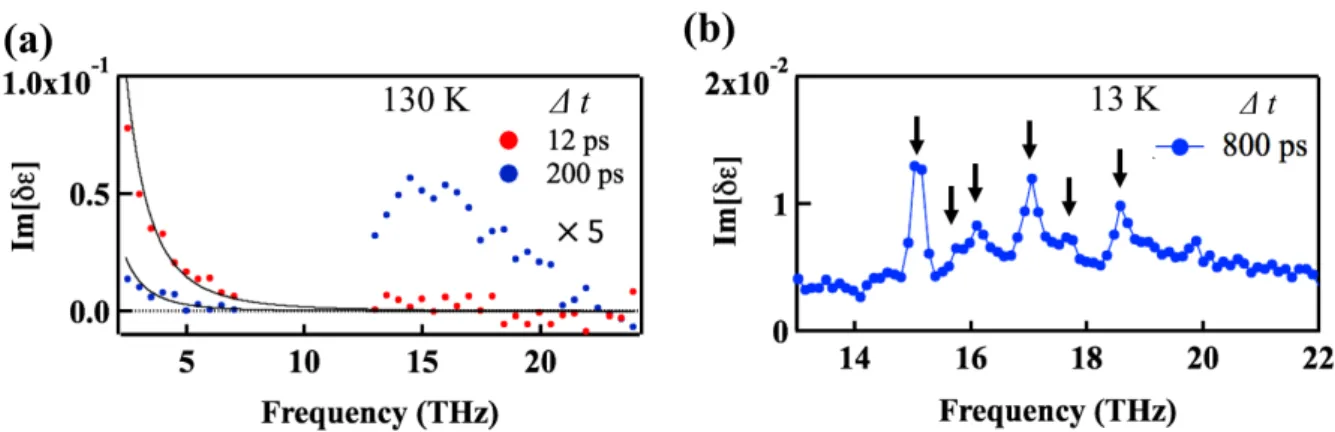
Figure 1a shows DUV pump-induced changes in the imaginary part of the dielectric function at 100 K for two pump-probe delays ( t). At t = 12 ps, we observed the drude response, indicating the creation of free e-h pairs.
The solid curves represent analysis by a Drude model, which yields the e-h pair density, Neh. At t = 200 ps, we observed the decrease of Drude response and emergency of a peak, which should be attributed to internal transitions of the exction. This shows formation of excitons from free e-h pairs. On the other hands, the peak due to inner transition of excitons is divided into several peaks at 13 K (arrows in Figure 1b), suggesting a splitting of the 1s exciton state. Temperature dependence and time-development of the dielectric function allows us to clarify the fundamental properties of free carriers and excitons as follows. First, we studied thermal ionization of excitons at equilibrium state. We found that the ionization ratio is quantitatively well reproduced by taking account of fine structure of the 1s exciton. Second, we investigated non-equilibrium formation dynamics of excitons from photo-excited carriers. We quantitatively found that formation dynamics is dominated by the thermalization of carrier system via the interband and intraband scattering of carriers with phonons. Further, we revealed that excitons are randomly distributed in splitting 1s exciton states.
References
[1] Y. Hazama, N. Naka, and H. Stolz, Phys. Rev. B 90, 045209 (2014).
[2] H. Morimoto, Y. Hazama, K. Tanaka, and N. Naka, Phys. Rev. B 92, 201202 (2015).
[3] V. A. Andreeva et al., Phys. Rev. Lett. 116, 0639s02 (2016).
Figure 1. Photoinduced changes in the imaginary part of the dielectric function (a) at 100 K and (b) at 13 K. Δt is a delay time after DUV-pump. Solid lines are best functions according to the Drude model.
![Fig. 1. Temperature dependence of 59 Co nuclear spin-lattice relaxation rate divided by temperature (1/T 1 T) at some pressures on UCoGe [5]](https://thumb-ap.123doks.com/thumbv2/123deta/6105015.2084444/7.892.539.798.637.968/temperature-dependence-nuclear-lattice-relaxation-divided-temperature-pressures.webp)