Japanese from Venus?
Explanations of foreign and particularly security policy behavior of any government usually include factors such as the relative position of a country within the international system and its perception of security threats. Triggered by the different reactions to 9/11 and its different perceptions of international threats such as terrorism and WMDs, Robert Kagan (2002) categorized US foreign policy behavior as paradigmatic for the only remaining superpower, and European behavior as paradigmatic for countries that had chosen to remain at the fringes of power politics because they simply did not have the capability or had learned their lesson from history. Kagan began his article with the now infamous distinction that “Americans are from Mars and Europeans are from Venus”.
One could describe the development and current international role of Japan in a very similar way, an economic superpower but a “political pigmy”(2). Pygmy not in terms of its military arsenal and expenditure, but considering its real and potential political and military role in the postwar era. Having experienced the catastrophic consequences of nationalism, militarism, and expansionism, after World War II the Japanese had completely changed their mindsets and embraced anti-militarism and the development towards a civil power (Berger, 1996;
Berger, 1998; Hook, 1996). At least so it seems. This paper will analyze Japanese attitudes towards militarism. It will compare Japanese and US American attitudes in order to develop a better frame of reference for the interpretation of values and attitudes towards foreign policy issues and the relationship between societal and political systems in general.
Are Americans from Mars and Japanese from Venus?
– New Approaches in Explaining Different Public Attitudes towards Foreign Policy in Japan and the United States
(1)–
The Journal of Social Science 57 COE Special Edition [2006]
pp.305-330
Wilhelm Vosse
*Japanese from Venus?
I. Introduction
After the Meiji Restoration, the slogan of the Japanese government that also motivated the society at large was to “catch up with the West” by becoming a rich state with a strong army (fukoku kyôhei). In a breathtaking speed, Japan developed from a country that was technologically and politically comparable to Europe in the 15th or 16th century, to a country that was able to develop a military power that successfully fought a war first against China (1895) and then again Russia (1905). Soon thereafter, Japan occupied Korea (1910) and in the 1930s not only the Northeastern part of China (Manchuria) but large parts of East and south East Asia. The Japanese people had developed a feeling of superiority, ultra-nationalism, and militarism for which it would be hard to find a parallel in world history. Japanese economy and society was based on a militaristic ideology that was never seriously questioned and taken for granted by most until 1945.
After losing the war, Japan was occupied and in 1947 given a Constitution that exemplified a high level of distrust by the US forces against the Japanese.
The central objective after World War II was to de-militarize Japan by dissolving the Japanese Imperial Army and to make sure that Japan would never militarize again and endanger world peace. The core element of the de-militarization campaign was to put an article in the newly drafted Japanese Constitution that would ensure that Japan would never be able again to declare and fight wars against its neighbors. The two paragraphs of the Article Nine did not only include the universal “renunciation of war as a sovereign right of the nation” but also the renunciation of “land, sea, and air forces”. Because of Article Nine, the Japanese soon referred to it as the “Peace Constitution”, a title that is still widely used today. For most Japanese, the Constitution in general and Article Nine in particular became the core value of what Japan should represent. After half a century of war and militarism, the Japanese took a 180-degree turn from the pre- war slogan of “rich nation – strong army” to “friendly neighbor – small army”.
The desire to become a civil trading nation gradually became a widely embraced ideal for most Japanese, who seemed to have turned from being militarist for
Japanese from Venus?
five decades into anti-militarists (Berger, 1998).
In the early postwar years, many Japanese wanted a complete shift from their militarist past, which had brought death, destruction, and the biggest single attack on civilians in world history, the dropping of two atomic bombs on Hiroshima and Nagasaki. For a large number of Japanese, the only solution could mean pacifism and a very strict adherence to Article Nine. This is the reason why Japanese went to the streets when Prime Minister Yoshida signed the US-Japan Security Treaty in September 1951. They realized that this would mean that Japan would eventually have an army again. In 1954, the Special Police Unit was renamed to Self Defense Forces (SDF), which, although legally not considered armed forces by the Japanese government, in reality performs all the duties and responsibilities and is equipped like an army.
Despite the existence of Japanese SDF and the AMPO Treaty, for most Japanese the core foreign policy ideal was the basically civil nature of Japan and the goal to solve international conflicts diplomatically, and not militarily. Despite being indirectly involved in the Korean and the Vietnam Wars, the Japanese people and the government could always argue that Article Nine prohibits them from being directly involved in any military campaign. Article Nine and the one- sided US Security guarantees could be seen as an ideal combination that enabled the Japanese government to keep Japan out of harms way, provided Japanese security without the necessity to invest heavily in a military infrastructure, and finally maintaining the ideal (or image) of being a peaceful and non- militarist state. For the Japanese themselves, it meant that they could easily portray themselves as a non-militarist country with only the best intentions without seriously reflecting on Japan’s prewar history as a militaristic and ultra- nationalistic regional hegemon. Thomas Berger (1998) raised this paradox when he questioned the widely-held belief that Japan’s anti-militarism or pacifism is often explained by its suffering during World War II and particularly by being the only country that experienced the dropping of atomic bombs, when on the other hand Japanese are notorious for not considering their own actions in Southeast Asia between 1910 and 1945.
Japanese from Venus?
The Japanese postwar defense policy has been relatively stable in that deterrence was taken care of by the United States since the 1951 US-Japan Security Treaty. However, even in the original 1951 treaty and then in the first revision in 1960, Japan was expected by the United States to gradually increase its own defense capabilities. Since the end of the Cold War and particularly after being criticized for not participating in the 1991 Gulf War militarily by the US and other Allied countries, the Japanese government extended the role of the SDF by enabling it to participate in UN Peace-Keeping Operstions (1992). More importantly, with the gradual acceptance of a larger responsibility for regional security from the Revised Defense Guidelines (1997), a series of defense related working papers by the Task Force on Foreign Relations for the Prime Minister (2002(3)) headed by Yukio Okamoto, to the National Defense Program Guidelines for 2005 (December 2004), they all intended to allow a larger international role of Japan. The latest step by the Koizumi administration was to send a small contingent of about 600 Ground SDF troops to Iraq in 2004.
Just a few years earlier, this would have probably caused an outcry among the Japanese public, this time, however, Japan saw only a few demonstrations and protest movements, nothing to be too alarmed about. Compared to 1960, when the first revision of the AMPO Treaty triggered the largest and most violent demonstrations of Japan’s postwar history, sending SDF troops to Iraq seemed to have made most Japanese to “rally round the flag” or their government, an effect we also observe in the US or most other countries once a war begins or a country has “boots on the ground”. Between January 2004 and March 2004 opposition against the deployment of SDF troops declined from 51% before to 43% after troops had been deployed. In March 2004, 51% were in favor of SDF deployment(4). This change seems to indicate that pacifism or better anti- militarism might be conditional. This seems to be a paradigmatic development.
The question that this article is going to deal with is whether Japanese are indeed different from people in other countries when it comes to support or opposition of military action, including those that might be sanctioned by the United Nations or the international community. Hence the question, whether Japanese
Japanese from Venus?
people, sixty years after the end of World War II and the enactment of Article Nine still maintain the anti-militarist ideals they are so well-known for.
For the Japanese case, the following hypothesis seem plausible:
1. Younger people are more likely to include militarist options into their views of the world and the role of Japan, because they have not directly experienced World War II, whereas older people who have either directly experienced the war or the hardship of the postwar years are more critical of military means and more pacifist. This finding would be relevant because it could indicate a growing acceptance of military means in the future.
2. Given the Postwar Japanese history, those on the political right have always been more inclined to change Article Nine and have taken the position that Japan should have an army(5). Therefore, it can be expected that people with right-wing political views are more likely to embrace militarism that those on the political left.
3. Given that younger age cohorts are expected to lean more towards militarist sentiment, it is nevertheless expected that their militarism is not based on nationalism or authoritarianism, but that they are still critical of many policies of the Japanese government.
Defining militarism:
The militarism index used for analytical purposes in this article is derived from a combination of the following factors: A militarist is someone who considers war as justified when threatened by a hostile country (Q11d), when another country is harboring terrorist (Q11f(6)), someone who agrees that peace can be achieved through having strong defense capabilities (Q12f), someone who thinks that war is inevitable (Q13), and who thinks that defense spending should be increased (Q24).
Militarism or militarist attitude in the frame of this papers does therefore not mean that the respondent is a “war monger” or is inclined to solve international crises by military means, rather, it means “militarists” do consider military
Japanese from Venus?
options in case other means might fail. The definition of militarism used here includes the following five factors representing questions in the SAGE survey.
(1) War is justified when threatened by a hostile country.
A comparison between the US and Japan shows that in Japan, 14.9%
consider this as “very justified” and 38.8% as “somewhat justified”. The respective figures for the US are: 51.1% and 35.7%.
(2) War is justified against a country that is harboring terrorists.
A comparison between the US and Japan shows that in Japan, 8.0% consider this as “very justified” and 31.5% as “somewhat justified”. The respective figures for the US are: 25.1% and 42.9%.
(3) “Strong defense capabilities” will result in peace.
A comparison between the US and Japan shows that in Japan, 3.8% “strongly agree” and 19% “somewhat agree” with this statement. The respective figures for the US are: 23.6% and 43.8%.
(4) War is inevitable and cannot be avoided through cooperation.
In Japan, 12.5% stated that wars are inevitable, in the US, 43.4%.
(5) Defense spending: On a scale between 1 (greatly decrease) and 7 (greatly increase), 9.5 % of Japanese chose (7) “greatly decrease” and the next category (6) combined, while the respective figure for the US is 18.2%.
As a combination of all of these five factors, I have constructed a militarism index, which is based on the following formula:
Militarist Index: (RND((q11d/2)+(q11f/2)+(q12f/2)+q13+(8-q24)/4))-3(7))
II. Comparing Militarist Attitudes
When we compare militarist sentiment in Japan and the US, the difference could hardly be bigger. The following table 1 gives an overview of the distribution of the eight different categories this papers will use for analytical purposes. On a scale between 1 (Strong militarists) and 8 (Strong anti- militarists), this paper categorized those between 1 and 3 as “militarists”, 4 and 5 as mixed, and those between 6 and 8 as “anti-militarists”. A simple comparison between Japan and the US reveals a rather strong difference in all categories.
Japanese from Venus?
While 50.8% of Americans can be labeled militarists, only 8.4% of Japanese fall under the same category (Figure 1). Given N=525 in Japan, the N for militarist Japanese is relatively small with only 44, whereas in the US the N=842 and the absolute number of militarist in this study is 429. The following analysis will try comparing Japanese and American militarists in order to find out whether similar factors influence their actual and potential sentiment in both countries.
A direct comparison between levels of militarism in the United States and Japan reveal a very clear picture. Americans have significantly stronger militarist
7.0 19.8 24.0 24.0 16.2 6.3 2.3 0.5 0.2
1.7 6.5 17.3 29.3 25.0 13.1 6.9 Table 1: Comparative Militarism Index
USA Japan
1 2 3 4 5 6 7 8 Strong Militarist
Strong Anti-Militarist
© 2005, Wilhelm Vosse.
Based on SAGE 2004. Figures given are percentage of respondents who are categorized between 1 “Strong militarists” and 8 “Strong anti-militarists”.
Figure 1
Japanese from Venus?
attitudes than Japanese. Overall, Japanese are far more hesitant to use military means to achieve foreign policy objectives or in the case of a crisis. Hence, the gradual foreign policy changes in the last sixty years and particularly those of the last fifteen years have not had the effect of making Japanese embracing military options to a significant level. From a peace studies perspective this is a relief, however, the second question that has to be asked is what factors do influence militarist behavior in Japan, are they similar to the mechanisms that are at work in the United States, and is there any indications that the share of those with rather militarist attitudes will increase. It goes without saying that we cannot predict the future of militarist sentiment in Japan, this article is simply a first attempt to shed some light on the factors that seem to influence militarist attitudes in Japan in 2005. And a final note on the link between militarist attitudes and actual foreign policy. There is now broad theoretical and empirical evidence about a link between public opinion and foreign policy, here this link is not further explored and is left to further analysis (Sobel and Shiraev, 2003, Sobel, 1993; Everts and Isernia, 2001; Holsti, 2004; Foyle, 1999; Sobel, 2001;
Nacos et al., 2000; Powlick, 1995; Mueller, 2000; Holsti, 1992; Soroka, 2003;
Isernia et al., 2002; Mueller, 1994; Kull and Ramsay, 2000).
III. Factors influencing militarist sentiment?
Simply comparing the overall level of militarist sentiment in both countries revealed something that is not surprising given the long history of anti- militarist and often pacifist sentiment in postwar Japan. The difference can also be explained by extending Robert Kagan’s (2002) argument about Europe to Japan, namely that the attitudes of Japanese basically reflect the position of their country in world order today, and the way Japanese prefer the world to see them, namely as a peaceful nation with good intentions. Despite of a military budget that is in close range to those of other middle powers such as France, Germany, and the UK, Japan is portraying itself as a civil power, whose comprehensive security policy is based on trade and development assistance. For Japanese this basically excludes any military options(8). In addition, the Japanese military
Japanese from Venus?
is hardly ever seen and reported about in the media and it was only after they were sent to Iraq in 2004 that the media reported from the Japanese camp in Samawah (Southern Iraq) and even interviews with soldier in uniform appeared on Japanese television.
1. Data Analysis
The SAGE 2004 survey is a mail survey that was in the field in the USA and Japan in October and November 2004. The questions deal with six major areas: (1) justifications for wars and conditions for peace, (2) risk and threat perceptions, (3) political and civil rights and the limitation thereof, (4) media usage, (5) trust in government and other organizations, and (6) levels of satisfaction with government foreign and immigration policies. Besides these attitudes, the survey also included questions about political orientations, international experience, political knowledge, materialism-postmaterialism, and social capital.
The following analysis is a first attempt in identifying factors that have a significant influence on militarist attitudes in Japan. Data from the US sample are used to put the Japanese findings in comparative perspective. However, this is not a comparative paper in that it does not assume that the US is the ideal case for a comparison with Japan on issues of attitudes on peace and security, so the disparate shares of militarists in Japan and the US are not surprising but are just evidence for the different historical experience and current position of both countries. On the other hand, this makes it all the more interesting, if there are still significant similarities in terms of what influences militarist attitudes.
The following analysis will indeed show, that many factors that can be used to predict militarist attitudes in the US, can also be used in Japan.
The following table lists the factors that the following analysis will explore in more detail. The table lists the Pearson correlations of the most significant variables to explain our militarism index. The table lists the correlations first only for the US sample, then for Japan, and finally both samples combined.
Japanese from Venus?
The analysis here is only the first attempt to explore a better explanatory model for militarist attitudes not only in these two, but eventually also for other industrialized countries. This table lists most of those variables that showed a significant correlation in both countries combined, but not all. Even some of the variables listed here show only a weak combined correlation but sometimes a stronger one in one of the two countries. The list is also divided in positive and negative correlations. This is only for better viewing of the table and does not indicate that the questions and the militarism index have a negative or positive correlation. This will be explored further in the respective headings.
2. Age and other Demographic Factors
As we can see in the list, age is a better predictor in Japan for militarist sentiment than in the US. With an r=:-222 this deserves a closer look. The following graph indicates a positive correlation with age. The two peak values in the two higher age cohorts can in part be explained by the small N in Japan.
** Correlation is significant at the 0.01 level (2-tailed).
* Correlation is significant at the 0.05 level (2-tailed).
(1)Militarism Index: RND ((q11d/2)+(q11f/2)+(q12f/2)+q13+((8-q24)/4))-3
.346**
.505**
.412**
.545**
.334**
.439**
.325**
.470**
.354**
.504**
.259**
-.259**
-.444**
-.79**
.182**
.456**
.456**
.469**
.353**
.034 .325**
.178**
.266**
.385**
.188**
-.284**
-.342**
-.222**
.353**
.527**
.367**
.390**
.306**
.241**
.100**
.536**
.328**
.414**
.418**
-.351**
-.507**
-.030
Militarism Index(1) Pearson Correlations
USA Japan Japan
and US Statement: Media support leader/raise tough questions
We should support leaders even if we don’t agree with their politics
Citizens should give up some freedom for better security Schools should teach children to respect the national flag Trust in government
Confidence in: Church or organized religion Confidence in: Congress
Satisfied with foreign policy Desirability of strong leadership Confidence in: The military How patriotic are you?
Feeling about Immigration
Where would you place yourself on a scale from 0 to 10 of left and right?
What is your age?
Q7 Q8
Q9 Q10 Q25 Q26a Q26d Q32 Q34 Q26g Q29 Q23 Q15 Q47
Japanese from Venus?
Quite different from the United States where age plays almost no role in explaining military attitudes, in Japan, older age cohorts seem to be more inclined to militarist attitudes. A more detailed analysis of the data set indicates, that some of that can be explained by the educational background of older age cohorts, which tends to be lower than those of younger age cohorts. This finding is contrary to the hypothesis assuming that because of their war or postwar experience older age cohort should be less inclined to favor military engagement.
In reality, though, the SAGE data indicate the opposite. Therefore, additional factors have to be considered to explain why this is the case.
One might also expect a negative correlation between education and militarism, in that those with a higher educational background are less inclined to militarism and more supportive of diplomatic and multilateral institutional approaches in dealing with actual or potential conflicts. Indeed, we can observe a weak correlation between educational level and support for militarist policies.
Although the correlation in Japan is statistically significant with a Pearson correlation of r=.158** (US: r=.141**), this is mostly due to the fact that among those with the lowest educational background (up to junior high school) who make up a mere 12% of the sample in Japan, almost 20% were militarists, while the level for those with a post-graduate degree was a mere 5.3%. In both countries, educational levels are also correlated with age. Over 75% of those
Japanese from Venus?
with the lowest educational background are 60 years and older, equally divided into males and females.
A first look at some of the traditional social indicators such as gender, educational background, and income, reveals that none of them explains militarist sentiment very well, which is why they are not listed in the table above. Gender showed a rather weak correlation of r=-.099 in Japan (Combined:
r=-.166). In Japan, 7% of women and 9.1% of men can be classified as militarists.
3. Political Orientation
On a scale between 0 (Left) and 10 (Right), in Japan, 19% of the respondents can be classified as left, 57% as center, and 22% as right(9). In the US, the corresponding percentage figures are: Left: 16%, Center: 56%, Right: 27%. The distribution in terms of political party preference looks as follows:
In the US and in Japan, political orientation is a very strong predictor for militarist attitudes. Among those who consider themselves on the political right, the percentage of militarists is significantly higher than on the political left.
Figure 2 illustrates political orientation is a very strong predictor in the United States where the correlation is almost linear with under 20% of those on the left (category 0-3) are militarists, but this share increases to over 90% for those on the right side of the political spectrum. Partisan influence is not quite as strong in Japan, however, we can observe a similar trend. Those on the political left and the political middle are overwhelmingly critical of militarist policies, but among
126 9 144 26 30 215 21.7
1.5 24.8 4.5 5.2 37.0
Table 2: Political Party Preference in Japan (October 2004)
LDP Komeito DPJ SDPJ JCP
No party preference
%(10) N
© Vosse. Based on: SAGE 2004
Japanese from Venus?
those on the political right up to 40% can be considered militarists.
The trends for Japan are supported when we look at individual party affiliation. Among the 111 respondents with LDP party affiliation, almost 19%
can be categorized as militarists, while about 10% of the 130 supporters of the DPJ belong to this category. As for the other political parties, Komeito, JCP, and SDP, the share of militarist was zero, which is in line with their official party policy. These figures of party affiliation and militarist attitude should be considered only as a general trend because of the small total N for Japan.
Nevertheless, in the SAGE 2004 survey, over 60% or 304 respondents mentioned any one party affiliation. This is a relatively high percentage given that in most recent surveys, over 50% of Japanese could not name any preferred political party (GoJ Prime Ministers Office, 1967ff; NHK, 2004; ISSP, 2000(11)).
After having discovered that a political or party affiliation is a strong predictor of militarist attitudes in the US and in Japan, and that people on the right have a significantly stronger militarist stance than those on the left, it is important to understand what type of right ideology is behind this. Affiliation with the right can mean different things in different countries, therefore, it is important to take a closer look at some of the other elements that might better explain whether the support is based on ideas of political conservatism, value conservatism, or a form of nationalism. The SAGE 2004 survey provides some
Figure 2
Japanese from Venus?
answers to these questions.
4. Support for Government and Leaders
In times of crisis or national emergencies societies often move together for a while and stand behind their leaders or governments. This phenomenon is often called “rally behind the flag” and we could observe this very strongly again after the terrorist attacks of 9/11. In these times, citizens become more supportive and less critical of their government response to the crisis and tolerate policies such as arrests without warrants or limitations to certain civil liberties. Although this might be understandable for a limited time period, on the longer run it severely limits the established democratic political process of checks and balances. Our survey included the question “In times of crisis, we should support our nation’s leaders even if we don’t agree with them”. In Japan, about half (49.6%) of the respondents agreed(12) with this statement. The support for this statement was even higher in the US, where about two-third (64.6%) of the respondents agreed with it.
Figure 3
Japanese from Venus?
Although at this point we do not have any comparable data from other countries, particularly countries in Western Europe, this seems to be a very high level of support and an indication for a potentially authoritarian attitude.
Interestingly, we find a significantly higher percentage of militarists who agree with the statement, and therefore a first indication for a link between authoritarianism and militarist attitudes (Figure 3). A closer look at those with the highest levels of militarist attitudes in Japan(13) shows that the strong support(14) for leaders in times of crisis is held by an average of 92% of them, while among the three lowest levels of militarist attitudes (anti-militarists), a mere 25% shared this unconditional support for leaders.
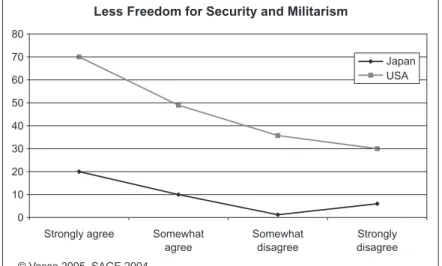
These answers indicate the existence of a link between support for militarist policies and support for (although limited) authoritarian values. However, there is more evidence to support this view. When asked whether they would even be willing to give up some freedom to increase security, almost two-third (64%) of Japanese agreed, compared with almost three-fourth (72%) in the US.
Table 3:
Support for Leaders and Militarism in Japan Strongly agree and Somewhat agree
1 Militarist 2
3 4 5 6 7
8 Strong Anti-Militarists
© Vosse. Based on Sage 2004.
Statement: We should agree with leaders even if we don’t agree with them.
100.0 88.9 88.2 70.3 54.9 43.8 25.0 5.7
Japanese from Venus?
Again, there is a strong correlation between the willingness to give up some freedom for security in Japan and the United States(15). While in Japan, only 8%
were labeled as militarists for this study, among those who would give up some freedom the level is 20%, while only 5% among those who strongly disagree (Figure 4).
Both, strong support for leaders and the willingness to give up freedom or civil rights indicate a certain preference for limited authoritarianism. Militarists in Japan, as well as in the US, show a very strong tendency to support these
Table 4: Give up freedom for security
Japan USA
Strongly Agree Somewhat agree Somewhat disagree Strongly disagree
9.9 54.4 21.4 14.3
31.1 41.5 15.4 12.0
© 2005, Wilhelm Vosse. Based on SAGE 2004.
Question: In times of crisis citizens should be willing to give up some freedoms”
so that our nations leaders can provide better security for our country.
Figure 4
Japanese from Venus?
at least potentially authoritarian traits. There is another set of values that is also strongly correlated with militarist attitudes, namely a type of patriotism that stresses symbols such as the flag, rather than specific cultural, social, or economic achievements of the country. Yoshito Ishio(16) has called this kind of patriotism “naïve patriotism” because of its relatively unreflected and uncritical nature. One could certainly argue that all forms of patriotism are at some level based on symbols, however, when this becomes the predominant aspect of their patriotism, than this might indicate that this person will also support government policies simply because they seem to be based on the preservation of national pride and honor, and are less a rational means to achieve a certain outcome.
An example of this attitude is a strong affiliation with the nation’s flag or other symbols. Patriotism can mean the defense of values that a country seems to stand for, such as democracy and freedom, but it can also mean support for its symbols. In the SAGE survey, respondents were asked whether they deem it important that schools should teach children to respect the flag. In the US, almost everyone (95%) support this view. In Japan, three-fourth (75%) support respect for the national flag. Hence a strong majority of people in both countries considers respect for the flag as important (Table 5).
Again, in both countries we find a strong correlation between respect for flag and militarism. As figure 5 illustrates, the share of militarists is significantly higher among those who demand respect for the national flag than among and those who do not. In Japan, this is particularly significant. For those who strongly demand respect for national flag more than 30% can be labeled militarists. On the other hand, among those who disagree with this statement, a mere 4.7% are militarists.
Table 5: Respect for the flag
Japan USA
Strongly Agree Somewhat agree Somewhat disagree Strongly disagree
29.2 45.3 17.2 8.3
74.7 19.2 4.4 1.8
© 2005, Wilhelm Vosse. Based on SAGE 2004.
Statement: Schools should teach children to respect the national flag.
Japanese from Venus?
The relationship is similarly strong in the United States.
This is another indication of a specific type of right or conservative ideology of militarists in Japan (and to a similar degree also in the United States), namely a strong sense of authoritarianism and nationalism, which is combined with a preference for a stronger and more independent Japan. The latter point is supported by the fact that militarists in both countries agree in that they wish their countries to develop a stronger international profile(17).
Figure 5
Japanese from Venus?
As figure 6 illustrates, the share of militarist is significantly higher than the average in Japan, and even more so in the United States. However, it is also remarkable, that among those who oppose a greater leadership role of Japan almost 10% can be label militarists. This might be an indication for a still widely held belief that the United States should provide this role for Japan, and are therefore critical of Japan taking up larger international responsibilities. It is also an indication of the divided debate about its future role in Japan itself. A debate between those who want to keep the status quo with US security guarantees in place, a gradual lifting of the limitation set in Article Nine of the Constitution, those who want to change Japan into a so-called “normal state” or futsu no kuni, (Ozawa, 1994), to those who prefer to even go back to prewar strength with a strong military presence and nationalist ideology. A further analysis of the SAGE data will have to look into this fact.
Other attitudes shared by militarist in Japan is a combination of a comparatively strong trust in the military (r=.385**) and surprisingly also the Diet (r=.325**), some level of satisfaction with Japan’s foreign policy (r=.178**) and a negative attitude towards immigration (r=-.284**). That militarists in both
Figure 6
Japanese from Venus?
countries have a higher level of trust in the military than the average citizen might not be surprising, however, Japanese militarist are somewhat distinguished from Americans in that they have a relatively high confidence in their parliament and a strong trust in government(18) (r=.353**). In Japan, 41% of those who say they “just about always” trust the government are militarists, but only 3.6% of those who “hardly ever” trust the government are. The correlations in the US are very similar with respective figure of 76% and 32%. This can perhaps be explained by the different political systems, a presidential system in the US where citizens might often get the impression that Congress works against a president who seems to share many of the militarist traits, and a cabinet system in Japan, where the prime ministers constantly needs the support of the Diet.
This interpretation for the United States is supported by the strong satisfaction with the US foreign policy among militarists (r=.536**) and the strong trust in government (r=.306**).
IV. Conclusion
The SAGE 2004 survey highlighted some of the factors that influence militarist attitudes in Japan and the United States. We expected to find that Americans would lean significantly more towards militarist attitudes than Japanese, but the question was whether militarist attitudes are shaped and influenced by similar factors and whether this might indicate a change in militarist attitudes particularly in Japan.
Returning to the three hypothesis stated at the outset, we can conclude that (1) age influences militarist attitude in Japan, but not in the United States. However, contrary to the prediction that older age cohorts would be more critical of military policies, the opposite is true for Japan. When we follow the generational interpretation of changes in attitudes, we could assume that Japan might not become more militaristic in the near future, however, only longitudinal data can support this assumption.
Secondly, we were assuming that militants would lean more towards the political right. This assumption proofed to be true. Indeed, in Japan (and
Japanese from Venus?
the US), there is a very strong correlation between ideology as well as party identification. This also means, that there is opposition in both countries against further militarization, and a change of government can also mean support for a different foreign policy platform. Although a significant share of LDP supporters are militarists, we also find militarists among supporters of the DPJ. This might be an indication for the weak foreign policy profile of the DPJ and the fact that it is still a kind of catch-all party with a weak ideological identity.
Since our first hypothesis proofed to be not true, the third hypothesis, namely the type of right wing or conservative ideology supported by militarists in Japan would be a form of modern conservatism that does in principle embrace a realist world view, exemplified by an acceptance of the legitimacy of the SDF and the need for cooperating with the United States, but modern in the sense that it would be critical of nationalistic or authoritarian views. However, this was neither the case in Japan nor in the United States. In Japan, militarist attitudes are accompanied by a somewhat uncritical stance towards authorities and a strong support for symbols of the state. This is the type of ideology that might be well represented by Tokyo’s Governor Ishihara Shintaro who is criticized but also supported for his ordinance to have the national anthem sung and the Japanese flag raised at school ceremonies.
Overall, this analysis of the SAGE data set gives us a first idea about just one aspect of peace and security in Japan, namely the type of militarist sentiment among the Japanese general public, sixty years after the end of World War II. It is just a first indication about the current state of Japan’s foreign policy identity.
It illustrates that the overall level of militarist attitudes is significantly lower than in the United States, but also that similar factors seem to have an influence on it.
A further analysis of the survey data will give us a better more multifaceted view of foreign policy identities in contemporary Japan(19).
Japanese from Venus?
Notes
The analysis for this article is based on the Survey on Attitudes and Social Engagement (SAGE), a joint project of ICU and WSU. Principal investigators: Wilhelm Vosse (ICU) and Andrew Appleton (WSU). The SAGE survey was funded by the ICU Center of Excellence Program “Peace, Security, and Conviviality”.
A widely used metaphor for Japanese international role. See: McNaughter, 1994: 292; Hook et al., 2001.
On 28 November 2002, the Task Force on Foreign Relations issued the “Basic Strategies for Japan’s Foreign Policy in the 21st Century New Era, New Vision, New Diplomacy”.
Based on a NHK public opinion polls in January, February, and March 2004 (NHK Hoso bunka kenkyujo (ed.), 2004).
See among others: Hook and McCormack, 2001; Hook, 1996; Hook et al., 2001.
These following numbers (Q11 etc.) refer to the variable number in the SAGE 2004 data set.
In order to weight and balance different variable width and positive and negative direction of variables, the following formula has been used to calculate a military index that is used for the analysis here. Finally, three (3) is subtracted from the rounded figure to bring the index to a scale from 1-8, instead of 3-10, as it would be otherwise.
The Japanese government has at times, and even today, considered military options, and the fact that AMPO as well as the US-Japan security guidelines include the possibility for Japanese troops to get involved in order to main regional security in areas around Japan.
However, as the country comparison demonstrated, compared with the US, Japanese people are still very reluctant when it comes to considering military options.
This classification is based on the following categories: On the scale between 0 and 10: Left:
0-3, Center: 4-6, Right: 7-10. This classification gives some preference to both the left and the right (both have a four point width, and the center a weight of 3 points). Nevertheless, the majority of respondents can be found in the center.
Percentage do not add up to 100 because the category “other parties” have been omitted and because of rounding.
In the ISSP 2000, 59% of the Japanese respondents could not name any party preference.
The figures represent the combined figures of those who answered “strongly agree” and
“somewhat agree”.
The three highest grades (1 to 3) on the scale between 1 (strong militarists) and 8 (strong anti- militarists).
Those who answered: “strongly agree” or “somewhat agree”.
See table 1 for comparative bivariate correlations.
Categorization of respondents who have strong emotions for symbols of their nations, without necessarily reflecting on the actual position or achievements of their country, combined with a kind of “blind” support for those in power or the elite in general, suggested by Yoshito Ishio (1)
(2) (3) (4)
(5) (6) (7)
(8)
(9)
(10)
(11) (12) (13)
(14) (15) (16)
Japanese from Venus?
during the preparatory meeting for the SAGE 2004 survey project in June 2004.
Question in the SAGE 2004 survey: From your point of view, how desirable is it that Japan exerts strong leadership in world affairs? [Anata, nihon ga kokusaishakai ni oite tsuyoi shidouryoku wo hakki suru koto ha, dono gurai nozomashii koto da to omoimasu ka?](In the US the question was directed towards a strong US leadership role).
Confidence in the Diet is similarly low in Japan. Only 28% trust the Japanese parliament
“a great deal” or “somewhat”, while 71% have a rather negative impression of it. However, among those who expressed a strong or moderate level of trust towards the parliament in Japan, 23% and 11% are militarists, while only 3% of those who say they don’t trust their parliament at all are militarists.
For a very good overview of four different foreign policy schools among Japanese intellectuals and politicians, see: Klien, 2002.
(17)
(18)
(19)
References
Berger, Thomas U. 1996. Norms, Identity, and National Security in Germany and Japan. In Peter J.
Katzenstein (ed.). The Culture of National Security Norms and Identity in World Politics, U.S.
Social Science Research Council, and on International Peace & Security Committee, New York: Columbia University Press.
Berger, Thomas U. 1998. Cultures of Antimilitarism: National Security in Germany and Japan.
Baltimore, Md.: Johns Hopkins University Press.
Carrière, Erin, Marc O'Reilly, and Richard Vengroff. 1999. In the Service of Peace: Reflexive Multilateralism and the Canadian Experience in Bosnia. Paper presented at the 40th International Studies Association Annual Meeting, Washington, D.C., February 16-20, 1999.
Foyle, Douglas C. 1999. Counting the Public in: Presidents, Public Opinion, and Foreign Policy.
New York: Columbia University Press.
Foyle, Douglas C. 2003. Foreign Policy Analysis and Globalization. Public Opinion, World Opinon, and the Individual. International Studies Review 5 (2): 155-202.
Foyle, Douglas C. 2004. Leading the Public to War? The Influence of American Public Opinion on the Bush Administration's Decision to Go to War in Iraq. Int J Public Opin Res 16 (3): 269-94.
Holsti, Ole R. 1992. Public Opinion and Foreign Policy: Challenges to the Almond/Lippmann Consensus. International Studies Quarterly (36): 439-66.
Holsti, Ole R. 2004. Public Opinion and American Foreign Policy. Ann Arbor: University of Michigan Press.
Hook, Glenn D. 1996. Militarization and Demilitarization in Contemporary Japan. London; New York: Routledge.
Hook, Glenn D, Julie Gilson, Christopher W. Hughes, and Hugo Dobson. 2001. Japan's
Japanese from Venus? International Relations: Politics, Economics, and Security. London; New York: Routledge.
Hook, Glenn D, and Gavan McCormack. 2001. Japan's Contested Constitution: Documents and Analysis. London; New York: Routledge.
ISSP (International Social Survey Program). 2000. Environment. Zentralarchiv fuer Empirische Sozialforschung an der Universitaet. Koeln: GESIS. Data set.
Kagan, Robert. 2002. Power and Weakness. Policy Review 113: 3-28.
Kagan, Robert. 2003. Of Paradise and Power: America and Europe in the New World Order. New York: Alfred and Knopf.
Katzenstein, Peter J. 1996. The Culture of National Security Norms and Identity in World Politics.
New York: Columbia University Press.
Klien, Susanne. 2002. Rethinking Japan's Identity and International Role: an Intercultural Perspective. London; New York: Routledge.
Kull, Steven, and Clay Ramsay. 2000. Elite Misperceptions of U.S. Public Opinion and Foreign Policy. In Brigitte L. Nacos, Robert Y. Shapiro, and Pierangelo Isernia (eds.). Decisionmaking in a Glass House: Mass Media, Public Opinion, and American and European Foreign Policy in the 21st Century, Lanham, MD: Rowman & Littlefield Publishers.
Kull, Steven, Clay Ramsay, and Evan Lewis. 2003. Misperceptions and the Iraq War. Political Science Quarterly 118 (4): 569-99.
Lawrence, Jacobs R. and Benjamin I. Page. 2005. Who Influences U.S. Foreign Policy? American Political Science Review 99 (1): 107-23.
McNaughter, Thomas L. 1994. U.S. Military Forces in East Asia: The Case for Long-Term Engagement. In Gerald L. Curtis (ed.). The United States, Japan, and Asia. New York: W.W.
Norton.
Mueller, John E. 1994. Policy and Opinion in the Gulf War. Chicago: University of Chicago Press.
Mueller, John E. 2000. Public Opinion as a Constraint on U.S. Foreign Policy: Assessing the Perceived Value of American and Foreign Lives. Los Angeles, CA.
Nacos, Brigitte L., Robert Y. Shapiro, and Pierangelo Isernia. 2000. Decisionmaking in a Glass House: Mass Media, Public Opinion, and American and European Foreign Policy in the 21st Century. Lanham, MD: Rowman & Littlefield Publishers.
Nakanishi, Hiroshi. 2004. Furukute atarashii jirenma. Minshu seiji to gaikou [The Old But New Dilemma. Democratic Politics and Foreign Relations]. Gaiko foramu [Gaiko forum] 196 (11):
20-25.
NHK bunka kenkyujo. 2004. Iraku jieitai haken to kokumin ishiki [Dispatch of the Self Defense Forces to Iraq and National Consciousness]. In NHK bunken seron chousa fairu. At website:
http://www.nhk.or.jp/bunken/research/ippan/ippan04040101.pdf (accessed: 30 October 2005).
Nishitani, Makiko. 2001. Kokusai yoron to kokunai yoron no renkan. Beikoku no wangankikisensou ni taisuru gaikouseisaku no jirei toshite (Hikakuseiji to Kokusaiseiji No Aida) [The Relations Between International Public Opinion and Domestic Public Opinion. The Case Study of the US Foreign Policy During the Gulf War Crisis (Between Comparative Politics and International
Japanese from Venus?
Politics)]. Kokusai seiji [International Politics] 128: 115-29.
Ozawa, Ichiro. 1994. Blueprint for a New Japan: The Rethinking of a Nation. Tokyo; New York:
Kodansha.
Page, Benjamin I., and Robert Y. Shapiro. 1992. The Rational Public: Fifty Years of Trends in Americans' Policy Preferences. Chicago: University of Chicago Press.
Powlick, Philip, J., and Andrew Z. Latz. 1998. Defining the American Public Opinion/Foreign Policy Nexus. Mershon International Studies Review 42: 29-61.
Prime Ministers Office. 1969-. Shakai ishiki ni kansuru seron chousa, [Public Opinion Poll Concerning Social Consciousness]. Yearly public opinion survey. Tokyo.
Prime Ministers Office. 1958-. Kokumin seikatsu ni kansuru seron chousa, [Public Opinion Poll Concerning Citizen and State]. Yearly public opinion survey. Tokyo.
Sobel, Richard, and Eric Shiraev. 2003. International Public Opinion and the Bosnia Crisis. Lanham, Md.: Lexington Books.
Sobel, Richard. 1993. Public Opinion in U.S. Foreign Policy: the Controversy Over Contra Aid.
Lanham, Md.: Rowman & Littlefield.
Sobel, Richard. 2001. The Impact of Public Opinion on U.S. Foreign Policy Since Vietnam:
Constraining the Colossus. New York: Oxford University Press.
The Chicago Council on Foreign Relations and German Marshall Fund of the United States (ed.).
2002. Worldviews 2002. Inter-University Consortium for Political and Social Research. Data set.
Wittkopf, Eugene R. 1990. Faces of Internationalism: Public Opinion and American Foreign Policy.
Durham: Duke University Press.
Yamaguchi, Jirou. 2003. Seiji jibyou: Seron ga machigatte iru to kangaeru "Heiwa Boke" Koizumi shushou no taibeitsuizui to iu jubaku [Political Comments on Current Events: Prime Ministers Koizumi's Spell to Follow the U.S.'s 'Peace-At-Any-Prize Mind Set' and to Think That Public Opinion is Wrong]. Shukan kinyoubi [Friday Weekly] 20.
日本人は、好んで自国を平和主義国家、問題解決のために軍事的選択肢をとること を好まない国家であると描き出す。第9条において戦争放棄が謳われている日本国憲 法は「平和憲法」として広く受け容れられており、「非核三原則」は他国にとっての 模範であると見做されている。軍国主義と領土拡張主義の終焉から半世紀を経た今、
日本人は過去から学び、「富国強兵」のスローガンは、少なくとも名目上は軍隊を持 たない貿易立国へと転換されたように見える。他方、日本は第二次世界大戦に敗北し たのち、他の選択肢をとることが出来ず、外交・安全保障政策上の選択肢が制限され ているという状況は今日に至るまで続いているという解釈が存在する。本論は、今日 の日本人は本当に軍事的選択肢をとることを好まないのか、そしていかなる要素が日 本人及びアメリカ人の軍事的手段を促しているのだろうか、という2つの問題を扱う。
本論における分析は、2004年の終わりに行われた「国際社会との関わり方につい ての日米比較調査」及び日本と米国で行われた郵送調査の結果に基づいている。最初 に行われた予備的分析は、日本人は実際のところアメリカ人と比べて軍事的手段に対 する傾斜が弱いことを明らかにした。しかし、同時に、極めて類似した要素が両国民 に軍事力への傾斜を促していることが明らかになった。政治的イデオロギー、権威主 義的傾向、愛国主義、軍を含む政治制度に対する強い信頼、そしてリーダーシップの 強化に対する支持が軍事的手段に対する傾斜の重要な前提条件として挙げられる。
結論として、全体として軍事的な含意のある政策に対する支持は今日の日本におい て比較的弱いと言えるが、他方において、現状における強い愛国主義的、権威主義的 傾向と将来におけるその強化の可能性は、日本の軍事的役割の強化が国民から支持さ れうるということを示唆している。
̶日米両国国民の自国外交政策に対する 態度の相違の説明のための新たなアプローチ̶
< 要 約 >
ヴィルヘルム・フォッセ