INTRODUCTION
The lymphatic system plays an important role in main- taining the homeostasis of tissue fluid, immune cell traf- ficking, and absorption of dietary lipids. Lymphatics are
present in the skin and almost all internal organs exclud- ing the central nervous system, bone marrow, and avascu- lar tissues such as the epidermis. The lymphatic network drains interstitial fluid from the tissues and returns it to the vascular system. Aberrant lymphangiogenesis is associ- ated with the pathogenesis of human disorders including lymphedema, tumor metastasis, and inflammatory condi- tions such as asthma, psoriasis, and rheumatoid arthritis.1,2 We must collect analytical findings and information concerning lymphatic flow at both the experimental and clinical levels when examining clinical treatments for lymphedema. Lymphoscintigraphy is a gold standard for diagnosis when pathological changes of lymphatic vessels must be identified. Computed tomography and fluores- cence lymphographies can provide views of lymph flow in detail.3–6 However, only partial lymphatic pathways were detectable by such methods after the uptake of contrast agents, but whole vessels were not visible. There is little information about the horizontal anatomy concerning the localization of lymphatic vessels in the superficial and/or deep layers. The number of lymphatic vessels localizing
Disclosure: The authors have no financial interest to declare in relation to the content of this article. The Article Processing Charge was paid for by the authors.
Enhancement of Lymphatic Vessels in the Superficial Layer in a Rat Model of a Lymphedematous Response
From the *Department of Plastic and Reconstructive Surgery, Okayama University Graduate School of Medicine, Dentistry and Pharmaceutical Science, Okayama, Japan; †Department of Anatomy, School of Medicine, International University of Health and Welfare, Narita, Japan; and ‡Australian Lymphoedema Education Research Treatment Centre (ALERT), Faculty of Medicine and Health Sciences, Macquarie University, Sydney, NSW, Australia
Received for publication March 2, 2018; accepted March 13,2018.
Supported by the grants-in–aids from the Ministry of Education, Culture, Sports, Science and Technology of Japan.
Presented at the 24th Research Council Meeting of Japan Society of Plastic and Reconstructive Surgery (2015) in Morioka, Japan, as a preliminary form in Japanese.
Kumiko Matsumoto, MD*
Jun Kosaka, MD, DSci†
Hiroo Suami, MD, PhD‡
Yoshihiro Kimata, MD, PhD*
Matsumoto et al.
Background: The morphologic and histologic behavior of lymphatic vessels in lymphedema has not been well analyzed using laboratory animals. The purpose of the present study was to elucidate the regeneration process of lymphatic vessels after acute lymphedema in a rat model.
Methods: The acute lymphedema was induced by an amputation and a replan- tation surgery on a rat hind limb. Recovery of lymphatic flow was traced using fluorescent lymphography with dye injection. The morphology and number of lymphatic vessels were immunohistochemically detected and quantified in both superficial and deep layers.
Results: The swelling was the most severe, and the number of lymphatic vessels in the superficial layer was significantly and maximally increased on postoperative day 3. Backflows and overflows were also detectable in the superficial layer on postop- erative day 3. The number of lymphatic vessels had decreased but remained signifi- cantly higher than that in the controls on postoperative day 14, when the swelling decreased to the levels in the controls. In contrast, the number of lymphatic vessels in the deep layer showed a tendency toward increased numbers; however, it was not statistically significant on postoperative day 3, 7, or 14.
Conclusions: We have obtained solid evidence showing the differential potency of lymphatic vessels between the superficial and the deep layers after temporal lymph- edematous induction. Further analysis of lymphedematous responses in animal models could provide new insights into the challenges associated with the clinical treatment of lymphedema. (Plast Reconstr Surg Glob Open 2018;6:e1770; doi: 10.1097/
GOX.0000000000001770; Published online 25 May 2018.)
Copyright © 2018 The Authors. Published by Wolters Kluwer Health, Inc. on behalf of The American Society of Plastic Surgeons. This is an open-access article distributed under the terms of the Creative Commons Attribution-Non Commercial-No Derivatives License 4.0 (CCBY-NC-ND), where it is permissible to download and share the work provided it is properly cited. The work cannot be changed in any way or used commercially without permission from the journal.
DOI: 10.1097/GOX.0000000000001770
PRS Global Open • 2018
in horizontal levels and in which layers and regions the lymphatic vessels distribute is inconsistent. To our knowl- edge, there have been no reports about lymphatic distri- bution in deep regions. The distribution of all lymphatic vessels in horizontal cross-section must be elucidated first in laboratory animals.7,8 Intradermal or subdermal lym- phangiogenesis has been studied morphologically, where- as physiological and pathological lymphatic responses in the deep layers, such as the intramuscular and peri-mus- cular layers including deep fascia, are still unknown. An adequate animal model to study lymphedema could be very powerful to help reveal the molecular and cellular backgrounds underlying lymphangiogenesis and in devel- oping further treatments for human clinical lymphedema from a novel viewpoint.9–12
In the present study, we tried to elucidate the lymphatic distribution in the superficial and deep layers of the lower leg, and then tried to trace the course of lymphangiogen- esis in an acute lymphedema animal model after an am- putation and replantation procedure. Our animal model cannot repeat human clinical lymphedema completely;
however, important information needed to solve clinical problems could be realized at this experimental level.
MATERIALS AND METHODS
Acute Lymphedema Model
Adult male Wistar rats (SLC, Shizuoka, Japan) weighing 250–350 g were used in this study. All animal experiments were conducted in strict accordance with institutional and NIH guidelines for “Using Animals in Intramural Re- search,” and all experimental protocols were approved by the Animal Research Committee of Okayama University, Japan (No. OKU-2014176). All rats were intraperitoneally
injected with pentobarbital sodium (Dainippon Sumitomo Pharma. Co., Osaka, Japan) at 50 mg/kg of rat body weight for anesthesia, and their hair was carefully removed with depilatory around the surgical area of the legs.
We evaluated the lymphatic pathways following an acute lymphedema model of the rat hind limb. The hind limbs of the anesthetized rats were amputated around the right groin line. The hind limb was cut so that the groin lymph node was contained in the central side, and the popliteal lymph node was contained in the peripheral side (Fig. 1). Soon after the amputation, the replantation sur- gery was carried out using an allograft. First, the femoral bone was fixed with a 20-G needle. The femoral artery and vein were anastomosed using 10-0 nylon. The muscles and skin were sutured with 3-0 silk. The lymphatic vessels were not anastomosed. The operated rats were caged individu- ally with ad libitum access to food until they underwent the following processes. They were put in Elizabethan col- lars so as not to bite themselves.
Tissue Harvest and Immunohistochemical Staining of Lymphatic Vessels
The rats were anesthetized and perfused transcardially with 4% paraformaldehyde fixative. The rats’ hind limbs were amputated around the right groin line. The amputated lower extremities were fixed again in 10% neutral buffered formalin overnight, defatted in ethanol for 4 days, and then decalcified by soaking in 10% ethylenediaminetetraacetic acid (EDTA) for 1 month. The tissues were cut in at 5 mm peripherally from the groin line (or from the suture line).
All the histochemical analyses were carried out on the sec- tions at the peripheral part in reference to the suture line.
The tissues were embedded in paraffin, and 4.5-µm thick sections were prepared as whole horizontal sections
Fig. 1. Hind limb amputation and replantation procedures. amputation was carried out be- tween the inguinal lymph node (upper yellow mark) and the popliteal lymph node (lower yellow mark). the femoral bone (green), the femoral artery (red), and the femoral vein (blue) were cut once. the femoral bone was fixed internally, the femoral artery and vein were anas- tomosed microsurgically, and then the muscle, subcutaneous tissue, and skin were sutured layer to layer.
of the hind limb. The sections were then deparaffinized in xylene and rehydrated. After antigen retrieval and block- ing, sections were incubated with anti-rat podoplanin monoclonal antibody (11035 AngioBio Co., San Diego, Calif.) overnight at 4°C.13 Next, sections were incubated in antimouse IgG Horse Radish Peroxidase conjugated (414171 Nichirei. Co., Tokyo, Japan). The immunoposi- tivities were visualized using a 3-3’-diaminobenzidine tetrahydrochloride Substrate Kit for Peroxidase (Vector Laboratories, Burlingame, Calif.). Finally, the sections were dehydrated and mounted. In the normal and postop- erative days (PODs) 3, 7, and 14 subject rats (each n = 3), we manually counted all the immunopositive lymphatic vessels in the horizontal cross sections. We defined “the superficial layer” as the dermis and the hypodermis lay- ers including the epimysium, and “the deep layer” as the
subfascial layer excluding the epimysium. The number of lymphatic vessels was counted manually in 4 independent specimens from each animal.
Measuring of the Ankle Circumference
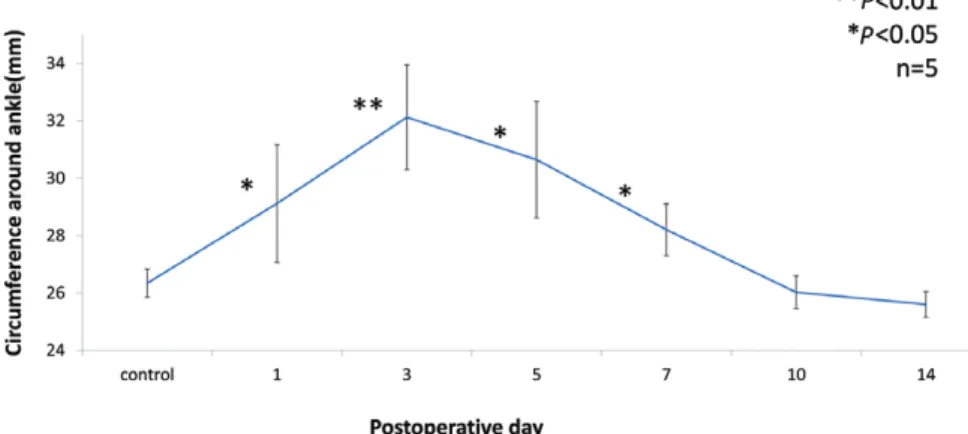
The ankle circumferences were measured manually be- fore and after the replantation procedure on PODs 1, 3, 5, 7, 10, and 14 (n = 5). We defined POD 0 as the control be- fore the operation. The mean circumference was obtained by taking the average of 10 measurements from 1 sample.
Fluorescence Lymphography with Indocyanine Green The near-infrared fluorescence imager PDE (Hama- matsu Photonics Co., Hamamatsu, Japan) was used to observe lymphatic flow. We injected 0.02 ml of 5 mg/ml indocyanine green (ICG) (Diagnogreen, Daiichi-Sankyo, Fig. 2. immunohistochemical studies of lymphatic vessels reacted with podoplanin antibody on pOD 0.
a, Hematoxylin and eosin staining of a horizontal slice section of rat hind limb at a lower magnification.
B, We defined “the superficial layer” as the dermis and the hypodermis layers including the epimysium, and “the deep layer” as the subfascial layer excluding the epimysium. lymphatic vessels detected in the superficial layer are shown in the center, and the deep layer in the area below. C, D, and E, podoplanin- positive lymphatic vessels in the superficial layer: the lymphatic valves were detectable (green arrow- heads). there were lymphatic vessels smaller than 10 µm diameter (red arrow head) and squashed or linear-shaped immunopositivity (blue arrowhead). this staining pattern and the immunopositive de- bris were undetectable as lymphatic vessels in this study. in the deep layer, immunopositivities were also dense between the periostea and muscles on the medial side of the femur (F). in the muscular layer, the lymphatic vessels were observed in the neurovascular bundles (G).
PRS Global Open • 2018
Tokyo, Japan) intradermally into the rats’ hind toes using a 30-gauge needle.14 Six rats were observed from POD 0 to POD 28. Fluorescence images were taken up to 120 min- utes after the ICG injections.
Dye Injection Procedure
The lymphatic pathways were visualized after the dye injection procedure as described previously.15 In this study, we manually injected acrylic ink (Sakura Acryl Col- ors, Sakura Color Products Co., Osaka, Japan) that had been diluted in saline directly into the subdermal capil- lary lymphatic vessels of the dorsalis pedis. The dye was delivered from the capillary lymphatic vessels to the col- lecting lymphatic vessels in the superficial layer, but was not delivered to the lymphatic vessels in the deep layer of the lower leg. Next, the dye was observed to ascend im- mediately to the inguinal region and the intraperitoneal lymph nodes. The skin was carefully removed to observe the subdermal lymphatic vessels directly. We injected the dye directly into the lymphatics of the superficial tissues, and we performed histological examinations of them on PODs 0, 3, and 7.
Statistical Analysis
Statistical comparisons of the ankle circumferences and the number of lymphatic vessels were carried out us- ing the Student’s unpaired t test. Statistical significance was set at P value less than 0.05 and 0.01. All numerical data are presented as the mean ± SD.
RESULTS
The Normal Distribution of Lymphatic Vessels in Horizontal Whole Sections of the Lower Leg
In normal conditions, we examined the distribution and morphology of the lymphatic vessels, considering the superficial layer and the deep layer separately. The mean number of preoperative lymphatic vessels on POD 0 was 70.6 ± 8.4 in the superficial layer and 190 ± 32.5 in the deep layer. Various shapes and sizes of immunoposi- tive vessels were detected in linear, nearly circle, irregu- lar circle, or elliptical forms, and their diameters ranged from less than 10 µm to more than 100 µm (Fig. 2). We defined such immunoreactivity with cavities as the lym- phatic vessels based on their morphology, however could not define the linear type as a collapsed lymph duct in this study (Fig. 2E center, right). The linear staining pathways were not conspicuous in the deep layer, but were in the superficial layer. In the deep layer, immu- nopositivities were also dense between the periostea and muscles on the medial side of the femur. In the muscular layer, the lymphatic vessels were observed in the neuro- vascular bundles or along the small vessels.
ICG lymphography and dye injection procedures showed evidence of lymphatic linear pathways from the dorsalis pedis to the dorsal side of the hind limb into the popliteal lymph node area (Fig. 3A) and then on into the peritoneal cavity. No ICG-fluorescence or dye leakage from lymphatic ducts was detected.
Temporal Change of Lymphatic Vessels in Acute Lymphedema
Edematous change achieved a peak on POD 3 (Fig. 4). At this point, in ICG lymphography, the area in the periphery compared with the suture line showed uniformly high fluoro- intensity representing dermal backflow on both the ventral and dorsal sides. ICG-fluorescence was not detected across the suture line (Fig. 3B, indicated by red line). The dye injection procedure revealed back-flows from the collecting vessels to the capillary vessels, and overflows to the inter-tissue spaces.
The number of lymphatic vessels in the superficial layer in- creased significantly (Figs. 5, 6). On the other hand, in the deep layer, the number of immunopositive-staining areas showed a tendency to increase from the preoperative status.
However, this increase was not statistically significant (Fig. 5A).
On and after POD 5, the swelling started to decrease but still enlarged significantly (Fig. 4). During this period, Fig. 3. time-dependent change of iCG-lymphangiography before and after the surgery. a, preoperative lymphangiography: lymph flows were detectable on the dorsal side. B, pOD 2: iCG-fluorescence was stuffed at the distal part from the suture line (red line). no fluo- rescence was detected beyond the proximal part. C, pOD 5: iCG-flu- orescence was detectable across the suture line (detected by yellow allow). Stuffed fluorescence was also detectable. the inguinal lymph node was fluoro-positive (indicated by green asterisks). D, pOD 14:
Stuffed fluorescence was washed out from the distal part of the hind limbs. Fluoro-positive lymph flows across the suture line to the in- guinal lymph node (indicated by green asterisks) were detectable.
Fig. 4. the ankle circumference temporally increased after the surgery. the circumference reached a maximum on pOD 3 and returned to baseline on pOD 10. all data were compared with pOD 0. **P < 0.01, *P < 0.05. n = 5.
Fig. 5. alteration in the distribution of the lymphatic vessels after the replantation. a, Comparison of the numbers of podoplanin-positive lymph vessels in the superficial and the deep layers. the number of lymph vessels in the superficial layer significantly in- creased on pODs 3, 7, and 14. **P < 0.01, *P < 0.05. n = 12. B, podoplanin-immunopos- itive lymphatic vessels in the superficial layer on pOD 0. C, the number and the size of lymphatic vessels increased and expanded on pOD 3. D, the number and the size of lymphatic vessels still increased and expanded on pOD 7. E, lymphatic vessels remained increased on pOD 14. Higher magnification microphotographs have been inserted to show immunopositivities (inserts in each photograph, Bar = 100 µm).
PRS Global Open • 2018
ICG lymphography showed recanalized pathways, and the ICG-fluorescence was still very noticeable on distal part of the suture line (Fig. 3C). The number of lymphatic vessels on POD 7 decreased with statistical significance compared with POD 3, but still remained increased sig- nificantly compared with the preoperative state (Fig. 5A).
On and after POD 10, the edema resolved to baseline (Fig. 4). At this point, ICG lymphography showed recanali- zation, and pooling of the fluorescence disappeared com- pletely (Fig. 3D). Dye injection procedures on POD 14 also showed the recanalized pathway clearly extending across
the suture line (Fig. 7). The number of lymphatic vessels on POD 14 decreased with statistical significance com- pared with POD 3, but remained significantly increased from the preoperative state similar to POD 7 (Fig. 5A).
DISCUSSION
An Increase in the Number of Lymphatic Vessels in the Superficial Layer
From our study, we developed the following 2 hypoth- eses to explain the increase in the number of lymphatic Fig. 6. Swelling lymphatic vessels in the superficial layer after replantation surgery. a, pOD 0: dye filled
in the collecting lymphatic vessels (indicated by red arrows). there was no leakage to the extraductal regions and no backflow to the dermal or subdermal capillary lymph vessels (indicated by blue arrows).
B, pOD 3: Collecting lymphatic vessels were overfilled with dye and were swelling (red arrows). Capillary vessels filled with the ink (indicated by blue arrows) due to back-flows were detectable. Green arrows show overflow to the extravascular space of lymphatic capillary. Higher magnification microphoto- graphs have been inserted to show immunopositivities (inserts in each photograph).
vessels. First, the reconstruction of lymphatic vessels was promptly stimulated after the operation. It is generally ac- cepted that lymphangiogenesis is triggered by inflamma- tion and retention of lymph fluid.9,16,17 Therefore, we have strongly considered the involvement of lymphangiogen- esis in the retention of lymph flow in our system. However, as shown in Figure 3, we can also suggest the lymphatic drainage inosculation between donor and recipient lym- phatic vessels near the suture site because of the rapid restoration of ICG flow in the recipients’ main lymphatic trunk. Therefore, as our second hypothesis, we suggest that all the lymph vessels showed little or no change from before to after the operation; however, we were unable to detect the majority of the superficial lymphatic vessels on POD 0 by our methods. From our observations, debris, and/or linear staining with podoplanin-immunoreactivi- ties were conspicuous in the superficial layer on POD 0, but we did not define them as lymphatic vessels (Fig. 2).
The afferent lymphatic flow in the lymphatic capillaries might be too weak and too small to dilate the vessels. The lymphatic vessels might collapse to linear configurations or smaller sizes under normal conditions. After surgery,
such vessels might swell and then become detectable by our methods.
On POD 3, the reason for the increasing number of lymphatic vessels could be explained by the second hypoth- esis mentioned above. We have shown that the temporal retention of lymphatic fluid occurred along the swelling around the ankle after the amputation and replantation surgery, evidenced by the use of ICG lymphangiography and the dye injection method. This lymphatic retention also brought back-flow to the capillary lymph vessels and overflow to the interstitial spaces by extrusion of lymphat- ic fluids from the lymphatic collecting vessels on POD 3 (Fig. 6B below). Therefore, previously collapsed lymph vessels became dilated, and we could then detect them by podoplanin-immunostaining. We observed that the num- ber of lymphatic vessels increased on POD 3.
We detected parallel relationships between the reten- tion of lymphatic fluids detected by ICG lymphangiog- raphy (Fig. 3) and the ankle circumference (Fig. 4). We also detected parallel relationships between the ankle circumference and the number of lymphatic vessels in the superficial layer until POD 3. On POD 7, the swell- ing was decreasing (Fig. 4), and ICG retention below the suture line was also decreasing (Fig. 3); however, the num- ber of lymphatic vessels in the superficial layer remained increased. These discrepant findings fit the first hypoth- esis mentioned above. Newly constructed lymphatic net- works in the superficial layer after lymphangiogenesis was already occurring. On the other hand, the once dilated lymph vessels started to collapse again on POD 7.
Our data on ICG-lymphangiography (Fig. 3) clearly show that the lymphatic fluids were already flowing from the periphery beyond the suture line back to the midline after POD 7. Therefore, we could recognize that swelling did not depend on the actual number of lymph vessels, but on the lymphatic flows from the periphery to the cen- tral body parts.
Taken together with these hypotheses, we can specu- late that the previously collapsed lymphatic vessels dilated around POD 3, and then collapsed again after PODs 7–14.
The newly constructed lymphatic vessels after lymphangi- ogenesis might have contributed to the increased number of lymphatic vessels on PODs 7 and 14.
In the Deep Layer, There Was No Significant Increase in the Number of Lymphatic Vessels
From our results, the lymphatic vessels in the deep layer did not significantly increase in acute lymphedema.
We were unable to detect the collapsed shape and linear staining using the podoplanin antibody in the deep layer at any time point. Histologically, the superficial layer (the dermis) has a rich network of small and thin lymphatic vessels. These branches descend to the deeper layer and join a larger and thick lymphatic trunk with relatively thick walls. In the normal state, the number of lymphatic vessels in the deep layer (190 ± 32.5) was approximately 3 times higher than in the superficial layer (70.6 ± 8.4) on POD 0 (Fig. 5). Stanton et al.18 clearly demonstrated by scintigraphy that lymph flow in the deep layer was ~2–3 times higher than that in the superficial layer in human Fig. 7. lymphatic vessels recanalized beyond the suture line. the
lymphatic network was visualized with acrylic ink on pOD 14. the dye ascended immediately to the inguinal region beyond the suture line. the lymphatic network on the peripheral side of the suture was enhanced (surrounded by yellow arrows). a recanalized superficial lymphatic vessel was observed clearly at a higher magnification (in- dicated by the blue arrow in the green square). the black dotted line shows the sutured line.
PRS Global Open • 2018
physiological conditions. Stanton’s finding is consistent with our present data.
From these findings, we suggest that the potential for pathological retention of lymphatic fluid in the deep layer was weaker than in the superficial layer, and that af- ter the amputation and replantation surgery, collapsed and linear lymph vessels would dilate only among the rich and thin networks of lymphatic drainage in the su- perficial layer.
We cannot completely rule out decreased blood flow as the main reason that the lymphatic flows brought on swelling despite the anastomoses of arteries and veins.
However, we have obtained solid evidence of back-flows of lymphatic fluids and increased number of lymphatic ves- sels in the amputated and replanted legs.
In a recent clinic, we have tried to overcome lymph- edema by lymphovenous anastomoses in the superficial layers mainly; however, the results were unfortunately inconsistent.3 To our knowledge, there are no challeng- es against lymph vessels focused on the deeper layer.
Based on our present findings, the different behaviors of the lymph vessels in the superficial and deeper lay- ers after a transient lymphedematous response present a hint as to how to treat lymphedema clinically and microsurgically in both the superficial and the deeper layers.
CONCLUSIONS
We have demonstrated a temporal lymphedematous response in the rat model. The rat’s edema worsened on POD 3, but recovered to normal on POD 10. The num- ber of lymph vessels increased during this acute phase but only in the superficial layer, not in the deeper layer.
This increase still remained at a higher level after attenu- ation of the edema. We have discovered new findings showing the differences in activity between the lymphatic vessels in the superficial and the deep layers. Future at- tempts to enhance the recovery of lymph flows in our rat model after lymphovenous anastomosis may offer a potential strategy to cure lymphedema clinically, accord- ing to basic evidence on the anatomy and reconstitution of peripheral lymphatic vessels in the superficial and the deep layers.
Jun Kosaka, MD, DSci Department of Anatomy School of Medicine International University of Health and Welfare 4-3 Kozunomori, Narita Chiba 286–8686, Japan E-mail: [email protected]
ACKNOWLEDGMENTS
The authors thank Ms. Furutani, Ms. Morishita, and Ms.
Monobe for their excellent technical assistance.
REFERENCES
1. Alitalo K, Tammela T, Petrova TV. Lymphangiogenesis in devel- opment and human disease. Nature. 2005;438:946–953.
2. Tammela T, Alitalo K. Lymphangiogenesis: molecular mecha- nisms and future promise. Cell. 2010;140:460–476.
3. Warren AG, Brorson H, Borud LJ, et al. Lymphedema: a compre- hensive review. Ann Plast Surg. 2007;59:464–472.
4. Munn LL, Padera TP. Imaging the lymphatic system. Microvasc Res. 2014;96:55–63.
5. Akita S, Mitsukawa N, Kazama T, et al. Comparison of lymphoscin- tigraphy and indocyanine green lymphography for the diagnosis of extremity lymphedema. J Plast Reconstr Aesthet Surg. 2013;66:792–798.
6. Ogata F, Azuma R, Kikuchi M, et al. Novel lymphography using indocyanine green dye for near-infrared fluorescence labeling.
Ann Plast Surg. 2007;58:652–655.
7. Frueh FS, Gousopoulos E, Rezaeian F, et al. Animal models in surgical lymphedema research—a systematic review. J Surg Res.
2016;200:208–220.
8. Tran BNN, Angelo JP, Lee JH, et al. A novel pilot animal model for the surgical prevention of lymphedema: the power of optical imaging. J Surg Res. 2018;221:285–292.
9. Boardman KC, Swartz MA. Interstitial flow as a guide for lym- phangiogenesis. Circ Res. 2003;92:801–808.
10. Yan A, Avraham T, Zampell JC, et al. Mechanisms of lymphatic regeneration after tissue transfer. PLoS One. 2011;6:e17201.
11. Torrisi JS, Joseph WJ, Ghanta S, et al. Lymphaticovenous bypass decreases pathologic skin changes in upper extremity breast cancer-related lymphedema. Lymphat Res Biol. 2015;13:46–53.
12. Mihara M, Hara H, Araki J, et al. Indocyanine green (ICG) lymphog- raphy is superior to lymphoscintigraphy for diagnostic imaging of early lymphedema of the upper limbs. PLoS One. 2012;7:e38182.
13. Nogami M, Hoshi T, Arai T, et al. Morphology of lymphatic re- generation in rat incision wound healing in comparison with vas- cular regeneration. Leg Med (Tokyo). 2009;11:213–218.
14. Buretta KJ, Brat GA, Christensen JM, et al. Near-infrared lym- phography as a minimally invasive modality for imaging lymphat- ic reconstitution in a rat orthotopic hind limb transplantation model. Transpl Int. 2013;26:928–937.
15. Suami H, Chang DW, Matsumoto K, et al. Demonstrating the lymphatic system in rats with microinjection. Anat Rec (Hoboken).
2011;294:1566–1573.
16. Zampell JC, Yan A, Avraham T, et al. Temporal and spatial pat- terns of endogenous danger signal expression after wound heal- ing and in response to lymphedema. Am J Physiol Cell Physiol.
2011;300:C1107–C1121.
17. Rutkowski JM, Boardman KC, Swartz MA. Characterization of lymphangiogenesis in a model of adult skin regeneration. Am J Physiol Heart Circ Physiol. 2006;291:H1402–H1410.
18. Stanton AW, Modi S, Bennett Britton TM, et al. Lymphatic drain- age in the muscle and subcutis of the arm after breast cancer treatment. Breast Cancer Res Treat. 2009;117:549–557.