57
Yonago Acta medica 2013;56:57–58 Patient Report
Skin Metastasis of Hypopharyngeal Carcinoma to the Nasal Tip
Masahisa Shindo,*† Yuichi Yoshida,† Kyoko Tominaga† and Osamu Yamamoto†*Clinic of Dermatology, National Hospital Organization Hamada Medical Center, Hamada 697-8511, Japan and †Division of Derma-tology, Department of Medicine of Sensory and Motor Organs, School of Medicine, Tottori University Faculty of Medicine, Yonago 683-8504, Japan
ABSTRACT
Head and neck squamous cell carcinoma (SCC) rarely metastasizes to the skin. Metastases to the nasal tip from hypopharyngeal malignancies are extremely rare. We present a patient with nasal tip metastasis from hypo-pharyngeal SCC. A 74-year-old man with hypopharyn-geal and esophahypopharyn-geal carcinomas had a red nodule on his nasal tip (so-called “clown nose”). Histopathologically, atypical squamoid cell nests had proliferated in a lobular fashion from the dermis to subcutaneous tissue. Those atypical cells were identical to primary tumor cells in the hypopharynx. Based on these findings, a diagnosis of skin metastasis from hypopharyngeal SCC was made. In patients with malignant disease, biopsy should be performed for any suspicious skin lesion. In a patient like ours, “clown nose” might be a symptom of cutane-ous metastasis. When clinicians note a “clown nose”, they should consider malignancies in the neck and chest areas.
Key words hypopharyngeal; nasal tip; metastasis Head and neck squamous cell carcinoma (SCC) rarely metastasizes to the skin, and the incidence has been reported to be less than 1%.1, 2 The discovery of skin
metastasis may be the first evidence of disseminated dis-ease or visceral cancer. Chest or abdominal skin is the most preferential site for cutaneous metastases, whereas the least common site is the face or scalp skin.2 The
na-sal tip is an extremely rare site for cutaneous metastatic spread. We report a rare case of a patient with nasal tip metastasis from hypopharyngeal SCC.
PATIENT REPORT
A 74-year-old man had a 2-week history of a skin lesion on his nasal tip. He had been diagnosed with hypopha-ryngeal and esophageal carcinomas 3 years before the first visit to the dermatology clinic of Tottori University Hospital. He had undergone an operation of the double cancer and chemotherapy. Microscopic examination of the hypopharyngeal tissue showed a poorly differenti-ated SCC. Regional lymph nodes had metastatic foci (T3, N2b, M0: Stage IV-A). Histopathological examination of esophageal tissue revealed that moderately to well-differentiated SCC remained in the esophageal mucosal
Corresponding author: Masahisa Shindo [email protected] Received 2013 February 2 Accepted 2013 March 5
Abbreviation: SCC, squamous cell carcinoma
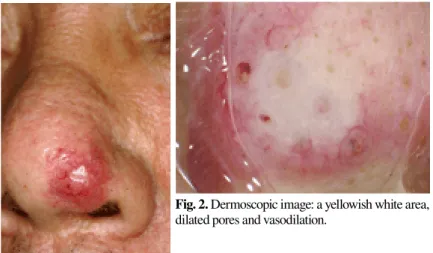
epithelium (T1b, N0, M0: Stage I). There were no meta-static foci in regional lymph nodes of the esophagus. On physical examination in our clinic, there was a red nod-ule of 1 cm in diameter on his nasal tip (so-called “clown nose”) (Fig. 1). Dermoscopic examination showed a yel-lowish white area, dilated follicular openings and vaso-dilation (Fig. 2). Histopathologically, atypical squamoid cell nests had proliferated in a lobular fashion from the dermis to subcutaneous tissue. There were no atypical cells in epidermis (Figs. 3a and b). The tumor stroma in the upper dermis showed significant vasodilatation. Those atypical cells were identical to primary tumor cells in the hypopharynx. Based on these findings, a diagnosis of skin metastasis from hypopharyngeal SCC was made. Then, chemotherapy, operation and radiation were done.
DISCUSSION
Cutaneous metastases commonly appear as round, discrete and painless nodules, which can have a firm, rubbery or fixed consistency. They can occur as a single lesion or multiple lesions anywhere on the body but are found predominantly on the anterior trunk or on the head and neck region.3 The average survival time
of patients with cutaneous metastasis is a few months.4
Cutaneous metastases occur in 0.7 to 9% of all patients with cancer, and the most common primary tumors associated with skin metastasis are breast cancer in women and lung cancer in men.5 Head and neck SCC
rarely metastasizes to any areas of the skin. The most common sites are the chest wall (28.4%) and abdomen (20.2%). In descending order of incidence, other sites are the extremities (12%), neck (11%), back (11%), scalp (7%), pelvis (6%) and face (5%).2 The nasal tip is, however,
an extremely rare site for cutaneous metastasis. In the English medical literature, 18 patients with nasal tip me-tastases, including the one in this paper, have been docu-mented over the last 20 years, more than half of which were associated with lung cancer.6, 7, 8, 9, 10 Other main
sites of primary cancer for cutaneous metastases to the nasal tip include the kidney11, 12 and esophagus.7 To our
58 M. Shindo et al. knowledge, only 4 patients with nasal
metas-tasisoriginated from primary malignancies on head and neck regions.6, 8, 9, 10 Nasal tip
metastasis was from hypopharyngeal SCC in 1 of them;6 from basaloid SCC of the larynx
in 2 others8, 9 and from pharyngeal
rhabdo-myosarcoma in the rest.10 Nasal metastasis
in our patient probably occurred through hematogenous dissemination.
It is not absolutely clear whether the primary site of the cutaneous metastatic foci was esophageal or hypopharyngeal. The esophageal SCC, however, was a moderately to well-differentiated tumor in histological grading, remained only in the esophageal mucosal epithelium, and showed no regional lymph node metastases. On the other hand, the hypopharyngeal SCC was an undiffer-entiated tumor and metastasized to regional lymph nodes. Therefore, it seems reasonable to assume that the nasal lesion was metasta-sis from the hypopharyngeal SCC.
Soyer et al.13 reported a case of a
pa-tient with nasal skin metastasis from breast cancer in 1990 and first introduced the term “clown nose” for describing the charac-teristic clinical feature. However, the term is not widely accepted now. Differential diagnosis of “clown nose” should include rosacea, pseudolymphoma, sarcoidosis and metastatic skin cancer. In patients with ma-lignant disease, biopsy should be performed
for any suspicious skin lesion even if it is in an unusual location. In a patient like ours, “clown nose” might be a symptom of cutaneous metastasis. The term “clown nose” proposed by Soyer et al.13 should be appreciated
more. When clinicians note a “clown nose”, they should consider malignancies in the neck and chest areas. The authors declare no conflict of interest.
REfERENCES
1 Pitman KT, Johnson JT. Skin metastases from head and neck squamous cell carcinoma: incidence and impact. Head Neck. 1999;21:560-5. PMID: 10449673.
2 Krathen RA, Orengo IF, Rosen T. Cutaneous metastasis: a meta-analysis of data. South Med J. 2003;96:164-7. PMID: 12630642.
3 Brownstein MH, Helwig EB. Metastatic tumors of the skin. Cancer 1972;29:1298-307. PMID: 4336632.
4 Alcaraz I, Cerroni L, Rütten A, Kutzner H, Requena L. Cuta-neous metastases from internal malignancies: a clinicopatho-logic and immunohistochemical review. Am J Dermatopathol. 2012;34:347-93. PMID: 22617133.
5 Spencer PS, Helm TN. Skin metastases in cancer patients. Cu-tis. 1987;39:119-21. PMID: 3829718.
Fig. 1. Clinical feature: a red nodule on the nasal tip.
Fig. 2. Dermoscopic image: a yellowish white area, dilated pores and vasodilation.
Fig. 3. Histopathologic examination: nests of atypical cells from the dermis to sub-cutaneous tissue (hematoxylin and eosin).
a: Bar = 1 mm. b: Bar = 100 µm.
6 Kocak Z, Uygun K, Uzal MC, Cicin I, Yalcin O. Unusual met-astatic site in a case of carcinoma of the hypopharynx: nasal tip. J Otolaryngol. 2005;34:250-2. PMID: 16048695.
7 Chau CH, Siu WT, Li MK. Nasal tip metastasis from esopha-geal carcinoma. Can J Surg. 2002;45:224-5. PMID: 12067183. 8 Shvili Y, Talmi YP, Gal R, Kessler E, Kolkov Z, Zohar Y.
Ba-saloid-squamous carci-noma of larynx metastatic to the skin of the nasal tip. J Craniomaxillofac Surg. 1990;18:322-4. PMID: 2262555.
9 Koutis EV, Assimakopoulos DA, Doukas MG, Zinovieva I. A rare nasal tip skin metastasis of a basaloid squamous cell carcinoma of the larynx. Am J Med. 2008;121:e3-4. PMID: 18724953.
10 Türegün M, Bozkurt M, Sengezer M, Külahçi Y. Nasal tip metastasis of pharyngeal rhabdomyosarcoma. Ann Plast Surg. 2001;46:656. PMID: 11405372.
11 Friedman I, Osborn DA. Metastatic tumors in the ear, nose, and throat region. J Laryngol Otol. 1965;79:576-91. PMID: 14335137.
12 Bernstein JM, Montgomery WW, Balogh K, Jr. Metastatic tumors to the maxilla, nose, and paranasal sinuses. Laryngo-scope. 1966;76:621-50. PMID: 5930356.
13 Soyer HP, Cerroni L, Smolle J, Kerl H. [“Clown nose”--skin metastasis of breast cancer]. Z Hautkr. 1990;65:929-31. Ger-man. PMID: 2291293.