Studies on the Biological Property of a Novel Fungicide, Cyflufenamid
<~m~ii~IJ cyflufenamid O)~~~M:~;:~--t
Q1Vf5E)
Masahiro Haramoto
)Jj(*
~M2006
CONTENTS
CHAPTERl:GENERALINTRODUCTION 1-1
1-2
Background of the present study
The aim and the outline of the present study
CHAPTER 2: Fungicidal Activities of Cyflufenamid against Various
2-1 2-2 2-2-1 2-2-2 2-2-3 2-2-4 2-2-5 2-3 2-3-1 2-3-2 2-3-3 2-3-3-1
Plant-Pathogenic Fungi INTRODUCTION
MATERIALS AND METHODS Chemicals and formulations Fungitoxic spectrum in vivo Fungitoxic spectrum in vitro Light microscopic observations
Transmission electron microscopic obserbations RESULTS
Fungitoxic spectrum in vivo Fungitoxic spectrum in vitro Light microscopic observations
Effect of cyflufenamid on the life cycle of B. graminis
Page 1 1 11
12 12 12 12 12 14 14 15 15 15 17 17
2-3-4 2-4
Transmission electron microscopic obserbations DISCUSSION
24 29
CHAPTER 3: Control Efficacy of Cyflufenamid in the Fields and Its Fungicidal
Properties 32
3-1 INTRODUCTION 32
3-2 MATERIALS AND METHODS 32
3-2-1 Chemicals and formulations 32
3-2-2 Field tests 32
3-2-2-1 Wheat powdery mildew 32
3-2-2-2 Strawberry powdery mildew 33
3-2-2-3 Cucumber powdery mildew 34
3-2-2-4 Peach brown rot 34
3-2-2-5 Cherry brown rot 35
3-2-3 Pot tests 35
3-2-3-1 Preventive activity 35
3-2-3-2 Curative activity 36
3-2-3-3 Residual activity 36
3-2-3-4 Translaminar activity 37
3-2-3-5 Translocative activity 37
3-2-3-6 Vapor phase activity 37
3-3 RESULTS 38
3-3-1 Field tests 38
38
3-3-1-2 Strawberry powdery mildew 38
3-3-1-3 Cucumber powdery mildew 40
3-3-1-4 Peach brown rot 40
3-3-1-5 Cherry brown rot 43
3-3-2 Pot tests 43
3-3-2-1 Preventive activity 43
3-3-2-2 Curative activity 43
3-3-2-3 Residual activity 43
3-3-2-4 Translaminar activity 48
3-3-2-5 Translocative activity 48
3-3-2-6 Vapor phase activity 48
3-4 DISCUSSION 54
CHAPTER 4: Sensitivity Monitoring of Powdery Mildew Pathogens to
4-1 4-2 4-2-1 4-2-2 4-2-2-1 4-2-2-2
Cyflufenamid and the Evaluation of Resistance Risk 58 INTRODUCTION
MATERIALS AND METHODS Chemicals and formulations
Sensitivity monitoring for cyflufenamid Monitoring studies in Japan
Monitoring studies in Europe
58 58 58 59 59 60
4-2-4 Cross resistance study
4-3 RESULTS
4-3-1 Sensitivity monitoring for cyflufenamid 4-3-1-1 Monitoring studies in Japan
4-3-1-2 Monitoring studies in Europe 4-3-2 Selection pressure tests
4-3-2-1 Selection pressure test in the greenhouse 4-3-2-2 Selection pressure test in the field 4-3-3 Cross resistance study
4-4 DISCUSSION
CHAPTER 5: GENERAL DISCUSSION
REFERENCES
ACKNOWLEDGMENTS SUMMARY
foJt:fi~
LIST OF PUBLICATIONS
63 64 64 64 64 69 69 69 74 76
79
82 89 90 92 94
CHAPTERl:
GENERAL INTRODUCTION
1-1. Background of the present study
Powdery mildew is one of the most serious disease groups in agricultural production. The powdery mildew fungi belong to the family Erysiphaceae (Fungi;
Ascomycota; Erysiphales) on taxonomy (Yarwood 1978, Braun 1995, Nomura 1997, Kakishima 2001) and have been well-studied and characterized on geographical distribution (Weltzien 1978) and epidemiology (Butt 1978). This natural group of pathogens infects on a wide range of phanerogams, including numerous economically important cultivated plants (Spencer 1978, Braun 1995). The serious economic damage to crops caused by the powdery mildews may be manifested as a direct fall in yield, as a suppression or distortion of plant growth which in the longer term affects yield, as spoilage of fruit or as a disfigurement of ornamental plants. These effects are often mixed.
The first serious attempts to stop damage caused by powdery mildews were probably made in the early nineteenth century, when sulphur dusting came into use for the control of powdery mildew on fruit trees and, a little later, on grape vines. Since that time the usage of fungicides against powdery mildews has increased enormously, in overall amount, in the number and variety of fungicides used and in the range of crops
with or without the concomitant use of other measures, forms the principal defense against powdery mildews throughout the world. At present, many chemicals have been developed as commercial fungicides and used for the control of powdery mildew (Bent 1978, Nakata 1987, Sano et al. 1997).
From view point of mode of action, fungicide with antifungal properties may be divided in two groups, non-specific and specific ones (Table 1-1) (FRAC 2005).
Fungicides with non-specific properties, the first were sulphur and move on to other non-specific fungicide which came into use in 1950's, are still more important in practical use in controlling powdery mildews. However, specific fungicides are going to play more and more important roles in practice because of their outstanding efficacies and properties in control of powdery mildews and also of their low influence to the environment due to their lower dosages.
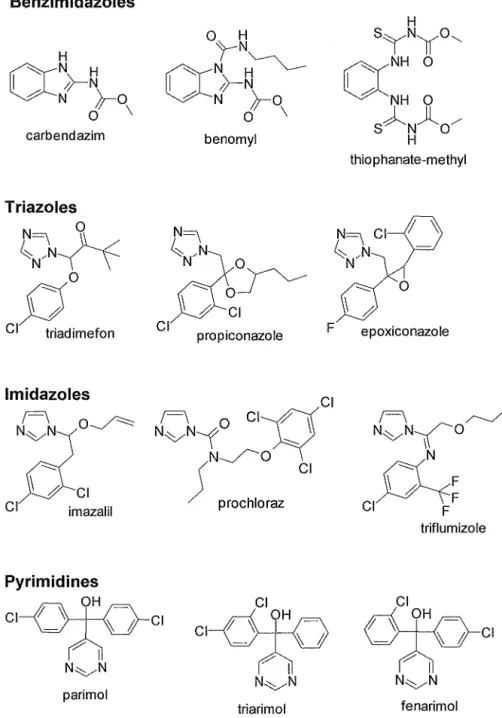
Non-specific fungicides, which may be regarded as multi-site inhibitors, such as sulphur, manneb, quinomethionate, chlorothalonil, iminoctadine-albesilate and others, act as preventive agent by covering the surfaces of plants, mainly resulting in inhibition of the infection with spores or mycelia of fungi, and need much more doses than specific fungicides in practical use (Table 1-1 and Fig. 1-1 ).
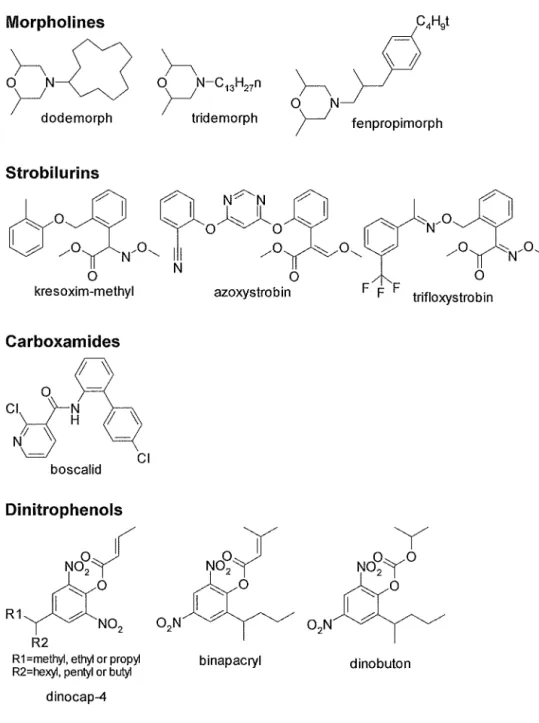
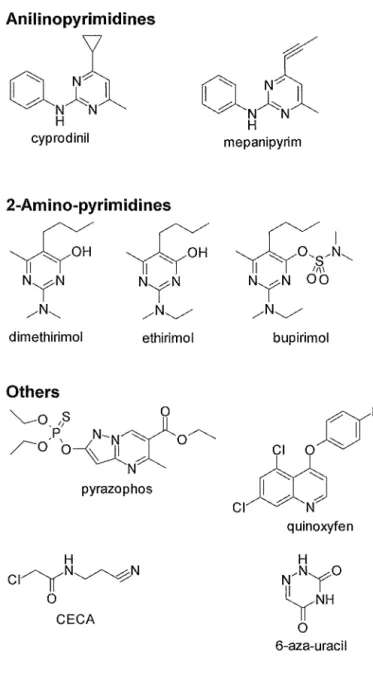
On the other hand, specific fungicides inhibit only with one or very few sites of metabolisms of fungi and control diseases in many cases by inhibiting development of fungi in curative condition with relatively low dosages. The mode of action of specific fungicides for control of powdery mildews is classified some categories, inhibition of mitosis, inhibition of respiration, inhibition of biosynthesis, inhibition of signal transduction and others (unknown or not clarified) (Table 1-1, Figs. 1-2-1, 1-2-2 and 1-2-3). The inhibitors of mitosis include benzimidazoles which interfere with mitotic
Table 1-1. Target sites of fungicides for controlling powdery mildew
Category Target site Fungicide (group)
Non-specific
Specific Mitosis Sterol
Respiration
Amino acid Nucleic acid Lipid
Multi-site
[3-tubulin assembly C 14-demethylase L114-reductase and L18 - L1 7 -isomerase
sulfur, manneb,
quinomethionate, doazoxolon, ditalimfos, chlorothalonil, DBEDC, iminoctadine etc.
Benzimidazoles Triazoles, lmidazoles, Pyrimidines etc.
Morpholines etc.
Electron transport Strobilurins system Complex Ill
cytochrome bc1 (ubiquinol oxidase) at Qo site
Electron transport system Complex II (succinate-
dehydrogenase)
Carboxamides
Uncoupler of oxidative Dinitrophenols phospholation
Methionine (proposed) Anilinopyrimidines Adenosin-deaminase 2-Amino-pyrimidines
Phospholipid pyrazophos
Signal transduction G-proteins (proposed) quinoxyfen
Others Unknown or not CECA, 6-aza-uracil,
Sx sulfur
l "sJ~~~'fs'MO 1
manneb
J:(~X:Fa
quinomethionate
C l - o
X
I 'o -N o Hdrazoxolon
0 _/
~
0 N-P s It ' I 00\
ditalimfos
Cl
~
NCl :?N
Cl chlorothalonil
I I
NH2 .NH2
1/
cu
\1NH2NH2
· [ c,H,.o---so,-1
DBEDC
~JNH
NH+2
NH+H~NH+ ~]
~N
f~ so,-
H,N [ C,H,.o- ,
iminoctadine-albesilate
Fig. 1-1. Chemical structure of non-specific fungicides.
Benzimidazoles
ccN~~
H N }-o0 \
carbendazim
Triazoles
~/N N9~
f)
0 Cl triadimefonlmidazoles
N~f~
Clf)--CI imazalil
Pyrimidines
CCN
or~ ~N~
N }-o0 \
benomyl
~ 0~
Cl 0Cl prop1conazole . F
Cl NF \ 0 C I H \
vN-t :::-..
j
N~O Cl prochlorazCl Cl
~
N~N OVH I~
CIparimol
Cl
N~N I triarimol
H SYNYO"
(XNH 0
NH 0
sANJlo/
H
thiophanate-methyl
/-::::/ ~0
epoxiconazole
NvN~O~
F\N N F
CI~F
Ftriflumizole
<=?Y
CI N~N I Clfenarimol
Fig. 1-2-1. Chemical structure of specific fungicides (Part 1).
Morpholines
~() rN---c0
dodemorph
Strobilurins
~N-C 1 3H27°
r.ridemorph
h n·"''
0 N__)--1
r
fenpropimorph~ Y l N~~~~ ~ ~~
'-'::: O
~ 0~0 ~
'-'::: :o-._N/0~
& / N'o~
II /o "'o~
I -" /o~N,o~
0 N 0 0
kresoxim-methyl azoxystrobin F F F trifloxystrobin
Carboxamides
CIJ-~
JJ
lj ~boscalid
Dinitrophenols
NO~~
~0 R1~N02
R2
Cl
R 1 =methyl, ethyl or propyl R2=hexyl, pentyl or butyl
dinocap-4
y y
No~y No~y
0~~ I
002N 02N
°
binapacryl dinobuton
Fig. 1-2-2. Chemical structure of specific fungicides (Part 2).
Anilinopyrimidines
n ~N~N~ Jl
-...:::::: N~
UA
N NH cyprodinil
2-Amino-pyrimidines
ww
NYN NYN/N"- /N~
dimethirimol ethirimol
Others
~O_,J3
pN
-N -...::::::xO~
0ro'
'o~/.:
N pyrazophos
CI~N~N H
0 CECA
H mepanipyrim
~/~'-,_
'l(yo~~,,
NYN 00
/N~
bupirimol
~F
u~
CI~N)
quinoxyfen
H N/NYO
~NH
0 6-aza-uracil
Fig. 1-2-3. Chemical structure of specific fungicides (Part 3).
processes by preventing assembly of f3-tubulin into microtubules resulting in inhibition of mitosis and disruption of cellular organization (Clemons and Sisler 1971, Davidse 1973, Davidse 197 5). The sterol biosynthesis inhibitors ( triazoles, imidazoles, pyrimidines, morpholines etc.) inhibit ergosterol synthesis (Ragsdale and Sisler 1973, Buchenauer 1977, Hashimoto et al. 1986). The inhibitors of respiration include strobilurins, carboxamides and dinitrophenols. Strobilurins act as the inhibitor of Complex III cytochrome bc1 (ubiquinol oxidase) at Qo site in electron transport system (Becker et al. 1981, Mansfield and Wiggins 1990, Wiggins and Jager 1993, Ziogas et al.
1997, Bartlet et al. 2002), carboxamides act as the inhibitor of Complex II (succinate-dehydrogenase) in electron transport system (Mathre 1970, Mathre 1971, White 1971, Lyr and Schewe 1975) and dinitrophenols act as uncoupler of oxidative phospholation (Parker 1958, Parker 1965), respectively. The inhibitor of biosynthesis also contain anilinopyrimidines which inhibit methionine synthesis (proposed) (Fritz et al. 1997), 2-amino-pyrimidines which inhibit nucleic acid synthesis (Hollomon 1979a, Hollomon 1979b, Hollomon and Chamberlain 1981 ), pyrazophos which inhibit phospholipid synthesis (de Waard 1975) and quinoxyfen which inhibit signal transduction of G-proteins (proposed) (Wheeler et al. 2003).
However, occurrence of modification in the specific site of fungal metabolism to fungicide by single gene mutation lead to the emergence of insensitive fungal isolates to the specific fungicide, resistant mutants, in the field. The presence of the selection pressure by the fungicide favors the growth of such isolates, which results in the recognition of the development of resistant strain to the fungicide in practice. The appearance of strains resistant to commercial fungicides among the pathogens causing powdery mildew has led to poor disease control (Brent 1982, Kiso et al. 1983, Smith
1988, de Waard 1994, Brent 1995, Ishii et al. 2001, Ishii et al. 2002).
A novel fungicide, cyflufenamid, (Z)-N-[ a-( cyclopropylmethoxyimino )-2,3- difluoro-6-(trifluoromethyl)benzyl]-2-phenylacetamide (Code Name: NF-149, Pancho®), is currently in development by Nippon Soda Co., Ltd (Nisso) (Fig. 1-3) (Kasahara et al.
1996, Kasahara 2005). This fungicide belongs to a new fungicide class, amidoximes (Kasahara 2005), and shows excellent control activity against powdery mildew in various plants and brown rot in stone fruits (Haramoto et al. 2001, Sano et al. 2001, Haramoto 2002, Haramoto et al. 2002, Yokota 2004a, Yokota 2004b). Its biological mode of action against pathogens is unique and differs from those of commercial fungicides such as benzimidazole (BI) fungicides, sterol demethylation-inhibiting (DMI) fungicides and strobilurin (Qoi) fungicides (Haramoto 2002).
The application of cyflufenamid in the field has been registered in Asia and Europe (Yokota 2004a, Yokota 2004b). In 2002, the first registration of cyflufenamid was received in Japan. A mixture formulation of cyflufenamid with triflumizole called Pancho TF®, a water-dispersible granule (WG) formulation [cyflufenamid 3.4% + triflumizole 15% (w/w)], was also developed to avoid the early appearance of resistant strains to the fungicide according to Nisso's resistance risk management strategies. In 2003, the mixture formulation was registered for strawberry, cucumber, watermelon, eggplant and green pepper plants in Japan. In 2005, mixture formulations of cyflufenamid with DMI fungicides were registered in Korea. In Europe, cyflufenamid
"0
.E
ro c Q)-
:::l >. (.)-
0 ~ :::l t5 :::l ...-
en(") ro (.) u..
.E
() Q) .c 0 u.. C"') I "'"" u.. 0')u:
1-2. The aim and the outline of the present study
The aim of the present study is to elucidate biological and fungicidal properties of a novel fungicide, cyflufenamid, and also to produce the possibility for the practical use of this fungicide in the field.
The fungicidal activities including the fungitoxic spectra in vivo and in vitro of cyflufenamid and the mode of action of this fungicide against pathogens are described in Chapter 2. The control efficacy of cyflufenamid in the field against powdery mildew in various plants and brown rot in stone fruits, and also its fungicidal properties, including preventive, curative, residual, translaminar, translocative and vapor phase activities in pot tests against cucumber powdery mildew are described in Chapter 3.
Baseline sensitivity of pathogens causing powdery mildew on wheat, barley and cucumber toward cyflufenamid in Japan and/or Europe, its selection pressure test results against pathogen causing powdery mildew on wheat in the greenhouse and field, and also some cross-resistance studies between this fungicide and other commercial fungicides on pathogen causing powdery mildew on cucumber are described in Chapter 4.
CHAPTER2:
Fungicidal Activities of Cyflufenamid against Various Plant- Pathogenic Fungi
2-1. INTRODUCTION
In Chapter 2, the author describes the fungicidal activities including the fungitoxic spectra in vivo and in vitro of cyflufenamid, and the mode of action of cyflufenamid against pathogens.
2-2. MATERIALS AND METHODS
2-2-1. Chemicals and formulations
Cyflufenamid was prepared as a 10% wettable granule (WG) formulation as described previously (Kasahara et al. 1996). The formulated chemical was used in this study.
2-2-2. Fungitoxic spectrum in vivo
The fungitoxic spectrum of cyflufenamid was evaluated based on efficacy to control powdery mildew on wheat (Triticum aestivum L., cv. Chihoku) caused by Blumeria graminis (de Candolle) Speer f. sp. tritici Marchal, grey mold on kidney bean (Phaseolus vulgaris L., cv. Nagauzura) caused by Botrytis cinerea Persoon: Fries, late blight on tomato (Lycopersicon esculentum Mill., cv. Regina) caused by Phytophthora irifestans (Montagne) deBary, downy mildew on grape (Vitis vinifera L., cv. Kousyu)
caused by Plasmopara viticola (Berkeley & Curtis) Berlese & de Toni and scab on apple (Malus pumila Miller var. domestica Schneider, cv. Rall's Janett) caused by Venturia inaequalis (Cooke) Winter.
Control efficacy against powdery mildew, late blight, downy mildew and scab was determined in pot tests. Plants at the 2-3 leaf stage were used in this experiment.
The test chemical solutions containing 0.01% Tween 20 were sprayed onto young seedlings. After the solutions had air-dried, the plants were artificially inoculated with either the spore dust or spore suspension depending on the test pathogen, and incubated at 20°C (12 hr light/12 hr dark) for a given period. Percent disease control was assessed 5-10 days after the inoculation by visually measuring the diseased leaf area.
Control efficacy against grey mold was determined in a flower test. Flowers of kidney bean plants were detached and immersed in the chemical solution. After air-drying, the flowers were inoculated with the spore suspension of B. cinerea and then placed on untreated detached leaves of kidney bean in a Petri dish. After incubation for 5 days at 20°C (12 hr light/12 hr dark), the diameter of lesions that developed on the leaves was measured and % disease control was calculated based on the mean of lesion sizes.
Fungitoxic activities in vivo of cyflufenamid against 7 pathogens causing powdery mildew listed in Table 2-2 were evaluated based on pot tests. The young seedlings or rooted cutting plants were treated by spraying with the test chemical solutions containing 0.01% Tween 20. After air-drying, the plants were artificially
concentration (MIC) was determined.
2-2-3. Ftmgitoxic spectrum in vitro
The fungitoxic spectrum in vitro of cyflufenamid was evaluated by culture tests using the agar dilution method. In this experiment, 37 fungal species listed in Table 2-3 maintained on potato sucrose agar (PSA) in our laboratory (Odawara, Japan) were used. The test chemical dissolved in sterilized deionized water was added to PSA media held at 45-50°C to obtain the given concentration. Mycelial agar discs (6 mm in diameter) of test fungi were placed at the center of agar plates (9 em in diameter) and incubated at their optimum temperatures. The diameters of mycelial colonies of the fungi were measured after 3-20 days and EC50 values were calculated.
2-2-4. Light microscopic observations
The effect of cyflufenamid on the life cycle of B. graminis f. sp. tritici on wheat ( cv. Chihoku) was evaluated. Wheat seedlings were sprayed with the test chemical solutions containing 0.01% Tween 20. After air-drying, the treated plants were artificially inoculated with spore dust of B. graminis f. sp. tritici. The inoculated pots were incubated at 20°C (12 hr light/12 hr dark) for a given period. Wheat leaves were detached, and the epidermal tissues were peeled off and stained with 0.1% cotton blue.
The stained samples were observed with a light microscope (BH-2, Olympus Optical Co., Ltd., Japan).
The effect of cyflufenamid on the spore germination stage of Monilinia fructicola (Winter) Honey was also observed. Spores of M fructicola were suspended in potato sucrose yeast extract (PSY) liquid medium. The spore suspension was mixed with the
test chemical solutions and put on a 96-well microplate. The microplate was incubated at 20°C under high humidity in the dark for 2, 8, 16 and 24 hr. Spore germination and germ tube elongation were light-microscopically observed.
2-2-5. Transmission electron microscopic observations
Spores of M fructicola were suspended in PSY liquid medium. The spore suspension was mixed with the test chemical solutions, and put on a 96-well microplate containing a thin layer of PSY agar medium. The microplate was incubated at 20°C under high humidity in the dark. After incubation for 24 hr, the small agar blocks containing the spores were removed from wells and pre-fixed with 2% glutaraldehyde (0.05 M phosphate buffer pH 7.0) at 4 °C for 24 hr. After 3 rinses with the same buffer, the blocks were post-fixed with 1% osmium tetroxide, dehydrated in ethyl alcohol, and then embedded in Epon 812. Ultrathin sections were stained with uranyl acetate and lead citrate. The stained ultrathin sections were observed with a transmission electron microscope (HS-9, HITACHI Ltd., Japan).
2-3. RESULTS
2-3-1. Fungitoxic spectrum in vivo
Cyflufenarnid at 200 ppm exhibited no fungitoxic activity against B. cinerea on
Table 2-1. Efficacy of cyflufenamid against diseases caused by various pathogens Cyfl ufenam id Control efficacl {% tl of disease bl: concentration Blumeria Botrytis Phytophthora Plasmopara Venturia (ppm) g_raminis cinerea infestans vitico/a inaeg_ualis 200 100 0 0 0 0 50 100 NTbl NT NT NT 12.5 100 NT NT NT NT 3.1 100 NT NT NT NT 0.8 100 NT NT NT NT 0.2 66 NT NT NT NT 0.05 30 NT NT NT NT 0.01 6 NT NT NT NT a) n
=
3. b) Not tested.The fungitoxic activity of cy:flufenamid among various pathogens causmg powdery mildew on plants was investigated. Cy:flufenamid exhibited complete control of powdery mildew on cucumber, strawberry, sweet pepper and wheat at 0.8 ppm, and on apple, grape and rose at 1.6 ppm (Table 2-2).
2-3-2. Fungitoxic spectrum in vitro
The fungitoxic spectrum in vitro of cy:flufenamid against 37 species of fungi is shown in Table 2-3. Some pathogens of Ascomycetes and Deuteromycetes such as Bottyosphaeria sp., Cercospora beticola Saccardo, Fusarium nivale (Fries) Cesati, M fructicola and Rosellinia necatrix Prillieux were sensitive to cy:flufenamid at
concentrations of 0.01 to 0.7 ppm (EC5o). Notably, M fructicola was highly sensitive to cy:flufenamid, the ECso being 0.01 ppm. In contrast, pathogens of Phycomycetes and Basidiomycetes were insensitive to cy:flufenamid even at 100 ppm.
2-3-3. Light microscopic observations
2-3-3-1. Effect of cy:flufenamid on the life cycle of B. graminis f. sp. tritici
To elucidate the point at which cy:flufenamid acts in the life cycle of B. graminis f.
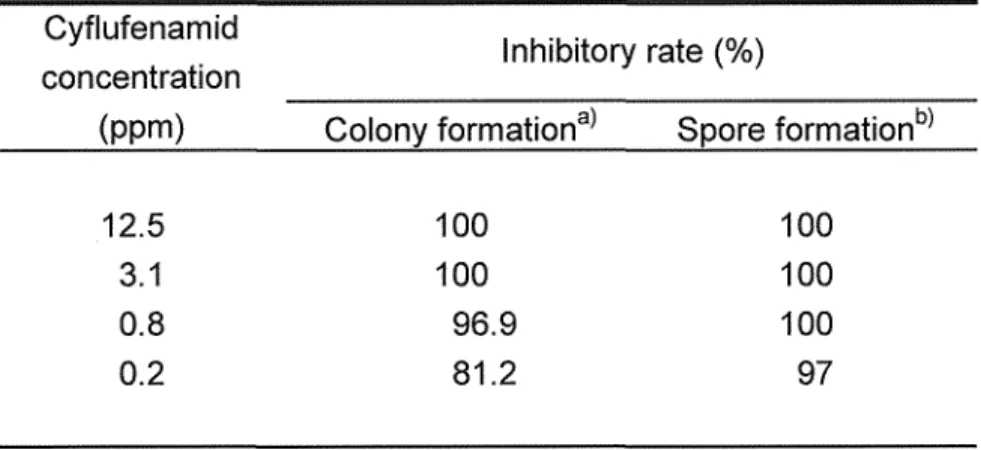
sp. tritici on wheat, light microscopic observation was performed. Cy:flufenamid at 12.5 ppm did not affect the germination of spores or formation of appressoria (Tables 2-4 and 2-5). However, the formation of haustoria, colonies and spores were all strongly inhibited by cy:flufenamid at 0.2 ppm (Tables 2-6 and 2-7).
Table 2-2. Efficacy of cyflufenamid against powdery mildew caused by various pathogens Plant Cultiver Pathogen MICa) (ppm) Cucumber Sagamihanjiro Sphaerotheca cucurbitae 0.8 Strawberry Nyohou Sphaerotheca aphanis var. aphanis 0.8 Sweet pepper Tosakatura Oidiopsis sicula 0.8 Wheat Chihoku 8/umeria graminis f.sp.tritici 0.8 Apple Rail's Janett Podosphaera /eucotricha 1.6 Grape Kousyu Uncinula necator 1.6 Rose Red planet Sphaerotheca pannosa 1.6 a) Minimum inhibitory concentration, (n
=
3).Table 2-3. Fungitoxic activity of cyflufenamid against various pathogens in culture (Agar dilution method)
Pathogen
Alternaria alternata apple pathotype Botrytis cinerea
Botrytis squamosa Botryosphaeria sp.
Cercospora beticola Cercospora kikuchii Cercospora theae
Cladosporium cucumerinum Coch/iobo/us miyabeanus Co/letotrichum /agenarium Co/letotrichum theae-sinensis Diaporthe citri
Elsinoe ampelina Fulvia fu/va Fusarium nivale Fusarium oxysporum Fusarium roseum Gibberella zeae Glomere/la cingulata He/icobasidium mompa Monilinia fructicola Penicillium italicum Pestalotia longiseta Phomopsis sp.
Phytophthora infestans
Pseudocercosporella herpotrichoides Pyricularia oryzae
Pythium aphanidermatum Rhizoctonia so/ani
Rose/linia necatrix Sclerotinia scleotiorum Septaria nodurum Taphrina deformans Trichoderma viride Va/sa ceratosperma Venturia inaequalis Verticil/ium dah/iae
EC5o (ppm)
>100
>100 100 0.07
0.3 1
>100
>100
>100
>100
>100 6 5
>100
0.3
>100
>100
>100
>100
>100 0.01
7
>100
>100
>100
>100 3
>100
>100 0.7 1
>100 3
>100 8
>100
>100
Table 2-4. Effect of cyflufenamid at 12.5 ppm on spore germination of Blumeria graminis f. sp. tritici on wheat leaves
Chemical Rate of spore germination (%)a> ± Sob>
Time after treatment
3 hr 6 hr 12 hr 24 hr
Cyflufenamid 19.8 ± 6.9 47.6 ± 14.3 60.7 ± 12.3 61.5 ± 12.2 Untreated control 22.5 ± 7.6 49.8 ± 17.3 67.4 ± 8.6 72.2 ± 4.2
a) n = 2.
b) Standard deviation.
Table 2-5. Effect of cyflufenamid at 12.5 ppm on appressorium formation of 8/umeria graminis f. sp. tritici on wheat leaves
Chemical Rate of appressorium formation (%)a>± sob>
Time after treatment
3 hr 6 hr 12 hr 24 hr
Cyflufenamid 0.3 ± 0.1 0.4 ± 0.1 28.1 ± 7.5 87.9 ± 3.7
Untreated control 1.7±1.4 3.5 ± 2.5 22.3 ± 10.2 89.7 ± 4.0
a) n = 2.
b) Standard deviation.
Table 2-6. Effect of cyflufenamid at various concentrations on haustorium formation of 8/umeria graminis f. sp.
tritici in wheat leaves
Cyflufenamid Inhibitory rate of haustorium formation (%)a)
concentration Time after treatment
(ppm) 76 hr 168 hr
12.5 100 100
3.1 99.4 99.9
0.8 96.4 99.4
0.2 77.6 80.1
a) n = 2.
Table 2-7. Effect of cyflufenamid at various concentrations on colony and spore formation of Blumeria graminis f. sp. tritici on wheat leaves
Cyflufenamid concentration
(ppm) 12.5
3.1 0.8 0.2
Inhibitory rate(%) Colony formational
100 100
96.9 81.2
Spore formationbl
100 100 100 97 a) Observed 5 days after cyflufenamid treatment, (n
=
2).b) Observed 7 days after cyflufenamid treatment, (n = 2).
2-3-3-2. Effect of cyflufenamid on the spore germination and germ tube elongation of M fructicola
The effect of cyflufenamid on the germination of spores and elongation of germ tubes in M fructicola was observed to elucidate the site of action of cyflufenamid.
Spores of M fructicola in cyflufenamid and water solutions started to germinate equally within 1 to 2 hr, and germ tubes elongated continuously. Cyflufenamid at 1 ppm affected neither the germination nor the elongation until 8 hr after treatment (Fig. 2-1 ).
Moreover, cyflufenamid at a high concentration (100 ppm) had no effect at this stage (data not shown). However, at 16 hr after the treatment with cyflufenamid, the elongation of germ tubes stopped (Fig. 2-1 ). Swelling at the tip of germ tubes, and vacuolation and rupturing of the cytoplasm in germ tubes were observed 24 hr after treatment (Fig. 2-2).
2-3-4. Transmission electron microscopic observations
The effect of cyflufenamid on the hyphal growth of M fructicola was observed under a transmission electron microscope. In untreated control hyphae, many vacuoles filled with highly electron-dense materials were observed in cytoplasms. The septa were thicker than the cell walls, and small pores were observed in the center of septa (Fig. 2-3-1 ). In the hyphae treated with cyflufenamid at 1 ppm, although vacuoles existed in the cytoplasm, highly electron-dense materials in the vacuoles were not detected (Figs. 2-3-2 and 2-3-3). The septa were thinner and smaller than in the untreated control, and septal pores were large (Figs. 2-3-1 and 2-3-2). There were no differences in the number and shape of mitochondria and nuclei between cyflufenamid-treated and untreated hyphae (Figs. 2-3-1 and 2-3-2). Ruptured hyphae
~I
!...
..c
<X)
!...
..c
<.0
" r "
8
0
(a
~·
~·
~
Q;
~ d
Control
I I ~ 0
0 .(') (') I
'"'
&
~ ~
Cyflufenamid
Fig. 2-1. Effect of cyflufenamid on spore germination of Monilinia fructicola.
Observations under a light microscope were made at 2, 8 and 16 hr after cyflufenamid (1 ppm) treatment. Scale bar= 30 11m.
s...
..c
-q- N
R
Control Cyflufenamid
Fig. 2-2. Effect of cyflufenamid on hyphal growth of Monilinia fructicola.
Observations under a light microscope were made at 24 hr after cyflufenamid (1 ppm) treatment. Scale bar= 30 J.lm.
R: Rupturing, V: Vacuolation.
Fig. 2-3. Ultrastructual effect of cyflufenamid on hyphal growth of Monilinia fructicola.
Observations under a transmission electron microscope were made at 24 hr after cyflufenamid (1 ppm) treatment. Scale bar= 2 J.lm.
1: Hypha of control, 2: Hypha treated with cyflufenamid, 3: Ruptured hypha caused by cyflufenamid treatment, 4: Vacuolated hypha caused by cyflufenamid treatment, M: Mitochondrion, N: Nucleus, S: Septum, V: Vacuole.
were detected frequently following treatment with cyflufenamid and vesicles of various sizes which originated from organelle were observed away from the ruptured sites (Fig.
2-3-3). Vacuolated hyphae also appeared on cyflufenamid treatment, and contained extremely immature septa (Fig. 2-3-4).
2-4. DISCUSSION
To elucidate the fungitoxic spectrum in vivo of cyflufenamid, fungitoxic activities against pathogens causing powdery mildew on wheat, grey mold on kidney bean, late blight on tomato, downy mildew on grape, and scab on apple were investigated. As shown in Table 2-1, cyflufenamid achieved excellent control of powdery mildew on wheat at 0.8 ppm, but exhibited no activity against the other four diseases even at 100 ppm. Pot tests of cyflufenamid against powdery mildew on plants caused by various pathogens revealed excellent control at 0.8 to 1.6 ppm (Table 2-2). These results suggest that cyflufenamid has strong fungicidal activity against many genera in Erysiphaceae.
We also performed culture tests using the agar dilution method to evaluate the fungitoxic spectrum in vitro of cyflufenamid. Cyflufenamid was active against limited numbers of fungi classified into Ascomycetes and Deuteromycetes (Table 2-3). The pattern of fungitoxic activity in vitro was clearly different from that of broad-spectrum fungicides such as benzimidazole (BI) fungicides (Sijppesteijn 1972) and demethylation-inhibitor (DMI) fungicides (Hashimoto et al. 1986).
In the light microscopic experiments, cyflufenamid at 0.2 ppm strongly inhibited the formation of haustoria, colonies and spores in B. graminis f. sp. tritici (Tables 2-6 and 2-7). However, it did not affect the germination of spores or formation of appressoria even at 12.5 ppm (Tables 2-4 and 2-5) as shown in a scheme (Fig. 2-4). In
Spore
.,...-,
~ 1st germtube ~~ ' 2nd germtube~
Spore formationf ~ .---.,
\ Appressorium
~ ~~ ,
I=• J
~'"
Colony formation \/
haustorium Fig. 2-4. Scheme on the action site of cyflufenamid in life cycle of Blumeria graminis f. sp. triticitube elongation (Fig. 2-1 ). After 24 hr, swelling at the tip of germ tubes, and vacuolation and rupturing of germ tubes were observed (Fig. 2-2). In the transmission electron microscopic experiments, treatment with cyflufenamid at 1 ppm for 24 hr in M fructicola induced ultrastructural changes such as a reduction in highly electron-dense
materials considered to be polyphosphoric acid (Yoshida 1959, Stevenson and Becker 1972, Stevenson and Becker 1979) in the vacuoles, and the appearance of immature of septa (Figs. 2-3-1, 2-3-2, 2-3-3 and 2-3-4). These morphological changes clearly differ from those caused by BI fungicides (Sijppesteijn 1972), DMI fungicides (Hashimoto et al. 1986) and strobilurin fungicides (Bartlett et al. 2002).
Thus, a novel fungicide, cyflufenamid, has excellent fungicidal activity against various pathogens causing powdery mildew and some other fungi such as M fructicola.
The results also suggest that the biochemical mode of action of cyflufenamid is different from that of commercial fungicides such as BI, DMI and strobilurin. We are now conducting experiments to clarify the site of action of cyflufenamid.
CHAPTER3:
Control Efficacy of Cyflufenamid in the Fields and Its Fungicidal Properties
3-1. INTRODUCTION
In Chapter 3, the author describes the control efficacy of cyflufenamid in the field against powdery mildew in various plants and brown rot in stone fruits, and also describes the fungicidal properties of cyflufenamid, including its preventive, curative, residual, translaminar, translocative and vapor phase activities in pot tests against cucumber powdery mildew.
3-2. MATERIALS AND METHODS
3-2-1. Chemicals and formulations
Cyflufenamid was synthesized and formulated as a 10% WG. Kresoxim-methyl [41.5% suspension concentrate (SC) and 47% WG], triadimefon [25% wettable powder (WP)], tebuconazole (40% SC), mepanipyrim (40% SC), tetraconazole [11.6% micro emulsion (ME)], bitertanol (25% WP), iprodione (50% WP and 40% SC) and triadimefon (5% WP) were purchased from commercial sources, and used as reference fungicides in the field and pot tests.
3-2-2. Field tests
3-2-2-1. Wheat powdery mildew
Seeds of winter wheat (Triticum aestivum L., cv. Chihoku) were sowed in a field at Bandai Agricultural Research Station, Nisso, Fukushima, Japan, on Oct. 2, 1996.
Three replicates of 5m2 (1 m x 5 m) per each plot were used. After the first symptoms of wheat powdery mildew by Brumeria graminis (de Cando lie) Speer f. sp. tritici Marchal were observed on May 10, 1997, foliar spraying was performed on May 13 with a knapsack-type power sprayer with a water volume of 100 liters per 10 a. At that time, the growth stage of wheat was BBCH (Lancashire et al. 1991) (Biologische Bundesanstalt fiir Land- und Forstwirtschaft, Bundessortenamt und Chemische Industrie) 37 (flag leaf just visible).
Disease severity in the field was evaluated on May 20, 27 and Jun. 9 using a disease index from 0 (no apparent symptoms) to 4 (severe disease). The disease degree (DD) of each plot was calculated by the following equation.
DD = (S/4 X N) X 100
S represents the sum of indices in the plot and N represents the number of plants in the plot. The results indicated the average infection degree in the three plots.
3-2-2-2. Strawberry powdery mildew
Strawberry sets (Fragaria ananassa Duchesne, cv. Nyohou) were bedded out in a greenhouse at Haibara Agricultural Research Center, Nisso, Shizuoka, Japan, on Nov.
2, 1997. The trial was laid out in randomized blocks with 3 replicates of 8 plants per plot. After the first symptoms of strawberry powdery mildew by Sphaerotheca
liters per 10 a. Disease severity in the field was evaluated on May 18, Jun. 1 and 16 with a disease rating from 0 (no apparent symptoms) to 4 (severe disease). The disease degree of each plot was calculated using the same formula as in Section 3-2-2-1.
The results indicated the average infection degree in the three plots.
3-2-2-3. Cucumber powdery mildew
Cucumber seedlings (Cucumis sativus L., cv. Hokushin) were bedded out in the greenhouse at Haibara Agricultural Research Center, Nisso, Shizuoka, Japan, on Sep. 2, 2000. The trial was laid out in randomized blocks with 3 replicates of 10 plants per plot. Diseased cucumber pots inoculated with a strobilurin-resistant strain of Sphaerotheca cucurbitae (Jaczewski) Zhao as an inoculum were placed in the test field.
After the first symptoms of cucumber powdery mildew were observed on Sep. 25, foliar spraying was performed on Sep. 26 (1 application) or Sep. 26 and Oct. 3 (2 applications), with a knapsack-type power sprayer with a water volume of 200 liters per 10 a. Disease severity in the field was evaluated on Oct. 3, 10, 17 and 25 with a disease rating from 0 (no apparent symptoms) to 4 (severe disease). The disease degree of each plot was calculated using the same formula as in Section 3-2-2-1. The results indicated the average infection degree in the three plots.
3-2-2-4. Peach brown rot
Eleven-year-old peach (Prunus persica Batsch var. vulgaris Maximowicz, cv.
Akatsuki) trees planted in a field at Bandai Agricultural Research Station, Nisso, Fukushima, Japan were used in the trial. The trial was laid out in randomized blocks with 3 replicates of 1 tree per plot. Foliar spraying was performed on Jul. 18, 29 and
Aug. 9, 1997 with a knapsack-type power sprayer with a water volume of 400 liters per 10 a. The first symptoms of peach brown rot by Monilinia fructicola (Winter) Honey were observed on Aug. 15. After harvesting on Aug. 20, the fruit from each plot was stored in plastic containers at room temperature. Disease severity was evaluated on Aug. 22, 25 and 28 by counting the number of diseased peaches. The percentage of diseased fruit in each plot was calculated. The results indicated the average % diseased fruit in the three plots.
3-2-2-5. Cherry brown rot
Twelve-year-old cherry (Prunus avium L., cv. Koukanishiki) trees planted in a field at Bandai Agricultural Research Station, Nisso, Fukushima, Japan were used in the trial. The trial was laid out in randomized blocks with 2 replicates of 1 tree per plot.
Foliar spraying was performed on Jun. 10 and 18, 1997 with a knapsack-type power sprayer with a water volume of 400 liters per 10 a. The first symptoms of cherry brown rot by M fructicola were observed on Jun. 15. Disease severity was evaluated on Jun. 18 and 24 by counting the number of diseased cherries on the tree. The percentage of diseased fruit in each plot was calculated. The results indicated the average % diseased fruit in the two plots.
3-2-3. Pot tests
3-2-3-1. Preventive activity
Tween 20 on the adaxial surface of first leaves. After the solutions were air-dried, the treated plants were inoculated with spore dust of S. cucurbitae, and incubated at 20°C for 10 days under 12 hr light/12 hr dark. The evaluation of fungicidal activity was determined by observing the area of visible lesions and was expressed as the percentage of diseased leaf area (0 to 100%). The control value (CV) was calculated from the following equation.
cv
= (1 - TIC) X 100T represents the percentage of diseased leaf area in the treated seedlings and C represents the percentage of diseased leaf area in the non-treated seedlings. The results indicated the average CV in three replications.
3-2-3-2. Curative activity
The adaxial surface of the first leaves of cucumbers ( cv. Sagamihanjiro, 1.2 leaf stage) was inoculated with spore dust of S. cucurbitae, and incubated at 20°C under 12 hr light/12 hr dark. After 4 days of inoculation, the test plants were sprayed with chemical solutions prepared by the same method as in Section 3-2-3-1 on the adaxial surface of inoculated leaves. The test plants were incubated again at 20°C for 6 days under 12 hr light/12 hr dark. Fungicidal activity was evaluated using the same formula as in Section 3-2-3-1.
3-2-3-3. Residual activity
The adaxial surface of the first leaves of cucumbers ( cv. Sagamihanjiro, 1.2 leaf stage) was sprayed with the test chemical solutions prepared by the same method as in Section 3-2-3-1. After the solutions were air-dried, the treated plants were kept in a
greenhouse. After 10 days, the treated plants were inoculated with spore dust of S.
cucurbitae, and incubated at 20°C for 10 days under 12 hr light/12 hr dark. Fungicidal activity was evaluated using the same formula as in Section 3-2-3-1.
3-2-3-4. Translaminar activity
The adaxial surface of the first leaves of cucumbers ( cv. Sagamihanjiro, 1.2 leaf stage) was sprayed with the test chemical solutions prepared by the same method as in Section 3-2-3-1. After the solutions were air-dried, the treated plants were kept in a greenhouse. After 1 0 days, the abaxial surface of the treated leaf was inoculated with spore dust of S. cucurbitae, and incubated at 20°C for 10 days under 12 hr light/12 hr dark. Fungicidal activity was evaluated using the same formula as in Section 3-2-3-1.
3-2-3-5. Translocative activity
Cucumber seedlings ( cv. Sagamihanjiro, 1.2 leaf stage) were removed from the pot and their roots were washed in water to remove soil and sand particles. The roots were then dipped into chemical solutions prepared by the same method as in Section 3-2-3-1 and incubated at 20°C for 5 days under 12 hr light/12 hr dark. The adaxial surface of the first leaves of treated seedlings was then inoculated with spore dust of S.
cucurbitae, and incubated at 20°C for 10 days under 12 hr light/12 hr dark. Fungicidal activity was evaluated using the same formula as in Section 3-2-3-1.
3-2-3-1 were dropped onto small squares (5 mm x 5 mm) of aluminum foil. After the solutions were air-dried, the squares of aluminum foil were placed onto the first leaves of seedlings. The seedlings were then inoculated with spore dust of S. cucurbitae, and incubated at 20°C for 10 days under 12 hr light/12 hr dark. To evaluate the vapor action, the diameter ( $, mm) of the inhibition zone of lesion formation on the first leaf of each seedling was measured.
3-3. RESULTS
3-3-1. Field tests
3-3-1-1. Wheat powdery mildew
Cyflufenamid was applied in 1 foliar spray to wheat powdery mildew in the field.
The disease degree in the plot of the untreated control reached over 70 at the last assessment (Jun. 9, 1997), showing that natural infection pressure was heavy.
Cyflufenamid at 25 ppm (w/v) showed excellent control of wheat powdery mildew, and the efficacy was equivalent or superior to reference fungicides (Fig. 3-1 ).
3-3-1-2. Strawberry powdery mildew
Cyflufenamid at 25 ppm was applied in a foliar spray to strawberry powdery mildew in the greenhouse. Natural infection pressure was heavy, and the disease degree in the plot ofuntreated control was over 75 at the last assessment (Jun. 16, 1998).
In this test, the efficacy of cyflufenamid with 1 or 2 applications was compared with reference fungicides with 3 applications. The efficacy of cyflufenamid at 25 ppm with
Cyflufenamid 25 ppm Triadimefon
125 ppm Tebuconazole
235 ppm
Untreated control
DMay 20
• May 27 DJun. 9
0 1 0 20 30 40 50 60 70 80 90 1 00 Disease degree
Fig. 3-1. Efficacy of cyflufenamid against wheat powdery mildew.
Crop: Winter wheat (cv. Chihoku), 1x5 m/plot, 3 replications.
Application: May 13, 1997 ( 100 liters/1 Oa).
Assessment: May 20, 27 and Jun. 9, 1997.
Bars indicate standard deviations (SO) from the mean (n
=
3).1 application was excellent, and was equivalent to reference fungicides. Two applications of cyflufenamid showed excellent efficacy even at 29 days after the last application (Fig. 3-2).
3-3-1-3. Cucumber powdery mildew
Cyflufenamid at 25 ppm was applied in a foliar spray to cucumber powdery mildew in the greenhouse. The test was carried out by artificial inoculation with a strobirulin-resistant strain. Infection pressure was heavy, and disease degree was over 60 at the last assessment (Oct. 25, 2000) in the plot of the untreated control. In this test, the efficacy of cyflufenamid with 1 or 2 applications was compared with reference fungicides with 2 applications. The efficacy of 1 application of cyflufenamid at 25 ppm was excellent, and was superior to that of tetraconazole at 39 ppm with 2 applications. Kresoxim-methyl at 208 ppm showed no effect against cucumber powdery mildew with 2 applications. Two applications of cyflufenamid showed excellent efficacy and cucumber powdery mildew lesions were hardly observed in the plot even at 22 days after the last application (Fig. 3-3).
3-3-1-4. Peach brown rot
Cyflufenamid at 25 ppm and 50 ppm was applied in a foliar spray to peach brown rot in the field. Diseased fruit was over 40% at the last assessment (Aug. 28, 1997) in the plot of the untreated control. Cyflufenamid at 25 ppm showed good control against peach brown rot. The efficacy of cyflufenamid was slightly inferior to bitertanol at 125 ppm, but was superior to iprodione at 383 ppm. The efficacy of cyflufenamid at 50 ppm was excellent, and was superior to the reference fungicides through the test
Cyflufenamid 25 ppm (1 time) Cyflufenamid
25 ppm (2 times) Mepanipyrim 200 ppm (3 times)
Kresoxim-methyl 208 ppm (3 times)
Untreated control
~ DMay 18
• Jun. 1
EH DJun. 16
0 1 0 20 30 40 50 60 70 80 90 1 00 Disease degree
Fig. 3-2. Efficacy of cyflufenamid against strawberry powdery mildew.
Crop: Strawberry (cv. Nyohou), 8 plants/plot, 3 replications.
Application: May 8, 1998 (150 liters/1 Oa). May 8 and 18, 1998.
May 8, 15 and 22, 1998.
Assessment: May 18, Jun. 1 and 16, 1998.
Bars indicate standard deviations (SD) from the mean (n
=
3).Cyflufenamid DOct. 3 25 ppm (1 time)
• Oct. 10
Cyflufenamid DOct. 17
25 ppm (2 times) DOct. 25
Kresoxim-methyl 208 ppm (2 times) T etraconazole
~
39 ppm (2 times) Untreated control
0 10 20 30 40 50 60 70
Disease degree
Fig. 3-3. Efficacy of cyflufenamid against cucumber powdery mildew.
Crop: Cucumber (cv. Hokushin), 10 plants/plot, 3 replications.
Plants were inoculated with a strobilurin-resistant strain, and symptoms appeared on Sep. 25, 2000.
Application: Sep. 26, 2000 (200 liters/1 Oa). Sep. 26 and Oct. 3, 2000.
Assessment: Oct. 3, 10, 17 and 25, 2000.
Bars indicate standard deviations (SO) from the mean (n
=
3).80
period (Fig. 3-4).
3-3-1-5. Cherry brown rot
Cyflufenamid at 25 ppm and 50 ppm was applied in a foliar spray to cherry brown rot in the field. Infection pressure was heavy, and diseased fruit reached over 55% at the last assessment (Jun. 24 1997) in the plot of the untreated control.
Cyflufenamid at 25 ppm showed good control against cherry brown rot. The efficacy of cyflufenamid was slightly inferior to bitertanol at 125 ppm, but was superior to iprodione at 400 ppm. The efficacy of cyflufenamid at 50 ppm was excellent, and was equivalent to that ofbitertanol at 125 ppm throughout the test period (Fig. 3-5).
3-3-2. Pot tests
3-3-2-1. Preventive activity
Cyflufenamid exhibited excellent preventive activity against cucumber powdery mildew even at 0.2 ppm, which was markedly lower than that (3.1 ppm) of kresoxim-methyl (Table 3-1).
3-3-2-2. Curative activity
When cyflufenamid was applied 4 days after spore dust inoculation, cyflufenamid at 6.3 ppm showed excellent curative activity against cucumber powdery mildew.
Kresoxim-methyl also showed curative activity at 6.3 ppm (Table 3-2).
Cyflufenamid 50 ppm 25 ppm Bitertanol 125 ppm lprodione 383 ppm Untreated control
0 10 20 30 40
OAug. 22
• Aug. 25 DAug. 28
50 60
% of diseased fruit
Fig. 3-4. Efficacy of cyflufenamid against peach brown rot.
Crop: Peach (cv. Akatsuki), 1 tree/plot, 3 replications.
70
Application: Jul. 18, 29 and Aug. 9, 1997 (400 liters/1 Oa).
Assessment: Aug. 22, 25 and 28, 1997 (fruits harvested on Aug. 20). Bars indicate standard deviations (SO) from the mean (n
=
3).Cyflufenamid 50 ppm 25 ppm Bitertanol 125 ppm lprodione 400 ppm Untreated control
~
0 10 20 30 40
DJun. 18
• Jun. 24
50 60
% of diseased fruit Fig. 3-5. Efficacy of cyflufenamid against cherry brown rot.
Crop: Cherry (cv. Koukanishiki), 1 tree/plot, 2 replications.
Application: Jun. 10 and 18, 1997 (400 liters/1 Oa). Assessment: Jun. 18 and 24, 1997.
Bars indicate standard deviations (SO) from the mean (n = 2).
70
Table 3-1. Preventive activity of cyflufenamid against cucumber powderv mildewal
Chemical Cone. Control value (%)
(ppm)
Cyflufenamid 3.1 100
0.8 100
0.2 99
0.05 71
Kresoxim-methyl 12.5 100
3.1 83
0.8 62
0.2 39
Untreated control 0
a) Inoculation was done immediately after the chemical solution was air-dried.
Table 3-2. Curative activity of cyflufenamid against cucumber powdery mildewal
Chemical Cone. Control value(%)
(ppm)
Cyflufenamid 12.5 100
6.3 100
3.1 69
Kresoxim-methyl 12.5 100
6.3 87
3.1 6
Untreated control 0
a) Chemical solutions were sprayed 4 days after inoculation.
greenhouse after the application of cyflufenamid. Cyflufenamid at 6.3 ppm showed excellent residual activity against cucumber powdery mildew. Kresoxim-methyl showed residual activity at 12.5 ppm (Table 3-3).
3-3-2-4. Translaminar activity
The translaminar action (adaxial to abaxial) of cyflufenamid was evaluated.
Cyflufenamid at 12.5 ppm exhibited excellent translaminar activity against cucumber powdery mildew. In contrast, kresoxim-methyl did not show translaminar activity even at 100ppm (Table 3-4).
3-3-2-5. Translocative activity
The translocative action of cyflufenamid was evaluated using the root dipping method. Cyflufenamid scarcely showed translocative activity against cucumber powdery mildew even at 50 ppm. In contrast, triadimefon showed excellent translocative activity at 3.1 ppm (Table 3-5).
3-3-2-6. Vapor phase activity
Cyflufenamid showed excellent vapor phase activity against cucumber powdery mildew at 3.1 ppm, and was superior to that ofkresoxim-methyl at 3.1 ppm (Table 3-6, Fig. 3-6).
Table 3-3. Residual activity of cyflufenamid against cucumber powdery mildewa)
Chemical Cone. Control value (%)
(ppm)
Cyflufenamid 25 100
12.5 100
6.3 77
Kresoxim-methyl 25 100
12.5 94
6.3 0
Untreated control 0
a) Inoculation was done at 10 days after treatment with chemicals.
Table 3-4. Translaminar activity of cyflufenamid against cucumber powderv mildewal
Chemical Cone. Control value(%)
(ppm) Cyflufenamid
Kresoxim-methyl
Untreated control
50 25 12.5 100
50 25
100 100 83 0 0 0 0
a) Inoculation was done at 10 days after treatment with chemicals.
Table 3-5. Translocative activity of cyflufenamid from the root aqainst cucumber powdery mildewa>
Chemical Cone. Control value (%)
(PPm)
Cyflufenamid 50 25
12.5 25
3.1 13
Triadimefon 12.5 100
3.1 81
0.8 31
Untreated control 0
a) Inoculation was done at 5 days after treatment with chemicals.
Table 3-6. Vapor phase activity of cyflufenamid against cucumber powderv mildewa)
Chemical Cone. Inhibition zone
(ppm) (<p, mm)
Cyflufenamid 50 41
Kresoxim-methyl
Untreated control
12.5 38
3.1 33
50 12.5
3.1
30 29 22 0
a) Inoculation was done at 10 days after treatment with chemicals.
Untreated control Cyflufenamid 12.5 ppm
Fig. 3-6. Inhibition zone of lesions formed on cucumber leaves in the vapor phase activity test of cyflufenamid against cucumber powdery mildew.