- 1 -
Visioning the Future of Rural Communities: How were Appreciative
Inquiry and Discontinuous Leap Approaches Applied in Japan‘s
Progressive Rural Revitalization Cases?
1Rikio KIMURA
Ritsumeikan Asia Pacific University
Abstract
Beyond the reactive and reductionist problem-focused approach, some of Japan‘s progressive rural revitalization cases utilized more proactive and constructionist appreciative inquiry and even discontinuous leap approaches that jump out of the existing system. Appreciative inquiry asks about the positive aspects of the past and current experiences – What works? What empowers? What gives energy, joy, happiness, motivation, hope, and inspiration? – in order to envision ‗what could be.‘ In contrast, discontinuous leap approaches ―suspend or transcend existing reality to free their creative imagination from the constraints of ‗what is‘ in order to dream ‗what could be‘‖ (Frantz 1998: 173). This article analyzes how Japan‘s progressive rural revitalization cases utilized appreciative inquiry and discontinuous leap approaches when visioning their futures. More specifically and importantly, this article examines under what circumstances or with what situational factors these communities chose either of the approaches, or instead employed both approaches in a complementary manner. In addition, this article inquires how these seemingly opposite approaches complemented each other. This article also illustrates how, through the adoption of such approaches, the prominent community problems were consequently solved. Lessons drawn from these cases may provide some ideas as strategies for visioning the future of rural communities in the Asia Pacific and beyond.
Keywords: communities, discontinuous leap approach, Japan, rural revitalization
1
A different article entitled ―Analysis of Visioning Approaches of Oita‘s ‗Best Practice‘ Rural
Revitalization Cases and Its Implications to the Transfer of Oita Model to Developing Countries,‖ which is based on this article yet substantially revised to include other components, is forthcoming in the peer-reviewed Journal of OVOP Policy.
- 2 -
Introduction
This article analyzes how Japan‘s progressive rural revitalization cases utilized the appreciative inquiry and discontinuous leap approaches when visioning their futures. The first section describes and compares the different approaches for visioning the future of the communities. The second section illustrates four vignettes of Japan‘s progressive rural revitalization and then analyzes and compares those in light of the appreciative inquiry and/or discontinuous leap approaches. The third section discusses the common factors of the four vignettes, the interpretation of the visioning approaches from the perspective of endogenous development, and the relationship of these approaches to problem-solving.
Approaches for Visioning the Future of Communities
How one envisions his or her future depends on how one views the world. In other words, one‘s perspective determines how one sees the future. The author sees that there are two approaches for visioning the future of communities, which are based on two distinctively different perspectives: the appreciative inquiry approach and the discontinuous leap approach.
It is useful here though to mention the problem-focused approach when comparing the visioning approaches and their underlying perspectives, although the problem-focused approach itself is not really a visioning approach. It is also worth describing the problem-focused approach since one of the expected outcomes of visioning is to eventually overcome prominent problems in the community.
The problem-focused approach is a weakness-based approach. Metaphorically speaking, in this approach, one views that the glass is half-empty . In other words, this approach assumes that a community has only half of what it needs. Therefore, community problems are to be solved by filling the other half of the glass. Solving problems is the center of this approach and hence this approach is adaptive and reactive to continually occurring problems. It is also reductionistic in the sense that everything is reduced to problems. Moreover, it is negativistic in the sense that (negative) problems are the focus of the approach and thus, in using this approach, people tend to feel negative rather than positive.
In contrast, the appreciative inquiry (AI) approach2 is a strength-based approach that
2
David Cooperrider and his colleagues at Case Western Reserve University originally developed AI for the purpose of organizational development in the 1980s. There has been growing evidence of its
application beyond the organizational development arena (to, for example, community development) (e.g., Hammond and Royal 1998; Finegold, Holland and Lingham 2002). However and interestingly, as seen in the subsequent sections, some of Japan‘s rural revitalization cases already utilized the essence of
- 3 -
affirms the existing strength, capacity, and resources of a community. Metaphorically speaking, one sees that the glass is already half-full (with necessary resources, e.g., material, finance, knowledge). Therefore, people in the community can further expand what they already have toward betterment. This approach is a social constructionist approach that assumes that our languages can create shared positive meaning toward the reality (Mathie and Cunningham 2003; Finegold et al. 2002; Barge 2001; Whitney and Trosten-Bloom 2003). AI looks at the successes and the best of the past and present experiences instead of the failures and negative experiences.3 The successes and the best naturally give energy and enthusiasm to people and community and therefore AI is the process to locate energy for change (Elliot 1999; Whitney and Trosten-Bloom 2003). Such positive aspects of the reality are utilized for the creation and generation of the preferred future. Therefore, AI marks a sharp contrast with the reductionist and negativistic problem-focused approach.
Unlike the AI approach that inquires as to ‗the best of what is‘ in order to envision ‗what could be,‘ the discontinuous leap (DL) approach ―suspend(s) existing reality to free their creative imaginations from the constraints of ‗what is‘ in order to dream ‗what could be‘‖ (Frantz 1998: 173). Analogically speaking, the AI approach resembles ‗ground travel‘, while the DL approach resembles ‗space travel‘. Appreciative inquirers or ―‗ground travelers‘ confine their expectations for the most part to the assumptions, constraints and possibilities of social realities that already exist‖ (Frantz 1998: 174) and ―[f]uture possibilities generated from within the constraining assumptions of existing reality tend to be much less imaginative and innovative‖ (Frantz 1998: 177). In contrast, for those who use the DL approach or ‗space travelers‘, ―leaping over the creativity barriers (the existing cognitive paradigms) brings them to the realm of the imaginative and creative‖ (Frantz 1998: 178) (parenthesis added).
Frantz (1998) identifies an anxiety barrier—the fear and uncertainty of being detached from one‘s cognitive paradigms, which those who use the DL approach need to overcome. Possible sources of such an anxiety include:
a) ―[T]he realization of how deeply disappointing it would be to find out that one‘s yearnings were foolishly unrealistic‖;
b) ―[L]eaping to something better means losing valued aspects of present reality, such as the security of the routine and the familiar‖;
c) ―Facing an existential void, as existing reality is left behind‖ (Frantz 1998: 179).
AI prior to the conceptual development of AI or without knowing the existence of the notion of AI. 3
The standard process of AI consists of: (a) appreciating and valuing the best of ―what is‖; (b) envisioning ―what might be‖; (c) dialoguing ―what should be‖; and (d) innovating ―what will be‖ (Cooperrider and Srivastva 1987). An alternative naming of this process is the 4D-process consisting of Discovery (Appreciating), Dream (Envisioning), Design (Dialoguing), and Destiny/Delivery
- 4 -
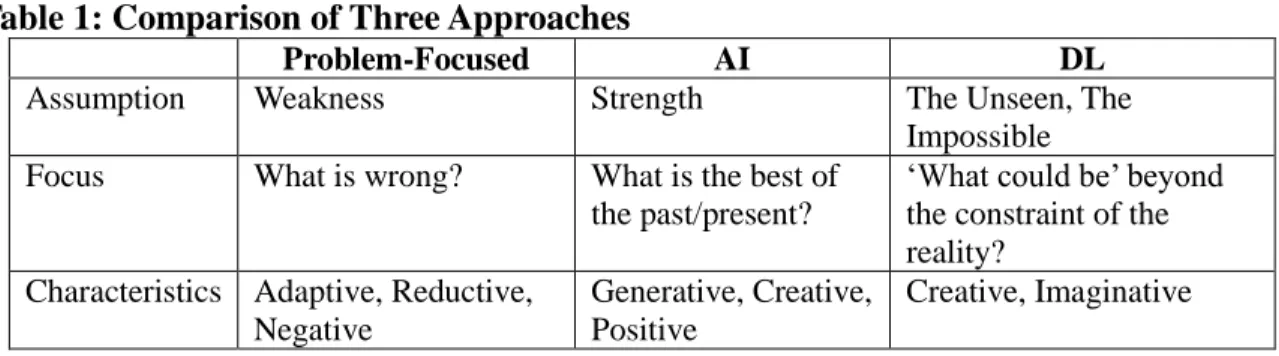
Table 1: Comparison of Three Approaches
Problem-Focused AI DL
Assumption Weakness Strength The Unseen, The
Impossible
Focus What is wrong? What is the best of
the past/present?
‗What could be‘ beyond the constraint of the reality?
Characteristics Adaptive, Reductive, Negative
Generative, Creative, Positive
Creative, Imaginative
Vignettes
This section illustrates four vignettes of Japan‘s progressive rural revitalization and then analyzes those in light of their application of the AI approach and/or the DL approach. Those four vignettes include: Ohyama-town, Nagahama-city, Yufuin-town (now part of Yufu-city), and Bungotakada-town. As the adjective ―progressive,‖ that the author uses, indicates, these communities are ‗best practice‘ revitalization cases in Japan. The author uses these vignettes not only because they are model cases, but also because interestingly, rather than using the problem-focused approach, they used either the AI approach or the DL approach, or both of them in a complementary manner and, as a result, they overcame their prominent problems.
Each vignette focuses on its initial attempt at visioning toward revitalization, although it should be noted that subsequent efforts to ‗keep up‘ their developmental momentum have continued until the present. The purpose of the four vignettes is to highlight how those desperate and destitute communities were radically transformed through their initial attempts at visioning and to analyze these transformations.
Vignette 1: Ohyama-town
Ohyama was the poorest rural town in Oita prefecture fifty years ago. Eighty percent of its land is mountainous and many of the villagers engaged in cutting down trees from the mountains or worked as seasonal laborers (Hibiki-no-sato 2008; Yamagami and Fujimoto 2006). They only had small plots for farming. The population of Ohyama in 1961 was 6168 (Yamagami and Fujimoto 2006).
Looking at the destitute condition of the community, in 1961 the then charismatic mayor of Ohyama, Harumi Yahata, initiated the First New Plum and Chestnuts (NPC) Movement, the purpose of which was to improve the economy of farm households by planting plum and chestnut trees. After thorough investigation inside the community as well as a week-long research trip on fruits production all over Kyusyu, Yahata encouraged farmers to shift from their traditional rice farming, which was aligned with the government policy of that time, to the production of plums and chestnuts which was envisaged to have a
- 5 -
higher land earning rate (Hibiki-no-sato 2008; Oita-Isson-Ippin-Undo-21-Suishin-Kyogi- Kai, 2001). Part of why Yahata pushed this initiative was that there were wild plum and chestnut trees in Ohyama and he thought it feasible to move agriculture in this region to the production of plums and chestnuts.
Under the leadership of Yahata, the municipality of Ohyama played an important role in fostering this movement. The municipality assisted farmers by stopping its ongoing and new projects and investing most of its resources in this initiative in the form of the provision of seedlings, a large tractor, two bulldozers (even operators for this machinery), and 13 out of 30 municipality staff members for technical assistance (Yamagami and Fujimoto 2006). The first NPC movement was against the government policy that promoted rice farming at that time (Hibiki-no-sato 2008; Yamagami and Fujimoto 2006). Under such adverse circumstances, Yahata convinced and trained (through regular study workshops and occasional tours to model community development cases) the staff members of the municipality of Ohyama town to fight against upper government bodies toward their own policy making (H. Ogata4, personal communication, July 25, 2008).
Yahata eagerly and persistently persuaded farmers to begin plum and chestnut tree planting. As mentioned, the first NPC movement was against the government policy that promoted rice farming at that time. Moreover, ―[t]here was also the social stigma that farmers were not really farmers unless they cultivated rice‖ (Hibiki-no-sato 2008: 2). Older farmers were particularly opposed to this initiative. Therefore, Yahata strived to persuade young farmers and then those young farmers in turn persuaded their parents. Yet, overall, the condition of the town was so poor that everyone felt that they needed to do something (M. Yahata5, quoted in Yamagami and Fujimoto 2006).
By the late 1960s, the first NPC movement already contributed to the income of Ohyama farmers. In 1967, 500 farmers engaged in plum planting which generated a total income of 10,000,000 yen. As for chestnuts, in 1966, 465 farmers engaged in chestnut planting which generated a total income of 15,000,000 yen (Yamagami and Fujimoto 2006).
Analysis of Ohyama
The first NPC movement of Ohyama used the DL approach. It introduced plum and chestnut tree planting, which farmers neither produced nor imagined that they would ever produce. Put another way, Ohyama suspended the existing reality of the unproductive rice production in order to dream ‗what could be‘ with plums and chestnuts toward the betterment of each household and the community.
Yet the first NPC movement also contains an element of the AI approach. Yahata
4
A former staff member of Ohyama municipality. 5
- 6 -
appreciatively inquired of the reality that there were wild plum and chestnut trees in Ohyama--existing potential--and scaled it up by persuading farmers to adopt production of these trees assisted by the municipality.
It was charismatic Yahata who functioned as the main driver of this initiative. His determination to gain farmers‘ buy-in as well as to invest most of the municipality resources enabled this movement to take off. His foresight, based on the extensive and thorough investigation, allowed this movement to bring prosperity to Ohyama as he envisaged. His strong leadership also enabled Ohyama to stand firm despite the fact that this movement was against the government policy that promoted rice production. Finally, his strong leadership was also indispensable in encouraging farmers to leap the anxiety barrier towards the unseen. In the case of Ohyama, one cause of this anxiety was the farmers‘ possible disappointment if their attempt to grow plums and chestnuts proved unsuccessful, particularly as they were going against government policy. Another cause of the anxiety, as noted by Frantz (1998) was that ―leaping to something better means losing valued aspects of present reality‖. Again, in Ohyama‘s case, farmers saw not planting rice as a social stigma and it was particularly difficult for old farmers to forgo the security of the routine and the familiar.
Vignette 2: Nagahama City
Nagahama in Shiga prefecture has been a commercial town since the Edo era and merchants have developed a spirit of self-reliance--chosyu. Nagahama is located on the east shore of Lake Biwa—the largest lake in Japan--and is en route between Hokuriku, the region facing the Japan Sea, and Kinki, historically the commercial center of Japan. Its strategic location and abundant natural resources including water have enabled the different sectors of Nagahama to prosper. Nagahama has traditionally been known for the production of silk crepe and velvet. Its fertile suburban area grows rice. There are now some large industries such as Canon, generating employment and contributing greatly to the economy. Its current population is 85,000.
However, due to the opening of a large shopping mall in its suburb, since the 1980s the city center of Nagahama—historically the center of commerce in the city--has become desolate. On one of the streets in the city center, it was observed, ―Only four people and one dog pass by in an hour‖ on Sunday afternoon (Yoshii 2005; Kurokabe 2004). Thus, the municipality of Nagahama has strived to revitalize its city center since then.
The core revitalization strategy was to use local resources. There was the 1900 building of the former national bank which had walls made of black plaster (‗Kurokabe‘ in Japanese) and which was a landmark in Nagahama. The building was about to be sold and dismantled but, after an appeal by residents, the CEOs of the local medium and small enterprises took the initiative of preserving it and making it the core of the revitalization
- 7 -
process of the city center. This new initiative took the third sector approach, which means it was a combined enterprise of the private and public sectors, being capitalized at ninety million yen from the private sector—namely the local small and medium enterprises--and forty million yen from the public sector—namely Nagahama municipality (Yoshii 2005).
In addition to ‗Kurokabe‘, another local resource – the road to the local temple along which traditional local shops were located – was utilized (Minohara 2002). Subsidies from Nagahama municipality were provided to give these shops a ‗retro‘ look that suited Nagahama‘s historical commercial center and road to the temple--Omotesando (Yoshii 2005). As a result of the preservation of the bank building and the renovation of the local shops on the street to the local temple, the city center was transformed to become the ‗retro‘-looking Kurokabe Square, which attracts many visitors.
It is worth mentioning here that the abovementioned initiatives were based on ―the conception for the town as a museum‖, which was declared and established in 1984 and aimed at transforming Nagahama into a historical and cultural town by utilizing its historical landscape (Yoshii 2005; Matsuo 2005). In other words, before Kurokabe Square and the renovation of the appearances of the shops, there already existed the higher-level conception, which gained the citizens‘ consensus, as an enabling environment for the undertaking of such initiatives.
Based on this conception, one of the tactics that Nagahama city municipality employed was to organize tours for retailers and non-retailers to other Japanese towns engaging in a unique and creative initiative. This enabled participants not only to gain new insights for and a new understanding of community revitalization but also to network among themselves.
Another noteworthy dimension of Kurokabe Square is that glass handicraft (shops and ateliers) was introduced for the first time in line with the concept of ―Internationality, Historicity, and Culture and Arts‖ (Yoshii 2005). The first CEO of Kurokabe Square had suggested, ―When I traveled Europe, the towns, which have glass handicrafts, attracted many people, and thus let‘s launch a glass handicraft venture in Kurokabe Square.‖ Since there were few retail shopowners and no manufacturers of glass handicrafts among the members of Kurokabe Square, they were skeptical about the feasibility of such a venture. However, under the strong leadership of the Kurokabe Square CEO, they organized a tour to glass handicraft facilities all over Japan where they found that domestic glass handicrafts were mainly for souvenirs. They then organized a trip to Venetia in Italy, which was internationally known for glass handicrafts where they found that European glass handicrafts were rooted in their culture and long history and the techniques and designs were first-class. As a result, they foresaw that if they brought glass handicrafts of this level to Nagahama, they could infuse a new culture of glass handicrafts into Nagahama (Kurokabe 2004). This added another dimension to the attractiveness of Kurokabe Square
- 8 - as the retro town with glass handicrafts.
In 1989 when Kurokabe Square was opened, two million people visited there. The number of visitors continued to increase and in 2002 there were five million visitors (Dejima, 2003).
Analysis of Nagahama
The AI approach was taken in the preservation and utilization of the former bank building and the renovation and utilization of the traditional local shops along the road to the local temple. Nagahama was already half-full (with its rich historical landscape) and was able to improve what it already had to attract many visitors.
However, the DL approach was taken in the introduction of glass handicrafts. Nagahama originally had no connection with glass handicrafts. So, to put it another way, the third sector enterprise of Kurokabe Square suspended the existing reality in order to dream ‗what could be‘ with glass handicrafts. Members of Kurokabe Square had an anxiety barrier to leaping into this unknown realm. But the strong leadership of the first CEO of Kurokabe Square helped them overcome this barrier by organizing the observation trips all over Japan and to Venetia, Italy.
Overall, it was the CEOs of medium and small enterprises who functioned as the main catalyst for this initiative. They took the risk of venturing into this new initiative, providing a large amount of funding, and therefore exercising overall leadership. However, it is worth pointing out here that the sense of chosyu—self-reliant merchants—is the ‗regional mindset‘ (values and attitudes) behind the acts of these CEOs (Yoshii 2005; Dejima 2003; Matsuo 2005).
It is also important to add that ―the conception for the town as a museum‖, which gained wide public consensus, existed before the launching of Kurokabe Square and without it Kurokabe Square would not have been able to take off as successfully as it actually did. This conception generated civic spirit, which is ―important for building a shared vision and goal for the region and in promoting the kind of networking and interaction that contributes to innovation‖ (Gertler and Wolfe 2003: 49). A tactic like the organized tour to another town in Japan was an activity which arose from this conception and consequently mobilized the citizens‘ buy-in and networking which led to the launching of Kurokabe Square.
Vignette 3: Yufuin-town
Yufuin-town was a rural town of 11,407 before it merged with two other towns to become Yufu City in 2005. Yufuin is a natural basin surrounded by the mountains—the most impressive mountain being Mount Yufu. The number and volume of its hot springs cause them to be ranked second in Japan after its neighbor Beppu City. However, until 30 years
- 9 -
ago, it was a desolate rural village based on agriculture and forestry, while its neighboring Beppu was a major hot spring resort attracting a large number of visitors domestically as well as internationally.
In 1973 three young hotel owners of Yufuin, who strongly felt that something needed to be done to revitalize this rural village, traveled to Europe to find models of rural communities that they could use to gain ideas for revitalizing Yufuin. In Germany, they found a small hot spring resort of similar size to Yufuin, which created, nurtured, and protected its nature, space, and quietness (Kitani 2004). Based on their insights and inspiration from this resort, they formulated the ―conception for residents‘-life-based-resort‖; in other words, the best resort is where its residents can also live comfortably (Kitani 2004; Nishikawa 2006). Appreciatively inquiring what Yufuin had, they identified the rural scenery of Mount Yufu and the rice fields in the basin as a resource to be promoted and nurtured (Nishikawa 2006; Kobayashi 2005; Kitani 2004). This local resource also allows Yufuin to be differentiated from Beppu and now Yufuin attracts nearly four million visitors a year (Kitani 2004; Nishikawa 2006).
The main drivers for this initiative to revitalize were the hotel owners (Matsuo 2005). They organized another tour to Germany for 20 Yufuin residents including the then mayor and set up various events and study workshops to mobilize residents toward the revitalization of Yufuin (Kitani 2004). Those hotel owners later established the Yufuin Tourist Association that promotes tourism in Yufuin.
Analysis of Yufuin
The AI approach was taken for the revitalization of Yufuin. Yufuin was already half-full with the quiet rural scenery of Mount Yufu and the rice fields in the basin. This local resource was identified and used to attract visitors. The basis for the use of this resource was ―the conception for residents‘-life-based-resort‖, which was formulated as the result of the trip to Germany by the hotel owners and subsequently widely recognized by Yufuin residents. This conception generated civic spirit in a similar manner to ―the conception for the town as a museum‖ in Nagahama.
The main actors were the hotel owners (the private sector) who mobilized residents toward the revitalization of Yufuin. The Yufuin Tourist Association established by those hotel owners has been so active and vigorous that it informally embraced some public and governmental functions and therefore Mitsumoto (2007) even calls it ―the private government‖ of Yufuin.
Vignette 4: Bungotakada City
Bungotakada is a rural city of 25,000 in Oita prefecture. Due to the expansion of large stores and a decline in population caused by emigration to urban cities, the city
- 10 -
(commercial) center has become deserted since the 1970s. It has even been called ―the dog-cat streets‖, meaning only dogs and cats walk in the city center (Yasuda 2008).
Given this situation, the Chamber of Commerce and Industry of Bungotakada and some retail shopowners at the city center in the early 1990s began planning an initiative for commercial revitalization (Commerce, Industry and Tourism Section of Bungotakada City, 2008). Through extensive and thorough investigation, they found that the city center was prosperous until the Showa 30s (the late 1950s and the early1960s) and 70 percent of buildings there were built until the Showa 30s(Yasuda 2008). As a result, they came up with the idea of creating a ‗retro‘-looking modern city (Commerce, Industry and Tourism Section of Bungotakada City, 2008). To gather information for this plan, they visited communities throughout Japan that have conducted similar initiatives (Yasuda 2008). In 2001 the Town of Showa was opened in 2001 and it now attracts 360,000 visitors a year.
The Town of Showa was created by utilizing and renovating its local resource—namely, its shop buildings constructed until the Showa 30s. The initiative restored the buildings to their original state by changing the doors and windows from aluminium to the wood that was originally used (Commerce, Industry and Tourism Section of Bungotakada City 2008). The signboards were also converted to wood or tinplate like those used in the Showa era. Two-thirds of the funding necessary for the restoration came as subsidies from the municipal and prefectural governments (Yasuda 2008).
It is worth describing here the participants in this initiative and how they are related. Several shopowners and residents began the initiative for revitalization, then soon after the Chamber of Commerce and Industry assumed the main coordinating and mobilizing role. The municipality of Bungotakada has been playing the enabling role e.g., by providing subsidies for the renovation of the shops‘ appearance (Yasuda 2008).
It is also important to add that this initiative eventually mobilized many residents in Bungotakada toward revitalization. Initially, only a few shops bought into this initiative, but the number increased greatly over time. For instance, in 2001 only nine shops were restored, but by 2007 the number of the restored shops increased to 41. In terms of non-merchant residents, elderly residents volunteered to serve as tour guides for the town of Showa. Also one individual resident, who has a large and valuable collection of Showa era toys, now generously allows them to be displayed at one of the buildings of the museum complex which opened in 2005 and now attracts many visitors (Yasuda 2008).
Analysis of Bungotakada
The AI approach was taken in the creation of the Town of Showa. The Chamber of Commerce and Industry, together with some retail shopowners at the city center and the municipality of Bungotakada, appreciatively inquired the city center‘s history—the successes and the best of the past--and its existing buildings—a latent local resource.
- 11 -
Eventually, those were utilized in the creation of the ‗retro‘ modern Town of Showa.
However, Bungotakada‘s case also appears to contain an element of the DL approach. While the utilization and renovation of the shops on the street to the temple in the Nagahama case was both reasonable and natural given the long and recognized history of the temple and the street, it is rather unreasonable and unnatural in Bungotakada‘s case to focus back on the Showa 30s, which was not widely recognized for its history, especially by its residents. It seems to require the element of ‗leap‘ to utilize the past prosperity of fifty years ago. Put another way, one needs to suspend and transcend existing reality to dream ‗what could be‘. With regard to this phenomenon, Frantz (1998: 181) points out that ―[i]n practice evolutionary visioning approaches (e.g., the AI approach) often help existing systems to move in the direction of their ‗impossible dreams‘ even as discontinuous leap visioning is going on.‖
The main catalyst for the creation of the Town of Showa (e.g., through the research efforts inside and outside the community) was the Chamber of Commerce and Industry. Through its initiative and efforts, not only the merchants at the city center but also other segments of population were mobilized toward the revitalization of the city center. As for the government sector, the municipality of Bungotakada has been playing a supportive role in this revitalization (e.g., through the provision of subsidies).
Comparison of Vignettes
Ohyama‘s core approach was the DL approach implicitly underpinned by the AI approach. The first NPC movement of Ohyama took the DL approach through the introduction of plum and chestnut tree planting, which farmers neither produced nor imagined that they would ever produce. Yet Ohyama‘s case also contains the element of the AI approach because the fact that wild plum and chestnut trees existed in Ohyama was appreciatively inquired.
Nagahama took both the DL and AI approaches. In the preservation and utilization of the former bank building and the renovation and utilization of the traditional local shops along the road to the local temple, the AI approach was taken. But the DL approach was taken in the introduction of glass handicrafts as they had not existed in Nagahama before.
Only the AI approach was taken in the revitalization of Yufuin. The quiet rural scenery of Mount Yufu and the rice fields in the basin was identified and used as a resource to attract visitors.
In Bungotakada‘s case, the AI approach helped the city center‘s landscape, but as Frantz (1998) states, ―to move in the direction of their ‗impossible dreams‘‖ required the DL approach. Apparently, the city center‘s history--the successes and the best of the past--and its existing buildings—a latent local resource—were appreciatively inquired and then utilized toward the creation of the ‗retro‘ modern Town of Showa. However, it was
- 12 -
rather unreasonable and unnatural to focus on the Showa 30s, which was not widely recognized for its history, especially by its residents and so the element of ‗leap‘ was required to conclude it necessary to use the prosperity of fifty years ago.
Table 2: Comparison of Four Vignettes
AI Relationship between AL and DL DL
Ohyama ++ AI as an implicit underpinning for DL +++++
Nagahama +++++ AI and DL were used independently +++++
Yufuin +++++ Only AI was used
Bungotakada +++++ AI moved existing system in the direction of DL ++
(+ indicates the degree to which a respective approach was employed. The greater the number of +s, the more the respective approach was used.)
Discussion
Common factors
The common factors among the vignettes are: their desperate and destitute situations, the existence of the main catalysts for creating a vision and mobilizing residents toward a shared sense of commitment to the vision, and extensive and thorough research prior to visioning their future (which were either done by the main catalysts themselves or organized by them). All these four communities were in the desperate and destitute situations characterized either by chronic poverty (i.e., Ohyama and Yufuin) or by the declining economy (i.e., Nagahama and Bungotakada).
In all the four vignettes there exist the main catalysts, who took an initiative, created a vision of revitalization, and mobilized residents toward the realization of the vision. These catalysts include either leaders (the Ohyama mayor, the CEOs of the small and medium enterprises in Nagahama, and the hotel owners in Yufuin) or an organization (the Chamber of Commerce and Industry in Bungotakada). The mobilization of residents toward the realization of a vision is actually a key element of visioning. Gertler and Wolfe (2003: 47) state, ―[Visioning] go beyond the presentation of scenarios (however stimulating these may be), and beyond the preparation of plans. What is crucial is the elaboration of a guiding strategic vision, to which there can be a shared sense of commitment (achieved, in part, through networking processes)‖ (emphasis added).
Finally, extensive and thorough investigations were done in each case to formulate the visions for revitalization. The locations of the investigations not only included other communities/regions in Japan but also overseas. Interestingly, even the cases that used the AI approach, which explored the existing strengths and resources within the community, also conducted the investigations outside their communities. Yufuin‘s revitalization started
- 13 -
after the trip to Germany, and prior to formalizing the concept of the Town of Showa the investigative trips to the other towns with similar initiatives was necessary for Bungotakada. Paradoxically, the cases using the DL approach, which imagined ‗the unseen‘, still needed to see what was happening in other parts of Japan and overseas to assess the feasibility of their initiatives. The Ohyama mayor travelled all over Kyusyu to find appropriate agricultural products, and the members of Kurokabe Square visited Venetia, Italy, to look for high-quality glass handicrafts.
Interpretation from the perspective of endogenous development
The concept of endogenous development sheds some light on the interesting and paradoxical relationship between the AI approach and the DL approach in Ohyama‘s case. Tsurumi (1996) defines endogenous development as development that people or groups of people in the region autonomously generate (a) in harmony with their local ecological systems; (b) based on their cultural heritage (tradition); and (c) in light of exogenous knowledge, technology, and systems. From this perspective, while the first NPC movement of Ohyama leapt into the realm of ‗the unseen‘ of plum and chestnut tree planting, it still needed the underpinning of the compatibility between plum and chestnut trees and the local ecological systems of Ohyama (the element of AI). In addition, as mentioned above, paradoxically Ohyama and Nagahama still needed to see what was happening in other parts of Japan and overseas with respect to what they were going to initiate. In a nutshell, these facts indicate that one cannot imagine ‗the unseen‘ in a vacuum and the DL approach needs to have footholds of high feasibility based on quality research. So, although its name—discontinuous leap—implies that the DL approach is not based on chance, it is actually based on feasibility.
The notion of endogenous development sheds light on the cases of Yufuin and Bungotakada where appreciatively inquiring local resources were actually triggered by and entailed insights from outside. Therefore, in addition to appreciatively inquiring about compatibility with the local ecological system (i.e., Yufuin‘s case) and the rootedness in the cultural heritage (i.e., Yufuin‘s and Bungotakada‘s cases), exogenous knowledge still needed to be referred to.
Relationship with problem-solving
All the cases did not take the problem-focused approach. Ohyama and Yufuin did not attempt to increase its rice and forestry production. Nagahama and Bungotakada did not attempt to simply modernize their city centers. Instead, they took the AI approach, the DL approach, or a combination of these approaches. Put another way, they either explored the existing strengths and resources or ‗the unseen‘ and ‗the impossible.‘ Through these approaches, these communities eventually overcame their prominent problems.
- 14 -
Existing literature examines why the AI approach is more effective than the conventional problem-focused approach. For example, Miyoshi and Stenning (2008: 41) point out that:
Setting realistic community objectives and striving to achieve them using the resources available is essentially a less difficult task than focusing on a negative aspect (problem) in the community and attempting to ‗solve‘ it … [Appreciative inquiry] is more realistic to make progress with rather than ‗problem-solving‘ which denotes negation, criticism and making difficult change to ‗fix‘ the problem.
This comparative advantage of the AI approach, in part, derives from the fact that successes, strengths, and locally available resources give energy, enthusiasm, and healthy pride to people. ―Just as plants grow towards their energy sources, so do communities … move towards what gives them life and energy‖ (Mathie and Cunningham 2003: 478). Moreover, AI‘s asset-based feature (the emphasis on ‗what is there‘) helps people logically and naturally move toward better utilizing existing resources rather than ‗fixing‘ the problem.
To shift from the problem-focused mode to the AI mode, it is essential to change how we think and thus how we ask questions. Instead of asking what we need to fix in order to increase agricultural production, we should ask what local resources and strengths we can use to enhance our livelihoods? Instead of asking what we need to fix in order to increase the number of visitors, we should ask what historical successes and resources we can use and innovate in order to make the community more attractive.
Beyond the constraints of the existing reality, the DL approach enables communities to freely vision their preferred futures. This approach brought Ohyama economic prosperity among other improvements and brought Nagahama an added attraction for its visitors (i.e., glass handicrafts).
Both the AI approach and the DL approach are more creative and proactive endeavors than the problem-focused approach. The AI approach requires a serious investigation into past and current successes and available resources with the goal of their better utilization. The DL approach requires strategic foresight based on solid feasibility studies to leap into ‗the unseen‘ realm. This marks a sharp contrast with the reductionist and reactive problem-focused approach.
Conclusion
By analyzing four vignettes of Japan‘s progressive rural revitalization, this article illustrates how those communities chose to use either the AI approach or the DL approach, or to use both together when visioning their futures. It is clear that even the cases which utilized the
- 15 -
DL approach still needed the underpinning of compatibility with the local systems (which needs to be appreciatively inquired) and the foothold of high feasibility based on quality research. Thus, unlike its name—discontinuous leap—denotes, the DL approach is not based on chance but on feasibility. It is also clear that even the cases which utilized the AI approach still needed exogenous knowledge and insight when visioning their futures. Thus unlike its name—appreciative inquiring (local strengths and resources)—denotes, the AI approach involves referring to exogenous knowledge. In one case (Nagahama), the AI approach helped the community to move in the direction of their ‗impossible dreams‘ that actually required the DL approach.
There are some common factors among these four communities. First, they were all desperate and destitute. Second, there existed main catalysts—leaders or an organization—for creating a vision and mobilizing residents toward a shared sense of commitment to the vision. Third, each community conducted extensive and thorough research prior to visioning its future, which was either conducted or organized by the main catalysts.
Through the AI and DL approaches, these four communities eventually overcame their prominent problems. AI‘s positive character gives people energy and enthusiasm and its asset-based attribute helps people logically move toward using existing resources. In contrast, the DL approach enables people to envision beyond the constraint of the existing reality. Both the AI and DL approaches are more creative and proactive endeavors than the problem-focused approach, which is reductionist and reactive. While this article analyzes Japan‘s rural revitalization cases, the advantage of the AI and DL approaches over the problem-focused approach may suggest an alternative visioning approach for communities in the Asia Pacific and beyond.
References
Barge, J. K. 2001. ―Creating Healthy Communities Through Affirmative Conflict Communication.‖ Conflict Resolution Quarterly 19(1): 89-101.
Commerce, Industry and Tourism Section of Bungotakada City. 2008. Town of Showa. (Paper presented at a visit as part of JICA training program for the government administrators from Chile.)
Cooperrider, D. and S. Srivastva. 1987. ―Appreciative Inquiry in Organizational Life.‖ Pp. 129-169 in Research in Organizational Change and Development. Vol. 1, eds, W.A. Pasmore and R.W. Woodman. Greenwich, CT: JAI Press.
Dejima, J. 2003. Nagahama Monogatari: Chosyu to Kurokabe no Jugonen [The Story of Nagahama: Fifteen Years of Chosyu and Kurokabe] (in Japanese). Nagahama: Machizukuri-Yakuba.
- 16 -
Elliot, C. 1999. ―Locating the Energy for Change: An Introduction to Appreciative Inquiry.” Winnipeg: International Institute for Sustainable Development. from
http://www.iisd.org/pdf/appreciativeinquiry.pdf (accessed 28 November 2008). Frantz, T. G. 1998. ―Visioning the Future of the Social Systems: Evolutionary and
Discontinuous Leap Approaches.‖ Systems Research and Behavioral Science 15: 173–182.
Finegold, M.A., B.M. Holland and T. Lingham. 2002. ―Appreciative Inquiry and Public Dialogue: An Approach To Community Change.‖ Public Organizational Review: A Global Journal 2: 235–252.
Gertler, M.S. and D.A. Wolfe. 2003. ―Local Social Knowledge Management: Community Actors, Institutions and Multilevel Governance in Regional Foresight Exercises.‖ Futures 36: 45–65.
Hammond, S.A. and C. Royal, eds. 1998. Lessons from the Field: Applying Appreciative Inquiry. Plano, TX: Practical Press.
Hibiki-no-sato 2008. The Past, Present and Future of the Town of Plum and Chestnuts: Oyama-Machi, Birth Place of “One Village, One Product” Project (Paper presented at a visit as part of JICA training program for the government administrators from ASEAN countries).
Kitani, F. 2004. Yufuin no Chiisana Kiseki [A Small Miracle of Yufuin] In Japanese. Tokyo: Shincho-sya.
Kobayashi, K. (2005). ―Yufuin to Machizukuri‖ [Yufuin and Its Revitalization]. Pp. 94-110 in Shiminsanka no Machizukuri: NPO, Shimin, Jichitai no Torikumi kara [Participatory Community Development: Lessons from the Engagements of NPOs, Citizens, and Municipalities]. M. Matsuo, Y. Nishikawa, and J. Isa, eds. In Japanese. Tokyo: Souseisya.
Kurokabe 2004. ―Kurokabe Tanjo no Zenya to Tanjo‖ [The Before, After and Moment of the Birth of Kurokabe].‖ Kurokabe Seasons 1: 2. In Japanese.
http://www.kurokabe.co.jp/main11_download/pdf/seasons_vol01_03.pdf. (accessed December 8, 2008).
Mathie, A. and G. Cunningham. 2003. ―From Clients to Citizens: Asset-based Community Development as a Strategy for Community-Driven Development.‖ Development in Practice 13(5): 474–486.
Matsuo, M. 2005. ―Nagahama, Yufuin no Machizukuri no Tenkan‖ [Transition of Community Development in Nagahama and Yufuin].‖ Pp. 1-18 in Shiminsanka no Machizukuri, Senryaku Hen: Sanka to Leadership, Jiritsu to Partnership. [Participatory Community Development: Participation and Leadership, Self-Reliance and Partnership.] M. Matsuo, Y. Nishikawa, and J. Isa, eds. In Japanese. Tokyo: Souseisya.
- 17 -
Minohara, K. 2002. ―Nagahama: Jichiishiki ga Sasaeru Machi no Fukei‖ [Nagahama: Landscape Supported by the Sense of Autonomy].‖ Pp. 26-38 in Machizukuri to Leadership [Urban Development and Leadership]. In Japanese. Kyoto: Gakugei-syuppan.
Mitsumoto, N. 2007. Jichi to Izon: Yufuin-cho to Tagawa-shi no Jichi Unei no Regime [Self-government and Dependence: The Regime of the Self-government Administration of Yufuin Town and Tagawa City]. In Japanese. Tokyo: Keibundo. Miyoshi, K. and N. Stenning. 2008. ―Designing Participatory Evaluation and Community
Capacity Development: A Theory-Driven Approach.‖ Japanese Journal of Evaluation Studies 8(2): 39-53.
Nishikawa, Y. 2006. ―Chiikizukuri niokeru Chiiki Shigen no Katsuyo‖ [The Utilization of Local Resources for Regional Development].‖ Pp. 121-141 in Isson Ippin Undo to Kaihatsu Tojokoku: Nihon no Chiiki Shinko ha Dotsutaeraretaka [One Village One Project Movement and Developing Countries: How Were Lessons from Japan‘s Rural Revitalization Transferred?] K. Matsui and S. Yamagami, eds. In Japanese. Chiba: IDE-JETRO.
Oita-Isson-Ippin-Undo-21-Suishin-Kyogi-Kai. 2001. Oita Isson Ippin Undo 20 Nen no Kiroku [The Record of Twenty Years of the One Village One Product Movement]. In Japanese. Oita: Author.
Tsurumi, K. 1996. Naihatsuteki Hattenron no Tenkai [Evolvement of Endogenous Development Theory] (Japanese). Tokyo: Chikuma-syobo.
Whitney, D. and A. Trosten-Bloom. 2003. The Power of Appreciative Inquiry: A Practical Guide to Positive Change. San Francisco: Berrett-Koehler Publishers.
Yamagami, S. and T. Fujimoto. 2006. ―Isson Ippin Undo no Genten, Ohyama-cho Niokeru Chiiki Shinko [Rural Revitalization in Ohyama-cho, the Archetype of the One Village One Product movement].‖ Pp. 19-40 in Isson Ippin Undo to Kaihatsu Tojokoku: Nihon no Chiiki Shinko ha Dotsutaeraretaka [One Village One Project Movement and Developing Countries: How Were Lessons from Japan‘s Rural Revitalization Transferred?] K. Matsui and S. Yamagami, eds. (in Japanese) Chiba: IDE-JETRO. Yasuda Y., Head of Commerce, Industry, and Tourism Section of Bungotakada City. 2008.
Personal communication, 29 July 2008.
Yoshii, S. 2005. ―Nagahama no Machizukuri to Keikan Keisei‖ [The Revitalization of Nagahama and the Formation of Landscape].‖ Pp. 111-125in Shiminsanka no Machizukuri: NPO, Shimin, Jichitai no Torikumi kara [Participatory Community Development: Lessons from the Engagements of NPOs, Citizens, and Municipalities.] M. Matsuo, Y. Nishikawa, and J. Isa, eds. In Japanese. Tokyo: Souseisya.