30 Rep. Tottori Mycol. Inst. 46 : 30-38, 2016.
原木の形質(産地,樹種,径級)と植菌法(種菌の種類,
植菌孔の深さ)がシイタケの栽培品種・菌興 115 号の 子実体収量に及ぼす影響
*前田亜紗**・舩戸知聖***・黒田 誠・寺島和寿・長谷部公三郎
Effects of wood-log characteristics(place of origin, tree species and log diameter)and inoculation methods (spawn types and depth of inoculation hole)upon fruiting body yields in wood-log cultivation
of Kinko115, a cultivar of Lentinula edodes
Asa MAEDA**, Chisato FUNATO***, Makoto KURODA, Kazuhisa TERASHIMA, Kozaburo HASEBE
Abstract
Branding of "Kinko 115", a cultivar of shiitake mushroom (Lentinula edodes), is being carried out in several regions in Japan because it produces large and very thick-fleshed fruiting bodies with an excellent taste and good flavor. In this study, we investigated the effects of the wood-log differences in terms of place of origin, tree species (Quercus serrata and Q. acutissima), and diameter, and of inoculation methods (spawn types and depth of inoculation hole) on the fruiting body yields in log cultivation of Kinko 115. The results were as follows: (1) the origin of the logs used for the cultivation affected mushroom yields; (2)Q. acutissima logs gave higher total yields in the 4-year cultivation period than Q. serrata logs in all of the experiments, while the yields in the first year were higher in Q. serrata logs than in Q. acutissima logs when sawdust plug spawns were used; (3) in the yields per unit volume, the small-diameter logs (5 to 7 cm) gave higher yields in dry-weight than the middle- (7 to 13 cm) and very small-diameter (below 5 cm) logs; (4) for the total yield per log, the middle-diameter logs gave higher yields in dry-weight than the small- and very small-diameter logs; (5) for yield per spawn, the very small-diameter logs tended to give higher yields than the middle- and small-diameter logs in Q.
serrata; (6) the average dry-weight of fruiting bodies produced on the middle-diameter logs tended to be larger than those on the logs of the small- and very small-diameter; (7) the inoculation methods, in which the effect of the deep hole (80 mm) with the wooden-plug spawn, and the standard depth hole (25 mm)
with the sawdust and wooden-plug spawn were compared, did not significantly influence yields.
Key words: fruiting body yields, Kinko 115, Lentinula edodes, Quercus acutissima, Quercus serrata, shiitake mushroom, wood-log cultivation.
*菌蕈研究所研究業績,第401号,(一財)日本きのこセンター・菌蕈研究所,〒689-1125 鳥取市古郡家211.
Contribution No. 401of the Tottori Mycological Institute, 211 Kokoge, Tottori 689-1125, Japan.
**現住所:鳥取県生活環境部,〒680-0061 鳥取市立川町6-176, Present address: Tottori Prefectural Government, 6-176, Tachikawa, Tottori 680-0061.
***現住所:菌興椎茸協同組合,〒680-0845 鳥取市富安1-84, Present address: Kinko Shiitake Cooperative Association, Tomiyasu, Tottori, 680-0845
31 緒 言
原木栽培用シイタケ品種「菌興115号」は,大 型で極めて肉厚な食味に優れた特徴をもつため,
この品種のブランド化に向けた取り組みが各地で 行われている(上馬,2012;垣田,2014).一方,
里山(林地)において栽培される原木シイタケの 作柄や品柄は,原木の形質,栽培管理手法の違い および気象条件などにより大きく変動することが 知られており,子実体の発生量を増大,安定させ るためには,これらの要因と子実体発生量との関 係を精査する必要がある.これまでに,いくつか の栽培品種について原木の形質と子実体発生量と の関係を調査されており(岸本ら,1985;福田ら,
1987;時本,2010),菌興115号については,ブ
ランド化が推進されている石川県において八島ら
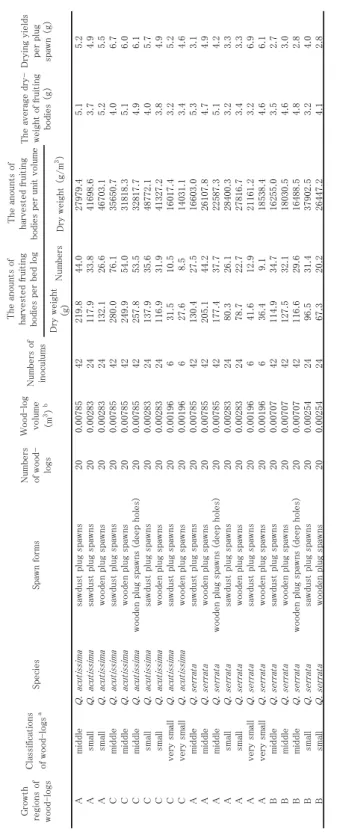
(2015)により子実体発生量と原木の径級の関係 についてが報告されている.
本研究では,菌興115号の子実体発生量に影響 すると考えられる栽培要因に関する基礎的知見を 集積するために,原木の産地,樹種,径級,植菌 法の異なる条件下における菌興115号の子実体収 量を調査した.
材料及び方法
供試原木は国内の3産地(A,B,C)から入 手したクヌギ(Quercus acutissima Carruth.)およ びコナラ(Q. serrata Murray)を使用した.産地A,
産地Bおよび産地Cのコナラ原木の外樹皮形態 は,それぞれイワ肌からフツウ肌,フツウ肌から サクラ肌,フツウ肌であり,産地Aのコナラ原 木の樹皮は産地Bのそれよりも明らかに厚かっ た.これらの原木外樹皮形態の記載は,橋詰・脇 田(1983)に従った. 供試した原木の長さは0.9
m(B)または1 m(A,C)であった.原木の径
の区分は,直径が7~13 cmの原木を中径木,5
~7 cmを小径木,5 cm以下を極小径木とし,材 積は中径木の直径を10 cm,小径木の直径を6
cm,極小径木の直径を 5 cmとして算出した.種
菌は菌興115号の駒菌あるいは形成菌を使用し,
1列につき6穴,列間が3 cmとなるように穿孔 して植菌した.なお,孔の深さは形成種菌試験区
では2.5 cm, 駒種菌試験区では3 cm, 駒種菌の深
植え試験区では8 cmとした.原木産地,樹種,
径級,植菌法の違いにより区分した試験区(22試 験区,20本/試験区)を設置し(Table 1),鳥取 市広岡にある一般財団法人日本きのこセンター圃 場(ヒノキ林)において慣行法(日本きのこセン ター,1986)に従って管理した.各試験区の詳細 に 関 し て はTable 1に 示 す.2010年 に 植 菌 後,
2013年までの4年間のほだ木1本ずつの収量(発 生個数と乾燥重量)を調査した.
統計処理には,Excel統計2012を使用し,多重 比較(Tukey-Kramer法)により解析を行った.
結 果 と 考 察 1)原木の産地による収量の比較
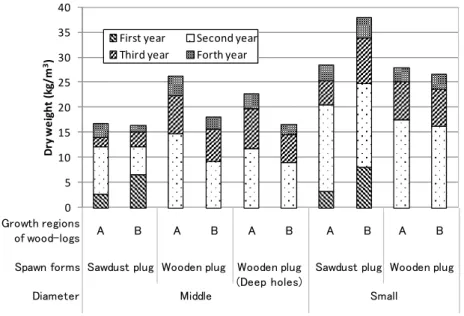
産地Aと産地Bのコナラ原木を使用した場合 の,1 m3当たりの収量(乾燥重量)を比較した
結果をFig. 1に示した.形成種菌を植菌した1年
ほだ木からの収量については,産地Bの原木が 多かったが,4年間の収量については,小径木・
形成種菌区を除き,産地Aの原木の方が産地B の原木よりも多い傾向が見られた.
菌興241号において原木産地の違いにより子実 体の収量に差が認められることが報告されており
(福田ら,1987),菌興115号においても同様な傾 向が認められた.本研究で使用したコナラ原木の 外樹皮形態として,産地Aの原木はイワ肌から フツウ肌,産地Bの原木はフツウ肌からサクラ肌,
産地Cの原木はフツウ肌であり,産地Aのコナ ラ原木の樹皮厚は産地Bのそれよりも明らかに 厚かった.外樹皮が厚いと子実体原基の形成が阻 害され,収量が低下することが報告されている(主 計・金子,1978;福田ら,1987).しかしながら,
4年間の収量においては,外樹皮厚が厚いA原木 を使用した試験区で,収量が多い傾向が認められ た.本試験は樹高が高いヒノキ林で行ったために,
外樹皮厚が薄いほだ木の方が乾燥気味となり,子 実体原基の形成が阻害された可能性が考えられ る.今後,外樹皮厚と水分管理の関係をより詳し く検討する必要性が示唆された.
32
前田亜紗・舩戸知聖・黒田 誠・寺島和寿・長谷部公三郎
*
菌蕈研究所研究業績,第xxx号,(一財)日本きのこセンター・菌蕈研究所,〒689-1125 鳥取市古郡家211. Contribution No. xxx of the Tottori Mycological Institute, 211 Kokoge, Tottori 689-1125, Japan.**
現住所:鳥取県生活環境部,
〒680-0061
鳥取市立川町6-176, Present address: Tottori Prefectural Government, 6-176, Tachikawa, Tottori 680-0061.
***
現住所:菌興椎茸協同組合,
〒680-0845
鳥取市富安1-84, Present address: Kinko Shiitake Cooperative Association, Tomiyasu, Tottori, 680-0845
The anounts of harvested fruiting bodies per unit volume Dry weight (g)NumbersDry weight (g/m3) AmiddleQ.acutissimasawdust plug spawns200.0078542219.844.027979.45.15.2 AsmallQ.acutissimasawdust plug spawns200.0028324117.933.841698.63.74.9 AsmallQ.acutissimawooden plug spawns200.0028324132.126.646703.15.25.5 CmiddleQ.acutissimasawdust plug spawns200.0078542280.076.135650.74.06.7 CmiddleQ.acutissimawooden plug spawns200.0078542249.954.031818.35.16.0 CmiddleQ.acutissimawooden plug spawns (deep holes)200.0078542257.853.532817.74.96.1 CsmallQ.acutissimasawdust plug spawns200.0028324137.935.648772.14.05.7 CsmallQ.acutissimawooden plug spawns200.0028324116.931.941327.23.84.9 Cvery smallQ.acutissimasawdust plug spawns200.00196631.510.516017.43.25.2 Cvery smallQ.acutissimawooden plug spawns200.00196627.68.514031.13.44.6 AmiddleQ. serratasawdust plug spawns200.0078542130.427.516603.05.33.1 AmiddleQ. serratawooden plug spawns200.0078542205.144.226107.84.74.9 AmiddleQ. serratawooden plug spawns (deep holes)200.0078542177.437.722587.35.14.2 AsmallQ. serratasawdust plug spawns200.002832480.326.128400.33.23.3 AsmallQ. serratawooden plug spawns200.002832478.722.727816.73.43.3 Avery smallQ. serratasawdust plug spawns200.00196641.612.921161.23.26.9 Avery smallQ. serratawooden plug spawns200.00196636.49.118538.44.66.1 BmiddleQ. serratasawdust plug spawns200.0070742114.934.716255.03.52.7 BmiddleQ. serratawooden plug spawns200.0070742127.532.118030.54.63.0 BmiddleQ. serratawooden plug spawns (deep holes)200.0070742116.629.616488.54.82.8 BsmallQ. serratasawdust plug spawns200.002542496.531.437902.53.24.0 BsmallQ. serratawooden plug spawns200.002542467.320.226447.24.12.8
Growth regions of wood-logs Classifications of wood-logs aSpeciesSpawn formsNumbers of wood- logs Drying yields per plug spawn (g)
Wood-log volume (m3) bNumbers of inoculums The anounts of harvested fruiting bodies per bed logThe average dry- weight of fruiting bodies (g)
Table 1. Experimental sections and results
a
According to the diameters, wood-logs were classified as follows: Middle, 7-13 cm;
small, 5-7 cm; very small, <5 cm.
Table 1. Experimental sections and results a According to the diameters, wood-logs were classified as follows: middle, 7-13 cm; small, 5-7 cm; very small, <5 cm. b Wood log volume was calculated regarding the diameters of the middle-, small-, and very small-logs as 10 cm, 6 cm and 5 cm, respectively.
33
* 菌蕈研究所研究業績,第xxx号,(一財)日本きのこセンター・菌蕈研究所,〒
689-1125鳥取市古郡家
211. Contribution No. xxx of the Tottori Mycological Institute, 211 Kokoge, Tottori 689-1125, Japan.** 現住所:鳥取県生活環境部 , 〒 680-0061 鳥取市立川町 6-176, Present address: Tottori Prefectural Government, 6-176, Tachikawa, Tottori 680-0061.
*** 現住所:菌興椎茸協同組合 , 〒 680-0845 鳥取市富安 1-84, Present address: Kinko Shiitake Cooperative Association, Tomiyasu, Tottori, 680-0845
very small-logs as 10 cm, 6 cm and 5 cm, respectively.
Fig. 1. The yields (dry weight/m
3) of 4 years cultivation using the wood-logs of different localities
Fig. 2. The yields (dry weight/m
3) of 4 years cultivation using the wood-logs of Q.
acutissima and Q. serrata
Growth regions of wood-logs Spawn forms Diameter
Sawdust plug Wooden plug Wooden plug (Deep holes)
Sawdust plug Wooden plug
Middle Small
A B A B A B A B A B
0 5 10 15 20 25 30 35 40
Dry weight (kg/m3)
First year Second year Third year Forth year
0 10 20 30 40 50
Dry weight (kg/m3)
First year Second year Third year Forth year
Wood-log species Spawn forms Diameter
Sawdust plug Sawdust plug Wooden plug
Middle Small
* **
**: P<0.01, *: P<0.05 (ANOVA followed by Tukey-Kramer’s test) Q. acutissima Q. serrata Q. acutissima Q. serrata Q. acutissima Q. serrata
* 菌蕈研究所研究業績,第xxx号,(一財)日本きのこセンター・菌蕈研究所,〒
689-1125鳥取市古郡家
211. Contribution No. xxx of the Tottori Mycological Institute, 211 Kokoge, Tottori 689-1125, Japan.** 現住所:鳥取県生活環境部 , 〒 680-0061 鳥取市立川町 6-176, Present address: Tottori Prefectural Government, 6-176, Tachikawa, Tottori 680-0061.
*** 現住所:菌興椎茸協同組合 , 〒 680-0845 鳥取市富安 1-84, Present address: Kinko Shiitake Cooperative Association, Tomiyasu, Tottori, 680-0845
Wood log volume was calculated regarding the diameters of the middle-, small-, and very small-logs as 10 cm, 6 cm and 5 cm, respectively.
Fig. 1. The yields (dry weight/m
3) of 4 years cultivation using the wood-logs of different localities
Fig. 2. The yields (dry weight/m
3) of 4 years cultivation using the wood-logs of Q.
acutissima and Q. serrata
Growth regions of wood-logs Spawn forms Diameter
Sawdust plug Wooden plug Wooden plug (Deep holes)
Sawdust plug Wooden plug
Middle Small
A B A B A B A B A B
0 5 10 15 20 25 30 35 40
Dry weight (kg/m3)
First year Second year Third year Forth year
0 10 20 30 40 50
Dry weight (kg/m3)
First year Second year Third year Forth year
Wood-log species Spawn forms Diameter
Sawdust plug Sawdust plug Wooden plug
Middle Small
* **
**: P<0.01, *: P<0.05 (ANOVA followed by Tukey-Kramer’s test) Q. acutissima Q. serrata Q. acutissima Q. serrata Q. acutissima Q. serrata
Fig. 1. The yields (dry weight/m3) of 4 years cultivation using the wood-logs of different localities.
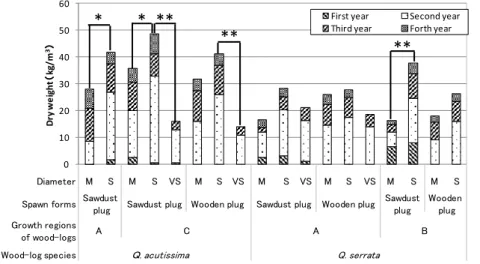
Fig. 2. The yields(dry weight/m3)of 4 years cultivation using the wood-logs of Q. acutissima and Q. serrata.
34
前田亜紗・舩戸知聖・黒田 誠・寺島和寿・長谷部公三郎 2) 樹種の違いによる収量の比較
産地Aの原木を使用した場合の,クヌギとコ ナラにおける1 m3当たりの収量(乾重)を比較 した結果をFig. 2に示した.原木の径,植菌法に 関わらず,4年間の収量については,クヌギがコ ナラよりも収量が多く,特に小径木においては,
形成種菌植菌原木では5%,駒種菌植菌原木は 1%レベルで統計的に有意な差が認められた.一 方,1年目の発生に注目すると,形成種菌を植菌 したコナラの方が同クヌギよりも収量が多かっ た.また,予備的に行った大径木(直径13~20 cm)を用いた試験においても同様な傾向が認め られた(データ未公表).
4年間の収量において,クヌギがコナラよりも 多かったことは,菌興101号,菌興514号の子実 体発生総量はクヌギの方がコナラよりも多いとい う報告(岸本ら,1985)と一致する.クヌギはコ ナラよりも辺材率が大きく(岸本ら,1985),含 まれる養分含量も多いため(時本,2010),子実 体収量が高くなったと考えられる.一方,形成種 菌を植菌した場合,クヌギの方がコナラよりも1 年目の発生が少なかったが,これは,導管などの 材組織構造の影響により,クヌギはコナラよりも 組織内の孔隙率が小さく(岸本ら,1985),シイ タケ菌の蔓延が遅くなりやすいことなどが影響し
ていると考えられ,今後検討する必要がある.
3) 径級と収量との関係
原木の産地(A,B,C),樹種(クヌギ,コナラ),
植菌法(形成,駒)の条件を同一とする各試験区 において,乾燥収量(原木1 m3当たり,ほだ木 1本当たり,種菌1個当たり)を,原木の径級区 分(中径木,小径木,極小径木)ごとに比較した
結果を, Figs. 3-5に示した. また,子実体1個当
たりの乾重を原木径級ごとに比較した結果を,
Fig. 6に 示 し た. な お, 調 査 期 間 は2010年 ~ 2013年の4年間であったが,4年目の極小径木か らの発生は認められなかった.
径級間で1 m3当たりの乾燥収量を比較した結 果,比較できる全ての試験区において,小径木の 収量が,中径木,極小径木よりも多かった(Fig. 3).
特に,産地Aのクヌギに形成種菌を植菌した中 径木と小径木との間,産地Cのクヌギに形成種 菌を植菌した小径木と中径木・極小径木との間,
および駒種菌を植菌した小径木と極小径木との 間,また,産地Bのコナラに形成種菌を植菌し た小径木と中径木との間において統計的に有意な 差が認められた.これらの結果は,コナラを用い
たTMI-563の栽培試験において,直径が小さい
ほど材積当たりの発生量は多いが,直径が小さす
*
菌蕈研究所研究業績,第xxx号,(一財)日本きのこセンター・菌蕈研究所,〒689-1125 鳥取市古郡家211. Contribution No. xxx of the Tottori Mycological Institute, 211 Kokoge, Tottori 689-1125, Japan.**
現住所:鳥取県生活環境部, 〒680-0061 鳥取市立川町 6-176, Present address: Tottori Prefectural Government, 6-176, Tachikawa, Tottori 680-0061.***
現住所:菌興椎茸協同組合, 〒680-0845 鳥取市富安 1-84, Present address: Kinko Shiitake Cooperative Association, Tomiyasu, Tottori, 680-0845Fig. 3. The yields (dry weight/m
3) of 4 years cultivation using the wood-logs of different classes
Classification of wood-logs: see Table 1. M, middle; S, small; VS, very small
Fig. 4. The yields (dry weight) per bed log of 4 years cultivation using the wood-logs of different classes
Classification of wood-logs: see Table 1 and Fig.3.
0 10 20 30 40 50 60
Dry weight(kg/m3)
First year Second year Third year Forth year
Wood-log species Spawn forms Diameter
Growth regions of wood-logs
Sawdust
plug Sawdust plug Wooden plug
B
A C A
Q. acutissima Q. serrata
* * **
** **
**: P<0.01, *: P<0.05 (ANOVA followed by Tukey-Kramer’s test) M
M S S VS M S VS M S VS M S VS M S M S
Wooden plug
Sawdust plug Wooden
plug Sawdust
plug
0 50 100 150 200 250 300
Dry weight (g per bed log) First yearSecond year
Third year Forth year
**
**
**
**
** ** *
**
**: P<0.01, *: P<0.05 (ANOVA followed by Tukey-Kramer’s test) Wood-log species
Spawn forms Diameter
Growth regions of wood-logs
Sawdust
plug Sawdust plug Wooden plug
B
A C A
Q. acutissima Q. serrata
M
M S S VS M S VS M S VS M S VS M S M S
Wooden plug
Sawdust plug Wooden
plug Sawdust
plug
Fig. 3. The yields(dry weight/m3)of 4 years cultivation using the wood-logs of different classes. Classification of wood-logs: see Table 1. M, middle; S, small; VS, very small.
35
原木形質と植菌法が菌興115号の子実体収量に及ぼす影響
*
菌蕈研究所研究業績,第xxx号,(一財)日本きのこセンター・菌蕈研究所,〒689-1125 鳥取市古郡家211. Contribution No. xxx of the Tottori Mycological Institute, 211 Kokoge, Tottori 689-1125, Japan.**
現住所:鳥取県生活環境部, 〒680-0061 鳥取市立川町 6-176, Present address: Tottori Prefectural Government, 6-176, Tachikawa, Tottori 680-0061.***
現住所:菌興椎茸協同組合, 〒680-0845 鳥取市富安 1-84, Present address: Kinko Shiitake Cooperative Association, Tomiyasu, Tottori, 680-0845Fig. 3. The yields (dry weight/m
3) of 4 years cultivation using the wood-logs of different classes
Classification of wood-logs: see Table 1. M, middle; S, small; VS, very small
Fig. 4. The yields (dry weight) per bed log of 4 years cultivation using the wood-logs of different classes
Classification of wood-logs: see Table 1 and Fig.3.
0 10 20 30 40 50 60
Dry weight(kg/m3)
First year Second year Third year Forth year
Wood-log species Spawn forms Diameter
Growth regions of wood-logs
Sawdust
plug Sawdust plug Wooden plug
B
A C A
Q. acutissima Q. serrata
* * **
** **
**: P<0.01, *: P<0.05 (ANOVA followed by Tukey-Kramer’s test) M
M S S VS M S VS M S VS M S VS M S M S
Wooden plug
Sawdust plug Wooden
plug Sawdust
plug
0 50 100 150 200 250 300
Dry weight (g per bed log) First yearSecond year
Third year Forth year
**
**
**
**
** ** *
**
**: P<0.01, *: P<0.05 (ANOVA followed by Tukey-Kramer’s test) Wood-log species
Spawn forms Diameter
Growth regions of wood-logs
Sawdust
plug Sawdust plug Wooden plug
B
A C A
Q. acutissima Q. serrata
M
M S S VS M S VS M S VS M S VS M S M S
Wooden plug
Sawdust plug Wooden
plug Sawdust
plug
*
菌蕈研究所研究業績,第xxx号,(一財)日本きのこセンター・菌蕈研究所,〒689-1125 鳥取市古郡家211. Contribution No. xxx of the Tottori Mycological Institute, 211 Kokoge, Tottori 689-1125, Japan.**
現住所:鳥取県生活環境部, 〒680-0061 鳥取市立川町 6-176, Present address: Tottori Prefectural Government, 6-176, Tachikawa, Tottori 680-0061.Fig. 5. The yields (dry weight) per spawn in 4 years cultivation using the wood-logs of different classes
Classification of wood-logs: see Table 1 and Fig.3.
0 1 2 3 4 5 6 7 8
Dry weight (g per spawn)
** **
**: P<0.01, *: P<0.05 (ANOVA followed by Tukey-Kramer’s test) Diameter
Sawdust
plug Sawdust plug Wooden plug
B
A C A
Q. acutissima Q. serrata
M
M S S VS M S VS M S VS M S VS M S M S
Wooden plug
Sawdust plug Wooden
plug Sawdust
plug
Wood-log species Spawn forms Growth regions of wood-logs
0 1 2 3 4 5 6
Dry weight (g per fruiting body)
** **
**: P<0.01, *: P<0.05 (ANOVA followed by Tukey-Kramer’s test) Diameter
Sawdust
plug Sawdust plug Wooden plug
B
A C A
Q. acutissima Q. serrata
M
M S S VS M S VS M S VS M S VS M S M S
Wooden plug
Sawdust plug Wooden
plug Sawdust
plug
Wood-log species Spawn forms Growth regions of wood-logs
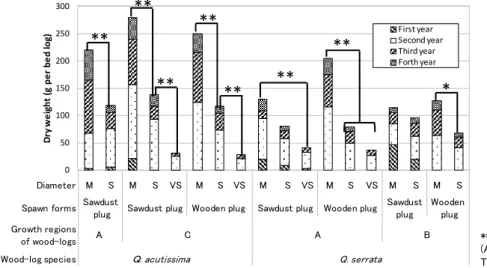
Fig. 4. The yields(dry weight)per bed log of 4 years cultivation using the wood-logs of different classes. Classification of wood-logs: see Table 1 and Fig.3.
Fig. 5. The yields(dry weight)per spawn in 4 years cultivation using the wood-logs of different classes. Classification of wood-logs: see Table 1 and Fig.3.
36
前田亜紗・舩戸知聖・黒田 誠・寺島和寿・長谷部公三郎 ぎる(6 cm以下)と逆に,発生量が減少するこ
とを示した福田ら(1987)および時本(2010)の 報告と一致した.本試験では,菌興115号の栽培 において, コナラ原木だけでなく,クヌギ原木に おいても直径が小さすぎると発生量が減少するこ とを示した.これは材積当たりでは小径木(7 cm 前後)の方が大~中径木よりも水溶性の窒素など 養分量が多く菌糸成長が良好だが,直径が小さす ぎる(6 cm以下)と過乾燥などの弊害を受けや すく,発生量が少なくなるためと考えられる(福 田ら,1987;時本,2010).
ほだ木1本当たりの乾燥収量を比較した結果,
全ての試験区において,原木の径が大きくなるほ ど収量も多かった(Fig. 4).特に,クヌギでは全 ての試験区で,コナラにおいては産地Aと産地 Bの原木に駒種菌を植菌した試験区で,中径木の 収量が,小径木や極小径木の収量と比べて統計的 に有意に多かった.この結果は小山田ら(1979)
の結果と一致しており,ほだ木1本当たりの養分 量は径が大きい方が多いためであると考えられる
(時本,2010).
種菌1個当たりの乾燥収量を比較した結果,コ ナラ極小径木において収量が高くなる傾向が認め られた(Fig. 5).特に,産地Aの形成試験区に
おける極小径木と小および中径木との間および産 地Aの駒試験区における極小径木と小径木との 間で,統計的に有意な差が認められた.これらの
結果は, 径が小さいほど材積当たりの養分量が豊
富なため(福田ら,1987;時本,2010),シイタ ケ菌がよく蔓延したものと考えられる.クヌギ極 小径木において,コナラと同様の結果が得られな かった原因として,クヌギはコナラと比較して樹 皮面からの水分の出入りが多いため(本田ら,
1981),径級が小さいほど乾燥しやすかったこと が考えられるが,今後の精査が必要である.
子実体1個あたりの乾重(平均1個乾重)につ いて比較した結果,クヌギ・産地C・形成試験区 およびコナラ・産地A・駒試験区を除き,原木径 が大きくなるほど,平均1個乾重が重い傾向が認 められた(Fig. 6).特に,クヌギ・産地C・駒試 験区およびコナラ・産地A・形成試験区において は,中径木の平均1個乾重が,極小径木あるいは 小径木と比較して,有意に大きかった.これらの 傾向は 八島ら(2015)の報告でも同様な結果が 得られている.これらの結果は,径が大きい程,
樹皮面積に対する材積が大きくなり,きのこ1個 当たりの養分供給量も多くなるためと考えられる
(時本,2008).
*
菌蕈研究所研究業績,第xxx号,(一財)日本きのこセンター・菌蕈研究所,〒689-1125 鳥取市古郡家211. Contribution No. xxx of the Tottori Mycological Institute, 211 Kokoge, Tottori 689-1125, Japan.**
現住所:鳥取県生活環境部, 〒680-0061 鳥取市立川町 6-176, Present address: Tottori Prefectural Government, 6-176, Tachikawa, Tottori 680-0061.***
現住所:菌興椎茸協同組合, 〒680-0845 鳥取市富安 1-84, Present address: Kinko Shiitake Cooperative Association, Tomiyasu, Tottori, 680-0845Fig. 5. The yields (dry weight) per spawn in 4 years cultivation using the wood-logs of different classes
Classification of wood-logs: see Table 1 and Fig.3.
0 1 2 3 4 5 6 7 8
Dry weight (g per spawn)
** **
**: P<0.01, *: P<0.05 (ANOVA followed by Tukey-Kramer’s test) Diameter
Sawdust
plug Sawdust plug Wooden plug
B
A C A
Q. acutissima Q. serrata
M
M S S VS M S VS M S VS M S VS M S M S
Wooden plug
Sawdust plug Wooden
plug Sawdust
plug
Wood-log species Spawn forms Growth regions of wood-logs
0 1 2 3 4 5 6
Dry weight (g per fruiting body)
** **
**: P<0.01, *: P<0.05 (ANOVA followed by Tukey-Kramer’s test) Diameter
Sawdust
plug Sawdust plug Wooden plug
B
A C A
Q. acutissima Q. serrata
M
M S S VS M S VS M S VS M S VS M S M S
Wooden plug
Sawdust plug Wooden
plug Sawdust
plug
Wood-log species Spawn forms Growth regions of wood-logs
Fig. 6. Mean values of dry weight per fruiting body in 4 years cultivation using the wood-logs of different classes. Classification of wood-logs: see Table 1 and Fig.3.
37
原木形質と植菌法が菌興115号の子実体収量に及ぼす影響
なお,Figs. 3-6に示したこれらの結果は,大径
木(直径13~20 cm)を含めた予備試験におい
ても同様の傾向が認められた(データ未公表).
今後, 大径木を用いた栽培試験において統計的処
理が可能な試験区を設定し,同様な結果が得られ るかを検討する必要があると思われる.
4) 植菌法の違いによる収量の比較
原木の産地(A,B,C),樹種(クヌギ,コナラ),
径級(中径木,小径木,極小径木)の条件を同じ とする各試験区において,植菌法(形成,駒,駒 深植)の異なる試験区間で収量を比較した(Fig. 7)
結果,植菌法と収量との間に明確な傾向は見られ なかった.しかし,大径木を用いた予備試験にお いて,駒深植区の収量は,対照区よりも,多い傾 向が認められており(データ未公表),今後,深 植効果の精査が必要である.
摘 要
原木シイタケ品種「菌興115号」は,肉質が極 めて厚く食味に優れた特徴を持つため,この品種 のブランド化に向けた取組みが各地で行われてい る.本研究では,菌興115号の収量性に影響する
栽培要因に関する基礎的知見を集積するために,
原木の産地,樹種,径級,植菌法(種菌の種類、
植菌孔の深さ)の異なる条件における菌興115号 の子実体発生特性を調査した.
その結果,菌興115号において,①原木産地が 収量に影響を与えること,②形成種菌を用いた場 合の1年目の発生では,コナラ試験区がクヌギ試 験区よりも乾燥収量は多いが, 4年間では原木の 径・種菌形態・植菌法を問わず,クヌギ試験区が コナラ試験区よりも乾燥収量が多いこと,③原木 材積当たりの乾燥収量は,小径木試験区の方が中 径木試験区および極小径木試験区よりも多いこ と,④ほだ木1本当たりの乾燥収量は,中径木試 験区が小径木試験区および極小径木試験区よりも 多いこと,⑤種菌1個当たりの収量は,コナラ試 験区では極小径木試験区が中径木試験区および小 径木試験区よりも多いこと,⑥子実体の平均1個 乾重は,中径木試験区の方が小径木試験区,極小 径木試験区と比較して大きい傾向があること,⑦ 植菌法(種菌の種類,植菌孔の深さ)が異なる試 験区間での収量性に有意な差が認められないこ と,が 示された.
* 菌蕈研究所研究業績,第xxx号,(一財)日本きのこセンター・菌蕈研究所,〒
689-1125鳥取市古郡家
211. Contribution No. xxx of the Tottori Mycological Institute, 211 Kokoge, Tottori 689-1125, Japan.** 現住所:鳥取県生活環境部 , 〒 680-0061 鳥取市立川町 6-176, Present address: Tottori Prefectural Government, 6-176, Tachikawa, Tottori 680-0061.
*** 現住所:菌興椎茸協同組合 , 〒 680-0845 鳥取市富安 1-84, Present address: Kinko Shiitake Cooperative Association, Tomiyasu, Tottori, 680-0845
wood-logs of different classes
Classification of wood-logs: see Table 1 and Fig.3.
Fig. 7. The yields (dry weight/m
3) of 4 years of cultivation using the wood-logs inoculated with sawdust and wooden spawn
S, Sawdust plug spawn; W, Wooden plug spawn; W (D), Wooden plug spawn (Deep hole, 8 cm depth)
0 10 20 30 40 50 60
Dry weight (kg/m3)
First year Second year Third year Forth year
A Small Wood-log species
Spawn form
Diameter Growth regions
of wood-logs C C C
Middle Very small
Q. acutissima
A Middle
B A B
Small
A Very small Q. serrata
S W W (D)
S S S S S W
(D)
S S
W W W W W W S W W
(D)
W
Fig. 7. The yields(dry weight/m3)of 4 years of cultivation using the wood-logs inoculated with sawdust and wooden spawn. S; Sawdust plug spawn; W; Wooden plug spawn; W(D); Wooden plug spawn(Deep hole, 8 cm depth).
38
前田亜紗・舩戸知聖・黒田 誠・寺島和寿・長谷部公三郎
引 用 文 献
上馬裕子. 2012. 原木シイタケ「のと115」の 生産拡大・知名度向上に向けた取組みについ て. 菌蕈 58: 16-19.
小山田研一,飯田達雄,千原賢次,松尾芳徳,佐々 木義則. 1979.シイタケ原木の採材部位に関 する試験. 日林九支研論 32: 349-350
垣田 修.2014.「鳥取県きのこビジョン」~き のこ王国とっとりの実現を目指して~.菌蕈 60: 10-17.
主計三平, 金子周平. 1978.シイタケ原木の特性 に関する研究(II)クヌギ原木樹皮の特性とシ イタケ発生量について.日林九支研論 31: 317- 318
岸本 潤,古川郁夫,作野友康.1985.コナラ,
クヌギほだ木におけるシイタケ発生の比較.
広葉樹研究 3: 121-131.
時本景亮. 2008. シイタケ原木栽培の栄養学-原
木一本からのきのこの最大発生量を考える-.
菌蕈 54: 36-41.
時本景亮.2010.シイタケ原木栽培の基礎.日本 きのこ学会誌 18: 131-138.
日本きのこセンター(編).1986.“シイタケ栽培 の技術と経営”,家の光協会, 東京, 220p.
橋詰隼人,脇田嘉輔.1983.シイタケ原木育種の 基礎となるコナラ樹皮の形質の変異.広葉樹研 究 2: 27-40.
福 田 正 樹, 時 本 景 亮, 坪 井 正 知, 西 尾 幸 弘. 1987.シイタケ原木の形質とほだ木の腐朽度お よび子実体発生量の関係.菌蕈研報 25: 68-74.
本田耕吉,古川郁夫,作野友康,岸本 潤.1981.
シイタケ原木としてのコナラ・クヌギの水分挙 動について.鳥大演報 13: 49-57.
八島武志, 小谷二郎, 角 正明.2015.シイタケ
子実体のサイズと原木サイズの関係について,
石川県農林セ林試報 47: 5-7.