ISSN 1881-9109 National Museum of Nature and Science Monograph No. 47
BIO-ANTHROPOLOGICAL STUDIES OF EARLY HOLOCENE HUNTER-GATHERER SITES AT HUIYAOTIAN AND LIYUPO IN GUANGXI, CHINA
Edited by
Hirofumi Matsumura Hsiao-chun Hung Li Zhen
Kenichi Shinoda
National Museum of Nature and Science Monographs
No. 47
National Museum of Nature and Science Monographs No. 47
ISSN 1881-9109
Bio-Anthropological Studies of Early Holocene Hunter-Gatherer Sites at Huiyaotian and Liyupo in Guangxi, China
Hirofumi Matsumura Hsiao-chun Hung Li Zhen
Kenichi Shinoda
National Museum of Nature and Science
Tokyo, November 2017
Makoto Manabe, Collection Center
National Museum of Nature and Science Ueno Park, Tokyo 110–8718
Japan
Copyright ©2017
National Museum of Nature and Science, Tokyo Published on November 30, 2017
Printed by Kokusai Bunkensha Co. Ltd., Tokyo ISSN: 1881-9109
ISBN: 978-4-87803-041-3
PREFACE
PREFACE
This monograph is a product of a multi-disciplinary and multi-national research project by researchers from China, Japan, and Australia to understand the prehistory of Guangxi Province in China based on our bio-anthropological analyses of the early Holocene hunter-gatherer sites of Huiyaotian and Liyupo. The principle focus of this volume are the micro-evolutionary history, specific and general aspects of health, sub- sistence strategies, and burial practices of these ancient hunter-gatherers. We hope that this monograph will provide an invaluable source of information concerning prehis- toric peoples in East Asia.
The editors would like to thank all of the authors for their contributions to this vol- ume.
Hirofumi Matsumura 松村博文 Hsiao-chun Hung 洪曉純 Li Zhen 李珍
Kenichi Shinoda 篠田謙一
Director Lin Qiang 林強
(Guangxi Institute of Cultural Relic Protection and Archaeology, China) Vice Director Wei Ge 韦革
(Guangxi Institute of Cultural Relic Protection and Archaeology, China) Professor Xie Guangmao
谢光茂(Guangxi Institute of Cultural Relic Protection and Archaeology, China) Director Huang Shengmin 黄圣敏
(Nanning City Museum, Guangxi, China) Dr. Wei Xing-tao 魏兴涛
(Henan Provincial Institute of Cultural Heritage and Archaeology, China) Professor Li Xin-wei 李新
伟(Institute of Archaeology, Chinese Academy of Social Science in Beijing, China) Director Huang Wei-jin 黃渭金
(Hemudu Museum in Zhejiang, China) Professor Sun Guo-ping
孙国平(Cultural Relics and Archaeology Institute of Zhejiang Province, China)
This research project was supported by a Grant-in-Aid KAKENHI (B) in 2013–2017
(No. 25304020) from the Japan Society for the Promotion of Science (JSPS), and
ARC Discovery Project (ID: DP 110101097) from the Australian Research Council
(ARC) Grant Aid in Australia.
CONTRIBUTORS
CONTRIBUTORS
(alphabetical order of surname)
Huang Qiang
Nanning City Museum, China Huang Yunzhong 黄云忠
Nanning City Museum, China Hsiao-chun Hung 洪曉純
Department of Archaeology and Natural History, Australian National University, Australia
Yousuke Kaifu 海部陽介
Department of Anthropology, National Museum of Nature and Science, Tokyo, Japan
Tsuneo Kakuda 角田恒雄
Department of Legal Medicine, Interdisciplinary Graduate School of Medicine and Engineering, University of Yamanashi, Japan
Shinji Kubota 久保田慎二
Center for Cultural Resource Studies, Kanazawa University, Japan Li Zhen 李珍
Guangxi Institute of Cultural Relic Protection and Archaeology Cultural Relics and Archeological, China
Lin Qiang 林強
Guangxi Institute of Cultural Relic Protection and Archaeology Cultural Relics and Archeological, China
Hirofumi Matsumura 松村博文
School of Health Science, Sapporo Medical University, Japan Emiri Miyama 深山絵実梨
Public Collaboration Center, Tokyo University of the Arts, Tokyo, Japan Nguyen Lan Cuong
The Vietnamese Institute of Archaeology, Vietnam Junmei Sawada 澤田純明
Faculty of Medical Technology, Niigata University of Health and Welfare, Japan Ken-ichi Shinoda 篠田謙一
Department of Anthropology, National Museum of Nature and Science, Tokyo, Japan
Shinya Watanabe 渡辺慎也
Toshima Ward Education Board, Tokyo, Japan Mariko Yamagata 山形眞理子
Department of Economy, Okayama Science University, Japan Zhang Chi 張弛
School of Archaeology and Museology, Peking University, China
Chapter 1 Introduction 1 Hirofumi Matsumura, Hsiao-chun Hung, Li Zhen, Mariko Yamagata, Lin Qiang,
Zhang Chi
Chapter 2 Huiyaotian Site in Nanning, Guangxi, China 7 Li Zhen, Hsiao-chun Hung, Huang Yun-zhong, and Hirofumi Matsumura
Chapter 3 Burial Practice and Individual Descriptions of the Human Skeletal
Remains at Huiyaotian 17
Hirofumi Matsumura, Shinya Watanabe, and Mariko Yamagata
Chapter 4 Unique Squatting Burial Posture Observed at Huiyaotian 61 Yosuke Kaifu
Chapter 5 Paleopathological Description of
the Huiyaotian Human Remains 65
Junmei Sawada, Emiri Miyama, Shinya Watanabe, and Shinji Kubota
Chapter 6 Morphometric Records of the Huiyaotian Human Skulls 81 Hirofumi Matsumura and Nguyen Lan Cuong
Chapter 7 Morphometric Records of the Huiyaotian Human Teeth 85 Shinji Kubota and Hirofumi Matsumura
Chapter 8 Morphometric Records of the Huiyaotian Human Limb Bones 89 Shinya Watanabe, Emiri Miyama, and Hirofumi Matsumura
Chapter 9 Liyupo Site in Longan, Guangxi, China 95 Li Zhen, Hsiao-chun Hung, Huang Qiang, and Hirofumi Matsumura
Chapter 10 Individual Descriptions of Human Skeletal Remains at Liyupo 105 Hirofumi Matsumura, Emiri Miyama, and Shinya Watanabe
Chapter 11 Paleopathological Description of the Liyupo Human Remains 129
Junmei Sawada
Chapter 12 Morphometric Records of the Liyupo Human Skulls 143 Hirofumi Matsumura and Nguyen Lan Cuong
Chapter 13 Morphometric Records of the Liyupo Human Teeth 145 Shinji Kubota and Hirofumi Matsumura
Chapter 14 Morphometric Records of the Liyupo Human Limb Bones 149 Emiri Miyama, Shinya Watanabe, and Hirofumi Matsumura
Chapter 15 The Origin of Early Holocene Hunter-Gatherers at Huiyaotian and Liyupo in Guangxi, Southern China: Craniometric Perspective 155 Hirofumi Matsumura, Nguyen Lan Cuong, Li Zhen, Hsiao-chun Hung, and Huang
Yun-zhong
Chapter 16 The Origin of Early Holocene Hunter-Gathers at Huiyaotian
and Liyupo in Guangxi, Southern China: Odontmetric Perspective 171 Shinji Kubota and Hirofumi Matsumura
Chapter 17 Comparative Study of the Limb Bones
at Huiyaotian and Liyupo 181
Emiri Miyama and Hirofumi Matsumura
Chapter 18 Health Profiles of the Huiyaotian and Liyupo Hunter-Gatherers 191 Junmei Sawada
Chapter 19 Mitochondrial DNA Analysis of the Human Remains Excavated
from Huiyaotian and Liyupo 199
Kenichi Shinoda and Tsuneo Kakuda
Chapter 20 Neolithic Transition in Guangxi: A Long Development of
Hunting-Gathering Society in Southern China 205
Hsiao-chun Hung, Zhang Chi, Hirofumi Matsumura, and Li Zhen
Hirofumi Matsumura et al.
Introduction 1
Hirofumi Matsumura,
1Hsiao-chun Hung,
2Li Zhen,
3Mariko Yamagata,
4Lin Qiang,
3and Zhang Chi
51
School of Health Science, Sapporo Medical University, Sapporo, Japan
2
Department of Archaeology and Natural History, Australian National University, Canberra, Australia
3
Guangxi Institute of Cultural Relic Protection and Archaeology, Nanning, China
4
Department of Economy, Okayama Science University, Japan
5
School of Archaeology and Museology, Peking University, Beijing, China
PROJECT CONCEPT
Guangxi Province in Southern China has produced a great quantity of important and unique prehistoric human remains. For example, the Liujiang materials are well-known Late-Pleistocene human fossils, and subsequent early to middle Holocene sites, such as Dalongtan, Zengpiyan, and Dingsishan, exhibit transition stages between hunter-gath- erer subsistence to agricultural development. This research project focused on two shell-midden sites in southwestern Guangxi that were settled by early hunter-gatherers, Huiyaotian and Liyupo, which date to approximately 9,000 to 7,000 years BP and are contemporary with the early rice-farming societies in the middle and lower Yangtze River Valley. The site of Huiyaotian is located in the Qingxiu District in the eastern suburban area of the City of Nanning on a terrace along the Yongjiang River. Liyupo is located in Longan County around 80 km northwest of Nanning. Huiyaotian is notable for its inhumation burials, which are customarily in a flexed positioned style (four- limbs tightly flexed at the joints) but also are found with a squatting style. The burial practice of Liyupo is also unique, in that people in a flexed position were covered fre- quently with large stones.
Another unique and significant feature of these prehistoric foragers is their skeletal
morphology, particularly their cranial forms that exhibit identifiable characteristics,
which are distinctive from present-day East Asians. Current cranial morphology
reflects the fact that Eastern Eurasia has been widely occupied by people morphologi-
cally adapted to an extremely cold climate during the last glacial period, who display
the characteristics of very flat face and proportionally short limbs. Hypothetically, indi-
viduals with these characteristics would have dispersed throughout Eastern/Southeast-
ern Asia along with an agricultural society that included plant and animal domestica-
tion from the Neolithic period onward. At the very least, the pre-Neolithic
hunter-gatherers of Huiyaotian and Liyupo visually present a very different cranial
form from later occupants of the area.
Studying the population history of East Asia has been difficult due to various migra- tion processes and intermixing of populations throughout prehistory. Focusing on an area adjacent to Guangxi, for instance Vietnam in the early Holocene, it can be seen that the so-called epi-Paleolithic Hoabinhian foragers exhibited Australo-Melanesian characteristics. It has been argued that a similar indigenous population occupied South- east Asia and replaced or intermixed with later Neolithic agricultural populations origi- nating from northern mainland China. This population history model in Southeast Asia is known as the “two-layer” model.
[1][2][3][4][5]Given this perspective from the population history of surrounding regions, the dis- covery of human skeletal remains at the shell-midden sites of Huiyaotian and Liyupo is very important evidence of early hunter-gatherers and their unique mortuary practices.
These cranial remains provide a valuable opportunity to evaluate the “two-layer” model Figure 1-1. Research participants at the excavation of Huiyaotian and the monu-
ments at Huiyaotian and Liyupo (Lower left: Yamagata M., Matsumura H., Shi-
noda K., Sawada J., Nguyen LC., and Li Z.; Lower right: front Huang Q., Hung
HC., Yamagata M., Miyama E., rear Huang Y., Liu J., Matsumura H., Li Z., Kaifu
Y., and Watanabe S.).
Hirofumi Matsumura et al.
hypothesis in mainland China. Thereby, based on discussion and agreements between Director Lin Qing, Professor Li Zhen (Guangxi Institute of Cultural Relic Protection and Archaeology, China), Dr. Hsiao-chun Hung (Australian National University), Pro-
Figure 1-2. Views of post-excavation activities by the research members (clean-
ing and reconstructing, 3D scanning, DNA sampling skeletons at the storage
Nanning City Museum) and members at the symposium at the Guangxi Institute
of Cultural Relic Protection and Archaeology organized by the Director, Lin
Qiang (seventh from the right).
This volume is a product of multi-disciplinary and multi-national efforts over the past five years. The first section (Chapters 2–8) presents the basic information concern- ing the human remains from Huiyaotian, and the second section (Chapters 9–14) describes the materials from Liyupo. These two sections provide general information on the sites, including location, cultural context, burial distribution, C14 chronology, and morphometric data recorded for the human skeletal and dental remains excavated from the cemeteries. Furthermore, detailed descriptions of the posture observed in one of the best-preserved cases of the unique squatting burials at Huiyaotian are included.
The third section (Chapters 15–19) explores comprehensive studies using materials from the two sites. The morphometric analyses address cranial and dental limb affinity in comparison with surrounding population samples from East/Southeast Asia and the Western Pacific. The paleopathological study assesses stress markers in terms of dental enamel hypoplasia, cribra orbitalia, and oral diseases in comparison with later Neo- lithic agricultural population samples from the surrounding area. An examination of ancient mitochondrial DNA is presented in this section. Lastly, a summary of this proj- ect is given in Chapter 20.
CONFERENCE PRESENTATIONS
In addition to the material included in this volume, the results of this project were presented in the 69th Annual Meeting of the Anthropological Society Japan, with the titles listed below.
Unique Flexed Burial Human Remains of Prehistoric Hunter-Gatherers in Yongji- ang Region, Guangxi, China — Challenging Hypothesis on the Population History of Eastern Eurasia — presented by Matsumura H, Li Z, Huang Y, Huang Q, Kubota S, Nguyen LC, Miyama E, Yamagata M, Watanabe S, Sawada J, Shinoda K, Kaifu Y, and Hung HC. Abstract: Anthropol. Sci., 2015, 123: 9.
Paleopathological Findings in the Prehistoric Hunter-gatherer Skeletons of Yongji- ang Region, Guangxi, China — presented by Sawada J, Li Z, Huang Y, Huang Q, Kubota S, Miyama E, Watanabe S, Yamagata M, Nguyen, LC, Hung H, and Matsu- mura H. Anthropol. Sci., 2015, 123: 10.
LITERATURE CITED
[1] Matsumura H, Oxenham MF, Thuy NK, Nguyen LC, Dung NK. The population history of mainland Southeast Asia: Two layer model in the context of northern Vietnam. In: Enfield N. (ed.), Dynamics of human diversity: the case of mainland Southeast Asia. Pacific Linguistics, Canberra, 2011: 153–
178.
Hirofumi Matsumura et al.
[2] Matsumura H, Oxenham MF. Population dispersal from East Asia into Southeast Asia: Perspectives from prehistoric human remains. In: Pechenkina K, Oxenham MF. (eds.), Bioarchaeological Per- spectives on Migration and Health in Ancient East Asia. University of Florida, Florida, 2013: 179–
212.
[3] Matsumura H, Oxenham MF. Demographic transitions and migration in prehistoric East/Southeast Asia: Through the lens of nonmetric dental traits. American Journal Physical Anthropology, 2014, 155:45–65.
[4] Matsumura H, Oxenham MF. Eastern Asia and Japan: human biology. In: Bellwood P. (ed.), The Global Prehistory of Human Migration. Wiley-Liss, New York, 2014: 217–223.
[5] Matsumura H, Oxenham MF, Nguyen LC. Hoabinhian: key population with which to debate the peopling Southeast Asia. In: Kaifu Y, Izuho M, Goebel T, Sato H, Ono A. (eds.), Emergence and Diversity of Modern Human Behavior in Palaeolithic Asia. Texas A&M University Press, Texas, 2015: 117–132.
Li Zhen et al.
Huiyaotian Site in Nanning, Guangxi, China 2
Li Zhen
1, Hsiao-chun Hung
2, Huang Yun-zhong
3and Hirofumi Matsumura
41
Guangxi Institute of Cultural Relic Protection and Archaeology, Nanning, China
2
Department of Archaeology and Natural History, Australian National University, Australia
3
Nanning City Museum, Nanning, China
4
School of Health Science, Sapporo Medical University, Sapporo, Japan
This chapter presents a brief introduction of the Huiyaotain site in Nanning, Guangxi, which is one of the key sites of our focus for this international archaeological collaboration research.
SITE LOCATION AND RESEARCH HISTORY
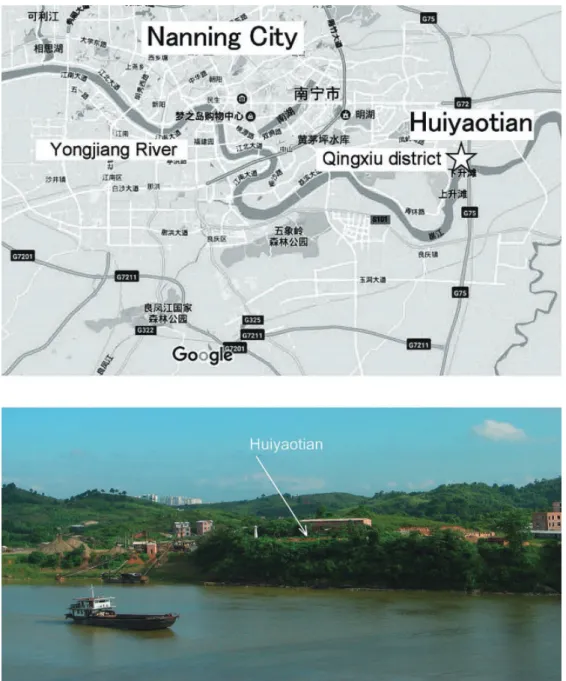
Huiyaotian is located at the foot of Huiyaotian hill, which is in the south of Sanʼan garden, Qingxiu district, Nanning city, Guangxi (Figure 2-1). The site is located on the first terrace on the left bank of Yongjiang River, and about 12–15 meters above the river. The extant area of the Huiyaotian site is 1800 square meters, about 60 meters long (east-west) by 30 meters wide (north-south). It is one of the well-preserved shell mounds in Yongjiang river basin. It is surrounded by short hills in the east, west and north.
Huiyaotian was discovered in 1973, and now is a protected cultural relic of Guangxi Zhuang Autonomous Region. The site was first excavated by a joint archaeological team from the Relic and Archaeology Institution of Guangxi, and Nanning City Museum, from April to July in 2006. The 2006 excavation opened 11 test pits of 5 by 5 meters for each square, about 280 square meters of total exposed area, located in the east, west and north portions of the site. This excavation discovered a clear strati- graphic sequence, with a large number of important cultural and natural relics. Because the landscape of Huiyaotian is higher at its north portion, the stratigraphic deposit therefore leans from north to south. The thickness of the cultural component is about 60 to 120 cm, in a matrix composed mainly of river shells (Figure 2-2).
CHRONOLOGY
Three samples including 2 charred Canarium sp. seed fragments and one human tooth have produced AMS dating results (see Table 2-1). The results indicate the age of Huiyaotian is about 7,000–6,300 cal. BC. This dating and its archaeological findings (see below) are congruent with the Dingsishan Cultural Phase of the Guangxi region.
As noticed previously, while rice-growing economies were developing in the Middle
and Lower Yangtze, a contemporary complex hunting-gathering group termed the Dingsishan Culture continued in existence and grew in the southern Guangxi region, c.
7,000–3,000 BC (Zhang and Hung
[1]). At the Dingsishan site itself, 16 burials have been excavated from phase 2 and 133 from phase 3, within a 500 square-meters exca- vated area. These cemeteries included flexed, squatted and even dismembered burials, all without grave goods (Guangxi Team et al.
[2]). The artifacts found in Dingsishan
Figure 2-1. The location of Huiyaotian site (upper image; map data: Google), and
its setting a viewed from across the Yongjiang River (lower image).
Li Zhen et al.
shell middens (phases 1 to 3) include polished stone axes and adzes (made of stone and bone), arrowheads, awls, needles, spears and hooks (all made of bone), shell tools and pottery. The most common shell tools are perforated so called fish-headed knives. The pottery was greyish-brown in color with coarse quartz or sand temper. Pottery surfaces are parallel ribbed or cord marked. Large quantities of aquatic and terrestrial animal bones have been discovered in Dingsishan (Lu
[3]; Zhang and Hung
[1]).
ARCHAEOLOGICAL FINDINGS FROM HUIYAOTIAN
In the 2006 season of archaeological excavation at Huiyaotian, more than 60 human burials, trash pits, post holes, and varied artifacts made by pottery, bone and clam have
Figure 2-2. The stratigraphy of east profile of T1209 at Huiyaotian.
Table 2-1. Results of carbone 14 dating for Huiyaotian materials.
been discovered.
1. Human burials and other features
Human burials were distributed primarily in the southern part of the site, and con- Figure 2-3. Huiyaotian cemetery from 2006 eexcavation, and the layout of
human burials in two trenches (M: human burial; T: post hole; H: trash-pit).
Li Zhen et al.
centrated in an area about 40 meters in length and 10–15 meters in width. Many of those burials were arranged in east-west direction along the river bank (Figures 2–3 and 2–4). Most graves contained single individuals, although some were joint burials.
They mainly were buried in flexed positions. The forms of flexed position at Huiyao- Figure 2-4. Recovery of human skeletons from Huiyaotian by the project mem-
bers in 2012.
Regarding burial goods, only very few burials have been found with 1 or 2 polished tools made of stone, bone or clam, but it is uncertain if those were placed there inten- tionally. Overall, most of the burials at Huiyaotian were without any burial goods.
Some of the burials had small stones associated with the human skeletons, in which some of them were found on the top of the skeletons.
With the cemetery, 13 post holes and 2 trash pits have been identified in trenches T1003 and T1004. Those post holes were mostly in round or oval shapes. Some of them were filled with stones or shells in the bottom. One representative post hole (see T4 in Figure 2-3) was round shaped, about 34–42 cm in diameter, and 38 cm in depth.
The trash pits at Huiyaotian contained potsherds, animal bones, shells and stones.
2. Artifacts
Unearthed artifacts from Huiyaotian include pottery and varied tools made of stone, clam, animal bone and horn.
(1). Pottery
The pottery is mainly reddish brown ware (about 50%), and there are also some in greyish-brown, greyish-black, greyish-yellow and red colors. Most pottery is sandy ware containing temper of quartz or shell fragments. Few potsherds contained charcoal temper or purely clay without inclusions. All pottery had been decorated with cord marks. The sizes of cords on Huiyaotian pottery can be divided into three approximate categories of coarse, middle and fine, in which about 96% belongs to the middle size. Only very few pieces had been decorated with incised line designs above the corded patterns. Because the firing temperature was low for this assemblage, all unearthed remains are potsherds, and no complete pots have been found. However, the pottery vessel forms are rather sim- ple as jars or cauldrons with a round base, either with open mouth or contracted mouth.
The only one available reconstructed pottery vessel is a reddish sand ware with middle size of cord marked decoration below its rim (Figure 2-5).
(2). Tools made of stone, clam, bone and horn
The stone implements include polished adzes, axes and grinding basin stones (Fig- ure 2-6). Most of the adzes or axes are partially polished, especially on their blade por- tions, and many of them have shown use-wear marks on the blades.
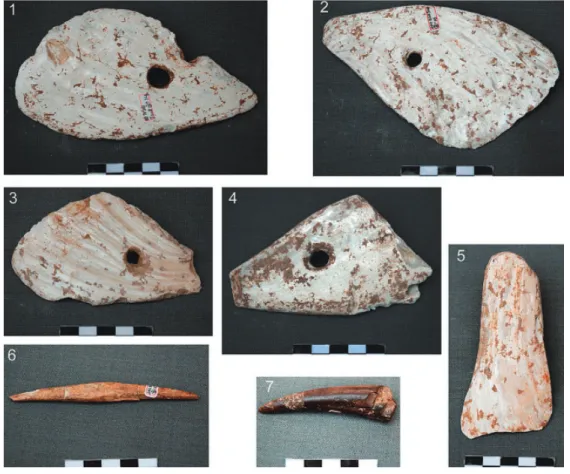
Clam implements comprise 50% of the artifacts from Huiyaoyian (Figure 2-7: 1-5).
They are polished knives and perhaps daggers. In fact, most of them are knives in a
“fish head” form. They were mainly made of Margaritiana sp. and some of Lamprotula
sp. clam. Many of them are in triangle shape with one perforation, and often intention-
Li Zhen et al.
ally chipped at the point part, thus producing a shape similar to a fish head. It is one of the unique characters of Dingsishan shell tools.
The number of bone implements unearthed from Huiyaotian is limited. They are in
Figure 2-5. Cord marked pottery unearthed from Huiyaotian.
Figure 2-6. Representative stone artifacts from Huiyaotian: stone adzes (1–4),
stone axes (5–7) and grinding basin stone (8).
Li Zhen et al.
the forms of awls, shovels and arrowheads. The raw materials of those bone tools are the limb bones of mammals. Moreover, there are also small findings of tools made of animal teeth and horns (Figure 2-7: 6–7).
3. Animal remains
Remains from both aquatic and terrestrial animals are rather abundant at Huiyaotian.
The identified fauna include mollusks (Gastropoda, Pulmonata, and Lamellibranchia), arthropods (Crustacea), and vertebrates (Pisces, Reptilia, Aves, and Mammalia). Within these seven classes, 53 species are identified from Huiyaotian.
Among the remains of molluska, Bellamya occupied more than 95%. Aquatic ani- mals include river fish such as yellowcheek carps, and turtles. Terrestrial animals include monkeys (Cercopithecidae), voles (Microtus sp.), bamboo rats (Rhizomys sp.), Chinese porcupines (Hystrix hodgsoni Gray), dogs (Canis familiaris Linnaeus), rac- coon dogs (Nyctereutes procyonoides Gray), hog-nosed badgers (Arctonyx collaris F.
Cuvier), hog-nosed badgers (Arctonyx collaris F. Cuvier), Asian elephants (Elephas maximus Linnaeus), wild pigs (Sus scrofa Linnaeus), barking deers (Muntiacus vagina- lis, Boddaert), Chinese Muntjaks (Muntiacus reevesi Ogilby), Sambars (Rusa unicolor
Figure 2-7. Shell knives (1–4), shell dagger (?)(5), bone awl (6) and horn tool (7).
yaotian definitely enrich the understanding of Dingsishan Culture in the Guangxi region.
Our work at Huiyaotian has successfully provided some reliable dates, thus over- coming the limited chronometric results from other Dingsishan sites. The new C14 dat- ing at Huiyaotian ca. 7,000–6,300 BC confirms it is among one of the earlier Dingsis- han sites in the Nanning region, and specifically it represents the early-middle stage within the extended period of Dingsishan Culture. The cultural assemblage and other findings from Huiyaotian can be regarded as a type-site for future comparison study to increase our understanding of the Holocene hunter-gather societies of southern China.
ABBREVIATIONS IA: Institute of Archaeology
ATGZ: Archaeological Team of the Guangxi Zhuang Autonomous Region CASS: Chinese Academy of Social Science
LITERATURE CITED
[1] Zhang C, Hung H. Later hunter-gatherers in southern China, 18000–3000 BC. Antiquity, 2012, 86:11–29.
[2] Guangxi Team, IA of CASS, ATGZ, Nanning Museum. Excavation at Dingsishan in Yongning, Guangxi. Kaogu. Archaeology, 1998.
[3] Lu P. Zooarchaeological study on the shell middens in the Yong Valley of Guangxi. Unpublished PhD dissertation, IA of CASS, Beijing, 2010.
Hirofumi Matsumura, Shinya Watanabe, and Mariko Yamagata
Burial Practice and Individual Descriptions of 3 Human Skeletal Remains at Huiyaotian
Hirofumi Matsumura,
1Shinya Watanabe,
2and Mariko Yamagata
31
School of helath Science, Sapporo Medical University, Sapporo, Japan
2
Toshima Ward Education Board, Tokyo, Japan
3
Department of Economy, Okayama Science University, Okayama, Japan
The state of preservation of 60 skeletal individuals excavated between 2012 and 2014 at the site of Huiyaotian is described below together with sex and age determina- tions and notes on their condition of preservation. Aspects of the burial pits undis- turbed nor heavily damaged are exhibited in Appendix Figure 3-A. The best-preserved skull and appendicular bones are displayed in the photographs included in Appendix Figure 3-B.
Age estimates were made based on the tooth eruption phase, extent of tooth attrition, cranial suture closure, postcranial epiphyseal unions, pubic symphyseal face morphol- ogy, sequential changes of sternal rib ends, and the severity of osteoarthritis. Age classes for adult individuals were assigned as follows:
Young adult (20–29 years) Middle-aged adult (30–49 years) Old adult (over 50 years old)
For recording occlusal surface wear of the dentition, a simple five-phase scheme of Broca
[1]was adopted. Sex determination was based on pelvic indicators, cranial mor- phology, and epiphyseal size of the long bones. As far as the permanent dentition is concerned, the tooth presence and condition was recorded via standard recording pro- tocols, as per the following example.
0 M2 M1 P2 P1 C X I1 I1 X C P1 P2 M1 M2 M3
M3 M2 M1 P2 P1 C / X X / C P1 P2 M1 M2 △
I: incisor, C: canine, P: premolar, M: molar
0: tooth missing but socket present, △: only tooth root remaining
X: socket closed, /: socket broken and tooth missing
disturbances by artificial means, animal activity, or tree roots. Such abnormalities are detected in burial Nos. 29 and 56-1 (see Appendix Figure 3A). In No. 29, the knee joint of the femur and tibia neighbors the pelvis, showing an anatomically impossible orien- tation. A similar case is observed in No. 56-1, in which the chest and neck, along with the skull, lie on the face (dorsally) despite the hip lying on the back (ventrally).
Another unique case is found in several burials (e.g., Nos. 6, 7, 9, 15, and 22; see Appendix Figure 3A). Here, packages of long bones stand upright in the burial pit, as if they were tightly bundled firewood. Although some articular joints maintain the ana- tomical position, the tightly composed limb packages are highly improbable in the nat- ural postmortem condition.
Considering such mismatched anatomical positions and bundled long bone compo- nents, these inhumations may be regarded as secondary burials. Furthermore, given such anatomical orientations, we can plausibly assume the cadavers were primarily under aerial sepulture elsewhere, after which people responsible for mummification transported the cadavers with wrapping, or often with bundled long bones, to this site for secondary inhumation. As a result of mummification, some portions were acciden- tally deviated at the articular joints, and thus anatomical misplacement occurred during burial. This burial practice might be, if our assumptions are acceptable, peculiar among early Holocene hunter-gatherers in this region.
M3 Condition: poor; Burial Type: squatting Age: adult; Sex: male
Remarks:
The cranium was severely damaged, and the postcranial bones were fragmented. It is notable that an anomaly is observed for tooth condition. The canines are erupted from the surface of cheeks and superiorly positioned from the alveolar. The glabella is well protruding, and the mastoid process is moderate in size. The mandibular chin is angu- lated. The tooth wear grade is at the Brocaʼs 3rd level, in which dentine is exposed at the large area of crown surface. The following teeth are remaining.
△ M2 M1 P2 P1 C I2 I1 I1 I2 C P1 P2 M1 M2 M3
M3 M2 M1 P2 P1 C I2 I1 I1 I2 C P1 P2 M1 M2 M3
Hirofumi Matsumura, Shinya Watanabe, and Mariko Yamagata
M4 Condition: poor; Burial Type: flexed Age: adult; Sex: female
Remarks:
The great sciatic notch of the pelvis is wide, indicating a female. A deep groove is observable below the sacroiliac joint surface, which is assumed to have been formed by pregnancy stress. All the limbs are fragmentally remaining, and the shafts are slen- der.
M5 Condition: moderate; Burial Type: flexed Age: adult; Sex: male
Remarks:
The limb shafts are long and slender. The muscle attachment areas are smooth on the upper limbs, while the lower limbs are well developed at the gluteus maximus on the femurs and the soleus regions of tibiae. The tibial shafts are laterally vending. The squatting facets are present at the talus. The vertebrae have week lipping.
M6 Condition: poor; Burial Type: squatting Age: adult 40–60 years; Sex: female Remarks:
All the portions are fragmented. Only large pieces of the limb shafts are remaining, which are slender with weak muscle attachment areas. The great sciatic notch of the pelvis is wide, indicating that it is a female. A deep groove is present below the illiosa- cral joint surface indicating a birth relic. The linea asperea is well developed at the femoral shaft. The tibial shaft is very flat. Several teeth are also present, whose crown surfaces are worn at the Brocaʼs 3rd level, indicating a probably middle or late mature age.
M7 Condition: moderate; Burial Type: squatting Age: adult middle mature; Sex: female Remarks:
The skull is in relatively good condition with the exception of smashed occipital bones.
The glabella region of the frontal bone is flat and the mastoid process is small, clearly indicating a female. The teeth are severely worn, suggesting a middle mature age. The limbs are compact, but the shape indicates the well-developed muscles. The talus has a squatting facet. The following teeth are present.
/ / M1 P2 △ C I2 / I1 I2 C △ P2 M1 M2 M3
△ M2 × P2 P1 C △ I1 I1 I2 △ △ △ × M2 ○
limbs is excellent. The humeri are long and robust, and all of the muscle attachments are well developed. Furthermore, the humeral radial and ulnal shaft and the femoral shaft are well vending. The cervical and thoracic vertebrae are partially preserved, and lipping is not observed.
M9 Condition: good; Burial Type: squatting Age: adult middle mature; Sex: male Remarks:
This skeleton was excavated in a manner to retain the original anatomical position for museum exhibition. This individual was probably buried in a secondary context, because the limbs are very tightly neighbored as if they were wrapped by wires or cloths. Dental wear is at the 3rd grade, indicating a middle mature age. The glabella region of the frontal bone is well protruding, and the mastoid process is large. The con- dyles of all limbs are wide, indicating a male.
M10 Condition: poor or moderate; Burial Type: squatting Age: adult young mature; Sex: male
Remarks:
The cranial remains are very fragmented. The limbs are well preserved; the tibias are nearly complete. The humeral and femoral head diameters are large, exhibiting a size typical of a male. The upper canine remains have crown surfaces of Brocaʼs 2 grade.
The sagittal and coronoid sutures are not fused on either the outer or inner surfaces.
The condylar fused line with clear groove indicate this individual was young mature at death. The marginal condition of vertebral bodies shows young adult status as well.
The limb lengths (the right femur=440, the right tibia=358mm) and robustness are moderate within male ranges.
M11 Condition: moderate; Burial Type: flexed Age: adult middle mature; Sex: female Remarks:
The cranium is in poor condition despite the post-cranial remains being relatively well pre-
served. The tooth enamel show severe attrition of a 4th grade. The limbs are in relatively in
good condition despite broken proximal and distal ends. The limbs are slender and moder-
ate in the size of females, suggesting that this individual was a middle mature woman.
Hirofumi Matsumura, Shinya Watanabe, and Mariko Yamagata
M12 Condition: poor; Burial Type: flexed Age: adult young mature; Sex: female Remarks:
Only the jaws and limb bones are well preserved. These are very slender and gracile, indicating this individual is female. The tooth wear is 2nd grade, from which the age is estimated to be young mature. The following teeth are present.
M3 M2 M1 P2 P1 C I2 I1 I1 I2 C P1 P2 M1 M2 /
M3 M2 M1 P2 P1 C I2 I1 / I2 C P1 P2 M1 M2 M3
M13 Condition: poor; Burial Type: flexed Age: adult middle mature; Sex: female Remarks:
Only the large fragmental skull and limbs are well preserved. The teeth have entirely lost their crown surfaces due to severe attrition. The cranial sutures are not fused at the bregma portion. The limb shafts are very slender with narrow condyles, indicating a female. The following teeth are present.
/ M2 M1 / P1 C I2 / / / / / P2 M1 M2 /
M3 M2 M1 P2 / / / / / / ○ P1 P2 M1 M2 M3
M14 Condition: good; Burial Type: flexed Age: adult middle mature; Sex: male Remarks:
The skull is in relatively good condition in terms of the anterior portion, although the glabella area is compressed. The mastoid process of temporal bone is moderate in size.
The mandible is nearly complete. The post cranial skeleton remains partially in good condition. The size, thickness, and robustness show moderate male features. The pelvis and vertebrae remain fragmented. The weak lipping is presented at the edge of vertebral bodies. The tooth attrition is heavy at 3rd or 4th level. The following teeth are remaining.
/ / / / P1 ○ △ △ I1 / C P1 P2 / / /
/ / M1 P2 P1 C ○ I1 I1 I2 C P1 P2 M1 M2 M3
M15 Condition: unknown; Burial Type: unknown secondary packaged Age: child 3–5 years old; Sex: unknown
Remarks:
The skeleton was very compactly packed in the tomb, evidently showing inhumation in
a secondary burial. No permanent teeth have erupted. The set of deciduous teeth indi-
cates the age of this infant was between 3 and 5 years old.
shafts are in good condition and are of moderate size and robustness. The maximum length was measured in situ: the femoral length is 460mm, and the femoral head diam- eter is 43mm.
M17 Condition: poor; Burial Type: flexed Age: adult; Sex: unknown
Remarks:
The skull and all body were detected, but the condition of preservation is very poor.
M18 Condition: poor; Burial Type: flexed Age: adult; Sex: male
Remarks:
Only the humerus and femur are in partially good condition. Others are fragmented.
The limb articular joints are all robust and wide, indicating the bones of male. The ver- tebral spine has no lipping, suggesting a mature age.
M19 Condition: good; Burial Type: flexed Age: adult middle mature; Sex: female Remarks:
The skull is well preserved and displays the characteristics of a female, such as a flat glabella, elevated frontal bone, smooth occipital nuchal plane, and small mastoid pro- cess. The facial skeleton is broken and incomplete. The teeth are attributed to the 4th level, and the cranial sutures are fused on the inner surface, suggesting a middle mature age. The cranial vault is very thick, while the mastoid process is small, and the glabella is not protruding. The limb bones are also small and compact, presenting female fea- tures.
/ / M1 P2 P1 C I2 / / I2 C P1 P2 M1 M2 M3
M3 M2 ○ ○ P1 C I2 / △ / / / P2 M1 M2 ○
Hirofumi Matsumura, Shinya Watanabe, and Mariko Yamagata
M20 Condition: good; Burial Type: flexed Age: adult middle mature; Sex: female Remarks:
Generally, the skeleton is in relatively good condition and well preserved. The broad sciatic notch of the pelvis, the smooth muscle attachment of limb bones, the glacial skull, and the mandible indicate a female. The tooth wear is severe corresponding to the 4th grade, while the cranial suture is not fused. The following teeth are present.
M3 △ × P2 P1 C △ I1 I1 I2 C P1 P2 △ M2 M3
○ M2 M1 △ ○ C / / ○ × ○ ○ P2 M1 M2 M3
M21 Condition: poor; Burial Type: unknown Age: unknown; Sex: unknown
Remarks:
Only the small fragments remain due to this disturbance of this burial and its destruc- tion during a later period.
M22 Condition: poor; Burial Type: flexed Age: unknown; Sex: female?
Remarks:
Only a few fragments remain.
M23 Condition: poor; Burial Type: unknown Age: adult mature; Sex: female
Remarks:
The skull was crushed by soil pressure, although some portions remain. The mastoid process of the temporal bone is very small, and the glabella portion is flat on the ele- vated frontal bone, suggesting a female. The dental wear processed at the level of Bro- caʼs 3rd grade. The following teeth are remaining.
/ M2 M1 P2 ○ ○ / / / / / / P2 M1 M2 ×
/ △ M1 / / / / / / / / P1 P2 × × ×
M24 Condition: poor; Burial Type: flexed Age: adult; Sex: unknown
Remarks:
Only the small pieces of limbs and unknown pieces remain.
M3 M2 M1 P2 P1 / I2 I1 I1 / / P1 P2 M1 M2 M3
/ M2 M1 P2 P1 C I2 I1 I1 I2 C P1 P2 / / /
M26 Condition: good; Burial Type: squatting Age: adult middle mature; Sex: male Remarks:
This individual was excavated in a manner to retrain its buried anatomical position for museum exhibition. The dental wear is severe corresponding to a 4th grade and show- ing completely exposed dentine. The cranial suture is fused on the outer surface, sug- gesting a middle mature age. The limb bones are moderate in size with relatively strong muscle attachment areas.
M27 Condition: poor; Burial Type: flexed Age: adult mature; Sex: male Remarks:
The skeleton is highly fragmented. A few fragments of the lower molars remain and the crown wear corresponds to Brocaʼs 4th grade. Vertebral lipping is not present, indi- cating the age of this individual was not yet old. The femoral head diameter is 45mm, within range of male size, but the humerus is slender and the deltoid muscle is weak.
M28 Condition: poor; Burial Type: flexed Age: adult middle mature; Sex: male Remarks:
Only the lower limbs are well preserved. The large humeral condyles suggest a male
sex. A few teeth are preserved and the crowns are severely worn to the 3rd grade. The
vertebrae have lipping.
Hirofumi Matsumura, Shinya Watanabe, and Mariko Yamagata
M29 Condition: good; Burial Type: flexed secondary burial Age: adult middle mature; Sex: female
Remarks:
The skull is in good condition, except the left side, which was crushed by soil pressure.
The mastoid process of the temporal bone is small and the glabella projection is weak, showing female features. The major cranial sutures were completely fused on the outer surface. The teeth are severally worn at the level of Brocaʼs 4th grade. The limbs are slender, but the femoral and tibial shafts are strongly vending. This individual was sep- arated between the body trunk and the lower extremities at the sacro-lumber joint, and the lower limbs were positioned in the opposite direction against the trunkʼs lumber vertebrate and sacrum. This deviation from normal anatomical position of body and the limb segments are evidence of a secondary burial. The following teeth remain.
M3 M2 M1 P2 P1 C I2 I1 I1 I2 C P1 P2 M1 M2 M3
/ M2 M1 P2 P1 C I2 I1 I1 I2 C P1 P2 M1 M2 M3
M30 Condition: poor; Burial Type: squatting Age: adult middle mature; Sex: male Remarks:
Of the skull, only the mandible remains. The teeth are worn at the 3rd level. The limb bones are partially well preserved, of which the proximal and distal ends of the shafts are damaged. The humeral condyles are very wide, indicating a male.
M31 Condition: poor; Burial Type: unknown Age: unknown; Sex: unknown
Remarks:
Only very small fragments remain.
M32 Condition: poor; Burial Type: flexed
Age: adult young or middle mature; Sex: female Remarks:
Most of the post cranial skeleton is missing due disturbance, but the cranium remains.
The skull is very large, but the vertically elevated frontal bone and flat glabella region indicate a female. The coronoid suture is not fused on the outer surface. Most of the teeth were missing, but those excavated are moderately worn at Brocaʼs 3rd grade. The following teeth are present.
/ / M1 ○ P1 ○ ○ ○ / I2 C / / △ M2 M3
/ i / / / / / / I1 I2 C P1 / M1 M2 M3
Condition: poor or moderate; Burial Type: flexed Age: adult middle mature; Sex: female
Remarks:
The skull is heavily damaged. The mastoid process of temporal bone is quite small and the attachment area of the neck muscles on the occipital bone is very smooth. The cra- nial sutures are not fused on either side. The postcranial bones are partially preserved except the vertebrae and ribs, which are missing. The great sciatic notch of pelvis is wide, indicating a female. The limb size is moderate among females. The remaining teeth are severally worn to the level of Brocaʼs 4th grade, indicating a middle mature age. The following teeth are remaining.
/ / / / / / / / / ○ C P1 P2 ○ / /
M3 M2 M1 P2 × C / I1 I1 I2 C P1 P2 M1 / /
M35 Condition: moderate; Burial Type: squatting Age: adult middle mature; Sex: male Remarks:
The cranium is partially well preserved, which shows entirely large robust morphology.
The cranial sutures are not fused on either side. The four limbs are relatively in good condition, although the proximal and distal ends are broken. The femoral head is very large, and muscle attachment areas are robust with well ridged surface or tuberosity, showing male characteristics. The tooth attrition is in the Brocaʼs 3rd grade, allowing an estimate of middle mature age. The following teeth are present.
/ / / / / / / / / / / / / / / /
△ M2 ○ ○ ○ ○ ○ ○ ○ I2 C P1 P2 M1 M2 M3
M36-1
Condition: poor; Burial Type: unknown secondary burial Age: adult middle mature; Sex: female
Remarks:
This is a highly fragmented skeleton. Some of the bones are partially burned. The large humeral head indicates a probable female sex. The following teeth are present and are heavily worn to Brocaʼs 4th grade.
/ / M1 ○ P1 C I2 / / / / P1 P2 M1 / /
/ / M1 P2 △ C I2 I1 I1 I2 C P1 / / / /
Hirofumi Matsumura, Shinya Watanabe, and Mariko Yamagata
M36-2
Condition: poor; Burial Type: unknown Age: adult middle mature; Sex: male Remarks:
Very small numbers of skull and limb fragments are preserved. Only the mandible is nearly complete. The robust big mandible is apparently that of a male. The tooth wear is to Brocaʼs 3rd level. The following teeth are present.
M3 M2 M1 P2 P1 C I2 I1 I1 I2 C P1 P2 M1 M2 M3
M3 M2 M1 P2 P1 C I2 I1 I1 I2 C P1 P2 M1 M2 M3
M37 Condition: moderate; Burial Type: squatting Age: adult middle mature; Sex: female Remarks:
A heavily damaged skeleton was unearthed from this burial. All portions of the skele- ton are fragmented. The femoral head is small, and the mastoid process of temporal bone is gracile, showing female characteristics. Several heavily worn teeth were also detected.
M38 Condition: poor; Burial Type: flexed Age: adult middle mature; Sex: female Remarks:
Only small numbers of fragmental bones and fragile broken mandible were present.
The mandible size is compact and the teeth are severally worn to Brocaʼs 4th grade.
The following teeth are remaining.
/ M2 M1 P2 P1 C / I1 I1 I2 C P1 P2 M1 / /
/ ○ M1 P2 P1 C / / / / △ P1 ○ ○ / /
M39 Condition: moderate; Burial Type: squatting Age: adult middle mature; Sex: female Remarks:
The cranium is missing the right side. The facial skeleton and frontal and occipital bones present gracile female features. The limb bones are also compact. Other body portions are highly fragmented. The cranial sutures are not fused on the outer surface.
Several teeth are preserved, whose crowns are worn to Brocaʼs 4th grade.
/ / / / / / / / / / / / / / / /
/ M2 M1 / / / / / △ I2 C ○ △ △ M2 M3
M40-2
Condition: poor; Burial Type: unknown Age: child; Sex: unknown
Remarks:
Only the fragments of the skull are preserved.
M41 Condition: poor; Burial Type: unknown Age: Child; Sex: unknown
Remarks:
Only a large shell was detected, regarded as an associated burial material.
M42 Condition: poor; Burial Type: squatting Age: adult; Sex: unknown
Remarks:
Heavily damaged bones remain. The following teeth are remaining.
/ △ M1 ○ ○ ○ △ ○ ○ ○ ○ P1 P2 M1 / M3
/ / / / / / / / / / / / / / / /
M43 Condition: excellent; Burial Type: squatting Age: adult late middle mature; Sex: male Remarks:
The skull shows nearly complete preservation. The limbs are in partially good condi- tion. As for the skeletal features, the small mastoid process of the temporal bone and slender limbs are likely female, but other skeletal traits, including the glabella projec- tion, fontal leaning, the wide humeral condyle of the limbs, and wide femoral head, indicate a male. Consequently, this individual is identified as gracile man. The teeth are worn to the Brocaʼs 4th grade, and the cranial sutures are completely closed, suggesting a late middle mature age. The bones of the body trunk, such as the ribs and vertebrae, are absent. The following teeth are remaining.
△ △ M1 P2 ○ ○ ○ ○ ○ ○ C P1 P2 M1 M2 △
M3 M2 M1 P2 P1 C I2 I1 △ I2 C △ P2 M1 M2 M3
Hirofumi Matsumura, Shinya Watanabe, and Mariko Yamagata
M44 Condition: poor; Burial Type: unknown Age: adult middle mature; Sex: male Remarks:
The burial includes heavily damaged bones. Only the cranial vault is partially well pre- served. The glabella of frontal bone is well protruding, indicating a male. The cranial sutures are not fused on the outer surface. The following teeth are present, which are severely worn (missing the occlusal surface).
M3 M2 △ △ △ C I2 I1 I1 I2 C P1 P2 M1 / M3
/ M2 M1 P2 P1 / / / / I2 C P1 P2 M1 / /
M45-1
Condition: moderate; Burial Type: squatting Age: adult mature; Sex: female
Remarks:
The skull is well preserved in terms of the cranial vault and mandible. The facial fea- tures are damaged. The cranial size is compact and gracile, showing female character- istics. The cranial suture is fused partially on the outer side and completely on the inner one. The limbs are well preserved, small, and gracile. The humeral condyle is small, showing female features. The following teeth are present. These remaining teeth are worn at the Brocaʼs 3rd or 4th level.
/ / / / / / / / / / / / / M1 M2 /
○ M2 M1 P2 P1 C I2 △ / I2 C P1 P2 M1 M2 M3
M45-2
Condition: moderate; Burial Type: unknown Age: unknown; Sex: male
Remarks:
The skull is broken into small fragments. The mandible body is in good condition. The teeth are in the Brocaʼs 4th attrition level. The limb bones are robust with large heads and condyles, clearly indicating that this individual is male. The following teeth are remaining.
M3 M2 M1 △ △ △ / / ○ ○ △ P1 P2 M1 M2 ○
○ M2 M1 △ P1 / △ △ I1 I2 C P1 △ M1 M2 △
on the inner surface. The remaining limbs are parts of the right arm. The maxillary teeth and mandibular molars were removed ante mortem. Only the heavily worn ante- rior teeth of mandible were in place. The following teeth are present.
/ / / / / / / / / / / / / / / /
M3 × × × P1 C / △ △ I2 C P1 P2 × M2 △
M46-2
Condition: poor; Burial Type: unknown secondary burial Age: adult; Sex: female
Remarks:
The several fragments of upper limbs and well-preserved lower limbs are detected.
These are compact and gracile, and the articular joints are narrow indicating a female.
M51 Condition: moderate; Burial Type: squatting Age: adult young mature; Sex: male
Remarks:
The skull is heavily damaged and in small fragments. The limbs are well preserved, which are characterized by a very thick robust morphology, including well-developed deltoid muscles attachment areas on the humerus. The great sciatic notch of the pelvis is quite narrow, presenting a male feature. The following teeth are remaining and are wear processed on the level of Brocaʼs 3rd grade.
/ M2 M1 P2 P1 C I2 I1 I1 I2 C P1 P2 M1 M2 M3
M3 M2 M1 P2 P1 C I2 I1 I1 I2 C P1 P2 M1 M2 M3
M52 Condition: poor; Burial Type: flexed Age: adult; Sex: unknown
Remarks:
Only the fragile fragments of limb bones were detected.
Hirofumi Matsumura, Shinya Watanabe, and Mariko Yamagata
M53 Condition: poor; Burial Type: unknown Age: child; Sex: unknown
Remarks:
The limbs unearthed are very fragile and fragmented.
M54 Condition: excellent; Burial Type: unknown Age: adult middle mature; Sex: male Remarks:
The skull is in very good condition, except the missing right frontal portion. The gla- bella of the frontal bone and the mastoid process of the temporal bone are ridged, and the frontal bone is leaning back, exhibiting male morphology. The limbs are moder- ately sized, and the muscle attachment development is characteristic of a male. The fol- lowing teeth are present.
M3 M2 M1 P2 P1 C I2 I1 I1 I2 C P1 P2 M1 M2 △
M3 M2 M1 P2 P1 C I2 I1 △ I2 C P1 P2 M1 M2 M3
M55 Condition: poor; Burial Type: unknown Age: adult middle mature; Sex: female Remarks:
The jaws and large fragments of upper and lower limbs remain. All the head and con- dyles of limbs are quite small, indicating a female. The following teeth are present, with the crowns worn to the level of Brocaʼs 4th grade.
/ △ M1 △ ○ ○ I2 I1 △ I2 C △ △ / / /
/ / / P2 P1 C △ I1 I1 I2 C P1 P2 M1 M2 △
M56-1
Condition: good; Burial Type: flexed Age: adult mature; Sex: male Remarks:
The skull is partially preserved, while the postcranial bones are in relatively good con- dition. The protruding glabella of the skull and the wide femoral condyle suggest a male. The lumber bodies have strong lipping, allowing for a mature age estimate. The following teeth are remaining, of which the crown surfaces are worn to Brocaʼs 4th level.
/ M2 M1 P2 P1 C I2 I1 / I2 C P1 P2 M1 M2 /
M3 M2 M1 P2 P1 / I2 I1 I1 I2 C △ P2 M1 M2 M3
M56-3
Condition: poor; Burial Type: unknown Age: adult; Sex: unknown
Remarks:
Only fragments of the femoral and tibial shafts were unearthed from this burial.
M57 Condition: poor; Burial Type: unknown
Age: adult young or middle mature; Sex: female Remarks:
A few large cranial vault fragments are remaining. The cranial suture is not fused. The limbs are relatively small, probably that of a female.
M58 Condition: poor; Burial Type: unknown Age: adult middle mature; Sex: male Remarks:
Fragments of the skull, mandible, and hand bones are preserved. The glabella is well protruding, and the teeth are worn to Brocaʼs 4th level.
M59 Condition: poor; Burial Type: unknown
Age: child approximately 13–14 years old; Sex: unknown Remarks:
This skeleton is heavily damaged, and all portions are fragmented. The skeletal mor- phology appears to be that of a sub-adult. The dental wear is Brocaʼs 1st grade, and the third molars are not yet erupted, suggesting an age of about 13–14 years old.
× M2 M1 P2 P1 C I2 I1 / I2 C P1 P2 M1 M2 ×
/ / / / P1 / / / ○ ○ C P1 P2 M1 M2 /
Hirofumi Matsumura, Shinya Watanabe, and Mariko Yamagata
M60 Condition: poor; Burial Type: unknown Age: adult mature; Sex: male
Remarks:
The skull is well preserved in the posterior potion, including occipital and parietal bones. The facial skeletons are also well preserved except the frontal bone. The mas- toid process is large, and the glabella is moderately protruding, indicating a male. The cranial sutures are completely fused only on the inner surface. All limb shafts are well preserved. The following teeth remain with a dental wear of Brocaʼs 3rd grade, which provides an estimate of middle mature age.
/ ○ ○ ○ ○ ○ ○ ○ ○ ○ ○ ○ ○ ○ ○ /
M3 M2 M1 ○ ○ C I2 I1 ○ ○ ○ ○ ○ ○ M2 M3
LITERATURE CITED
[1] Broca P. Instructions relative a `lʼétude anthropologique du Syste`me dentaire. Bulletin de la Societe
́Anthropologique du Paris 2, 1879: 128–152.
Appendix Figures 3-A
Burial aspects at Huiyaotian.
Hirofumi Matsumura, Shinya Watanabe, and Mariko Yamagata
Figure 3-A (top). Burial aspects at Huiyaotian.
Appendix Figure 3-A (Continued 1).
Hirofumi Matsumura, Shinya Watanabe, and Mariko Yamagata
Appendix Figure 3-A (Continued 2).
Appendix Figure 3-A (Continued 3).
Hirofumi Matsumura, Shinya Watanabe, and Mariko Yamagata
Appendix Figure 3-A (Continued 4).
Appendix Figure 3-A (Continued 5).
Hirofumi Matsumura, Shinya Watanabe, and Mariko Yamagata
Appendix Figure 3-A (Continued 6).
Appendix Figures 3-B
Reconstructed human skeletal remains from Huiyaotian
Hirofumi Matsumura, Shinya Watanabe, and Mariko Yamagata
Hirofumi Matsumura, Shinya Watanabe, and Mariko Yamagata
Hirofumi Matsumura, Shinya Watanabe, and Mariko Yamagata
Hirofumi Matsumura, Shinya Watanabe, and Mariko Yamagata
Hirofumi Matsumura, Shinya Watanabe, and Mariko Yamagata
Hirofumi Matsumura, Shinya Watanabe, and Mariko Yamagata
Hirofumi Matsumura, Shinya Watanabe, and Mariko Yamagata
Hirofumi Matsumura, Shinya Watanabe, and Mariko Yamagata
Hirofumi Matsumura, Shinya Watanabe, and Mariko Yamagata
Yousuke Kaifu
Unique Squatting Burial Posture 4 Observed at Huiyaotian
Yousuke Kaifu
11
Department of Anthropology, National Museum of Nature and Science, Tokyo, Japan
Huiyaotian is a Neolithic mass burial site located near Nanning, the capital of the Guangxi Zhuang Autonomous Region, South Central China. This site is unique in that it contains a number of skeletons buried in a squatting posture. Among the 60 exca- vated human skeletons, the burial posture could be confirmed in 37 cases. Among the 37 burials with confirmed burial posture, 16 were flexed burials, one was an extended burial, two were secondary burials, and as many as 18 were squatting burials. This chapter describes the details of the posture observed in one of the best-preserved cases of the squatting burials.
MATERIALS AND METHODS
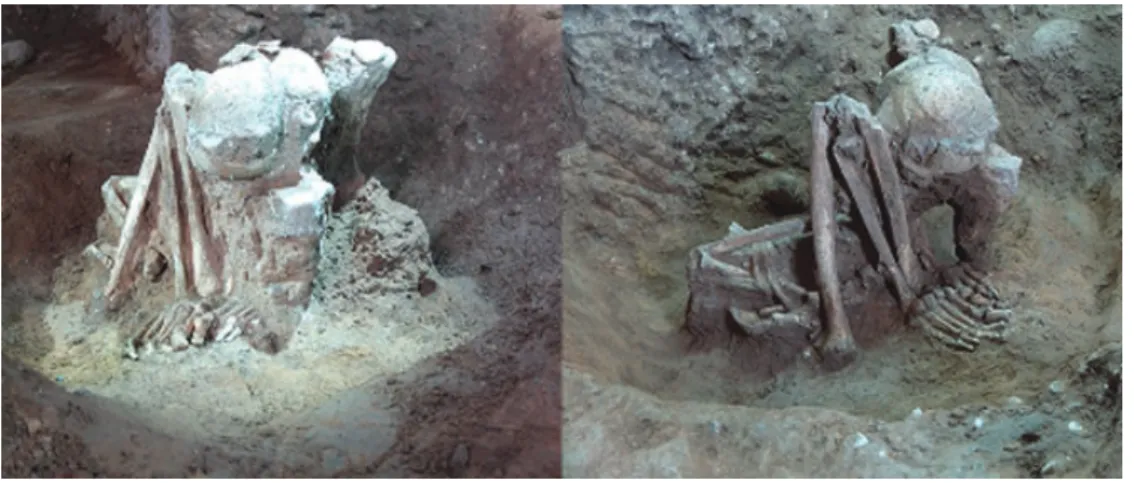
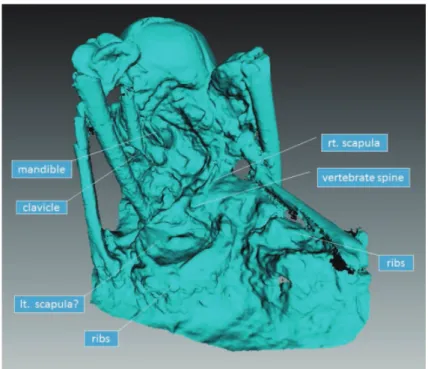
In this chapter, the burial posture of M26 is described, which is the skeleton of an adult male individual (Figure 4-1). The skeleton was excavated and brought to the lab- oratory without isolating each bone. Some bones are still embedded in soil, but the position and orientation of the individual bones can be identified mostly. Three-dimen- sional (3D) surface scans were taken using an Artec EVA portable scanner (Figures 4-2, 4-3, 4-4).
Figure 4-1. The skeleton of M26 excavated at Huiyaotian.
Figure 4-3. Surface scan of M26 (anterolateral view).
Figure 4-2. Surface scan of M26 (superior diagonal view).
Yousuke Kaifu
DESCRIPTION
The skeleton is mostly complete and maintains the original articulated relationship, although the ribcage is collapsed and partly missing. The position of each bone is indi- cated in Figures 4-2, 4-3, and 4-4.
The broken pelvis is on the ground, and the right and left femora stand almost verti- cally with their distal ends oriented towards the top. On both sides, the knee joint is flexed strongly so that the foot is located immediately medial to the hip joint. The bones of each foot are mostly complete. The right and left feet are laid side-by-side, directly below the cranium. The cranium is currently at the level of the knee joints with the face looking downward. It is possible that the cranium was originally at a higher level, but later dropped downward during decay.
The right and left shoulders, rib cage, and the upper limb bones are collapsed down- ward, but the positional relationship of the humerus, radius and ulna clearly indicate that the arms were crossed below the thigh, and each hand was inserted below the knee joint of the opposite side.
In summary, the body of M26 is folded in a very compact manner. This compact squatting posture may have been made by tying body with rope, though more simply the corpus may have been forced into the narrow pit.
ACKNOWLEDGMENTS
I am grateful to Dr. Kazuhiro Sakaue for his helpful comments and input.
Figure 4-4. Surface scan of M26 (posterolateral view).
Junmei Sawada et al.
Paleopathological Description of 5 the Huiyaotian Human Remains
Junmei Sawada
1, Emiri Miyama
2, Shinya Watanabe
3, and Shinji Kubota
41
Faculty of Medical Technology, Niigata University of Health and Welfare, Nigata, Japan
2
Public Collaboration Center, Tokyo University of the Arts, Tokyo, Japan
3
Toshima Ward Education Board, Tokyo, Japan
4