【総 説】
抗ウイルス薬開発の現状
―抗ヘルペス薬
Amenamevir
と抗インフルエンザ薬Favipiravir―
白 木 公 康
富山大学大学院医学薬学研究部ウイルス学*
(平成26年11月12日受付・平成27年3月4日受理)
抗ヘルペス薬
ASP2151(amenamevir)と抗インフルエンザ薬 T-705(favipiravir)はわが国で開発さ
れた抗ウイルス薬で,それぞれ,ヘルペスウイルスのHelicase-primase
阻害活性とRNA
ウイルスのRNA
合成阻害活性を示す薬剤である。ASP2151
は,これまでのヘルペスウイルスのチミジンキナーゼを 介する抗ヘルペス薬と作用機序が異なる点と薬剤の血中動態が良いことから,性器ヘルペスの感染の完 全阻止等が期待される抗ヘルペス薬として注目される。抗インフルエンザ薬であるノイラミニダーゼ阻 害薬(NAI)は,感染細胞でのインフルエンザウイルスの増殖を許容するが,細胞表面から周辺への感染 の広がりを阻害する。一方,T-705はウイルスRNA
合成の際に,T-705のリボース三リン酸体がchain
terminator
として,RNAに取り込まれた部位でRNA
の伸長を阻害して,新たなウイルスRNA
の合成を阻害するので,細胞内に新たなウイルス
RNA
を合成させない。以上のように培養細胞レベルではRNA
合成を阻害しウイルス負荷を減らすだけでなく,耐性ウイルスを生じない等,優れた特性を有する。感染動物における検討では,低力価感染では,NAIと
T-705
の治療効果の差異は認めない。しかし,oseltamivir
が有効でない重症インフルエンザウイルス(高力価)感染にもT-705
は有効であるという特徴をもつことから,
T-705
はインフルエンザウイルス感染の切り札として期待される。このような特性をもつ
T-705
は,季節性インフルエンザに対する適応はなく,他の抗インフルエンザ薬が無効又は効果不十分であり,流行と感染重症度が懸念される
H5
やH7
等の新型インフルエンザが発生し,国が判断した 場合に生産・使用できるという条件付き承認となった。また,T-705は,RNAウイルスのRNA
合成阻 害活性の共通性から,インフルエンザウイルスだけでなく,エボラウイルスや黄熱ウイルス等のRNA
ウイルスの感染動物モデルでも有効性が確認されている。Key words: antiviral agents,nucleic acid synthesis inhibitor,herpes virus,influenza virus
抗ウイルス薬,特に,ヒト免疫不全ウイルス感染症に対する インテグラーゼ阻害薬,C型肝炎のプロテアーゼ阻害薬等は,
慢性ウイルス感染症の疾患概念の変更につながる変化をもた らしてきている。急性感染症としてのヘルペスウイルス感染 症とインフルエンザウイルス(IFV)感染症に対して,従来と は異なるまったく新しい作用機序の抗ウイルス薬が開発され てきた。私達は,アシクロビル(ACV),ソリブジン,ファム ビルなどの抗ウイルス薬の承認のための臨床検体の取り扱い や基礎研究や薬理作用の解析と感染動物での検討を実施して きたなかで,下記の2薬剤の開発に関与してきた。わが国で見 いだされ,臨床試験中である抗ヘルペス薬ASP2151(アメナ メビル:amenamevir)(Fig. 1A)と平成26年3月に承認され た抗インフルエンザ薬T-705(ファビピラビル:favipiravir,
商品名アビガンAviganⓇ)(Fig. 1B)についてその特徴を紹介 する。
アステラス製薬が開発して,マルホが臨床試験を実施して
いるASP2151の標的酵素は,Helicase-primase1〜4)である。こ の酵素は,2本鎖DNAを分けて2本の1本鎖として,それぞ れの1本鎖DNAのDNA合成開始地点にDNA合成酵素が 働くことによって,それぞれの1本鎖DNAが2本鎖DNA に複製される。ASP2151はDNA合成過程の2本鎖DNAを 1本鎖DNAとするHelicase-primaseを阻害するので,これ までのチミジンキナーゼを介する抗ヘルペス薬とは異なった 特徴を有し,1日1回の投与で十分な抗ヘルペス活性を示す 薬物動態に加え,ACV耐性株にも有効である。このように優 れた特性を有するASP2151は世界の標準的抗ヘルペス薬と なることが期待される。
富山化学工業は化合物の合成技術に優れ,これまでに多く の抗菌薬を開発してきた。私達は,私達の研究室が有する動物 での抗ウイルス薬の評価系による抗ウイルス薬の共同研究を 行ってきた。そのなかで,T-705は抗IFV活性が認められ,マ ウスとフェレットの2種の動物でのIFV感染実験での有効
*富山県富山市杉谷2630
Fig. 1. Structures of anti-herpetic drug ASP2151 (A) and anti-influenza drug T-705 (B).
Anti-herpetic drug ASP2151 (Amenamevir) (A) is not a DNA synthesis inhibitor through viral thymidine kinase but a helicase-primase inhibitor. Anti-influenza drug T-705 (B) is a chain terminator inhibiting chain elongation at the incorpo- rated site of RNA dependent RNA synthesis. This inhibits RNA synthesis leading to reduction in the viral load. Fig. 1C illustrates the action of helicase-primase:
separating the double strand DNA to two single strands, and each strand starts complementary DNA synthesis. Helicase-primases are composed of UL5, UL52, and UL8 of herpes simplex virus and ORF55, ORF 6, and ORF52 of varicella-zoster virus.
A. Amenamevir (ASP2151), a Helicase- primase inhibitor (Asteras Pharma Inc. and Maruho Co., Ltd)
N N
NH N
NH2
O O
O O O
DNA polymerase Single-stranded
DNA-binding protein ICP8
Helicase-primase complex (UL5, 8, 52)
Accessory protein UL42
Leading strand
Lagging strand
3’ 3’
3’
552 8 O
S
F
N OH
B. Favipiravir (T-705), a Viral RNA polymerase inhibitor (Toyama Chemical Co., Ltd)
C. Point of action of helicase-primase inhibitor N
性も確認されたことから,ヒトでのIFV感染症に対する有効 性が期待された。その他,RNAウイルスのRNA合成阻害は,
IFV以外にも認められ,エボラウイルス感染や黄熱病等のヒ トでの重症感染症の感染動物モデルでも有効性5〜11)が確認さ れており,T-705の広域抗RNAウイルス薬としての特性も示 されてきた。
T-705の抗インフルエンザ薬としての特性としては,これ
までのノイラミニダーゼ阻害薬(NAI)にない高力価感染での 強い抗IFV活性と生存率の改善など,多くの知見が明らかに
なり7,12〜14),高病原性IFVの動物モデルでの有効性15〜17)も確認
された。これまでに,IFV感染動物実験での有効性をふまえ,
臨床試験が行われ,T-705は優先審査を経て,平成26年3 月24日に「新型又は再興型インフルエンザウイルス感染症
(ただし,他の抗インフルエンザウイルス薬が無効又は効果不 十分な新型又は再興型インフルエンザウイルス感染症が発生 し,本剤の使用を国が判断した場合にのみ)」を効能・効果と して承認された。
I. ASP2151の作用機序
ASP2151
(Fig. 1A)の標的酵素Helicase-primase
は,HSV
(VZV)ではhelicase UL5
(ORF55),primase UL52(ORF6),cofactor UL8(ORF52)の
3
つの蛋白の複合体 酵素で,2本鎖DNA
を分けて2
本の1
本鎖とする活性 を有する(Fig. 1C)。そして,それぞれの1
本鎖となった鋳型
DNA
鎖合成開始部位のDNA
合成酵素が働くこと によって,両鋳型DNA
鎖に,それぞれ相補鎖DNA
の合 成が開始され,それぞれ2
本鎖DNA
が複製される。した がって,これまでのウイルスのチミジンキナーゼを介す る抗ヘルペス薬とは異なった作用機序を有する。これま でに海外の2
社がHelicase-primase
阻害剤を開発した が,単純ヘルペスウイルス(HSV)に有効であるが,水 痘帯状疱疹ウイルス(VZV)には有効ではない18〜20)。一方,ASP2151
は両ウイルスに有効という優れた抗ウイルス活性スペクトルを有する。さらに,ASP2151は,1日
1
回の投与で十分な抗ヘルペス活性を示す薬物動態を有 し,ACVとの併用により相乗効果を示し,ACV耐性株 にも有効である。このように優れた特性を有するASP 2151
は世界の標準的抗ヘルペス薬となることが期待さ れる。ASP2151
は,これまでのHSV
やVZV
による疾患が対 象となるが,特に,その特性が期待できるのは,性器ヘ ルペスに対する効果である。HSV-2の性器への感染は1
年以内にほとんどが再発し,その平均再発回数は5〜6
回とされる。その後,再発回数は減るが,HSV-2による 性器ヘルペス患者の約20% は年間 6
回以上再発すると される。当学会と日本性感染症学会で,世界の標準療法 であった「性器ヘルペス再発抑制療法」のわが国への導Fig. 2. Nucleic acid, its intermediate and ribavirin and T-705.
Nucleic acid and AICAR are synthesized in vivo and their structures are contrasted with those of ribavirin and T-705. AICAR, Ribavirin, and T-705 resemble each other, but T-705 has a 6 membered ring and not a 5 membered rig as AICAR and ribavirin. AICAR is further processed to inosine, adenosine, and guanosine.
O N HN N
N O
H2N HO
HO OH
O N H2N N
O
HO
HO OH
H2N
O N N H2N N
O
HO
HO OH
N N
HO O
HO OH
H2N F O
O
Guanosine
5-aminoimidazole- 4-carboxamide ribotide (AICAR)
Ribavirin T-705-ribose Nucleic acid and its intermediate Anti-viral agents
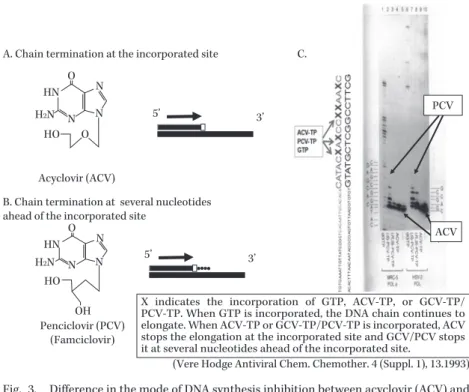
Fig. 3. Difference in the mode of DNA synthesis inhibition between acyclovir (ACV) and penciclovir (PCV: active form of famciclovir)24).
ACV is lacking a 3ʼOH residue that binds to the next nucleotide and thus cannot elongate any more, working as a chain terminator. Right figure (modified from refer- ence 23) shows the chain termination at the incorporated site (□). On the other hand, PCV has a 3ʼOH residue and binds to the next nucleotide. However, elongation terminates several nucleotides ahead of the PCV incorporated site (□). Thus both drugs terminate DNA chain elongation but their mode of action is different.
PCV
ACV A. Chain termination at the incorporated site
Penciclovir (PCV) (Famciclovir)
(Vere Hodge Antiviral Chem. Chemother. 4 (Suppl. 1), 13.1993) B. Chain termination at several nucleotides
ahead of the incorporated site
5’ 3’
Acyclovir (ACV) O
HN N
N N H2N
HO O
O
HN N
N N H2N
HO OH
5’ 3’
C.
X indicates the incorporation of GTP, ACV-TP, or GCV-TP/
PCV-TP. When GTP is incorporated, the DNA chain continues to elongate. When ACV-TP or GCV-TP/PCV-TP is incorporated, ACV stops the elongation at the incorporated site and GCV/PCV stops it at several nucleotides ahead of the incorporated site.
入を厚生労働省に要望し,
2006
年に承認・保険適応され た。現在は,再発性性器ヘルペスはバラシクロビルを1
日1
回で再発抑制ができているが,やはり,薬剤の血中 動態は十分でなく,無症候性ウイルス排泄だけでなく,感受性ウイルスによる再発が起こっている。その点では,
ASP2151
は,薬剤の血中動態が良く,1日1
回で有効血中濃度が維持できるので,1日中体内でのウイルスの完 全な増殖阻害効果が期待できる。したがって,ASP2151 によって,無症候性ウイルス排泄さえ阻止できるので,
性器ヘルペスの再発と無症候性ウイルス排泄の完全抑制
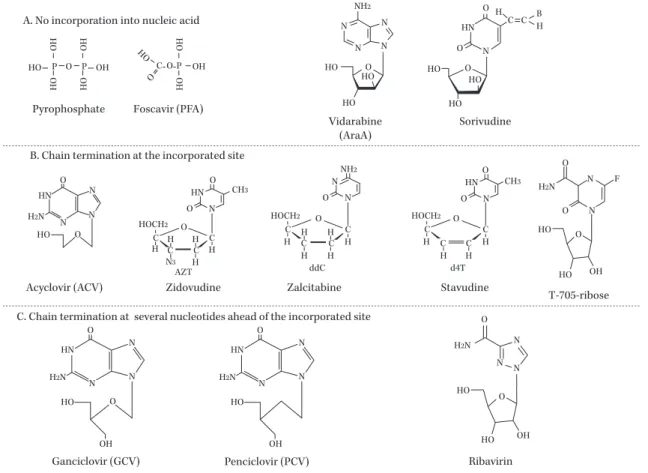
Fig. 4. Classification of nucleic acid synthesis inhibitor with the mode of inhibition.
A) Inhibition by non-incorporation type into DNA or RNA: Foscarnet, vidarabine, sorivudine. B) Chain termination at the incorporated site: Nucleotide reverse transcriptase inhibitors lack a 3ʼOH residue and terminate chain elongation at the incorporated site. Ribosylated T-705 works as a chain terminator at the incorporated site of elongating RNA. C) GCV and PCV have a 3ʼOH residue and elongation terminates several nucleotides ahead of the PCV incorporated site. (The mecha- nism of Ribavirin is not as clear as the others.)
Sorivudine
Ganciclovir (GCV) Penciclovir (PCV)
Vidarabine (AraA)
N N
HO O
HO OH H2N F
O
O
O N N H2N N
O
HO
HO OH Ribavirin A. No incorporation into nucleic acid
B. Chain termination at the incorporated site
C. Chain termination at several nucleotides ahead of the incorporated site Acyclovir (ACV)
T-705-ribose Foscavir (PFA)
Pyrophosphate
HO OH OH
NH2 N
N N
N N
O O
O O
HO HO HO
H2N
HOCH2
N3
CH3
N HN
O
O
O N
N N HN
HO
OH H2N
O N
N N HN
HO
OH H2N O O O O
N N
N C C
C C H H H H
H AZT
HN
HO
HN
HO
H C C B H
HO HO
HOOH HOOH
P O P COP
Zidovudine Zalcitabine Stavudine
HOOH
OH O
HOCH2
NH2 O O
N C C
C C H H H H H H
ddC N
HOCH2 O
CH3 O
O N C C
C C H H H H
d4T HN
に加え,
HSV
の患者からの排泄がないため,パートナー への感染阻止 も 可 能 と 考 え ら れ る。す な わ ち,こ のASP2151
の注目されている点は,HSVによる性感染症の減少が期待できる点である。
II. T-705の作用機序
T-705
の構造(Fig. 1B)は,核酸の生合成過程で,イノ シンの前駆物質である5-aminoimidazole-4-carboxamide
(AICAR)との類似性からの核酸類似体として(Fig. 2),
RNA
合成阻害機序が推定された。T-705の抗IFV
活性 はプリン系核酸の追加により中和され,T-705のリボー ス三リン酸体はIFV
のRNA
合成酵素を選択的に阻害 した13)。そのRNA
合成阻害機序と感染性ウイルス産生阻 止の様式として,2つのモデルが示された。一つは,T-705
の存在下でのウイルスの増殖では,プリンとピリミ ジン間の変異(transversion)が多くなることから,T-705
を取り込んだRNA
鎖が,鋳型として複製さ れ るRNA
に変異が蓄積して,その変異蛋白のため,感染性ウ イルスができない「Lethal Mutagenesis」説が提唱され た21)。一方,RNA合成阻止様式からは,T-705のRNA
合成阻害機序はChain terminator
(伸長阻止薬)となることが示された。
T-705
は,合成されるRNA
にプリンヌク レオチドと競合して取り込まれるが,1分子の取り込み ではRNA
合成を完全に止めず,2
分子続くと伸長停止し た22)。さらに,詳細な検討によって,T-705
は,プリンの 代わりにRNA
に取り込まれた部位からのRNA
伸長(塩 基の追加)を阻止することが示された23)。Fig. 3
に示すとおり,ACVとペンシクロビル(PCV,ファムシクロビルの活性型)は,ヘルペスウイルスの
DNA
合成を阻害するが,ACVは取り込まれた部位で伸 長停止し,PCV
は取り込まれて数塩基進んで伸長を停止 する24)。したがって,核酸類似体である抗ウイルス薬によ る核酸合成の阻害様式としては,抗ウイルス薬が「核酸 に取り込まれない」,「核酸に取り込まれた部位で伸長を 停止する」,「核酸に取り込まれた位置では停止せず数塩 基進んで停止する」の3
種の様式があり,Fig. 4
にそれぞ れを例示した。私達も,増殖可能条件下で増殖した
IFV
のクローンを 分離して薬剤感受性と遺伝子変異を調べた25)。その結果,ウイルス
RNA
の多様性変異による薬剤感受性変異株(Variant)は得られたが,耐性株は得られなかった。また,
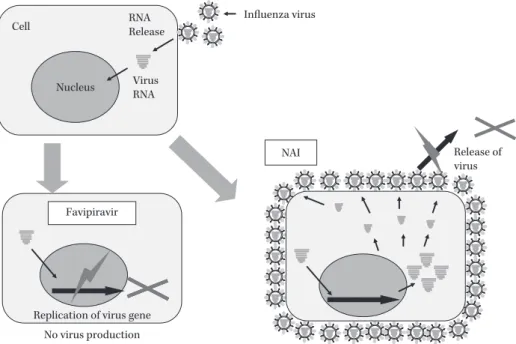
Fig. 5. The difference between NAI and T-705 in the inhibitory action against influenza virus rep- lication.
T-705 inhibits viral RNA synthesis and viral RNA and virus particles were not produced in the infected cell. NAI allows viral RNA synthesis and inhibits the spread of infection by accumulat- ing viral particles on the cell surface. Thus T-705 is expected to reduce the viral load in influ- enza infection.
Favipiravir
Influenza virus Cell
Nucleus
NAI Release of
virus RNA
Release
Replication of virus gene Virus RNA
No virus production
Fig. 6. Efficacy of oseltamivir and T-705 in mice infected with influenza virus intranasally at a low dose (mild infection A) and a high dose (severe infection B)14).
Oseltamivir and T-705 have different mechanisms of action against influenza infection as shown in Fig. 5. This difference in the mechanism and the effect on the viral load showed an apparent difference in severe infection (modified from reference 23). Fig. 6A shows the mild infection group and there is no significant difference between oseltamivir and T-705. In contrast, T-705 showed a significant difference in the survival rate in the severe infection group. As shown in Fig. 6B, control mice died around 5 days after infection. Oseltamivir prolonged the survival period but most mice died. T-705 cured all infected mice without any deaths. Thus although oseltamivir and T-705 failed to show any difference in the mild infection condition, supe- riority of the therapeutic efficacy of T-705 was apparent under conditions of severe infection.
0 20 40 60 80 100
0 5 10 15 20
*, *
Survival (%)
Days after infection
*
*
*
*
0 20 40 60 80 100
0 5 10 15 20
Survival (%)
Days after infection
T-705 200 mg/kg/day T-705 400 mg/kg/day T-705 (1 h)
T-705 (13 h)
Oseltamivir (13 h) Oseltamivir (1 h) Control
T-705 (25 h)
Oseltamivir (25 h) Virus: A/PR/8 (H1N1)
Infectious dose: 3×10² PFU Administration: 1, 13, 25 hrs after infection
200 mg/kg/day 1 group: 14 mice
Virus: A/PR/8 (H1N1) Infectious dose: 3×10⁴ PFU
*: P<0.01, compared to 0.5% methylcellulose solution-treated controls (log-rank test).
*: P<0.01, compared to 0.5% methylcellulose solution-treated controls and oseltamivir-treated groups (log-rank test).
(n=14) (n=14)
Control
Oseltamivir 200 mg/kg/day Oseltamivir 400 mg/kg/day
A. B.
*, *
Fig. 7. Mechanism of action of Kakkon-to in influenza infection.
Interferon (IFN) administration causes influenza-like symptoms. Influenza virus in- fection induces interferon, and then interleukin (IL)-1, followed by cyclooxygenase (COX) induction in the hypothalamus, resulting in the fever induction. Kakkon-to and its active components, cinnamyl compounds, anti-IFN antibody, anti-IL-1 antibody, NAIDS and aspirin show an antipyretic action irrespective of viral replication.
Cinnamyl compounds, active components of Kakkon-to, modulate cytokine produc- tion in the macrophages by modifying the transcription of transcription factors. Espe- cially, augmentation of IL-12 and IFN-γ production works to alleviate pneumonia and systemic reduction of inflammatory cytokine IL-1 level, normalization of overproduc- tion of IL-1, alleviates the general condition and shows an anti-pyretic action.
それらのクローンで調べると,有意な
Transversion
は 生じていなかった。「Lethal Mutagenesis」には必須である
T-705
を取り込んだRNA
の合成,すなわち,アミノ酸変異を起こすための鋳型
RNA
が合成される必要があ る。しかし,IFVのRNA
合成酵素には取り込まれたT- 705
を除去して新たに合成するProof-reading
活性はなく,
T-705
の存在下ではウイルスRNA
複製も認められない。さらに,
T-705
が取り込まれた部位でRNA
伸長を阻 止する。したがって,「T-705の存在下で,T-705を取り 込んだままRNA
合成を続け,変異に満ちたRNA
が鋳型RNA
となり,機能を有しない致死的変異蛋白を合成し,致死性ウイルスを生じる」とする「Lethal Mutagenesis」
説は否定的である。すなわち,T-705の作用機序として は,
Chain terminator
として,RNA
合成の伸長を停止す る機序が合理的と思われる。IFV
は,ヘムアグルチニンが細胞のシアル酸に結合し て,細胞内に取り込まれ,RNA
の複製と蛋白合成を経て,出芽,放出され感染が広がる。
NAI
は感染細胞内のIFV
複製と出芽は阻害しないが,感染細胞表面からIFV
が放 出され拡散する過程を阻害する。そのため,IFVは細胞 表面に蓄積する。一方,T-705は感染細胞内でのRNA
合成を阻害し,新しいウイルスは産生されず,ウイルス 負荷(Viral Load)を軽減させる特徴を有する(Fig. 5)。III. T-705のIFV感染動物での効果12〜14)
Fig. 5
に示したような,感染細胞でのウイルス産生の有無による「ウイルス量・ウイルス負荷(viral load)」の
差異は,感染動物での
NAI
とT-705
の感染動物での抗IFV
活性の有効性の差異として反映された(Fig. 6)。これらは,
Fig. 6
の高力価感染動物モデルでの有効性,すなわち,
Fig. 5
に示したviral load
の差異は,IFV
の重症感 染症におけるviral load
の大きな感染に対するT-705
の 有効性に反映されていると思われる。軽症
IFV
感染モデル(ヒトでの季節性感染症の多くの ケース)では,Fig. 6Aのように,oseltamivir(OS)とT-705
は同等な治療効果を示す。両薬剤は,十分な効果を発揮できるので,差異を認めることは困難と思われる。
すなわち,健常者の季節性
IFV
では,T-705の有する優 れた特徴を見出すことは困難と思われる。一方,重症(高力価)
IFV
感染(新型や重症季節性IFV
感染に相当する)で,viral loadが大きい場合には,Fig.6B
のように,T-705
の有する特徴的な有効性が発揮され る14)。高病原性鳥IFV・新型 IFV
だけでなく,IFV
に対 する免疫が不十分で,ウイルスの増殖が多くなり,viralload
が大きい場合には,動物モデルのように,OS
の効果よりも
T-705
が有効と思われる。このようなIFV
感染動物での
T-705
の有効性は,季節性IFV
だけでなく,高病原性鳥
IFV,新型 IFV, NAI
耐性IFV
にも示され,NAI
にはないT-705
の優れた有効性が報告されてきた15〜17,26)。IV. お わ り に
単純ヘルペスウイルスモデルでは,抗ウイルス活性の 評価は,ウイルスの増殖と病変は相関するのでわかりや すい。その意味では
IFV
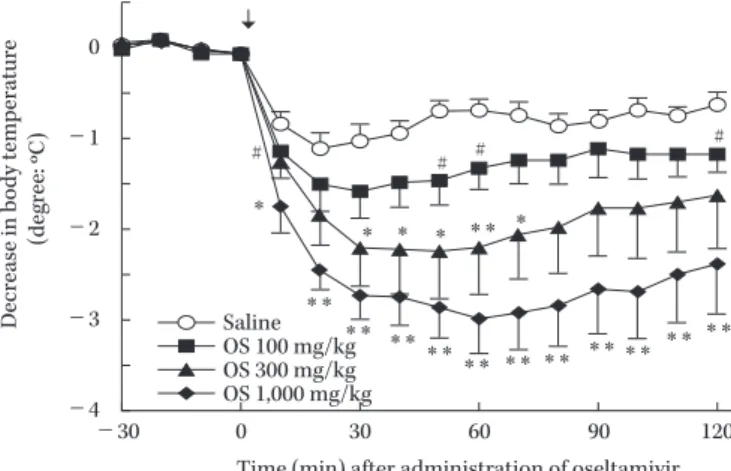
は対照的である。私達はこれまFig. 8. Hypothermia induction by oseltamivir.
Oseltamivir (OS) induces hypothermia in the otherwise healthy mice (figure is modified from reference 32). The arrow indicates the admin- istration of oseltamivir. Thus oseltamivir exhibits an anti-influenza ac- tion and induces hypothermia in mice.
Time (min) after administration of oseltamivir 0
−1
−2
−3
−4−30
*
# # # #
* * * *
**
**
****
** ** ** ** ******
0 30
Saline OS 100 mg/kg OS 300 mg/kg OS 1,000 mg/kg
60 90 120
Decrease in body temperature (degree: ºC)
**
でに
IFV
の発熱機構(Fig. 7)を解明し27),葛根湯の作用 機序を明らかにしてきた28〜31)。その結果,IFV
感染やIFV
様症状を呈するインターフェロン投与で発熱するのは7
系統マウス中4
系統のみであり,動物においては,発熱 は, 必ずしも,IFV
感染や重症度の指標とはならない。マウスの病態は,IFVの増殖だけでなく,サイトカイン や肺で産生される
superoxide
32)等により決まる。そのた め,IFV
による重症感染の病態はウイルス量と相関する が,IFV
増殖が誘導する発熱やサイトカイン等による症 状は必ずしも相関するとは思われない。また,OS
はFig.
8
のようにマウスの健常体温から低体温を誘導することが報告33〜36)され,私達も確認している。
T-705
の抗インフルエンザ作用が解熱等を主要評価項目とした場合には,臨床ではその有効性が十分に反映さ れなかったと思われる。また,
T-705
の動物での毒性とし ては,ラットでの妊孕性の低下と催奇形性が知られてい る。わが国で行われた臨床試験では,T-705
の投与グルー プの有害事象は尿酸値の上昇以外はタミフルグループの 有害事象との差異はなかった。T-705
に関しては,現在,米国国防総省の資金援助を受け,欧米を中心に季節性イ ンフルエンザの臨床試験が実施されている。
最後に,わが国で開発された
ASP2151
とT-705
は,上 記に記したような特性を有する抗ウイルス薬であり,こ れまでにない新規な作用機序を有する薬剤である。した がって,これまでの抗ウイルス薬の評価法が,作用機序 の異なる新規抗ウイルス薬に対してその特性が考慮され ず,適用される点については,今後検討が必要と思われ る。利益相反自己申告:著者 白木公康は富山化学工業株 式会社から資金援助を得ている。
文 献
1) Chono K, Katsumata K, Kontani T, Kobayashi M, Sudo K, Yokota T, et al: ASP2151, a novel helicase- primase inhibitor, possesses antiviral activity against varicella-zoster virus and herpes simplex vi- rus types 1 and 2. J Antimicrob Chemother 2010; 65:
1733-41
2) Chono K, Katsumata K, Kontani T, Shiraki K, Suzuki H: Characterization of virus strains resistant to the herpes virus helicase-primase inhibitor ASP 2151 (Amenamevir). Biochem Pharmacol 2012; 84: 459-67 3) Chono K, Katsumata K, Suzuki H, Shiraki K: Syner-
gistic activity of amenamevir ( ASP 2151 ) with nu- cleoside analogs against herpes simplex virus types 1 and 2 and varicella-zoster virus. Antiviral Res 2013; 97: 154-60
4) Himaki T, Masui Y, Chono K, Daikoku T, Takemoto M, Haixia B, et al: Efficacy of ASP 2151, a helicase- primase inhibitor, against thymidine kinase-deficient herpes simplex virus type 2 infection in vitro and in vivo. Antiviral Res 2012; 93: 301-4
5) Oestereich L, Ludtke A, Wurr S, Rieger T, Munoz- Fontela C, Gunther S: Successful treatment of ad- vanced Ebola virus infection with T-705 (favipiravir) in a small animal model. Antiviral Res 2014; 105: 17- 21
6) Smither S J, Eastaugh L S, Steward J A, Nelson M, Lenk R P, Lever M S: Post-exposure efficacy of oral T-705 (Favipiravir) against inhalational Ebola virus infection in a mouse model. Antiviral Res 2014; 104:
153-5
7) Furuta Y, Gowen B B, Takahashi K, Shiraki K, Smee D F, Barnard D L: Favipiravir (T-705), a novel viral RNA polymerase inhibitor. Antiviral Res 2013; 100:
446-54
8) Safronetz D, Falzarano D, Scott D P, Furuta Y, Feld- mann H, Gowen B B: Antiviral efficacy of favipiravir against two prominent etiological agents of hantavi-
rus pulmonary syndrome. Antimicrob Agents Che- mother 2013; 57: 4673-80
9) Julander J G, Smee D F, Morrey J D, Furuta Y: Effect of T-705 treatment on western equine encephalitis in a mouse model. Antiviral Res 2009; 82: 169-71 10) Morrey J D, Taro B S, Siddharthan V, Wang H, Smee
D F, Christensen A J, et al: Efficacy of orally admin- istered T-705 pyrazine analog on lethal West Nile vi- rus infection in rodents. Antiviral Res 2008; 80: 377-9 11) Julander J G, Shafer K, Smee D F, Morrey J D, Fu-
ruta Y: Activity of T-705 in a hamster model of yel- low fever virus infection in comparison with that of a chemically related compound, T-1106. Antimicrob Agents Chemother 2009; 53: 202-9
12) Furuta Y, Takahashi K, Fukuda Y, Kuno M, Kami- yama T, Kozaki K, et al: In vitro and in vivo activi- ties of anti-influenza virus compound T-705. Antimi- crob Agents Chemother 2002; 46: 977-81
13) Furuta Y, Takahashi K, Kuno-Maekawa M, Sangawa H, Uehara S, Kozaki K, et al: Mechanism of action of T-705 against influenza virus. Antimicrob Agents Chemother 2005; 49: 981-6
14) Takahashi K, Furuta Y, Fukuda Y, Kuno M, Kami- yama T, Kozaki K, et al: In vitro and in vivo activi- ties of T-705 and oseltamivir against influenza virus.
Antivir Chem Chemother 2003; 14: 235-41
15) Sidwell R W, Barnard D L, Day C W, Smee D F, Bailey K W, Wong M H, et al: Efficacy of orally ad- ministered T-705 on lethal avian influenza A (H5N1) virus infections in mice. Antimicrob Agents Che- mother 2007; 51: 845-51
16) Kiso M, Takahashi K, Sakai-Tagawa Y, Shinya K, Sakabe S, Le Q M, et al: T-705 (favipiravir) activity against lethal H5N1 influenza A viruses. Proc Natl Acad Sci U S A 2010; 107: 882-7
17) Sleeman K, Mishin V P, Deyde V M, Furuta Y, Kli- mov A I, Gubareva L V: In vitro antiviral activity of favipiravir (T-705) against drug-resistant influenza and 2009 A (H1N1) viruses. Antimicrob Agents Che- mother 2010; 54: 2517-24
18) Crumpacker C S, Schaffer P A: New anti-HSV thera- peutics target the helicase-primase complex. Nat Med 2002; 8: 327-8
19) Crute J J, Grygon C A, Hargrave K D, Simoneau B, Faucher A M, Bolger G, et al: Herpes simplex virus helicase-primase inhibitors are active in animal mod- els of human disease. Nat Med 2002; 8: 386-91 20) Kleymann G, Fischer R, Betz U A, Hendrix M,
Bender W, Schneider U, et al: New helicase-primase inhibitors as drug candidates for the treatment of herpes simplex disease. Nat Med 2002; 8: 392-8 21) Baranovich T, Wong S S, Armstrong J, Marjuki H,
Webby R J, Webster R G, et al: T-705 (favipiravir) in- duces lethal mutagenesis in influenza A H1 N1 vi- ruses in vitro. J Virol 2013; 87: 3741-51
22) Jin Z, Smith L K, Rajwanshi V K, Kim B, Deval J: The ambiguous base-pairing and high substrate effi- ciency of T-705 ( Favipiravir ) Ribofuranosyl 5 ʼ - triphosphate towards influenza A virus polymerase.
PLoS One 2013; 8: e68347
23) Sangawa H, Komeno T, Nishikawa H, Yoshida A,
Takahashi K, Nomura N, et al: Mechanism of action of T-705 ribosyl triphosphate against influenza virus RNA polymerase. Antimicrob Agents Chemother 2013; 57: 5202-8
24) Vere Hodge R A, Cheng Y C: The mode of action of penciclovir. Antivir Chem Chemother 1993; 4(Suppl 1): 13-24
25) Daikoku T, Yoshida Y, Okuda T, Shiraki K: Charac- terization of susceptibility variants of influenza vi- rus grown in the presence of T-705. J Pharmacol Sci 2014; 126: 281-4
26) Smee D F, Hurst B L, Egawa H, Takahashi K, Kadota T, Furuta Y: Intracellular metabolism of favipiravir (T-705) in uninfected and influenza A (H5N1) virus- infected cells. J Antimicrob Chemother 2009; 64: 741- 6
27) Kurokawa M, Imakita M, Kumeda C A, Shiraki K:
Cascade of fever production in mice infected with in- fluenza virus. J Med Virol 1996; 50: 152-8
28) Kurokawa M, Brown J, Kagawa Y, Shiraki K : Cytokine-regulatory activity and therapeutic effi- cacy of cinnamyl derivatives in endotoxin shock. Eur J Pharmacol 2003; 474: 283-93
29) Kurokawa M, Watanabe W, Shimizu T, Sawamura R, Shiraki K: Modulation of cytokine production by 7- hydroxycoumarin in vitro and its efficacy against in- fluenza infection in mice. Antiviral Res 2010; 85: 373- 80
30) Kurokawa M, Kumeda C A, Yamamura J, Kamiyama T, Shiraki K: Antipyretic activity of cinnamyl de- rivatives and related compounds in influenza virus- infected mice. Eur J Pharmacol 1998; 348: 45-51 31) Kurokawa M, Tsurita M, Brown J, Fukuda Y, Shiraki
K : Effect of interleukin-12 level augmented by Kakkon-to, a herbal medicine, on the early stage of influenza infection in mice. Antiviral Res 2002 ; 56 : 183-8
32) Oda T, Akaike T, Hamamoto T, Suzuki F, Hirano T, Maeda H : Oxygen radicals in influenza-induced pathogenesis and treatment with pyran polymer- conjugated SOD. Science 1989; 244: 974-6
33) Ono H, Nagano Y, Matsunami N, Sugiyama S, Yamamoto S, Tanabe M : Oseltamivir, an anti- influenza virus drug, produces hypothermia in mice.
Biol Pharm Bull 2008; 31: 638-42
34) Freichel C, Breidenbach A, Gand L, Toot J, Weiser T, Körner A, et al: Lack of unwanted effects of oseltamivir carboxylate in juvenile rats after subcu- taneous administration. Basic Clin Pharmacol Toxi- col 2012; 110: 551-3
35) Freichel C, Breidenbach A, Hoffmann G, Körner A, Gatti S, Donner B, et al: Absence of central nervous system and hypothermic effects after single oral ad- ministration of high doses of oseltamivir in the rat.
Basic Clin Pharmacol Toxicol 2012; 111: 50-7
36) Ono H, Iwajima Y, Nagano Y, Chazono K, Maeda Y, Ohsawa M, et al: Reduction in sympathetic nerve ac- tivity as a possible mechanism for the hypothermic effect of oseltamivir, an anti-influenza virus drug, in normal mice. Basic Clin Pharmacol Toxicol 2013 ; 113: 25-30
Current status of anti-viral drug development of anti-herpetic drug ASP2151 and anti-influenza drug T-705
Kimiyasu Shiraki
Department of Virology, University of Toyama, 2630 Sugitani, Toyama, Japan