II 章 総括研究報告
厚生労働科学研究費補助金(厚生労働科学特別研究事業)
総括研究報告書
高齢化と
UHCに関する総括マクロビジョンに関する研究
研究代表者 渋谷 健司 東京大学大学院医学系研究科国際保健政策学教室教授 研究分担者 橋本 英樹 東京大学大学院医学系研究科保健社会行動学教室教授
I.
背景
現在のエボラ出血熱の流行は、グローバルヘルスの様相を一変させた。とりわけ、
グローバルヘルス・ガバナンスに大きな課題を突きつけ、新たな状況への適応が迫 られている。そこでは、感染症を国家的、世界的脅威であると同時に人間の安全保 障に対する脅威と捉え、これに対処する新たな方法を模索することが求められてい る。
こうした危機に直面し、国内および国際的レベルで対応に当たる各関係者の間で、
より効果的でタイムリーな調整を図ることが求められている。国連エボラ緊急対応 ミッション
(UNMEER)は、国連の各機関、世界銀行、米国疾病予防管理センター
(CDC)
、軍隊の間で繰り広げられるあらゆる活動を調整する重要な役割を担ってい
る。
その一方で、世界保健機関
(WHO)の対応の有効性に関しては、多くの批判が寄せら れた。
WHOが単独でエボラ出血熱に対応する能力や義務はないが、
WHOが果たす べき役割は依然として重要であり、感染症だけでなく患者の適切な治療や保健医療 人材育成に関して
WHOが有する専門知識は不可欠である。
同時に、我々がより大きな全体像に着目すべきことも明らかになってきている。エ ボラ出血熱の影響を受けた国々が、マラリア感染の削減や母子保健の改善といった 保健目標に支障を与えることなく、効果的に今後の危機に対応できるようにするた めに、我々は保健医療制度やコミュニティの強靭性強化に重点を置くべきである。
今後のパンデミックに備え、よりよいアプローチを模索する上で、人間の安全保障
は我々を正しい方向へと導く重要な政策概念の一つになりうると思われる。
II.
人間の安全保障に対する日本の取り組みと
UHCに関わる経験
1.
グローバルな人間の安全保障に向けた日本の取り組み
社会の発展と個人の尊厳の実現にとって健康は中心的な資本である。
2003年に日本 政府は開発政策の基本方針として人間の安全保障のアプローチを採用し、
2007年に は保健システム強化による世界的な健康改善に取り組み始めた
1。人間の安全保障は 人間を中心に据えた概念で、多次元的な脅威の根本的原因と相互作用に注目する。
また、部門を超えた包括的アプローチ、そしてボトムアップの能力強化とトップダ ウンの保護による相乗効果を生む双方向の戦略を提唱している。今では、人間の安 全保障を推進する具体的な活動として、ユニバーサル・ヘルス・カバレッジ(
UniversalHealth Coverage: UHC)
を国際的に推進する活動が進められている。
UHCとは、全て
の人々が財政的苦難に陥ることなく、必要な時に適切な保健医療サービスを受けら けることを保証するものである。
2.
日本の国民皆保険達成と新たな課題
UHC
に関する日本の先駆的な経験については近年分析が行われ、
UHC実施の諸段 階にある低中所得国の間でその経験が共有されている
2。日本の国民皆保険は、年齢 や所得、居住地域に関わらず、全ての住民に対して支払い可能な範囲で医療保健サ ービスを提供しており、サービスへのアクセスの公平性も高い
3。最近の調査による と、プライマリ・ケアへのアクセス向上は、高血圧などの慢性疾患の管理向上に少 なくとも部分的には貢献しており、脳卒中による死亡率の著しい低下や平均寿命の 向上につながっていることが明らかになっている
4。さらに、日本の国民皆保険は、
保健医療サービスの給付を通じて大きな所得の再分配効果を間接的に生み出し、
1970
年代以降の安定した社会の発展と経済成長に貢献した。しかし、こうした効果 を最も強く実感できたのは、人口構成に占める若年層の割合が多く、日本が高い経 済成長率を誇った時代であった。
1980年代末には日本の人口ボーナスは終わり、景 気低迷に苦しみ始めた。その後、リスク・プーリング機能、保健医療サービスへの アクセスの公平性、家庭の貧困防止に対する国民皆保険の影響力は次第に弱まり
5、 日本の財政の持続性を疑問視する声が高まっていった。
1 Takemi K, et al.(2008) Lancet.
2 Ikeda, et al. (2011) Lancet.; Ikegami N(ed.) Universal Health Coverage for Inclusive and Sustainable Development: Lessons from Japan. (pp.27–40), Washington: World Bank
Group.(邦訳:池上直己編著『包括的で持続可能な発展のためのユニバーサル・ヘルス・
カバレッジ:日本からの教訓』)
3 Oshio T, et al. (2014) In N.Ikegami (ibid)
4 Ikeda, et al. (2011) Lancet.
5 Watanabe R and Hashimoto H (2012) Soc Sci Med.
III. UHC
の推進と持続における課題
1.
グローバルな
UHCの推進における課題
日本は
2007年から保健システム強化を推進しており、日本の国民皆保険達成から
50年目を迎えた
2011年、
UHCを推進する政策目標を発表した。
2013年には安倍首 相が『ランセット』誌への寄稿文の中で、 「私は途上国と共に
UHCを実現するため、
日本の開発支援を強化する」と述べた。日本・世界銀行共同研究プログラムは昨年、
UHC
の実施から維持に至る諸段階にある国々を対象とした
11カ国事例研究の成果 報告書を発表した。
新たなイニシアチブが提案される際には大きな反対を常に伴う。2008 年の
G8北海 道洞爺湖サミットで、日本がグローバルヘルスを最重要アジェンダとして保健シス テム強化に取り組む姿勢を発表した時の反応も例外ではない。同様に、
UHCは費用 がかさみ、達成不可能な目標であり、その効果も適切に測定できないと考える向き も多い。また、
UHCを推進すると、必要性の高い疾患別アプローチに対する資源が 奪われるという不満の声も聞かれる。しかし、それが神話に過ぎないことを日本や 他の国々の経験が実証している。日本は発展途上の段階で国民皆保険を達成し、経 済発展の諸段階にある他の国々も保健医療サービスへのアクセスを拡大してきた。
UHC
と個別の疾病対策は互いに対立するものではなく、むしろ相互に強化できるこ とを証明するためにも、両社の密接な関係を示すデータがさらに必要である。また、
UHC
に関する日本の知見を現場で生かしていくことも必要である。日本の若手官僚 によるグループが、
UHCを維持するために必要な日本の政策、組織能力、および個 人の能力について分析を行っている。日本の独立行政法人国際協力機構(JICA)、国 立保健医療科学院(NIPH)、国立国際医療研究センター(NGMC)の三者から成る
「トロイカチーム」は、各組織の活動により相乗効果を生み出し、知識の集積や状 況に応じた解決策、さらに
UHCの管理に関わる人的能力の向上を目指した戦略的 な管理に関する研修を体系的に提供するために、「ダイナミックかつシームレスな
UHC支援プラットフォーム」を策定した。
2.
公平な
UHCの維持にとっての共通課題である人口と保健医療の変遷
世界では、とりわけアジアを中心として急速に高齢化が進んでおり、こうした人口 構造の転換に直面する中で、
UHCシステムをいかに持続させていくか、その解決策 を見いだすことが日本の大きな課題の一つである。経済成長のサイクルと人口ボー ナスを考慮に入れ、UHC を中長期的視点で捉えると、この点はさらに重要となる。
日本は、世界で最も急速に高齢化が進んでいる国であり、日本の
UHCに関する経
験を、他国の教訓として提供することができる。特に、近い将来に日本と同じ課題 に直面するアジア諸国にとっては大きな教訓となる。いくつかの国々では日本より も速く高齢化が進むと見込まれていることから、こうした知識基盤が早急に必要と されている。
日本は国民皆保険を達成した
1960年代、人口ボーナスを享受したが、現在の人口 オーナスの時代への移行前にその制度を新たな状況に適応するための改革に着手 できなかった。そのため、日本では
UHCの制度改革に伴う社会的・経済的負担が 増大した。
IV.
持続可能な開発目標(SDGs)の主要目標である公平かつ持続可能な
UHC1.
保健分野を超えた
UHCのアジェンダ
現在の
UHCに関する議論は、主として財政や保健医療サービスの給付に焦点が当 てられている。しかし、
UHCは保健医療サービスに限られず、その範囲を超えるも のである。日本は第二次世界大戦後、健康で強い中産階級を創出することに取り組 み、それを目標に掲げた政策パッケージを策定した。
UHCの達成には、いくつかの 重要な要素が必要不可欠となる。第一に、政治的意思と社会的連帯に対する大衆の 支持が必要である。第二に、この両者に沿った政策パッケージを策定することが必 要である。第三に、国の人口構成と経済状況が適切な時期に政策パッケージを導入 することが必要である。すなわち、人口構成がまだ若く、経済も発展段階にある間 に政策を導入すると、成功する可能性が最も高くなるのである。
2. UHC
の持続可能性と公平性を実現する方法
UHC
は人間の安全保障の実現にとって重要な試金石であるが、最終到達点ではない。
UHC
を維持するためには、需要やテクノロジー、外部環境の変化に対応するための 継続的な努力が必要である。高齢化と景気低迷に立ち向かうためには、新たなパラ ダイムが求められる。高齢者が社会と経済の活力に貢献し続けることができるよう、
アクティブ・エイジングの実現を目指した政策が必要であり、そのためには予防と 治療、介護の単なる統合、あるいは、これらの連携を高めるだけでは不十分である。
医療、長期ケア、予防という
3枚の葉を育てるためには、まずは土として福祉とコ ミュニティサービスが必要であり、土を入れる鉢として住居やコミュニティ環境と いった基本的要素が必要である。最後に、これら全ての基盤を形成するものとして、
人々の選択と積極的な参加が必要である。こうしたビジョンを実現するには、人間
の安全保障の中心に据え保健医療に焦点を当てる必要がある。官民を問わず現地の
システムの関係者が、さまざまな立場から保健医療および非保健医療の施策から成
る政策パッケージを実施し、健康的で活力のある高齢者を育てるための基盤を形成 する必要がある。
このような政策空間は、新しい形の人間中心のガバナンスによってのみ作られ、維 持される。我々は、健康を作る社会的決定因子の一つとして、この政策空間で
UHCについて議論する必要がある。
V.
結論
来年、ポスト
2015年開発アジェンダ採択後初の
G7サミットが日本で開催される。
我々は、このサミットが公平かつ持続可能な
UHCシステムを実行に移すための具 体案を提案する機会となることを望んでいる。
UHC
の達成を通じて、日本は、社会の安定や社会的連帯だけでなく、国民全体の保 健アウトカムの改善を加速させることに成功した。
UHCから得られる恩恵の一つは 共生社会の推進であると安倍首相が記したのもそのためである。今、世界が必要と しているのは、分断ではなく連帯できる共生社会を築くことのできる力強いアイデ アである。来年の
G7サミットはそうしたアイデアを推し進める好機である。
日本は、主として3
つの方法により、国際的に提唱されている
UHCに貢献すること ができる。1 つ目は、UHC を推進し保健医療に投資することで、全ての人々の保健 医療アクセスが向上するだけでなく、所得格差の解消、経済成長への貢献、そして 社会の安定も促進できることを日本は示すことができる。2 つ目は、人口減少と低 成長の経済環境下で急速な高齢化が進む成熟経済においても、
UHCを維持し、アク ティブ・エイジングの推進によって活力ある社会を維持できることを日本は示すこ とができる。最後の
3つ目は、保健システムとコミュニティの強靭性を高める新た なグローバルヘルス・ガバナンスに関わる議論への貢献である。
ポスト
2015年開発アジェンダの中で最も興味深い側面は、いかにして保健医療を
統合するかということではない。いかにして部門を横断し、いかにして人間の安全
保障が重視している人間一人ひとりに着目するべきかが重要な側面なのである。保
健医療のための基本的システムと基盤が必要である。今日本が進めようとしている
地域包括ケア含め、強靭な保健システムとコミュニティを構築する施策を総合的に
分析し、その教訓を共有することが、
UHCを推進する上でも、人間の安全保障の実
現を後押しする上でも今、求められている。
Overview
Kenji Shibuya1 and Hideki Hashimoto2
1. Department of Global Health Policy, Graduate School of Medicine, The University of Tokyo, Japan 2. Department of Health and Social Behavior, School of Public Health, University of Tokyo
I. Background
The current Ebola epidemic has been a game changer for those of us in the global health field. In particular, it has challenged our system of global health governance as we have had to adapt to new circumstances, requiring us to find new ways to deal with epidemics as threats to national, global, and human security.
In the face of this crisis, we need a mechanism for more effective, timely coordination among the various actors in the response at national and global levels. The United Nations Mission for Ebola Emergency Response (UNMEER) is playing a critical role in coordinating all of the operations among UN agencies, the World Bank, the Centers for Disease Control and Prevention (CDC) of the United Sates, and militaries.
Meanwhile, there has been considerable criticism about the effectiveness of the WHO’s response. But while the WHO does not have the capacity or mandate to deal with the Ebola response on its own, its role is still critical and its expertise on infectious diseases, proper treatment of patients, and the development of human resources for health is indispensable.
At the same time, it is becoming increasingly clear that we need to look at the bigger picture.
We should focus on strengthening health systems and community resilience, so that affected countries are better able to deal with crises in the future without sacrificing other health goals, such as reducing malaria transmission and improving maternal and child health. We believe that human security can be one of the key policy concepts guiding us as we explore better approaches to prepare for future pandemics.
II. Japan’s Commitment to Human Security and Experiences with UHC 1. Japan’s Commitment Towards Global Human Security
Health is a pivotal asset for social development and individual realization of human dignity.
In 2003 the Japanese government adopted the human security approach as a guiding principle for its policy on development, and in 2007 it began promoting global health improvements through health-system strengthening6. Human security is a people-centered concept, with attention to the root causes of and interactions among multi-dimensional threats. It calls for a comprehensive approach that goes beyond sectors and a dual strategy that builds synergy between bottom-up empowerment and top-down protection. Today, the human security movement is aligned with global advocacy for universal health coverage (UHC), which ensures necessary and adequate health services for all without financial hardship.
2. Achievement of Japan’s UHC and New Challenges
Japan’s pioneering experiences in UHC have recently been analyzed to be shared with lower-middle income countries that are in different stages of implementing UHC7. Japan’s UHC has provided affordable healthcare to all citizens with high levels of equity in access regardless of age, income, and geographic region8. Recent research has also found that improved access to primary care has at least partially contributed to improved control of chronic conditions such as hypertension, resulting in a remarkable reduction in stroke mortality and extension of life expectancy9. Moreover, Japan’s UHC has indirectly exercised considerable impact on income redistribution through benefit provision, and has contributed to stable social development and economic growth since the 1970s. However, these impacts were best felt when the demographic structure of the population was young and the nation’s economic growth rate was still high. Since Japan’s demographic dividend ended in the late 1980s and it began to suffer from economic stagnation, the impact of UHC on risk pooling, equity in access, and protection against household impoverishment has been getting weaker10 and its financial sustainability is ever more questioned.
6 Takemi K, et al.(2008) Lancet.
7 Ikeda, et al. (2011) Lancet.; Ikegami N(ed.) Universal Health Coverage for Inclusive and Sustainable Development: Lessons from Japan. (pp.27–40), Washington: World Bank Group.
8 Oshio T, et al. (2014) In N.Ikegami (ibid)
9 Ikeda, et al. (2011) Lancet.
10 Watanabe R and Hashimoto H (2012) Soc Sci Med.
III. Challenges in Promoting and Sustaining UHC
1. Challenges in Promoting UHC Globally
Japan has been promoting health system strengthening (HSS) since 2007 and announced the policy goal of promoting UHC in 2011 when it celebrated its 50th anniversary of having achieved it. In 2013, Prime Minister Abe stated in a commentary in the Lancet that he would reinforce Japan’s assistance to developing countries by working with them to achieve UHC. Last year the World Bank-Japan joint research project published a series of 11 case studies of countries in different stages of implementing and sustaining UHC.
Whenever a new initiative is proposed, there is always strong opposition. The reaction to Japan’s announcement of its intent to pursue HSS as the centerpiece of the global health agenda at the 2008 G8 Hokkaido-Toyako Summit was no different. Likewise, many people also see UHC as another costly and unattainable goal whose impact cannot be adequately monitored. We often hear complaints that promoting UHC will divert resources from badly needed disease-specific initiatives. But Japan and other countries’ experience demonstrate that these are myths. Japan achieved UHC when it was still a developing country, and other countries have expanded access at different stages of economic development.
We also need more data demonstrating the close link between UHC and the fight against individual diseases to demonstrate that the two are not incompatible but rather can be mutually reinforcing. In addition, it is necessary to operationalize our knowledge of UHC. A group of young Japanese bureaucrats have analyzed Japan’s policy, institutional capacities, and individual competencies that are needed to sustain UHC. Japan’s “troika team,”
comprising the Japan International Cooperation Agency (JICA), the National Institute for Public Health (NIPH), and the National Center for Global Health and Medicine (NGMC), has developed a “Dynamic and Seamless UHC Support Platform” in order to build synergies among their activities and systematically provide a knowledge hub, content-based solutions, and personnel training on strategic management to raise human capacity for UHC management.
2. Demographic and Health Transition as the Common Challenge to Sustaining Equitable UHC
The world, and particularly Asia, is aging rapidly, and one of our biggest challenges is figuring out how to sustain our UHC systems in the face of this demographic transition.
This becomes increasingly important when we think about UHC in the medium and long
term, taking into account economic growth cycles and demographic dividends.
Japan is the most rapidly aging country in the world and its experience with UHC can offer lessons for other countries, especially other Asian countries that will face these challenges in the near future. This knowledge base is urgently needed, given that the speed of population aging in some countries is estimated to be faster than what it is in Japan.
Japan enjoyed its demographic dividend in the 1960s when it achieved UHC. However it failed to adjust its system before its society shifted into the current period of demographic onus. This has increased the burden on Japan to reform its UHC system.
IV. Sustainable and Equitable UHC as a Key Goal Within the SDGs
1. UHC’s Agenda Beyond Health
Current discussions on UHC focus mainly on financing and healthcare provision. However, UHC is more than just health care—UHC goes beyond health. After World War II, Japan committed to creating a strong, healthy middle class, and developed policy packages with that goal in mind. Achieving UHC requires several important considerations. First, it requires both political will and support among the general public for social solidarity.
Second, a policy package that is in line with those will need to be developed. Third, it should be introduced at an appropriate juncture in the country’s demographic structure and economic circumstances. In other words, it is most likely to succeed when introduced while the population is still young and the economy is still developing.
2. How to Make UHC Sustainable and Equitable
UHC is a milestone toward human security, but not a goal. Continued efforts are required to meet changing demands, technologies, and external environments in order to sustain UHC.
In the face of aging populations and economic stagnation, a new paradigm is necessary. We need policies for active aging so that the elderly can continue contributing to the social and economic vitality of our societies, and this will require more than just the simple integration of or increased coordination between prevention, treatment, and long-term care.
In order to let the three leaves
−
medical care, long-term care, and prevention−
grow, we first need welfare and community services as the soil, with the fundamentals including housing and community environments as the pot. Finally, forming the base of all of this, there should be people’s choice and active participation. Achieving this vision requires afocus on health as a central pillar of human security. Multiple stakeholders at various levels of local systems—both public and private—need to implement policy packages consisting of health and non-health measures to form a foundation for healthy and active aging.
Such a policy space can only be created and sustained with a new type of people-centered governance. We need to discuss UHC as one of the social determinants of health in this policy space.
V. Conclusion
Next year, Japan will host the first G7 Summit to take place after the adoption of the post-2015 development agenda. We hope that the opportunity can be used to propose concrete ideas for putting sustainable and equitable systems of UHC into practice.
Through UHC, Japan has succeeded in accelerating the improvement of its population’s health outcomes as well as social stability and solidarity. This is why Prime Minister Abe wrote that one of UHC’s benefits is the promotion of cohesiveness in societies. This is a time when the world needs strong ideas that can build cohesiveness and unite rather than divide. The G7 summit next year is an opportunity to put forth such ideas.
Japan can contribute to global advocacy for UHC in three main ways. First, Japan can show that investing in health by promoting UHC not only improves access to healthcare for all but also reduces income inequalities, contributes to economic growth, and promotes social stability. Second, Japan can show how a mature economy that is aging rapidly while experiencing depopulation and low economic growth can sustain UHC and keep its society active by promoting active aging. Finally, Japan can contribute to the discussion about new global health governance mechanisms, which enhance the resilience of health systems and communities.
The most interesting aspect of the post-2015 development agenda is not how to put health together. Rather, it is how to look across sectors and at people, which is the core of the human security approach. We need the basic systems and foundations for health, and then we can focus on the specific problems that we each need to focus on. It’s time for Japan to share our experiences with building resilient health systems and community to promote UHC. It is an excellent movement, we just need to work together and think of how we get there.
III 章 分担研究報告
The economic impact of universal health coverage in Japan
Takashi Oshio, Hitotsubashi University※
Key points
Japan’s UHC reduced income inequality as a byproduct of equal access to health services.
Its success has been supported by a young population and high economic growth.
UHC is now burdened by the aging population and structural changes in the economy.
1. Introduction
Japan instituted universal health coverage (UHC) in 1961, by passing a law implementing Citizens’ Health Insurance (CHI) plans (Campbell, Ikegami, and Tsugawa, 2014). This law did not unify the health insurance programs created before World War II; it kept employees and their dependent family members covered by their existing plans. The biggest change was that all other citizens were covered by municipality-provided health insurance plans, thereby making the coverage of healthcare insurance mandatory and universal. The new system ensured the same access to health services as the existing plans for employees; the insured were entitled to go to any physician or hospital they chose and could receive the same procedures and medications.
UHC in Japan established a foundation for the subsequent development of the healthcare systems and social well-being. However, it now faces several challenges, which puts a strain on its sustainability (Ikegami et al., 2011). In the following presentation, we will briefly discuss the economic impact of UHC, including how it has affected household income, income inequality, and the government’s fiscal position in Japan. The presentation is based on a report by Oshio, Miake, and Ikegami (2014).
The bottom line is that the effectiveness and economic impact of Japan’s UHC have depended heavily on the demographic and macroeconomic conditions of the economy.
※ This paper was compiled from the discussions of the research team on Social and Economic Impact of UHC, consisting of Professor Takashi Oshio, Dr. Reiko Hayashi of National Institute of Population and Social Security Research, Dr. Yuki Murakami of OECD, and Dr. Yusuke Tsugawa of Harvard University.
When Japan was “young” and growing at a rapid pace in the 1960s and 70s, UHC as a whole made a substantial contribution to the transfer of income from the rich to the poor and reduced income inequality at the national level. However, the aging population and changing economic structures have required adjustments to the current UHC scheme.
2. Success: favorable impact on household income and income distribution
Japan was quite “young” when it instituted UHC. In 1960, the proportion of people aged 65 and older was only 5.7 percent of the population and the average age was 28.5, compared to 24.1 percent of the population and 45.1 years of age in 2012. A young population structure provided favorable conditions for establishing of UHC because it controlled the transfer of income from the young to the old via social security programs. Public pension programs had not matured yet, and healthcare benefits to the elderly had not started to mount.
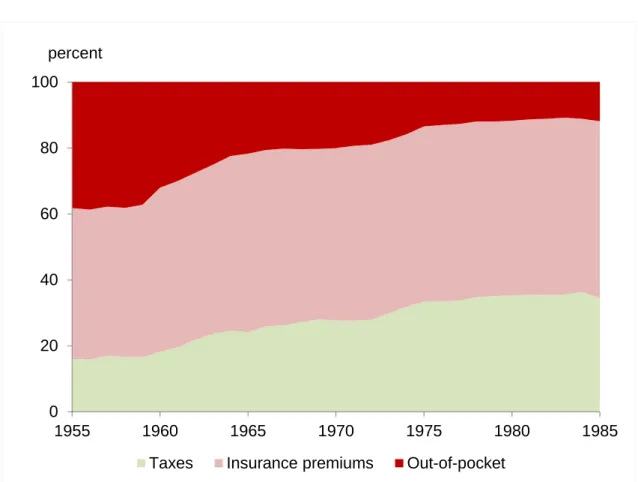
With the expanded coverage of health insurance plans, UHC reduced people’s reliance on out-of-pocket spending to purchase health services. When UHC was expanded to the private sector, national and local governments were obliged by law to utilize more tax revenues to finance spending on the costs of health services. As seen in Figure 1, the proportion of out-of-pocket spending in overall health expenditures gradually declined from 38.7 percent in 1955, to 10.5 percent in 1982. Along with this change in spending, the expansion of UHC had two important implications for household income and income distribution.
First, health services became more evenly accessible. Figure 2 compares the concentration curves of healthcare benefits, which were provided by public healthcare insurance, between 1952 (before the establishment of UHC) and 1967 (after its establishment). The concentration curve graphs the cumulative proportion of healthcare benefits against the cumulative proportion of households ranked by income (van Doorslaer et al., 2000). We observe that the curve for 1952 is located below the diagonal, indicating that the receipt of healthcare benefits was distributed in favor of richer households. By comparison, the curve for 1967 is located close to the diagonal, indicating a relatively even distribution of benefits.
We also can calculate the concentration index, which indicates the degree of inequality in the distribution of health care and is measured as twice the area between the concentration curve and the diagonal. The index declined from 0.145 in 1952 to –0.001 in 1967.
The second implication, related to the first one, is the increasing importance of income transfer via taxation and the social security programs. Figure 3 confirms this by showing
healthcare benefits in kind and benefits in cash by income class in 1967, compared to social security costs, which are the sum of social security contributions (premiums) and an estimated portion of taxes to finance overall social security benefits.
We can see three noteworthy findings in this figure. First, spending for healthcare benefits dominated social security benefits except for the lowest income groups, reflecting a limited number of public pension recipients in the younger population. Second, healthcare benefits exist within a relatively limited range across income groups, reflecting an equal access to healthcare services. This is consistent with the shape of the concentration curve for 1967 in Figure 2.
Third, the observed relationship between social security benefits and costs across income groups suggests income transfer from the rich to the poor—that is, the net benefits were positive for the poor and negative for the rich. To be sure, it may be controversial whether, and to what extent, income redistribution should be expected from social security programs, which were originally designed to reduce peoples’ exposure to social risks. However, the fact that UHC had the favorable byproduct of reducing income inequality in Japan should be remembered; it has important implication for countries that do not have a rigorous taxation system.
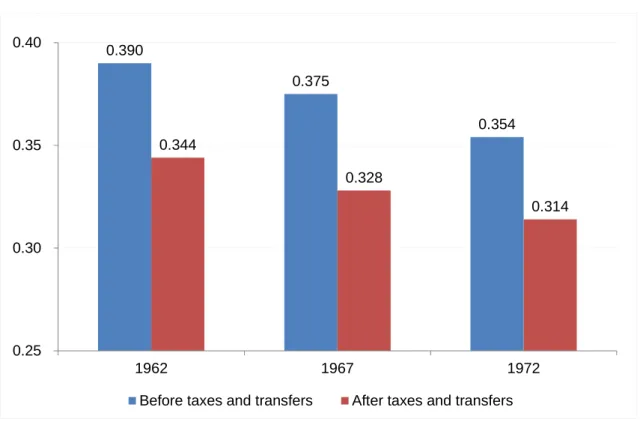
Income redistribution by UHC has contributed to a reduction in overall income inequality, which is measured by the Gini index. Figure 4 shows the changes in the official estimates of the Gini index over the decade after the establishment of UHC, beginning at its initial stage. For both types of income—before and after taxes and transfers, the figure shows that income inequality successfully declined during that period. The main driver of the reduction in income inequality was rapid economic growth, which raised the mean household income.
Also, the relatively equal development across areas and the nationwide income redistribution of tax revenues across local governments favored equitable income redistribution (Tachibanaki, 2004).
UHC was another main contributor to equitable income redistribution. The MHLW (2013a) decomposed the reduction in the Gini index after income redistribution into those attributable to taxation and social security programs for 1967 and 1972. This decomposition showed that social security programs explained about 70 and 50 percent, respectively in each year, of the reduction in the Gini index. Considering that public pension benefits had not matured at the time, this underscores that healthcare programs substantially mitigated
income inequality in a market economy.
Finally, we can argue that a gradual introduction of UHC was helped by rapid economic growth. Between 1955 and 1970, the real gross domestic product (GDP) increased at nearly a 10 percent rate and kept overall healthcare expenditures below 3 percent of the GDP until 1973 (compared to 7.3% in 2013; NIPSS, 2012). Rapid economic growth also raised government revenues through taxes and social security contributions, which sustained sufficient fiscal space for health care benefits.
3. Challenges: pressures from the aging population and changing economic structure
Japan’s UHC was successfully established in the 1960s and had favorable effects on household income and income distribution. Half a century later, however, it is facing several challenges because of the aging population and structural changes in the economy. The proportion of people aged 65 and over has been rising rapidly and is 26.1 percent as of 2014, making Japan the “oldest” country in the world. At the same time, the economy has experienced a reduction in the self-employed and farmers, as well an increase in non-regular employees. These secular changes have reduced fiscal space for UHC and put a strain on the existing scheme of health care insurance.
Aging affects the fiscal space on both the expenditure and revenue sides. On the expenditure side, a rising proportion of the elderly naturally raised total health expenditures because the elderly consume more healthcare services than the young population and their share of benefits. Indeed, as seen in Figure 5, the share of healthcare benefits for the elderly (aged 70 and older) to the total benefits rose from 15.2 percent in 1975 to 46.4 percent in 2012, and an increase in benefits for the elderly explained more than half of the increase in total benefits. On the revenue side, the elderly tend to have a lower income so that the amount they contribute is less. Moreover, lower rates of income tax and healthcare insurance contributions are applied to public pension income for the elderly. At the same time, health insurance has become similar to pensions in that they have led to large-scale income transfers from the young to elders (Figure 6), because funding is on a pay-as-you-go basis. Increasing income transfers between age groups have made the health care insurance less sustainable under an aging population.
The government was not aware of the potential pressures of the aging population on UHC until the 1980s. Indeed, it made health care for the elderly free of charge at the national
level in 1973 (until ten years later), along with other, generous reforms in social security programs. Since then, the government has gradually become more concerned about its deteriorating fiscal position and its causes: population aging and lower economic growth.
Policymakers have tried to reduce the fiscal burden on the general budget by forcing health insurance plans to contribute more to the health expenditures of the elderly. However, they have faced increasing resistance from the employers and the employees, who are members of the employment-based plans, because they are already contributing nearly half of their premium revenue to the funding pool to finance the elderly’s health expenditures.
Decreased growth in government revenues, due to a prolonged economic slowdown, and mounting healthcare and other social security benefits for the elderly have increased dependence on government bond issues. According to the latest official projections by the MHLW (2012c), the ratio of healthcare benefits to the GDP will grow from 7.3 percent in 2012 to 8.9 percent in 2025. Without any substantial increase in tax rates or social security premiums, fiscal space for UHC will likely continue to shrink.
Shrinking fiscal space has been accompanied by a change in the structure of income transfer related to UHC. Healthcare insurance programs are pay-as-you-go in nature because people are most exposed to health risks when they are old and pay more premiums and taxes when they are young. Figure 7 shows the comparison of healthcare costs (the sum of the copayment plus out-of-pocket spending) and benefits by age group. When the population was young in the initial stage of UHC, the magnitude of this inter-generational transfer of income was relatively limited at the national level and dominated by intra-generational transfer. However, the population’s aging has accelerated the inter-generational transfer and reduced fiscal space because the elderly did not accept reduced benefits easily and the young usually were opposed to higher taxes and premiums.
Another key challenge to UHC has come from structural changes in the labor market. Japan has not established a unified system of healthcare insurance, and citizens are covered by either employee-based plans (for employees and their family dependents) or municipality-based plans (for others). The latter plans, that is, CHI plans, originally were supposed to cover self-employed workers, farmers, and their family dependents.
Industrialization of the economy has reduced the proportion of these types of individuals in the total population, and hence the structure of CHI group membership.
The CHI plans are now absorbing an increasing number of non-regular employees, who are
not covered by employer-provided health insurance plans, which conflicts with their original purpose. The rising proportion of non-working people, most of whom are retired or unemployed, makes the CHI plans less sustainable. Moreover, the uneven rates of aging and economic growth across regions have led to a wider disparity in the premium rates of CHI plans, which are municipality-based and exposed to the fiscal positions of local governments. The current system does not provide municipalities with strong incentives to enhance efficiency because CHI-plan deficits usually are funded by subsidies from the central government. The increasing presence of members with low incomes and a lack of incentives to enhance efficiency put a strain not only on the CHI plans but also on the country’s healthcare plans as a whole, because more subsidies are needed to fill the revenue shortages of the CHI plans.
4. Conclusion: implications from Japan’s experience in UHC
We have briefly summarized the impact of UHC in Japan over the past half a century from an economic viewpoint. Japan’s experience with UHC provides important lessons—both positive and negative—for countries that are in the initial stage of establishing healthcare and other social security programs.
On the positive side, UHC is expected to create a favorable byproduct. The goal of universal health coverage is to ensure that all people obtain the health services they need without suffering financial hardship when paying for them. The system, which Japan established to finance their UHC program, had another important effect: it indirectly reduced income inequality via contributions and benefits. This income transfer worked effectively, during the initial stage of establishing UHC, because the population was young.
Therefore, income distribution should be a key contributor to social well-being and to the people’s support of economic development.
At the same time, we should remember that the sustainability of UHC depends largely on demographic and economic conditions. One of the most formidable, albeit foreseeable, challenges is the aging population, and it is advisable to make the system as robust as possible in advance, to counter its stress on the economy. Japan’s experience clearly reveals that once a population starts to shrink and the economy stops expanding, the fiscal sustainability of the system will decline. In addition, changes in industry and labor market structures are likely to have substantial effects on UHC programs that differ from their original goals. This is especially the case, given that UHC has a history of expanding from
the public to the private sectors and has not been unified at the national level.
It is politically challenging to reform UHC once these changes are realized, as evidenced by Japan’s experience. Under conditions of an aging population and low economic growth, any reform in UHC should take the form of a zero-sum game. It would be advisable to design a system that is sufficiently robust to withstand demographic and economic pressures, using projections that are as precise as possible.
References
Campbell, J. C., Ikegami, N., and Tsugawa, Y. (2014). The political-historical context of Japanese health care. In N. Ikegami (ed.) Universal Health Coverage for Inclusive and Sustainable Development: Lessons from Japan. (pp.15–26), Washington: World Bank Group.
Ikegami, N., Yoo, B.-K., Hashimoto, H. et al. (2011). Japanese universal health coverage:
evolution, achievements, and challenges. Lancet, 378 (9796), 1106–1115.
Ministry of Health, Labour and Welfare (MHLW). (2012a). National Medical Expenditures http://www.e-stat.go.jp/SG1/estat/List.do?lid=000001127463 (accessed January 2015).
Ministry of Health, Labour and Welfare (MHLW). (2012b). Survey of the Citizens’ Health Insurance. http://www.e-stat.go.jp/SG1/estat/GL08020101.do?_toGL08020101_ (accessed January 2015).
Ministry of Health, Labour and Welfare (MHLW). (2013a). Survey of Income Redistribution http://www.e-stat.go.jp/SG1/estat/List.do?lid=000001114582 (accessed January 2015).
Ministry of Health, Labour and Welfare (MHLW). (2013b). On the revisions to the projections of social security costs.
http://www.mhlw.go.jp/seisakunitsuite/bunya/hokabunya/shakaihoshou/dl/shouraisuikei.pdf (accessed January 2015).
National Institute of Population and Social Security Research (NIPSS). (2012). The Financial Statistics of Social Security in Japan http://www.ipss.go.jp/ss-cost/j/fsss-h24/fsss_h24.asp (accessed January 2015).
Oshio, T., Miake, N., and Ikegami, M. (2014). Macroeconomic context and challenges for maintaining universal health coverage in Japan. In N. Ikegami (ed.) Universal Health Coverage for Inclusive and Sustainable Development: Lessons from Japan. (pp.27–40), Washington: World Bank Group.
Tachibanaki, T. (2004). Confronting Income Inequality in Japan: A Comparative Analysis of Causes, Consequences, and Reform. Cambridge: MIT Press.
Van Doorslaer, E., Wagstaff, A., van dear Burg, H. et al. (2000). Equity in the delivery of health care in Europe and the US. Journal of Health Economics, 19, 553–583.
Figure 1: Changes in funding sources for health expenditures: 1955–1985
Source: MHLW (2012a).
0 20 40 60 80 100
1955 1960 1965 1970 1975 1980 1985
Taxes Insurance premiums Out-of-pocket percent
Figure 2: Concentration curves of healthcare benefits: 1952 vs. 1967
Note: Income is before taxes and transfers.
Source: The author’s calculations were based on MHLW (2013a).
0.0 0.2 0.4 0.6 0.8 1.0
0.0 0.2 0.4 0.6 0.8 1.0
Cumulative proportion of households ranked by income Cumulative proportion of healthcare benefits
1952 1967
Figure 3: Social security benefits and costs by income class in 1967
Note. Social security costs indicate the sum of social security contributions (premiums) and the estimated portion of taxes to finance overall social security benefits.
Source: MHLW (2013a).
0 50 100 150 200
Healthcare benefits in kind Benefits in cash Social security costs thousand yen, annual
Household income class (thousand yen, annual)
Figure 4: Declining Gini index after the establishment of UHC: 1962–1972
Source: MHLW (2013a).
0.390
0.375
0.354 0.344
0.328
0.314
0.25 0.30 0.35 0.40
1962 1967 1972
Before taxes and transfers After taxes and transfers
Figure 5: Increasing healthcare benefits for the elderly
Note: Benefits for those aged 70 years and above before 1997, are the author’s estimation based on the reports from the MHLW (2012a) and NIPPS (2012).
Sources: MHLW (2012a) and NIPPS (2012).
0 10 20 30 40 50
0 10 20 30 40 50
1975 1980 1985 1990 1995 2000 2005 2010
Benefits for those aged 0-69 years
Benefits for those aged 70 years and above (right scale)
trillion yen percent
Figure 6: Healthcare payments and benefits by age group in 2011
Source: MHLW (2012b).
0 200 400 600 800 1000 1200
Premium Copayment
Heathcare expenditures thousand yen (annual)
Age group
Figure 7: Changing membership composition of Citizens’ Health Insurance (CHI)
Source: MHLW (2012b).
0 20 40 60 80 100
1965 1975 1985 1995 2000 2005 2010 2012
Farmers Self-employed Employed Others Non-working percent
Impact of the Recent Socioeconomic Changes on Equity, Effectiveness, and Efficiency of the
Universal Health Coverage in Japan
Hideo Yasunaga1, Naoki Kondo2, Toshiaki Iizuka3, Haruko Noguchi4, Yusuke Tsugawa5, Akihiro Nishi6, Hideki Hashimoto7, Kenji Shibuya8
1. Department of Clinical Epidemiology and Health Economics, School of Public Health, The University of Tokyo
2. Departments of Health and Social Behavior, School of Public Health, The University of Tokyo;
3. Graduate School of Economics, The University of Tokyo;
4. Faculty of Political Science and Economics, Waseda University;
5. Harvard University Interfaculty Initiative in Health Policy;
6. Yale Institute for Network Science;
7. Departments of Global Health Policy, Graduate School of Medicine, The University of Tokyo
Summary
This study team will analyze the impact of recent socioeconomic changes on equity, effectiveness, and efficiency of universal health coverage (UHC) in Japan using national health-related databases, with a special focus on the following aspects: 1) impact of two recent crises on healthcare in Japan (i.e., economic downturn precipitated by the global financial crisis in 2008, and the Great East Japan Earthquake in 2011), and 2) recent changes to Japan’s healthcare system that were not fully examined in the Lancet Special Series on Japan, 2011, including (i) input-output analysis on efficiency of primary care and acute care, and (ii) overview of the current long-term care system in Japan.
1. Background
The Lancet Special Series on Japan: Universal Health Care at 50 years (2011) and the Japan–World Bank Partnership Program on Universal Health Coverage (2014) described the historical background, current status, and sustainability of Universal Health Coverage (UHC) in Japan. However, in the last several years we have witnessed various socioeconomic changes in Japan, and the impacts of these changes on equity, effectiveness, and efficiency of UHC remains unclear.
Two recent crises in Japan may have affected the sustainability of its national healthcare system. One was the economic crisis in Japan following the 2008 global financial crisis, and the other was the earthquake and tsunami disaster that hit northeast Japan in 2011. The authors aim to clarify the impacts of these crises on healthcare delivery, access, and
outcomes and to examine how Japan’s UHC system alleviated the impact of these crises through comparisons with similar situations in other countries (e.g. European countries under economic crisis and subsequent austerity measures and policy change). The study will provide new insight into how such crises can affect UHC and how countries should prepare robust UHC systems to protect against such shocks, which will provide useful lessons for any country that has established—or is in the process of introducing—a UHC system.
In addition, several issues related to recent changes to the healthcare system were not completely investigated in the Lancet Special Series on Japan in 2011. Primary and long-term care systems are pivotal healthcare pillars in “super-aging” societies where integrated community healthcare and welfare programs are coordinated to deliver services.
In the present study, the authors will examine (i) equity, effectiveness, and efficiency of Japan’s primary and acute care systems, and (ii) details of the current long-term care system in Japan.
2. Data sources
In this study, the authors will perform secondary analyses of the following large healthcare databases in Japan:
A. Comprehensive Survey of Living Conditions (
国民生活基礎調査
) B. National Health and Nutrition Survey (国民健康・栄養調査
) C. National Census (国勢調査
)D. Report of Vital Statistics: Occupational and Industrial Aspects(
人口動態職業・産業別 統計
)E. Japan Gerontological Evalusation Study (JAGES) (
日本老年学的評価研究
)F. Longitudinal Survey of Newborns in the 21st Century (
21世紀新生児縦断調査デ ータ
)G. Survey of Physicians, Dentists and Pharmacists (
医師調査医師・歯科医師・薬剤師調 査
)H. Survey of Medical Institutions/ Hospital Report (
医療施設調査・病院報告
) I. Diagnosis Procedure Combination (DPC) inpatient data (DPCデータ
) J. Patient Survey (患者調査
)K. All-Japan Utstein Registry (
救急蘇生統計
)L. Specific health checkup and health insurance claims data from Federation of National Health Insurance and Japan Health Insurance Association (
国保・協会けんぽの特定健 診・レセプトデータ
)M. Survey of Institutions and Establishments for Long-term Care (
介護サービス施設・事
業所調査)
N. Survey of Long-term Care Benefit Expenditures (介護給付費実態調査)
3. Impact of the two crises on UHC in Japan
3.1. Impact of the economic downturn after the global financial crisis in 2008 Naoki Kondo, Associate Professor
(i) Using data from the Comprehensive Survey of Living Conditions and the National Health and Nutrition Survey, the authors will analyze annual trends in socioeconomic disparities in health indicators and health behaviors, and changes in these trends before and after various exogenous shocks (including the 2008 global financial crisis). Trends will be analyzed at the national and prefectural levels.
(ii) The authors will also perform similar analyses with cause-specific mortality as the outcome variable, using data from the National Census and Report of Vital Statistics:
Occupational and Industrial Aspects.
(iii) Using 2010 and 2013 panel data from the Japan Gerontological Evaluation Study (JAGES), the authors will analyze changes in health status of the elderly (activities of daily living and nursing care needs) and disparities in access to healthcare based on self-administered questionnaires.
(vi) Using the Longitudinal Survey of Newborns in the 21st Century (2001 and 2010 cohorts) the authors will evaluate the impacts of the 2008 global financial crisis on the health and health care utilization of children of various socioeconomic statuses.
3.2. Impact of the Great East Japan Earthquake in 2011 Hideo Yasunaga, Professor, and Toshiaki Iizuka, Professor
The authors will gather data from the Survey of Physicians, Dentists and Pharmacists;
Survey of Medical Institutions/ Hospital Report; Diagnosis Procedure Combination (DPC) inpatient data; Patient Survey; and All-Japan Utstein Registry. They will use this data to analyze changes in the distribution of healthcare resources (including medical institutions and healthcare providers) and access to healthcare services before and after the 2011 earthquake and tsunami disaster. For instance, using Patient Survey data the authors will analyze annual trends in hospital admission rates for stroke and acute myocardial infarction in secondary medical areas.
4. Issues related to recent changes in the healthcare system
4.1. Input-output analysis on efficiency of primary care and acute care Hideo Yasunaga, Professor
Using the Survey of Medical Institutions/Hospital Report, Diagnosis Procedure Combination inpatient data, Patient Survey, and specific health checkup and health insurance claims data from the Federation of National Health Insurance and Japan Health Insurance Association, the authors will perform input-output analysis on the efficiency of primary care and acute care services. In hospital-level analysis, the authors will use
“hospital standardized mortality ratio (HSMR)” as the output indicator, and healthcare resources (healthcare providers and medical devices) as the input indicators. In secondary medical area–level analysis, we use “effective coverage” as the output, and local healthcare resources (healthcare providers and medical facilities) as the inputs. Effective coverage is measured using (i) the gap between positive rates in screening tests and the rates of receiving treatment, and (ii) the gap between health guidance for smokers and their visits to smoking cessation clinics.
4.2. Overview of long-term care in Japan Toshiaki Iizuka, Professor
Using the Survey of Institutions and Establishments for Long-term Care and the Survey of Long-term Care Benefit Expenditures, the authors will interpret and review the long-term care system in Japan. In an analysis of P4P (pay for performance) in long-term care, the authors will analyze the impact of “contingency fees” on improving the quality of nursing care.
5. Expected outcomes of the project
This study is expected to provide evidence on how we can better prepare for social, economic, and demographic crises through a robust UHC system. The roles of government, healthcare providers, and citizens in the community will be further discussed to glean policy lessons for emerging countries that will soon face similar challenges.
厚生労働科学研究費補助金(厚生労働科学特別研究事業)
分担研究報告書
UHC の実践的手法と教訓に関する研究
橋本 英樹 東京大学大学院医学系研究科保健社会行動学教室教授 渋谷 健司 東京大学大学院医学系研究科国際保健政策学教室教授
津川 友介 ハーバード大学医療政策学、世界銀行グループコンサルタント[研究協力者]
(関係省庁若手グループの協力を得て執筆)
【概要】
日本・世界銀行共同研究プログラムの成果等をさらに発展させ、保健医療政策の立 案・実行に携わる当事者である技術系行政官の視点で、国際的に情報の発信が乏し くブラックボックスとなっており言語化されていない分野に焦点を当て、UHC の 実現に向けた実践的な提言を行う。
提言は、以下の3つの方針に沿って、まとめていく。
・ 『健康長寿社会』を見据えた持続可能な保健医療制度の提言
・ 『部分最適(partial optimization)』から『全体最適(total optimization)』へ
・ 『後ろ向き(retrospective)』から『前向き(prospective)』へ
研究・検討においては、WHO Health Systems Frameworkとして提唱しているThe six building blocks of a health systemに沿って、知識を体系化する。
1. はじめに
UHC に関する日本・世界銀行共同研 究プログラム(以下、「共同プログラム」) が発足し、日本政府と世界銀行の共同 研究チームが編成され、これまでの我 が国の医療政策等についてレビューし、
昨年、日本のUHC に関わる経験を10 のテーマで分析した研究成果がまとめ られた。
当グループとしては、これまでの共同 プログラムやその他の医療政策に関す る文献や研究を発展させ、その成果を 参考にしながら、以下の3つの方針の もと、G8における提言や学術雑誌への
論文の投稿を見据えてまとめる。
これらの視点及びより現実に則した考 察・提言は、日々試行錯誤しながら実 際に保健医療政策の立案・実行に携わ る当事者である技術系行政官こそ、本 領を発揮できる領域である。
(1)『健康長寿社会』を見据えた持続可能 な保健医療制度の提言
我が国は世界一の長寿国であり、50年 以上前に達成した国民皆保険や 2000 年から施行されている介護保険等の保 健医療福祉制度(社会保障制度)が健 康・平均寿命の延伸に大きく寄与し、
同時に社会保障制度の整備に伴う健康 な労働人口の増加は高度経済成長を支 えてきたという正のスパイラルがあっ たと考えられる。
こうした日本においても、2016年 G8 サミットから10 年後の 2025年には、
団塊世代が 75 歳を迎えることを踏ま え、地域包括ケアシステムの構築等、
将来にわたって持続可能な制度改革が 行われつつある。
高齢化は、先進国のみならず低・中所 得国においても、ほぼ例外なく全世界 的に進展していくが、それらの国々に おける高齢化対策の政策的優先度は高 いとは言えない。
また、経済成長として享受されること が多い人口ボーナスの恩恵が受けられ ず、国家の経済が未成熟で社会保障制 度が未整備のまま、高齢化及び生産年 齢の人口の減少に直面する国々が出て くると見込まれ、UHCの持続可能性が 問われている。
先行研究においては、社会保障制度に 関する検証や考察は多いが、人口動態 の変化や高齢化も勘案しマクロ・ミク ロの視点から UHC を総合的にレビュ ーし、その結論に基づき高齢化社会に 対応した望ましい UHC について知識 を体系化している取組は少ない。これ らの課題及び取組みは世界で日本が最 初に経験するものであり、その知見は 世界各国の対策に資するものである。
以上から、本グループでは、人口動態・
高齢化の問題に特化して、健康長寿社 会における理想的な高齢化社会対応型 UHCについて、検討していく。
(2)『部分最適(partial optimization)』
から『全体最適(total optimization)』へ
我が国においては、世界に先駆けて高 齢化が進展したことから、政策・制度 面で参照すべき他国の UHC 等の社会 保障制度は存在しなかった。また、社 会保障制度はその財源確保が経済状況 と密接に関連するとともに、制度その ものが政治経済社会の状況を反映して 構築・運用されるため、目の前の問題 解決に資する資源配分(部分最適)が 図られてきた。
一方で、近年、社会保障のうち、とり わけ保健医療分野においては、IT技術 の活用が積極的に図られ、財源を含め た医療資源の効果的な配分という政策 判断においても「全体最適化」が可能 となりつつある。
我が国においては、等しく国民に対し 必要な医療を提供するという方針のも と取り組みが進められてきた。また、
我が国におけるITの活用等による「部 分最適」から「全体最適」への移行の 例は、これから UHC 等の社会保障制 度を設計し実行していく国々にとって、
制度創設の初期段階から全体最適化を 指向した制度設計の参考になる。この ように、我が国が UHC のロールモデ ルになることは、国際社会における責 務である。
そのためには、我が国の成功体験や失 敗体験を、より長期的かつ大局的な視 点で、まとめていく。
(3)『後ろ向き(retrospective)』から『前 向き(prospective)』へ
多くの先行研究は、過去の出来事につ いてレビューや検証等を行っているも のが多い。本グループでは、現在直面 している喫緊の課題やその解決策につ いて、今後どのような対策を取るべき か等について、日頃保健医療制度の立 案・実施に携わる行政官が、これまで 言語化されていなかった領域等につい て、実践的な課題や対策に関する知見 を体系的にまとめていく。
2.研究・検討の進め方
知識の体系化にあたっては、既存の国際 的なUHCの枠組みに沿って整理すること が望ましい。WHOは、2007年に、
“Everybody's Business: Strengthening
Health Systems to Improve Health Outcomes: WHO's Framework for Action”
等において、The WHO Health Systems Frameworkとして、The six building blocks of a health systemを提唱している。
一方、Health Systemに関するフレームワ ークとしては、世界銀行研究所のヘルスシ ステムに関するFlagship Courseのために ハーバード大学が開発した、Flagship Approach(世銀・ハーバードモデル)も知 られる。
また、現在、WHOにおいては、UHCの 必須要素として、以下のようなものを掲げ ている。
本グループとしては、これらのフレーム ワークを日本の文脈に沿って活用・検討し、
提言や学術論文としてまとめていく。
Fig 1. The WHO Health Systems Framework
http://www.who.int/healthsystems/strategy/everybodys_business.pdf Fig 2. Harvard/The World Bank Flagship Approach
Fig 1. The WHO Health Systems Framework
http://www.who.int/healthsystems/strategy/everybodys_business.pdf Fig 2. Harvard/The World Bank Flagship Approach
Fig 1. The WHO Health Systems Framework
http://www.who.int/healthsystems/strategy/everybodys_business.pdf Fig 2. Harvard/The World Bank Flagship Approach
Fig 1. The WHO Health Systems Framework
http://www.who.int/healthsystems/strategy/everybodys_business.pdf Fig 2. Harvard/The World Bank Flagship Approach
Fig 1. The WHO Health Systems Framework
http://www.who.int/healthsystems/strategy/everybodys_business.pdf Fig 2. Harvard/The World Bank Flagship Approach
http://www.who.int/healthsystems/strategy/everybodys_business.pdf Fig 2. Harvard/The World Bank Flagship Approach
http://www.who.int/healthsystems/strategy/everybodys_business.pdf