MEMBERSHIP OF POLAND IN THE EUROPEAN UNION. CONVERGENCE, TRADE AND FOREIGN DIRECT INVESTMENT
Maria Curie-Sklodowska University
Pawel Pasierbiak
1【Abstract】 A real convergence can be treated as a main goal for less economically advanced coun- tries joining the regional economic integrational scheme. This was also the case of Central and East- ern European Countries (CEEC) that entered the European Union in 2004. Poland and other econo- mies have gone through a period of economic changes and were gradually catching up with the ʻoldʼ EUʼs economies. The enlargement of the EU made Polish economy more connected to the common market offering potential benefits but also more competitive pressure. The aim of the article is to an- alyze and evaluate the experience of Poland in selected areas of the economy as a result of member- ship in the European Union. Using analytical and descriptive methods, the author will evaluate changes that have taken place since the year 2000. Main area of interest is a real convergence but additionally, as developments of foreign trade of an accessing country is complementary to the anal- ysis of a convergence process, and because foreign direct investments have a significant impact on economic growth, these two areas will be addressed as well. Main findings of the analysis leads to the clear conclusion that in the case of Poland the accession to the European Union should be as- sessed positively. Although a dynamic could be faster, the convergence process is gradually taking place. Additionally, foreign trade and FDI developments are generally supportive to GDP growth and helpful in narrowing the developmental gap between Poland and the EU countries.
【Keywords】 Poland, European Union, convergence, economic growth, foreign trade, FDI.
Table 1.Introduction
2.Remarks on effects of integration for countries with lower level of development 3.Real convergence of Polish economy
4.Foreign trade developments 5.Area of foreign direct investments Conclusion
特集Ⅱ:ポーランド経済と EU
1 Maria Curie-Sklodowska University, Lublin, Poland; Faculty of Economics, Chair of World Economy and European Integration; Phone: +48-81-537-51-68; E-mail: [email protected].
1 . Introduction
Regional economic integration is one of the two most prominent and significant trends in the con- temporary world economy. In parallel to processes of economic globalization, it is increasingly evi- dent that regional integration is organizing links between economies. In order to raise economic strength and competitive position in the global economy, countries intensify cooperation within the region. On the one hand, it may be a bottom-up (market) integration but on the other, a top-down process, where formal links between countries exist and sometimes even common institutions are created.
When analyzing motives why countries engage in the process of strengthening regional ties, one can indicate various opinions. Basically however, a fundamental motif may be defined either as net economic benefits expected from integration compared to non-integration situation [Jovanović 2015, p. 12] or acceleration of convergence process, i. e. lowering developmental differences [Mu- cha-Leszko 2014, p. 15]. The latter statement describes a main motif for countries joining an inte- grational initiative that are at lower levels of economic development, and which, by entering region- al integration processes, bargain for accelerated narrowing developmental gaps in relation to more economically advanced countries.
In May 2004 Poland formally joined the European Union. It was an important stage in the difficult process of socio-economic transformation that began at the turn of the 1980s and 1990s. Poland en- tered the grouping of much more economically developed countries, hoping to accelerate the pro- cess of real convergence. Although, a creation of more favorable conditions for economic develop- ment had already been taking place (e. g. with the entry into force of the trade part of the Europe Agreement in 1992), and the convergence process was initiated earlier than formal entry, the acces- sion was hoped to speed up the process even more.
These issues are covered by presented study. The author will analyze and assess the effects of Poland's membership in the European Union in selected economic areas. This should allow to veri- fy the hypothesis that Poland took advantage of the opportunity to accelerate economic growth re- sulting from joining an integration group. The subject of the analysis is mainly economic conver- gence, but complementarily developments of foreign trade and foreign direct investment as factors significantly influencing economic growth and convergence will also be analyzed. The time span covers mainly a period of 2000-2016 but in some cases changes in longer period are described.
2 . Remarks on effects of integration for countries with lower level of development
When analyzing the processes of leveling economic development between different countries, the literature often describes the real convergence of beta type (β-convergence) and sigma (σ -convergence) [Barro, Sala-i-Martin 1991, p. 112]. The first type of convergence (β) takes place when countries with lower levels of development are consistently achieving higher growth rates than those with higher levels of development. This is a catching-up process, which is usually mea-
sured by an income or GDP per capita growth in terms of purchasing power parity. The second type of convergence (σ) means the reduction in the level of economic development and is measured by the standard deviation of income or product per capita within the analyzed group of regions or countries. The first type (beta) convergence is working towards achieving the second type (sigma) convergence, but to some extent it is affected by new disturbances that tend to amplify deviations (Barro, Sala-i-Martin 1990, p. 11-12).
One of the key drivers of convergence is total factor productivity (TFP). TFP measures the effi- ciency with which labor and capital inputs are used in the production process. In economic theory, there are two classes of models that explain the importance of technology and TFP in the process of convergence over time. The first group assumes the exogenous technology path, while the sec- ond group introduces endogeneity into the technology path. The first group is referred to as neo- classical models, and one of its most prominent representatives is Robert Solow. In these models, the technological level of the country determines the efficiency of the production process. R. Solow assumes that the population and technology are growing at an exogenous rate, while the amount of physical capital depends on the level of savings. The greater the existing capital resources in the economy, the greater the amount of savings needed to compensate for depreciation and to keep capital at its current level. At the end, the economy will reach the point at which there are just enough savings to maintain capital at its current level. In this steady state, capital per unit of effec- tive labor will not increase, and all per capita variable values will grow in line with the rate of tech- nological progress [ECB 2015, p. 38]. Solow explained that differences in the rate of economic growth between countries are due to the differences in stocks of physical capital, and therefore the countries are at different points on their balanced growth paths. One of the basic assumptions of the Solow model is that marginal return to capital decreases. If the economy has little capital, then the benefits of increased investment are high. Equally, investments in less capital abundant coun- tries should bring greater return to investors and encourage them to invest more in these markets.
Then the catching-up process, i. e. β-convergence to the same level of income could be accelerat- ed. This convergence is conditional on economic agents across countries having the same prefer- ences and all other features of economies are identical ('conditional theory'). Such processes could have taken place in the Polish economy, as it became more attractive to investments, generally after accession to the European Union.
Neoclassical theories, however, have limitations, because despite the creation of a theoretical framework and the conditional theory, they could not give an explanation of the sources of conver- gence. One of possible explanations could be differences in the efficiency of production factors and the different pace of technological progress, but because neoclassical models cannot tell where these differences come from, their role in explaining the convergence process is limited. As such, new (endogenous) concepts have emerged where technological progress is generated by ever-ra- tional consumers and producers, and can be shaped by appropriate state policies. At the same time, it is worth mentioning that two main approaches to endogenous growth patterns have emerged [ECB 2015, p. 39-40]: 1) the modeling of increased productivity through increasing returns to pro-
duction factors (either capital or labour), and 2) the explicit modelling of research and development (R&D) activities as a separate sector of the economy.
The latter approach attributes an active role to the economic policies of countries. They can try, by appropriate strategy, to influence the total factor productivity (TFP). Efforts aimed at increasing the quality of skilled workforce, increasing R&D spending, openness and competition that promote productivity, and the spread of new technologies, all this contributes to economic growth and con- vergence. As a result, the changes that have taken place in Poland's economic policy and the focus on technological development are crucial for real convergence within the European Union.
But what is also true is the fact that there is quite a clear polarization in the real world levels of economic development, and the area of economic growth is just one of many to be considered in convergence analysis [Quah 1996, p. 1354].
3 . Real convergence of Polish economy
One of the expected effects of integration processes in Europe was to reduce differences in the level of economic development of the participating countries. After the year 2000, an accelerated real convergence process in the European Union was observed, but this was mainly due to catch- ing-up of countries from Central and Eastern Europe [ECB 2015, p. 30, Monfort et al. 2013, p. 694].
This process can be measured in several ways, and one of the most basic and commonly used mea- sures is GDP growth: the overall and per capita. These simple indicators and, additionally, changes in labor productivity/TFP will be used in this study to compare of Polandʼs performance with select- ed group of countries.
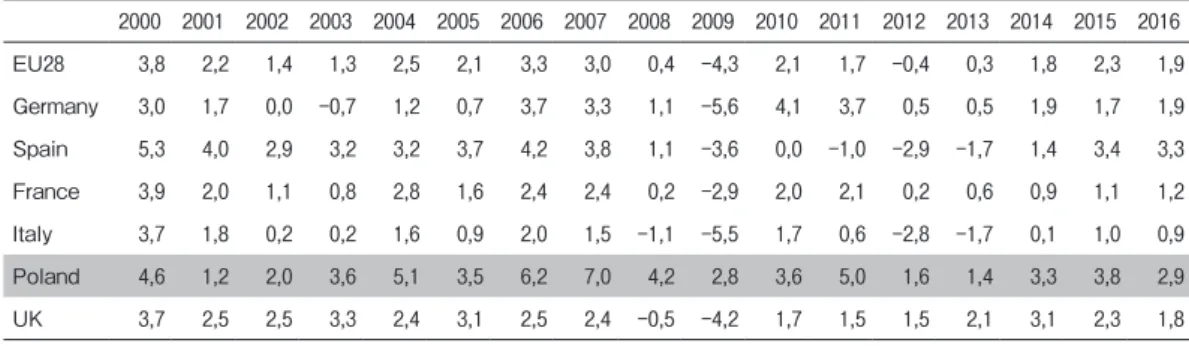
Table 1 presents data of growth dynamics in Poland against the background of the selected de- veloped countries of the European Union. On the basis of the data, one can observe the good situa- tion of Poland in comparison to other countries. Poland was the only country showing a positive economic growth rate throughout the years of analysis. Nevertheless, the situation was different depending on the period.
At the beginning of the 21st century, between 2001 and 2003, the economic situation in the Euro-
Table 1 . Real GDP growth in selected economies, 2000-2016, %
2000 2001 2002 2003 2004 2005 2006 2007 2008 2009 2010 2011 2012 2013 2014 2015 2016
EU28 3,8 2,2 1,4 1,3 2,5 2,1 3,3 3,0 0,4 -4,3 2,1 1,7 -0,4 0,3 1,8 2,3 1,9
Germany 3,0 1,7 0,0 -0,7 1,2 0,7 3,7 3,3 1,1 -5,6 4,1 3,7 0,5 0,5 1,9 1,7 1,9 Spain 5,3 4,0 2,9 3,2 3,2 3,7 4,2 3,8 1,1 -3,6 0,0 -1,0 -2,9 -1,7 1,4 3,4 3,3 France 3,9 2,0 1,1 0,8 2,8 1,6 2,4 2,4 0,2 -2,9 2,0 2,1 0,2 0,6 0,9 1,1 1,2 Italy 3,7 1,8 0,2 0,2 1,6 0,9 2,0 1,5 -1,1 -5,5 1,7 0,6 -2,8 -1,7 0,1 1,0 0,9
Poland 4,6 1,2 2,0 3,6 5,1 3,5 6,2 7,0 4,2 2,8 3,6 5,0 1,6 1,4 3,3 3,8 2,9
UK 3,7 2,5 2,5 3,3 2,4 3,1 2,5 2,4 -0,5 -4,2 1,7 1,5 1,5 2,1 3,1 2,3 1,8
Source: [Eurostat Database 2017].
pean Union was noticeably weak. This slowdown took place after the ICT (dot-com) crisis in the United States, and in Europe lasted almost three years. Nevertheless, the process of convergence of Poland's economy at that time was already taking place. Only in 2001, the economy of Poland showed a short-term decline (to 1.2%), but after that year it grew rapidly (up to 7% in 2007). In entire period Poland was the most dynamically developing country within those presented in the table.
Even during the global financial crisis (2008-2009), GDP growth in Poland was relatively high. By 2016, Poland has made up the distance it had with the more developed European economies. The good results of the Polish economy are illustrated in Figure 1, where the dynamics of GDP growth in Poland is related to the average for the European Union and Germany.
According to data from Figure 1 only in two years (2001, 2010) Poland recorded a lower eco- nomic growth rate than Germany, and compared with the EU28 average this situation was only ob- served only once, in 2001. Generally good economic situation in the period under review did not translate into significant increase of Poland's share in product creation of the whole grouping. The share increased by only one percentage point from 1.9 (2004) to 2.9% (2016), while for Germany it was 20.4 and 21.1%, respectively [Eurostat Database 2017].
The eastern enlargement of the European Union in 2004 has led to an increase in the diversifica- tion of the group from the GDP per capita point of view. In the year of accession, GDP per capita in relation to the EU average ranged from 46% (Latvia) to 240% (Luxembourg). Table 2 presents data illustrating changes in GDP per capita in selected countries.
Based on the analysis of data from Table 2, it can be stated that compared to other countries GDP per capita growth in relation to the EU average was the highest. In the years 2004-2016 this share increased as much as 19 percentage points, however it should be remembered that it was an in- crease from a low level of 50% (to 69%). What is positive about Poland in reference to other coun- tries in the group is that in relation to the EUʼs average (EU=100) only in Poland (and Germany) an Figure 1 . Real GDP growth in Poland, Germany and the EU28, 2000-2016, %
Source: Own preparation based on [Eurostat Database 2017].
-8.0
-6.0
-4.0
-2.0 0.0 2.0 4.0 6.0 8.0
-8.0
-6.0
-4.0
-2.0 0.0 2.0 4.0 6.0 8.0
2000 2001 2002 2003 2004 2005 2006 2007 2008 2009 2010 2011 2012 2013 2014 2015 2016
EU28 Germany Poland
increase in GDP per capita was observed. Other countries, Spain, France, the United Kingdom, and Italy in particular, showed declines. This phenomenon should be assessed positively from the point of view of Poland's economic convergence. Poland has been relatively quick in closing the develop- ment gap in relation to the most advanced European economies.
Scientific reliability requires that Poland's achievements be compared with the countries that have joined the European Union together with Poland – countries that share common experiences in the socialist economic system and were at a similar level of development. Against this backdrop, Poland appears as a country with moderate achievements. In 2016, GDP per capita in Poland was higher only in comparison to Bulgaria, Romania, Latvia and Hungary [Eurostat Database 2017]. In all other countries that joined the EU, the level was higher, with Czech Republic (88% of the EU av- erage) and Slovenia (83%) as leaders. However, this statement does not change the positive assess- ment of the process of convergence of the Polish economy with the more developed EU countries.
There is still much to do in this area, and one possibility is to take up opportunities from changes in foreign trade.2
The development of foreign trade is an important and positive factor in Poland's economic devel- opment, especially after its accession to the EU. The increased size of the market, the possibility of developing production specializations and benefiting from the increase in the scale of production is undoubtedly an advantage for Polish companies and a factor which increases the opportunities for economic growth. However, much depends on the extent to which a country has a competitive ad- vantage over its rivals. This in turn is a consequence of cost-price competitiveness and structural competitiveness [Mucha-Leszko 2014, p. 32]. The first is influenced mainly by changes in labor pro- ductivity and unit labor costs, in turn the latter is influenced by institutional environment and the quality of the human capital. The changes in the cost-price competitiveness of the Polish economy should be assessed highly. According to an analysis conducted by B. Mucha-Leszko, changes in la- Table 2 . GDP per capita: value and in relations to the EU average, 2000, 2004, 2016, %
GDP per capita
(PPS, EUR) GDP per capita
(PPS, EU28=100)
2000 2004 2016 2000 2004 2016
EU28 19 800 22 500 29 000 100 100 100
Germany 24 100 26 900 35 700 122 120 123
Spain 18 900 22 200 26 500 95 98 92
France 23 000 24 700 30 400 116 110 105
Italy 23 700 24 800 27 900 120 110 96
Poland 9 300 11 300 20 100 47 50 69
United Kingdom 22 800 26 800 31 200 115 119 108
Source: [Eurostat Database 2017].
2 This will be discussed in the following sections.
bor costs gave Poland a competitive advantage. This was particularly evident in the early years of membership. In the period 2003-2006, labor costs in Poland declined sharply, while in other coun- tries a growth was noted. This has improved the competitiveness of Polish exports, increasing its dynamics. In addition, positive changes occurred in the area of labor productivity. Table 3 shows the changes in this area between 2000 and 2017.
Poland's advantageous situation should be emphasized in the context of its competitors – in the whole period Poland maintained a positive growth rate of productivity while in other countries there were periods of decline. Taking into account TFP, however, the situation was no longer so favorable.
According to the Conference Board data [2017], the total factor productivity in Poland was increas- ing until 2008, while in 2008-2009 and 2012-2014 a TFP growth was in negative territory. From 2015 onwards, TFP dynamics is positive but remains relatively low. In this respect, Poland is behind the countries that joined the EU in 2007 (Bulgaria and Romania) and in 2013 (Croatia). However, com- paring the results of Poland to the more developed EU countries such as Italy, Spain and the United Kingdom, the situation in Poland is favorable.
4 . Foreign trade developments
Improvement of cost-price competitiveness resulting from increasing labor productivity and fall- ing or moderately rising unit labor costs have contributed to improving competitiveness of Polish exports. In the analyzed period the turnover of foreign trade in Poland increased significantly. Fig- ure 2 shows changes in this area.
Figure 2 shows the increase in both exports and imports of Poland as a whole and to the Europe- an Union. Apart from the period of collapse in 2009, as a result of the global financial and economic Table 3 . Labor productivity growth (output per person employed), 2000, 2004-2017, %
COUNTRY 2000 2004 2005 2006 2007 2008 2009 2010 2011 2012 2013 2014 2015 2016 2017 Bulgaria 7,5 3,7 4,3 3,4 4,0 3,6 -1,9 5,4 4,2 2,6 1,3 1,0 3,3 2,9 2,4 Croatia 7,9 2,6 3,4 0,9 -4,1 -1,7 -6,7 2,1 3,8 1,4 1,7 -3,1 0,1 1,0 1,0 Czech Repub-
lic 5,2 5,1 4,4 5,5 3,4 0,5 -3,1 3,4 2,3 -1,2 -0,8 2,2 3,1 0,6 2,5
Estonia 9,6 6,7 6,9 5,1 7,5 -5,2 -5,0 7,6 1,0 2,6 0,2 2,0 -1,4 1,3 2,1 Hungary 3,2 6,0 4,7 3,4 0,3 2,9 -4,2 1,8 1,7 -1,8 1,0 -0,7 0,9 -0,2 3,0
Latvia 9,1 8,1 9,7 5,8 5,9 -2,8 0,0 3,1 4,8 2,5 0,3 3,5 1,5 2,2 2,5
Lithuania 8,5 7,7 6,9 7,7 8,9 4,0 -7,7 7,3 5,5 2,0 2,1 1,5 0,5 0,5 2,4
Poland 7,1 4,0 1,3 2,9 2,4 0,4 2,4 6,4 4,4 1,5 1,5 1,5 2,3 2,1 2,8
Romania 3,2 10,2 5,8 7,3 6,5 8,4 -5,2 -0,5 1,9 5,7 4,4 2,3 4,9 5,8 4,3 S l o v a k R e -
public 3,2 5,5 5,1 6,2 8,5 2,3 -3,5 6,7 1,0 1,6 2,3 1,1 1,8 0,9 1,5
Slovenia 2,6 4,0 4,5 4,0 3,5 0,7 -6,1 3,4 2,4 -1,8 0,0 2,7 1,2 0,5 1,2 Source: [The Conference Board 2017].
crisis, in the remaining years there was a continuous increase in flows. In 2002 total exports of Po- land amounted to EUR 43.5 billion, of which as much as 81.4% (EUR 39.1 billion) were destined for the EU market. By 2016, the value of exports increased to EUR 183 billion, of which 79.6% (EUR 145.6 billion) were exported to EU countries. The increase in trade turnover with the EU meant an increase of Poland's share in intra-EU trade. In the case of exports, this share increased from 2.3% (2004) to 4.7% (2016) [Eurostat Database 2017]. This result should be assessed as unsatisfactory taking into account a potential of the Polish economy.
On the other hand, interesting changes occurred in the trade balance of Poland in the analyzed period. For a long time the country has been experiencing a trade deficit with the rest of the world.
The situation changed when the Polish trade with the EU countries improved in value terms. Since 2009, Poland has started to show a surplus of exports to over imports from the EU, and in 2015 the surplus generated exceeded the deficit with third, mainly Asian, countries. Since then the total trade balance of Poland has been positive and growing.
It may be a little risky that Poland's foreign trade is dominated by one main partner – the Europe- an Union, and in particular by Germany (as an individual country). On the export side, the EU share is around 80%, and remained virtually unchanged throughout the period considered. On the import side, the share is slightly smaller. Shortly after the accession of Poland to the EU, the mar- ket share increased to 75.4%, followed by a fall in the following years and to 72.1% in 2016 [Eurostat Database 2017]. In this context, both positive and negative links between Polish and German econo- mies can also be presented. In the years 2000-2016, Germany's share in Polish exports was at a high level of 35.6% (2000) and 27% (2016), while imports were at 24.2% (2000) and 22.9% (2016) [UNCTADStat 2017]. Too much dependence on one market can cause a threat when the economic situation of partners is deteriorating. This is a case of trade relations between Poland and the Euro- Figure 2 . Trade of Poland: total and with the EU, 2002-2016, EUR million
Source: [Eurostat Database 2017].
-50 000.0 0.0 50 000.0 100 000.0 150 000.0 200 000.0
2002 2003 2004 2005 2006 2007 2008 2009 2010 2011 2012 2013 2014 2015 2016 Total export Total import Total balance
Export to EU Import from EU Balance with EU
pean Union. The dominance of the European Union, and especially Germany in the Polish foreign trade, may mean a sudden drop in demand if the economic situation of the partners deteriorates.
This demand shock may cause a decrease of exports, a fall in production and, consequently, a slow- down in economic growth. One of the manifestations of the links between the Polish and German economies is the development of international production networks in which Polish companies widely participate and which produce parts and components to a large extent for German custom- ers. At the same time, Germany is the strongest economy in Europe, with developed links to the global economy. If the situation in the world economy is good, this affects the stabilization of the sit- uation in Germany and the related countries, including Poland. Nevertheless, any collapse in the global market must also be reflected in the results of foreign trade and, more generally, in Poland's economic performance.
When analyzing foreign trade of Poland, one should also be aware of its weak product break- down. Without addressing this issue in detail, it is worth emphasizing that the structure of trade in terms of technological advancement of products is far from ideal. Polish exports are dominated by medium and low technologically advanced products [UNCTADStat 2017]. The share of high-tech products and their sub-categories (e. g. ICT products) is much lower than in countries such as Hun- gary or Czech Republic. This is partly due to the structure of production in Poland, which evolves fairly slowly, and traditionally is based on goods of lower level of technological advancement. This can also be attributed to the sectoral structure of incoming foreign direct investments, which were often located in areas that are traditional specializations of Poland.
One of the interesting issue with an influence on convergence process of Poland is an intra-indus- try trade. Contemporary international trade is based on advanced specialization, which increases the share of intra-industry trade in total trade of countries. An accession to an integration group means, first of all, an increase in internal trade flows (this was discussed in the previous section), second, greater opportunities for adjustment of economic structures and, third, increase in intra-in- dustry trade. According to the research carried out by E. Czarny, K. Śledziewska and P. Toporows- ki, in 2004 the share of intra-industry trade in Polandʼs trade was 24% with the EU15, 22.6% with EU12 and 23.7% with EU27 [Zielińska 2014, p. 173]. By 2013, the situation had changed and the re- spective shares were: 29.3%, 25.2% and 28.5%. These data confirm the existence of a convergence process of Polish economy that has taken place to the greatest extent in relation to the most devel- oped countries of the European Union (EU15). This phenomenon should be assessed positively and indicated as a clear advantage of Poland's integration with the European Union. This, however, is due to not only Polish companies but also foreign corporations, which are largely responsible for Polish foreign trade, especially on the export side.
5 . Area of foreign direct investments
One of the effects of regional economic integration is the increase in investment attractiveness of the newly admitted country. Even before the accession to the European Union, investment in coun-
tries with a clearly defined goal of accession increased considerably. Initially the promise and later a formal confirmation of the possibility of functioning on a larger market and fear of excessive barri- ers caused greater interest of foreign corporations in investments in Poland and other new member states. Figure 3 shows changes in the inflow of foreign direct investment to Poland in the years 1990-2016.
From the data presented in Figure 3, it is clear that investments started with the beginning of the process of socio-economic transformation in Poland. By the beginning of the 21st century the value of investments was growing but since the economic crisis touched Europe (2001-2003), the growth of investment inflows declined. The change took place again with the accession of Poland to the Eu- ropean Union in 2004. Since then, the dynamics of the FDI inflows has definitely increased, and in 2007 the value of those has reached almost USD 20 billion. This year has been so far the record- breaking from the point of view of FDI coming to Poland. After 2007, the value of investments de- creased, which was related to the global financial and economic crisis, and since 2010 the invest- ments have increased again. After 2013, when there was a slowdown in investment, due to a significant decrease in the value of capital in transit3, the value of the investment again exceeds USD 10 billion a year.
Among the largest investors in Poland are companies from the European Union (mainly from Germany, the Netherlands and France), although American corporations (mainly from the United States) and Asian (Japanese, Korean and Chinese) play a significant role. As far as the industry structure of the investment is concerned, they are currently located mainly in services (real estate and business services) and their involvement in the manufacturing sector is falling.
Figure 3 . FDI Inflows to Poland, 1990-2016, USD million
Source: Own preparations based on [UNCTADStat 2017].
3 Capital in transit is a part of FDIs undertaken by so called Special Purpose Units. Those investments meet criteria of FDI formally but are done mainly for tax optimization reasons.
88 359 678 1715 1875 3658 4499 4910 6398 7271 9445 5579 4030 3982 12140 8203 14577 19836 12283 10039 12796 15925 12424 3625 14269 13472 11358
0 5000 10000 15000 20000 25000
1990 1991 1992 1993 1994 1995 1996 1997 1998 1999 2000 2001 2002 2003 2004 2005 2006 2007 2008 2009 2010 2011 2012 2013 2014 2015 2016
The growth of investment in a country at a lower level of development is crucial in terms of boosting its economic growth. This was shown in the theoretical part of the paper, where models of exogenous and endogenous growth were presented. The inflow of FDI to Poland should be treated as an increase in the amount of capital (physical but not only physical) which, on the one hand, would bring a higher return to investors and, on the other, would supply a lacking factor of produc- tion. The inflow of foreign capital brings many economic effects for a host country. In analyzing the impact of foreign direct investment on the economy, different areas can be addressed [Białowąs 2014]: 1) economic growth and technological progress, 2) investment growth, 3) increase in R&D
spending, 4) labor market, and last but not least 5) foreign trade.
In all these areas the impact of FDI inflowing to Poland can be considered. According to [Białowąs 2014, p. 118], the largest impact of FDI on economic growth occurred just after Poland's accession (2004-2007), contributing to an increase in investment rates to over 20% of GDP and in economic growth to above 5%. After 2007, when the share of FDI in gross fixed capital formation reached 20.6%, since 2008 this share has fallen to 10% in 2008 and 14.1% in 2015 [UNCTADStat 2017]. Similar situation was observed in the share of FDI in Polish GDP – the share was as follows:
4.6% (2007), 2.3% (2008) and 2.4% (2016). Corporations contribute to increasing R&D spending, which still remains a significant problem for the Polish economy. Additionally, FDI inflows contrib- ute to improving the situation on the labor market. This is confirmed, among others, by the fact that Poland is one of the leaders in Central and Eastern Europe as regards the creation of new jobs by international corporations [Ernst & Young 2017, p. 15]. Therefore, it can be stated that the increas- ing openness of the economy and the increase in investment attractiveness of the country are con- ducive to improving the situation on the labor market in Poland. This conclusion is reinforced by the findings drawn from the analysis of the impact of FDI on Polish foreign trade. As more than 50%
of Polish exports are made by subsidiaries of foreign corporations, it means that foreign companies or foreign capital companies employ Polish workers to produce and export their products abroad.
In conclusion, if membership in the European Union strengthened the interest of foreign inves- tors in Poland as a place to invest capital, this phenomenon should be assessed positively. From a theoretical point of view, the amount of capital in a country with a lower level of development in- creases, so the capital inflows to those locations where it is more productive. In addition, keeping in mind positive developments in the GDP growth rate, investment, technological and organizational progress, exports and the labor market, the assessment of Poland's economic convergence with the European Union should be unambiguously positive.
Conclusion
The paper presents the process of real economic convergence of Poland under condition of a membership in the European Union. At the same time, changes in foreign trade and direct invest- ment were analyzed, as these areas have an indirect but significant link with the processes of eco- nomic convergence. These spheres have an influence on changes taking place in the Polish econo-
my and on the assessment of the effects of Poland's accession into the structures of the European Union. On the basis of the analysis, several conclusions can be drawn.
1. In the analyzed period of 2000-2016 the economy of Poland has experienced a real convergence (beta convergence) process in relation to EU countries.
• Differences in GDP growth rates over the period (except 2001) were above the EU28 averages and were particularly high in relation to some EU15 countries (Italy, France).
• GDP per capita has grown relatively fast, reducing the gap with developed EU15 countries (e. g.
Italy, Spain), but the growth in comparison to the EU10 has not been so spectacular. In 2016 GDP per capita in Poland reached only 69% of the EU28 average and is higher only then in Bul- garia, Romania, Latvia and Hungary.
• An important role in the process of economic growth is attributed to increasing labor produc- tivity. Over the whole period Poland showed a positive level of this indicator, which positively distinguishes it from most EU countries.
• In spite of the high and above of the EU average growth rate, the share of Poland in the EU's GDP is relatively low (2.9% in 2016). If Poland wants its position in the EU to match its poten- tial, it should maintain a high economic growth rate, higher than the EU average.
2. Foreign trade was an important element of positive changes in Poland's economic situation. In the analyzed period there was a dynamic increase in exports (to a greater extent) and imports (to a lesser extent), which ultimately resulted in the surplus in Poland's total trade balance in 2015. During the whole period of Poland's membership in the EU, this situation had not hap-
pened before.
3. The inflow of foreign direct investment to Poland has been a positive factor in the dynamics of economic growth and the convergence process. In countries at lower levels of economic devel- opment, FDI inflows supply a stock of capital. This can have a positive impact on economy of the host country. In case of Poland, favorable influence of FDI on the share of investment in GDP, economic growth, technological and organizational progress, foreign trade, and finally on the la- bor market may prove that the opening up of the economy and FDI inflows have benefited the economy.
In conclusion, the accession to the European Union can be unequivocally recognized as advanta- geous for the Polish economy. Poland has taken the opportunity to accelerate the economic growth stemming from its membership in the European Union. Nevertheless, it should be emphasized that membership in the EUʼs structures does not generate only benefits. There exist also problem areas, such as, for instance, the weak structure of Polish exports or excessive investment in service sec- tors where the opportunities for productivity growth are lower. Resolving these problems should be treated as a challenge the Polish economy and economic policy faces, and overcoming them will help to sustain the process of economic convergence.
● References
1.Barro R. J., Sala-i-Martin X., Convergence Across States and Regions, Brooking Papers on Economic Ac-
tivity, No. 1/1991.
2.Barro R. J., Sala-i-Martin X., Economic Growth and Convergence across the United States, Working Paper 3419, National Bureau of Economic Research, Cambridge, August 1990.
3.Białowąs T., Rozwój i znaczenie zagranicznych inwestycji bezpośrednich, [in:] Mucha-Leszko B., Pozycja gospodarcza Polski w Unii Europejskiej, Wydawnictwo UMCS, Lublin 2014.
4.Eurostat Database. http://ec.europa.eu/eurostat/data/database. Date of Access: 2017/11/2. 5.EY’s Attractiveness Survey Europe, Ernst&Young, May 2017.
6.Jovanović M. N., The Economics of International Integration, Edward Elgar Publishing, Cheltenham 2015.
7.Monfort M., Cuestas J. C., Ordonez J., Real convergence in Europe: A Cluster Analysis, Economic Model- ling, No. 33/2013.
8.Mucha-Leszko B., Wzrost gospodarczy i proces konwergencji oraz średnio i długoterminowe perspektywy zmniejszania luki rozwojowej [in:] Mucha-Leszko B., Pozycja gospodarcza Polski w Unii Europejskiej, Wydawnictwo UMCS, Lublin 2014.
9.Quah D. T., Empirics for Economic Growth and Convergence, European Economic Review, No. 40/1996.
10.Real convergence in the euro area: evidence, theory and policy implications, ECB Economic Bulletin, Is- sue 5/2015.
11.The Conference Board, Total Economy Database, May 2017. Date of Access: 2017/11/3. 12.UNCTADStat 2017. Data center.
http://unctadstat.unctad.org/wds/TableViewer/tableView.aspx. Date of Access: 2017/11/19.
13.Zielińska J., Udział Polski w wymianie towarowej na rynku wewnętrznym Unii Europejskiej [in:] Mucha- Leszko B., Pozycja gospodarcza Polski w Unii Europejskiej, Wydawnictwo UMCS, Lublin 2014.