Shibaura Institute of Technology
Learning and Executing Everyday Task
from Instruction Manual and Human
Demonstration
A DISSERTATION SUBMITTED TO THE
GRADUATE SCHOOL OF ENGINEERING AND SCIENCE OF THE SHIBAURA INSTITUTE OF TECHNOLOGY
by
PHAM NGOC HUNG
IN PARTIAL FULFILLMENT OF THE REQUIREMENTS FOR THE DEGREE OF
DOCTOR OF ENGINEERING
Abstract
Robots have been widely used in the industrial applications where they are often pre-programmed in a well-defined and controlled en-vironment. With the significant improvements of robotic technology nowadays, many special-purpose robots are entering human daily life. Autonomous robots are becoming more and more skilled in performing human-scale manipulation tasks. However, everyday tasks at home demand much knowledge a robot needs to have. The main challenges facing the robots are (1) what actions the robot needs to perform in the task; (2) how to perform each action; (3) perceiving objects (identification, pose, location) for manipulation actions.
Acknowledgments
First of all, I would like to express my sincere gratitude to my su-pervisor, Professor Takashi Yoshimi, for his guidance, support, and encouragement throughout my research at Robot Task and System Laboratory, Shibaura Institute of Technology. His continued support led me to the right way.
I would also like to extend my appreciation to the review commit-tee members: Prof. Tadahiro Hasegawa, Prof. Satoko Abiko, Prof. Masaomi Kimura, and Prof. Mihoko Niitsuma for their advice and comments for my research. My sincere thanks to Pro-fessor Makoto Mizukawa, ProPro-fessor Yoshinobu Ando for their advice and valuable lecturer what I attended.
My sincere appreciation is extended to all staff members of Shibaura Institute of Technology for their kind support during my stay in Japan.
I would also like to thank all members of Robot Task and System Laboratory. They are my good friends who shared with me for study-ing and enjoystudy-ing the student life durstudy-ing my doctoral course. The enjoyable parties and summer camps are a part of my memories in Japan.
I would like to acknowledge the financial support from JICA (Japan International Cooperation Agency), AUN/SEED-Net for my doctoral course and my daily life in Japan.
Contents
Abstract i Acknowledgments ii List of Figures vi List of Tables ix 1 Introduction 1 1.1 Motivation . . . 1 1.2 Example Scenario . . . 21.3 Task, Action and Motion Primitive . . . 4
1.4 Research Purpose . . . 4
1.5 Research Overview . . . 5
1.5.1 Acquiring Actions from Instruction Manual . . . 7
1.5.2 Learning Action from Human Demonstration . . . 7
1.5.3 Perceiving Object for Manipulation Actions . . . 8
1.6 Thesis Organization . . . 9
2 Acquiring Actions from Instruction Manual 10 2.1 Introduction . . . 10
2.2 Acquisition of Robot Knowledge . . . 12
2.3 Extraction of Action and Object from Instruction Manual . . . . 13
2.3.1 Parsing Syntax Structure . . . 15
2.3.2 Removing Indirect Action . . . 16
2.3.3 Searching for Action and Object . . . 17
2.3.4 Action-Object Extraction Algorithm . . . 18
2.4 Task Planning . . . 19
CONTENTS
3 Learning Action from Human Demonstration 24
3.1 Introduction . . . 24
3.2 Background and Related Work . . . 27
3.2.1 Learning from Demonstration . . . 27
3.2.1.1 An Overview . . . 27
3.2.1.2 Interface for Demonstration . . . 28
3.2.1.3 How to Solve LfD . . . 29
3.2.2 Learning Movements using Dynamic Movement Primitives 31 3.2.2.1 Dynamic Movement Primitives . . . 31
3.2.2.2 Learning and Executing DMPs . . . 33
3.2.2.3 Characteristics of DMPs . . . 36
3.2.2.4 Improvements of DMPs . . . 36
3.3 Learning Action from Hand Movement in Human Demonstration 37 3.3.1 The Approach . . . 37
3.3.2 Recording Hand Movement in Human Demonstration . . . 39
3.3.2.1 Hand Movement Tracking Solution . . . 39
3.3.2.2 Hand Movement Data Description . . . 43
3.3.3 Segmentation of Movement . . . 44
3.3.4 Adaptive Learning of Hand Movement with DMPs . . . . 46
3.4 Experiments and Results . . . 49
3.4.1 Experiment 1. Learning a movement adapted to new goal 49 3.4.2 Experiment 2. Executing the Task ’Dispensing Water’ . . 52
3.4.3 Experiment 3. Performing the Action ’Open a Microwave Oven’s Door’ . . . 58
4 Perceiving Object for Manipulation Actions 61 4.1 Introduction . . . 61
4.2 Background and Related Work . . . 62
4.2.1 Point Cloud Data from RGB-D Camera . . . 62
4.2.2 Object Descriptors . . . 63
4.2.3 Viewpoint Feature Histogram . . . 64
4.3 Object Recognition and Pose Estimation . . . 66
4.3.1 Segmentation and Clustering . . . 68
4.3.2 Feature Extraction . . . 68
4.3.3 Matching . . . 69
CONTENTS
4.4 Implementation and Experimental Results . . . 69 4.4.1 Applying for the Action ’Pick up a Cup’ . . . 75
5 Discussion 76
5.1 Acquiring Actions from Instruction Manual . . . 76 5.2 Learning Action from Hand Movement in Human Demonstration 77 5.3 Recognizing Object for Manipulation Actions . . . 79
6 Conclusion and Future Work 80
6.1 Conclusion . . . 80 6.2 Future Work . . . 81
A Inverse Kinematic for Robot Arm LWA3 82
Bibliography 85
List of Figures
1.1 Example of actions that manipulate home appliances in daily life. From left to right: pick up a cup, press a key, open a oven’s door, push a button . . . 2 1.2 An example of instruction taken from instruction manuals of some
common home appliances . . . 3 1.3 Conceptual design for everyday task executing robot . . . 6 1.4 The overview of research works in this dissertation . . . 7
2.1 The flow of method extracting action and object from instruction sentences . . . 14 2.2 The parse tree of a given example is outputted by Stanford Parser 16 2.3 The edited parse tree after pruning the sub tree of dependent clause 17 2.4 The edited parse tree after pruning the sub tree of dependent clause 18
3.1 Illustration of a one-dimensional DMP model . . . 33 3.2 The summary of learning phase of DMPs model . . . 35 3.3 The summary of executing phase of DMPs model . . . 35 3.4 The flow of proposed method for learning action from hand
move-ments in human demonstration with Dynamic Movement Primi-tives (DMPs) . . . 38 3.5 The hand motion tracker using Kinect camera with a color-marker
glove . . . 39 3.6 Image processing steps for tracking color markers on the glove . . 40 3.7 The 3D position trajectories of points B, I, T are recorded in the
demonstration of the action ’pick up’ a cup . . . 42 3.8 The trajectory of point B and orientation vector OhZh, viewed in
LIST OF FIGURES
3.9 The segmentation technique based on two parameters distance L and hand velocity MSV . . . 45 3.10 Sketch of a 8-dimensional DMPs to encode a motion primitive . . 47 3.11 The 3D position data (x, y, z) of recorded demonstration (blue
line), reproduction (dashed green line) and adapted (red line) with the change to new goal . . . 49 3.12 The 3D trajectories (in robot space) of recorded demonstration
(blue line), reproduction (dashed green line) and adaptive learning (red line) . . . 50 3.13 The orientation data (x, y, z, angle) of recorded demonstration
(blue line), reproduction (dashed green line) . . . 51 3.14 Robot arm Schunk LWA3 and parallel gripper used in the experiment 52 3.15 Robot arm LWA3 performs the approaching movement to the cup
in new location (left photo) and grasping the cup (right photo) with 2-finger hand . . . 52 3.16 Photos from (a)-(d): A human demonstrated the actions in the
task ’dispensing water’ . . . 53 3.17 The 3D trajectory and orientation vector of hand movement
ac-quired from human demonstration . . . 54 3.18 The movement trajectory of demonstrated task is represented
us-ing DMPs model. The red symbols mark segmentation points where are critical positions for grasping cup (Ppick1 and Ppick2),
releasing cup (Pplace) and pressing button (Ppress). . . 55
3.19 The trajectory of sub-movement ”approaching object” is generated by DMPs model adapted to a new goal. . . 56 3.20 Screen shots from (a)-(f): Robot performs the actions in the task
’dispensing water’ from a water thermos pot . . . 57 3.21 Experiment for recording the hand movement in demonstration of
the action open microwave oven’s door . . . 58 3.22 The 3D position of point I, B, T in the demonstration of the action
open microwave oven’s door. . . 59 3.23 The movement trajectory (point B) along with orientation vector
OhZh. . . 60
LIST OF FIGURES
4.1 An example of point cloud containing objects from RGB-D camera 63 4.2 Surflet-pair Relation between two points pi and pj . . . 64
4.3 An example of Viewpoint Feature Histogram . . . 65 4.4 The training phase of method to recognize object and estimate its
pose . . . 66 4.5 The testing phase method to recognize object and estimate its pose 67 4.6 The pipeline of method implementation using Point Cloud Library
functions . . . 70 4.7 Setup of experiment with Microsoft Kinect and testing objects . . 71 4.8 Four tested objects: box, can, cup, bottle . . . 71 4.9 Point cloud data of a scene with tested objects captured by Kinect
camera . . . 72 4.10 Result after planar segmentation and cluster extraction. Four
ob-ject clusters is segmented and show in one viewer . . . 72 4.11 The VFH descriptor of the cluster for object candidate - a cookie
box . . . 73 4.12 The VFH descriptor of the cluster for object candidate - a cleaning
bottle . . . 73 4.13 The VFH descriptor of the cluster for object candidate - a cup . . 74 4.14 The VFH descriptor of the cluster for object candidate - a beer can 74 4.15 Three best matching candidates of the tested object - a cup, from
the trained database . . . 74 4.16 The robot arm and hand perform the movement approaching the
cup in the situation after recognizing the location and pose of the cup . . . 75
List of Tables
2.1 Extracted result of action and object from task instruction ’dis-pensing water’ . . . 21 2.2 Extracted result of action and object from task instruction ’cooking
food’ by microwave oven . . . 21 2.3 Extracted result of action and object from task instruction ’making
a cup of coffee’ . . . 22
3.1 A part of recorded data from demonstration of action ’pick up a cup’ . . . 43 3.2 Segmentation Rules based on mean squared velocity (MSV) and
fingers distance (L) . . . 46
Chapter 1
Introduction
1.1
Motivation
Robots have been widely used in the industrial applications where they are often pre-programmed in a well-defined and controlled environment. With the signifi-cant improvements of robotic technology nowadays, many special-purpose robots are entering human daily life. Cognitive robots are becoming more and more skilled in performing human-scale manipulation tasks. Robots are expected to serve everyday task for human in daily life at home, especially for elderly, dis-abled person. However, everyday tasks at home demand much knowledge a robot needs to have. The main challenges are that the robot needs to determine the sequence of actions in the task, perform actions in the unstructured and dynamic environment, and manipulate with a variety of differing objects.
1.2 Example Scenario
recognize how to perform an action for the robot. Figure 1.1 shows the example about actions which operate home appliances in everyday such as pick and place a cup, press a key on a water thermos pot, open a oven’s door, push a button on microwave oven.
Figure 1.1: Example of actions that manipulate home appliances in daily life. From left to right: pick up a cup, press a key, open a oven’s door, push a button
The motivation for the work described in this thesis is to develop a method for learning and executing the everyday tasks by providing the robots the knowledge on two key problems:
1. What actions the robot needs to perform in the task 2. How the robot perform the action
1.2
Example Scenario
Imagine an example scenario that a home service robot receives the command ”dispensing water” or ”making a cup of coffee”. Given this command, it has to create a plan to achieve the desired goal, which is usually solved by planning, for example, searching for a sequence of actions and generating executable plan of each action that leads to the given goal state. However, doing this from human everyday tasks is still challenge to the capabilities of the intelligent robots nowa-days. Solving this problem demands the robots the abilities to acquire actions in the task, perform actions, and perceive the object that the action operates.
1.2 Example Scenario
appliances or equipment that explain how to perform a certain everyday task. The robot can use these instruction manuals to look up the sequence of actions the robot needs to perform in the task. After having read the instructions, the robot is autonomously provided a plan containing actions that it needs to perform. With the state-of-the-art techniques in natural language processing nowadays, it is feasible to equip for robots the capability of reading these instructions.
There are lots of instruction manuals equipped for home appliances which contain instructions for many everyday tasks. Figure 1.2 shows an examples of instructions taken from user manual of a coffee maker and a water thermos pot. These instructions are to guide a part of tasks ’how to dispense water’ or ’how to make a cup of coffee’.
(a) ‘dispensing water’ from a water thermos pot (b) ‘making coffee’ from a coffee maker
Figure 1.2: An example of instruction taken from instruction manuals of some common home appliances
1.3 Task, Action and Motion Primitive
1.3
Task, Action and Motion Primitive
In robotic research, some different terms can be used with equivalent meaning or some similar terms can be used with different meaning depending on the research context. The terms as ’task’, ’action’, ’motion primitive’ are used frequently in this thesis will be explained as listed below.
Motion Primitive A motion primitive is a small unit of behavior that, for example, can be a part of a motion trajectory or a specific motion type such as ”move the robot’s end-effector from position A to position B”.
Action An action consists of a sequence of motion primitives. For example, the action ”pick up an object” consists of motion primitives: (1) reaching the object, (2) grasping the object, (3) withdrawing from object’s location.
Task A task is composed by a sequence of actions. For example, the task ”dispensing water” which is collected from instruction manual can be composed by three actions: (1) pick up a cup, (2) place the cup under the spout, (3) press the button. The task plan is dependent on the specific task.
1.4
Research Purpose
The purpose of the research conducted in this dissertation is make the robot to execute everyday manipulation task by automatically acquiring the sequence of actions what the robot needs to perform in the task from instruction manual of home appliances; and learning how to perform the action from hand movement in human demonstration using Dynamic Movement Primitives (DMP) model for generating sub-movements adapted to new changes in the execution of that action. This is a method to build robot programs that avoids manually programming for each one specific task in static conditions. The idea is for the robot ’under-stand’ what action the robot needs to perform in the task and ’learn’ how to perform each action from human demonstration.
1.5 Research Overview
method of object recognition and pose estimation using 3D object information for robot vision ability.
There are two original points in this research:
• The robot can acquire the sequence of action and related object from in-struction manual for task planing without understanding the meaning of the task.
• The introduction of learning method of human hand movement using DMP model for robot action.
1.5
Research Overview
The main contributions of the work in this dissertation is developing a method to learn and execute everyday manipulation tasks by providing the robots the knowledge about the task from two sources of knowledge: instruction manual and human demonstration. In particular, the thesis solves three challenge problems: (1) acquiring the actions the robot needs to perform in the task; (2) learning how to perform the actions from human demonstration; and (3) perceiving objects for manipulation actions. We propose the solution for each problem as follows
• Proposal 1. Instead of planning the task manually, the task plan which contains the sequence of actions and the related objects is automatically obtained from instruction manuals.
• Proposal 2. The executable plan of each action can be achieved from observ-ing human demonstrations (in general, human activities in daily life). This action execution plan is able to adapt to changes in dynamic environment such as the change of object location in manipulation action.
• Proposal 3. The robot needs to perceive about objects for manipulation actions, for example, object’s identification, object’s location, object’s pose.
1.5 Research Overview
Human Demonstration
Action Knowledge
- Action execution plan -Adaptation to changes Learning
movement with DMP model
Task Planner
Executable task planRobot Controller Control robot arm/hand
Action Plan DB Instruction Manual Task Knowledge - Sequence of actions - Related objects Syntax Parsing (Stanford Parser) & Searching (Action, Object) Task Plan DB Objects Object Knowledge - Identification -6-DOF pose Recognizing using 3D object descriptor - VFH
Figure 1.3: Conceptual design for everyday task executing robot
Secondly, the knowledge about how to perform the actions achieved by learn-ing from human demonstration. A learnlearn-ing method of movement is applied for adapting to new changes which can come from dynamic environment such as the change of object’s location, pose. Thirdly, the robots need to perceive the object that the action manipulates. This is done by providing the robot with the vi-sion ability for object recognition and pose estimation. A task planner will gather these three knowledge and generate a executable plan for a robot controller which controls a robot arm to perform the task.
1.5 Research Overview Acquiring Actions Instruction Manual Human Demonstration Executing Task 3D Object Recognizing Robot system Task-level command Learning Actions DB DB Offline Online DB
Figure 1.4: The overview of research works in this dissertation
1.5.1
Acquiring Actions from Instruction Manual
This work aimed at acquisition of actions and objects from instruction manual for automatically generating a task plan. The proposed method in this work includes two main steps:
• Parsing the grammar structure of instruction sentences. This step outputs the parse tree of each sentence.
• Searching on parse tree to extract actions and their following objects.
This work is presented in the Chapter 2.
1.5.2
Learning Action from Human Demonstration
1.5 Research Overview
A learning method with the ability of adaptation to new changes was proposed. The key points in this work are:
• Recording human hand movement
• Segmentation of movement
• Learning movement with adaptation to new changes
This work is described in the Chapter 3. A scenario of the task ’dispensing water’ is considered with the sequence of actions performing by a robot arm according to the proposed method.
1.5.3
Perceiving Object for Manipulation Actions
The robots need to perceive about the objects that they want to manipulate. The object information including identification, pose, location, size, etc are important for object manipulation actions. Recognizing the change of object’s location in real time also help to adapt a robot action to new location of the object. In this work, a method of object recognition and pose estimation using a RGB-D camera is implemented to provide a vision ability for robot in manipulating objects. The method includes main steps:
• Retrieving point cloud data from RGB-D camera
• Segmenting and clustering object cluster
• Extracting feature using Viewpoint Feature Histogram
• Recognizing objects
• Estimating object pose
1.6 Thesis Organization
1.6
Thesis Organization
This thesis is organized into six chapters as below.
• Chapter 1. Introduction
• Chapter 2. Acquiring Actions from Instruction Manual
• Chapter 3. Learning Action from Demonstration
• Chapter 4. Perceiving Object for Manipulation Actions
• Chapter 5. Discussion
Chapter 2
Acquiring Actions from
Instruction Manual
This chapter introduces a proposal to acquire actions and objects from instruction manual to generate an executable plan of the everyday task for the robot.
2.1
Introduction
Everyday tasks at home such as dispensing water from a water thermos pot, making a cup of coffee by a coffee maker, cooking or warming food by a microwave oven, etc. are still hard for robots due to challenges in understanding the tasks about what actions need to perform in the task, how to perform that actions. These tasks can be decomposed into isolated actions such as pick up an object, place object to somewhere, press a button, turn a knob, open or close a cover, and so on. These actions are common and may be repeated many times in one or some tasks in daily life.
A service robot should be able to automatically plan manipulation actions to accomplish the task in domestic environments. If the service robot is ordered to serve a cup of water, it should be able to move to the water pot, pick up a cup and place under the spout, then press a button to pour out some water. The robot should be able to perform this sequence of actions and plan it by the robot itself. Therefore a method for automated task planning is essential for robots.
2.1 Introduction
the sequences of actions to reach their goals. The planning is normally abstracted to a symbolic level, so that a symbolic planner can handle and solve the problem. Although solutions in the symbolic world can be found, it is still problem for map the used symbols back to the real world. For example, if a symbolic planner generates an action ”pick up a cup” without considering the arm reachability and obstacles around the cup, the plan could not be performed in the real world, although its symbolic formulation is correct. Automated task planning for the service robots faces great challenges in handling dynamic domestic environments. There are two challenges that can be foreseen. Firstly, service robots are required to work in home environments, which are highly unstructured and present con-siderable uncertainties. For example, a cup may have been observed to be one location, yet might not be at the same location at a different time. Secondly, the construction of a sequence of actions for a service robot presents another challenge. Although a robot can detect an object using computer vision or other sensing technologies, it will not know when it should search for the object or how the object is linked to the task. The robot requires certain knowledge from human users. Nowadays, in practice, action sequences for robots are mostly hard-coded or predefined for certain scenarios. This method is rather inflexible as it requires manual amendments of source code in orders to reprogram the action sequence for each task.
2.2 Acquisition of Robot Knowledge
2.2
Acquisition of Robot Knowledge
When an intelligent robot acts in home environment, it is inevitable to consider what tasks the robot is competent for and how the robot plans to accomplish the task. Instead of pre-programming all actions that robots might need, automati-cally acquiring the corresponding action knowledge is necessary to automatiautomati-cally plan the task.
There are more and more open-source knowledge resources being available including knowledge bases, ontologies, household appliance manuals. etc. Such open knowledge provides a new opportunity for intelligent robots to dynamically acquire the action knowledge. The challenge of translating open knowledge lies in the formalization of natural language [11]. Many researches provide a number of effective approaches so called semantic parsing, to translating natural language into formal expression, for example in [70], [32]. Kunze et al. [31] present a robotic system that translates the OMICS (Open Mind Indoor Common Sense) knowledge into a formal presentation. Tenorth et al [63] proposed extracting the action knowledge from the natural language instructions from the World Wide Web.
2.3 Extraction of Action and Object from Instruction Manual
the problem of ambiguities using a dialog manager, and incrementally learns from human robot conversations by inducing training data from user paraphrases.
Some researches emphasized on solving the problem of understanding and performance of everyday tasks by robots. Moritz Ternorth and et al. in [63], [62], [64], Daniel Nyga and Michael Beetz in [44] translated the task instructions from websites into the almost executable robot plans. These researches aim at building up a robot knowledge framework which shares the large amount of robot knowledge about every tasks, actions as well as related objects and world. Mario Bollini and et al. [6] described a method of interpreting and executing recipes with a cooking robot. The authors mapped from natural language instructions to robotics instructions by designing an appropriate state-action space. Dipendra K Misra and et al. [38] and [37] carried out grounding the natural language instructions with appropriate environment context and task constraints.
2.3
Extraction of Action and Object from
In-struction Manual
For everyday tasks taken from instruction manuals, in order to build a task plan, we proposed a method to automatically acquire the sequences of actions in the task from instruction manual. The method uses syntax parsing of sentences to extract actions and flowing objects if applicable.
From the linguistic point of view, verbs denoting actions and nouns denoting objects are very important in a sentence because they can briefly convey the key message of the sentence. This is more exact with the sentences in the instruction manuals since they are often imperative statements that guide to perform certain actions. For example, the instruction take from the user manual of a water thermos pot ”Place a cup to fill with hot water just beneath the spout, and press the ’Push’ key” contains two important pair of actions and following objects ’place - cup’ and ’press - key’ which describe the actions need to be performed in this instruction. From this key point, a method of extracting action and object from instructions was proposed to provide robots necessary knowledge about what actions the robots need to perform in the instructions of a certain task.
2.3 Extraction of Action and Object from Instruction Manual
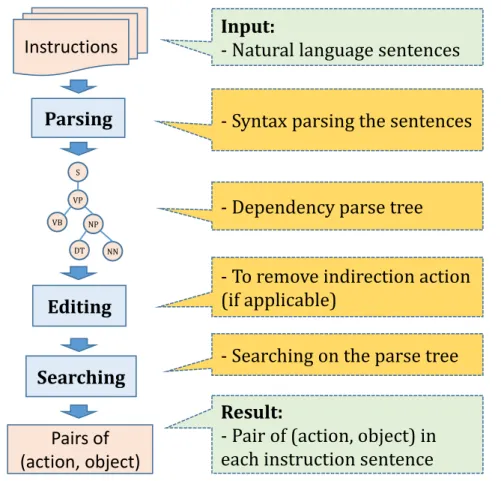
summarizing document or enriching knowledge for conceptual ontology. Delia Rusu and et al. in [15] presented the methods to extract subject-predicate-object triplets from English sentences by using four different well-known syntactical parser including Stanford Parser, OpenNLP, Link Parser, and Minipar. However, the extraction algorithms determined only one pair of verb and object in each sentence. This leads to ignorance of other action verbs if the sentence combine more than one action verb. In natural language sentence, action an object are identified based on the part-of-speech (POS) of words in the grammatical struc-ture. Accordingly, the extraction method of action and object includes three steps. Firstly, parsing the syntax structure of a sentence to achieve parse tree, then editing the parse tree to remove the indirect action if it exists, finally, search-ing on each parse tree to determine action and object based on POS tags that are labeled in the parse tree. The flow of this method is shown in figure 2.1
Parsing
S VP VB NP DT NNSearching
Input:
- Natural language sentences
- Syntax parsing the sentences
- Dependency parse tree
- Searching on the parse tree
Result:
- Pair of (action, object) in
each instruction sentence
Instructions
Pairs of
(action, object)
Editing
- To remove indirection action
(if applicable)
2.3 Extraction of Action and Object from Instruction Manual
2.3.1
Parsing Syntax Structure
In the first step, syntax parsing, the input data which are natural instruction sentences in text files are parsed to determine the syntax structure of each sen-tence. There are some syntax parsing tools satisfying this situation. This study applied a state-of-the-art parsing tool, Stanford Parser, which is a well-known PCFG (Probabilistic Context Free Grammar) parser working out the grammati-cal structure of sentences [29]. This parser generates the dependence parse trees. The parse trees are labeled with part-of-speech (POS) tag for their words and phrases depending on their grammatical structure. Stanford dependence parse tree is represented in text form as an example follows:
(ROOT (S (VP (VP (VB Place) (NP (DT a) (NN cup) (S (VP (TO to) (VP (VB fill) (PP (IN with) (NP (JJ hot) (NN water))) (PP (ADVP (RB just)) (IN beneath) (NP (DT the) (NN spout)))))))) (CC and) (VP (VB press)
(NP (DT the) (JJ Push) (NN key))))))
2.3 Extraction of Action and Object from Instruction Manual
2.3.2
Removing Indirect Action
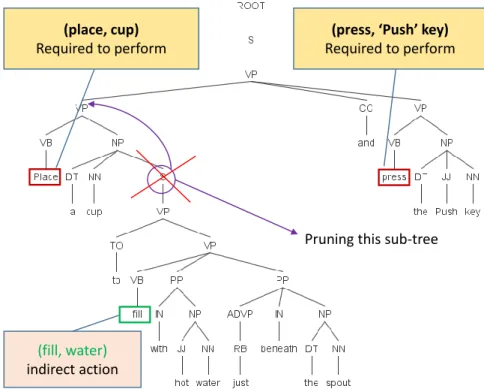
Instruction statements may be a simple grammatical pattern consisting of one action verb and one object noun or may combine more than one action. In the case of the sentence with more than one action, a certain action may not require to perform, so-called indirect action in the sentence. For example, in the example of above given sentence, the action ’fill’ (with hot water) is an indirect action which does not require to perform. Hence, this kind of actions need to remove from extracted result. This situation mainly occurs when the instruction sentence contains a dependence clause that can be omitted without changing the key meaning of the sentence. As shown in figure 2.2, the action ’fill’ is located in a sub tree with the node ’S’ which is a dependent clause and can be removed. From this crucial point, the solution for removing indirect action is to prune the sub tree of dependent clause from the parse tree of original sentence before having next step to search pairs of action and object in the parse tree.
Figure 2.2: The parse tree of a given example is outputted by Stanford Parser
2.3 Extraction of Action and Object from Instruction Manual
a tregex pattern. This is similar to regular expression for tree matching. The condition to identify the sub tree of a dependent clause is that its root node is labeled with ’S’ tag and is dominated by a VP sub tree. The tregex pattern (regular expression) is ”S=node VP”. Then, the surgery operation ’prune’ is executed to remove this sub tree from original parse tree. This procedure is illustrated as in figure 2.3. Figure 2.4 depicts the parse tree after pruning to remove a sub tree of dependent clause of given example. The pairs of action and object then are found in this edited tree. In case there is no dependent clause in a sentence matching with the above condition, the parse tree will not change.
(place, cup)
Required to perform
(press, ‘Push’ key)
Required to perform
(fill, water)
indirect action
Pruning this sub-tree
Figure 2.3: The edited parse tree after pruning the sub tree of dependent clause
2.3.3
Searching for Action and Object
2.3 Extraction of Action and Object from Instruction Manual
Figure 2.4: The edited parse tree after pruning the sub tree of dependent clause
traverses sequentially each action verb and its following object noun in the parse tree. Firstly, one verb is searched in the first VP sub tree and assigned as first action. With each action verb found in the VP sub tree, an object is assigned by noun following it by searching in siblings sub trees of that VP sub tree. Object is assigned as last noun that is found firstly in sibling sub trees ”NP” or if not it is assigned as the first noun found in sibling sub trees ”PP”.
In given example, the instruction sentence is parsed into a VP tree at top-level as shown in figure 2.2. After pruning the sub tree of dependent clause, the edited parse tree is obtained as shown in figure 2.4. The searching procedure is implemented on this edited tree. The first verb found in the first VP sub tree ’place’ is assigned as first action. Then, its following noun ’cup’ which is found in the NP sibling sub tree is assigned as the object that accompanies with the action ’place’. Next, the second pair of action ’press’ and object ’key’ is determined in same way. The searching procedure is repeated until the end of each parse tree to obtain all possible pairs of action and object.
2.3.4
Action-Object Extraction Algorithm
2.4 Task Planning
Algorithm 1: Pseudocode of Action and Object Extraction Function getParseTree(sentence)
word list ← tokenize the sentence ; parse tree ← parse the world list ; Function pruneDependenceTree(parse tree)
edit tree ← pruning the dependence sub tree ; Function extractActionObject(parse tree)
VP subtree ← the top level VP sub tree of parse tree ; for each verb leaf node found in VP subtree do
action ← word of verb leaf node ; ao pair ← append action ;
siblings ← siblings subtrees of verb leaf node ; for each sib tree in siblings do
object ← last noun in ”NP”, ”PP” sib tree ; if object found then
break;
object ← first noun in other sib tree ; ao pair ← append object
ao list ← append ao pair ;
In this algorithm, each extracted object is assigned by a single noun. However, in some cases, better result can be achieved if an object is possibly identified by a noun phrase which provides more detailed information, for example, ’coffee cup’, ’Push key’, ’Lock/Unlock key’. In order to assign an object by a two-noun phrase, the searching procedure can be improved by finding and storing all nouns in a noun phrase and assigning two last ones for object if it exists.
2.4
Task Planning
After obtaining the sequence of action and following object if applicable, the task plan is built by assembling the series of these actions. A task plan is simply represented by:
T = {< Actioni, Objecti >} i = 1, 2, ..., n (2.1)
2.5 Experiment and Result
from instruction manual. In next step, each action is built an executable plan for the robot.
2.5
Experiment and Result
We collected test data including natural language sentences of many different tasks taken from home appliance instruction manuals such as making coffee by a coffee maker, dispensing water from thermos pot, cooking something by mi-crowave oven, etc. These task instructions are stored in text files as input data. We implemented the program of proposed algorithm to extract all possible pairs of action and object in instructions from each input text file. The extracted re-sults are evaluated by comparing manually the pairs of action and object with respective to each described in the primary sentence to decide the accuracy of outputs. We tested two examples of extracted results corresponding to two input texts.
In the first example, the input texts consist of only two sentences guiding a simple task ’dispensing water’ as described text 1, a principle task described in many water thermos pot user manuals. In this case, all extracted results are correct as shown in the table 2.1. Objects are also assigned by two nouns, if any, including a main noun and an auxiliary which provides more specific information on that object.
Text 1. Instructions of ’dispensing water’ task taken from a water thermos pot user manual
1. Press the ’Lock/Unlock’ key once.
2. Place a cup to fill with hot water just beneath the spout and press the ’Push’ key.
Text 2. Instructions of ’cooking some food’ by microwave oven 1. Push the button and open the door
2.5 Experiment and Result
Table 2.1: Extracted result of action and object from task instruction ’dispensing water’
Sentence No. Action Object
1 ’Press’ ’Lock/Unlock’, ’key’
2 ’Place’ ’cup’
’press’ ’Push’, ’key’
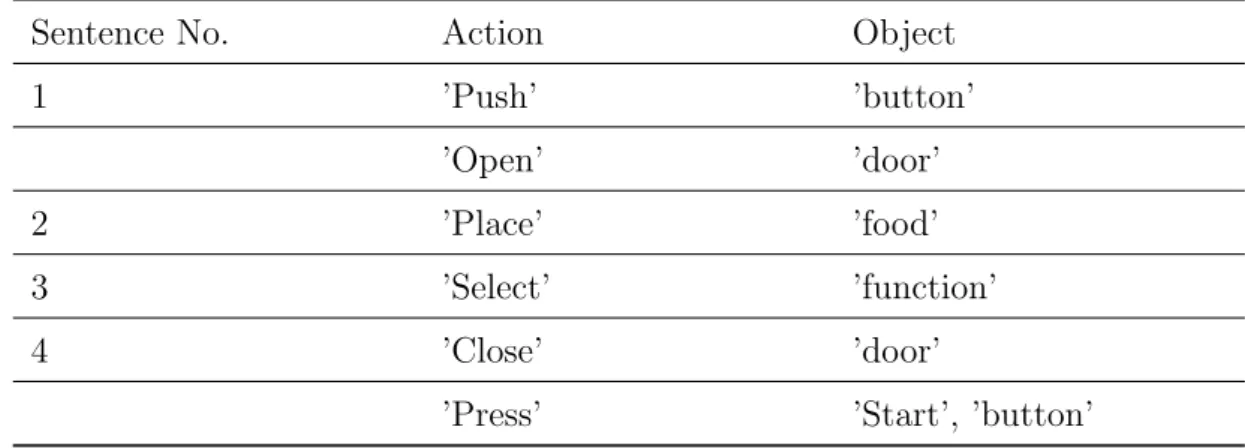
Table 2.2: Extracted result of action and object from task instruction ’cooking food’ by microwave oven
Sentence No. Action Object
1 ’Push’ ’button’
’Open’ ’door’
2 ’Place’ ’food’
3 ’Select’ ’function’
4 ’Close’ ’door’
’Press’ ’Start’, ’button’
In the second example, the input text is the instructions from an user manual of microwave oven for the task ’cooking food’. The extracted result of action and object is shown in table 2.2.
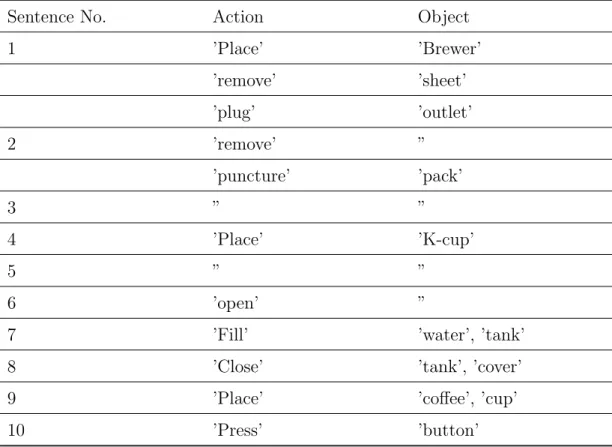
In the third example, the input texts are the instructions of a more complex task, which combine many operations taken from a coffee maker user manual as describe in text 3. The extracted results as represented in table 2.3 contain 6/10 instruction sentences obtaining the correct pairs of action and object (Sentences No. 1, 4, 7, 8, 9, 10). Four sentences (2, 3, 5, 6) with complex grammar structure return incorrect or empty actions due to the mistakes in syntax parsing by the Stanford parser.
2.5 Experiment and Result
1. Place the Brewer on a flat surface, remove protective sheet and plug into outlet.
2. Do not remove or puncture the foil lid of the K-Cup portion pack. 3. Lift front facing of the brewer to insert K-Cup.
4. Place chosen K-Cup into the K-Cup Assembly Housing.
5. Lower the front facing completely and firmly to close the Lid and puncture the K-Cup portion pack.
6. Depress the water marking button and the hot water tank will open auto-matically.
7. Fill the Hot Water tank with filtered or bottled water up to the FILL LEVEL indicator.
8. Close the Hot Water Tank cover.
9. Place a coffee cup in the dispense area on the drip tray. 10. Press the BREWNOW button.
Table 2.3: Extracted result of action and object from task instruction ’making a cup of coffee’
Sentence No. Action Object
1 ’Place’ ’Brewer’ ’remove’ ’sheet’ ’plug’ ’outlet’ 2 ’remove’ ” ’puncture’ ’pack’ 3 ” ” 4 ’Place’ ’K-cup’ 5 ” ” 6 ’open’ ”
7 ’Fill’ ’water’, ’tank’
8 ’Close’ ’tank’, ’cover’
9 ’Place’ ’coffee’, ’cup’
10 ’Press’ ’button’
2.5 Experiment and Result
this study works with very high accuracy but still has errors when the instruction sentences are formed by complex grammatical structures.
Chapter 3
Learning Action from Human
Demonstration
3.1
Introduction
In chapter 2, the actions what the robot needs to perform in a task can be achieved from instruction manual. In order to perform each action , the robot needs to be provided an executable plan. The knowledge about how to perform the action is necessary. The work in this chapter deals with the problem of planning action for the robot by learning from demonstration provided by human. The goal is to generate appropriate motion patterns for the robot (robot’s end-effector and gripper in particular) to perform a desired action.
Learning from Demonstration (LfD) [1] (also known as Programming by Demon-stration (PbD), Imitation Learning) aims to enable robots to autonomously per-form new behaviors with the ability of adaptation to the new changes. This paradigm allows to transfer the knowledge about how to perform behaviors from an expert teacher to a robot through the use of demonstrations. This approach takes the view that an appropriate robot controller can be derived from observa-tions of a human’s own performance.
3.1 Introduction
its own particularities, they can be classified into two main categories: learning by observation and learning from experience.
Learning by observation includes techniques based on the robot observes pas-sively the teacher’s performance, and attempting to reproduce the observed be-havior. These techniques allow robots to gather external sensory information, in most cases from a camera. This requires using complex computer vision tech-niques to translate the teacher’s actions. In learning by observation, the robot has to face with the major challenge of accurately perceiving the teacher’s demon-stration which is dependent on the ability of observation and noise in the real world domains. In addition, the robot must also be able to interpret the demon-strations and map them to its own capabilities accounting for differences in body structure with respect to the teacher. In this work, we rely on observed human demonstration to transfer the knowledge about task and actions from a teacher to the robot.
Learning from experience includes approaches which require the robot par-ticipates actively in the demonstration, performing the actions along with the teacher and experiencing it through its own sensors. From the physical guideline of the teacher, the robot is able to record internal information such as joint an-gles or positions relative to its own body. This approach is often appropriate for humanoid robots.
In learning from observing, the demonstration of a human expert is recorded and then reproduced by a robot. If the environment does not change during the robot’s performance then learning to imitate the demonstrated trajectory of teacher is sufficient. However, in many cases the actions that the robot should learn are influenced by the state of the environment. Repeating exactly an ob-served movement for the robot is not realistic in a dynamic environment. For example, in the action ’pick up an object’, if the robot only records exactly the trajectory of a particular instance of a demonstration, it would not be able to get the object in a dynamic environment when the object’s location is changed. Therefore, learning a demonstrated movement should have the ability of adap-tation to new changes such as changing the goal, scaling of time. A learning method that allows to adapt with new changes is essential.
3.1 Introduction
methods have been deployed to model the movements and reproduce them for robot accurately and stably. Dynamic Movement Primitives (DMPs) framework was used for encoding and and regenerating movement trajectories for the robot in many studies, for example in [45], [35], [48], [42]. DMPs can be used to repre-sent the movement trajectory in end-effector space (task space), which encodes robot trajectories from start position to goal position. The DMPs model has the generalization ability. The generated movement can be adapted to some new changes such as the change of new goal. In addition, this representation can gen-erate continuous robot movements and has robustness to perturbations. DMPs framework can also be further extended to have capabilities such as joint limits avoidance and obstacle avoidance [45].
3.2 Background and Related Work
3.2
Background and Related Work
3.2.1
Learning from Demonstration
3.2.1.1 An Overview
The term ’learning’ in the context of this study is in a general sense. It implies the ability of a robot system to autonomously acquire new skills, to adapt to changes in the environment and/or tasks, and to improve its performance over time. Instructions, experiences, demonstrations provided by a teacher may facilitate the learning process. The learning process here is not completely equivalent to the concept of machine learning but different machine learning techniques can be used as tools for the learning method. The level of learning is subject to the abilities that are desired from the system. The literature on learning from demonstration does not make a clear distinction among these various levels. Generally, two popular approaches are learning tasks and learning skills or actions.
In Learning from Demonstration (LfD), a teacher demonstrates a task or ac-tion to a robot, then in such a way that the robot is able to reproduce that task or action. A robot has ability of reproducing exactly certain behaviors as demon-strated but it is difficult to adapt to changed environment or conditions which come naturally to human. Although the idea of learning from demonstration at first seems simple, it faces many challenges [43]:
• The sensing abilities of robots are limited and different from human per-ception. What is the best way to give demonstrations to robots so that it can maximize knowledge transfer ?
• The robot’s embodiment is different than a human’s. For example, the motion of human arm and fingers is still difficult to be compatible with the configuration of robot arm and fingers. What matching mechanism is needed to create the mapping between teacher’s actions and the robot’s own sensory-motor capabilities ?
3.2 Background and Related Work
An overview of learning from demonstration and its classifications can be found in the survey article [3] and the book chapter [5]. These are some terms including Learning from Demonstration, Programming by Demonstration and Learning by Imitation, which are typically used as synonyms in most literature with some slight differences.
Simple methods of learning from demonstration topic such as teach-in and playback were developed from many year ago. In such scenarios, the teacher moves the robot arm manually or by teleoperation and a sequence of exact po-sitions and orientations are recorded. Then the robot imitate exactly the move-ment as recorded. Although these methods are successful for some tasks, they still suffer from drawbacks. For example, this kind of imitation is only suitable for predefined work spaces and processes. Nowadays, advanced approaches in learning from demonstration enable to overcome this limitation to make robots operate in unstructured environments such as households.
3.2.1.2 Interface for Demonstration
The interface used to provide demonstrations influences how the information is acquired and transmitted. Different types of interfaces can be distinguished to two major categories:
• Directly Recording Human Motions This interface can use any of var-ious different motion tracking systems, based on vision or wearable motion sensors, markers. The teacher performs demonstration on his own. The data is recorded either observed by external sensors like a camera or by sensors attached to the teacher. These methods have the advantage in that they allow the human to move freely in natural ways, but require good so-lutions to the corresponding problem. The observed data does not match with the actions of the robot. Therefore, a mapping between the different embodiment must be employed. Typically, this is done by an explicit map-ping between human and robot joints, but can be quite difficult if the robot differs greatly from the human.
3.2 Background and Related Work
actions for teaching a manipulator. Ren Mao et al. in [35], Oikonomidis et al. in [22] used marker-less hand tracker which can reliably track a skeletal hand model. This approach was based on a 3D hand model, which has the advantage of accurate estimation of hand pose. The 3D data in real world is captured from Kinect FORTH tracking system using the hand model based method.
• Kinesthetic Teaching The teacher teleoperates the robot or moves the robot limbs physically (kinesthetic teaching). All joint states of the robot are recorded using sensors attached the joints. This results in good data quality and is not affected by the corresponding problem. However, one main drawback of this method is that the human must often use more of their own degrees of freedom to move the robot than the number of degrees of freedom they are trying to control. For example, the human must use both hands to move a few robot fingers. In both cases, teleoperation as well as kinesthetic teaching, a robot with dozens of joints is difficult to handle.
3.2.1.3 How to Solve LfD
Approaches in the topic of LfD results in different views on the learning and the representation of tasks. The most differing of the representations among learned robotic skills are symbolic encoding (high-level) and trajectory encoding (low-level). Symbolic encoding describes the task with a sequence of already known action primitives, like reaching object. The trajectory encoding represents a task as a sequence of sensor data such as positions, velocities and accelerations.
Learning high-level action composition
3.2 Background and Related Work
Another method is to observe the human demonstrate the complete task and to automatically segment the task to extract the primitive actions which may then become task-dependent, [30]. The main advantage is that both the primitive actions and the way they should be combined are learned in one pass. One issue that arises is that the number of primitive tasks is often unknown, and there could be multiple possible segmentation which must be considered [18].
In the studies at [12], [13], a high-level approach of LfD was presented. The learning method proposed in these publications focuses on extracting an abstract description of the task from multiple demonstrations. The actual movements are generated using a trajectory planner.
Low-level learning of individual motions
Individual motions/actions (e.g. picking up a cup, pressing a button) could be taught separately instead of all at once. The teacher would then provide one or more examples of each sub-motion apart from the others. If the learning proceeds from the observation of a single instance of the motion/action, it is called one-shot learning [69]. Examples can be found in [41] for learning locomotion patterns. Different from simple record and play, here the controller is provided with prior knowledge in the form of primitive motion patterns and learns parameters for these patterns from the demonstration.
Multi-shot learning can be performed in batch after recording several demon-strations, or incrementally as new demonstrations are performed [33]. Learning generally performs inference from statistical analysis of the data across demon-strations, where the signals are modeled via a probability density function, and analyzed with various non-linear regression techniques from machine learning. Popular methods nowadays include Gaussian Process, Gaussian Mixture Models, Support Vector Machines.
of gestures by imitation.
3.2 Background and Related Work
using a standard controller. Thus interaction with the environment is impossible, feedback at execution time can not be considered.
A more low-level approach on learning movements is presented in [54], [25]. These works use dynamical systems to encode a movement. The main advantage of dynamical systems is their adaptation. In such systems the next state is always calculated from the current state by applying the fixed rule. Regression methods are used to approximated the non-linear part of these dynamical systems. Learn-ing is possible with a sLearn-ingle demonstrated trajectory [54] or by generalization over multiple [19]. Improving a trajectory with reinforcement learning has also been done successfully for example in [47]. This encoding of a trajectory is point attractive, which means a trajectory is represented in terms of a fixed start and goal state. Unfortunately, this limits the field of application to tasks with a pre-defined goal position. In order to overcome this limitation it is possible to build a sequence of these motion primitives to represent more complex tasks. This bases on the assumption that complex movements can be described by small units of action.
3.2.2
Learning Movements using Dynamic Movement
Prim-itives
To facilitate automatic planning of actions with the data recorded from demon-strations, some frameworks of learning from demonstration are selected. The goal is to generate appropriate motion patterns for the robot. A popular frame-work for the representation and learning of movements with dynamical systems is known as Dynamic Movement Primitives (DMPs), originally introduced in [25]. The DMPs framework has advantage of adaptive learning to new changes of en-vironment or the own movements. Furthermore, this framework has also been improved by modified DMPs versions which have advanced abilities such as gen-eralization in 3D task space, joint limits avoidance and obstacle avoidance, for example in publications in [20], [21], [46], [45].
3.2.2.1 Dynamic Movement Primitives
3.2 Background and Related Work
DMPs framework, a captured movement can be described by a set of differential equations which is from a mathematical model of a dynamical system. It has the advantages in generating smooth movements with the perturbation that can be automatically corrected by the dynamics of the system. It addresses the flexibility and does not rely on time. Moreover, it allows the capability of generalization because the characteristic that the equations are formulated in way adapting to a new goal by changing goal parameter. In [60] F. Stulp et al. proposed an approach using DMP and a probabilistic model-free reinforcement learning algorithm to learn motion primitives.
The DMP framework enables to learn a movement trajectory from one ref-erence sample. It represents a movement as a time evolution of a nonlinear dynamical system. Then it can reproduce the movement and optionally adapt to different configurations by changing the goal parameter. The formulation of a standard DMP model originates from a second order linear dynamical system (like a spring-damper system model) which is stimulated with a nonlinear forcing term, uses a set of differential equations:
τ ˙v = K(g − x) − Dv + (g − x0)f (s) (3.1a)
τ ˙x = v (3.1b)
where x(t) denotes a sample trajectory starting at start position x(t0) = x0
towards to goal position x(tf) = g. K and D involve the inherent dynamics of
the second order linear system, as the spring constant and the damper coefficient, respectively. K is chosen in advance to meet the desired velocity response of the system. D is chosen to satisfy that the dynamic system be critically damped and thus reach the goal position without overshoots. A suitable choice is D = 2√K. The forcing term f (s) is an arbitrary non-linear function which is used to adapt the response of the dynamic system to an arbitrary complex movement. In [27], Ijspeert et al. proposed a suitable choice for f (s) as a sum of M weighted exponential basis functions:
3.2 Background and Related Work
where ψi(s) are Gaussian functions defined as
ψi(s) = exp(−
1
2σ2(s − ci)
2) (3.3)
Parameters ci and σi define the center and the width of the i th basis
func-tion, while wi are the adjustable weights used to obtain the desired shape of the
trajectory [42]. The variable s is a phase variable and defined by the canonical system:
τ ˙s = −αs (3.4)
where α is a pre-defined constant. This variable evolves exponentially from 1 to 0. It used to remove the direct dependency on time of the forcing term f (s) and also to weight the forcing term to continuously shift towards a purely goal-attracted system [48]. The dynamical system as described above was called as a trans-formation system. Figure 3.1 sketches the DMPs model: the canonical system drives the nonlinear function f (s) which perturbs the transformation system.
Canonical
System
Transformation
System
𝜏 𝑠 = −𝛼𝑠
Learned
weights 𝑤
𝑖Desired
parameters
x
0,g
𝑓 𝑠, 𝑤
𝑖Desired
movement:
- Position x
- Velocity v
- Acceleration 𝑣
DMP
Figure 3.1: Illustration of a one-dimensional DMP model
3.2.2.2 Learning and Executing DMPs
3.2 Background and Related Work
nonlinear function f (s) forces the transformation system to follow the observed trajectory x(t).
The first step of learning procedure is to initialize values to the parameters of the system. K and D is set beforehand responding to changes in the goal parameter. τ is the time constant and should be set to the duration of the sample trajectory τ = tf − t0. The factor α in the canonical system (3.4) determines the
decay rate of the phase variable, which is appropriate chosen to ensure that s will evolve to 0 at t = τ .
Once these values are initialized, in the next step, the desired values of the forcing term is computed by extracting it from (3.1a).
fdes(s) =
−K(g − x) + Dv + τ ˙v g − x0
(3.5)
Then the values of the sample trajectory x = x(t), which is recorded from human demonstration and its derivatives v = τ ˙x(t) and ˙v = τ ¨x(t) are computed for each time step t = t0, ..., tf and inserted in the (3.5). x0 and g are set to
x(t0) and x(tf), respectively. Next, the canonical system in (3.4) is integrated.
s(t) is computed with an appropriately adjusted temporal scaling τ by: s(t) = exp(−ατt).
With these arrays of desired values fdes(s), the appropriate centers and widths
of the basis exponential functions in (3.2) can be set, and the weights wi in (3.2)
is found by minimizing the error criterion by least squares J = P
s(fdes(s) −
f (s))2, which is a linear regression problem. Figure 3.2 summarizes the process
of learning phase of DMPs model.
The results of learning phase are learned weights wi. The movement plan is
generated by reusing the learned weights wi. The desired start position x0 and
the goal position g are selected as required by the movement. The canonical system is reset by assigning the phase variable s = 1. By replacing the learned parameters wi, adapting the desired movement duration τ , evaluating s(t), and
3.2 Background and Related Work Canonical system τ s = −αs Learned weights 𝑤𝑖 Input: - Position x - Velocity v - Acceleration v Transformation system τ v = K 𝑔 − x − Dv + 𝑔 − x0 fdes(s) τ x = v
Nonlinear function approximator f s = i=1𝑤𝑖ψi(s)
) i=1ψi(s
s
(𝜓𝑖(s) are Gaussian basic functions)
- Start position x0
- Goal position g
Weights 𝑤𝑖are found by minimizing the error criterion 𝐽 = 𝑠(𝑓𝑑𝑒𝑠 𝑠 −𝑓 𝑠 )2
DMPs: Learning Phase
Figure 3.2: The summary of learning phase of DMPs model
Canonical system τ s = −αs Transformation system τ v = K g − x − Dv + g − x0 f(s
τ x = v
Nonlinear function approximator f s = i=1𝑤𝑖ψi(s
i=1ψi(s s (𝜓𝑖(s) are Gaussian basic functions)
Change parameters: - start position x0 - goal position g Learned weights 𝑤𝑖 Output: - Position x - Velocity v - Acceleration v Control signals to robot
DMPs: Executing Phase
3.2 Background and Related Work
3.2.2.3 Characteristics of DMPs
DMPs framework has the characteristics which are advantages when applying this framework for low-level learning of movements to generating total movement for the action.
• Multiple Degrees of Freedom Using DMPs for real world applications like moving a robot arm requires them to encode more than one-dimensional movements. This can be obtained by using one transformation system for each dimension of the data.
• Sequence DMPs DMPs are intended to be single basic units of movement. To allow more complex movements it is possible to sequence several DMPs.
• Online Adaptation The goal position g in Equation 3.1a can changed at any time of the execution. In the Learning for Demonstration context, online adaptation is the crucial advantage of using DMPs to encode a move-ment.
• Movement Recognition The similarity of two movements can be deter-mined by comparing the weights wi of two movements with each other.
3.2.2.4 Improvements of DMPs
The original formulation of DMPs as presented in the previous section, has some drawbacks with the adaptation to new goals. When the changes of the goal are extremely small, the movement between start and goal position does not adapt as expected. The work in [21] presents a modified version of DMPs which is not affected by this drawbacks. While the transformation system is changed to the following formulation, the canonical system stays the same as in equation (3.4).
τ ˙v = K(g − x) − Dv − K(g − x0)s + Kf (s)
τ ˙x = v (3.6)
The function f(s) is the same as defined in the original formulation (Equation (3.2)). But the function f is not multiplied by (g − x0) any more. This helps to
3.3 Learning Action from Hand Movement in Human Demonstration
(g = x0). It also makes the adaptation to only slightly changed goals more
optimal. The most important characteristic of this improved formulation is that it generalizes to new goals well. The third term K(g − x0) is required to avoid
jumps at the beginning of the movements [45]. Learning and propagating DMPs is achieved with the same procedure as before, except that the target function fdess is computed according to
fdes(s) =
τ ˙v + Dv
K − (g − x) + (g − x0)s. (3.7) This new formulation are used in our implementation in the next section.
3.3
Learning Action from Hand Movement in
Human Demonstration
3.3.1
The Approach
3.3 Learning Action from Hand Movement in Human Demonstration
We proposed a method for learning and reproduction of a demonstrated ac-tion. This approach is based on a single demonstrated trajectory from hand movements. The movement of a manipulation action is segmented into move-ment primitives. Then movemove-ment primitives are encoded by DMPs with the ability of adaptation to new changes. A sequence of DMPs is used to generate the whole movement of desired action. The adaptation to changes in the environ-ment is made possible by the ability to change the goal position of a DMPs. In order to know how the goal position should be changed, a reference object must be identified. Tracking the position of target object enables the system to update the goal position online, which in turn makes it possible to move objects while the action is performed.
Demonstration
Tracking
Hand Movement
Segmenting
Movement
Learning
Movement
with DMPs
Primitive Skills
Robot Controller
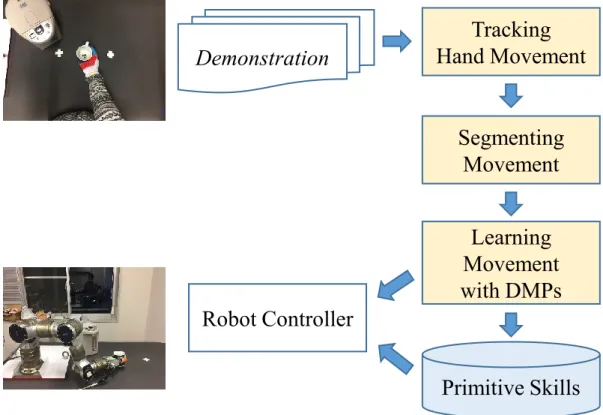
Figure 3.4: The flow of proposed method for learning action from hand movements in human demonstration with Dynamic Movement Primitives (DMPs)
Figure 3.4 shows the architecture of proposed method including three main steps:
• Recording Hand Movement
3.3 Learning Action from Hand Movement in Human Demonstration
• Learning Movement with DMPs
3.3.2
Recording Hand Movement in Human
Demonstra-tion
3.3.2.1 Hand Movement Tracking Solution
B
Index finger (I)
Thumb (T) Between (B) Hand fixed frame Position Distance L T I Zk Xk Yk Kinect coordinate system
Robot coordinate system Xh Yh Zh YR ZR XR Oh M
Figure 3.5: The hand motion tracker using Kinect camera with a color-marker glove
3.3 Learning Action from Hand Movement in Human Demonstration
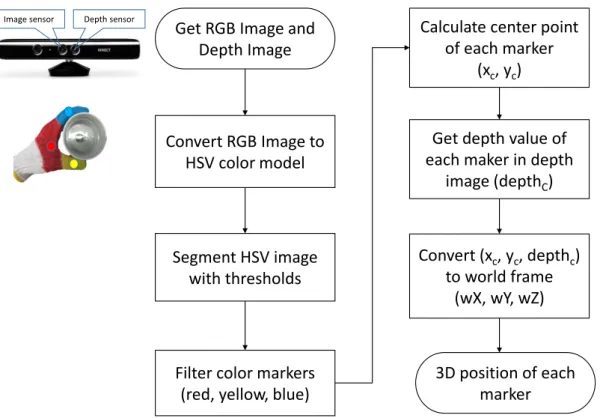
I, T, B which are center points of color parts on the index finger, the thumb and the part between them, in respectively. Kinect camera captures both color image and depth image at the same time in data streaming sequences with a sequence of timestamp. The center points of color markers are detected in the image color by applying image processing algorithms with color image. Then, their 2D coordinates together with their depth values obtaining from Kinect’s depth sensor are projected to world coordinate system to archive their three dimensional (3D) positions. The series of these image processing steps is shown as in figure 3.6. The detail of steps are summarized as follows:
Convert RGB Image to HSV color model Get RGB Image and
Depth Image
Segment HSV image with thresholds
Filter color markers (red, yellow, blue)
Calculate center point of each marker
(xc, yc)
Get depth value of each maker in depth
image (depthC) Convert (xc, yc, depthc)
to world frame (wX, wY, wZ)
Image sensor Depth sensor
3D position of each marker
Figure 3.6: Image processing steps for tracking color markers on the glove
1. Getting both color image and depth image from Kinect sensor simultane-ously. Both images must be same size and be aligned (registration).
2. Converting RGB image to HSV color model.
3.3 Learning Action from Hand Movement in Human Demonstration
4. Filter sequentially 3 color markers (red, blue, yellow). After this step, color markers are detected as areas on HSV image.
5. Calculating center coordination (xC, yC) of each detected color marker using
the moments. Getting depth value at each color marker center to have (xC, yC, depth).
6. Converting (xC, yC, depth) to world coordinate to obtain 3D position (wX, wY, wZ)
of each marker.
The 3D positions of points I, T, B are recorded during the demonstration corresponding to the recording frequency of Kinect camera. The data is captured as discrete points. Because these data are in the Kinect’s coordinate system, they are transformed to Robot’s coordinate system when using as control signals for the robot. This is easy by applying the coordinate system transformation. In addition, the tracked data may contain errors or be affected by noise. Therefore, we applied a moving average calculation to smooth the recorded trajectories of points.
Figure 3.7 shows the trajectories of 3D position of points B, I, T are tracked in the demonstration of the action ’pick up’ a cup.
From the 3D position of three points I, T, B, the tracked data of hand motion is computed including hand position, hand orientation and distance between two fingers. The hand position is assigned by the 3D position of point B. The hand orientation is assigned by the orientation of a fixed frame Ohxhyhzh attached to
the hand where the origin Oh is at point B; the axis Ohzh is identical with vector
BM where M is middle of I, T; the axis Ohyh being right-hand perpendicular to
Ohzh and satisfying Ohyhzh is identical with the plane of B, I, T. the axis Ohxh
being upside perpendicular to Ohyhzh. The orientation data of hand is obtained
by the orientation of this fixed frame refer to the robot’s base coordinate system. The distance between the index finger and the thumb is calculated by distance L in mm between point I and T.
3.3 Learning Action from Hand Movement in Human Demonstration -200 -100 Y [mm] 0 100 200 300 400 450 400 350 300 X [mm] 250 200 150 100 50 0 -50 1180 1160 1140 1100 1120 1040 1020 1000 1080 1060 Z [mm]
Figure 3.7: The 3D position trajectories of points B, I, T are recorded in the demonstration of the action ’pick up’ a cup
X [mm] -50 0 50 100 150 200 250 300 350 400 450 Y [mm] 100 200 300 400 500 600 700
Figure 3.8: The trajectory of point B and orientation vector OhZh, viewed in
3.3 Learning Action from Hand Movement in Human Demonstration
3.3.2.2 Hand Movement Data Description
By using the design and tracking solution as mentioned above, we can obtain desired tracking data including a set of discrete points captured by Kinect camera. The tracking data of hand motion for each demonstration of a manipulation action can be described as follows:
D = {< posi, orienti, disti >} i = 1, 2, ..., n (3.8)
where:
posi = [pxi, pyi, pzi] is 3D position of hand (point B),
orienti = [xZi, yZi, zZi, α] is the orientation data of fixed hand frame which
rep-resents the hand orientation,
disti is distance L [mm] between index finger and thumb.
pos1 records the starting position of hand and posnrecords the position when the
demonstration finished.
The table 3.1 shows a part of hand movement data which is recorded in the demonstration of the action ’pick up a cup’. The recorded data includes hand 3D position data (Pos x, Pos y, Pos z), hand orientation data (Orient x, Orient y, Orient z, Orient angle) and fingers distance (Dist L).
Table 3.1: A part of recorded data from demonstration of action ’pick up a cup’
Pos x Pos y Pos z Orient x Orient y Orient z Orient angle Dist L