Improving the Transfer of Global R&D Knowledge between Overseas Research
Institutes and their Home Institutes
Kenji TOMITA
ⅠIntroduction
ⅡPrevious studies on global R&D
ⅢThe development of Perampanel
ⅣDiscussion
ⅤConclusion
Summary
Global R&D has become increasingly important over the past few decades, and the transfer and integration of such knowledge has become vital for companies aiming to achieve long
term success. However, difficulties in the transfer of global R&D knowledge can arise, especially when the role of the sender and that of the receiver are divided. Therefore, the present study examines a case in which both sides (in this case, the Tsukuba Research Institute in Japan and the Eisai Research Institute in London) become the sender and receiver of knowledge in the creation of an innovative new drug. The findings indicate three factors that allowed the research institute to effectively integrate such knowledge into their development process : 1) symmetricalness in the knowledge transfer between the overseas research institute and the home institute; 2) complementary communication between both entities; and 3) opportunities to observe one another’s practices. The implication of the findings is that companies should increase the autonomy of their overseas research institutes in order to improve the transfer of global R&D knowledge.
Keywords: Global R&D, Overseas research institutes, Knowledge transfer, Integration, Autonomy
Ⅰ Introduction
Over the past few decades, global R&D has become increasingly important for the long
term success of companies. Although the definition of global R&D can vary, Asakawa (2011) and Sugiyama (2001) pointed out that its main purpose is to acquire new technical knowledge/
abilities, which can be used to create a new project. A company can also secure a competitive advantage by utilizing a worldwide network and transferring knowledge and resources on a
(1165)163
global scale (Asakawa, 2002). Furthermore, Asakawa (2002) indicated that new development talent in foreign countries has become increasingly important, due to their tacit knowledge and skills. Thus, many companies have established overseas research institutes in order to absorb new knowledge and conduct R&D projects.
In general, the absorption of new knowledge in foreign countries is important for all industries, but it is especially important for knowledgeintensive industries such as the pharmaceutical industry. More specially, the R&D process in this industry can be complicated, and the creation of a new drug can take time and significant funds. In addition, a single company cannot perform all of its R&D processes, while acquiring new knowledge/techniques of other companies. Hence, major drug companies in Japan have established research institutes in foreign countries, such as Europe and the United States, in order to acquire the latest information of their competitors.
In other industries, there are many examples of overseas activities in which the express purpose is to establish factories and sales companies in developing countries, including those in Asia. Similar trends can be found in the pharmaceutical industry, through the establishment of research institutes. The roles of such entities are twofold : 1) to perform clinical trials, which are generally required by foreign authorities before approving a particular drug; and 2) to acquire the latest knowledge from fundamental research as quickly as possible.
However, since it is almost impossible for overseas research institutes to effectively perform all of the R&D processes for a new drug, while conducting fundamental research and clinical trials, some companies have focused on improving the transfer of R&D knowledge between their overseas research institutes and their home institutes. For example, Perampanel is a new antiepileptic drug that was created by integrating the respective knowledge of the Tsukuba Research Institute in Japan and the Eisai Research Institute in London, England (hereafter referred to as the “London Research Institute”)1. Therefore, in order to reveal how improving the transfer of global R&D knowledge between overseas research institutes and their home institutes can be effective for innovative drug development, it is important to examine this particular case in more detail.
The remainder of this study is as follows. Section 2 examines previous studies on the
────────────
1 The number of epilepsy patients in Japan is approximately one million. An epileptic attack is the state in which cerebral nerve cells are suddenly disheveled, which results in small seizures or major convulsions. Although it is apt to consider that epilepsy develops in children, there are cases in which it develops in adults. Thus, drug treatments can suppress the excessive activity of the cerebral nerve cells and prevent such activity from affecting other nerves. To date, between 70% and 80% of all patients can suppress an epileptic attack by taking certain drugs.
同志社商学 第69巻 第6号(2018年3月)
164(1166)
transfer of global R&D knowledge, while Section 3 shows how the basic research for Perampanel was performed at both research institutes. Section 4 discusses the findings of this investigation, after which Section 5 presents the conclusion.
Ⅱ Previous studies on global R&D
During the 1980s and early 1990s, many large Japanese companies established overseas research institutes in Europe and the United States in order to acquire local knowledge/
techniques (Asakawa, 2011; Sugiyama, 2001; Song and Shin, 2008). However, the merits of such actions have been limited, since the European and American research institutes were ineffective in transferring the findings of their fundamental research to their home institutes.
More specially, although company forms a multinational enterprise for the purpose of facilitating knowledge transfer, it can become difficult to transfer such knowledge from the overseas research institute to the company (Kogut, 1991; Sugiyama, 2009), since tacit knowledge is not necessarily apparent (Szulanski, 1996). In addition, according to Sugiyama (2001) and Von Hippel (1994), since knowledge can be situationspecific, significant time and funds are required.
Sugiyama (2001) also highlighted several important factors, including the property of the knowledge itself and the issue of engaging in knowledge transfer. In regard to the former, the type of intellectual or tacit knowledge (Winter, 1987) and the degree of such knowledge (Kogut and Zander, 1993; Zander and Kogut, 1995) are the targets of this argument. Regarding the latter, Szulanski (1996) pointed out three factors : 1) the ability of the receiver to absorb knowledge (Cohen and Levinthal, 1990); 2) the motivation of the receiver; and 3) the communication between the sender and receiver (Sugiyama, 2001). Based on these factors, knowledge transfer can be extremely difficult, especially for multinational enterprises (Kogut, 1991).
Furthermore, Asakawa (2011) pointed out the issue of autonomy and control between the overseas R&D base and the home institute. More specially, technical knowledge is generally acquired in the local R&D base, after which the knowledge flows outwardly from the head office to other branches (Asakawa, 2011; Kuemmerle, 1997). However, when the majority of the research is conducted by local directors/scientists, they sometimes fail to share vital information with their subsidiaries in foreign countries (Asakawa, 2011).
As stated earlier, the purpose of global R&D is to acquire new knowledge and resources.
However, since the types of knowledge as well as the purposes of the overseas research institutes and their home institutes can differ, it is important to discuss them separately
Improving the Transfer of Global R&D Knowledge(TOMITA) (1167)165
(Rondstadt, 1978; Kuemmerle, 1999; Barlett and Ghoshal, 2002). Sugiyama (2001) stated that, since the distinction between the acquisition and development of knowledge can be vague, the competitiveness of a product may be strengthened by combining the knowledge of the overseas research institute and that of its home institute. In addition, it is insufficient to conduct an analysis from a dynamic viewpoint; that is, how a company acquires knowledge and disperses it on a global scale (Asakawa, 2011). Furthermore, due to limitations in the methodology, few studies have focused on the development of products based on overseas knowledge (Sugiyama, 2001).
According to this literature review, the transfer of R&D knowledge, especially between an overseas research institute and its home institute, can be extremely difficult. In addition, previous studies have generally divided the role of the sender and that of the receiver.
Therefore, the next Section focuses on the example in which the London Research Institute (the overseas research institute) and the Tsukuba Research institute (the home institute) effectively integrated their respective knowledge/resources in order to create the antiepileptic drug Perampanel.
Ⅲ The development of Perampanel
Ⅲ1 The R&D of this new drug
In the pharmaceutical industry, it is important for a company to market a new drug before
Figure 1 R&D Process of New Drug
Source : Created from Nagao (2009) and Noguchi (2003) 同志社商学 第69巻 第6号(2018年3月)
166(1168)
its competitors and acquire a patent so that other companies cannot sell a similar product. If it is an epochmaking new drug, such as one that can cure a certain disease, then it can significantly increase a company’s profits. However, in order to create a new drug, a company must complete the R&D process (shown in Figure 1), which can take approximately 20 years and cost more than 100 billion yen.
In addition, the success probability of new drug development in Japan is shown in Table 1.
According to the table, the success probability of marketing a new drug is approximately one in 30,000, which is extremely low.
Finally, according to Kuwashima (1999), since the discovery of a certain compound in fundamental research often depends on luck and the daily efforts of individual researchers, the management usually concedes that progress can be slow. However, in recent years, companies have become increasingly interested in the science behind various research methods as well as their outcomes2.
Ⅲ2 Basic research of Perampanel
Interruption of the AMPA antagonist project in the early 1990s
In the early 1990s, the ionotropic glutamic acid receptor antagonist (also known as the AMPA receptor) was recognized as a significant innovative drug development target in the pharmaceutical industry. In 1993, the Eisai Corporation conducted two projects that included the AMPA receptor, as a subtype of a therapeutic agent for cerebrovascular disease. In the first project, Eisai aimed to improve upon the problem encountered by other companies. More specially, it focused on the toxicity of a compound and the expected usefulness by adding a
────────────
2 According to Nakanishi (2007), the importance of screening has increased, since each company can accumulate more than 1 million original compounds. Initially, screenings were relatively slow, since they were performed manually onebyone. However, after a highspeed screening system (highthroughput screening) was introduced, it was possible to screen more than 100,000 compounds a day.
Table 1 Probability of Success of New Drug Development in Japan (from 2007 to 2011)
Development Process Compound Probability
of success
Accumulation probability of success Synthetic compound
Nonclinical tests starts Clinical trials starts Application for approval Approval acquisition
704,333 291 85 25 26
1 : 3,216 1 : 2.58 1 : 3.40 1 : 0.96
1 : 8,286 1 : 28,173 1 : 27,090 Note.The data of approximately 20 companies of JPMA. The total from 2007 to 2011.
Source : DATA BOOK,2013
Improving the Transfer of Global R&D Knowledge(TOMITA) (1169)167
NMDA receptor (another type of glutamic acid receptor). However, Eisai judged that the process was too difficult, after which it discontinued the project3. In the second project, Eisai conducted highthroughput screening of a new compound (cf. Footnote 2), but was unable to find a solution. Consequently, the project lost its importance and was placed “onhold.”
However, Eisai decided to examine the new adaptation of this compound, not as a therapeutic agent for cerebrovascular disease, but as an agent for neurological chronic disease.
Subsequently, the findings of the research on the AMPA receptor were shared with the Tsukuba Research Institute, which had experience in innovative drug development4.
The London Research Institute5
The London Research Institute, established in 1990, primarily focused on neurological immune disease and cerebral edema, since the first director believed that the control of the bloodbrain barrier could help treat multiple sclerosis. A researcher at the Tsukuba Research Institute (hereafter referred to as “Person A”) mainly carried out the evaluation of a patient animal model, after which the London Research Institute examined the efficacy and toxicity of certain drugs on a patient animal model with multiple sclerosis6. Eventually, a renowned pathologist (hereafter referred to as “Person B”) joined the London Research Institute, after which he proved that the AMPA receptor was effective for treating multiple sclerosis.
Development through this collaborative research project
As stated earlier, the Tsukuba Research Institute reexamined Eisai’s previous project that was placed “onhold.” At that time, Person B entered the London Research Institute and made a threemonth visit to the Tsukuba Research Institute7. During his stay, he and the other
────────────
3 The main problem was that it was difficult for the drug to dissolve in a neutral domain with low pH levels. As a result, 100% of the drug’s ingredients entered the blood vessels, but they failed to reach the cranial nerve.
4 Regarding the Tsukuba Research Institute, it possessed knowledge about the compound that could control a glutamic acid receptor and its activity, since the study of therapeutic drugs for cerebrovascular disease was of utmost importance at that time.
5 Although other major pharmaceutical companies established subsidiaries abroad, they primarily focused on sales and clinical trials. For example, Takeda Pharmaceutical formed a sales company in France in 1978, after which it established additional subsidiaries in other countries. Conversely, in 1987, Eisai established the Boston Institute for the purpose of conducting basic research. In regard to London, Eisai established a clinical company in 1988 and the Eisai Research Institute in 1990. At that time, Eisai was one of the first Japanese companies to focus on fundamental research and global R&D. Asakawa (2011) highlighted the London Research Institute as an important example in which global R&D is prioritized before production and other processes are considered.
6 A “patient animal model” is an animal with the same disease as that of humans, which can be used to examine the effects of certain drugs. In the pharmaceutical industry, this term is often substituted for the term “animal experiment.”
7 Person B requested a threemonth visit to the Tsukuba Research Institute, since he knew that related experiments were being conducted in Japan. In addition, he believed that his visit would facilitate ↗
同志社商学 第69巻 第6号(2018年3月)
168(1170)
researchers exchanged opinions about the effects of the AMPA receptor.
After Person B returned to London, the institute evaluated his idea about the patient animal model and published a paper on neuroprotection, with the ultimate goal of applying for a patent. Thus, the team leader (hereafter referred to as “Person C”) requested that the home institute collaborate with Person B. Although Person B had reservations about a certain side effect, based on his previous research8, the collaborative research project on a therapeutic agent for multiple sclerosis began in January 1999.
During the collaborative research project, the Tsukuba Research Institute focused on the design and synthesis of the compound and basic screening, while the London Research Institute evaluated the multiple sclerosis model, based on the active compound. In addition, the Tsukuba Research Institute performed drug disposition kinetics, while the London Research Institute performed various experiments, based on the acute multiple sclerosis model and the chronic multiple sclerosis model. The screening flow of this collaborative research project in shown in Figure 2.
Overall, although both research institutes had their individual roles and responsibilities, only the Tsukuba Research Institute was able to conclude the study, since it had the patient animal model. However, since the London Research Institute had discovered the idea for the disease, both institutes were considered as the originators. Moreover, since this collaborative research
────────────
↘ communication and improve the overall development process.
8 Person B cancelled an earlier project in which a candidate compound showed strong sedation in the patients with cerebrovascular disease.
Figure 2 Screening Flow of Collaborative Research Project
Source : Created from document of Eisai
Improving the Transfer of Global R&D Knowledge(TOMITA) (1171)169
project proved to be the first successful joint project for Eisai, it motivated the top management to consider future projects.
Communication in the collaborative research project
Person C at the Tsukuba Research Institute and Person A at the London Research Institute served as the project leaders in this collaborative research project. Communication between the two teams was basically through email, and the exchanges generally occurred at least once a day. The overall process can be divided into three stages. During the first stage, the team members exchanged numerous emails about personal information in order to become acquainted with one another. In the second stage, they reached an agreement about the procedure of the study. In the third stage, Person C discussed the compound, after which Person A reported on the progress of the experiments as well as initiated related discussions.
Through the emails, the teams also exchanged information about their daily lives such as
“my child was born” and “my child was sick.” Such conversations effectively established a sense of mutual trust and deepened their personal and professional relationships. According to Person C, “Whether we could trust each other had a positive influence on the collaborative research. In this regard, the exchange of emails was very important.” In addition to their conversations by email, they held video conferences once a month in which they argued about joint ownership of the project, rearranged certain aspects of the experiments, discussed future directions, etc. Person A and Person B also visited their respective research institutes in order to hold facetoface discussions.
Overall, since Person B personally visited the Tsukuba Research Institute, its members were able to gain knowledge about his ideas and concerns regarding the experiment. Conversely, the members of the London Research Institute were able to obtain knowledge about AMPA receptor and the compound that could control the activity. As a result of the integration of such knowledge, both entities were able to prepare the nonclinical tests.
Finally, it is important to note that all of the members of the Tsukuba Research Institute were Japanese, but there were no Japanese members in the London Research Institute, other than the director. Therefore, both teams communicated in English. However, when disagreements occurred during video conferences, the director took control of the conversations and served as the mediator between the two parties.
The project’s progress and the integration of knowledge
The AMPA antagonist project began its basic research in January 1999, after which it
同志社商学 第69巻 第6号(2018年3月)
170(1172)
performed non-clinical trials and advanced to clinical trials by April 2000. As stated earlier, the knowledge acquired by the Tsukuba Research Institute (i.e., about the AMPA receptor and the compound that could control the activity) and the knowledge obtained by the London Research Institute (i.e., the ideas of Person B and his concerns regarding the side effect of the experiment) were integrated. As a result, the need to combat the side effect became clear, and they were able to successfully change the indication from a neuro-autoimmune disease to a neurodegenerative disease. Although the project initially focused on multiple sclerosis, it was eventually expanded into other diseases, such as epilepsy. In this regard, since there was significant scientific evidence showing that the AMPA receptor positively affected epilepsy, they continued to examine and confirm its overall effectiveness9. In sum, this collaborative research project became the first successful innovative drug development project for the London Research Institute10.
Ⅳ Discussion
In this collaborative research project, the Tsukuba Research Institute had knowledge about the AMPA receptor, knowledge about the structure activity correlation, and knowledge about the compound that could control the activity, after which it transferred such knowledge to the London Research Institute (Figure 3). Meanwhile, the London Research Institute possessed
────────────
9 Researchers frequently enlarge the field of vision during innovative drug development.
10 Initially, the London Research Institute focused on fundamental research, but the researchers eventually recognized that they were able to perform innovative drug development, based on their experience in the collaborative research project. Conversely, the Tsukuba Research Institute was not active in collaborative research with foreign countries, due to their communication concerns. However, their positive experience in this project made them reconsider such projects in the future.
Figure 3 Integration of Knowledge between Both Research Institutes
Improving the Transfer of Global R&D Knowledge(TOMITA) (1173)171
knowledge regarding the positive effect of the AMPA receptor on multiple sclerosis, knowledge regarding the side effect, knowledge about the evaluation method for the patient animal model, and the laboratory findings. The institute then transferred such knowledge to the Tsukuba Research Institute. As a result, both institutes integrated the information before creating the non-clinical tests. Moreover, as a result of obtaining the knowledge regarding the side effect, they changed the indication to epilepsy, and the APMA antagonist project was able to complete its basic research as well as the non-clinical tests in a relatively short amount of time.
The following considers the three factors that allowed both research institutes to effectively integrate such knowledge in the development process. The first factor is that both research institutes had expertise that overlapped one another. In general, when information is transferred, non-symmetricalness tends to occur between two parties, and the information flow is usually in one direction. However, in this collaborative research project, the Tsukuba Research Institute had knowledge about the chemical formula of the compound, while the London Research Institute possessed knowledge about the side effect, the laboratory findings, and knowledge about the compound of the AMPA antagonist. In other words, since both institutes had knowledge of one another’s expertise, non-symmetricalness did not occur.
Regarding the knowledge transfer, the receiver must obtain knowledge that can be easily evaluated. In other words, the receiver’s capability of absorption (Cohen and Levinthal, 1990) is important. If both parties possess high-level knowledge, then knowledge transfer can be theoretically carried out. However, mutual knowledge transfer can be extremely difficult between overseas research institutes and their home institutes. Moreover, in many cases, the home institute plays the main role, while the overseas research institute only provides support.
In such an environment, even if an overseas research institute acquires important knowledge, the home institute can fail to integrate such knowledge from the foreign entity.
In this study, the London Research Institute was the base of the overseas R&D. However, the institute did not simply follow the orders from Japan, but it made its own conclusions. In addition, since Person B had established a direct relationship with the Tsukuba Research Institute, he was able to suggest an effective “story” for the collaborative research project11.
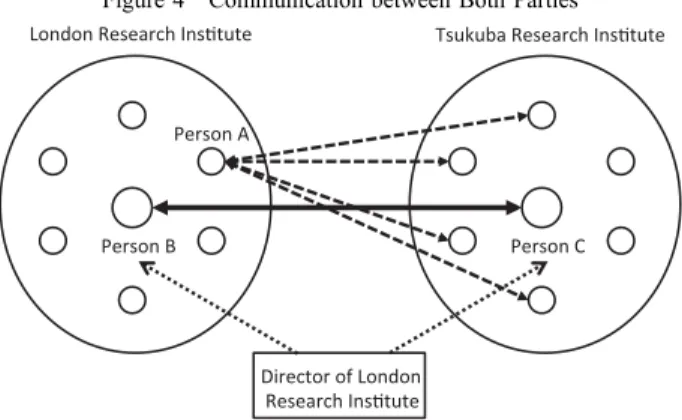
The second factor is that complementary communication existed between both parties. More specifically, Persons A and C, who were the respective leaders of the teams, served as the
“gatekeepers,” while Person B was able to address any questions and send additional information (Figure 4). As a result, both research institutes were able to exchange knowledge
────────────
11 The “story” is the design of the overall research.
同志社商学 第69巻 第6号(2018年3月)
172(1174)
quickly and efficiently. In addition, due to Person B’s visit to the Tsukuba Research Institute, the team members were able to establish mutual trust. According to Szulanski (2000), building mutual trust can help reduce/eliminate any problems that emerge during knowledge transfer.
Furthermore, since the director of the London Research Institute was Japanese, he was able to meditate any hearted discussions that exceeded the language abilities of the team members.
This was especially important, since there is a tendency for overseas research institutes to be controlled by their home institutes.
The third factor is that both institutes were able to observe one another. In this collaborative research project, the Tsukuba Research Institute focused on the composition of the compound and the screenings, while the London Research Institute evaluated the efficacy of the patient animal model. As shown earlier in Figure 2, the Tsukuba Research Institute performed the three upper processes, while the London Research Institute performed the two lower processes.
However, as shown in Figure 5, a time lag did not occur and the five processes were carried out rather quickly.
Figure 4 Communication between Both Parties
Figure 5 Time Overlap during the Five Processes
Improving the Transfer of Global R&D Knowledge(TOMITA) (1175)173
Furthermore, since there was a time overlap during the five processes, the transmission and reception of knowledge occurred on a daily basis. In brief, the knowledge sharing between both parties was relatively easy, since the data itself was explicit knowledge. The ease of the knowledge transfer is extremely important in collaborative research projects, since the researcher in the subsequent process cannot begin his/her work before the appropriate data is passed down from the previous researcher. In this study, both research institutes were able to send and receive the related data, since they had established a sense of mutual trust, had observed one another, and acknowledged the roles and responsibilities of each team.
Ⅴ Conclusion
The present study examined a case in which both the overseas research institute (the London Research Institute) and its home institute (the Tsukuba Research Institute) became the sender and receiver of knowledge in a collaborative research project. Based on the findings, there were three factors that allowed both research institutes to effectively integrate such knowledge into their innovative drug development process : 1) symmetricalness in the knowledge transfer between the overseas research institute and the home institute; 2) complementary communication between both entities; and 3) opportunities to observe one another’s practices.
This study also showed that companies should increase the autonomy of their overseas research institutes in order to improve the transfer of global R&D knowledge. In this case, the London research Institute was not controlled by the Tsukuba Research Institute. Moreover, both research institutes frequently exchanged information and held productive discussions, based on their established mutual trust. In other words, both entities became the sender and receiver of global R&D knowledge. Finally, it is important to mention the main limitation of this study, which was the difficulty in observing the level of absorption and integration in more detail. Such difficulty was due to two reasons. First, R&D projects are, in general, not widely shared among a company, due to the possible leakage of information. Second, tacit knowledge is difficult to assess and quantify. However, despite this limitation, this study provided evidence of how one overseas research institute effectively collaborated with its home institute in order to successfully develop a new anti-epileptic drug for the market.
References
Asakawa, K. (2001), “Evolving Headquarters-subsidiary Dynamics in International R&D : The Case example of Japanese Multinationals,”R&D Management,Vol.31, No.1, pp.1-14.
同志社商学 第69巻 第6号(2018年3月)
174(1176)
Barlett, C. A. and S. Ghoshal (2002), Managing Across Borders : The Transnational Solution, 2nd edition, Boston, MA : Harvard Business School Press.
Cohen, W. M. and D. A. Levinthal (1990), “Absorptive Capacity : A New Perspective on Learning and Innovation,”Administrative Science Quarterly,Vol.35, Special Issue, pp.128-152.
Kogut, B. (1991), “Country Capabilities and the Permeability of Borders,” Strategic Management Journal, Vol.12, Summer Special Issue, pp.33-47.
Kogut, B and U. Zander (1993), “Knowledge of the Firm and the Evolutionary Theory of the Multinational Corporation,”Journal of International Business Studies,Vol.24, No.4, pp.625-645.
Kuemmerle, W. (1997), “Building Effective R&D Capabilities Abroad,”Harvard Business Review,Vol.75, No.2, pp.61-70.
Kuemmerle, W. (1999), “The Drivers of Foreign Direct Investment into Research and Development : An Empirical Investigation,”Journal of International Business Studies,Vol.30, No.1, pp.1-24
Ronstadt, R. C. (1978), “International R&D : The Establishment and Evolution of Research and Development Abroad by Seven U.S. Multinationals,”Journal of International Business Studies,Vol.9, No.1, pp.7-24.
Song, J. and J. Shin (2008), “The Paradox of Technological Capabilities : A Study of Knowledge Sourcing from Host Countries of Overseas R&D Operations,”Journal of International Business,Vol.39, No.2, pp.291-303.
Szulanski, G. (1996), “Exploring Internal Stickiness : Impediments to the Transfer of Best Practice within the Firm,”Strategic Management Journal,Vol.17, Winter Special Issue, pp.27-43.
Szulanski, G. (2000), “The Process of Knowledge Transfer : A Diachronic Analysis of Stickiness,”
Organizational Behavior and Human Decision Processes,Vol.82, No.1, pp.9-27.
von Hippel, E. (1994), “‘Sticky Information’ and the Locus of Problem Solving : Implications for Innovation,”
Management Science,Vol.40, No.4, pp.429-439.
Winter, S. G. (1987), “Knowledge and Competence as Strategic Assets,” in Teece, D. J. (eds),The Competitive Challenge : Strategies for Industrial Innovation and Renewal,Cambridge, MA : Ballinger, pp.159-184.
Zander, U. and B. Kogut (1995), “Knowledge and the Speed of the Transfer and Imitation of Organizational Capabilities : An Empirical Test,”Organization Science, Vol.6, No.1, pp.76-92.
(in Japanese)
Asakawa, K (2002) “Guroubaru R&D Senryaku to Narejji Manejimento [Global R&D Strategy and Knowledge Management],”Soshiki Kagaku[Organizational Science], Vol.36, No.1, pp.51-67.
Asakawa, K. (2011),Guroubaru R&D Manejimento[Global R&D Management], Tokyo : Keio Gijuku Daigaku Shuppankai.
Endo, T. (1997), 5 Nengo no Iyakuhin Gyoukai [Pharmaceutical Industry Five Years Later], Tokyo : Paru Shuppan.
Kuwashima, K. (1999), “Iyakuhin no Kenkyuu Kaihatsu Purosesu niokeru Soshiki Nouryoku [Organizational Capability in R&D Process of Pharmaceutical Products],”Soshiki Kagaku[Organizational Science], Vol.33, No.2, pp.88-104.
Nakanishi I. (2007), “Kusuri wo Dezain suru [Designing Drug],”Atarashii Kusuri wo Dou Tsukuruka [How do We Make New Drug?],pp.109-142, Tokyo : Koudansha.
Noguchi, M. (2003),Yoku Wakaru Iyakuhin Goukai[Pharmaceutical Industry to Know Well], Tokyo : Nippon Jitsugyou Shuppansha.
Sugiyama Y. (2001), “Guroubaruka suru Seihin Kaihatsu no Bunseki Shikaku [Analysis Visual Angle of the Development of Products to Globalize],”Soshiki Kagaku[Organizational Science], Vol.35, No.2, pp.81-94.
本稿は,科学研究費基盤研究(C)「知識の取引を活性化させるマーケティング戦略の構築」(研究課
題番号16K03959)(2016年度〜2021年度)の成果の一部である。
Improving the Transfer of Global R&D Knowledge(TOMITA) (1177)175