SUMMARY As the demand of data reliability becomes more and more larger, most of today’s storage systems adopt erasure codes to assure the data could be reconstructed when suffering from physical device failures.
In order to fast recover the lost data from a single failure, recovery opti- mization methods have attracted a lot of attention in recent years. However, most of the existing optimization methods focus on homogeneous devices, ignoring the fact that the storage devices are usually heterogeneous. In this paper, we propose a new recovery optimization method named HSR (Het- erogeneous Storage Recovery) method, which uses both loads and speed rate among physical devices as the optimization target, in order to further improve the recovery performance for heterogeneous devices. The experi- ment results show that, compared to existing popular recovery optimization methods, HSR method gains much higher recovery speed over heteroge- neous storage devices.
key words: storage system, erasure code, heterogeneous devices, single failure recovery
1. Introduction
With the data rapid growth in both size and complexity, data centers have more and more storage devices[1]. Since stor- age devices usually have a certain error rate, when the scale of devices is very large, the number and possibility of error emergence are very high[2]. In order to recover the lost data from failed devices, today’s data center usually adopts era- sure codes, which usually divide data into a series of chunks with a fixed size. Erasure codes also provide some redun- dant chunks calculating from some of the data chunks[3], and then store them into a certain storage system named era- sure coded storage system. When some data chunk lost, era- sure coded storage system should retrieve a part of surviving data/redundant chunks to reconstruct the lost data.
When suffers from devices errors, the system should fast recover the lost chunks and rewrite them into a new de- vice, in order to maintain the data reliability. The recovery performance is very important for storage systems, which attracts a lot of attention in recent years. Since more than 99.75% failure patterns are single device failure[4], most of the existing researches focus on single failure. Due to the different feature of scenarios and applications, the sys- tem adopts different erasure codes. Existing single failure optimization methods usually fit for most of the popular erasure codes, including[5]’s method, BP method[6], STP
Manuscript received January 24, 2019.
Manuscript revised March 29, 2019.
Manuscript publicized June 14, 2019.
†The authors are with the College of Computer Science and Technology, North China University of Technology, China.
a) E-mail: [email protected]
DOI: 10.1587/transinf.2019EDL8021
method[7], et al. Although all these methods usually per- form well on homogeneous devices, most of existing meth- ods may not provide good performance when comes to het- erogeneous devices, because the bottleneck turns into the slowest device.
Focusing on this problem, in this paper we propose a new heterogeneous device based recovery method termed HSR (Heterogeneous Storage Recovery) method, in order to further improve the recovery performance for heterogeneous devices. HSR method first tests the speed rate of all devices as an input parameter, and then uses simulated annealing algorithm to balance the production of the loads and speed rate among all devices. The experiment results show that, compared to [5]’s method and STP method, HSR method gains up to 39.6% and 17.6% higher recovery speed over existing popular erasure codes with heterogeneous devices, respectively.
2. Background and Our Motivation
2.1 Terms and Notations
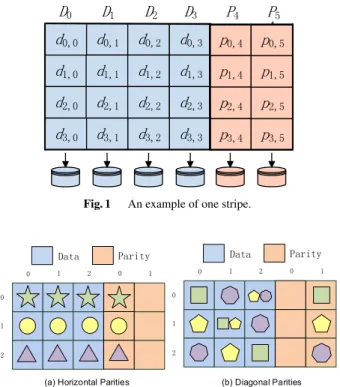
We first give some frequently used terms and notations based on [8]. In erasure coded storage systems, data and parity that calculate by a set of data to improve the reliabil- ity, are usually partitioned to chunks and stored in different physical devices. These chunks termed “elements”, includ- ing data elements and parity elements. The basic logic unit of erasure coded system names “stripe”. In each stripe, the generation of the parity elements only depends on the ele- ments of this stripe. Each column of “stripe” calls “strip”.
To assure the reliability, each strip of the same stripe should be mapped to different physical devices. We usedi,jandpi,j
to denote theith element of the jth column, wheredi,jrepre- sents data element, and pi,jdenotes the parity element. We useDiandPito represent data strip and parity strip, respec- tively. Figure 1 shows an example of one stripe.
2.2 Erasure Codes
Erasure codes are widely used in reliable storage systems, including Reed-Solomon code[9], Rotated Reed-Solomon code[5], et al. These codes areGF(2n) based codes usu- ally tolerating arbitrary device failures. The other impor- tant class of erasure codes is XOR-based codes, includ- ing Cauchy Reed-Solomon code[10], Liberation code[11], RDP code[16], D-Code[13], et al. Cauchy Reed-Solomon Copyright c2019 The Institute of Electronics, Information and Communication Engineers
Fig. 1 An example of one stripe.
Fig. 2 An example of 5-devices liberation code.
code is an improved Reed-Solomon code tolerating arbitrary number of device failures. Liberation code, RDP code, and D-Code are classic RAID-6 codes tolerating up to 2 device failures.
Figure 2 gives an example of 5-devices Liberation code, where the same icons mean the XOR sum of the related elements equals to zero. E.g., in Fig. 2 (a), d0,0, d0,1,d0,2, and p0,0 with the same icon “star”, which means d0,0⊕d0,1⊕d0,2⊕p0,0=0 orp0,0=d0,0⊕d0,1⊕d0,2. Simi- larly, in Fig. 2 (b),d0,0⊕d1,1⊕d2,2⊕p0,1=0. Based on the encoding equations, we can choose either one of the above equations to recoverd0,0 when D0fails, which is the basic principle of single failure recovery optimization.
2.3 Heterogeneous Erasure Coded Storage Systems Today’s storage systems usually suffer from storage device failures. When a device fails, the system should recover the data from the survived devices and use new devices to re- place the failed device to establish the new erasure coded system. The new device and failed device have different types and specifications forming the heterogeneous storage systems. On the other hand, erasure coded storage system usually rotate the map from strip to physical devices to al- leviate the influence of writes. Figure 3 gives an example of heterogeneous erasure coded storage systems, where the access speed rate for solid state disks (SSDs) are higher than hard disks (HDs).
2.4 Single Failure Recovery Methods
When suffer from device failures, erasure coded storage sys-
Fig. 3 An example of heterogeneous erasure coded system.
tems should retrieve the surviving information to recover the lost elements. Since more than 99.75% failure patterns are a single failure, recently researches usually focus on single failure recovery, in which the optimization methods includ- ing[5]’s recovery method, BP method[6], STP method[7], SIOR method[14], SSDM method[12], et al. These meth- ods use hybrid recovery principle[5], in order to search for the proper recovery scheme over different scenarios.
2.5 Our Motivation
Existing single failure recovery methods usually focus on homogeneous devices and assume that the storage devices have similar access speed[7],[12],[14], so that the bottle- neck is the highest loaded device. In heterogeneous stor- age systems, the lowest accessed device is usually not the most loaded device but the oldest device. We should pro- pose new recovery optimization method for heterogeneous storage systems, in order to balance the access speed and loads among all devices.
3. The HSR Recovery Method
In this paper, we propose a new recovery method named het- erogeneous storage recovery method (HSR method), in or- der to speed up the recovery performance on erasure coded storage system over heterogeneous devices. HSR method first tests the access speed for each device as an input pa- rameter, and then utilizes the recovery equations and simu- lation annealing algorithm to search for the proper recovery scheme.
3.1 Generate Recovery Equations
We first generate recovery equations for optimizing the re- covery performance. Firstly, we generate the original equa- tions by the encoding rules. We then generate the derived equations by iterating the common elements from different equations. Repeat this process, until no more new equations have been generated. Algorithm 1 gives the pseudo-code.
Line 1 defines two parametersEall and Euse f ul to de- posit the recovery equations. Line 2 generates the origi- nal recovery equations by the encoding rules of the erasure code. Line 3–14 define a while loop, which is used for
10: end if
11: end for
12: end for
13: end for 14: end while
15: forEachequi∈Ealldo
16: forEacheleiin the lost element setdo 17: ifelei∈equithen
18: Euse f ul.add(equi)
19: end if
20: end for 21: end for 22: returnEuse f ul
finding the recovery equations and storing them intoEall. Specifically, Line 4–5 sequently go through all elements of each equation inEall. Line 6 go through all equations inEall. Line 7–8 indicate that ifequiandequjsimultaneously con- tainelei, then combine the two equations into a new equa- tion by replacingelei. Line 9 adds the new equation intoEall. WhenEalldoes not add any new equation for the loop, then end the loop. Line 15–21 utilize dual-for loop to pick out the equations containing lost element, and then store them inEuse f ul. The algorithm returnsEuse f ul.
3.2 Search for Recovery Scheme
We then utilize theEuse f ul to search for the proper equa- tions (i.e., recovery solutions) to reconstruct the lost ele- ments. The basic principle is to set an array of parameters
“weights” to control the “energy”, and use the standard sim- ulated annealing algorithm to search for the feasible recov- ery solutions. Algorithm 2 gives the pseudo-code.
Line 1 collects the speed rate among all storage de- vices. Line 2 initials two key parameters for the algorithm.
Line 3 defines a function, which uses to calculate the en- ergy for simulated annealing. Line 4–7 count the number of the required elements of eachstripi, and then multiplesrias the weight. Line 8 returns the square deviation of weight as energy.
Line 10–31 use simulated annealing algorithm to search for the recovery scheme. We first initiate three pa- rameters (K, T, M) for standard simulated annealing al- gorithm, and initiate parameter R to control the variation fromSolutiontoSolutionnew(Line 10). Line 11 generates the initialSolution fromEuse f ul. Line 12–13 calculate the energy of Solution and set the expire condition. The fol- lowing steps are used to optimize the Solution. First, we randomly selectRfailed elements and denote their relative recovery equations inSolutionasEneed replace, and then gen-
10: initial parameterEuse f ul,K,T,RandM 11: Solution←Euse f ul
12: de=cal energy(Solution) 13: remain times=M 14: whileremain times>0do
15: Eneed replace←SelectRequations inSolution 16: Enew←select equations(Eneed replace,Euse f ul) 17: Solutionnew=generate solutions(Solution,Enew) 18: denew=cal energy(Solutionnew)
19: Δt=denew−de
20: ifΔt>0 orexp(Δt/T)>rand()/rand maxthen 21: Solution=Solutionnew
22: de=denew
23: remain times=M 24: ifΔt<0then
25: T=K∗T
26: end if
27: else
28: remain times− − 29: end if
30: end while 31: ReturnSolution
erate a replacement equation set Enewby choosing another recovery equation for each selected failed elements. We replace each equation of Eneed replace by its relative equa- tion in Enew, in order to generate another stack-based so- lutionSolutionnew (Line 15–17). Afterwards, we calculate the energy gap betweenSolutionnewandSolution, and utilize simulated annealing algorithm to determine whether replace Solution with Solutionnew or not (Line 18–19). Line 20–
30 use standard simulated annealing algorithm to optimize the Solution. Specifically, Line 20–23 illustrate if the en- ergy subtraction is above zero or a random condition has been triggered, the algorithm will replace the Solution by Solutionnew, and reset remain times to M. If the energy subtraction is below zero and the replacing process occurs, the algorithm reduces the temperature by parameter Kand T (Line 24–26). Else if the replacing process does not occur, the algorithm decreases the remain times, until the remain timesequals to zero (Line 27–29). At last, the algo- rithm returnsSolution(Line 31).
3.3 Reconstruct the Lost Elements
According to theSolutionreturned in Algorithm 2, we can first retrieve the needed elements from surviving devices in parallel. We then reconstruct the lost elements by the related equations inSolution, and write the reconstructed elements into new storage devices.
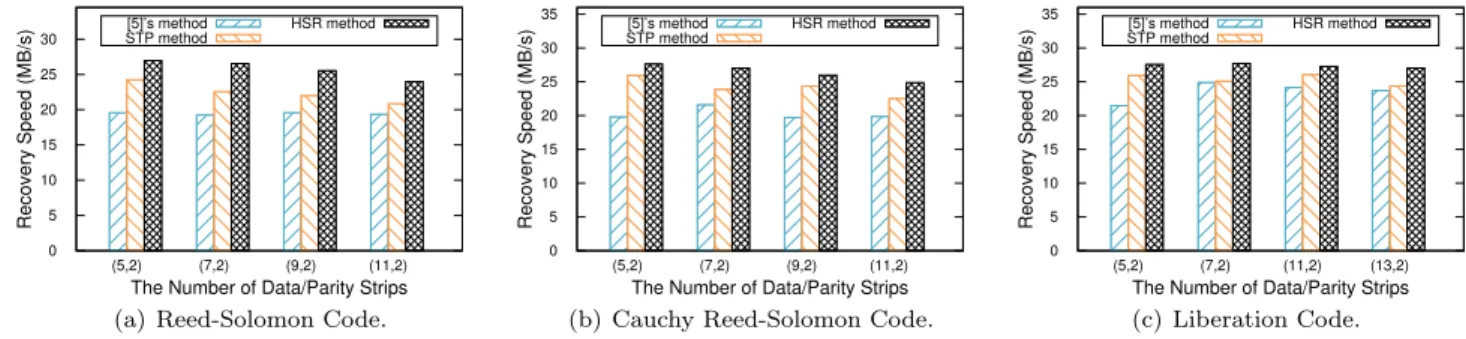
Fig. 4 Recovery speed for different erasure codes over heterogeneous storage devices.
Table 1 Time overhead for different recovery methods over different erasure codes (unit: seconds).
Erasure Codes Ref.[5] STP HSR
RS (9,2) <1s <1s <1s
RS (10,3) <1s <1s <1s
Liberation (11,2) <1s 2s 2s
Liberation (13,2) <1s 3s 3s
Cauchy RS (9,2) <1s 3s 3s
Cauchy RS (10,3) <1s 8s 8s
Cauchy RS (13,3) 1s 24s 23s
Cauchy RS (16,4) 941s 232s 229s
4. The Search Time Analysis
We analyze the search time of HSR method by compar- ing with Ref.[5]’s method and STP method[7], which are popular recovery method for today’s erasure coded storage systems. Reference [5]’s method searches for all poten- tial stripe-based solutions for each stripe, so that the search time is exponentially increased with the scale. STP method and HSR method utilize simulated annealing algorithm to search for the feasible solutions in the stack-level. The time cost is major in the initial process of simulated annealing algorithm, which is polynomially increased with the scale.
Therefore, when the scale is small, Ref.[5]’s method will run fast due to the faster initial process; otherwise, STP method and HSR method run fast due to the polynomial complexity. STP method and HSR method have similar time overhead, because they have the similar scale and utilize the same algorithm concept.
We implement Ref.[5]’s method, STP method, and our proposed HSR method based on C++ language over vi- sual studio 2010 toolbox, and use RS code, and Cauchy RS code[10], and Liberation code with different parameter to evaluate the real search time. The machine has a Intel i7- 6820HQ CPU and 32GB memory. As shown in Table 1, the search time well matches above analysis and illustrates that the time complexity is very close to STP method.
On the other hand, the searching process only runs on the initialization of erasure coded storage system with very low frequency, which is not performance sensitive. The re- covery process runs when the system suffers from disk fail- ure, which is important for erasure coded storage systems as discussed in Sect. 1. Therefore, we usually pay more atten- tion on recovery performance.
5. Experiment Evaluation
In this section, we conduct a series of experiments in real storage system, in order to illustrate HSR method achieves good single failure recovery performance over heteroge- neous devices.
5.1 Environment
Our experiments are run on a machine and a disk array.
The hardware environment of the machine is an Intel Xeon X5472 processor and 12GB memory. The disk array con- tains 13 Seagate 10K.3 SAS disks and 3 SATA-3 Disks.
Each SARS disk has 300GB capability, and each SATA3 disk has 1TB capability. The machine and disk array are connected by a fiber cable with 800MB bandwidth. The operation system of the machine is SUSE with Linux fs91 3.2.16.
5.2 Methodology
We select Reed-Solomon coded, Cauchy Reed-Solomon coded, and Liberation coded storage systems as comparison, and implement them with different parameter in the above environment by Jeasure-1.2[15], which is widely used for erasure coded storage system implementation. On the other hand, we implement[5]’s method, STP method[7]and our proposed HSR method by C++language over visual studio 2010 toolbox in the environment referred in Sect. 4. Please note that the process of searching recovery solutions runs when the erasure coded storage system initializes. The re- covery solutions are usually stored in both memories and permanent storage devices.
When suffer from disk failures, the storage system should retrieve the recovery solutions from memories or permanent storage devices, and access the surviving ele- ments to reconstruct the lost elements. We test all potential physical failures for all test erasure coded storage systems, collect the real recovery speed, and calculate the average recovery speed as evaluation metrics. For the tested era- sure coded storage systems, we set 3 SATA disks and some SARS disks as heterogeneous devices, and use the circularly rotated mappings referred in Fig. 3. We set Reed-Solomon code and Cauchy Reed-Solomon code with two parity strips.
method. This is because HSR method balance the number of elements and speed rate among physical storage devices simultaneously, but other methods only consider homoge- neous devices in which the storage devices have the similar speed rate. In statistic, HSR method gains 11.3% to 39.6%
higher recovery speed than Ref.[5]’s method, and achieves 7.6% to 14.7% higher recovery speed than STP method for the tested erasure codes over heterogeneous devices. The results illustrate that HSR method has good recovery per- formance than other tested recovery methods.
6. Conclusion
In this paper, we propose a new recovery optimiza- tion method termed HSR (heterogeneous storage recovery) method, in order to optimize the single failure recovery per- formance for erasure coded storage systems with hetero- geneous devices. HSR method uses the production of the loaded and the speed rate among all disks as the optimiza- tion target, and utilizes the concept of simulated annealing algorithm to search for the proper recovery scheme. The ex- periment results show that HSR method gains much higher recovery speed compared to existing popular recovery opti- mization methods over heterogeneous storage devices.
Acknowledgments
This work was supported by the National Natural Science Foundation of China (61702013, 61672040), the Beijing Outstanding Talent Training Project (2016000020124G016), the Science and Technology Project of Beijing Educa- tional Committee (KM201710009008, KZ201810009011), and the Science and Technology Innovation Project of North China University of Technology (18XN012, 18XN053).
References
[1] S. Ghemawat, H. Gobioff, and S.-T. Leung, “The google file sys- tem,” Proc. ACM SOSP ’03, pp.29–43, 2003.
tures,” IEEE Trans. Inf. Theory, vol.44, no.2, pp.192–202, 1995.
[4] E. Pinheiro, W. Weber, and L. Barroso, “Failure trends in a large disk drive population,” Proc. USENIX FAST ’07, 2007.
[5] O. Khan, R. Burns, J. Plank, and W. Pierce, “Rethinking erasure codes for cloud file systems: Minimizing I/O for recovery and de- graded reads,” Proc. USENIX FAST ’12, 2012.
[6] Y. Fu, J. Shu, and X. Luo, “A stack-based single disk failure recovery scheme for erasure coded storage systems,” Proc. IEEE SRDS ’14, pp.136–145, Oct. 2014.
[7] Y. Fu, J. Shu, Z. Shen, and G. Zhang, “Reconsidering single disk failure recovery for erasure coded storage systems: Optimizing load balancing in stack-level,” IEEE Trans. Parallel Distrib. Syst., vol.27, no.5, pp.1457–1469, 2016.
[8] J.L. Hafner, V. Deenadhayalan, T. Kanungo, and K. Rao, “Perfor- mance metrics for erasure codes in storage systems,” Technical Re- port, RJ 10321, IBM Research, San Jose, 2004.
[9] I.S. Reed and G. Solomon, “Polynomial codes over certain finite fields,” J. Society for Industrial and Applied Mathematice, vol.8, no.2, pp.300–304, 1960.
[10] J. Blomer, M. Kalfane, R. Krap, M. Karpinski, M. Luby, and D. Zuckerman, “An XOR-based erasure-resilient coding scheme,”
Technical Report TR-95-048, International Computer Science Insti- tute, Aug. 1995.
[11] J. Plank, “The RAID-6 liberation codes,” Proc. USENIX FAST ’08, Feb. 2008.
[12] Y. Fu, S. Wen, L. Ma, and J. Duan, “Strip-switched deploy- ment method to optimize single failure recovery for erasure coded storage systems,” IEICE Trans. Inf. & Syst., vol.E101-D, no.11, pp.2818–2822, Nov. 2018.
[13] Y. Fu and J. Shu, “D-Code: An efficient RAID-6 code to optimize I/O loads and read performance,” Proc. IPDPS ’15, pp.603–612, 2015.
[14] Z. Shen, J. Shu, and Y. Fu, “Seek-efficient I/O optimization in single failure recovery for XOR-coded storage systems,” Proc. SRDS ’15, pp.228–237, Sept. 2015.
[15] J. Plank, S. Simmerman, and C. Schuman, “Jerasure: A library in C/C++facilitating erasure coding for storage applications-Version 1.2,” Technical Report CS-08-627, University of Tennessee, Aug.
2008.
[16] P. Corbett, B. English, A. Goel, T. Grcanac, S. Kleiman, J. Leong, and S. Sankar, “Row-diagonal parity for double disk failure correc- tion,” Proc. FAST ’04, 2004.