INVITED PAPER
Special Section on Advanced Information and Communication Technologies and Services in Conjunction with Main Topics of APCC2015Radio Access Technologies for Fifth Generation Mobile Communications System: Review of Recent Research and Developments in Japan
Hidekazu MURATA†a),Senior Member, Eiji OKAMOTO††,Member, Manabu MIKAMI†††, Akihiro OKAZAKI††††,Senior Members, Satoshi SUYAMA†††††, Takamichi INOUE††††††, Jun MASHINO∗, Tetsuya YAMAMOTO∗∗,Members,andMakoto TAROMARU∗∗∗,Senior Member
SUMMARY As the demand for higher transmission rates and spectral efficiency is steadily increasing, the research and development of novel mo- bile communication systems has gained momentum. This paper focuses on providing a comprehensive survey of research and development activities on fifth generation mobile communication systems in Japan. We try to sur- vey a vast area of wireless communication systems and the developments that led to future 5G systems.
key words: fifth generation mobile communication systems, higher fre- quency band, massive MIMO, C-Plane/U-Plane splitting, C-RAN
1. Introduction
With the tremendous growth in wireless data traffic and mo- bile services, fifth generation (5G) mobile communication systems have gained considerable interest from academia, industry, and standards bodies. Among various technolog- ical aspects related to 5G mobile communication systems, a survey article[1]covers research and development activ- ities for 5G reported in the IEICE technical committee on radio communication systems (RCS), in which nearly 400 papers are presented every year. The IEICE RCS offers academic open discussion to 5G researchers in operators, vendors, and universities in Japan. Unlike IEEE Standards Association, IEICE RCS does not have standardization ac- tivity. In this survey paper, we expand its scope to include
Manuscript received December 1, 2015.
Manuscript revised March 30, 2016.
†The author is with Graduate School of Informatics, Kyoto University, Kyoto-shi, 606-8501 Japan.
††The author is with Graduate School of Engineering, Nagoya Institute of Technology, Nagoya-shi, 466-8555 Japan.
†††The author is with R&D Division, Softbank Corp., Tokyo, 135-0064 Japan.
††††The author is with Information Technology R&D Center, Mitsubishi Electric Corporation, Kamakura-shi, 247-8501 Japan.
†††††The author is with 5G Laboratory, NTT DOCOMO, INC., Yokosuka-shi, 239-8536 Japan.
††††††The author is with Cloud System Research Laboratories, NEC Corporation, Kawasaki-shi, 211-8666 Japan.
∗The author is with NTT Network Innovation Laboratories, NTT Corporation, Yokosuka-shi, 239-0847 Japan.
∗∗The author is with Technology Development Laboratory, Panasonic Corporation, Yokohama-shi, 224-8539 Japan.
∗∗∗The author is with Faculty of Engineering, Fukuoka Univer- sity, Fukuoka-shi, 814-0180 Japan.
a) E-mail: [email protected] DOI: 10.1587/transcom.2015CCI0004
major published papers in Japan. And also, references are updated.
The traffic increasing rate of the mobile communica- tion systems in Japan is around 50% per year[2]. This in- creasing rate leads to 1000 folded traffic within 20 years.
Therefore, one of the main objectives of 5G mobile commu- nication systems should, not only offer more traffic capacity, but also support emerging applications described in Sect. 2.
As the key for the success of 5G, most of the re- searchers emphasize the technical aspect of the use of higher frequency bands. This is the most important issue to be cov- ered by R&D activities. Throughout this article, we describe in-depth survey of recent progress on cutting-edge technolo- gies intended to contribute toward 5G, especially the tech- nologies for higher frequency bands are highlighted.
The remainder of this paper is organized as follows.
We first present definition of 5G in Sect. 2. Section 3 cov- ers heterogeneous networks and radio access network archi- tectures. Section 4 introduces technical studies for 5G fre- quency bands. Section 5 describes multi-antenna technolo- gies. Advanced modulation and multiple access schemes are presented in Sect. 6. In Sect. 7, challenges to further enhance coverage and services are given. Section 8 sum- marizes proof-of-concept activities. Finally, Sect. 9 presents the conclusions of this paper.
2. Definition of 5G
Currently, the service rollout of long term evolution (LTE)- Advanced “true 4G” is being underway to further enhance LTE performance. However, anticipated challenges of the next decade (2020s) are so tremendous and diverse that there is a vastly increased need for a 5G mobile communi- cations system with even further enhanced capabilities and new functionalities.
5G use cases, requirements, concept, and radio access technologies (RATs) are being discussed by many operators and vendors worldwide [3]–[6], and especially in Japan,
“Association of Radio Industries and Businesses (ARIB) 2020 and Beyond Ad Hoc” organization has summarized them[7],[8]. In[8], 5G will enhance socio-economic satis- faction for existing services. 5G provides more efficient and safer transportation, home security and remote control of Copyright c⃝2016 The Institute of Electronics, Information and Communication Engineers
Fig. 1 Maximum system capabilities of 5G RAN[7].
consumer electronics, collision avoidance and rescue from distress and accidents, and prediction technology for dis- aster using massive sensors. These services support ma- chine type communications (MTC) and Internet of things (IoT) with massive connectivity and ultra reliability. Dis- tance learning, virtual experience, remote medical exam- ination, and richer contents such as multiuser ultra-high- definition teleconferences, videos, music, and books are also experienced by users in 5G. In addition to the enhance- ment of user satisfaction for existing services, 5G induces completely new use cases. Smart citizen services realize knowledge creation and activity support. Shared experi- ence provides virtual and perceptual touches with fidelity, reality and tactile sense. Automatic information sharing in proximity assists communication between unacquainted persons. In the 5G era, such new applications and services are expected to emerge to satisfy diverse needs and require- ments of users. In [7]and [8], 5G radio access network (RAN) needs to provide significant performance gains in system capacity (>1000×), peak data rates (> 10 Gbps), the number of simultaneously connected devices, and la- tency as shown in Fig. 1. 5G RAN consists of New RAT(s) and Enhanced IMT-Advanced (LTE-Advanced), and New RAT(s) will emerge to satisfy the requirements not satisfied by Enhanced IMT-Advanced that is a further enhancement of IMT-Advanced as shown in Fig. 2.
In order to ensure a sustainable system evolution, it is crucial to extend the spectrum usage to the frequency bands higher than currently used frequency bands. To this end, 5G will efficiently integrate new spectrum bands over a wide range of frequency bands. One example of 5G promising technologies for the integration of lower and higher fre- quency bands is control (C)-plane and user data (U)-plane split over the radio access [3], [9]. For exploitation of higher frequency bands such as centimeter wave and mil- limeter wave, massive MIMO, which employs very large number of antenna elements, is one promising technology for the 5G RAN[3]–[5],[7],[9].
On the other hand,[10]presented the Ministry’s efforts along with ‘The 5G Roadmap’ contained in the interim re- port of ‘Radio Policy Vision Council’ toward realizing 5G
Fig. 2 Definition of 5G[7].
around 2020. Note that 5G activities in “2020 and Beyond Ad Hoc” are continued by “Fifth Generation Mobile Com- munications Promotion Forum (5GMF)”[2].
3. 5G Architecture
3.1 Heterogeneous Network
A promising concept for the 5G RAN architecture is in- troduced [5], [11]–[15]. As shown in Fig. 3, 5G RAN is generally perceived as a heterogeneous network employ- ing different RATs, that combines with Enhanced IMT- Advanced using the existing cellular frequency bands and New RAT(s) using higher frequency bands with wider band- width as an enabler of more advanced capabilities. The anticipated future traffic growth is so tremendous that, be- sides further spectrum efficiency enhancements, there is a vastly increased need for further network densification with small cells, and utilization of higher and wider frequency bands. Figure 4 shows these promising approaches for increasing network capacity introduced in [11]. The rest of this section mainly focuses on heterogeneous network structure with different cell sizes and different frequency bands. The technical studies for spectrum expansion with higher and wider frequency bands are introduced in Sect. 4.
Those of spectrum efficiency improvement, such as multi- antenna technologies, advanced modulation and multiple access schemes, are introduced in Sect. 5 and Sect. 6, re- spectively.
From the view points of increasing network capacity and improving Quality of Experience (QoE), network den- sification based on heterogeneous cell deployment using dif- ferent cell sizes, in which small-cell base stations (BSs) with a low transmission power are overlaid at the hot spot area (local area) of a wide area covered by macro-cell BS with a high transmission power, is a very important approach for 5G RAN as well as 4G RAN i.e., LTE-Advanced. This is because the heterogeneous cell deployment enables network densification without the change of the macro-cell cover- age. Note that co-channel inter-cell interference (ICI) from macro cells to small cells is unavoidable when the same car-
Fig. 3 A promising concept of heterogeneous network for 5G RAN[11].
Fig. 4 Promising approaches for increasing network capacity[11].
Fig. 5 Heterogeneous cell deployment scenarios[17].
rier frequency is applied between macro and small cells, as shown in Fig. 5(a). On the other hand, when the different carrier frequencies are applied between them, the ICI is eas- ily avoidable, as shown in Fig. 5(b).
In the heterogeneous cell deployment, however, there is a lack of connectivity and mobility in small cell area, when small cells using higher frequency bands are high-densely overlaid over existing macro cells in lower frequency bands as shown in Fig. 5(b). In order to solve this issue, a new network concept with C-plane/U-plane split configuration, called Phantom-cell, is also proposed[11]. Figure 6 shows the concept of Phantom-cell using C-plane/U-plane split.
The Phantom-cell concept is very reasonable for the fol- lowing reasons. In the Phantom-cell concept, the C-plane is mainly provided by macro-cells in a lower frequency band to maintain good connectivity and mobility. On the other hand, U-plane is mainly provided by small-cells us- ing higher frequency bands with wider bandwidth in order
Fig. 6 C-plane/U-plane split and Phantom cell[11].
to boost the user data rate. Therefore, it is a promising approach for 5G RAN developments to establish heteroge- neous network technologies using different RATs and dif- ferent cell sizes with different carrier frequency based on C- plane/U-plane split. A development of heterogeneous net- work technologies based on C-plane/U-plane split is also introduced in order to realize 5G RAN[12].
In heterogeneous networks for 5G RAN using a huge number of small cells, efficient small-cell opera- tion techniques, such as ICI mitigation among small cells, cell-discovery, cell-selection, and self-organizing networks (SON), are also very important. Since the highly dense small-cells increase residual ICI among small-cells due to common signals constantly transmitted from all BSs, the residual ICI degrades the user throughput. In order to solve this issue, the concept of small-cell On/Off operation, in which small-cell BSs without user-data traffic stop most of common signals so as to decrease the residual ICI, is introduced [16],[17]. The small-cell On/Off operation is also effective to reduce power consumption for heteroge- neous networks with dense small-cells. A highly energy- efficient small-cell BS On/Offswitching algorithm with the aim of balancing traffic load and energy consumption is pro- posed[18]. On the other hand, the performance degradation problem on small-cell discovery in high-density small-cell environments is revealed[19],[20], and a small-cell discov- ery improvement scheme is introduced when applying the small-cell On/Offoperation in the case that small-cell BSs synchronize to macro-cell BSs in time domain [17],[21].
SON algorithms for heterogeneous cell deployment scenar- ios are proposed in order to operate high-density small cells efficiently[22],[23]. In[22]and[23], automatic neighbor relation (ANR), mobility robust optimization (MRO), and coverage and capacity optimization (CCO) are introduced.
3.2 RAN Architecture
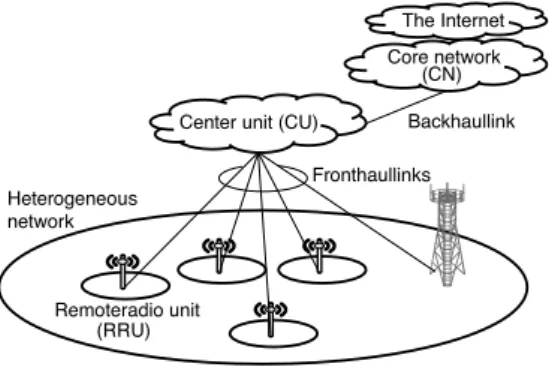
In order to reduce the operating cost of heterogeneous network using a huge number of small cells, use of a centralized- (or cloud-) RAN (C-RAN) architecture has at- tracted attention[14]. Figure 7 shows the typical C-RAN ar- chitecture. C-RAN consists of a center unit (CU), fronthaul links and remote radio units (RRUs). CU carries out the layer 1, layer 2 and layer 3 processing. Specifically, layer 1 processing includes digital baseband modulation. Layer 2 is composed of media access control (MAC), radio link con-
Fig. 7 Typical C-RAN architecture.
trol (RLC) and packet data convergence protocol (PDCP) layer. Layer 3 is composed of radio resource control (RRC) layer. RRU transmits/receives radio signals. Since CU and RRUs work in close cooperation, it becomes easy to intro- duce new technologies to enhance network capability. One of the new technologies is coordinated multi point transmis- sion/reception (CoMP). C-RAN architecture and CoMP are very compatible because the information for the coordinated cells can be treated in CU. Coordinated beamforming (CB), which is one of CoMP schemes, was studied for ultra-high- density small cell[24]. In CB, precoding weights for trans- mission antennas are selected so as to avoid ICI. By apply- ing CB, it was possible to achieve network capacity in pro- portion to the ultra-high-density of small cell.
In C-RAN architecture, fronthaul links require higher data rate and lower latency as radio data rate is higher[25].
In order to address these requirements, there are two ap- proaches. One approach is to enhance data compression scheme for fronthaul links; the other approach is to revise C-RAN architecture to alleviate the requirements of fron- thaul links. As the former approach, an enhanced data com- pression scheme was proposed[26]. The data compression scheme minimized the performance degradation with reduc- ing the latency increase due to data compression/extension.
As the latter approach, layer2(L2)-C-RAN architecture was proposed[27]. In L2-C-RAN architecture, the function of processing on layer1 is transferred from CU to RRU.
Similar to fronthaul links, an enhancement of backhaul links was proposed for group mobility issue[28]. Group mobility issue is performance degradation due to concen- tration of control load. The proposal is to introduce mov- ing cells, which are installed inside the moving object such as bus and train, and to apply massive MIMO to backhaul links. It was reported that the proposal was feasible in terms of backhaul link capacity and amount of control signal.
4. Technical Studies for 5G Frequency Bands
In order to provide throughput of over 10 Gbps, in addition to 4–6 GHz bands, new bands over 6 GHz, referred to as higher frequency bands, are required. Technical problems and solutions related to usage of the higher frequency bands are described in this section.
For 5G, wide frequency bands from 4 GHz to 100 GHz have been well studied. In[29], low-SHF band (–8.4 GHz) are evaluated with the time-spatial propagation model.
In [30], high-SHF band (6–30 GHz) and EHF band (30–
60 GHz) are introduced as promising bands, and vegeta- tion loss, human body shadowing, and scattering effect on rough surface are some of loss inducing elements in the aforementioned bands. On MIMO aspects, a multi-path angular spread is receiving much more attention and re- sults from several measurement campaigns demonstrate rich multipath angular spread and effectiveness of MIMO trans- mission in the following conditions: outdoor-to-indoor in 2.2 GHz[31], indoor measurements in 3.35 GHz[32], out- door measurements in 11 GHz[33]and 44 GHz[34].
In higher frequency bands, high gain antennas with high directivity are effective to overcome the severe path loss effect. Massive MIMO technology is a promising one mentioned in Sect. 5.
Also, rain attenuation in higher frequency bands be- comes much severe and its effects are well evaluated[35]. In addition, studies on user’s hand shadowing effect against the mobile terminal are other issues[36].[37]evaluates perfor- mance of the prototype with two 4-elements array antennas in order to avoid this effect. Furthermore,[38]shows the ef- fectiveness with an antenna-sharing cooperation among mo- bile terminals, which can multiply the number of antenna elements virtually.
Thanks to these research activities, a cost-effective base station with large number of antennas is realized. Moreover, the distance between the base station and the mobile termi- nal can be extended to several tens of meters and more. As a result, an environmentally friendly 5G system in higher frequency bands can be realized with the reduced number of base stations.
5. Multi-Antenna Technologies
Multi-antenna technologies are mandatory technologies in 5G wireless systems to increase spectral efficiency. Since frequency resource is highly limited, spectral efficiency is expected to be mainly improved by spatial reuse.
Multi-user multi-input multi-output (MU-MIMO) can achieve MIMO transmission by regarding the multiple users as the virtual large scale array antenna system. Nonlin- ear precoding MU-MIMO is promising to increase sys- tem capacity [39], [40]. However, the transmission per- formance seriously degrades due to inter-user-interference (IUI) caused by low channel state information (CSI) accu- racy. [41]proposes IUI suppression scheme for nonlinear MU-MIMO. In the receiver, perturbation vector is temporar- ily estimated through spatial linear filtering and then maxi- mum likelihood detection (MLD) with sphere decoding is applied for the filtered signal space. [42] proposes THP scheme minimizing the influence of noise enhancement at the receivers by placing the diagonal weighted filters at both transmitter side and receiver side with square root.
Beamforming using adaptive antenna array (AAA) is a
significant technique for flexible cell design. Various beam- controlling technologies including beam search[43], beam transition[44], and coordinated beamforming[24]are stud- ied. Full-dimensional MIMO (FD-MIMO), also known as three-dimensional MIMO (3D-MIMO) or vertical MIMO, is a new beamforming paradigm in cellular systems. Spa- tial multiplexing gains will be obtained by exploiting not only horizontal dimension but also the vertical dimension.
[45]reports that the throughput of FD-MIMO is 30% larger than the legacy MIMO in cumulative distribution function (CDF) 50% from the field experiment for 4–by–2 MU–
MIMO transmission. Link-adaptable non-linear precoder for FD-MIMO is studied in[46].
Massive MIMO is also a key technology for 5G wire- less systems. Base station with huge number of trans- mit/receive antennas will realize sharper beamforming, wider coverage expansion, and higher order spatial division multiplexing. With the massive MIMO technologies, [47]
and[48]investigate a novel mobile communication system.
[49]proposes a massive MIMO system applied in line-of- sight (LOS) link to establish a wireless entrance MU-MIMO system. Since direct wave is dominant and stable in LOS en- vironment, coherent combining of desired signal is achieved without frequent CSI update. IUI is fortunately suppressed without null-steering since interference waves are randomly combined thanks to massive antennas property. Another ef- ficient IUI suppression technique with massive MIMO is null-space extension[50], which uses some spatial degrees of freedom to expand the dimension of the null space with current and past CSIs. The complexity of MIMO algorithms grows significantly with the number of antennas. Cost- effective solutions for base stations with large number of antenna elements are also important research topics: hy- brid massive MIMO systems with fixed and adaptive ana- log beams are investigated in[44],[51],[52], respectively, which provide beam-space MIMO processing with the num- ber of spatial-multiplexing streams. Other practical issue for massive MIMO is computational complexity for detection at the receiver. Belief propagation (BP) algorithm based sig- nal detection technique[53], that passes likelihood between antenna nodes, is an attractive approach to reduce the com- plexity proportional to the second power of the number of antenna elements. Antenna calibration regarding the differ- ence of each radio frequency (RF) circuit on antenna is the other practical issue for realizing massive MIMO.[54]and [55]propose antenna calibration schemes for implicit feed- back downlink beamforming exploiting uplink CSI. On the other hand[56]proposes an antenna calibration scheme for explicit feedback beamforming.
Mobile station like small smart-phone may have a lim- itation for the number of installed antennas due to its form factor. Overloaded MIMO, that permits the more signal streams multiplexing than receive antennas, is an approach to achieve much higher speed transmission for downlink without huge number of reception antennas. Joint detec- tion and decoding for repetition-coded overloaded MIMO- OFDM is proposed in[57]. The transmitted signal stream is
encoded by a repetition code and the spatially multiplexed signals are jointly decoded after joint MLD in the receiver.
Various receiver structures with idea of virtual channels for overloaded MIMO is introduced in[58]. It achieves supe- rior performance to MIMO linear detectors with much lower computational complexity than MLD receivers.
MIMO transmission can be jointly used with other transmission technologies. [59]and[60]evaluated MIMO with non-orthogonal multiple access technology mentioned in Sect. 6.
6. Advanced Modulation and Multiple Access Schemes Considering 5G, further enhancement to achieve significant gains in capacity and system throughput performance is a high priority requirement. Non-orthogonal multiple access (NOMA) has been attracting much attention as a candidate multiple access scheme for future radio access network sys- tems. In NOMA, multiple signals for different users are su- perimposed before transmission on common resources. At the receiver, successive interference cancellation (SIC) is applied in order to reduce the inter-user interference caused by the non-orthogonally multiplexing. NOMA can be ap- plied to both downlink and uplink[61]–[65].
In NOMA, the signals are assigned different power levels to facilitate reception at the receiver and therefore, not only channel dependent scheduling, which is commonly used in 4G, but also pairing of multiplexed users and multi- user power allocation should also be considered for further enhancement of user throughput. For downlink, the perfor- mance of NOMA using various user pairing and multi-user power allocation schemes are studied in[61],[62]. In[62], pre-defined user grouping and fixed per-group power allo- cation is proposed to reduce the overhead associated with power allocation signaling while maintaining a hefty por- tion of NOMA gains. The complexity reduced proportional fair scheduling method for NOMA is proposed in [63]. It was shown that by searching only the user combinations that are worth non-orthogonally-multiplexing, the number of the user combinations to be searched can be significantly reduced while keeping almost identical average and cell- edge throughput performance compared with conventional exhaustive search method. Similar to downlink NOMA, re- source allocation, user grouping, and power allocation is- sues are studied in[64],[65]for uplink single-carrier fre- quency division multiple access (SC-FDMA).
NOMA is also beneficial for the reliable readiness communication, which is one of key applications of 5G.
By simultaneously transmitting own message by spectrum sharing on the basis of NOMA from plural nodes, the la- tency can be shorter. Resource management methods are proposed in[66]to suppress the impact of interference.
The researches on NOMA above are mostly based on traditional orthogonal frequency division multiplexing (OFDM) waveform design. On the other hand, new wave- form has also been attracting much attention in recent year as one of the key enabling technologies for 5G. New wave-
form research is also undergoing a paradigm shift from or- thogonal to non-orthogonal design approach[67]. Faster- than-Nyquist (FTN) transmission and filter bank multi car- rier (FBMC) transmission are considered as examples of candidate non-orthogonal transmission schemes for future systems that could improve the spectrum efficiency by in- creasing the data rate. For both FTN and FBMC, channel es- timation is one of the key technical issues as classical chan- nel estimation schemes used for OFDM cannot be applied in a straightforward manner due to presence of interference caused by the relaxation of the orthogonality. Channel esti- mation methods are studied in[68]for FTN and in[69]for FBMC.
A well-known simultaneous transmission and recep- tion (STR) or full duplex transmission can also enhance the spectral efficiency (theoretically double the spectral ef- ficiency), and is expected to be realized in 5G. An STR scheme utilizing MIMO spatial modulation, in which the unselected antenna is used as a reception antenna of STR, is proposed in[70]. Development of self-interference cancel- lation technique is proposed in[71].
7. Challenges to Further Enhance Coverage and Ser- vices
In 5G system, it is considered that technologies which are not currently implemented are to be developed and to be included as much as possible. Some topics of these tech- nologies are introduced in this section.
The proximity service, defined as a concept to improve user experiences and resource utilization by taking advan- tage of users’ proximity, becomes more important in recent mobile communications. By the proximity communication using location information, the large effects such as cov- erage expansion, latency reduction, spectral efficiency im- provement, and provision of social networking service, are expected. Device to device (D2D) communication is quite suitable for those proximity services and has already been discussed in 3GPP standardization. Because it is planned that the cellular uplink resource is shared with the D2D link, the interference mitigation between cellular uplink and D2D link, and between D2D links is essential. To realize it, a ran- dom resource allocation scheme to suppress the interference for D2D throughput enhancement is proposed[72]. Further- more, a transmit power control scheme with interference- aware adaptive transmission modes in D2D is proposed and its improvement on system capacity is shown[73]. Before D2D communication, the D2D discovery process is always needed, and it is shown that the discovery resource enhance- ment and the intermittent transmission from D2D terminal improves the discovery performance[74]. The demands for D2D communication is growing and the commercial use will be started in the initial stage of 5G. This technology is connected to machine to machine (M2M) communication of Internet of things (IoT). M2M is a rather genetic term in which a machine automatically connects communication networks each other, and is also called as machine type com-
munication (MTC). In general, M2M includes D2D. In 5G M2M communications, there are some requirements such as massive connectivity, eco M2M, reliable M2M, that include huge demands of home smart meter and autonomous driv- ing.
On the other hand, the utilization of satellite commu- nication is also considered in 5G. To deploy services in iso- lated areas such as mountainous region and ocean, the satel- lite communication is efficient. In addition, when the ter- restrial network is down by a natural disaster, the satellite communication becomes quite important communication method. Because of this effectiveness and importance, the cooperation of terrestrial and satellite systems has been dis- cussed in ITU-R standardization[75]. For the disaster case, a simultaneous short-message communication with million terminals based on spread spectrum - code division multiple access (SS-CDMA) using satellite is proposed[76]. There are two schemes for terrestrial-satellite cooperation, indirect and direct communications. In the indirect scheme, a ter- restrial base station has the satellite backhaul and forwards the connection to terminals[77]. In the direct scheme, the terrestrial terminal directly connects to the satellite basesta- tion[78]. In addition to that, there are two types in the direct scheme, the common wireless interface between terrestrial and satellite systems, and the different interfaces with dual mode chip in mobile terminal. If the satellite system can synchronize the terrestrial system, the satellite cell can be accommodated as a super macro cell of 5G, and the 5G sys- tem will be further evolved.
8. Proof of Concept
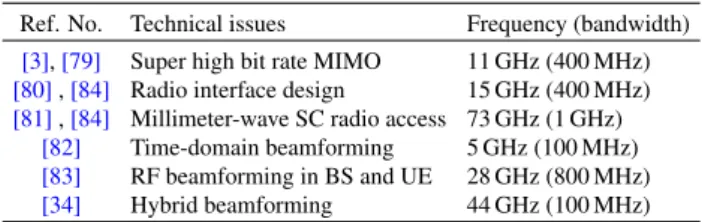
Several proof-of-concept activities and investigations on the 5G concept and RATs in Japan have been introduced[34], [79]–[83],[84]and are summarized in Table 1. In[79], the world first 10 Gbps transmission experiment was reported in outdoor mobile environments using 8×16 MIMO system with 400 MHz bandwidth in 11 GHz frequency band. Fur- thermore,[80]presented the experimental trial and its con- cept for a new radio interface design in 15 GHz frequency band, and[81]investigated other experimental trial for the 5G millimeter-wave radio access with super wideband sin- gle carrier (SC) transmission. In addition, to verify the po- tential of massive MIMO beamforming in sub-6 GHz fre- quency band, [82] described a fundamental transmission experiment using time-domain beamforming by over-100 antenna elements. [83] introduced preliminary results of the 28 GHz band experimental trial using analog RF beam-
Table 1 5G proof-of-concept activities.
Ref. No. Technical issues Frequency (bandwidth) [3],[79] Super high bit rate MIMO 11 GHz (400 MHz) [80],[84] Radio interface design 15 GHz (400 MHz) [81],[84] Millimeter-wave SC radio access 73 GHz (1 GHz)
[82] Time-domain beamforming 5 GHz (100 MHz) [83] RF beamforming in BS and UE 28 GHz (800 MHz) [34] Hybrid beamforming 44 GHz (100 MHz)
forming in both the BS and user equipment (UE), and[34]
showed the potential of massive MIMO hybrid (analog- digital) beamforming for 5G ultra high capacity by exploit- ing 44 GHz band propagation measurement results. [84]
also described massive MIMO experimental trials briefly.
9. Conclusion
With the increasing demand for mobile data communica- tions, higher frequency bands are gaining importance. This paper surveys recent research and development activities in Japan related to 5G mobile communication systems. Those are creating new paths to “5G World” especially on higher frequency bands. As the result of sophisticated integra- tion of these innovative technologies, 5G systems will pro- vide pleasant services for users with unprecedented capac- ity, higher throughput, and less latency.
References
[1] H. Murata, E. Okamoto, M. Mikami, A. Okazaki, S. Suyama, T.
Inoue, J. Mashino, T. Yamamoto, and M. Taromaru, “R&D activi- ties for 5G in IEICE technical committee on radio communication systems,” Proc. 2015 21st Asia-Pacific Conference on Communica- tions (APCC), pp.250–256, 2015.
[2] T. Nakamura, “Research activities of the fifth generation mobile communication promotion forum radio access technologies towards the fifth generation mobile communications system,” Proc. 2015 21st Asia-Pacific Conference on Communications (APCC), pp.169–
173, 2015.
[3] T. Nakamura, A. Benjebbour, Y. Kishiyama, S. Suyama, and T.
Imai, “5G radio access: Requirements, concept and experimental tri- als,” IEICE Trans. Commun., vol.E98-B, no.8, pp.1397–1406, Aug.
2015. DOI: 10.1587/transcom.E98.B.1397
[4] E. Dahlman, S. Parkval, J. Peisa, “5G wireless access,” IEICE Trans. Commun., vol.E98-B, no.8, pp.1407–1414, Aug. 2015. DOI:
10.1587/transcom.E98.B.1407
[5] K. Sakaguchi, E.M. Mohamed, H. Kusano, M. Mizukami, S.
Miyamoto, R.E. Rezagah, K. Takinami, K. Takahashi, N. Shirakawa, H. Peng, T. Yamamoto, and S. Nanba, “Millimeter-wave wireless LAN and its extension toward 5G heterogeneous networks,” IEICE Trans. Commun., vol.E98-B, no.10, pp.1932–1948, Oct. 2015. DOI:
10.1587/transcom.E98.B.1932
[6] M. Mueck, M. Msallem, C. Drewes, and M. Stinner, “Optimum selection of radio access technologies in a 5G heterogeneous mul- ticomm environment,” IEICE Trans. Commun., vol.E98-B, no.10, pp.1949–1956, Oct. 2015. DOI: 10.1587/transcom.E98.B.1949 [7] T. Nakamura and T. Nakamura, “[Invited Talk] Activities of ARIB
2020 and beyond Ad Hoc,” IEICE Technical Report, RCS2014-87, June 2014. (in Japanese)
[8] “Mobile communications systems for 2020 and beyond,” ARIB 2020 and Beyond Ad Hoc Group White Paper, Oct. 2014.
[9] Y. Okumura and T. Nakamura, “Future radio access and mobile optical network — Part I/II,” IEICE Technical Report, RCS2013- 231/232, Dec. 2013. (in Japanese)
[10] H. Fuseda, “[Invited Talk] The future of radio use, 5G,” IEICE Tech- nical Report, RCS2014-85, June 2014. (in Japanese)
[11] Y. Kishiyama, S. Nagata, A. Benjeboour, and T. Nakamura, “[In- vited Lecture] LTE small cell enhancement and phantom cell concept,” IEICE Technical Report, RCS2012-332, Feb. 2013. (in Japanese)
[12] S. Nakao, T. Yamamoto, S. Okasaka, and H. Suzuki, “[Invited Talk] Activities on heterogeneous network for 5G — C-plane/U- plane splitting control in heterogeneous networks,” IEICE Technical
Report, RCS2014-183, Oct. 2014. (in Japanese)
[13] S. Sampei, “Toward more flexible heterogeneous wireless network- ing,” IEICE Technical Report, SR2013-63, Oct. 2013. (in Japanese) [14] K. Sakaguchi, G.K. Tran, H. Shimodaira, S. Nanba, T. Sakurai, K. Takinami, I. Siaud, E.C. Strinati, A. Capone, I. Karls, R. Arefi, and T. Haustein, “Millimeter-wave evolution for 5G cellular net- works,” IEICE Trans. Commun., vol.E98-B, no.3, pp.388–402, March 2015. DOI: 10.1587/transcom.E9.B.388
[15] H. Peng, T. Yamamoto, and Y. Suegara, “LTE/WiGig RAN-Level in- terworking architecture for 5G millimeter-wave heterogeneous net- works,” IEICE Trans. Commun., vol.E98-B, no.10, pp.1957–1968, Oct. 2015. DOI: 10.1587/transcom.E98.B.1957
[16] K. Takeda, J. Yu, H. Harada, and H. Ishii, “Investigation on inter-cell interference suppression using small cell discovery signal in LTE- Advanced,” IEICE Technical Report, RCS2013-216, Dec. 2013. (in Japanese)
[17] H. Harada, K. Takeda, S. Nagata, H. Ishii, and T. Nakamura, “Tech- nologies for efficient small cell operation in 3GPP LTE,” IEICE Trans. Commun. (Japanese Edition), vol.J98-B, no.11, pp.1179–
1192, Nov. 2015.
[18] R. Yoneya, A. Mehbodniya, and F. Adachi, “Highly energy-efficient base station ON/OFF switching algorithm for HetNet,” IEICE Tech- nical Report, RCS2014-193, Oct. 2014. (in Japanese)
[19] H. Harada, A. Morimoto, Y. Ohwatari, S. Nagata, H. Ishii, and Y. Okumura, “Cell identification performance based on hierarchical synchronization channels in dense small cell environment,” IEICE Technical Report, RCS2012-130, Oct. 2012. (in Japanese) [20] M. Mikami, M. Miyashita, and H. Yoshino, “A cell identifica-
tion performance improvement in co-channel heterogeneous cellu- lar networks with cell range expansion,” Proc. IEEE VTC2015- Spring, Glasgow, Scotland, May 2015. DOI: 10.1109/VTC- Spring.2015.7145590
[21] H. Harada, K. Takeda, S. Nagata, H. Ishii, and Y. Kishiyama,
“A study on discovery signal for efficient macro-assisted small cell discovery mechanism in LTE SCE,” IEICE Technical Report, RCS2013-215, Dec. 2013. (in Japanese)
[22] T. Inoue, K. Kobayashi, Y. Watanabe, H. Sugahara, and Y.
Matsunaga, “[Invited Talk] SON algorithm for small cell eNB in LTE heterogeneous network,” IEICE Technical Report, RCS2013- 234, Dec. 2013. (in Japanese)
[23] S. Konishi and T. Yamamoto, “Effectiveness of automatic optimiza- tion by self-organizing networks (SON) for LTE/LTE-Advanced systems,” IEICE Trans. Commun. (Japanese Edition), vol.J97-B, no.8, pp.599–610, Aug. 2014.
[24] T. Kobayashi, T. Sawamoto, T. Seyama, T. Dateki, H. Seki, K. Kobayashi, M. Minowa, S. Suyama, and Y. Okumura, “A study on coordinated beamforming for 5G ultra high-density small cells and its indoor experiment,” IEICE Technical Report, RCS2015-18, April 2015. (in Japanese)
[25] J. Terada, S. Kuwano, H. Suzuki, T. Asai, Y. Okumura, and A. Otaka, “Mobile optical networking technologies toward 5G,”
IEICE Technical Report, RCS2014-238, Dec. 2014. (in Japanese) [26] S. Nanba, A. Agata, and T. Hayashi, “Efficient transmission scheme
for C-RAN fronthaul link,” IEICE Technical Report, RCS2014-239, Dec. 2014. (in Japanese)
[27] Y. Matsunaga, “Radio access network architecture evolution to- ward 5G,” IEICE Technical Report, RCS2014-172, Oct. 2014. (in Japanese)
[28] H. Yasuda, J. Shen, Y. Morihiro, Y. Morioka, S. Suyama, and Y. Okumura, “Challenges and solutions for group mobility on 5G ra- dio access network,” IEICE Technical Report, RCS2014-144, Aug.
2014. (in Japanese)
[29] T. Fujii, H. Omote, and Y. Ohta, “Time-spatial propagation model for wideband mobile communications,” IEICE Trans. Commun.
(Japanese Edition), vol.J91-B, no.9, pp.901–915, Sept. 2008.
[30] T. Imai, K. Kitao, N. Tran, N. Omaki, Y. Okumura, M. Sasaki, and W. Yamada, “[Invited Lecture] Study on propagation characteris-
tics for design of fifth-generation mobile communication systems — Frequency dependency of path loss in 800 MHz to 37 GHz band in small-cell environment,” IEICE Technical Report, RCS2014-218, Nov. 2014. (in Japanese)
[31] K. Kitao, T. Imai, K. Saito, and Y. Okumura, “[Invited Lecture] Ex- perimental study on elevation directional channel properties to eval- uate performance of FD-MIMO at base station in microcell envi- ronment — Outdoor to indoor propagation environment (O2I Sce- nario),” IEICE Technical Report, RCS2013-188, Nov. 2013. (in Japanese)
[32] K. Kitao, T. Imai, K. Saito, and Y. Okumura, “Experimental study on ray based spatio-temporal channel characteristics in indoor en- vironment,” IEICE Trans. Commun., vol.E98-B, no.5, pp.798–805, May 2015.
[33] M. Kim, J. Takada, J. Shen, and S. Suyama, “[Invited Lecture]
11 GHz directional wideband channel measurements in residential microcellular environments,” IEICE Technical Report, RCS2014- 197, Nov. 2014. (in Japanese)
[34] A. Okazaki, H. Iura, K. Nakagawa, K. Ishioka, K. Kihira, A. Okamura, S. Suyama, and Y. Okumura, “Multi-beam multiplex- ing technologies for 5G ultra high capacity massive MIMO trans- mission and evaluation by outdoor fundamental experiment trial at 44 GHz band,” IEICE Technical Report, RCS2015-22, April 2015.
(in Japanese)
[35] H.V. Le, H.M. Mohibul, T. Hirano, T. Taniguchi, A. Yamaguchi, J. Hirokawa, and M. Ando, “Millimeter-wave propagation charac- teristics and localized rain effects in a small-scale university cam- pus network in Tokyo,” IEICE Trans. Commun., vol.E97-B, no.5, pp.1012–1021, May 2014.
[36] N. Tran, T. Imai, and Y. Okumura, “Study on model of radio wave shadowing by a human body at high frequency bands,” IEICE Tech- nical Report, AP2013-198, March 2014. (in Japanese)
[37] Y. Aoki, “5G mobile communications for 2020 and beyond — Vision and key enabling technologies,” IEICE Technical Report, RCS2014-169, Oct. 2014. (in Japanese)
[38] H. Murata, “Collaborative interference cancellation for multi- user MIMO communication systems,” IEICE Technical Report, RCS2013-201, Nov. 2013. (in Japanese)
[39] T. Itakura and S. Denno, “Multi-user MIMO of using block- triangulation,” IEICE Technical Report, RCS2013-205, Nov. 2013.
(in Japanese)
[40] T. Itakura and S. Denno, “Tomlinson-Harashima precoding with Cholesky decomposition for multi-user MIMO,” IEICE Technical Report, RCS2014-157, Oct. 2014. (in Japanese)
[41] H. Tomeba, T. Yoshimura, T. Onodera, M. Kubota, and F. Maehara,
“A study on interference suppression techniques for downlink non- linear MU-MIMO,” IEICE Technical Report, RCS2014-212, Nov.
2014. (in Japanese)
[42] S. Fujita, L.L. Jr, Y. Nagao, M. Kurosaki, and H. Ochi, “Novel THP scheme with minimum noise enhancement for multi-user MIMO systems,” IEICE Trans. Fundamentals, vol.E96-A, no.6, pp.1340–
1347, Feb. 2013.
[43] T. Yamamoto, H. Peng, and Y. Suegara, “A study on cell cover- age expansion of millimeter-wave base station with beamforming technique in millimeter-wave heterogeneous networks,” Proc. IEICE Gen. Conf. ’15, B-5-48, March 2015. (in Japanese)
[44] T. Obara, S. Suyama, J. Shen, and Y. Okumura, “Joint processing of analog fixed beamforming and CSI-based precoding for super high bit rate massive MIMO transmission using higher frequency bands,” IEICE Trans. Commun., vol.E98-B, no.8, pp.1474–1481, Aug. 2015.
[45] Y. Inoue, D. Takeda, K. Saito, T. Kawamura, and H. Andoh, “Field experimental evaluation of null control performance of MU-MIMO considering smart vertical MIMO in LTE-Advanced downlink un- der LOS dominant conditions,” IEICE Trans. Commun., vol.E97-B, no.10, pp.2136–2144, Oct. 2014.
[46] M. Fujii, “Link-adaptable vector-perturbation ZFBF precoder for
multi-point 3D-beamformers,” IEICE Technical Report, RCS2014- 296, Jan. 2015.
[47] S. Suyama, J. Shen, T. Obara, M. Sumi, M. Nakajima, and Y. Okumura, “Basic performances of super high bit rate massive MIMO transmission using higher frequency bands,” IEICE Techni- cal Report, RCS2013-348, March 2014. (in Japanese)
[48] S. Suyama, J. Shen, K. Takeda, Y. Kishiyama, and Y. Okumura,
“Super high bit rate radio access technologies for future radio access and mobile optical network,” IEICE Technical Report, RCS2013- 165, Oct. 2013. (in Japanese)
[49] A. Ohta, K. Maruta, S. Kurosaki, T. Arai, and M. Iizuka, “Basic concept and technology of massive antenna systems for wireless en- trance links — A proposal of a new approach for multi-user MIMO,”
IEICE Technical Report, RCS2013-5, April 2013. (in Japanese) [50] T. Iwakuni, K. Maruta, A. Ohta, Y. Shirato, T. Arai, and M. Iizuka,
“Inter-user interference suppression with null-space extension in multiuser massive MIMO for time varying channel,” IEICE Tech- nical Report, RCS2015-17, April 2015. (in Japanese)
[51] A. Okazaki, H. Iura, N. Fukui, K. Take, and A. Okamura, “A study on next-generation wireless access with higher frequency bands,”
IEICE Technical Report, RCS2014-81, June 2014. (in Japanese) [52] R. Kataoka, J. Miyazawa, K. Nishimori, N. Tran, T. Imai,
and H. Makino, “Performance evaluation of Massive MIMO with analog-digital hybrid processing in a real microcell environ- ment,” IEICE Trans. Commun. (Japanese Edition), vol.J98-B, no.9, pp.967–978, Sept. 2015.
[53] T. Usami, T. Nishimura, T. Ohgane, and Y. Ogawa, “A BP-based approach for M-QAM signal detection in a fully massive MIMO system,” IEICE Technical Report, RCS2014-297, Jan. 2015. (in Japanese)
[54] H. Fukuzono, T. Murakami, R. Kudo, Y. Takatori, and M.
Mizoguchi, “Weighted-combining calibration on multiuser MIMO systems with implicit feedback,” IEICE Trans. Commun., vol.E98- B, no.4, pp.701–713, April 2015.
[55] K. Nishimori, K. Kameyama, T. Hiraguri, and H. Yamada, “Mas- sive MIMO transmission with multi-beam forming network elim- inating CSI estimation,” IEICE Technical Report, RCS2014-324, March 2015. (in Japanese)
[56] R. Kudo, S.M.D. Armour, J.P. McGeehan, and M. Mizoguchi, “Ex- plicit feedback method for massive MIMO OFDM systems,” IEICE Technical Report, RCS2013-195, Nov. 2013. (in Japanese) [57] H. Matsuoka, Y. Doi, T. Yabe, and Y. Sanada, “Performance of over-
loaded MIMO-OFDM system with repetition code,” IEICE Trans.
Commun., vol.E97-B, no.12, pp. 2767–2775, Dec. 2014.
[58] S. Denno, “MIMO receivers with virtual channels,” IEICE Technical Report, RCS2014-286, Jan. 2015. (in Japanese)
[59] A. Benjebbour, A. Li, Y. Kishiyama, J. Huiling, and T. Nakamura,
“System-level evaluations of SU-MIMO combined with NOMA,”
IEICE Technical Report, RCS2014-141, Aug. 2014.
[60] C.H. Liao and H. Morikawa, “Non-linear pre-coding for non-orthogonal multiple access in MU-MIMO system with modulo-based interference cancellation,” IEICE Technical Report, RCS2014-365, March 2015.
[61] N. Otao, Y. Kishiyama, and K. Higuchi, “Performance of non- orthogonal multiple access with SIC in cellular downlink using pro- portional fair-based resource allocation,” IEICE Trans. Commun., vol.E98-B, no.2, pp.344–351, Feb. 2015.
[62] A. Benjebbour, A. Li, Y. Kishiyama, A. Harada, and T. Nakamura,
“On multi-user power allocation and scheduling of downlink NOMA for future radio access,” IEICE Technical Report, RCS2013- 197, Nov. 2013.
[63] T. Seyama and T. Dateki, “A study of PF scheduling for downlink non-orthogonal multiple access with SIC,” IEICE Technical Report, RCS2014-164, Oct. 2014. (in Japanese)
[64] A. Li, A. Benjebbour, X. Chen, H. Jiang, and H. Kayama, “Up- link non-orthogonal multiple access (NOMA) with single-carrier frequency division multiple access (SC-FDMA) for 5G systems,”
IEICE Trans. Commun., vol.E98-B, no.8, pp.1426–1435, Aug.
2015.
[65] J. Goto, O. Nakamura, K. Yokomakura, Y. Hamaguchi, S. Ibi and S. Sampei, “A study on transmit power control for uplink single carrier non-orthogonal multiple access,” IEICE Technical Report, RCS2015-124, July 2015. (in Japanese)
[66] K. Kobayashi, S. Ibi, and S. Sampei, “A study on resource manage- ment of non-orthogonal multiple access for reliable readiness com- munication,” IEICE Technical Report, RCS2014-359, March 2015.
(in Japanese)
[67] A. Benjebbour, Y. Kishiyama, K. Saito, P. Weitkemper, and K. Kusume, “Study on candidate waveform designs for 5G,” Proc.
IEICE Gen. Conf. ’15, B-5-99, March 2015.
[68] T. Hirano, Y. Kakishima, and M. Sawahashi, “TDM based ref- erence signal multiplexing for faster-than-Nyquist signaling us- ing OFDM/OQAM,” IEICE Technical Report, RCS2014-153, Aug.
2014. (in Japanese)
[69] P. Weitkemper, J. Bazzi, K. Kusume, A. Benjebbour, and Y. Kishiyama, “Power efficient channel estimation for FBMC/ OQAM,” Proc. IEICE Gen. Conf. ’15, B-5-100, March 2015.
[70] K. Ishii, “Spatial modulation based full-duplex communication and its applications,” IEICE Technical Report, RCS2013-207, Dec.
2013. (in Japanese)
[71] S. Narieda, “Single channel full duplex transceiver with dual stage analog cancellation of self interference,” IEICE Technical Report, SR2015-18, July 2015. (in Japanese)
[72] C. Yamazaki, T. Saiwai, M. Fujishiro, and K. Morita, “Study on in- terference mitigation using random resource allocation for device to device direct communication underlaying LTE-Advanced network,”
IEICE Technical Report, RCS2014-28, May 2014. (in Japanese) [73] K. Kitagawa and Y. Suegara, “A study on mutual interference reduc-
tion schemes in LTE-advanced device-to-device communication,”
IEICE Technical Report, RCS2014-318, March 2015. (in Japanese) [74] S. Yasukawa, Q. Zhao, Y. Zeng, H. Harada, S. Nagata, and T. Nakamura, “Resource allocation scheme for device to device dis- covery in LTE-Advanced,” IEICE Technical Report, RCS2014-132, July 2014. (in Japanese)
[75] C. Ciochina-Duchesne, D. Castelain, L. Brunel, D. Mottier, F. Hasegawa, M. Higashinaka, and A. Okazaki, “Combined terrestrial-satellite communication networks in international stan- dards,” IEICE Technical Report, RCS2013-137, Aug. 2013.
[76] A. Taira, Y. Miyake, S. Kameda, N. Suematsu, T. Takagi, and K. Tsubouchi, “SS-CDMA for location and short message commu- nication using QZSS,” IEICE Technical Report, RCS2014-124, July 2014. (in Japanese)
[77] S. Kameda, H. Oguma, M. Sasanuma, S. Eguchi, K. Kuroda, and N. Suematsu, “Satellite communication networks valid for disaster recovery: development and field trial of multi-mode SDR VSAT,”
IEICE Technical Report, RCS2014-146, Aug. 2014. (in Japanese) [78] E. Okamoto, H. Tsuji, and A. Miura, “Satellite/terrestrial integrated
mobile communication system and its performance improvement,”
Proc. IEICE Vietnam-Japan Int’l Sym. on Antennas and Propaga- tion, pp.72–76, Jan. 2015.
[79] S. Suyama, J. Shen, Y. Oda, H. Suzuki, and K. Fukawa, “10 Gbps MIMO-OFDM outdoor transmission experiment for super high bit- rate mobile communications,” IEICE Technical Report, RCS2012- 327, Feb. 2013. (in Japanese)
[80] T. Nakamura, Y. Kishiyama, S. Parkvall, E. Dahlman, and J. Furuskog, “Concept of experimental trial for 5G cellular radio access,” Proc. IEICE Society Conf., B-5-58, Sept. 2014.
[81] Y. Kishiyama, T. Nakamura, A. Ghosh, and M. Cudak, “Concept of mmW experimental trial for 5G radio access,” Proc. IEICE Society Conf., B-5-59, Sept. 2014.
[82] J. Shen, S. Suyama, Y. Maruta, and Y. Okumura, “5G fundamental transmission experiment using 5 GHz band massive MIMO,” Proc.
IEICE Gen. Conf., B-5-93, March 2015.
[83] T. Obara, T. Okuyama, Y. Aoki, S. Suyama, J. Shen, J. Lee, and
Y. Okumura, “Experimental trial for 5G systems using 28 GHz band — Part I/II,” IEICE Technical Report, RCS2015-20/21, April 2015.
[84] H. Papadopoulos, C. Wang, O. Bursalioglu, X. Hou, Y. Kishiyama,
“Massive MIMO technologies and challenges towards 5G,” IEICE Trans. Commun., vol.E99-B, no.3, pp.602–621, March 2016. DOI:
10.1587/transcom.2015EBI0002
Hidekazu Murata received the B.E., M.E., and Ph.D. degrees in electronic engineering from Kyoto University, Kyoto, Japan, in 1991, 1993, and 2000, respectively. In 1993, he joined the Faculty of Engineering, Kyoto University.
From 2002 to 2006, he served an Associate Pro- fessor of Tokyo Institute of Technology. He has been at Kyoto University since October 2006 and is currently an Associate Professor at De- partment of Communications and Computer En- gineering, Graduate School of Informatics. His major research interests include signal processing and its hardware imple- mentation, particularly, its application to cooperative wireless networks.
He received the Young Researcher’s Award from the IEICE of Japan in 1997, the Ericsson Young Scientist Award in 2000, and the Young Scien- tists’ Prize of the Commendation for Science and Technology by the Min- ister of Education, Culture, Sports, Science and Technology in 2006, and the Paper Awards of the IEICE in 2011 and 2013, and IEEE ICC Best Paper Award in 2014. He is a member of the IEEE.
Eiji Okamoto received the B.E., M.S., and Ph.D. degrees in Electrical Engineering from Kyoto University in 1993, 1995, and 2003, re- spectively. In 1995 he joined the Communica- tions Research Laboratory (CRL), Japan. Cur- rently, he is an associate professor at Nagoya In- stitute of Technology. In 2004 he was a guest researcher at Simon Fraser University. He re- ceived the Young Researchers’ Award in 1999 from IEICE, and the FUNAI Information Tech- nology Award for Young Researchers in 2008.
His current research interests are in the areas of wireless technologies, satellite communication, and mobile communication systems. He is a member of IEEE.
Manabu Mikami received the B.E., M.S., and Ph.D. degrees from Tohoku University in 1993, 1995 and 2008, respectively. He joined International Telecom Japan Co., LTD. (cur- rently Softbank Corp.) in 1995. From 1995 to 1999, he engaged in operating facilities for telecommunication services. From 2000 to 2006, he has been a research engineer at Japan Telecom Co., LTD. (currently, Softbank Corp.) and engaged in R&D of mobile communication systems. Since October 2006, he has been also a senior research engineer with Wireless R&D Division at Softbank Mobile Corp. (currently, Softbank Corp.) His current interests include wireless transmission technologies for cellular mobile radio systems. He received the Distinguished Contributions Award of Communication Society from IEICE in 2010, 2013 and 2015, respectively. He is a member of IEEE.
Akihiro Okazaki received the B.E. and M.E. degrees in communications and computer engineering from Kyoto University, Kyoto, Japan, in 1996 and 1998, respectively. He joined Mitsubishi Electric Corporation in 1998. From May 2006 to February 2009, he was with Mit- subishi Electric R&D Centre Europe (MERCE).
Since 1998, he has been engaged in research and development on digital mobile radio communi- cation systems. He is currently a manager of the Wireless Transmission System group in Wire- less Communication Technology Department in the Information Technol- ogy R&D Center of Mitsubishi Electric Corporation. He received the Min- ister of Education, Culture, Sports, Science and Technology Award in 2010.
He also received the Young Engineer Award from IEICE in 2004.
Satoshi Suyama received the B.S. de- gree in electrical and electronic engineering, the M.S. degree in information processing, and the Dr. Eng. degree in communications and inte- grated systems, all from Tokyo Institute of Tech- nology, Tokyo, Japan, in 1999, 2001, and 2010, respectively. From 2001 to 2013, he was an Assistant Professor in the Department of Com- munications and Integrated Systems at the To- kyo Institute of Technology. He has been en- gaged in research on OFDM mobile communi- cations systems and applications of the adaptive signal processing, includ- ing turbo equalization, interference cancellation, and channel estimation.
Since April 2013, he has joined NTT DOCOMO, INC. and is involved in research and development of fifth generation mobile communications system. Dr. Suyama is a member of IEEE and the Institute of Electronics, Information, and Communication Engineers (IEICE) of Japan. He received the Young Researchers’ Award from IEICE in 2005, the Best Paper Prize from the European Wireless Technology Conference (EuWiT) in 2009, and the Paper Award from IEICE in 2012.
Takamichi Inoue received the B.E. and M.E. degrees in communications engineering from Tohoku University, Sendai, Japan, in 2003 and 2005, respectively. He joined NEC Cor- poration in 2005. Currently, he is engaged in research and development for mobile commu- nication systems. He received the Young Re- searcher’s Award from the IEICE of Japan in 2011. He is a member of the IEICE.
Jun Mashino received the B.E. degree in electrical and electronic engineering and M.E.
degree in communications and computer engi- neering from Kyoto University, Japan in 2003 and 2005, respectively. He joined NTT Access Network Service Systems Laboratories, NTT Corporation in 2005. He is currently working as a research engineer in NTT Network Inno- vation Laboratories for the research and devel- opment of intelligent interference compensation technologies, and signal processing for future wireless communication systems. He received the IEICE Young Engineers Award in 2009 and APMC 2014 Prize in 2014. He is a member of IEICE.
Tetsuya Yamamoto received his B.S. de- gree in Electrical, Information and Physics En- gineering in 2008 and M.S. and Dr. Eng. degrees in communications engineering from Tohoku University, Sendai Japan, in 2010 and 2012, re- spectively. From April 2010 to March 2013, he was a Japan Society for the Promotion of Sci- ence (JSPS) research fellow. Since April 2013, he has been with Panasonic Corporation. He was a recipient of the 2008 IEICE RCS (Ra- dio Communication Systems) Active Research Award and Ericsson Best Student Award 2012. His research interests in- clude cellular technologies (LTE, LTE-A, and future mobile communica- tion systems such as 5G).
Makoto Taromaru received the B.E. and M.E. degrees in electronics engineering from the Tokyo Institute of Technology in 1985 and 1987, respectively, and the Ph.D. degree from Kyushu Institute of Technology in 1997. In 1987, he joined Kyushu Matsushita Electric Corporation, a company of Panasonic, where he worked on the development of wireless commu- nication devices. Between 2001 and 2004, he was with the Faculty of Engineering, Kyushu Sangyo University, where he was an Associate Professor in the Department of Electronics. From 2004 to 2010, he was with ATR Wave Engineering Laboratories, Kyoto, and was the head of the Department of Wireless Communication Systems. In 2010, he joined Fukuoka University, where he is currently a professor. He served as an Ed- itor of IEICE Transactions on Communications during 2006–2008, and he also served as an Editor of IEICE Communications Express during 2014–
2015. His research interests include radio communication systems, espe- cially on transceiver architectures, diversity and adaptive antenna systems.
Dr. Taromaru is a member of IEEE.
![Fig. 2 Definition of 5G [7].](https://thumb-ap.123doks.com/thumbv2/123deta/10098651.1498944/2.892.80.424.123.333/fig-definition-of-g.webp)
![Fig. 4 Promising approaches for increasing network capacity [11].](https://thumb-ap.123doks.com/thumbv2/123deta/10098651.1498944/3.892.78.428.120.322/fig-promising-approaches-increasing-network-capacity.webp)