LETTER
On the Security of Keyed-Homomorphic PKE: Preventing Key Recovery Attacks and Ciphertext Validity Attacks ∗
Keita EMURA†a),Member
SUMMARY In this short note, we formally show that Keyed- Homomorphic Public Key Encryption (KH-PKE) is secure against key recovery attacks and ciphertext validity attacks that have been introduced as chosen-ciphertext attacks for homomorphic encryption.
key words: Keyed-Homomorphic PKE, CCA security, key recovery attacks, ciphertext validity attacks
1. Introduction
Homomorphic encryption allows us to operate encrypted data, and this attractive functionality has been applied to construct several secure protocols, especially after the sem- inal work by Gentry[1]. However, the fact that homomor- phic encryption schemes are vulnerable against (adaptive) chosen-ciphertext attacks (CCA)∗∗is somewhat overlooked.
1.1 CCA1 Attacks against Homomorphic Encryption Theoretically, an adversary sends a homomorphically eval- uated challenge ciphertext to the decryption oracle, and can immediately break the security. One may think that this is just a theoretical result and there is no practical impact. Even though Bleichenbacher’s CCA attack[2]has been widely rec- ognized, it is also widely recognized that a weaker security level is acceptable in return for obtaining a homomorphic property. However, several CCA attacks against concrete homomorphic encryption schemes have been also shown.
We introduce key recovery attacks (KRA) as follows.
Key Recovery Attacks: An adversary recovers secret keys via the access of the decryption oracle. These attacks work well regardless of whether or not a ciphertext input to the decryption oracle is the challenge one, and allows to recover secret keys. Currently, many attacks have been proposed[3]–
[8]. We introduce these attacks in Sect. 1.4.
1.2 Is CCA1 Security Sufficient?
Canetti et al. [9] have proposed three IND-CCA1 secure Manuscript received April 10, 2020.
Manuscript revised May 21, 2020.
Manuscript publicized July 8, 2020.
†The author is with the National Institute of Communications and Information Technology (NICT), Koganei-shi, 184-8795 Japan.
∗This work was supported by JST CREST Grant Number JP- MJCR19F6, Japan.
a) E-mail: [email protected]
DOI: 10.1587/transfun.2020EAL2039
fully homomorphic encryption schemes. Because decryp- tion queries can be simulated, it might be sufficient to prevent key recovery attacks. However, CCA1 security seems to be insufficient owing to ciphertext validity attacks (CVA) as follows.
Ciphertext Validity Attacks: Although KRA is run via the access of the decryption oracle, CVA is run via the access of a ciphertext validity oracle (both before and after the challenge phase), where the oracle takes ciphertext as an input and determines whether it would output⊥or not on decryption.
We introduce the Loftus et al. attack[3]in Sect. 1.4.
1.3 Our Contribution
In this short note, we formally show that Keyed- Homomorphic Public Key Encryption (KH-PKE)[10]–[14], which is a CCA2 secure homomorphic encryption by intro- ducing a designated evaluation, prevents key recovery attacks and ciphertext validity attacks. Since several homomorphic encryption schemes are vulnerable against these attacks as mentioned before, our result suggests that KH-PKE is an at- tractive option when the designated evaluation is allowable.
1.4 Related Work
Loftus et al. [3] have shown that the Gentry scheme (of the Gentry-Halevi variant [15]) is not CCA1 secure where a secret key z ∈ [0,d) is recovered by O(logd) decryp- tion queries. Zhang, Plantard, and Susilo[4]have shown a CCA1 attack against the Dijk-Gentry-Halevi-Vaikuntanathan scheme [16] that recovers a secret key by O(λ2) decryp- tion queries (whereλis a security parameter). Chenal and Tang [5]have shown several key recovery attacks such as the Brakerski-Vaikuntanathan scheme[17]withnNdecryp- tion queries, where a secret key is an element of Znq and N =blog2(q−1)c+1, the other Brakerski-Vaikuntanathan scheme [18] with dblog2(q −1)c+1/blog2(t −1)c +1e decryption queries where t = poly(λ) ∈ Z∗q, the Gentry- Sahai-Waters scheme[19]that each decryption query recov- ers 1 bit of each coefficientti of the secret vector~t ∈ Znq. They have also shown that these attacks work against the Brakerski-Gentry-Vaikuntanathan scheme [20]. The Dijk- Gentry-Halevi-Vaikuntanathan scheme [16]withO(η) de- cryption queries whereη is the bit-length of the secret key
∗∗Throughout this study, we use CCA2 or CCA as adap- tive chosen-ciphertext attacks and CCA1 as non-adaptive chosen- ciphertext (i.e., lunchtime) attacks.
Copyright © 2021 The Institute of Electronics, Information and Communication Engineers
(which improves the abovementioned Zhang et al.’s attack).
Dahab, Galbraith, and Morais [6] have shown a key re- covery attack against a NTRU-based scheme proposed by Bos et al.[21]withddlog2(B)e, where the scheme is con- structed on a ringZq[x]/(xd+1),d is a power of 2,Bis a bound on the coefficient size of error distribution such that B2 <q/(36t2), andt specifies a plaintext spaceR/t Rwith R=Z[x]/(xd+1). Chenal and Tang[7]have shown a key recovery attack against an NTRU-based scheme proposed by Lopez-Alt et al.[22]withblog2(B)c+ndecryption queries, and improved the Dahab-Galbraith-Morais attack. Peng[8]
showed a key recovery attack with single decryption query against the Brakerski-Fan-Vercauteren scheme (a Ring-LWE variant of the Brakerski scheme[23]proposed by Fan and Vercauteren[24]) which is employed in Microsoft SEAL.
Loftus et al.[3]have shown that the Smart-Vercauteren scheme[25] (with a modification by adding a ciphertext- checking procedure) is IND-CCA1 secure (under a lattice- based knowledge assumption), but is not IND-CVA secure.
This is a CCA2-like attack where an adversary obtains the challenge ciphertextC∗, adds some values toC∗via homo- morphic operations, and sends the ciphertext to the ciphertext validity oracle. They have shown that the decryption result ofC∗is recovered byO(Nlog2T)ciphertext validity queries whereNis the degree of a polynomial andTdefines the size of the circuit. They insisted that “Such an oracle can often be obtained in the real world by the attacker observing the behavior of a party who is fed ciphertexts of the attacker’s choosing.”. Li, Galbraith, and Ma[26]also insisted that “If a user is storing an encrypted database in the cloud and making queries to it, then an attacker could send ciphertexts of its choosing in response. If these ciphertexts are invalid, then the user might re-send the same query until a valid ci- phertext is received in response. Such a situation precisely gives a CVA oracle.”.
2. Keyed-Homomorphic Public Key Encryption Emura et al. [10], [11] have proposed a KH-PKE notion.
In addition to a public and decryption key pair(pk,skd), a homomorphic operation keyskhis defined and the evaluation algorithm requires to take skh as input while anyone can evaluate ciphertext freely in usual homomorphic encryption schemes. This designated evaluation allows us to define CCA security for outsiders who do not haveskh.
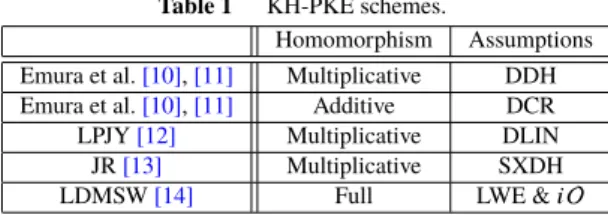
Emura et al. have shown two instantiations of their generic construction. The first one is a multiplicative KH- PKE scheme, which is secure under the decisional Diffie- Hellman (DDH) assumption, and the second one is an addi- tive KH-PKE scheme, which is secure under the decisional composite residuosity (DCR) assumption. These schemes are pairing-free. Later, Libert, Peters, Joye, and Yung (LPYJ)[12]have proposed a multiplicative KH-PKE scheme supporting threshold decryption and publicly verifiability.
Jutla and Roy (JR)[13]have also proposed a publicly veri- fiable KH-PKE scheme with a shorter ciphertext size. The LPYJ and JR KH-PKE schemes are pairing-based. Though
Table 1 KH-PKE schemes.
Homomorphism Assumptions Emura et al.[10],[11] Multiplicative DDH Emura et al.[10],[11] Additive DCR
LPJY[12] Multiplicative DLIN
JR[13] Multiplicative SXDH
LDMSW[14] Full LWE &iO
these KH-PKE schemes support either additive or multiplica- tive homomorphic operation, Lai et al. [14]have proposed Keyed-Fully Homomorphic Encryption (keyed-FHE) whose security relies on the learning with errors (LWE) assump- tion and indistinguishability obfuscation (iO) [27]. Thus, one definite future work is to construct a keyed-FHE scheme withoutiO. We summarize these schemes in Table 1.
The syntax of KH-PKE is given as follows.
Definition 1(Syntax of KH-PKE[10],[11]): Let M be a message space and be a binary operation over M. A KH-PKE scheme K H-PK E = (KeyGen,Enc,Dec,Eval) for homomorphic operationconsists of the following four algorithms:
KeyGen: The key generation algorithm takes a security pa- rameterλ ∈Nas input, and outputs a public keypk, a decryption keyskd, and a homomorphic operation key skh.
Enc: The encryption algorithm takes pk, and a message M ∈ Mas input, and outputs a ciphertextC.
Dec: The decryption algorithm takes skd andC as input, and outputsM or⊥.
Eval: The evaluation algorithm takes skh, two ciphertexts C1andC2as input, and outputs a ciphertextCor⊥. Next, we provide the definition of correctness. For a public keypkgenerated by theKeyGenalgorithm, letCpk,M be the set of all ciphertexts ofM ∈ Munderpk.
Definition 2(Correctness[10],[11]): We say that the KH- PKE scheme for homomorphic operationiscorrectif for all (pk,skd,skh) ← KeyGen(1λ), the following two con- ditions hold: (1) For all M ∈ M, and all C ∈ Cpk,M, Dec(skd,C)= Mholds. (2) For allM1,M2 ∈ M, allC1 ∈ Cpk,M1, and allC2 ∈ Cpk,M2,Eval(skh,C1,C2)∈ Cpk,M1M2 holds.
Next, we provide the definition of indistinguishability under adaptive chosen ciphertext attacks (IND-KH-CCA).
We simply denote IND-KH-CCA as KH-CCA.
Definition 3(KH-CCA): We say that the KH-PKE scheme is KH-CCA secure if for any probabilistic polynomial-time (PPT) adversaryA, the advantage
AdvKH-CCAKH-PKE,A(λ)=
Pr[(pk,skd,skh)←KeyGen(1λ); (M0∗,M1∗,State)← AO(find,pk); β← {$ 0,1}; C∗ ←Enc(pk,Mβ∗); β0← AO(guess,State,C∗);
β= β0]−1 2
is negligible in λ, where O consists of oracles RevHK, Eval(skh,·,·), and Dec(skd,·) defined as follows. Let D be a list which is initialized as∅, and is set asD={C∗}right after the challenge stage.
• RevHK: Upon a request, the homomorphic key reveal oracle responds withskh. This oracle is available only once.
• Eval(skh,·,·): IfRevHKhas already been queried be- fore, then the evaluation oracle is not available. Other- wise, the oracle responds to a query(C1,C2)with the result ofC ←Eval(skh,C1,C2). In addition, ifC ,⊥ and eitherC1 ∈ DorC2 ∈ D, then the oracle updates the list byD ← D ∪ {C}.
• Dec(skd,·): The decryption oracle is not available ifA has queried toRevHKandAhas obtained the challenge ciphertextC∗. Otherwise, the oracle responds to a query Cwith the result ofDec(skd,C)ifC<Dor returns⊥ otherwise.
It is particularly worth noting that any ciphertext in- cluding the challenge one is allowed to be the inputs of the evaluation oracle. As a restriction to avoid trivial attacks, the challenge ciphertext and challenge-related ciphertexts (which are listed inD) are not allowed to be input into the decryption oracle.
Is Designated Evaluation Setting Sufficient?In KH-PKE, the evaluation algorithm requiresskh. This designated eval- uation setting is acceptable in the following case: (1) a client sets up a public and decryption key pair, encrypts data, and sends the ciphertext to a server, (2) the server runs the eval- uation algorithm for encrypted data to perform homomor- phic operations to them, and returns the evaluation result (a ciphertext) to the client, and (3) the client decrypts the ci- phertext and obtains the result. As an example of this frame- work, Shimizu et al.[28]have proposed a privacy-preserving search mechanism for chemical compound databases using the additive homomorphic encryption.
3. On the Security of KH-PKE
Although KH-CCA security formally states the security of KH-PKE, in this section we formally show that KH-CCA can prevent key recovery attacks and ciphertext validity attacks.
We assume that an adversaryAis an outsider who does not call theRevHKoracle.
3.1 KH-PKE is Secure against Key Recovery Attacks Here, we formalize key recovery attacks in the KH-PKE context. We assume thatArecovers the actualskd for the sake of simplicity. However, we can easily extend it such thatArecovers an equivalent key sk0d , skd where for all M ∈ M, and allC ∈ Cpk,M,Dec(skd0,C)=M holds.
Definition 4(KRA Security): We say that the KH-PKE scheme is secure against key recovery attacks if for any PPT adversaryA, the advantage
AdvKRAKH-PKE,A(λ)=Pr[(pk,skd,skh)←KeyGen(1λ); skd← ADec(skd,·)(pk)]
is negligible inλ, whereDec(skd,·)is the decryption oracle which responds to a queryCwith the result ofDec(skd,C). Next, we show that if the KH-PKE scheme is KH-CCA secure, then it is secure against key recovery attacks.† This is somewhat trivial since the decryption oracle is available in the definition of KH-CCA, and all decryption queries are simulatable. LetA be an adversary that issues decryption queries and recovers the secret key skd. We show there exists an algorithm Bthat breaks the KH-CCA security of a KH-PKE scheme by interacting withA. First,Breceives pk from the KH-CCA challenger of the KH-PKE scheme.
B forwards it to A. When A sends a decryption query, thenBforwards it to the challenger, obtains the decryption result, and returns it toA. Since no target ciphertext exists in key recovery attacks,Aoutputsskdat some point. Then, B chooses (M0∗,M1∗) and sends it to the challenger, and the challenger returns the challenge ciphertext C∗.†† By decryptingC∗,Bbreaks the KH-CCA security. This shows that if the KH-PKE scheme is KH-CCA secure, then it is KRA secure.
3.2 KH-PKE is Secure against Ciphertext Validity Attacks Here, we formalize ciphertext validity attacks in the KH-PKE context. Since this is a CCA2-like attack, we additionally consider the evaluation oracle that allows the adversary to check the validity of challenge-related ciphertexts. Although here we give an IND-type definition, Loftus et al.[3]gave an onewayness-type definition: the challenge ciphertextC∗ is associated with a hidden message M∗ andA recovers M∗. Our IND-type definition implies the onewayness-type definition.
Definition 5(IND-CVA): We say that the KH-PKE scheme is IND-CVA secure if for any PPT adversaryA, the advan- tage
AdvIND-CVAKH-PKE,A(λ)=
Pr[(pk,skd,skh)←KeyGen(1λ);
(M0∗,M1∗,State)← AValidity(skd,·),Eval(skh,·,·)(find,pk); β← {$ 0,1}; C∗←Enc(pk,Mβ∗);
β0← AValidity(skd,·),Eval(skh,·,·)(guess,State,C∗); β= β0]−1
2
is negligible in λ, where the ciphertext validity oracle Validity(skd,·)is defined as follows.
• Validity(skd,·): The oracle takes as inputCand returns 1 if the result of Dec(skd,C) is not ⊥ or returns 0
†Our reduction still works in the equivalent key case. Moreover, our reduction works even ifAis allowed to access the evaluation oracle.
††Clearly, our reduction works even ifAchooses(M0∗,M1∗).
otherwise.
Basically, the ciphertext validity oracle is directly sim- ulated by the decryption oracle, i.e., if the decryption oracle returns a non-⊥value, then the reduction returns 1, and oth- erwise, if the decryption oracle returns⊥, then the reduction returns 0. Because Das et al.[29]have shown that CVA is weaker than CCA2, one may think that it is also trivial to show that a KH-CCA secure KH-PKE scheme is also se- cure against ciphertext validity attacks. However, we need to additionally simulate the ciphertext validity oracle even when challenge-related ciphertexts containingDare queried (remember that in the Loftus et al. attack the challenge ci- phertext is modified via homomorphic operations, and the modified ciphertext is sent to the ciphertext validity oracle).
Of note, a KH-CCA adversary (the reduction in this context) is not allowed to send a ciphertextC ∈ Dto the decryption oracle to avoid a trivial attack. However, such ciphertexts are generated via the evaluation oracle, and thus the reduction simply returns 1 ifC∈ Dis queried to the ciphertext validity oracle. We emphasize that if a challenge-related ciphertext C < D is queried (it shows that homomorphic operations were done without usingskh), then it immediately breaks the KH-CCA security. Thus, here, we are interested in the caseC∈ Donly for handling challenge-related queries.
Next, we show that if the KH-PKE scheme is KH-CCA secure, then it is secure against ciphertext validity attacks.
LetAbe an adversary that issues ciphertext validity queries.
Ais additionally allowed to access the evaluation oracle. We show there exists an algorithmBthat breaks the KH-CCA security of a KH-PKE scheme by interacting withA. First, B receives pk from the KH-CCA challenger of the KH- PKE scheme. Bforwards it toA. IfAsends a ciphertext validity query C, then B forwards it to the challenger as a decryption query, obtains the decryption result M, and returns 1 ifM ,⊥and 0 ifM =⊥. IfAsends an evaluation query(C1,C2)toB, thenBforwards it to the challenger as an evaluation query, and returns the evaluation resutCtoA. In the challenge phase, A chooses (M0∗,M1∗) and sends it toB. Bforwards it to the challenger, obtains the challenge ciphertextC∗, and returns it toA. Later,Balso manages a setD0which is initialized as{C∗}. IfAsends an evaluation query (C1,C2) toB, thenB forwards it to the challenger as an evaluation query, and returns the evaluation resultC toA. IfC , ⊥and eitherC1 ∈ D0or C2 ∈ D0, thenB updates the list byD0← D ∪ {C}. IfAsends a ciphertext validity queryC <D0, thenBforwards it to the challenger as a decryption query, obtains the decryption resultM, and returns 1 ifM ,⊥and 0 ifM=⊥. IfAsends a ciphertext validity queryC ∈ D0, then Breturns 1. A outputs β0at some point. Then,B outputs β0, and breaks the KH-CCA security. This shows that if the KH-PKE scheme is KH-CCA secure, then it is IND-CVA secure.†
†Clearly, our reduction works even ifAis allowed to access the decryption oracle.
4. Discussion
Differences Other Post-CCA1 Security: Loftus et al.[3]
have introduced the notion of CCA-embeddable homomor- phic encryption. From a ciphertext of a CCA secure PKE scheme (e.g., the Cramer-Shoup PKE scheme[30]), anyone can extract a ciphertext of a CPA homomorphic PKE scheme (e.g., the ElGamal PKE scheme). Unfortunately, CCA se- curity is missing after homomorphic operations. Li, Gal- braith, and Ma[26]have modified the Gentry-Sahai-Waters scheme [19] where the decryption algorithm generates a fresh random one-time secret key for each decryption. They insisted that the scheme is secure against ciphertext valid- ity attacks because no valid ciphertext notion is introduced (i.e, the decryption algorithm does not output ⊥). Owing to the Chenal-Tang key recovery attack against the Gentry- Sahai-Waters scheme[5], some bits of the one-time private key are recovered by decryption queries, however, this does not allow the adversary to compute a valid secret key owing to the freshness. Although this attempt is attractive, it is not proved that the modified Gentry-Sahai-Waters scheme is IND-CCA1 secure. Desmedt et al.[31]have proposed con- trolled homomorphic encryption where a token is required for evaluation. This also introduces the designated evalu- ation setting but does not consider any CCA security. Joo and Yun[32]proposed homomorphic authenticated encryp- tion and defined its CCA security. Unlike KH-PKE, it is symmetric key encryption.
Is Double Encryption Sufficient? Emura et al. have shown that a simple double encryption produces the designated evaluation where a plaintext is encrypted by a CCA1 homo- morphic PKE scheme, and the ciphertext is again encrypted by a CCA2 PKE scheme. Then the decryption key of the CCA2 PKE scheme is regarded asskh. It may be sufficient to prevent key recovery attacks, but is insufficient to prevent ciphertext validity attacks. Let the inner PKE be CCA1 se- cure but not CVA secure (as the modified Smart-Vercauteren scheme[3]). After obtaining the challenge ciphertext, if a CVA adversary calls the ciphertext validity oracle, then the scheme is broken. If a CVA secure PKE scheme, or rather CCA1.5 secure PKE scheme††, is employed as the inner PKE, then it may be sufficient to protect the scheme against outsider adversaries. However, KH-CCA security considers the following case, which is not captured by double encryp- tion: an adversary issues decryption queries even after the challenge phase and later the adversary obtainsskh via the RevHK oracle. Although there is a room for argument on whether or not this case affects security in practice, neverthe- less, we insist that stronger security should be considered as much as possible as long as the homomorphic functionality is provided.
††Das et al.[29]defined CCA1.5 where the decryption oracle is available before the challenge phase and the ciphertext validity oracle is available even after the challenge phase. They showed that CCA1.5 is stronger than CCA1 but is weaker than (replayable) CCA2.
References
[1] C. Gentry, “Fully homomorphic encryption using ideal lattices,”
STOC, pp.169–178, 2009.
[2] D. Bleichenbacher, “Chosen ciphertext attacks against protocols based on the RSA encryption standard PKCS #1,” CRYPTO, pp.1–
12, 1998.
[3] J. Loftus, A. May, N.P. Smart, and F. Vercauteren, “On CCA-secure somewhat homomorphic encryption,” Selected Areas in Cryptogra- phy, pp.55–72, 2011.
[4] Z. Zhang, T. Plantard, and W. Susilo, “On the CCA-1 security of somewhat homomorphic encryption over the integers,” ISPEC, pp.353–368, 2012.
[5] M. Chenal and Q. Tang, “On key recovery attacks against exist- ing somewhat homomorphic encryption schemes,” LATINCRYPT, pp.239–258, 2014.
[6] R. Dahab, S.D. Galbraith, and E. Morais, “Adaptive key recov- ery attacks on NTRU-based somewhat homomorphic encryption schemes,” ICITS, pp.283–296, 2015.
[7] M. Chenal and Q. Tang, “Key recovery attacks against NTRU-based somewhat homomorphic encryption schemes,” ISC, pp.397–418, 2015.
[8] Z. Peng, “Danger of using fully homomorphic encryption: A look at microsoft SEAL,” CoRR, vol.abs/1906.07127, 2019.
[9] R. Canetti, S. Raghuraman, S. Richelson, and V. Vaikuntanathan,
“Chosen-ciphertext secure fully homomorphic encryption,” Public- Key Cryptography, pp.213–240, 2017.
[10] K. Emura, G. Hanaoka, G. Ohtake, T. Matsuda, and S. Yamada,
“Chosen ciphertext secure keyed-homomorphic public-key encryp- tion,” Public-Key Cryptography, pp.32–50, 2013.
[11] K. Emura, G. Hanaoka, K. Nuida, G. Ohtake, T. Matsuda, and S. Ya- mada, “Chosen ciphertext secure keyed-homomorphic public-key cryptosystems,” Des. Codes Cryptogr., vol.86, no.8, pp.1623–1683, 2018.
[12] B. Libert, T. Peters, M. Joye, and M. Yung, “Non-malleability from malleability: Simulation-sound quasi-adaptive NIZK proofs and CCA2-secure encryption from homomorphic signatures,” EU- ROCRYPT, pp.514–532, 2014.
[13] C.S. Jutla and A. Roy, “Dual-system simulation-soundness with ap- plications to UC-PAKE and more,” ASIACRYPT, pp.630–655, 2015.
[14] J. Lai, R.H. Deng, C. Ma, K. Sakurai, and J. Weng, “CCA-secure keyed-fully homomorphic encryption,” Public-Key Cryptography, pp.70–98, 2016.
[15] C. Gentry and S. Halevi, “Implementing Gentry’s fully- homomorphic encryption scheme,” EUROCRYPT, pp.129–148, 2011.
[16] M. van Dijk, C. Gentry, S. Halevi, and V. Vaikuntanathan, “Fully homomorphic encryption over the integers,” EUROCRYPT, pp.24–
43, 2010.
[17] Z. Brakerski and V. Vaikuntanathan, “Efficient fully homomorphic encryption from (standard) LWE,” FOCS, pp.97–106, 2011.
[18] Z. Brakerski and V. Vaikuntanathan, “Fully homomorphic encryption from ring-lwe and security for key dependent messages,” CRYPTO, pp.505–524, 2011.
[19] C. Gentry, A. Sahai, and B. Waters, “Homomorphic encryption from learning with errors: Conceptually-simpler, asymptotically-faster, attribute-based,” CRYPTO, pp.75–92, 2013.
[20] Z. Brakerski, C. Gentry, and V. Vaikuntanathan, “(Leveled) fully ho- momorphic encryption without bootstrapping,” ITCS, pp.309–325, 2012.
[21] J.W. Bos, K.E. Lauter, J. Loftus, and M. Naehrig, “Improved security for a ring-based fully homomorphic encryption scheme,” IMACC, pp.45–64, 2013.
[22] A. López-Alt, E. Tromer, and V. Vaikuntanathan, “On-the-fly mul- tiparty computation on the cloud via multikey fully homomorphic encryption,” STOC, pp.1219–1234, 2012.
[23] Z. Brakerski, “Fully homomorphic encryption without modulus switching from classical gapsvp,” CRYPTO, pp.868–886, 2012.
[24] J. Fan and F. Vercauteren, “Somewhat practical fully homomor- phic encryption,” IACR Cryptology ePrint Archive, vol.2012, p.144, 2012.
[25] N.P. Smart and F. Vercauteren, “Fully homomorphic encryption with relatively small key and ciphertext sizes,” Public Key Cryptography, pp.420–443, 2010.
[26] Z. Li, S.D. Galbraith, and C. Ma, “Preventing adaptive key recov- ery attacks on the GSW levelled homomorphic encryption scheme,”
Provable Security, pp.373–383, 2016.
[27] B. Barak, O. Goldreich, R. Impagliazzo, S. Rudich, A. Sahai, S.P.
Vadhan, and K. Yang, “On the (im)possibility of obfuscating pro- grams,” J. ACM, vol.59, no.2, p.6, 2012.
[28] K. Shimizu, K. Nuida, H. Arai, S. Mitsunari, N. Attrapadung, M. Hamada, K. Tsuda, T. Hirokawa, J. Sakuma, G. Hanaoka, and K. Asai, “Privacy-preserving search for chemical compound databases,” BMC Bioinform., vol.16, no.S6, 2015.
[29] A. Das, S. Dutta, and A. Adhikari, “Indistinguishability against cho- sen ciphertext verification attack revisited: The complete picture,”
Provable Security, pp.104–120, 2013.
[30] R. Cramer and V. Shoup, “A practical public key cryptosystem prov- ably secure against adaptive chosen ciphertext attack,” CRYPTO, pp.13–25, 1998.
[31] Y. Desmedt, V. Iovino, G. Persiano, and I. Visconti, “Controlled homomorphic encryption: Definition and construction,” Workshop on Encrypted Computing and Applied Homomorphic Cryptography, pp.107–129, 2017.
[32] C. Joo and A. Yun, “Homomorphic authenticated encryption secure against chosen-ciphertext attack,” ASIACRYPT, pp.173–192, 2014.