Akemi Fu
実地体験を重視した新海外研修プログラムのデザイン
夫
明
美
Abstract
The present paper reports the designing process of a new study abroad program, Area Studies (U.S.) The unique characteristics of this new program are found the following three aspects.
1. Making connection between the content of IS, Sustainable Futures, with the experiential learning in Big Island
2. Building connection with local professionals who play influential roles in their specialized fields
3. Bringing connection across generations for passing down traditional values and philosophies
In adding a new program into a repertoire of different study abroad programs in Osaka Jogakuin College, this designing process pays particular attention to the continuous process of plan-do-see process with using the guideline suggested by Deardorff (2013). In order to start “with the end in mind” (p.111) learning outcomes set in the beginning stage leads us to make
appropriate execution and evaluation of the program.
Keywords: a contextualized program, connection of contents with experiential learning, seeing oneself, intercultural competence
(Received September 26, 2017)
抄 録
本稿の目的は、大阪女学院短期大学が「エリアスタディーズ(米国)」として新たに加え る海外研修プログラムのデザイン過程を、記録として残すことである。Deardorff(2013) が指摘するように、プログラムを適切に評価するためには、企画―運営―評価の全体プロ セスを念頭に置くことが重要であり、本稿内でも、現段階での全体像を記す。また、新プ ログラムの特色は以下の 3 点に集約される。1. IS4 で学ぶ「Sustainable Futures」をハワイ島ヒロでの体験学習と結びつける 2. ヒロ現地で活躍する専門家たちとの関係を築く
キーワード:教室内学習と体験学習の融合、国際理解、文脈に根差した学習
(2017 年 9 月 26 日受理)
1. Introduction
The main purpose of this paper is to report how one study abroad program, Area Studies (U.S.), has been designed and developed with a strong focus on building connections. Osaka Jogakuin University (OJU) and Osaka Jogakuin College (OJC) have different types of study abroad programs, which have various lengths, learning objectives, and unique program contents. As Osaka Jogakuin (OJ) is going to add a new short study abroad program under the course of Area Studies, the author describes how the university started cultivating a new place for integrated and contextualized learning at the University of Hawai'i at the Hilo (UHH) in Big Island.
The second section provides a literature review on how previous studies have reported on the pedagogical merits of study abroad programs, mainly in academic growth and in intercultural understanding development. The third section reports some concerns in the plan-do-see process through a study abroad program. The fourth section, the most important part, describes the key foci of this new study abroad program. The fifth section shows the direction to move forward.
2. Literature Review
2-1. Pedagogical merits of study abroad programs
This part reports how previous studies have described the educational benefits of study abroad programs. Regardless of various types of length, the nature of the sending/host institutions, objectives of the programs, common merits have been reported in quite a few articles and reports. This paper particularly pays special attention to the qualitative changes found in the study abroad experience, although it recognized that quantitative changes are equally important and meaningful.
2-1-1. Academic growth through a study abroad program
Among various benefits from study abroad programs, the present paper pays special attention to academic growth seen in students (Anderson, Lawton, Rexeisen, & Hubbard, 2005, Chieffo & Criffiths, 2004, Dwyer, 2004, Holoviak, Verney, Winter & Holoviak, 2011). Categorization by the Michigan State University Office Study Abroad (2017) provides simple
and clear clarification. Benefits from study program abroad are seen in the following four main areas: academic/intellectual, professional, personal, and intercultural aspects. The academic/ intellectual category includes problem solving skills, language skills, geographical and historical knowledge. The professional area holds a sense of direction for future careers, and a sense of responsibility. The personal section entails appreciation for the host/home countries, confidence, and flexibility. The intercultural area implies general curiosity and interests in other cultures, weakened stereotypes/prejudice, and cultural sensitivity.
Regarding deeper cultural understanding or cultural sensitivity, this paper follows the framework proposed by Deardorff (2006, 2011), and the next section provides a more detailed explanation.
2-1-2. Intercultural understanding through study abroad programs and assessment As mentioned in the earlier section, developing cultural understanding or improving cultural sensitivity is a major pedagogical gain achieved through study abroad programs. Deardorff (2006, 2011) provides a model of intercultural competence through intensive research, and the present paper and Area Study (US) follows this framework to define various aspects of development.
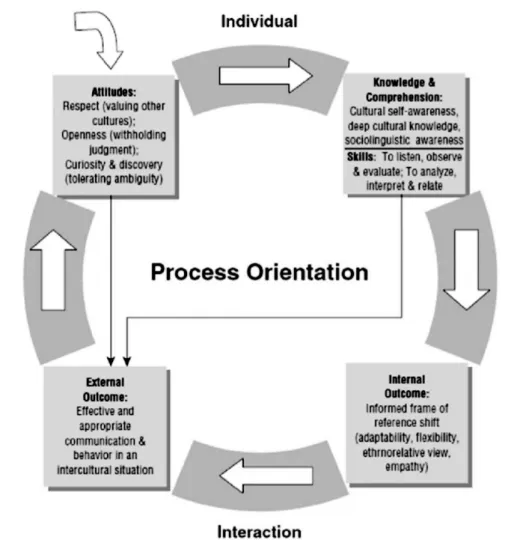
Her studies suggest that improvement of intercultural competence is an on-going process with four main aspects: attitude, knowledge and skills, internal outcome, and external outcome (see Figure 1). The most relevant factors to this project are found in the knowledge/skills aspect.
Knowledge and skills includes developing cultural self-awareness and deepening cultural knowledge and analytical skills. In her process model of intercultural competence, Deardoff (2006) suggests that “knowledge and comprehension” include the areas of “cultural self-awareness, deep cultural knowledge, (and) linguistic self-awareness,” as well as the skills of listening, observation and evaluation, analysis, and interpretation and relating (p. 256). 2-1-3. Targeted qualitative growth in academic knowledge and competence
Among various benefits reported in the earlier section (see 2-1-1), language skills and academic knowledge are relatively easy to assess with tests. However, the scope of the present paper and the program lie in the qualitative phase, which is often impossible to evaluate from formal tests. Therefore, in the program being designed we are going to have end-of-program poster presentations, hoike (to show or demonstrate in Hawaiian), on the final day of the program which is open to the public. Each student is going to select one particular topic that caught her interest and make a poster presentation. They are expected to demonstrate what they have learnt and integrate the acquired knowledge/skills in a comprehensive and communicative delivery. Audiences and lectures are welcome to observe and have a Q and A
session with the presenters. Since OJ students are required to have quite similar requirements in mandatory English courses during their first year, the task itself is not strange for them and their anxiety should be relatively low. The goal of this presentation is to show their learning outcomes and to observe how the students interact with the audience to make themselves understood in English. We tentatively plan to video record their presentation in order to see and evaluate how much and how deep they understand their chosen issue and the way they present their research. This would allow us to assess their academic and personal development in an interactive and qualitative manner.
Other data collection methods, such as pre/post-questionnaires, journal keeping, and researcher's observation of the students' engagement in lecture and on-site learning, would allow us to capture the larger picture of the students' development in integrating their knowledge and experience.
3. Important points in designing, conducting, and evaluating
study-abroad programs
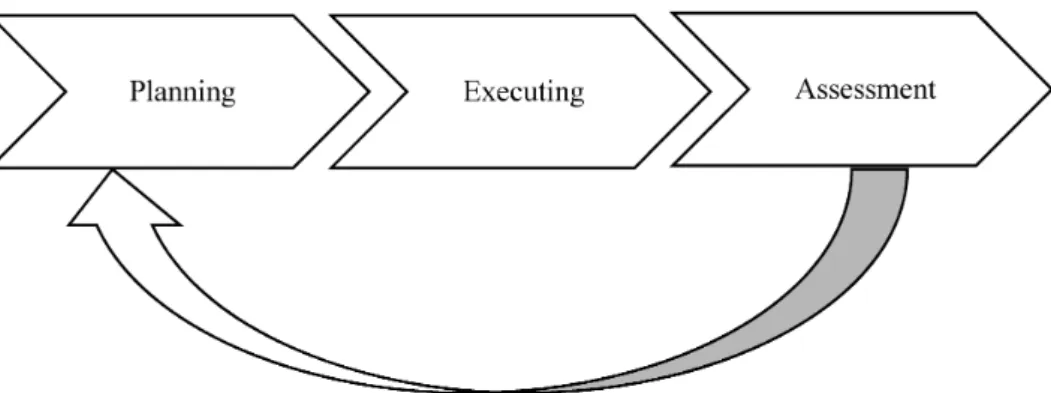
Although the main purpose of this paper is to report on the launch of a new study abroad program, it should be also noted that this is one part of a continuous process which entails a plan-do-see cycle (see Figure 2). Each segment does not exist independently. The planning process should have clear images of how those who are involved (e.g. faculty, sending/host institutions, involved professionals/cooperators, and stakeholders) are going to carry out the plans appropriately and smoothly, and to evaluate the outcome of the program. This flow also tries to capture the idea that assessment in the final stage will be effectively used to further develop the program. It is emphasized by Deardorff (2013) “it's best to start with the end in mind” (p.111, emphasis mine).
Figure 2. Plan-do-see process for building up a new study abroad program
Deardorff (2013) also provides very practical and systematic guidelines for this end. As cited in the previous paragraph, the author would like to emphasize that the starting point is crucial. By asking and defining the goals and objectives of the program in the beginning, we would be able to employ appropriate assessment methods during/after the program. What Deardorff (2013) refers as “introduced myths” to be kept in mind are (p.111):
1. Pre and post surveys are sufficient for assessment.
2. We just need to collect information; we do not need a plan on how to use it. 3. There is one best way to assess a program.
4. One international education program is the same as another.
It is often the case that some programs are carried out without careful shared planning or detailed shared reflection. Some only use simple pre/post surveys. Rather than following that
path, the new program aims to use a continuous holistic process with the plan-do-see cycle in mind. The next section describes key foci regarding learning outcomes and a few ideas for assessing those outcomes.
4. Key foci in our design process: targeted learning outcomes
There are three main foci in designing this program; each of them is unique and aims for a high standard for pedagogical values of the program. The entire goal is to try to make the best use of environmental, institutional, and human resources. The first one it to make connections between in-class learning and hands-on experiences in Hawai'i. The second one is to build connections with local professionals who have worked for sustainable future in their professional fields. The third one is to form connections across generations.
4-1. Connecting in-class e-Book learning with hands-on experiences
At Osaka Jogakuin College, all first year students take Integrated Studies (IS) courses 1, 2, 3, and 4. The main objectives of these courses, which are very relevant to this study abroad program, are the following.
1. To develop English skills in speaking, reading, listening, and writing to express their ideas on the topics of global citizenship, peace, and human rights & social justice. 2. To practice basic research procedures, collecting, organizing, and presenting
information about these topics in a variety of formal and informal ways.
3. To be able to prepare and give oral presentations on various topics related to global, environmental, and human rights issues, as well as poverty, social justice, and food/ water supply.
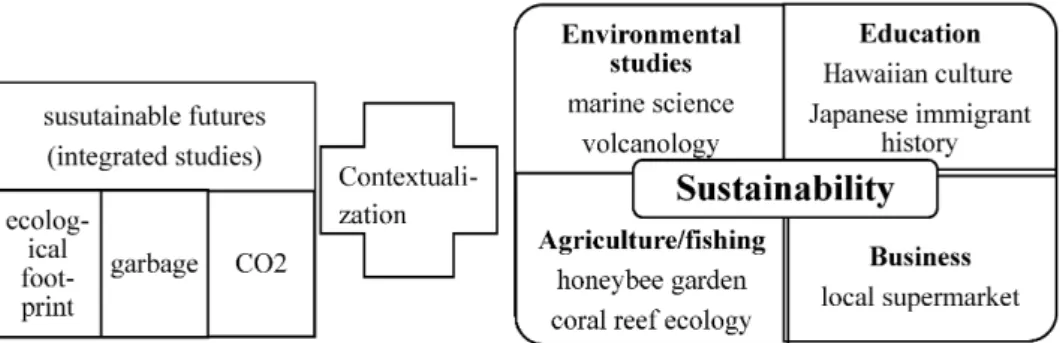
Among various topics which are covered in these four courses, the most relevant ones are covered in IS 4, the Sustainable Futures series, in which the students learn about current environmental issues, such as garbage, ecological footpint, CO2, and overfishing. Figure 3 shows how these in-class topics are related to the contents of hands-on experience in the Hawaiian Islands. Students will gain basic understanding of these topics through classes in Jogakuin, then they will further develop their knowledge and skills in a contextualized environmental in Hawai'i.
There are four main categories on the Hawai'i side; environmental studies, education, agriculture/fishing, and business. In environmental studies, students will meet professors and professionals of marine science and volcanology. They will guide the students to the important sites where people have made great efforts to maintain a healthy environment
for future generations. In education, students will meet professors and local professionals who try to perpetuate Hawaiian language/culture and Japanese immigrant history. Students will visit the Department of Hawaiian Studies, Ka Haka 'Ula O Ke'elikōlani and an Hawaiian immersion school, Ke Kula 'o Nāwahīokalaniōpu 'u and observe Hawaiian language classes and hula classes. Students will also visit the Hawai'i Japanese Center in Hilo and will be guided by the director to see the exhibition and hisitorically important documents and pictures. For agriculture and fishing, students will visit a honeybee garden and learn about honey harvesting. After gaining basic information about the garden, they will try honey harvesting, too. For coral reef ecology, a group of professors and assistant students will guide the students to a coral reef. Students will observe the ecological system and try snorkeling at a beach. And for business, students will visit a KTA Super Store, one of a group of locally owned supermarkets and will meet a vice president of the company. He will give a short lecture on how this supermarket has used teamwork with local farmers to produce local products that support the local economy.
These four areas have deep connections with what has been covered in IS courses, and will further enhance their knowledge and understanding about the important issues through the very Hawaiian concepts of ike maka, ike kino (see with own eyes and experience with your own body).
Figure 3. Connection between in-class learning with hand-on experience in UHH.
4-2. Connecting with local professionals
As mentioned in the previous section, students will meet teachers and local professionals during this program. This section describes specific aspects of the program through the profiles of a few professionals who will share their knowledge and experiences to build and develop the pedagogical value of the program. By knowing these professionals' backgrounds, we can see what they will provide to the program.
Prof. Kekoa Harman is an associate professor at Ka Haka 'Ula O Ke'elikōlani, College of Hawaiian Language in UHH. His professional field is in documentation of 'Ōlelo Hawai'i
(Hawaiian language) and perpetuation of Hawaiian culture through hula practice. His area is on the upper right [education] in Figure 3, preserving and perpetuating Hawaiian culture. Kekoa san, or Kumu (teacher, master) Koa, has been involved in hula for quite a long time, and he has played a very honorable and responsible role as an opening chanter in the Merrie Monarch Festival every year. This annual hula festival is often referred to as the Hula Olympics, and is a-week-long event held in Hilo. The highlight is the hula competition for three nights, where many hālau hula (hula schools) step on the stage to demonstrate what they have trained
for intensively and collectively; and people not only from the Hawaiian islands but also from the entire globe come to appreciate the outcomes.
He himself has gone through very intensive training of hula, which led him to be a kumu
hula (hula teacher). While working as an associate professor in UHH where he teaches 'Ōlelo Hawai'i and hula, he and his wife Ms. Pele Harman have their own hālau hula in a Hawaiian immersion school, Ke Kula 'o Nāwahīokalaniōpu'u (Nāwahī) (see the next section). He has various responsibilities which keep him quite busy, but he carries his kuleana (responsibility) as an active vehicle to pass down what he has learnt from his seniors to new generations. His sincere and calmly passionate attitude will surely make the learning opportunity for OJ students one of a kind, especially knowing that continuous and collective effort has been made for language/cultural revitalization. This will make a strong impression on our students. Therefore, they can be aware of endangered languages or language death in a rapidly globalizing world where English plays a dominant role as an international language.
He is going to give a class about how to revitalize and perpetuate 'Ōlelo Hawai'i and Hawaiian culture, with particular focus on the connection between the mele (song) and its historical facts in the land. If schedule allows, he and Ms. Harman might give the students hula lessons with their Hilo haumāna (students).
Mr. Derek Kurisu is an Executive Vice President at KTA Superstore, and is a sansei (third generation) of Japanese immigrants in Hakalau plantation on the Hāmākua coast. His area is on the lower right [business] in Figure 3, how to sustain local business with strong team work. He has been working for KTA for more than 40 years since he started his career as a bag boy when he was a high school student. According to Kurisu (2014), he first worked for the founder of KTA, Mr. Koichi Taniguchi, and Mr. Kurisu have carried on the ethics and legacy of Mr. Taniguchi and his successors, such as humbleness, hard-work, respect and honor for those who came before them, and caring for those who come after. One of his remarkable achievements was to start the original Mountain Apple Brand at KTA. The main goals for this brand were the following:
1. to help the local economy 2. to connect people with the land
3. to connect ancestors and children
First, to sustain local business and economy was the primary goal during the plantation closure period in the late 1980's and 1990's. The sugar industry had been so dominant (Kurisu, 2014, p.77) for the local economy that Mr. Kurisu himself could not believe that the industry would ever disappear. While seeing one mill closure after another, he started a private brand in 1992 for sustainable community partnership. With the slogan of [Buy local, and Eat local], the Mountain Apple brand now deals with over 200 products and has 60 different partnerships. One of the signature lineups found in the store is a soft drink named PAVA, a juice made from guavas and papayas. The paper container has lovely illustrations of local scenery drawn by a local artist Mr. Eddy Yamamoto.
Second, the brand tries to emphasize the importance of preservation. It tries to preserve not only the quality and the taste of the products but also the natural environment. Many trees were destroyed because of invasive species or pollution, and the lack of connection between the land and the people. The brand strived to natural and eco-friendly products; the harm on the land, air and water were kept low to sustain nature.
Third, the brand wants to perpetuate the traditions and values of the old days. Kurisu (2014) emphasizes the roles of ancestors, who made us who we are today (p.78). As he himself and the founders' descendants are from an old close-knit plantation, he and the entire company think much of the connection among people in and out of communities. He started two different monthly TV shows that highlight island peoples' way of life. The underlying goal is to keep digital documents so the people can see and remember their dear people and sceneries. It also has a section called [Uncle Derek, it's selfie time!] and televises the still shots and brief movies of Mr. Kurisu and many customers. Young students and children especially like this segment, and often ask him about it when they see him in the store.
He is going to provide a guided-tour in the largest branch in Puainako, and give a short lecture. And if the schedule allows, the bakery staff and the OJ students will bake something together and share the snack for “talk story” (a term that refers to the social interaction that can come from conversations).
4-3. Connecting across generations
This section continues to show specific events in the program through the profiles of other professionals who have worked on their special fields with a strong sense of kuleana (responsibility) to carry and pass down traditional values to the next generation. The author would like to emphasize that people described in the previous section also share the same philosophy.
(Nāwahī), a Hawaiian language immersion charter school in Kea'au. Her professional area is in the upper right [education] in Figure 3. She is a great-grand daughter of an extremely influential scholar, Ms. Mary Kawena Pukui, who made great contributions to preserve and revitalize 'Ōlelo Hawai'i (Hawaiian language) and Hawaiian culture. Ms. Harman is the oldest daughter of five sisters, and has received an American style education while being exposed to the Hawaiian language as a young child through interactions with her kūpuna (family elders)
through hula, and in her Hawaiian church. Through the language elderly people spoke and her intensive experience and training in hula, she developed her strong passion and kuleana to keep the integrity of tradition and evolution.
She has a hālau (hula school) with her husband Mr. Kekoa Harman (see the previous
section for further information) at Nāwahī with a strong focus on the educational value of hula. They both have a strong belief that perpetuating tradition through hula and 'Ōlelo Hawai'i enables their haumāna (students) to carry on that tradition. They also believe that it enhances
the bond between the haumāna and the parents/community, and strengthens the mutual trust
between the teachers and the parents.
She is going to provide one 60-minute session via the internet for our pre-departure program with a special focus on hula and mele (songs) of a particular place in Hawai'i Island. While in Hilo, she is also going to show us around the area that the mele or songs are about. The primary goal is to create a contextualized environment for our students to further enhance their learning there with ike maka (seeing with your own eyes) style.
Mr. Arnold Hiura, or Ano san, as he is called with respect and affection, is the president and executive director of the Hawai'i Japanese Center in Hilo. He was editor of the Hawai'i Herald Newspaper, and a curator for the Japanese-American National Museum. His area is placed in the upper right [education] in the Figure 3, with special emphasis on immigrant history. He is a Hilo local sansei (third generation) of Japanese immigrants to Hawai'i, and the author of Kau Kau: Cuisine & Culture in the Hawaiian Islands. Kau Kau literally means [food] or [to eat]. The book showcases various local recipes that have different ethnic and historical backgrounds, and more importantly, the book covers the roots of different dishes and provides real anecdotes from local people. It also exemplifies historically important pictures and images. Mr. Hiura also curated the travelling exhibition, From Bento to Mixed Plate: Americans of Japanese Ancestry in Multicultural Hawai'i. The exhibition was held in Hawai'i, LA, and at the Smithsonian Institution in Washington D.C. A slightly modified Japanese version was also held at four galleries in Japan, including the National Museum of Ethnology (Minpaku) in Osaka.
He uses food as a metaphor to sketch a vivid picture of immigrant history and to connect past and present. What used to be both available and affordable during the plantation era was
very limited, but people in the community made the best use of it. For example, heavily salted canned Spam was cooked with a large amount homegrown vegetables to feed a big family. The dish itself may not have had a pretty appearance, but people usually had no other choices and shared the dish together. Today, Spam has an iconic and signature role, and it has evolved into different types of [fashionable] dishes.
He is going to give us a guided-tour in the center and a lecture about food and immigrant history. Special emphasis will be put on the traditional values in the past and their influence today.
5. Conclusion
There are a few challenges this program will face, which are summarized as the following: 1. to gather a sufficient number of students
2. to establish valid and appropriate assessment
For recruiting an ample group of students, we plan to have a recruiting session which explains about this program. For most students, this might be their first time to visit Hawai'i which is often televised or pictured as a “Paradise in the Pacific Ocean” where TV hosts or advertisers show people enjoying tropical weather and [exotic] culture. However, the pedagogical value of this new program takes a different perspective. The program does not just have students hop around the island to enjoy sightseeing. As mentioned in the previous section, this program aims to build connections in terms of the content, people, and the stories. Although there might be certain students who expect sheer enjoyment, the recruiting session is going to give special attention to the fact that this program has exceeding value with strong teamwork, which will make a good pedagogical impact on their continuous learning. In this regard, Area Study (Okinawa 2), which has been held at OJ for quite a long time, provides a good example, since the program covers the post WWⅡ history of Okinawa and its impact on the current lives of Okinawan and Japanese people (see Appendix A). The author will make a further examination of that program in order to better prepare for the recruiting session as well as carrying out the new program.
In two recruiting sessions, the author provided basic information about Big Island, the program content, and students' life in Hilo. In addition, some video segments which include Mr. Hiura and Mr. Kurisu were shown to those who joined the session (Kurisu, 2011). The main goal was to activate the students' interests in the program contents as well as to let them feel close or connected to the local professionals.
For valid and appropriate assessment, our main area is to assess the learning outcomes of the students through questionnaires, journals, and the final poster presentations. All of these
aim to capture the qualitative development that occurs in their intercultural competence, especially in knowledge and comprehension (Deardorff, 2006, 2011). However, as suggested by Deardorff (2006, 2011) this competence is an on-going process and attitude, knowledge/ comprehension, desired internal outcome, and desired external outcome, have an interactive relationship. Further detailed and sophisticated approaches are necessary to establish the assessment standard in order to depict the pedagogical quality of the program as well as to further refine the plan-do-see model.
With these important aspects in mind, the author and other related professionals plan to take continuous steps to build and develop a new study abroad program which builds strong connections in a contextualized learning environment.
References
Anderson, P. H., Lawton, L., Rexeisen, R. J., & Hubbard, A. C. (2005). Short-term study abroad and intercultural sensitivity: A pilot study. International Journal of Intercultural Relations, 10, 1-13. doi:10.1016/j.ijintrel.2005.10.004.
Chieffo, L., and Griffiths, L. (2004). Large-scale assessment of student attitudes after a short-term study abroad program. The Interdisciplinary Journal of Study Abroad, 10 Fall, 165-177.
Chong-Stannard, C. (2012 July 24). Long story short with Leslie Wilcox Derek Kurisu. In Pennybacker, R. Long story short with Leslie Wilcox. Honolulu, Hawai'i: PBS: Hawai'i.
Deardorff, D. K. (2006). The identification and assessment of intercultural competence as a student outcome of internationalization at institutions of higher education in the United States. Journal of Studies in International Education, 10(3), 241-266. doi: 10.1177/1028315306287002
Deardorff, D. K. (2011). Assessing intercultural competence. New Directions for Institutional Research, 149, 65-79. doi: 10.1002/ir.381.
Deardorff, D. K. (2013). Demystifying outcomes assessment for international educators. Virginia: Sterling. Dwyer, M. (2004). More is better: The impact of study abroad program duration. The Interdisciplinary
Journal of Study Abroad, 10 Fall, 151-164.
Holoviak, J., Vernery, T., Winter, A., & Holoviak S. (2011). Assessing academic performance through study abroad: Benefits of the experience. Research in Higher Education Journal, 11 (1), 1-10.
Hu, S. (2013, September 18). Hawai'i: Food as a Bridge to Harmony [Blog post]. Retrieved from http:// specialforkblog.com/2013/09/30/hawai%E2%80%99i-food-as-a-bridge-to-harmony/
Kurisu, D. (2014). Honoring the family of KTA super stores. In A.Yamashiro & N. Goodyear-Ka'ōpua (Eds). The Value of Hawai’i 2. Ancestral Roots, Oceanic Visions. (pp. 75-81). Honolulu: University of Hawai'i Press.
Kurisu, S. (2011, June 23). Biting commentary episode 1: Kau Kau with Arnold Hiura. In Pacific Basin Communications. Biting commentary. Honolulu, Hawai'i: KGMB.
Michigan State University Office of Study Abroad. (2017). Why should you study abroad? Retrieved from http://www.cal.msu.edu/currentstudents/studyabroad/study-abroad-programs/why-should-i-go/
Appendix A. Course description of Area Study (Okinawa 2 )
授業の目的 Course objectives 春学期授業科目「地域研究(沖縄)Ⅰ」(週 1 時間 1 単位)の学びを、沖縄現地における フィールドワークを通し、さらに深める。 戦後日本の豊かさが、沖縄の人々の大きな犠牲のうえに成り立っていたことに気づく。 沖縄のもつ文化、芸能の豊かさに触れる。 沖縄の精神文化「ヌチドウタカラ」「チムグリサ」に学ぶ。1. Through fieldwork, participants deepen what they have learnt from Area Study (Okinawa 1 ) 2. To be aware that post-war flourish
3. To experience the richness of Okinawan culture and arts
4. To learn Okinawan spirituality [Life is a treasure] and [sharing the pain of others'] 授業の概要
Course description
沖縄の歴史と現在を沖縄の地で見る、聞く、読む、話す、食べるなどの体験を通し、沖縄 の特有の歴史・沖縄戦・米軍基地の現実、自然の豊かさ、ことば・音楽等に触れるなかで 日本と世界が平和のうちに生きる道を見つける手掛かりをつかむ。
To search a key for Japan and the entire globe to live in peace through experiential learning. The participants will learn Okinawan history and its current situation through hands on experience. They also learn about World War Ⅱ in Okinawa, American military bases, richness of nature, and language and arts.
「地域研究(沖縄)I 」受講必須
Pre requisite: Participants must pass Area Study (Okinawa 1 ) 成績評価方法・基準
Evaluation standard
フィールドワークノート(日々の記録・各自の研究)と討論参加 表現コミュニケーション群で春学期の選択 1 単位に認定される Field notes (diaries, individual research), participation in discussion 1 credit will be given after completing this program.