Production of Valuable Materials from Rice
Bran Biomass Using Subcritical Water
著者
Pourali Omid
内容記述
学位授与大学: Osaka Prefecture University(大阪
府立大学), 学位の種類: 博士(工学), 学位記番号:
論工第1254号, 学位授与年月日: 2010-03-31, 指導
教員: 吉田弘之.
Production of Valuable Materials from
Rice Bran Biomass Using
Subcritical Water
Omid Pourali
February 2010
Acknowledgment
First of all, I would like to sincerely thank Professor Hiroyuki Yoshida of the Department of Chemical Engineering, Osaka Prefecture University, for his outstanding guidance, support, and encouragement in all phases of this work.
I deeply appreciate Assistant Professor Feridoun Salak Asghari of the Research Institute on Material Cycling Engineering, Osaka Prefecture University, for his kind support, consulting, and always taking time to answer to all of my questions about this research.
My deep gratitude goes to Professor Yasuhiro Konishi of the Department of Chemical Engineering, Osaka Prefecture University, and Professor Masamitsu Shirai of the Department of Applied Chemistry, Osaka Prefecture University, for generously taking time out to read an earlier version of my thesis and for offering many insightful comments and suggestions to this study.
I would like to acknowledge Assistant Professor Hayato Tokumoto, and to all former and present students of the Separation Science and Engineering Laboratory of the Department of Chemical Engineering, Osaka Prefecture University, where I proudly belong, for all their great help, and warm encouragement to my educational pursuits in Japan.
I want to express my appreciation to Associate Professor Toshiyuki Nomura of the Department of Chemical Engineering, Osaka Prefecture University, for his kindly help and also letting me use one of their expensive laboratory equipment throughout this research work.
Chemical Engineering, Osaka Prefecture University, for their indispensable help dealing with administration and bureaucratic matters in my study. In addition, I would like to thank to all library and workshop staffs at Osaka Prefecture University for their tireless efforts.
I would like gratefully acknowledge to the Monbukagakusho Scholarship from Japanese government.
Finally, I would like to express my warmest and deepest gratitude to my family for their support, optimism, constant love and encouragement.
Contents
AcknowledgmentChapter 1 Introduction 1
1. General background 3
1. 1. Introduction to rice bran biomass 3
1. 1. 1. Biomass 3
1. 1. 2. Rice bran 6
1. 1. 3. Composition of rice bran 6
1. 2. Review of related literatures 12
1. 2. 1. Conventional methods 12
1. 2. 2. New methods 13
1. 3. Subcritical and supercritical water 15
1. 3. 1. Physicochemical properties of water 17 1. 3. 1. 1. Ion production constant of water 17
1. 3. 1. 2. Dielectric constant of water 20
2. The aim of the thesis 20
Nomenclature 22 References 24
Chapter 2 Decomposition of rice bran and production of valuable
materials using subcritical water 31
1. Introduction 33
2. Materials and methods 34
2. 1. Materials 34
2. 2. Procedure 35
2. 4. Analysis 36
3. Results and discussion 37
3. 1. Specifications of rice bran 37
3. 2. Isolated phases from rice bran slurry after subcritical
water treatment 37
3. 3. Water-soluble (WS) phase 40
3. 3. 1. General 40
3. 3. 2. Amino acids 43
3. 3. 3. Saccharides (total soluble sugars) 43
3. 3. 4. Organic acids 47
3. 4. Remained solid 47
3. 5. Hexane, acetone, and water solubilities by rice bran
conversion 49
4. Conclusions 49
Nomenclature 52
References 53
Chapter 3 Application of subcritical water treatment for
simultaneous inactivation of rice bran lipase enzyme and
extraction of edible oil 57
1. Introduction 59
2. Materials and methods 60
2. 1. Materials 60
2. 2. Procedure 61
2. 3. Analysis 62
3. Results and discussion 63
3. 1. FFAs formation in rice bran 63
3. 2. Stabilization of RBO 64
3. 2. 1. 1. FTIR studies 67 3. 2. 2. Comparison between subcritical water and conventional
methods in the stabilization (treatment) of RBO 70 3. 3. Simultaneous RBO extraction and stabilization 72 3. 4. Kinetics of free fatty acids formation in the stored
rice bran 76
4. Conclusions 77
Nomenclature 80
References 81
Chapter 4 Production of phenolic compounds from rice bran in subcritical
water medium 87
1. Introduction 89
2. Materials and methods 91
2. 1. Materials 91
2. 2. Procedure 91
2. 3. Analysis 95
3. Results and discussion 97
3. 1. TPC (total phenolic content) yield and antioxidant
activity of ethanolic solution 97
3. 2. Identified phenolic compounds in ethanolic solution 99 3. 3. Decomposition of carbohydrate part of rice bran 102 3. 4. pH and conductivity of the aqueous solution 106 3. 5. Remained solid after treatment of rice bran 109
4. Conclusions 113
Nomenclature 114
References 115
Chapter 1
1. General background
1. 1. Introduction to rice bran biomass
1. 1. 1. Biomass
The worldwide demand for fossil fuels continues to rise at a rapid pace while supplies are finite. As developing nations increase their needs for petroleum products, plastics, etc., supplies will become even tighter. In addition due to excessive use of hydrocarbon products environmental issues such as global warming have become considerably serious in the world. It is therefore important to develop alternative forms of energy and feed stocks based on renewable resources. Biomass is the most abundant renewable resource in the world.
Biomass is defined as matter produced through photosynthesis. Biomass contains three primary constituents: cellulose, hemicellulose, and lignin, and can contain other compounds (for example, extractives). Cellulose is a polymer of glucose, hemicellulose is an oligomer of both C6- and C5- sugars (mainly glucose and xylose), and lignin is a highly
cross-linked polymer. The common molecular formula of cellulose, hemicellulose, and lignin are [C6(H2O)5]n, [C5(H2O)4]n, and [C10H12O3]n, respectively [Petrus and Noordermeer, 2006].
Lignin and (hemi)cellulose together form a sort of fiber reinforced composite structure, in which cellulose is the fiber part and lignin forms a cross-linked three-dimensional resinous structure. Such lignocellulose gives strength to trees and plants.
Biomass includes plant materials; agricultural, industrial, municipal wastes, and residues derived from them (such as rice bran, switch grass, sugar cane (bagasse), trees, paper waste, plastics, plant and tree clippings cardboard). In general, biomass can include anything that is not a fossil fuel that is bioorganic-based [Lucia et al., 2006]. Estimated amount of annual effectively available biomass (by type) in the USA (California) and Japan are shown in Figures 1 and 2, respectively [Moller, online; The Asia Network of Organics Recycling,
online].
With an annual production of up to 1.7-2.0 × 10¹¹ ton, biomass has been identified as an important source for alternative fuels and valuable chemicals. Although a huge amount of biomass is annually produced in the world; however, only 6 × 10⁹ tons of biomass is currently
Agricultural residue
28.5% Municiple waste28.9%
Forest materials 42.6%
Stock farming 34.1% Agriculture 5.0% Sludges 42.5%
Grass and wood 0.9% Garbage 7.2% Construction2.2% Food processing 6.2% Forestry 1.9%
Figure 2. Amount of annually effectively available biomass in Japan [The Asia Network of Organics
used for food and non-food applications [Girisuta et al., 2008]. Therefore, it is indispensable to develop the environmentally friendly technologies to produce fuels, power, heat, and high-value chemicals from biomass with the lowest impact to the environment.
1. 1. 2. Rice bran
Rice (Oryza sativa) is one of the most important biomass in the world. It is a staple diet for two-thirds of the world’s population [Kaimal et al., 2002]. About 617 million tons of rice is annually produced worldwide [Watchararuji et al., 2008]. Rough rice or paddy consists of a white, starchy endosperm kernel surrounded by a tight adhering bran coat that is enclosed by a looser outer hull or husk [Prakash, 1996]. Figure 3 shows the structure of rice [Rice
solution, online]. In order to make rice susceptible for human consumption, several sequential
processes must be carried out, such as cleaning, dehulling, milling, and polishing [Danielski,
2007].
Rice hulls, which comprise about 25% by weight of paddy, are composed mainly of cellulose, lignin, and siliceous ash, and have feed and other industrial uses but no food value
[Saunders, 1985-86].
Rice bran is the major by-product of rice milling process. It is a brown layer which is nearly 8% of milled rice [Sereewatthanawut et al., 2008]. The production amount of rice bran is about 50-60 million tons per year [Renuka Devi and Arumughan, 2007], which is mostly utilized as an animal feed ingredient, fertilizer, and fuel [Pan et al., 2005; Zullaikah et al.,
2005]. Japan produces about 900 thousand tons of rice bran per year [Tanaka et al., 2006]
which is used for different purposes. In Japan, approximately 34.0% of the produced rice bran is used to extract its oil, and nearly 80 thousand tons of rice bran oil is annually consumed
[Danielski et al., 2005]. As shown in Figure 4, other estimated utilizations of rice bran are:
30.0%, 28.5%, 5.0%, 2.0%, and 0.5%, as waste and unknown, animal food, mushroom production, pickle preservation, and fertilization, respectively.
1. 1. 3. Composition of rice bran
Figure 3. Diagrammatic representation of rice.
White rice Rice bran
Figure 4. Utilizations of rice bran in Japan. Pickle preservation 2.0% Fertilization 0.5% Mushroom production 5.0% Waste 30.0% Animal food 28.5% Oil 34.0%
proteins, enzymes, vitamins, and dietary minerals [Luh, 1980].
Depending on milling procedure, bran contains 10.0 to 26% oil [Prabhakar and
Venkatesh, 1986] which has vast food and industrial applications. The commercial production
of rice bran oil in year 2000 was estimated to be about 783 thousand tons [Danielski et al.,
2005]. Rice bran oil contains triglycerides, diglycerides, monoglycerides, free fatty acids, wax,
glycolipids, and phospholipids [McCaskill and Zhang, 1999].
Bran is rich in carbohydrates and lignin. Major carbohydrates in commercial bran are cellulose, hemicellulose, and starch. Lignin, cellulose, hemicellulose, and starch contents in bran ranged from 7.7 to 13.1%, 9.6 to 12.8%, 8.7 to 11.4%, and 5 to 15%, respectively
[Saunders, 1985-86]. Phenolic compounds are useful substances with nutraceutical and
antioxidant properties which are extensively bounded to carbohydrates and lignin in the cell wall of rice bran [Wiboonsirikul et al., 2008]. Rice bran is a potential source of antioxidants (such as phenolic compounds) for food, pharmaceutical, and cosmetic industries [Iqbal et al.,
2005].
The protein content of full-fat rice bran is about 14% [Prakash, 1996]. The major protein fractions in bran are albumin and globulin [Luh, 1980]. Protein content is influenced by variety, environment, and nitrogen fertilization [Saunders, 1985-86].
Rice bran contains numerous enzymes. Among the enzymes, lipase has merited most attention because it is responsible factor in the nonutilization of rice bran as foodstuff and extent of industrial utilization of bran [Luh, 1980; Saunders, 1985-86].
Vitamins found in rice bran are listed in Table 1. The range of vitamins depends on the degree of milling and processing, and possible contamination with hull [Marshall and
Wadsworth, 1994].
Rice bran is a good source of minerals; it contains aluminum, calcium, chlorine, iron, magnesium, manganese, phosphorous, potassium, silicon, sodium, and zinc. The ranges of mineral contents in rice bran are depicted in Table 2. The mineral content is impacted by variety, soil conditions and growing environment, and by the milling process used [Luh, 1980;
Table 1. Vitamins in rice bran. Vitamin Content [ppm] Vitamin A 4 Thiamine 10-28 Riboflavin 2-3 Niacin 236-590 Pyridoxine 10-32 Pantothenic acid 28-71 Biotin 0.2-0.6 Myoinositol 4600-9300 Choline 1300-1700 p-Aminobenzoic acid 0.7 Folic acid 0.5-1.5 Vitamin B12 0.005 Vitamin E 150
Table 2. Minerals in rice bran. Mineral Content [ppm] Aluminum 53-369 Calcium 140-1310 Chlorine 510-970 Iron 190-530 Magnesium 8650-12300 Manganese 110-877 Phosphorus 14800-28700 Potassium 13650-23900 Silicon 1700-16300 Sodium 0-290 Zinc 80
1. 2. Review of related literatures
To date, numerous researches on treatment and extraction of useful compounds of rice bran have been reported. Also, many studies have been conducted for production of valuable compounds from rice bran biomass using solvent extractions and chemical processes like hydrolysis and decomposition. Some of these reports are classified and mentioned in the following.
1. 2. 1. Conventional methods
Over the years, conventional methods have been used for production of useful compounds of rice bran. There are many academic reports and patents on the application of conventional methods for treatment and extraction of valuable materials from rice bran, and increasing their production yield.
Many scientists have focused on the extraction of rice bran oil using conventional methods. Most of these methods are based on the choice of solvent with the use of heat and/or agitation [Wang and Weller, 2006]. Soxhlet and direct solid-solvent extraction techniques are as examples of the conventional methods which have been used for rice bran oil extraction. Generally organic solvents, especially hexane, have been used to extract its oil. Mamidipally and Liu [2004] extracted rice bran oil using hexane and d-limonene at their respective boiling points at various solvent-to-meal ratios; it was found that the optimum solvent-to-meal ratio was 5:1. Hu et al. [1996] have studied the effects of solvent-to-bran ratio and extraction temperature in direct solid-solvent extraction method; they used hexane and isopropanol solvents, and reported that increasing the solvent-bran ratios and extraction temperature increased the extraction yield of oil.
Rice bran oil is decomposed extraordinary quickly into free fatty acids and glycerol by lipase enzyme soon after milling process, which makes it unfit for edible use. The process of rancidity development can be avoided either by rapid oil extraction or by inactivation the enzyme, known as stabilization process [Goffman et al., 2003]. Numerous attempts have been made for inactivation of lipase enzyme and stabilization of oil. Prabhakar and Venkatesh
increase was observed in free fatty acids concentration. Randall et al. [1985] stabilized rice bran by extrusion cooking process, and free fatty acids concentration remained constant for at least 30-60 days. Tao et al. [1993] applied microwave heating method for inactivation of lipase enzyme, and free fatty acids content in the treated samples slightly increased during storage. In another report, application of ohmic heating for stabilization of oil was studied
[Rao Lakkakula et al., 2004], and ohmic method could effectively inactivate enzyme.
Rice bran protein is favorable for human consumption. The most common method for production of rice bran protein is alkali hydrolysis followed by acid precipitation
[Sereewatthanawut et al., 2008]. Jiamyangyuen et al. [2005] could recover rice bran protein
in alkaline medium, and they showed that production yield depended on pH and extraction time; the optimum pH and time were 11 and 45 min, respectively. In another study, Shih et al.
[1999] have treated rice bran using enzyme, and they could prepared protein-enriched
products. Parrado et al. [2006] could also extract soluble proteins, peptides, and free amino acids from rice bran by enzymatic treatment technique.
Conventional extraction techniques have also been implemented for recovery of phenolic compounds from rice bran. Extraction of these valuable compounds has been performed using organic solvents. Generally, acetone, ethanol, ethyl acetate, methanol, propanol and/or their combinations have been applied [Naczk and Shahidi, 2006]. Chotimarkon et al. [2008] and Iqbal et al. [2005] could extract phenolic compounds with methanol from different types of rice bran using direct solid-solvent extraction method. Renuka and Arumughan [2007] have studied the extraction of phenolic compounds from rice bran by using organic solvents and application of soxhlet technique. Taniguchi et al. [1994] have patented a method for production of ferulic acid by hydrolysis of waste materials of rice bran oil production industries at 373 K, pH of 10, and reaction time from 8 to 10 hours; the produced ferulic acid was extracted using hexane solvent.
1. 2. 2. New methods
Conventional methods have several drawbacks; they are time-consuming, are of low selectivity, give low extraction yield, and use large amount of expensive, explosive, and sometimes toxic organic solvents [Wang and Weller, 2006]. These disadvantages can be
overcome by application of the new environmentally friendly techniques like supercritical and subcritical water.
Supercritical and subcritical water are performed by utilization of water as treatment medium which is abundant and green solvent. Water at near critical point has properties that are different from water under normal conditions. An example is the relative low dielectric constant, which is comparable with that of methanol or ethanol under ambient conditions. Because of these properties, along with the higher concentration of hydrogen and hydroxide ions [Herrero et al., 2006], it seems to be a good medium for application in various fields of chemical reaction and material cycling. Supercritical and subcritical water, as green alternative techniques to conventional methods have attracted growing attention recently with a range of different applications such as oxidation of waste [Dinaro et al., 2000], extraction [Kubatova et
al., 2001], hydrolysis and synthesis of organic compounds [Galkin and Lunin, 2005; Herrero et al., 2006; Kruse and Dinjus, 2007]. Yoshida et al. [1999] could produce organic acids and
amino acids from fish waste using subcritical water hydrolysis. Salak Asghari and Yoshida
[2006] performed decomposition reaction of fructose to 5-hydroxymethyl furfural over a
temperature range of 473-593 K in a batch subcritical water system. Sasaki et al. [1998] have shown that cellulose could be rapidly hydrolyzed in subcritical and supercritical water in the range of temperature from 563 to 673 K. Hydrothermal conversion of municipal waste [Goto
et al., 2004], catalytic reduction [Jennings et al., 2000], recovery of harmful metal ions from
squid waste [Tavakoli and Yoshida, 2005], conversion of scallop viscera wastes to valuable compounds [Tavakoli and Yoshida, 2006], oxidation of alkyl aromatics [Holliday et al., 1998], production of lactic acid from carbohydrates [Bicker et al., 2005], and decomposition of plastics [Shibasaki et al., 2004] have been also reported.
Recently, increasing attention has been paid to the hydrolysis, conversion, and decomposition of biomass (especially in subcritical and supercritical water medium) for energy and synthesis of materials and chemical [Lucia et al., 2006; Peterson et al., 2008]. However, there are very few reports for treatment of rice bran biomass under subcritical water conditions. Wiboonsirikul et al. [2007a] have studied the production of functional substances from defatted black rice bran by subcritical water treatment; protein, carbohydrates, and radical scavenging activity of the products were investigated in detail. In another study, Wiboonsirikul et al. [2007b] could treat defatted rice bran in subcritical water medium in
order to extract phenolic and other antioxidant compounds at 323 to 523 K for 5 min reaction time. Wiboonsirikul et al. [2008] have produced phenolic compounds from defatted rice bran using subcritical water at 293 to 533 K for 5 min, and also at 473 and 533 K for 5 to 120 min; total phenolic content and antioxidant activity of the obtained solution after subcritical water treatment were investigated. Sereewatthanawut et al. [2008] have investigated defatted rice bran under subcritical water conditions; highest yield of protein and amino acids were obtained after 30 min of reaction at 473 K. Hata et al. [2008] evaluated antioxidant activity and total soluble sugar yield after subcritical water treatment of the defatted rice bran at the temperature range of 453 to 553 K for 5 min.
1. 3. Subcritical and supercritical water
Water, like other solvents, has "critical point" that occurs at a high temperature where liquid and vapor can coexist in the same container. The critical point of water has been reported at Pc = 22.1 MPa and Tc= 647.15 K [Galkin and Lunin, 2005]. At the critical point
the two classic phases of vapor and liquid become indistinguishable. Supercritical water is described as water in temperature and pressure state over the critical point. The term of subcritical water refers to liquid water between its boiling point (373.15 K) and its critical temperature (647.15 K) under pressure high enough to maintain the water in the liquid phase. The positions of supercritical and subcritical water regions are shown on the phase diagram in Figure 5.
Generally water under subcritical or supercritical conditions, possesses properties very different from those of ambient liquid water. It has been demonstrated that supercritical water can be an effective technique for destruction of hazardous organic waste and sludge. During this process, most organic compounds are converted to CO2, N2, and water. However,
supercritical water treatment has some disadvantages which can be overcome by using subcritical water treatment. There are three main important reasons to use subcritical water instead of supercritical water technique. Firstly, the main aim in supercritical water is decomposition of wastes to CO2, N2, and water which are not valuable compounds. On the
other hand, subcritical water hydrolysis produces many valuable organic compounds. Secondly, subcritical water acts as a green powerful solvent which can be used for extraction
Figure 5. Phase diagram of water in P-T plane.
273.15 273.16 373.15 647.15 194.15 Temperature [K] 0.13 0.611 101.3 22100 Triple point Liquid Solid Vapor Normal boiling point Normal melting point Critical point Supercritical water region Normal boiling point Subcritical water region P re ss u re [k Pa ]
of useful materials. Thirdly, the preparation of supercritical water, needs higher temperature and pressure than subcritical water; in the other words, working under critical point of water is much more economic and feasible than above its critical point. In this work we focused on water applications under its critical point.
1. 3. 1. Physicochemical properties of water
At a temperature of 295 K and a pressure of 0.1 MPa, water is a polar solvent with a density of 1000 kg.m-3, a dielectric constant , ε, of 79.73, and an ion production constant, Kw,
of 1×10-14 [Aki et al., 2001]. Raising the temperature and pressure causes significant changes
in the properties of water. The properties of water vary owing to variation of its dielectric constant, conductivity, ionic product, and the structure of H bond network. Changes in viscosity, heat capacity, diffusion coefficients, density influence the transport characteristics of aqueous solution [Galkin and Lunin, 2005]. Two main parameters of water are illustrated in the following.
1. 3. 1. 1. Ion production constant of water
Water, as acid and base, is both giver and taker of protons. When water reacts with its own kind, the hydronium and hydroxide ions are produced. The scheme of water dissociation is shown in Figure 6 [Harvey, 2000].
The ion production constant of water is defined as Kw = [H+][OH-]; the concentration
at room temperature and atmospheric pressure is 1×0-7 mol/l for both, and the value of Kw is
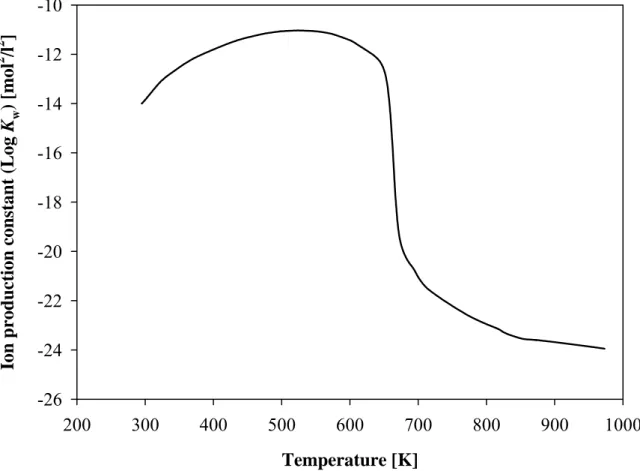
1×10-14 mol2/l2. Under high temperature and pressure conditions, the value of the ion production increases considerably from 10-14 to 10-11 mol2/l2 at about 520 K, and decreases sharply at temperatures higher than that temperature. The effect of temperature on ion production of water is shown in Figure 7 [Akiya and Savage, 2002]. Water has maximum ion production at around 523 K under saturation vapor pressure. This indicates that subcritical water may possess the effect of an acid catalyst [Fukushima].
O H H : : : H H . .O : H H O+ H . .O H : :
Base Acid Conjugate
acid
Conjugate base
Figure 6. Scheme of water dissociation.
Temperature [K]
200 300 400 500 600 700 800 900 1000
Ion production constant (
L og K w ) [mol 2 /l 2 ] -26 -24 -22 -20 -18 -16 -14 -12 -10
1. 3. 1. 2. Dielectric constant of water
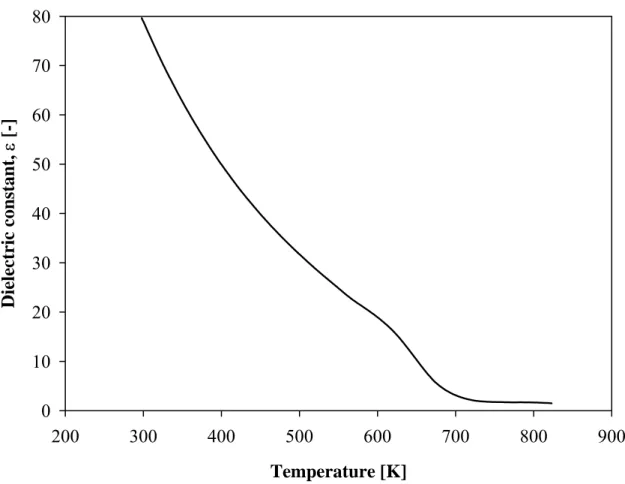
Dielectric constant (ε) expresses the affinity of water, as a reaction media, to reaction materials. When water is heated at temperatures above 373.15 K, under sufficient pressure to remain as liquid, its dielectric constant can be changed; changing temperature and pressure can control this value. Figure 8 shows the effect of temperature on dielectric constant [Uematsu
and Franck, 1980]. For instance, water dielectric constant decreases from 80 (at room
temperature) to 27 (at 523 K) almost equaling to that of ethanol at ambient temperature
[Luque de Castro et al., 1999].
These considerable manipulations of physicochemical parameters with pressure and temperature should be important in any application sensitive to the thermodynamic properties of water. These variations offer the possibility of using pressure and temperature to tune the properties of water to optimal values for a given chemical reaction. High temperatures and pressures actually induce a nonpolar solvent behavior of water. As sequence, organic compounds are completely miscible with water. As mentioned above, subcritical water is not only more economic and feasible process than supercritical water, but also is capable to produce and extract valuable organic compounds.
2. The aim of the thesis
The aim of this study is to develop an efficient environmentally friendly technique for hydrolysis and conversion of rice bran, a low-cost and abundant biomass, to valuable compounds (such as phenolic compounds, soluble sugars, organic acids, and amino acids) in subcritical water medium. Furthermore, efficient extraction of rice bran oil as favorable edible oil by subcritical water, and simultaneous lipase enzyme inactivation by hydrolysis reaction in subcritical water medium are investigated.
This thesis contains five chapters. The main focus of each chapter is summarized as follows:
Chapter 1 provides general background of this thesis. In the first part of this chapter, a general introduction about rice bran biomass is given, and its composition is presented. In the next part, conventional methods related to this thesis are described. In addition, application of
Temperature [K] 200 300 400 500 600 700 800 900 Dielectric constant, ε [-] 0 10 20 30 40 50 60 70 80
subcritical and supercritical water as new green methods in various fields of chemical engineering and material cycling, and related researches on rice bran are reviewed. Finally, properties of water under and above its critical point are described.
Chapter 2 is devoted to evaluate the hydrolysis and decomposition of rice bran under subcritical water conditions in order to obtain value-added materials. Effect of temperature (over the whole temperature range of subcritical water) on the hydrolysis reaction is studied. In this chapter, production of various water-soluble compounds such as amino acids, organic acids, and soluble sugars is studied, and their optimum production conditions are described. In addition, extraction of hexane soluble (mainly rice bran oil) and acetone soluble substances after subcritical water reaction is also evaluated.
Chapter 3 deals with extraction of high quality edible oil from rice bran. In the first half of this chapter, effect of lipase enzyme on the quality of oil during storage of rice bran is experimentally analyzed, and lipase enzyme inactivation using subcritical water technique is studied. In the second half of this chapter, extraction of rice bran oil simultaneous with oil stabilization under subcritical water conditions is investigated. Furthermore, the production yield and quality of the extracted oil is compared with the oil obtained by conventional extraction methods.
Chapter 4 describes the production of phenolic compounds as well as other valuable substances from rice bran using subcritical water treatment. The effect of temperature (over the whole temperature range of subcritical water) and reaction time on the decomposition of lignin/phenolics-carbohydrate complexes of rice bran and production of phenolic compounds and water-soluble sugars are investigated, and the optimum temperature and reaction time for each phenolic compound are presented.
Chapter 5 summarizes the conclusions of this thesis.
Nomenclature
ε Dielectric constant K Kelvin
Kw Water ion production constant
Pc Critical pressure
References
Akai, S. N. V. K., Feng, J., Chateauneuf, J. E., Brennecke, J. F., Generation of xanthenium and 9-phenylxanthenium carbocations in subcritical water and reactivity with amylamine, The
Journal of Physical Chemistry A, 105, 8046-8052, (2001).
Akiya, N., Savage, P. E., Roles of water for chemical reactions in high-temperature water,
Chemical Reviews, 102, 2725-2750, (2002).
Bicker, M., Endres, S., Ott, L., Vogel, H., Catalytical conversion of carbohydrates in subcritical water: a new chemical process for lactic acid production, Journal of Molecular
Catalysis A: Chemical, 239, 151-157, (2005).
Chotimarkon, C., Benjakul, S., Silalai, N., Antioxidant components and properties of five long-grained rice bran extracts from commercial available cultivars in Thailand, Food
Chemistry, 111, 636-641, (2008).
Danielski, L., Extraction and fractionation of natural organic compounds from plant materials with supercritical carbon dioxide, PhD Thesis, Technische Universität Hamburg, Hamburg, Germany, (2007).
Danielski, L., Zetal, C., Hense, H., Brunner, G., A process line for the production of raffinated rice bran oil from rice bran, The Journal of Supercritical Fluids, 34, 133-141, (2005).
Dinaro, J., Howard, J. B., Green, W. H., Tester, J. W., Bozzelli, J. W., Analysis of an elementary reaction mechanism for benzene oxidation in supercritical water, Proceeding of
the Combustion Institute, 28, 1529-1536, (2000).
Fukushima, Y., Application of supercritical fluids: a review, R&D Review of Toyota CRDL, 35, 1-9.
Galkin, A. A., Lunin, V. V., Subcritical and supercritical water: a universal medium for chemical reactions, Russian Chemical Reviews (English Translation), 74, 21-35, (2005). Girisuta, B., Danon, B., Manurung, R., Janssen, L. P. B. M., Heeres, H. J., Experimental and
kinetic modeling studies on the acid-catalysed hydrolysis of the water hyacinth plant to levulinic acid, Bioresource Technology, 99, 8367-8375, (2008).
Goffman, F. D., Pinson, S., Bergman, C., Genetic diversity for lipid content and fatty acid profile in rice bran, Journal of the American Oil Chemists’ Society, 80, 485-490, (2003). Goto, M., Obuchi, R., Hirose, T., Sasaki, T., Shibata, M., Hydrothermal conversion of
municipal organic waste into resources, Bioresource Technology, 93, 279-284, (2004). Harvey, D., Modern Analytical Chemistry, McGraw-Hill Companies, Inc., the USA, (2000). Hata, S., Wiboonsirikul, J., Maeda, A., Kimura, Y., Adachi, S., Extraction of defatted rice bran
by subcritical water treatment, Biological Engineering Journal, 40, 44-53, (2008).
Herrero, M., Cifuentes, A., Ibanez, E., Sub- and supercritical fluid extraction of functional ingredients from different natural sources: plants, food-by-products, algae and microalgae: a review, Food Chemistry, 98, 136-148, (2006).
Holliday, R. L., Jong, B. Y. M., Kolis, J. W., Organic synthesis in subcritical water oxidation of alkyl aromatics, The Journal of Supercritical Fluids, 12, 255-260, (1998).
Hu, W., Wells, J. H., Shin, T. S., Godber, J. S., Comparision of isopropanol and hexane for extraction of vitamin E and oryzanols from stabilized rice bran, Journal of the American
Oil Chemist’s Society, 73, 1653-1656, (1996).
Iqbal, S., Bhanger, M. I., Anwar, F., Antioxidant properties and components of some commercially available varieties of rice bran in Pakistan, Food Chemistry, 93, 265-272, (2005).
Jennings, J. M., Bryson, T. A., Gibson, J. M., Catalytic reduction in subcritical water, Green
Chemistry, 2, 87-88, (2000).
Jiamyangyuen, S., Srijesdaruk, V., Harper, W. J., Extraction of rice bran protein concentrate and its application in bread, The Songklanakarin Journal of Science and Technology, 27, 55-64, (2005).
Kaimal, T. N. B., Vali, S. R., Rao, B. V. S. K., Chakrabarti, P. P., Vijayalakshmi, P., Kale, V., Rani, K. N. P., Rajamma, O., Bhaskar, P. S., Rao, T. C., Origin of problems encountered in rice bran oil processing, European Journal of Lipid Science and Technology, 104, 203-211, (2002).
synthesis reactions, The Journal of Supercritical Fluids, 39, 362-380, (2007).
Kubatova, A., Miller, D. J., Hawthorne, S. B., Comparison of subcritical water and organic solvents for extracting Kava lactones from Kava root, Journal of Chromatography A, 923, 187-194, (2001).
Lucia, L. A., Argyropoulos, D. S., Adamopoulos, L., Gaspar, A. R., Chemical and energy from biomass, Canadian Journal of Chemistry, 84, 960-970, (2006).
Luh, B. S., Rice: Production and Utilization, AVI Publishing Company, Inc., the USA, (1980). Luque de Castro, M. D., Jimenez-Carmona, M. M., Fernandez-Perez, V., Towards more
rational technique for the isolation of valuable essential oils from plants, Trends in
Analytical Chemistry, 18, 708-716, (1999).
Mamidipally, P. K., Liu, S. X., First approach on rice bran oil extraction using limonene,
European Journal of Lipid Science and Technology, 106, 122-125, (2004).
Marshall, W. E., Wadsworth, J. I., Rice Science and Technology, Marcel Dekker, Inc., the USA, (1994).
McCaskill, D. R., Zhang, F., Use of rice bran oil in foods, Food Technology, 53, 50-53, (1999). Moller, R. M., Brief on biomass and cellulosic ethanol, California biomass commission,
California Research Bureau, ISBN: 1-58703-206-6, Available from http://www.library.ca.gov/crb/05/10/05-010.pdf.
Naczk, M., Shahidi, F., Phenolics in cereals, fruits and vegetables: occurrence, extraction and analysis: a review, Journal of Pharmaceutical and Biomedical Analysis, 41, 1532-1542, (2006).
Pan, Z., Cathcart, A., Wang, D., Thermal and chemical treatments to improve adhesive property of rice bran, Industrial Crops and Products, 22, 233-240, (2005).
Parrado, J., Miramontes, E., Jover, M., Gutierrez, J. F., Teran, L. C., Bautista, J., Preparation of a rice bran enzymatic extract with potential use as functional food, Food Chemistry, 98, 742-748, (2006).
Peterson, A. A., Vogel, F., Lachance, R. P., Froling, M., Antal, M. J., Tester, W. J., Thermochemical biofuel production in hydrothermal media: a review of sub- and
supercritical water technologies, Energy & Environmental Science, 1, 32-65, (2008).
Petrus, L., Noordermeer, M. A., Biomass to biofuels, a chemical perspective, Green Chemistry, 8, 861-867, (2006).
Prabhakar, J. V., Venkatesh, K. V. L., A simple chemical method for stabilization of rice bran,
Journal of the American Oil Chemist’s Society, 63, 644-646, (1986).
Prakash, J., Rice bran: properties and food uses, Critical Reviews in Food Science and
Nutrition, 36, 537-552, (1996).
Randall, J. M., Sayre, R. N., Schultz, W. G., Fong, R. Y., Mossman, A. P., Tribelhorn, R. E., Saunders, R. M., Rice bran stabilization by extrusion cooking for extraction of edible oil,
Journal of Food Science, 50, 361-364, (1985).
Rao Lakkakula, N., Lima, M., Walker, T., Rice bran stabilization and rice bran oil extraction using ohmic heating, Bioresource Technology, 92, 157-161, (2004).
Renuka Devi, R., Arumughan, C., Phytochemical characterization of defatted rice bran and optimization of a process for their extraction and enrichment, Bioresource Technology, 98, 3037-3043, (2007).
Rice solution, Available from http://www.ricesolution.com/img/rice_diagram.jpg.
Salak Asghari, F., Yoshida, H., Acid-catalyzed production of 5-hydroxymethyl furfural from
D-fructose in subcritical water, Industrial & Engineering Chemistry Research, 45,
2163-2173, (2006).
Sasaki, M., Kabyemela, B., Malaluan, R., Hirose, S., Takeda, N., Adschiri, T., Arai, K., Cellulose hydrolysis in subcritical and supercritical water, The Journal of Supercritical
Fluids, 13, 261-268, (1998).
Saunders, R. M., Rice bran: composition and potential food uses, Food Reviews International, 1, 465-495, (1985-86).
Sereewatthanawut, I., Prapintip, S., Watchiraruji, K., Goto, M., Sasaki, M., Shotipruk, A., Extraction of protein and amino acids from deoiled rice bran by subcritical water hydrolysis,
Bioresource Technology, 99, 555-561, (2008).
of plastic model compounds in sub- and supercritical water, Polymer Degradation and
Stability, 83, 481-485, (2004).
Shih, F. F., Champagne, E. T., Daigle, K., Zarins, Z., Use of enzymes in the processing of protein products from rice bran and rice flour, Nahrung, 43, 14-18, (1999).
Tanaka, T., Hoshina, M., Tanabe, S., Sakai, K., Ohtsubo, S., Taniguchi, M., Production of
D-lactic acid from defatted rice bran by simultaneous saccharification and fermentation, Bioresource Technology, 97, 211-217, (2006).
Taniguchi, H., Nomura, E., Tsuno, T., Minami, S., Method of manufacturing ferulic acid, US
Patent, 5288902, (1994).
Tao, J., Rao, R., Liuzzo, J., Microwave heating for rice bran stabilization, Journal of
Microwave Power and Electromagnetic Energy, 28, 156-164, (1993).
Tavakoli, O., Yoshida, H., Conversion of scallop viscera wastes to valuable compounds using sub-critical water, Green Chemistry, 8, 100-106, (2006).
Tavakoli, O., Yoshida, H., Effective recovery of harmful metal ions from squid wastes using subcritical and supercritical water treatments, Environmental Science & Technology, 39, 2357-2363, (2005).
The Asia Network of Organics Recycling (ANOR), The amount of generation of main organic
wastes, Available from http://www.jora.jp/anor/eng/jap.html.
Uematsu, M., Franck, E. U., Static dielectric constant of water and steam, Journal of Physical
and Chemical Reference Data, 9, 1291-1306, (1980).
Wang, L., Weller, C. L., Recent advances in extraction of nutraceuticals from plants, Trends in
Food Science & Technology, 17, 300-312, (2006).
Watchararuji, K., Goto, M., Sasaki, M., Shotipruk, A., Value-added subcritical water hydrolysate from rice bran and soybean meal, Bioresource Technology, 99, 6207-6213, (2008).
Wiboonsirikul, J., Hata, S., Tsuno, T., Kimura, Y., Adachi, S., Production of functional substances from black rice bran by its treatment in subcritical water, LWT-Food Science
Wiboonsirikul, J., Kimura, Y., Kadota, M., Morita, H., Tsuno, T., Adachi, S., Properties of extracts from defatted rice bran by its subcritical water treatment, Journal of Agricultural
and Food Chemistry, 55, 8759-8765, (2007b).
Wiboonsirikul, J., Kimura, Y., Kanaya, Y., Tsuno, T., Adachi, S., Production and characterization of functional substances from a by-product of rice bran oil and protein production by a compressed hot water treatment, Bioscience Biotechnology and
Biochemistry, 72, 384-392, (2008).
Yoshida, H., Terashima, M., Takahashi, Y., Production of organic acids and amino acids from fish meat by sub-critical water hydrolysis, Biotechnology Progress, 15, 1090-1094, (1999). Zullaikah, S., Lai, C. C., Vali, S. R., Ju, Y. H., A two-step acid-catalyzed process for the
Chapter 2
Decomposition of Rice Bran and
Production of Valuable Materials
1. Introduction
Subcritical water treatment is an environmentally friendly technique with a wide range of applications, such as extraction, hydrolysis, and wet oxidation of organic compounds
[Holliday et al., 1998; Kruse and Dinjus, 2007]. Subcritical water is defined as hot water at
temperatures ranging between 373 and 647 K under high pressure to maintain water in the liquid state. Dielectric constant, which can be changed by temperature, is the most important when using water as an extraction solvent; it decreases from 80 (at room temperature) to 27 (at 523 K) which is almost equal to that of ethanol at ambient temperature [Galkin and Lunin,
2005; Herrero et al., 2006]. Thus, subcritical water can be used for extraction of organic
compounds instead of using organic solvents which are environmentally unacceptable. On the other hand, subcritical water has been widely used for hydrolysis of organic compounds. Recently growing attention has led to extensive research activities using subcritical water for hydrolysis and conversion of biomass and carbohydrates to useful compounds [Sasaki et al.,
1998; Yoshida et al., 1999; Kruse and Gawlik, 2003; Yoshida and Tavakoli, 2004; Bicker et al., 2005; Tavakoli and Yoshida, 2005; Abdelmoez and Yoshida, 2006b; Salak Asghari and Yoshida, 2006; Tavakoli and Yoshida, 2006; Salak Asghari and Yoshida, 2007].
One of the most useful biomass is rice. Rice bran is a by-product of rice milling process which is nearly 8% of milled rice [Danielski et al., 2005]. The production amount of rice bran is about 50-60 million tons per year, which is normally used as animal feed [Renuka
Devi and Arumughan, 2007]. Japan produces about 0.9 million tons of rice bran [Tanaka et al., 2006] which is used for different purposes.
Rice bran is a natural resource of oil, proteins, fibers, vitamins and antioxidants. In addition, it is a good resource of minerals such as silica, iron, calcium, and zinc [Luh, 1980]. There are many methods for treatment and extraction of its useful compounds, such as soxhlet extraction, direct solid-solvent extraction, and more recently supercritical CO2 and subcritical
water treatments [Hu et al., 1996; Xu and Godber, 2000; Mamidipally and Liu, 2004]. Mostly, organic solvents, such as methanol, ethanol, ethyl acetate, hexane, acetone and isopropanol
[Proctor et al., 1994; Proctor and Bowen, 1996; Chen and Bergman, 2005] have been used
for rice bran treatment.
time-consuming, are of low selectivity, give low extraction yield and utilize large amounts of expensive and/or toxic organic solvents [Wang and Weller, 2006]. Moreover, some of organic solvents create problems of explosion, pollution, and fire escape. These disadvantages of organic solvents can be overcome by using subcritical water as a so-called green solvent.
Recently, increasing attention has been paid to subcritical water treatment of rice bran as a cheap and abundant biomass. For instance, Wiboonsirikul et al. [2007a] have studied the production of functional substances from defatted black rice bran by subcritical water treatment; protein, carbohydrates, and antioxidant activity of the products were investigated in detail. In another report, defatted rice bran has been treated in subcritical water in order to study the extraction of phenolic and other antioxidant compounds at 323 to 523 K for a 5 min reaction time [Wiboonsirikul et al., 2007b]. Sereewatthanawut et al. [2008] have investigated defatted rice bran under subcritical water; highest yields of protein and amino acids were obtained after 30 min of reaction at 473 K.
There are few available reports on subcritical water treatment of rice bran. To the best of our knowledge, there is no previous report on the study of rice bran over the whole temperature range of subcritical water. In this chapter, our objective is to develop and evaluate subcritical water in order to better understand its temperature effects (from 373 to 633 K) on rice bran.
2. Materials and methods
2. 1. Materials
A Japonica-type rice (Oryza sativa L. japonica) was used in this experimental study. Sodium carbonate, sodium hydrogen carbonate, and phenol were purchased from Nacalai Tesque, Inc. (Kyoto, Japan). EDTA and Bis-Tris were bought from Dojindo (Japan); n-caprilic acid was purchased from Tokyo Chemical Industry Co. Ltd. (Japan). Mercaptoethanol and brij-35 (Polyoxyethyleneglycol dodecyl ether) were obtained from Pierce (USA). Potassium hydrogen phthalate, sulfuric acid and sodium hypochlorite were purchased from Chameleon Reagent (Osaka, Japan). All other reagents and solvents were purchased from Wako Pure Chemical Industries, Ltd. (Japan).
2. 2. Procedure
A batch reactor used for subcritical water treatment was a stainless steel tube (SUS316, i.d. 16.5 mm × 150.4 mm) with a Swagelok fitting (ready-made, from Swagelok AG). In a typical experiment, an accurately weighted amount (about 3.0 g) of rice bran (comminuted and sieved through a 590 µm-mesh sieve) and about 18 cm3 of distilled water
were charged into the reactor. Argon gas was used to force air out of the reactor before the reaction, and it was capped tightly. It was immersed in a preheated oil bath (Thomas Kagaku Co. Ltd., Celsius M type) with temperatures ranging from 373 to 453 K or in a preheated salt bath (Thomas Kagaku Co. Ltd., Celsius 600H) in the temperature range 453 to 633 K for 5 min. In this work, the reaction time (i.e. 5 min) mentioned above includes the heat-up time. The salt bath mixing speed and reactor shaking rate have great effects on the rate of heating-up. The combined effects of both reactor shaking and salt bath mixing speed can significantly increase heating-up rate to a steady state condition in a very short time (e.g. 25 s) [Abdelmoez
and Yoshida, 2006a]. This reaction time was also suitable to investigate most of the desired
and undesired reactions in subcritical water medium [Yoshida et al., 1999 and 2003]. The reactor was then removed from thermal bath and quickly quenched by soaking into a cold water bath at room temperature. Reactor content was washed into a test tube, taking particular care to prevent loss of any of the liquid. The reaction pressure was estimated from a steam table. The details were explained elsewhere [Yoshida et al., 1999].
2. 3. Separation of produced phases after subcritical water treatment
After subcritical water treatment, all contents in the reactor were poured into a test tube and classified and isolated into four phases: hexane-soluble (HS), water-soluble (WS), acetone-soluble (AS), and remained solid phases. The separation procedure was as follows: Hexane (5 cm3) was gently added to the test tube and allowed to stand for 5 min at 298 K, then centrifuged at 2500 g for 10 min and supernatant was separated. This procedure was repeated eight times. Then, aqueous phase and remained solid were separated by filtration. Hexane (5 cm3) was added to the remained solid and this mixture was shaken for 5 min. After centrifugation, the supernatant was separated and added to the obtained HS phase from
water-soluble phase. This procedure was repeated four times. HS amount was calculated by weight after evaporation of hexane. Remained solid was also washed with 10 cm3 of acetone, several times. AS amount was calculated by weight after evaporation of the solvent. Finally, remained solid was placed in an oven at 333 K to dry to constant weight. The solubility, remained solid, and rice bran conversion yields were calculated as follows:
i s W W yield Solubility = (1) i rs W W yield solid Remained = (2) yield solid Remained 1 yield conversion bran Rice = − (3)
in which Ws, Wrs, and Wi are weights of soluble materials (into hexane, acetone, or water),
remained solid, and initial dry sample, respectively.
2. 4. Analysis
Concentration of organic acids were determined by HPLC, using a pump (Shimadzu LC-10AD VP, Shimadzu Co., Japan) with two ion-exclusion chromatography columns (Shim-pack SCR-102H, 8 mm × 300 mm, Shimadzu Co., Japan) in series and their detection affected using post-column pH-buffered electroconductivity detection (Shimadzu CDD-6A, Shimadzu Co., Japan). The mobile phase was 5.5 mM p-toluensulfonic acid solution at a flow rate of 0.8 cm3/min. Mixtures of 5.5 mM p-toluensulfonic, 20 mM Bis-Tris and 100 µM
EDTA were used as post-column reagents, all at flow rates of 0.8 cm3/min. The column (Shimadzu CTO-10AC VP, Shimadzu Co., Japan) temperature was kept at 318 K.
Amino acids concentration was determined by an HPLC system (Shimadzu LC-10AT VP, AM1NO-NA column) using a fluorescence detector (Shimadzu RF-10A XL, Shimadzu Co., Japan). The temperature of the column (Shimadzu CTO-10A VP, Shimadzu Co., Japan) was 333 K.
Two size-exclusion chromatography columns in series (Shodex-sugar KS-804 and KS-801, 8 mm × 300 mm, Shodex Co., Japan) in an HPLC system, in conjunction with a pump (Jasco PU-2080plus, Jasco Crop., Japan) coupled to a refractive index detector (Jasco RI-2031plus, Jasco Crop., Japan), were used for quantitative analysis of the products, which could not be detected using a UV detector. This HPLC system was operated at an oven (Jasco
CO-2065plus, Jasco Crop., Japan) temperature of 305 K using mili-Q water at 0.4 cm3/min
flow rate as a mobile phase.
Total organic carbon (TOC) and total nitrogen (TN) were measured by a TOC/TN analyzer (Shimadzu TOC-V CPH/CPN, Shimadzu Co., Japan). A double-beam UV-visible spectrophotometer (Shimadzu UV-1600, Shimadzu Co., Japan) was used for all spectrophotometric measurements.
A CHNS analyzer (Perkin-Elmer, model 2400) was used to calculate the carbon, hydrogen, nitrogen, and sulfur content of the solid samples.
3. Results and discussion
3. 1. Specifications of rice bran
Rice bran contains organic and mineral compounds. The contents and composition of rice bran depend on the internal (species) and external (soil, climate) conditions. The organic part of the rice bran was identified as 44.9% of carbon, 7.2% of hydrogen, 3.3% of nitrogen, and 1.2% of sulfur. Aluminum, calcium, chlorine, iron, magnesium, manganese, phosphorous, potassium, silicon, sodium, and zinc have already been reported as main inorganic compounds
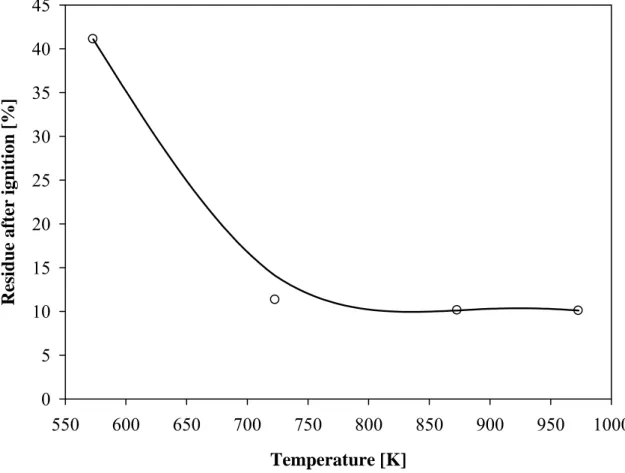
[Marshall and Wadsworth, 1994]. Water content was 8.8%. Figure 1 shows the effect of
ignition temperature on the residue of the rice bran after 6 h of ignition. The loss of the sample weight increased up to 90% at temperatures higher than 823 K. Obviously, the lost and remaining amounts were attributed to organic and non-volatile inorganic compounds, respectively.
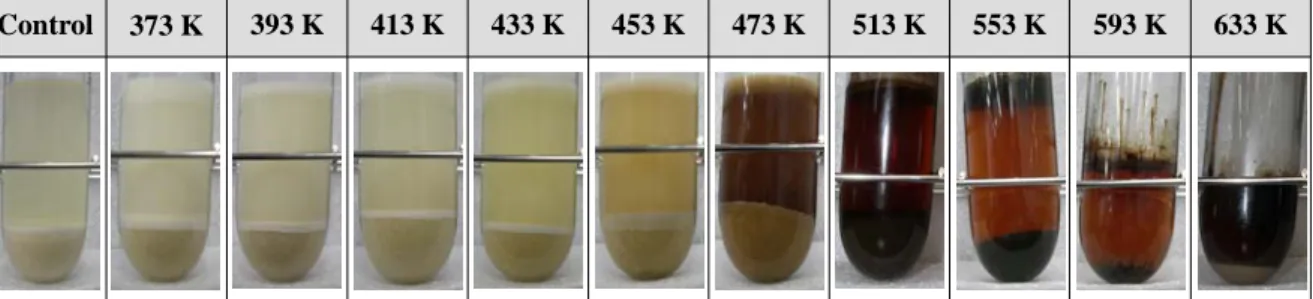
Figure 2 shows photos of products after subcritical water reaction for 5 min. Generally, rice bran is a water-insoluble biomass. However, after subcritical water treatment, at low temperatures (i.e. 373-433 K) a slurry phase was obtained. It was viscous and its color was little changed. However, at moderate temperatures (i.e. 433-553 K), it was slightly viscous and reddish to brown in color. At high temperatures (i.e. 553-633 K), it was a very viscous slurry with dark brown to black color.
Temperature [K]
550 600 650 700 750 800 850 900 950 1000
Residue after ignition [%
] 0 5 10 15 20 25 30 35 40 45
Figure 2. Typical photographs of subcritical water treatment of rice bran as function of temperature for
5 min reaction time.
633 K 593 K 553 K 513 K 473 K 453 K 433 K 413 K 393 K 373 K Control
Figure 3 demonstrates the effects of reaction temperature on HS phase, AS phase and remained solid of rice bran after subcritical water treatment for 5 min. The amounts of HS and AS increased with increasing temperature and remained solid amount decreased consequently. HS phase was a yellowish viscose liquid, which was mainly rice bran oil [Liu and
Mamidipally, 2005] with maximum yield of 27% (see Figure 3). On the other hand, any other
extractive compounds, which may be soluble in hexane, can also be extracted into this phase. The extracted oil has a variety of applications. For instance, depending on its quality, it can be used as edible oil or as feed stock of biodiesel [Zullaikah et al., 2005]. The AS phase is ascribed to tar, carbonized sample, and any other compounds that can dissolve neither in water nor in hexane. Most of the remained solid contains un-reacted rice bran and mineral compounds. The aqueous phase contains mainly hydrolyzed products of proteins, cellulose, and hemicellulose parts of rice bran [Sasaki et al., 1998; Wiboonsirikul et al., 2007a and b;
Sereewatthanawut et al., 2008]. These will be discussed in more detail later in this chapter and
chapter 4. In this chapter, we mainly focus on the WS compositions.
3. 3. Water-soluble (WS) phase
3. 3. 1. General
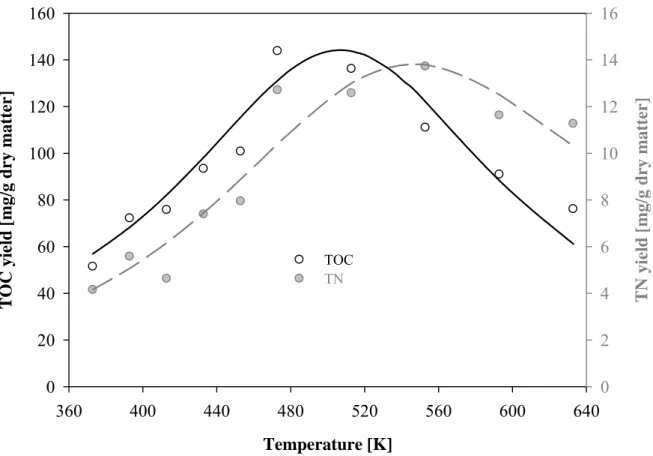
As the most important measures of decomposition of rice bran by the subcritical water hydrolysis reaction, TOC and TN were investigated. Figure 4 shows the effect of subcritical water temperature on TOC and TN yields at a reaction time of 5 min. As both curves showed peaks at almost the same temperature as ion production of water-temperature curve, the soluble products were produced by hydrolysis reaction in subcritical water. TOC showed a peak at around 505 K, and then this decreased with increasing temperature, owing to a weak hydrolysis reaction, pyrolysis, and gasification of the organic compounds.
The shape of the TN profile is similar to the TOC curve. This profile showed a peak at 553 K, which decreased somewhat by increasing temperature due to final degradation of N-containing organic compounds to gaseous by-products such as NH3. Generally, TN contents
in the aqueous phase are a function of N-containing soluble proteins, peptides, and particularly of the amino acids and ammonia. The small amounts of the produced gases were not
Temperature [K] 360 400 440 480 520 560 600 640 Yi eld of H S , AS,
and remained solid
[mg /g dry ma tter] 0 50 100 150 200 250 300 350 400 450 Hexane-soluble (HS) Acetone-soluble (AS) Remained solid
Figure 3. Effect of temperature on amounts of hexane-soluble (HS), acetone-soluble (AS), and
Temperature [K] 360 400 440 480 520 560 600 640 T O C y ie ld [ m g/ g dr y m a tte r] 0 20 40 60 80 100 120 140 160 TN yiel d [mg/g dr y matter] 0 2 4 6 8 10 12 14 16 TOC TN
quantified in this research work.
3. 3. 2. Amino acids
Water-soluble amino acids were produced by subcritical water hydrolysis reaction of rice bran protein. Up to eight essential amino acids (histidine, isoleucine, leucine, lysine, methionine, phenylalanine, threonine, and valine) and six non- and/or conditionally essential amino acids (glutamic acid, alanine, tyrosine, serine, glycine, and asparatic acid) were found in WS phase. Figures 5 and 6 show the effect of reaction temperature on amino acid yields at the reaction time of 5 min. In general, peaks appeared around 400 K. Lysine and glutamic acid had the highest yield among the identified essential and nonessential amino acids, respectively. Due to decomposition of amino acids to low molecular weight carboxylic acids and gaseous products [Yoshida et al., 1999; Abdelmoez and Yoshida, 2006b; Lamoolphak et al., 2006], amino acids were not identified at temperatures higher than 520 K. Yield and temperature differences between amino acid and TN peaks confirmed that other N-containing compounds (water-soluble proteins and peptides) were produced in the aqueous phase by hydrolysis reaction of rice bran under subcritical water conditions, and these may be main components of TN. These compounds were not analyzed in this research work.
3. 3. 3. Saccharides (total soluble sugars)
As rice bran is a rich source of polysaccharides, subcritical water hydrolyzed them to significant amounts of water-soluble sugars. Figure 7 shows the production yields of several quantified soluble sugars (sucrose, fructose, glucose, and glyceraldehyde) as a function of temperature at the reaction time of 5 min. Sucrose showed a peak at 413 K, and decomposed to fructose and glucose [Haghighat Khajavi et al., 2005] at higher temperatures. In fact, it must give equimolar amounts of fructose and glucose from hydrolysis of sucrose; on the other hand, fructose is less stable than glucose at the subcritical water condition [Salak Asghari and
Yoshida, 2006]. Since production yield of fructose was higher than that of glucose (see Figure
7), it seems that another pathway must also exist for production of fructose (besides that obtained from hydrolysis of sucrose) [Salak Asghari and Yoshida, 2006]. The yield of
Temperature [K]
360 400 440 480 520 560 600 640
Yiel
d of amino a
cids [mg/g dry matter]
0.0 0.1 0.2 0.3 0.4 0.5 0.6 0.7 L y sine y
ield [mg/g dry matter]
0 1 2 3 4 5 6 7 Histidine Isoleucine Leucine Methionine Phenylalanine Threonine Valine Lysine
Figure 5. Yield of essential amino acids after subcritical water treatment of rice bran (identified in the
Temperature [K] 360 400 440 480 520 560 600 640 Y ie ld of am in o ac id s [m g/ g dr y m a tt er ] 0.0 0.2 0.4 0.6 0.8 1.0 1.2 Gluta m ic aci d y ield [mg/g dry matter] 0.0 0.5 1.0 1.5 2.0 2.5 3.0 Alanine Asparatic acid Glycine Serine Tyrosine Glutamic acid
Figure 6. Yield of nonessential amino acids after subcritical water treatment of rice bran (identified in
Temperature [K]
360 400 440 480 520 560 600 640
Sugar yield [mg/g dry
matter] 0 10 20 30 40 50 60 70 80 90 100 T o tal so lu ble sugars yi eld [glucose eq uivalents mg/g dry matter] 0 20 40 60 80 100 120 140 160 180 200 Sucrose Fructose Glucose Glyceraldehyde
Total soluble sugars
Figure 7. Effect of subcritical water temperature on sugar production yields in aqueous phase at the
glyceraldehyde increased almost linearly by increasing temperature.
Furthermore, total sugars of aqueous phase (including mixtures of poly-, oligo-, di-, and mono-saccharides) were quantified by a photometric method [Hodge and Hofreiter, 1962] and results are shown in the same Figure. About 20% of total soluble sugars in the aqueous phase is a very promising amount of rice bran hydrolysis by subcritical water. This amount decreased steeply from 463 to 633 K.
3. 3. 4. Organic acids
Organic acids can be produced by decomposition of biomass, carbohydrates, and amino acids [Yoshida et al., 1999; Yoshida and Tavakoli, 2004; Abdelmoez and Yoshida,
2006b; Lamoolphak et al., 2006; Salak Asghari and Yoshida, 2006; Tavakoli and Yoshida, 2006]. In this work, five WS organic acids were identified from decomposition of the rice
bran. Figure 8 shows that acetic, formic, glycolic, and levulinic acids were produced at temperatures above 463 K. Acetic acid increased up to 553 K and then leveled off to a constant yield. Formic acid showed a peak at 513 K and decreased to zero at temperatures above 608 K. Glycolic and levulinic acid yields continuously rose with increasing temperature; however, glycolic acid showed a small amount of degradation at higher temperatures (i.e. 583 K). Citric acid was only identified at temperatures lower than 473 K. Due to the formation of WS organic acids, pH in the aqueous phase was changed, by increasing subcritical water temperature, to acidic values. The minimum pH was 4.6 at around 513 K. Then it was again increased to 5.1 at 593 K. This increment may be attributed to the decomposition of organic acids to other compounds, especially gaseous products and may also be due to buffering of the solution. Production of organic acids, and consequently, decreasing of the pH, led to the conclusion that autocatalysis may occur during subcritical water treatment of rice bran.
3. 4. Remained solid
In order to realize the changes in composition of remained solid by subcritical water treatment, CHNS (carbon, hydrogen, nitrogen, and sulfur) amounts in remained solid were
Temperature [K] 360 400 440 480 520 560 600 640 Orga n ic acid yi eld [mg/ g dry matter] 0 2 4 6 8 10 12 14 16 18 20 22 pH of aqu eou s sol u ti on after sub cri ti cal water 4.0 4.2 4.4 4.6 4.8 5.0 5.2 5.4 5.6 5.8 6.0 Acetic acid Citric acid Formic acid Glycolic acid Levulinic acid pH
Figure 8. Organic acid yields of aqueous phase and its pH as a function of subcritical water
evaluated. Figure 9 shows the effect of temperature on the ratios of H/C, N/C, and S/C in the remained solid for 5 min of reaction time. The H/C was decreased by increasing subcritical water temperature, particularly at higher temperatures, due to pyrolysis reactions. N/C ratio showed a minimum at 533 K and, the S/C ratio was gradually decreased by subcritical water temperature increase.
3. 5. Hexane, acetone, and water solubilities by rice bran conversion
Part of rice bran was dissolved in the three phases (HS, AS, and WS) by treating it under subcritical water conditions. Remained solid was the phase which was not dissolved in the above phases. Obviously the amounts of remained solid and dissolved materials depended on rice bran conversion. The solubilities of rice bran in hexane, acetone, and water phases, as functions of rice bran conversion by subcritical water were calculated by equations (1) to (3) and the results are shown in Figure 10. The greater the rice bran conversion, the greater were the amounts of HS, AS, and WS produced. Clearly, rice bran conversion and solubility yields depended on subcritical water reaction temperature (see Figure 3). Figure 10 also reveals that HS yield was always higher than that of AS, and WS yield was greater than those of HS and AS. This Figure shows that WS, HS, and AS solubilities were non-linear functions of rice bran conversion whilst total solubility was a linear function of rice bran conversion.
4. Conclusions
Subcritical water processing, as a green and environmentally friendly technique, has been successfully applied for rice bran treatment and production of valuable materials. The extraction of rice bran oil was found to be a feasible process. Rice bran oil was successfully extracted with higher yields than those obtained by conventional methods. It was apparent that subcritical water temperature influenced oil production. The higher the subcritical water temperature was, the greater was the amount of oil obtained. Maximum extracted rice bran oil, as HS phase, was nearly 27 % of the initial dry matter. In addition, temperature had considerable effects on the yield of the obtained tar and remained solid.
Temperature [K] 360 400 440 480 520 560 600 640 Atom ic H/C r a ti o [m ol/ m o l] 0.00 0.25 0.50 0.75 1.00 1.25 1.50 1.75 2.00 2.25 2.50 Atomi c N/ C and S/ C ratio [mol /m ol ] 0.00 0.01 0.02 0.03 0.04 0.05 0.06 0.07 0.08 0.09 H/C N/C S/C
Figure 9. Effect of reaction temperature on the element composition of remained solid at 5 min
Conversion of rice bran to soluble materials [g/g dry matter]
0.50 0.55 0.60 0.65 0.70 0.75 0.80 0.85 0.90 0.95 1.00
Solubil
ity yield [g/g dry matter]
0.0 0.1 0.2 0.3 0.4 0.5 0.6 0.7 0.8 0.9 1.0 Solubility in acetone Solubility in hexane Solubility in water Total solubility
reaction and hydrolysis in a short reaction time (5 min). The experimental TOC and TN confirmed that protein and cellulosic parts were hydrolyzed and efficiently converted into water-soluble compounds. TOC and TN yield curves showed peaks at around 505 and 553 K, respectively. Subcritical water converted cellulosic parts of rice bran into the water-soluble di- and mono-saccharides. Maximum total yield of sugars produced by the hydrolysis reaction was nearly 20% of initial dry matter. This is a very suitable feed stock for bioethanol production and/or other industrial and food applications. The protein part of rice bran was hydrolyzed to a variety of essential and nonessential amino acids. Totally, more than 14 amino acids were identified in the aqueous phase. Among the obtained amino acids, the most plentiful yields were those of lysine, glutamic acid, alanine, and asparatic acid. Besides amino acids, five organic acids, in considerable amounts, were produced from decomposition of rice bran. Acids may autocatalyze further solubility of rice bran under subcritical water conditions. It was found that amino acid and organic acid yields were functions of subcritical water temperature. The optimum production temperature for most of the amino acids was 400 K, and at temperatures higher than 520 K no amino acid was detected while organic acids production began at temperatures higher than 463 K.
Nomenclature
AS Acetone-soluble HS Hexane-soluble K Kelvin
TOC Total organic carbon
TN Total nitrogen
References
Abdelmoez, W., Yoshida, H., Simulation of fast reactions in batch reactors under sub-critical water condition, AIChE Journal, 52, 3600-3611, (2006a).
Abdelmoez, W., Yoshida, H., Synthesis of a novel protein-based plastic using sub-critical water technology, AIChE Journal, 52, 2607-2616, (2006b).
Bicker, M., Endres, S., Ott, L., Vogel, H., Catalytical conversion of carbohydrates in subcritical water: a new chemical process for lactic acid production, Journal of Molecular
Catalysis A: Chemical, 239, 151-157, (2005).
Chen, M. H., Bergman, C. J., A rapid procedure for analysing rice bran tocopherol, tocotrienol and γ-oryzanol contents, Journal of Food Composition and Analysis, 18, 139-151, (2005). Danielski, L., Zetzl, C., Hense, H., Brunner, G., A process line for the production of raffinated
rice oil from rice bran, The Journal of Supercritical Fluids, 34, 133-141, (2005).
Galkin, A. A., Lunin, V. V., Subcritical and supercritical water: a universal medium for chemical reactions, Russian Chemical Reviews (English Translation), 74, 21-35, (2005). Haghighat Khajavi, S., Kimura, Y., Oomori, T., Matsuno, R., Adachi, S., Kinetics on sucrose
decomposition in subcritical water, LWT-Food Science and technology, 38, 297-302, (2005).
Herrero, M., Cifuentes, A., Ibanez, E., Sub- and supercritical fluid extraction of functional ingredients from different natural sources: plants, food-by-products, algae and microalgae,
Food Chemistry, 98, 136-148, (2006).
Hodge, J. E., Hofreiter, B. T., Determination of reducing sugars and carbohydrates, Methods in
Carbohydrate Chemistry, 1, 380-394, (1962).
Holliday, R. L., Jong, Y. M., Kolis, J. W., Organic synthesis in subcritical water: oxidation of alkyl aromatics, The Journal of Supercritical Fluids, 12, 255-260, (1998).
Hu, W., Wells, J. H., Shin, T. S., Godber, J. S., Comparison of isopropanol and hexane for extraction of vitamin E and oryzanols from stabilized rice bran, Journal of the American
![Figure 1. Amount of annually effectively available biomass in the USA (California) [Moller, online]](https://thumb-ap.123doks.com/thumbv2/123deta/8512735.1805605/11.892.191.720.402.686/figure-annually-effectively-available-biomass-california-moller-online.webp)

![Table 2. Minerals in rice bran. Mineral Content [ppm] Aluminum 53-369 Calcium 140-1310 Chlorine 510-970 Iron 190-530 Magnesium 8650-12300 Manganese 110-877 Phosphorus 14800-28700 Potassium 13650-23900 Silicon 1700-16300 Sodium 0-290 Zinc 80](https://thumb-ap.123doks.com/thumbv2/123deta/8512735.1805605/18.892.282.640.448.796/minerals-mineral-aluminum-chlorine-magnesium-manganese-phosphorus-potassium.webp)