Splitting Long Input Sentences for Phrase-based Statistical Machine
Translation
Chooi-Ling Goh and Eiichiro Sumita
Language Translation Group, MASTAR Project
National Institute of Information and Communications Technology, 619-0289 Kyoto
{chooiling.goh,eiichiro.sumita}@nict.go.jp
Abstract
Translation results suffer when a standard phrase-based statistical machine translation system is used for translating long sentences. The translation output will not have the same word order as the source. When a sentence is long, it should be partitioned into several clauses, and the word re-ordering during the translation done within these clauses, not between the clauses. In this paper, we propose splitting the long sentences using linguis-tic information, and translating the sentence piece by piece. In other words, we constrain the word reordering so that it can only be done within the pieces but not between the pieces. We then ap-ply a language model to join the pieces back to-gether in the original sequence in order to reduce disfluencies in the connection. By doing so, word order can be preserved and translation quality im-proved. Our experiments on the patent translation from Japanese to English are able to achieve bet-ter translations measured by both BLEU score and word error rate (WER).
1
Introduction
Translating long and complex sentences has been a crit-ical problem in machine translation. A standard phrase-based statistical machine translation (SMT) system cannot solve the problem of word reordering in the target when the source sentence has a complex structure. A syntax-based machine translation system could solve the problem by running a parser on the source sentence in order to get the dependency structure, but when a sentence is long and complex, the parser may fail to give a correct parse tree. However, in this research, we found that even when a sen-tence is long and complex, it is possible to split a sensen-tence into smaller units which can be translated seperately with minor consideration of the context. The main problem here is locating the best locations for the split. We use linguistic information such part-of-speech (POS) tags and commas as clues to determine the split positions. After splitting a sen-tence into small clauses, the clauses are translated indepen-dently. This means that word reordering can only be done within a clause, not between clauses. Finally, we apply a language model to join these translated pieces together to form a complete translation sentence.
We use the NTCIR-8 Patent Translation shared task data for Japanese to English in our experiment. The results show that splitting the long sentences into small indepen-dent clauses helps to improve the translation quality. Auto-matic evaluation using BLEU scores and WER shows that splitting long sentences can improve the translation, and ap-plying a language model to join the pieces further improves fluency.
2
Previous Work
Research has been done on splitting long sentences into smaller pieces in order to improve the translation (Kim and Ehara, 1994; Furuse et al., 1998; Doi and Sumita, 2003; Sudoh et al., 2010). (Furuse et al., 1998) and (Doi and Sumita, 2003) tend to split speech output instead of text data. For speech output, the main issue is that one utterance may contain a few short sentences instead of one long sen-tence. Therefore, the main problem is splitting them into proper sentences for translation.
(Sudoh et al., 2010) divide the source sentence into small clauses based on a syntactic parser. Then, a non-terminal symbol serves as a place-holder for the relative clause. However, they also have to train a clause translation model which can translate the non-terminal symbols. They proposed a clause alignment method using a graph-based method.
(Kim and Ehara, 1994) proposed using a rule-based method to split the long sentences into multiple sentences. Furthermore, after splitting the sentences, they tried to iden-tify a subject and inserted it into the subsequence sentences wherever needed. Wherever a sentence is split, the ending grammar is changed so that its conjugation (tense, aspect, modality) matches the ending of the original complete sen-tence.
Our research in this paper is different in the sense that we only want to split for translation long sentences where the context before and after the splitting points are indepen-dent, and we try to join these translations sequentially in a more natural manner to reduce disinfluecies. Our method is simple and does not require complicated processes like clause alignment, subject supplement or sentence ending completion.
3
Translation of Long Sentences
A standard phrase-based statistical machine translation sys-tem does not work well for translating long sentences.
Fig-言語処理学会 第 17 回年次大会 発表論文集 (2011 年 3 月)
 ̄ ̄ ̄ ̄ ̄ ̄ ̄ ̄ ̄ ̄ ̄ ̄ ̄ ̄ ̄ ̄ ̄ ̄ ̄ ̄ ̄ ̄ ̄ ̄ ̄ ̄ ̄ ̄ ̄ ̄ ̄ ̄ ̄ ̄ ̄ ̄ ̄ ̄ ̄ ̄ ̄ ̄ ̄ ̄ ̄ ̄ ̄ ̄ ̄ ̄ ̄ ̄
Copyright(C) 2011 The Association for Natural Language Processing. All Rights Reserved.
ure 1 shows two examples of long sentence translation us-ing a phrase-based SMT system. In both sentences, the word order of the translation does not follow the source sentence and the translation is bad. However, if we can split the sentences into small clauses such as those shown below the baseline translation, each clause can be translated in a better word order, and the overall translation improves. Our research here is to find out where best to split the sen-tences and how to join the pieces together in a more natural manner in order to keep the fluency.
4
Method
4.1 Split Conditions
Usually in Japanese written text, a comma will be used if a sentence is long and complicated in order to improve the readability. However, having a comma inserted is not compulsory and there are no strict rules on where a comma should be inserted. There is some research being done on inserting missing punctuation into the text (Murata et al., 2010; Guo et al., 2010). Punctuation could be very useful in written texts for understanding the meaning. In our case, the comma in Japanese is used as a clue for the split po-sition. According to (Murata et al., 2010), there are more than 8 uses for commas in Japanese text and 36.32% of them are used when the content before and after the comma are independent of each other.
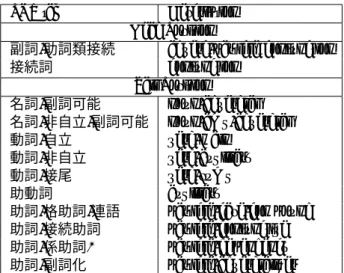
Similar to (Kim and Ehara, 1994), a rule-based approach is proposed to split a sentence into multiple clauses. First, the sentence is POS tagged by ChaSen1 using the IPAdic dictionary. In many cases, if there is a comma, the context before and after the comma are possibly independent and can be translated separately, making a comma a very im-portant clue for locating splitting position candidates. We therefore combine the POS tags and commas as clues to de-termine the split position for long sentences. Table 1 shows some of the POS tags that have been used for splitting. These POS tags were analyzed and found to be good mark-ers for splitting position candidates, as the clauses before and after they occur may be independent of each other and thus able to be translated seperately. Two rules are used:
• If a POS tag in the head position is found after a comma, then the head will be a split position.
• If a POS tag in the tail position is found before a comma, then the word after the comma will be a split position.
If a comma is found after a dependency particle (助詞-係 助詞), it is hard to say that the context before the particle is independent of the context after the comma. However, by observing the corpus data, we found that when the sentence is long, it is better if the text before the dependency particle to be translated seperately if it happens to be a very long noun phrase. Therefore, we leave it here as one of the POS tags for splitting the sentences. The other POS tags indicate places that are very likely to be good for splitting.
1http://chasen-legacy.sourceforge.jp/
POS tag Description
Head Position 副詞-助詞類接続 adverb-particle conjunction 接続詞 conjunction Tail Position 名詞-副詞可能 noun-adverbial 名詞-非自立-副詞可能 noun-affix-adverbial 動詞-自立 verb-main 動詞-非自立 verb-auxiliary 動詞-接尾 verb-suffix 助動詞 auxiliary 助詞-格助詞-連語 particle-case-compound 助詞-接続助詞 particle-conjunctive 助詞-係助詞* particle-dependency 助詞-副詞化 particle-adverbializer
Table 1: POS tags used for split
4.2 Joining Conditions
After a long sentence has been split into multiple clauses, the clauses are independently translated as usual. However, when these translated pieces are joined back together se-quentially, we face the problem of unsatisfactory fluency. In order to make the translation more fluent, we apply a language model when joining the pieces back together.
ebest= argmax e p(e|f) = argmax e p(f|e)p(e)
p(e|f) = pφ(f|e)λφ× pLM(e)λLM× pD(e, f )λD
× ωlength(e)λω(e)
(1)
Equation 1 shows the standard statistical translation equation from source language f to target language e us-ing translation model, language model, distortion model and word penalty. If we split the sentence into multiple clauses f1, ..., fnand translate these separately, we can use
Equation 2 to calculate the translation probability, but this results in the the translation output suffering from the con-nectivity between clauses. Therefore, a language model is applied to the whole translated sentence instead of to indi-vidual clauses2as shown in Equation 3.
p(e|f) = n ∏ i=1 p(ei|fi) (2) p(e|f) = n ∏ i=1 pφ(fi|ei)λφ× n ∏ i=1 pD(ei, fi)λD × n ∏ i=1
ωlength(ei)λω(ei)× pLM(e)λLM (3)
2This should be similar to the wall constraint in Moses (Koehn
and Haddow, 2009).
Copyright(C) 2011 The Association for Natural Language Processing. All Rights Reserved.
Source また 、 図 1 中 の 第 1 の スイッチ 素子 1 3 は 放電 用 の N M O S トランジスタ 1 7 から なり 、この N M O S トランジスタ 1 7 の ゲート は 制 御 回路 2 3 により 制御 さ れる 。 Reference In addition , the first switch element 13 in FIG . 1 comprises an NMOS transistor 17 , and a gate electrode
of the NMOS transistor 17 is controlled by a control circuit 23 .
Baseline Further , the first NMOS transistor 17 , and the gate of NMOS transistor 17 is controlled by the control circuit 23 in FIG . 1 a switch element 13 for discharge from .
Split into また 、 図 1 中 の 第 1 の スイッチ 素子 1 3 は 放電 用 の N M O S トランジスタ 1 7 から
なり 、
multiple Further , the first switch element 13 is for discharging NMOS transistor 17 in FIG . 1 ,
clauses この N M O S トランジスタ 1 7 の ゲート は 制御 回路 2 3 により 制御 さ れる 。
The gate of NMOS transistor 17 is controlled by the control circuit 23 .
Source 以上 説明 し た 第 一 実施 形態 に よる と 、 許容 範囲 W θ に おい て は 、 第 一 及び 第 二 回転
カム 5 2 , 5 3 が それぞれ ローラ 4 3 及び 接触 部 材 4 4 と 常に 接触 する 。
Reference In this embodiment , the first cam 52 is constantly in contact with the roller 43 and second cam 53 is constantly in contact with the contact member 44 in the allowable range W .theta. .
Baseline According to the above described first embodiment , the first and second rotating cam 52 and 53 are brought into contact with the contact member 44 and each roller 43 and allowable range W .theta. always .
以上 説明 し た 第 一 実施 形態 に よる と 、
Split into As described above , according to the first embodiment ,
multiple 許容 範囲 W θ に おい て は 、
clauses In the allowable range W .theta.
第 一 及び 第 二 回転 カム 5 2 , 5 3 が それぞれ ローラ 4 3 及び 接触 部 材 4 4 と 常に 接 触 する 。
The first and second rotary cams 52 and 53 are always in contact with the roller 43 and contact portion material 44 .
Figure 1: Long sentence translation examples
0 20 40 60 80 100 120 140 160 180 25 50 75 100 125 150 # of sentences/clauses Sentence length len2 len4 len6 len8 len10 len12 len14 len16 len18 len20 nosplit
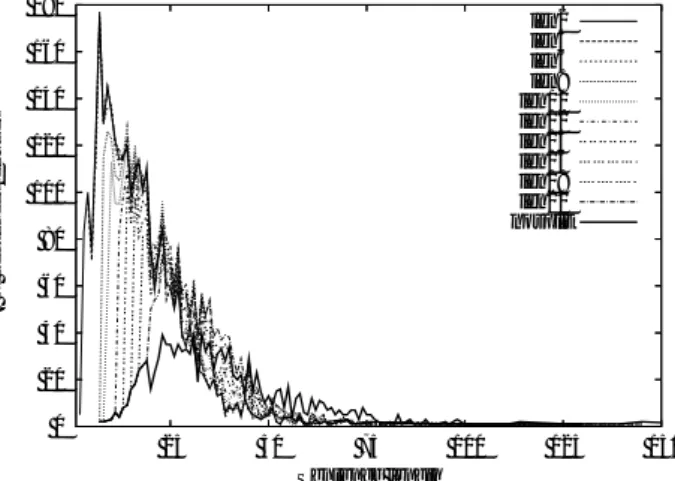
Figure 2: Distribution of sentence length before and after split
5
Experiment Results
We used the Patent corpus provided by the NTCIR-8 Trans-lation Campaign for Japanese to English transTrans-lation. The training corpus contains about 3 million sentence pairs, the development set has 1,000 sentence pairs and the test set has 1,251 sentence pairs. The MT system used is an in-house phrase-based statistical machine translation system, CleopATRa. The development set is used to tune the pa-rameter weights using MERT.
Split # of sentences Average
length /clauses length
len2 2,892 17.83 len4 2,804 18.36 len6 2,643 19.42 len8 2,385 21.41 len10 2,173 23.40 len12 1,999 25.35 len14 1,857 27.22 len16 1,720 29.31 len18 1,605 31.33 len20 1,520 33.03 Nosplit 1,251 38.92
Table 2: Number of sentences/clauses after split
Figure 2 shows the distribution of sentence lengths be-fore and after splitting for the test set. The length threshold is the minimum length of a clause after a split. As you can see, if we fix the split length to be shorter, more clauses are generated and the number of long sentences decreases. Table 2 shows the number of sentences/clauses for each length category after splitting. Before splitting, the average length of the sentences is about 39 words but after splitting it ranges from 18 to 33 words. We will examine which split length is best for translation in the following paragraph.
Figure 3 and Figure 4 show the translation results eval-uated in BLEU scores and word error rate (WER) by the
Copyright(C) 2011 The Association for Natural Language Processing. All Rights Reserved.
27 27.5 28 28.5 29 29.5 30 30.5 31 31.5 32 32.5 33 2 4 6 8 10 12 14 16 18 20 BLEU score Sentence length test baseline test sequence test lmodel dev baseline dev sequence dev lmodel
Figure 3: Translation evaluation results by BLEU scores
73 73.5 74 74.5 75 75.5 76 76.5 77 77.5 78 78.5 79 79.5 80 80.5 81 81.5 82 82.5 83 2 4 6 8 10 12 14 16 18 20 WER Sentence length test baseline test sequence test lmodel dev baseline dev sequence dev lmodel
Figure 4: Translation evaluation results by WER
length of clauses. There is only one reference transla-tion and the evaluatransla-tion is case-sensitive. “Baseline” is the standard translation using Equation 1, “sequence” is using Equation 2 and “lmodel” is using Equation 3. In general, our proposed method shows improvements in both evalua-tion metrics. Applying a language model when joining the translated pieces together could further improve the results. From our experimental experience, we found that although splitting long sentences into smaller pieces could improve the translation results, it is better not to split them if the clauses are too short as the translations may no longer be independent of each other. Based on the BLEU scores, the development set did best with clauses of a minimum of 16 words and the test set did best with a minimum of 12. WER scores, however, were best at 6 and 8 words, respectively. (Gerber and Hovy, 1998) has fixed the minimum sentence length as 7 words for splitting, but they could not prove that this is the best length. In our case, we still cannot conclude which case is the best and we will leave the problem for future study.
6
Conclusion and Future Work
It is difficult to translate long sentences using a phrase-based statistical machine translation system due to context word order being badly preserved. We proposed splitting the long sentence into multiple short clauses that could be translated independently. POS tags and commas are used as clues to determine the splitting positions. In order to re-duce the disinfluencies when rejoining the translated pieces, a language model is applied to the whole translated sen-tence instead of to the individual pieces. Our experiment results for the patent translation from Japanese to English showed some improvements on the translation quality mea-sured by BLEU score and WER. In the future, we would like to discover optimum clause length for individual sen-tences instead of an overall blanket length. Furthermore, we will work on inserting commas into the sentences whenever they are needed for sentences that are missing them.
References
Takao Doi and Eiichiro Sumita. 2003. Input Sen-tence Splitting and Translating. In Proceedings of the HLT/NAACL: Workshop on Building and Using Parallel Texts.
Osamu Furuse, Setsuo Yamada, and Kazuhide Yamamoto. 1998. Splitting Long and Ill-formed input for Ro-bust Spoken-language Translation. In Proceedings of COLING-ACL, pages 421–427.
Laurie Gerber and Eduard Hovy. 1998. Improving Trans-lation Quality by Manipulating Sentence Length. In Pro-ceedings of AMTA, pages 448–460.
Yuqing Guo, Haifeng Wang, and Josef van Genabith. 2010. A Linguistically Inspired Statistical Model for Chinese Punctuation Generation. ACL Transactions on Asian Language Information Processing, 9(2):6:1–6:27. Yeun-Bae Kim and Terumasa Ehara. 1994. A Method
for Partitioning of Long Japanese Sentences with Subject Resolution in J/E Machine Translation. In Proceedings of International Conference on Computer Processing of Oriental Languages, pages 467–473.
Philipp Koehn and Barry Haddow. 2009. Edinburgh’s Sub-mission to all Tracks of the WMT2009 Shared Task with Reordering and Speed Improvements to Moses. In Pro-ceedings of the Fourth Workshop on Statistical Machine Translation, pages 160–164.
Masaki Murata, Tomohiro Ohno, and Shigeki Matsubara. 2010. Automatic Comma Insertion for Japanese Text Generation. In Proceedings of the EMNLP, pages 892– 901.
Katsuhito Sudoh, Kevin Duh, Hajime Tsukada, Tsutomu Hirao, and Masaaki Nagata. 2010. Divide and Translate: Improving Long Distance Reordering in Statistical Ma-chine Translation. In Proceedings of the Joint 5th Work-shop on SMT and MetricsMATR, pages 418–427.
Copyright(C) 2011 The Association for Natural Language Processing. All Rights Reserved.