Doctorate Dissertation
博士論文
Photoevaporation of Protoplanetary Disks and Molecular
Cloud Cores in Star-Forming Regions
(星形成領域中の原始惑星系円盤および分子雲コアの光蒸発)
A Dissertation Submitted for Degree of Doctor of Philosophy
December 2018
平成
30
年
12
月 博士(理学)申請
Department of Physics, Graduate School of Science,
The University of Tokyo
東京大学大学院理学系研究科物理学専攻
Riouhei Nakatani
ABSTRACT
Galaxies contain a large amount of gas in the form of molecules. The molecules shape gaseous clumps called molecular clouds. They are the parental bodies of stars, and star formation is initiated by the gravitational collapse of the clouds. A protostar forms in the collapsing core, and, at the same time, a gaseous disk surrounds the star. The circumstellar disk is composed of gas and a small amount of solid particles (dust) and is the birthplace of planets, and thus it is named a protoplanetary disk (PPD). The PPD coevolves with the central star and eventually disperses. A young stellar system is left behind as a remnant.
Recent observations have revealed that planets commonly exist around solar-type stars, but many of them have different characters from those of our Solar System’s planets. Although the origin of the variety is not yet clear, it can be attributed to some environmental factors that affect the formation and evolutionary processes of stellar systems. In fact, the occurrence of Jupiter-like planets (Jovian planets) is observationally known to decrease with the host star mass and with the host star metallicity, i.e. the amount of heavy elements. Similarly, the observations of the outer Galaxy, where metallicity is low, have proposed a short dispersal time of PPDs. The origins of these trends are also poorly understood, but it explicitly shows that the formation and evolutionary processes of stellar systems are affected by their forming environments. Studying the processes occurring in diverse environments is a necessary step to understand the origins of such varieties and trends, and, ultimately, to construct a universal picture of stellar system formation and evolution.
In this thesis, our main interest is in star and planet formation/evolution in various metallicity environments. Metallicity is one of the important quantities that has the potential to characterize the location of star-forming regions and the period of star-forming activities. For instance, metal-licity decreases as going further from the galactic center in the Milky Way, and more importantly, metallicity is increased as a whole, as galaxies evolve from their primordial states. Hence, consid-ering metallicity variation can give essential implications to study the formation and evolution of stellar systems since the birth of galaxies. This is, in turn, indispensable to study the evolution of galaxies, which are an important constituent of the universe.
To this end, in this thesis, we investigate the dispersal processes of PPDs and molecular clouds in star-forming regions with a wide variety of metallicity. PPDs are irradiated by the central stars with their intense ultraviolet (UV) and X-ray radiation. It heats disk surfaces and drives evaporative flows. The dispersal process is termed as photoevaporation and can disperse PPDs within a few million years, which is consistent with the observationally-estimated dispersal time. The disk lifetime limits the available time to form planets, especially for Jovian planets, within PPDs, and is a significantly relevant quantity to determine initial configurations of primordial planetary systems. Hence, the disk lifetime is a particularly important parameter in the context of planet formation. We investigate photoevaporation of PPDs with various metallicities to estimate their lifetimes and to derive, if any, their metallicity dependence. Similarly, in star-forming regions around massive stars, the star’s intense radiation drives photoevaporation from the surfaces of molecular clouds and reduces the cloud mass. This negatively affects star formation around massive stars. On the other hand, the
intense radiation is known to drive a strong shock in the interior of clouds. The central density of the clouds is increased to strengthen self-gravity. This process positively affects star formation in star-forming regions nearby massive stars. Whether positive or negative, these processes due to the existence of nearby massive stars contribute to set the efficiency of star formation in the star-forming regions. These processes may be particularly important in high-redshift galaxies and the early time of the Milky Way, where massive stars are considered to be preferentially formed. We study photoevaporation of molecular clouds with various metallicities to discuss the influences of massive stars on the efficiency of star formation.
First, we perform radiation hydrodynamics simulations of photoevaporating PPDs irradiated by far-UV (FUV; 6 eV ≲ hν ≤ 13.6 eV) and extreme-UV (EUV; hν > 13.6 eV) from the central young star. We solve nonequilibrium chemistry in a self-consistent manner. Dust temperatures are also self-consistently determined by solving radiation transfer for stellar irradiation and dust (re-)emission. We vary the disk metallicity Z in a wide range of 10−4Z⊙ ≤ Z ≤ 10 Z⊙. We find that FUV photoelectric heating drives dense, neutral photoevaporative flows, and the FUV heating and dust-gas collisional cooling regulate the resulting mass-loss rates. The FUV-driven neutral flows yield a mass-loss rate of the order of ∼ 10−8 M⊙ yr−1 at solar metallicity. The mass-loss rate increases as metallicity decreases for 10−1Z⊙ ≲ Z ≲ 10 Z⊙, because the amount of dust, which is the main absorber of FUV, is reduced. For 10−2Z⊙ ≲ Z ≲ 10−1Z⊙, dust-gas collisional cooling becomes efficient compared to FUV heating. This suppresses the FUV-driven photoevaporation, and the resulting mass-loss rates decrease with decreasing metallicity. In the low-metallicity extent of 10−4Z⊙ ≲ Z ≲ 10−2Z⊙, EUV-driven ionized flows dominantly contribute to the mass loss. Since the main absorber of EUV is hydrogen, the photoevaporation rates are roughly constant with
∼ 10−9 M
⊙ yr−1. The metallicity dependence of the estimated lifetimes is consistent with those of
the observational lifetimes. It directly shows that FUV photoevaporation can be a cause for the observational trend in PPD lifetimes.
Next, we incorporate X-ray (0.1 keV≲ hν ≲ 10 keV) effects into our simulations of photoevapo-rating PPDs and study the influences of X-ray on photoevaporation and lifetimes. The effectiveness of X-ray on photoevaporation has remained a matter of debate, and for the first time, we directly examine it with radiation hydrodynamics simulations with taking into account the spectral energy distribution of X-ray irradiation. The disk metallicity is varied again to investigate the metallicity dependence of photoevaporation caused by both UV and X-ray. Our results show that X-ray heating is not efficient to drive the dense, neutral photoevaporative flows as FUV, but X-ray ionization can strengthen FUV heating by ionizing the neutral regions of PPDs. The metallicity dependence of photoevaporation rates is again largely regulated by FUV heating and dust-gas collisional cooling, and thus the trend is similar to that in the case of UV photoevaporation. However, the strength-ening effect of X-ray boosts the photoevaporation rates in 10−2.5Z⊙ ≲ Z ≲ 10−2Z⊙, where FUV hardly drives the neutral photoevaporative flows without the X-ray effect. The resulting photoe-vaporation rates are of the order of 10−8–10−7 M⊙ yr−1 and decreases with decreasing metallicity. At Z≲ 10−3Z⊙, the neutral photoevaporative flows are hardly driven, and the resulting mass-loss rates are mainly contributed from the EUV-driven flows. The mass-loss rates are roughly constant without FUV heating, because the metallicity-independent EUV-driven flows set the mass-loss rates in this case. The estimated lifetimes are even more consistent with the observations when the X-ray effects are taken into account in the UV photoevaporation model. Although X-ray photoevaporation has been suggested as a key mechanism to explain the metallicity dependence of the observational lifetimes in a few previous studies that employ a simplified method, our direct comparison based on the self-consistent radiation hydrodynamics simulations indicate that X-ray is ineffective to drive a
strong photoevaporation or to directly cause a metallicity-dependent trend in the lifetimes.
Finally, we investigate the evolution of low-mass molecular clouds in star-forming regions with a wide variety of metallicities. We consider molecular cloud cores with 10−3Z⊙≤ Z ≤ 1 Z⊙exposed to UV field of nearby massive stars in order to derive their lifetimes and discuss star formation efficiency around the massive stars. We perform 3D radiation hydrodynamics simulations, including relevant thermochemical reactions. Again, we simultaneously solve hydrodynamics, radiative transfer, and nonequilibrium chemistry in a self-consistent manner. In our simulations, we observe a strong shock driven by the intense EUV irradiation in the interior of the cores with Z≳ 10−1Z⊙. The shock and hot ambient gas compress the cores to form a cometary structure. The cores survive for∼ 105yr.
Low-metallicity cores (Z ≲ 10−2Z⊙) lack coolants inside, and hence keep high temperatures after compression by the shock. The cores are short-lived and have lifetimes of the order of 104yr.
We find that the free fall time, which is an important measure to quantify the collapsing time of cores to form stars, is sufficiently shortened in the higher-metallicity cores to initiate gravitational collapse before completely dispersed. We also study photoevaporation of molecular cloud cores in photodissociation regions (PDRs), where EUV photons are hardly present. It is shown that FUV heating also compresses cores and form a cometary structure for Z ≳ 1 Z⊙, but the cores with Z ≲ 10−0.5Z⊙ expand rather than shrinking. This makes the free fall time longer and thus suppresses star formation. We conclude that in metal-rich star-forming regions with Z ≳ 10−1Z⊙, the effects of the intense EUV radiation from massive stars can promote star formation, and if metallicity is sufficiently high (Z ≳ 1 Z⊙), the gravitational collapse can be also initiated in the PDRs; otherwise, star formation is significantly suppressed or delayed by the effects of FUV and EUV radiation from massive stars. In metal-poor environments (Z ≲ 10−2Z⊙), UV radiation of massive stars generally have effects to suppress or to delay star formation.
Our results suggest that in the local, present-day star-forming regions (Z ≳ 0.1 Z⊙), star forma-tion is likely to be promoted around massive stars, and in the resulting young stellar systems, gas giant planets may efficiently form as metallicity increases. On the other hand, in low-metallicity en-vironments (Z ≲ 0.01 Z⊙) like protogalaxies, star formation can be significantly suppressed around massive stars. PPDs, if present, have longer lifetimes as metallicity decreases. Planets have a long time to grow and to evolve dynamically through the interaction with the parental disks. The wind profiles and the estimated lifetimes of the low-metallicity PPDs are still expected to be applicable to “evolved” disks, where dust grains have grown to larger bodies and settled to the midplane, and locally realize a low-metallicity environment. Future observations with next-generation telescopes would make a direct comparison possible. In this thesis, we focus on the dispersal processes of low-mass objects. In practice, these bodies have low-mass spectra. The dispersal processes of high- or even lower-mass molecular clouds and PPDs might have different evolutionary characters. In addition, the luminosities of the radiation sources would be more or less dependent on both the stellar mass and metallicity. In future works, we incorporate these effects to study the evolutionary processes. The results, including those in this thesis, can be broadly applied to many other fields, such as future planet-searching missions and theoretical studies of galaxy formation.
ACKNOWLEDGEMENT
First and foremost, I would like to express my sincere gratitude to my supervisor Prof. Naoki Yoshida for the continuous support and guidance to my study/research and for all his contribution of time, consideration, idea, and funding to make my time in the graduate school this fruitful and productive. I could enhance my strong points while acquiring new skills and pieces of knowledge. He has, both consciously and unconsciously, let me learn not only the ways to conduct researches and to grow as a research scientist but also an attitude to work and to life. I have seen that life is not so long as one expects, and therefore we had better make the most of this very second to contribute to society and nature. His teachings have motivated me not to make compromises during this invaluable fraction of my life. At the same time, I have also learned that being adequately optimistic helps myself in a lot of kinds of situations. The balance of this uncompromising and optimism is one of the most important acquirement during my time in graduate school. He encouraged me when we had a hard time, and he was glad for me when I made achievements. It has been such a great honor of mine to be his Ph.D./Master student for the last five years. I cannot thank him enough with words.
I would also like to express my special gratitude to Takashi Hosokawa for the technical advice and encouragement. Regardless of the physical distance separating our two universities, he always cared about me and frequently verified the progress of our researches. His insightful comments and practical advise also helped me deal with issues and immensely contributed to widening our researches from various perspectives.
My sincere thanks also go to my research collaborators, Hideko Nomura, and Rolf Kuiper. They provided me the observational data and the computational routines used in the simulations for the studies in this dissertation. They also gave me detailed and clear explanations when I had questions. It particularly deepened my understandings of the physics underlying observational results and computational methods in the works of literature.
I am deeply grateful to Neal Turner, Mario Flock, Yasuhiro Hasegawa, and Shigeru Suzuki for their great hospitality during my visit to NASA Jet Propulsion Laboratory from October 16 to December 25, 2017. Their supports and technical advises made my stay productive and fulfilling. The skills, knowledge, and ideas acquired through our discussions are indispensable for our future studies as well as those so far.
I am greatly indebted to my vice-supervisors, Hiromoto Shibahashi and Satoshi Yamamoto, for their continuous assistance and guidance. The helpful discussions not only broadened my knowledge but also developed new viewpoints to our studies. I would like to express my appreciation to the researchers in the field who devoted their time to discuss the results of our researches and provided ideas to make improvements/extensions for them: David Hollenbach, Shu-ichiro Inutsuka, Takeru Suzuki, Uma Gorti, Eiichiro Kokubo, Kengo Tomida, Xuening Bai, Kei Tanaka, Hiroshi Kobayashi, Shinsuke Takasao, Masahiro Machida, Hajime Susa, Nozomu Tominaga, Nathaniel Dylan Kee, Anastasia Fialkov, and Nami Sakai. I would like to thank the committee members for this dissertation: Fujihiro Hamba (chief), Aya Bamba, Noriko Yamasaki, Katsuaki Asano, and Masami Ouchi for their time, interest, and helpful and insightful comments.
With regards to daily life at the Hongo Campus of the University of Tokyo, I thank all the staffs, secretaries, friends belonging to the University of Tokyo Theoretical Astrophysics group (UTAP) and Research Center for Early Universe (ResCEU). Their presence is significant to make my time in the school invaluable and memorable. I am especially thankful to the present/past members: Kazumi Kashiyama, Gen Chiaki, Kento Masuda, Shigeki Inoue, Tilman Hartwig for their time, mentoring, and fruitful discussions.
Last but not least, a special thanks to my family. In particular, I am very grateful to my mother, Yuko, for your devoted support, uninterrupted assistance, powerful encouragement, valuable advice, and supportive care; to my little brothers, Hayato and Reo, for inspiring me and making me mo-tivated to be self-disciplined; to my nieces, Ria and Noa, for your innocent smile comforting and energizing your uncle to work. You all brought me this wonderful, satisfying, enjoyable life and accomplishments. Words cannot sufficiently describe my appreciation and gratitude to you.
I gratefully acknowledge the funding by the grant-in-aid for the Japan Society for the Promotion of Science (16J03534) and also by Advanced Leading Graduate Course for Photon Science (ALPS) of the University of Tokyo. All of the numerical computations were carried out on the Cray XC30 and XC50 at the Center for Computational Astrophysics, National Astronomical Observatory of Japan.
For the rest of my life, I would like to return the favor by continuously improving myself as a scientist and, more importantly, as a man and by contributing to society and nature, with the skills and pieces of knowledge I have obtained thanks to the precious supports from all of the people around me.
Riouhei Nakatani
Department of Physics, Graduate School of Science, The University of Tokyo December 2018
Contents
Chapter 1 Introduction 1
1.1 Molecular Clouds in Galaxies . . . 1
1.2 Overview of Stellar System Formation and Evolution . . . 3
1.3 Mass Functions of Clumps and Cores, and Initial Mass Function . . . 5
1.4 Birth and Evolution of Stars . . . 6
1.5 Protoplanetary Disks . . . 7
1.5.1 Protoplanetary Disk Formation . . . 7
1.5.2 Protoplanetary Disk Structure . . . 8
1.5.3 Observations of Protoplanetary Disks . . . 10
1.5.4 Lifetimes of Protoplanetary Disks . . . 11
1.5.5 Metallicity Dependence of Lifetimes . . . 14
1.5.6 Dispersal Mechanisms of Disks . . . 15
1.6 Aims and Structure of the Present Thesis . . . 23
Chapter 2 UV Photoevaporation of PPDs: Metallicity Dependence 26 2.1 Overview . . . 26
2.2 Methods . . . 26
2.2.1 Numerical Setup . . . 27
2.2.2 Basic Formulae . . . 28
2.2.3 Heating and Cooling . . . 31
2.2.4 Chemistry Model . . . 34
2.2.5 Radiative Transfer . . . 36
2.2.6 Initial Conditions . . . 36
2.3 Results . . . 37
2.3.1 Solar-Metallicity Disk Structure . . . 37
2.3.1.1 Structures of Density, Velocity, and Temperature . . . 37
2.3.1.2 Hydrogen-bearing Species . . . 40
2.3.1.3 Metal Species . . . 40
2.3.2 Different Metallicities Disks . . . 42
2.3.2.1 Photoevaporative Flows . . . 42
2.3.2.2 Hydrogen-Bering Species Distribution . . . 45
2.3.2.3 Metal Species Distribution . . . 46
2.3.3 Photoevaporation Rates and Metallicity Dependence . . . 47
2.3.4 Semi-Analytic Model for Photoevaporation Rates . . . 49
2.4 Discussion . . . 55
2.4.1 Differences from X-Ray Photoevaporation . . . 55
2.4.2 Lifetimes . . . 55
2.4.4 Spurious Reflection at Outer Boundary . . . 58
2.4.5 Measurement of Photoevaporation Rates . . . 61
2.4.6 Collisional Excited Lines in HIIregions . . . 62
2.5 Chapter Summary . . . 62
Chapter 3 UV & X-Ray Photoevaporation of PPDs: the Influences of X-Ray 64 3.1 Overview . . . 64 3.2 Methods . . . 65 3.2.1 X-Ray Heating/Ionization . . . 67 3.2.1.1 Cross Section . . . 67 3.2.1.2 X-Ray Ionization . . . 67 3.2.1.3 X-Ray Heating . . . 69 3.2.2 Chemistry Model . . . 69 3.3 Results . . . 70
3.3.1 Solar Metallicity Disk . . . 70
3.3.2 Photoelectric Heating in Disks with Low-Metallicities . . . 72
3.3.3 X-Ray Ionization Effect . . . 74
3.3.4 Mass-Loss Profile . . . 77
3.3.5 Lifetimes . . . 82
3.4 Discussion . . . 82
3.4.1 Spectral Hardness of X-ray . . . 83
3.4.2 Heating Efficiency . . . 85
3.4.3 Input Parameter Uncertainties . . . 88
3.5 Chapter Summary . . . 91
Chapter 4 Photoevaporation of Molecular Clumps with Various Metallicities 92 4.1 Overview . . . 92
4.2 Background . . . 92
4.3 Methods . . . 94
4.4 Results . . . 96
4.4.1 Solar-Metallicity Core . . . 96
4.4.1.1 Core Evolution and Lifetime . . . 96
4.4.1.2 The Rocket Effect . . . 99
4.4.2 Low-Metallicity Cores . . . 100
4.4.2.1 EUV Effects . . . 100
4.4.2.2 Photoevaporation Driven by FUV . . . 104
4.5 Discussions . . . 104
4.5.1 Core Photoevaporation with Weaker UV fluxes . . . 104
4.5.2 The Rocket Effect and Star Formation . . . 107
4.5.3 Gravity Effects . . . 108
4.5.4 Implications to Star Formation . . . 109
4.5.5 Metallicity Dependence in the Spectra of High-Energy Radition . . . 111
4.6 Chapter Summary . . . 112
Chapter 5 Summary and Concluding Remarks 114
Chapter 1
Introduction
The big bang model describes that the universe has been in a hot, dense state at an early time. As the universe expands, it cools, and several light elements such as hydrogen, deuterium, helium, and lithium are produced from protons and neutrons, which have not yet formed elements, through nuclear reactions (so-called primordial nucleosynthesis). The light elements form the first stars, and other heavy elements, or metals, are produced inside them via nuclear fusion. When the stars die, the heavy elements are scattered into space by the explosion. These materials are then used to form next-generation stars. There, nuclear fusion takes place to produce metals again. The stars assemble to shape galaxies, enriching their environments with metals by repeating the processes. This generally increases the amount of metals in the universe and metallicity of stars, as the universe evolves. The production of the metals is indispensable to build planets, especially for terrestrial planets like Earth. Metallicity is thus a key quantity that associates the formation of stars and planets, which are the constituents of galaxies, with the evolution of the universe. It is clearly an essential step to study formation/evolution of stars and planets in various metallicity environments to understand the evolutionary history of galaxies and the universe from their births, and the origins of our galaxy and solar system.
In the present thesis, we discuss the formation and evolutionary stages of star-planet systems in physically different environments, supposing star-forming regions in the inner/outer regions of the Milky Way and molecular complexes in distant galaxies. Particularly, our main interest is in the dispersal processes of young stellar systems with a wide variety of metallicities, as we will see in the following chapters.
1.1
Molecular Clouds in Galaxies
A galaxy is a self-gravitating body composed of stellar objects, interstellar medium (ISM), and dark matter. Dark matter is responsible for the majority of the total mass (∼ 90 %), and the rest mass belongs to the other objects. A galaxy contains about 107–1014stars, and the interspace between the
stars is filled with ISM. These components rotate around the galactic center, forming a geometrically thin disk with the typical diameter of 1–100 kpc.
ISM is the birthplace of stars and consists of gas and small solid particles called dust. A dense region of ISM is referred to as an interstellar cloud. Hydrogen is the most dominant element of ISM and is present in chemically different forms: atomic hydrogen HI, molecular hydrogen H2, and
ionized hydrogen H II. In the Milky Way, H I exists in rarefied gas as well as distinct clouds in ISM and has the largest total mass among the chemical species. Molecular hydrogen H2 is found
throughout our galaxy and are known to concentrate on the galactic plane more than HI. Ionized hydrogen HIIis relatively small in the total mass compared to H2 or HI in the Milky Way and is
Chapter 1 Introduction 2
often found around massive OB stars. The Lyman continuum photons (LyC; hν > 13.6 eV) from such stars ionize surrounding HI, and an HII region consequently forms with a typical radius of several parsecs. Recombinations between ions and electrons followed by level transitions produce a number of lines at, for instance, the optical wavelengths (e.g., Balmer lines) and centimeter wavelengths followed by transitions between high levels. These lines are used as a tracer of massive stars.
Most of the gas in the Milky Way is in distinct agglomerations called H I clouds. The clouds typically have hydrogen nuclei number density nH of 10–102cm−3, the radius of∼ 1–102pc, and a
temperature of∼ 102K. Similarly, most of the H2molecules exist in discrete clouds known as
molec-ular clouds. The physical properties of the clouds such as the size, morphology, optical thickness, density, temperature, and total mass are different one by one, but they are often categorized into several kinds: diffuse clouds, dark clouds, giant molecular clouds, molecular cloud clumps, molec-ular cloud cores, and globules. Note that the categorization of molecmolec-ular clouds is not completely distinct. There can exist a molecular cloud that is sorted into two of the kinds according to, for instance, its size.
Diffuse molecular clouds account for only a small portion of ISM. They are relatively optically thin molecular clouds with the typical visual extinction of AV ≃ 1. This allows much of the lights
from background stars to penetrate the clouds and to be observed with absorption lines. The clouds have typical masses of tens of solar masses and the typical size of a few parsecs, and the structure of the clouds are maintained by the confining pressure due to a surrounding warm and rarefied gas. Star formation is never seen in these clouds. The ζ Ophiuchi cloud is an example of diffuse clouds. Dark clouds are originally defined as invisible clouds in optical wavelengths, but at present, they are instead defined as the nearby clouds with the typical mass of ≲ 104M
⊙ where massive star
formation does not take place. The clouds have a large AV of the order of 10 and hence show
a significant absorption of optical photons. The Taurus-Auriga molecular cloud is one of such molecular clouds. There, hundreds of low-mass stars are newly forming.
Molecular clouds of the larger-mass counterpart (≳ 104M
⊙) are referred to as giant molecular
clouds (GMCs). GMCs are the largest self-gravitating bodies in galaxies and have the typical size, density, and mass of ∼ 50 pc, ∼ 105–106M
⊙, and nH ∼ 102cm−3, respectively. The mass even
reaches∼ 107M⊙at the highest in the central molecular region of the Milky Way (Oka et al. 2001). Most of the molecular ISM are contained in GMCs (e.g., Blitz 1993, Williams et al. 2000). It has been revealed through molecular line surveys at millimeter and submillimeter that GMCs have clumpy and inhomogeneous substructures with broad ranges of size (∼ 0.1–10 pc) and mass (∼ 1–103M
⊙)
(Bally et al. 1987, Bertoldi and McKee 1992, Blitz 1993, Evans 1999, Williams et al. 2000, Mu˜noz
et al. 2007). The structured clouds are called molecular cloud clumps, and have a higher density
(several times of nH ∼ 102cm−3) than the average density of the surrounding medium. Some of
the most massive clumps are sites of star and planet formation; young stellar systems form with materials contained in the cores inside the clumps. Further, molecular cloud clumps often contain even higher-density regions (nH∼ 105cm−3) called molecular cloud cores. The typical core density
is higher than the average clump density by about an order or two orders of magnitude. Formation of individual stellar systems is associated with a molecular core. Note that in GMCs massive OB stars form in several massive clumps, whereas only low-mass stars (M∗≲ M⊙) form in dark clouds. The massive stars ionize the interclump medium, and thus HII regions are often found in GMCs. The region where molecular clouds, young clusters, and H II regions are mixed is referred to as a molecular cloud complex.
Globules are small, isolated molecular clouds with a typical mass of ∼ 1 M⊙. Massive globules (∼ 101–102M
3 1.2 Overview of Stellar System Formation and Evolution
globules.
In this thesis, our focus is on the formation and evolutionary processes of young stellar systems that are supposed to occur in star-forming molecular clouds: namely, GMCs and dark clouds.
1.2
Overview of Stellar System Formation and Evolution
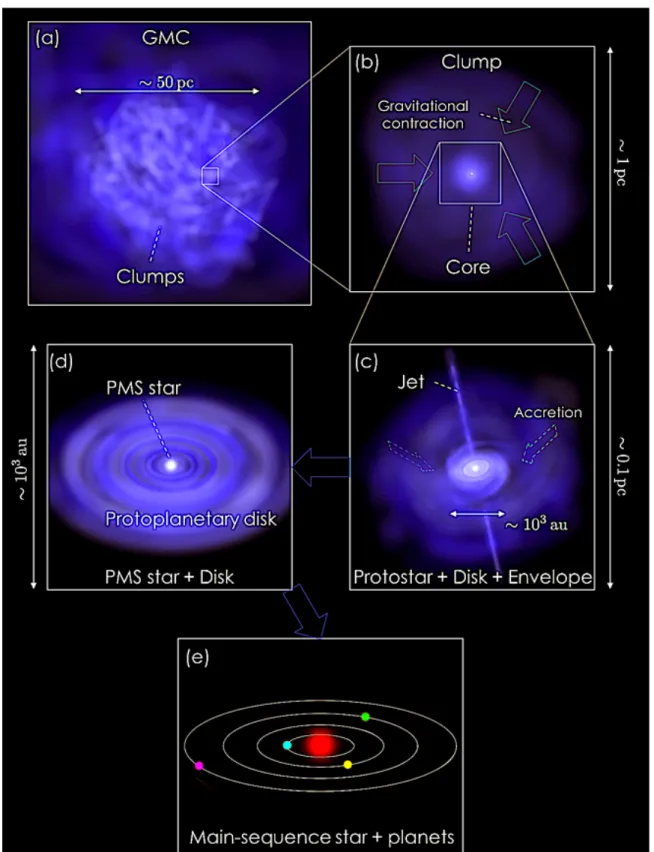
Stellar system formation begins with gravitational contraction of molecular cloud cores in a molecular cloud clump (Figure 1.1 (b)). Star “seeds” form there, while surrounding medium accretes to feed the seeds. The star seed gains mass and grows as the contraction proceeds (see also Section 1.4 for a detailed description of protostar formation). A geometrically thin Keplerian disk forms around the protostar as a natural consequence of angular momentum transfer (Figure 1.1 (c)). The disk is the birthplace of planets and thus is named a protoplanetary disk (PPD). In this earlier stage of stellar system formation, the envelope surrounds the young star-disk system. The envelope continuously falls onto the disk, and the disk, in turn, accretes to the star. The star gains mass through this accretion process.
The envelope finally disappears by the mass loss due to the accretion and/or dispersal by winds (Figure 1.1 (d)). The disappearance of the envelope makes the central star optically visible. The central star in this stage is referred to as a pre-main-sequence (PMS) star. PMS stars radiate photons with releasing its gravitational energy through the quasi-static contraction. The starlight is absorbed and scattered by circumstellar gas and dust. This significantly affects the structure and evolution of a PPD dynamically, thermally, and chemically. In the interior of a PPD, protoplanets are formed out of the gas and dust grains contained in the disk. Protoplanets grow to planets, while the disk loses the mass owing to disk winds and accretion.
After the disk dispersal, a planetary system and/or a debris disk may be left as a remnant of a PPD (Figure 1.1 (e)). The central PMS star becomes a zero-age main-sequence star (ZAMS) when the central density becomes high enough to burn hydrogen nuclei. At this point, the stellar system is composed of a main-sequence star and a planetary system as the solar system.
The timescale with which a protostar evolves to a main-sequence star is an important parameter to quantify a characteristic time of stellar system evolution. The gravitational energy of the star is radiated away during the quasi-static contraction. Thus,
d dt GM∗ R∗ ≃ L∗ d dtln R∗≃ −t −1 KH (1.1)
where G is the gravitational constant, M∗, R∗, and L∗ are stellar mass, radius, and luminosity, respectively. The right-hand-side of Eq.(1.1) is the inverse of the Kelvin-Helmholtz (KH) time
tKH= GM∗2 R∗L∗ = 3× 10⁷yr ( M∗ M⊙ )2( R∗ R⊙ )−1(L ∗ L⊙ )−1 . (1.2)
It gives a rough measure for the decrease of R∗ due to contraction. The KH time gets longer as the radius decreases by contraction. This indicates that the decrease of R∗slows down; young stars have stellar parameters close to the main-sequence values during a large portion of the time, until it evolves to the main-sequence star. Thus, tKH with the main-sequence values of M∗, R∗, and L∗
Chapter 1 Introduction 4
Fig. 1.1 Schematic picture of low-mass stellar system evolution. (a) GMC with clumpy substructures. (b) Close-up view of a molecular cloud clump in the GMC. The clump is gravitationally contracting in the central region, forming a molecular cloud core. (c) Close-up view of a molecular cloud core inside the clump. A disk forms around the central star, and the envelope falls onto the disk. A jet is observed in this system. (d) Young stellar system with PMS star and a surrounding PPD. Most of the envelope has disappeared by the time at which the system reaches this stage. Disk materials are accreting to the star and are forming protoplanets inside. (e) Disk has dispersed, and a young planetary system is left behind.
5 1.3 Mass Functions of Clumps and Cores, and Initial Mass Function
provides an approximate time with which a young star evolves to a main-sequence star. Note that the KH time is much longer than the crossing time of the star, which is of the order of hours. This guarantees the quasi-static evolution of PMS stars.
Eq.(1.2) shows that the evolution time of young stars depends on the mass. Since less massive stars tend to have smaller effective temperatures Teff, they take a longer time to evolve to main-sequence
stars. This indicates that the evolutional time of a young stellar system depicted in Figure 1.1 differs according to the mass of the stellar system. Although not necessarily related to the evolution time of stars, dispersal time of PPDs, which also quantifies evolutional time of young stellar systems, has been observationally found to be shorter around Herbig stars with a few solar masses than solar-type stars (see Section 1.5.4). This directly shows that the evolution time of the young stellar system depends on the mass. The evolutional time of young stellar systems might be also affected by other factors, such as metallicity, the multiplicity of central stars, and the existence of nearby luminous stars.
To summarize, some of the mass in the original molecular cloud core goes into the star, some of the other mass forms into planets, and the other is dispersed by jets and winds. Note that not all of the materials in the parental molecular core goes into constituent objects in the resulting stellar system. The evolutional time of young stellar systems may depend on the physical properties of the system itself and external environmental factors.
1.3
Mass Functions of Clumps and Cores, and Initial Mass Function
Molecular cloud clumps are the formation site of molecular cloud cores, and the cores are the parental bodies of stellar systems. The mass spectra of clumps and cores are thus significant to determine the initial mass function (IMF) of the resulting stellar systems and hence star formation efficiency. The IMF and star formation efficiency give many important implications to various fields of astrophysics, such as galaxy evolution and planet formation. Investigating these mass functions has been a subject of great importance.
Molecular line surveys have revealed that GMCs have self-similar structures, and the mass spectra of associated clumps commonly follow a power law relation dN/d log M ∝ M−x with x = 0.6–0.8 in a wide mass range of 10−4M⊙ < M < 105M
⊙ (Blitz 1993, Heithausen et al. 1998, Heyer and
Terebey 1998, Kramer et al. 1998, Mu˜noz et al. 2007). The index x is notably different from that of the Salpeter IMF x = 1.35 (Salpeter 1955). This suggests that there exists a departure from the self-similarity during star formation.
Continuum surveys have found steeper spectra of core mass functions (CMFs) than the clump mass function (Testi and Sargent 1998, Motte et al. 1998, Andr´e et al. 2010). The power law index of CMFs is estimated to be x = 1.1–1.5 for≳ M⊙ and fairly resembles the stellar IMF, in contrast to the clump mass function. The resemblance of CMFs to stellar IMFs holds to a lower mass extent
∼ 0.3 M⊙ (Andr´e et al. 2010), providing direct evidence of the connection between molecular cloud
cores and star formation. It is suggested that the core formation process may ultimately control the resulting mass spectra of stars.
Note that although the clump mass function is different from the IMFs, they do not necessarily have to be similar; not all molecular cloud clumps form stars inside them. Most of the contribution to star formation originates from star clusters forming in several of the most massive clumps in a molecular cloud. In order to reveal the origin of IMFs and the resulting mass spectra of young stellar systems, it would be necessary to understand the formation process of star-forming clumps and their evolution to individual star-forming cores.
Chapter 1 Introduction 6
1.4
Birth and Evolution of Stars
A star forms in a gravitationally-contracting molecular cloud core. As the contraction proceeds, the internal density of the core increases to become optically thick to infrared radiation. The core can not radiate away its internal energy anymore at this point. The internal temperature increases, and the pressure eventually balances with the gravity, when the central density reaches nH∼ 1011cm−3.
This (quasi-)hydrostatic gas sphere is a protostar core (the first core). The first core has a typical size of ∼ 1 au, the mass of ∼ 10−2M⊙, and the temperature of ∼ 103K. The main component is
molecular hydrogen.
The first core continuously grows in mass by accretion. The internal temperature also continu-ously increases. After∼ 104yr, it gets high enough (∼ 2000 K) to dissociate hydrogen molecules by collisions. The endothermic reaction allows the protostar core to resume a hydrodynamical contrac-tion.
The contracting protostar core reaches hydrostatic equilibrium again when it shrinks to several solar radii. The hydrostatic gas sphere is now a protostar (the second core). The typical temperature, density, and mass are∼ 4000 K, nH ∼ 1016cm−3, and ∼ 0.01 M⊙, respectively, at this point, and
the main component is ionized hydrogen HII.
Circumstellar materials accrete to feed the protostar. Dimensional analysis provides a typical accretion rate of ˙ Macc∼ MJ tff , (1.3)
where MJ is the Jeans mass given with gas density ρ and sound speed cs
MJ= π 6ρ ( cs √ ρG )3 , (1.4)
tff is the free fall time
tff =
√ 3π
32ρG. (1.5)
Thus, Eq.(1.3) reduces to
˙ Macc∼ c3 s G ≃ 6.4 × 10⁻⁶( cs 0.3 km s−1 )3 M⊙ yr−1. (1.6)
Note that Eq.(1.6) basically depend only on the temperature of the accreting gas. The validity of Eq.(1.6) is supported by numerical simulations (e.g., Shu 1977, Stahler et al. 1980, Masunaga and Inutsuka 2000) and the observations that typical accretion rates in the Taurus-Auriga molecular cloud is ˙Macc∼ 10−6 M⊙ yr−1 (e.g., Bertout et al. 1988, Hartigan et al. 1991).
When the accretion materials fall onto the star surface, it drives a shock with the temperatures of
7 1.5 Protoplanetary Disks
to radiation in optical and ultraviolet (UV) wavelengths. The accretion luminosity is estimated as
Lacc= GM∗M˙acc R∗ ≃ 3.1 × 101 ( M∗ M⊙ ) ( R∗ R⊙ )−1( M˙ acc 10−6 M⊙ yr−1 ) L⊙. (1.7)
Since protostars are embedded in optically thick clouds to optical and UV lights, the emitted photons can be only seen as infrared (re-)emitted by dust, which reprocesses the optical and UV photons.
The typical accretion rate in Eq.(1.6) indicates that protostars grow to a solar-type star on the timescale of∼ 105–106yr, while the accretion rate decays with time. The protostar finally shrinks to a few solar radii and has the central temperature of∼ 106K. The mass growth has almost completed
at this point, and the protostar proceeds to the pre-main-sequence phase.
PMS stars quasi-statically contract and radiate away its own gravitational energy. When the radius of a PMS star shrinks to ∼ R⊙, the central temperature reaches ∼ 1.5 × 10⁷K that is sufficiently high temperature to burn hydrogen. The nuclear fusion energy sustains high internal pressure of the star, and it halts the quasi-static gravitational contraction. Hydrogen burning is the onset of the main-sequence phase of stars. Main-sequence stars survive until they burn out all hydrogen fuel in the central region. Note that the overview of stellar system evolution described in this section holds for low- and intermediate-mass stars (M∗≲ 8 M⊙). Massive stars with a few tens of solar masses evolve in a different manner. *1
1.5
Protoplanetary Disks
In the formation process of stellar systems, a PPD forms around the central star and coevolves with it. The disk is composed of gas and dust, and is the parental body of a planetary system. Thus, physical properties of PPDs have a direct link to the formation and evolution of stars and planets. Understanding their properties and formation/evolution processes is essential to understand those of stellar systems. Especially, dispersal of PPDs is our focus of interest in Chapter 2 and Chapter 3. Here, we review their basic characters in detail.
1.5.1
Protoplanetary Disk Formation
Molecular clouds are inhomogeneous in both density and velocity, i.e. they have turbulent structure (Larson 1981, Ostriker 2007). This indicates that a star-forming core has angular momentum as a whole. The azimuthal motions of the circumstellar medium yield the centrifugal force and weaken the radial component of the gravity. The circumstellar medium thus flattens during the collapse and forms disk structure. An angular-momentum-conserved matter has a circular orbit with the radius
Reqat which the centrifugal force and gravity balance. The circular radius of a core with the specific
angular momentum l and mass Mc is approximately l2 2R2 eq =GMc Req Req= l2 2GMc .
*1 We omit to review the formation process of high-mass stars because our focus is on low-mass stellar systems
Chapter 1 Introduction 8
The specific angular momentum of a core with radius Rc and rotational energy Erot is roughly l≃√2R2
cErot/Mc. Thus, the circular radius is
Req= R2 cErot GM2 c . (1.8)
Observationally, an typical ratio of the rotational energy Erot to the gravitational energy Egrav= GM2
c/Rc of molecular cloud cores is χ≡ Erot/Egrav ∼ 10−2 (Goodman et al. 1993). The circular
radius of Eq.(1.8) is reduced to
Req∼ 102 ( Rc 0.05 pc ) ( χ 10−2 ) au. (1.9)
Hence, the collapse of a turbulent molecular cloud core results in the formation of a PPD with a typical radius of 102au. Note that a typical specific angular momentum of a molecular cloud core is
l≃ √ 2R2 cErot Mc ∼ 1021 ( Rc 0.05 pc ) ( Mc M⊙ )−1/2( χ 10−2 )1/2 cm2s−1, (1.10)
which is several orders of magnitude larger than the mean specific angular momentum of the solar system; a large fraction of the total angular momentum of parental cores might be lost during the formation process.
1.5.2
Protoplanetary Disk Structure
The dynamical time of a Keplerian disk is of the order of 103yr at 102au. It is several orders of
magnitude smaller than the dispersal time of PPDs, which will be discussed later in Section 1.5.4. This assures that as a first approximation, PPDs can be assumed to be in hydrostatic equilibrium (HSE).
PPD mass is typically Mdisk ∼ 0.01 M⊙ and at most Mdisk∼ 0.1 M⊙. The self-gravity of a PPD
is relatively weak, compared to the stellar gravity. In the cylindrical polar coordinates (R, ϕ, z), the radial and vertical force balances of an axisymmetric Keplerian disk are described as
0 =−1 ρ ∂P ∂z − GM∗ R2+ z2 z √ R2+ z2 (1.11) 0 =−1 ρ ∂P ∂R− GM∗ R2+ z2 R √ R2+ z2 + v2 ϕ R, (1.12)
where ρ, P , and vϕ are gas density, pressure, and azimuthal velocity, respectively. The equation of
state (EOS) for the ideal gas is given by
P = ρkBT µmu
. (1.13)
In the EOS, kB is the Boltzmann constant, µ is mean molecular weight, and muis the atomic mass
9 1.5 Protoplanetary Disks
vertically isothermal disk
ρ = ρmidexp [ v2 K c2 s ( 1 √ 1 + z2/R2 − 1 )] , (1.14) where vK= √
GM∗/R is the Keplerian velocity and cs=
√
kBT /µmuis the isothermal sound speed.
These quantities and the mid-plane temperature Tmiddefine the scale height of the disk H as H ≡ cs vK R ≃ 3.1 × 10⁻²(M∗ M⊙ )−1/2(R au )1/2 µ−1/2 ( Tmid 102K )1/2 R. (1.15)
The scale height H is notably much smaller than R at any distance. This indicates that ρ/ρmid≪ 1
holds for z≳ R in Eq.(1.14), and the bulk of the mass resides in the z ≲ R region. For the region, Eq.(1.14) is approximated by ρ≃ ρmidexp [ − z2 2H2 ] , (1.16)
and the disk surface density Σ is calculated as
Σ = ∫ ∞ −∞ ρ dz ≃√2πρmidH ∼ 103( nH,mid 1015cm−3 ) ( H 10−2au ) g cm−2, (1.17)
where nH,mid is the number density of hydrogen nuclei in the midplane. For comparison, the
so-called minimum mass Solar Nebula model (Weidenschilling 1977) of Hayashi (1981) gives the surface density distribution of Σ = 1.7× 10³ ( R 1 au )−3/2 g cm−2, (1.18)
for the gas component.
Eq.(1.12) describes force balance in the radial direction. Substituting Eq.(1.14) reduces Eq.(1.12) to vϕ2= vK2 { 1 +∂ ln Tmid ∂ ln R [ 1− ( 1 + z 2 R2 )−3/2] +H 2 R2 ( ∂ ln Tmid ∂ ln R + ∂ ln ρmid ∂ ln R )} . (1.19)
Supposing that Σ and Tmidhave power-law dependences on R of
Σ(R)∝ R−α Tmid(R)∝ R−β, Eq.(1.19) reduces to vϕ2= vK2 { 1− β [ 1− ( 1 + z 2 R2 )−3/2] −H2 R2 ( α +β 2 + 3 2 )} ≃ v2 K [ 1−H 2 R2 ( α +β 2 + 3 2 + 3β 2 z2 H2 ) +O ( z4 R4 )] (for R≫ z). (1.20)
Chapter 1 Introduction 10
velocity of PPD gas is sub-Keplerian. The sub-Keplerian motion has an important effect especially on dust dynamics in PPDs and, ultimately, on planet formation. Pressureless dust particles can orbit the central star with Keplerian velocity. Such dust particles move against the headwind by the sub-Keplerian gas. They transfer the angular momentum through aerodynamical friction to gas and migrate inward. The migration time of meter-sized planetesimals is the shortest, and it falls to the star on a much shorter time than planet formation timescale. This implies that such planetesimals cannot grow to a larger-size body in PPDs, which clearly contradicts the existence of the planets. This is one of the biggest issues in the field of planet formation theory. In order to form planets, planetesimals are necessary to grow fast before it falls to the star, or some mechanisms should work to stop the migration. Formation of fluffy dust aggregates is proposed as one of the potential solutions for the problem (Kataoka et al. 2013).
1.5.3
Observations of Protoplanetary Disks
By the beginning of the pre-main-sequence phase in the stellar system formation, the envelope has dispersed, and it makes the star-disk system visible in the optical and near-infrared wavelengths. The first direct observation of protoplanetary disks conducted by optical surveys with Hubble Space
Telescope (HST) in the mid-90s (McCaughrean and O’dell 1996). Its highly-resolved (∼ 0.1′′) observations captured direct images of PPDs, most of which are evaporating disks exposed to the intense radiation of nearby massive stars *2 or so-called silhouette PPDs. Those images show the
central luminous stars and surrounding dark disks with a size of∼ 100 au.
Before the direct observation by HST, Infrared Astronomical Satellite (IRAS) performed surveys of the entire night sky at mid- and far-infrared (IR) wavelengths (12 µm, 25 µm, 60 µm, and 100 µm). IRAS revealed that IR excess of PMS stars visible in optical light (See also Section 1.5.4) is ubiqui-tous in many molecular clouds and is originated from the reprocessed emission of the circumstellar medium. In the mid-90s, adaptive optics technique was applied to ground-based telescopes and made it possible to perform ground-based observations with resolutions as high as that of HST. High-resolution IR surveys have directly observed the near-IR lights of young stars scattered by the circumstellar disks. Those surveys have revealed that circumstellar disks have various morphology.
The development of bolometer array detectors greatly contributed to the studies of the young stellar system at submillimeter and millimeter wavelengths in the 80s and 90s. Since dust opacity is generally smaller in the submillimeter/millimeter wavelengths than in the ultraviolet, optical, or IR wavelengths, the submillimeter/millimeter wavelength lights are particularly useful to observe dense regions where AV is so high that their interiors cannot be seen even at IR wavelengths. One
example is the highly-dense, midplane region of circumstellar disks. The region is optically thick to the thermal emission of dust at the IR wavelengths but is optically thin to that at the submillime-ter/millimeter wavelengths. Thus, the emission is useful to systematically estimate the total mass of the disks. The submillimeter/millimeter lights are also used for the observations of protostars, which are generally embedded deep in the circumstellar medium. Thermal emission of protostars and sur-rounding medium cannot be seen even at the near-IR wavelengths. Submillimeter/millimeter surveys first succeeded to detect protostars that were hardly detected by IRAS. It is also noteworthy that the recent development of interferometer arrays permits the observations of young stellar systems with even higher resolutions. Atacama Large Millimeter/submillimeter Array (ALMA) achieves the highest resolution of∼ 0.01′′. The detailed observations with that high resolution have discovered many unexpected properties in young stellar systems. The discovery of the multiple rings in the
11 1.5 Protoplanetary Disks
HL Tau disk is a representative one. Since the detection of the rings in the HL Tau disk, ring/gap structure has been found in tens of PPDs. There also exist disks with a spiral structure of dust and with nonaxisymmetric structure. The recent discoveries of such detailed structure are changing our understanding of PPDs such that rather than a smooth density distribution, PPDs commonly have substructures: rings, gaps, spirals, nonaxisymmetries, and etc. In the 2020s, several other infrared and submillimeter/millimeter telescopes are planned to be in operation. Observations with these telescopes are expected to deepen our systematic understandings about the structure and properties of PPDs.
1.5.4
Lifetimes of Protoplanetary Disks
Materials of a PPD accrete onto the stellar surface in the region close to the star, while those apart from the star are dispersed by thermally- and/or magnetically-driven winds. Therefore, PPDs have the lifetimes. They are often estimated by observing the number fractions of disk-bearing members in young clusters. UV, optical, and IR lights are used for the observations. The optical and UV lights originate from the accreting gas driving a shock on the stellar surface, while the IR is from the reprocessed emission of dust on the surfaces of PPDs.
UV and optical photons of the central star are absorbed by the circumstellar materials. The circumstellar dust absorbs the UV and optical photons from the central star, reprocesses the photons, and thermally (re-)emits photons at IR wavelengths. A typical spectral energy distribution (SED) of a young stellar system is thus composed of two components: the stellar component whose wavelength ranges from ultraviolet to optical, and the circumstellar material component which significantly contributes to an observed intensity at the IR bands of the SED (Figure 1.2). The IR contribution from the circumstellar dust is referred to as the infrared excess (IR-excess), which is a direct indicator of the existence of a circumstellar disk around a PMS. Note that young stellar systems with embedded protostars, which are in the early stage of the evolution, are not visible at the optical or near-IR wavelengths in contrast to the young systems hosting PMS stars. The thin geometry of PPDs allows photons to be observed in a wide variety of wavelengths.
Although the IR-excess is defined as the excessive infrared above the stellar component, it does not mean that multiwavelength observations ranging from UV to IR are always necessary to find the IR-excess. The infrared colors J− H and H − K derived from J-, H-, and K-bands (1.25 µm, 1.65 µm, and 2.2 µm) photometric data provides a tool to detect the IR excess. Given that J HK photometric data is obtained for an infrared source, the infrared colors set the position of the source on the infrared color-color diagram. The position gives information about the magnitude of reddening due to the circumstellar and/or interstellar dust. Lada and Adams (1992) systematically showed that a young star surrounded by the circumstellar medium presents a significant H− K color excess on the color-color diagram, compared to stars without the circumstellar medium; such evolved objects are seen as main-sequence stars reddened by the interstellar extinction in the diagram. Applying these diagnostics to the members of a cluster yields the disk fraction, which is defined as the number ratio of the disk-bearing members to all the members. Observationally, it has been found that the disk fractions of the nearby clusters exponentially decrease as the cluster ages, and typically fall below 10% for the cluster age of ≳ 6 Myr (Haisch et al. 2001, Hern´andez et al. 2007, Meyer et al. 2007, Mamajek 2009, Ribas et al. 2014). Thus, typical disk lifetimes are estimated to be∼ 3–6 Myr for PPDs in the nearby clusters (Alexander et al. 2014, Gorti et al. 2016, Ercolano and Pascucci 2017). The lifetimes are estimated by deriving the disk fractions as a function of cluster age but not the age of a single star. One of the advantages using cluster ages to estimate the lifetimes is that
Chapter 1 Introduction 12
Fig. 1.2 Typical SED of a young star with a PPD. The red line shows the observed SED. The dotted blue line indicates the contribution from the stellar radiation, and the residual (the red area) are the contribution from the circumstellar dust.
broadband photometric data is not always necessary to determine their ages in contrast to the case of single stars. Using an evolutional model of PMS stars, we can model the near-IR functions of a cluster with a given IMF. Lada and Lada (1995) showed that the slope of the power-law portion of the K-band luminosity function (KLF) significantly changes as clusters age. Thus, cluster ages can be inferred by comparing the slopes of the model and observations. Both of cluster ages and the disk fractions, which are the necessities to estimate the lifetimes, are provided with the near-IR photometric data of clusters. Nevertheless, it is important to estimate the lifetimes as a function of the single star’s age because all members of a cluster may not necessarily have exactly the same age, and the environmental difference between single-star- and cluster-forming regions could yield a difference in their lifetimes. Takagi et al. (2014) investigated the disk lifetimes in single-star-forming regions. The ages of single stars are determined by the surface gravities derived with high-resolution optical and near-IR spectroscopy. The near-IR colors of the single stars are shown to decrease with increasing stellar ages. The dispersal time of PPDs is thus estimated to be∼ 3–4 Myr, which is in good agreement with the lifetimes of PPDs estimated for the nearby clusters. It is concluded that PPDs have the lifetimes of a few Myr in general.
Although the IR-excess due to warm and small circumstellar dust gives a tool to estimate the PPD lifetimes, dust is the minor component of PPDs in mass and evolves in a dynamically different manner from the gas component. The lifetimes derived with the IR-emission would not always coincide with those of gas disks. Gas disks could exist even after the disappearance of the IR-excess. Fedele et al. (2010) used Hα (656.28 nm) line emission from young stars to examine the lifetimes of the gas disks. It is empirically known that accreting stars have a larger equivalent width of Hα
13 1.5 Protoplanetary Disks
(EW [Hα]) than the chromospheric values of EW [Hα] (Barrado y Navascu´es and Mart´ın 2003, White and Basri 2003). Similarly, the width of Hα at 10% of the line peak is systematically known to be large (> 270 km s−1; Natta et al. (2004)) for accreting stars (White and Basri 2003, Natta
et al. 2004, Jayawardhana et al. 2006, Flaherty and Muzerolle 2008). These diagnostics are applied
to the nearby young clusters, and the gas disk fractions are shown to decrease as the cluster age increases. The typical lifetimes of the gas disks are derived to be 2.3 Myr; the gas component of PPDs also disperses on almost the same time as the dust component.
The near-IR traces the warm dust residing in the inner region (≲ 0.1 au) of a PPD. Therefore, the lifetime of ∼ 3 Myr estimated by the near-IR observations is not necessarily applicable to the dispersal time of the outer dust. Mid-IR (≃ 3 µm) and far-IR (≃ 20 µm) are used as tracers for the dust component at the outer radius of∼ 1 au and ∼ 10 au, respectively. Ribas et al. (2014) studied the decay of the disk fractions with these longer-wavelength IR, and showed that the e-folding time of the decay is similar for the disk fractions derived by near-IR and mid-IR (2–3 Myr) and is slightly longer for those estimated with far-IR (4–6 Myr). This suggests that a whole dust disk completely disperses within 10 Myr. Similarly, Hα is an accretion indicator which traces the gas component very close to the star. Millimeter transitions of 12CO and [O I] 63 µm are used to probe the cold outer disk. Although the number of the samples is limited, it has been found that the bulk of gas in the outer disk (∼ 10–102au) disperse within ∼ 10 Myr (Pascucci et al. 2006, Dent et al. 2013). Hence, both gas and dust components in a PPD are considered to disappear on the timescale of 10 Myr.
Multiwavelength IR observations have found a subgroup of PPDs that show lack of near- and/or mid-IR excess but have excess in mid- and far-IR wavelengths (e.g., Strom et al. 1989, Espaillat et al. 2014). These objects are termed transitional disks, and are inferred to be caught in the act of disk clearing. The fraction of transitional disks is only∼ 10% of detected PPDs. This statistically implies a much shorter transitional time, of the order of 105yr, than the disk lifetimes (e.g., Skrutskie et al.
1990). The existence of transitional disks and the aforementioned observational results indicate that PPDs abruptly disperse in an inside-out manner at the last stage of disk clearing. SEDs of some PPDs show a homogeneous depletion in the IR-wavelengths; the IR-excess emission is smaller than those of primordial (full) PPDs (for example, the average SED of the PPDs in Taurus star-forming region) but is larger than that of debris disks (Currie et al. 2009), which are the remnant objects after disk dispersal. However, recent radiative transfer studies showed that most of these homogeneously depleted disks may be optically thick disks with dust well settled in the midplane (Ercolano et al. 2011), and the dominant channel of disk dispersal is the inside-out clearing (Koepferl et al. 2013).
In the literature above, the lifetimes are estimated for young low-mass stars with M∗ ≲ M⊙. However, the different physical properties of high-mass stars can affect the lifetimes of PPDs. Ribas
et al. (2015) examine the PPD lifetimes around young stars with a wide range of mass covering
a high-mass regime M∗ ≥ 2 M⊙. The disk fractions are found to decrease for both low-mass stars (M∗< 2 M⊙) and high-mass stars (M∗≥ 2 M⊙) at older ages. It is also found that PPDs are present around the low-mass stars more frequently than around the high-mass stars at any age of stars. The mass dependence of the disk fractions is statistically robust enough to conclude that PPDs evolve faster and/or earlier around the high-mass stars. The physical reason for the mass dependence is still an open question but photoevaporation (Section 1.5.6) may be a key dispersal mechanism; higher luminosities of high-mass stars can potentially shorten the dispersal time of PPDs.
Chapter 1 Introduction 14
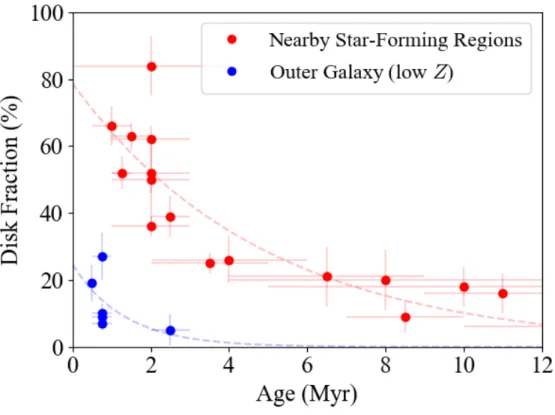
Fig. 1.3 Disk fractions of the nearby star-forming regions (red) and the clusters in the outer Galaxy (blue), where metallicity is significantly low, approximately Z ∼ 10−0.7Z⊙. The data is taken from Ribas et al. (2014) and Yasui et al. (2010) for the disk fractions in the nearby regions and in the low-metallicity environments, respectively. The dashed lines fit the observational disk fractions to the exponential function given by Eq.(1.21). The best-fit e-folding times, or typical lifetimes, are τlife= 4.9± 1.1 Myr for the nearby star-forming regions and τlife= 1.3±1.9 Myr for the clusters in the outer Galaxy. (See also Table 1.1 for the best-fit parameters.)
1.5.5
Metallicity Dependence of Lifetimes
Dust grains and metal species are important as the absorbers of photons as well as coolants in star-forming regions. The amount of them significantly matters in the formation and evolutional processes of stars, disks, and planets. The amounts of metal species and dust are associated with metallicity Z. Higher-metallicity environments correspondingly have a large amount of dust and metal species.
In the Milky Way, it is well known that the metallicity is the highest near the galactic center, where the stellar density is high and declines as it gets distant from the center. Star-forming regions also exist in the extreme outer regions, and the environmental difference can cause different PPD lifetimes from those of the nearby star-forming regions. Since PPD lifetimes directly links to the formation time of planets, it is essential to investigate PPD lifetimes in different metallicity environments in order to understand the stellar system formation in general.
The near-IR observations have been conducted for the star-forming regions in the extreme outer Galaxy, where the metallicity is significantly lower than in the solar neighborhood, to estimate the
15 1.5 Protoplanetary Disks
disk lifetimes (Yasui et al. 2009, 2010, 2016a,b). Interestingly, the disk fraction there declines steeply with increasing cluster age and becomes ≲ 10% at the cluster age of ≲ 1 Myr. In Figure 1.3, we compare the disk fractions in the nearby star-forming regions and in the low-metallicity environ-ments. The data are compiled from Ribas et al. (2014) for the nearby clusters and from Yasui et al. (2010) for those in the outer Galaxy. We fit the disk fractions fdisk as functions of cluster age tage
to
fdisk= f0exp[−tage/τlife], (1.21)
where f0 is the disk fraction at tage = 0, and τlife is the typical lifetime. Note that the fitting
function goes to zero with tage → ∞, implying the assumption that any disk eventually disappears.
We use the least squares method to fit the disk fractions. The best-fit parameters are listed in Table 1.1. It appears that a PPD in low metallicity environments disperses earlier and/or faster
Table 1.1 Best-Fit Parameters for the Observed Disk Fractions. Nearby clusters (Z ≃ 1 Z⊙) Outer Galaxy (Z≃ 0.2 Z⊙)
f0(%) 78± 9 4.9± 1.1
τlife(Myr) 25± 19 1.3± 1.9
than in nearby environments. The causes of the metallicity dependence have also been unclear but again, photoevaporation (Section 1.5.6) is proposed as a key dispersal mechanism that can potentially yield the metallicity dependence (Ercolano and Clarke 2010). The metallicity dependence of PPD photoevaporation is discussed in Chapter 2 and Chapter 3.
1.5.6
Dispersal Mechanisms of Disks
It has been observationally confirmed that the lifetime of PPDs is of the order of several million years in general, depending on metallicity and the stellar mass. Since not all materials might go into forming planets, some mechanisms should work to disperse PPDs within the time. Several dynamical processes such as accretion (Shakura and Sunyaev 1973, Lynden-Bell and Pringle 1974), photoevaporation (e.g., Hollenbach et al. 1994), magnetohydrodynamics (MHD) wind (e.g., Suzuki and Inutsuka 2009), stellar wind (e.g., Elmegreen 1979), and giant planet formation (Rice et al. 2003) have been proposed to be effective on disk dispersal. In particular, disk evolution models in which a viscous PPD evolves under the effects of the winds driven by photoevaporation and/or MHD effects appear to well explain both the lifetime and the formation of the transitional disks (Clarke et al. 2001, Alexander et al. 2006, Owen et al. 2010, Gorti et al. 2015). Thus, accretion, photoevaporation, and MHD wind are considered to be key dispersal mechanisms of PPDs at present. We briefly review these processes in this section.
Accretion
PPDs lose the mass mainly via accretion, especially at the early stage of disk evolution. The angular momentum of a PPD is transferred and redistributed within the disks. The angular momentum of an inner annulus is transferred to the adjacent outer annulus via viscous friction. The governing
Chapter 1 Introduction 16
equations of motion for viscous gas are
∂ρ
∂t +∇ · ρv = 0 (1.22)
ρdv
dt =∇ · S + ρK, (1.23)
where S is the stress tensor and K is body force. Let µ be the coefficient of the shear viscosity in this section. The stress tensor is given as
Sij=−P δij+ 2µ ( eij− 1 3eδij ) , (1.24)
where e is the rate of straining tensor
eij ≡ 1 2 ( ∂vi ∂xj +∂vj ∂xi ) , (1.25)
and e is its trace. The bulk viscosity is neglected in Eq.(1.24) because it is generally small compared to the pressure or shear stress. Hereafter in this section, we use the cylindrical polar coordinates, and we assume that the viscous gas has a rotational axis and is axisymmetric around it, and that the variables are symmetric along the z-direction. Galilean invariance allows us to set vz≃ 0. Thus,
Eq.(1.22) and the ϕ-component of Eq.(1.23) reduce to
∂Σ ∂t + 1 R ∂ ∂RRΣvR= 0 (1.26) ∂ ∂tΣR 2Ω + 1 R ∂ ∂RR 3Σv RΩ = 1 2πR ∂ ∂R ( 2πR3νΣ∂Ω ∂R ) , (1.27)
where ν ≡ µ/ρ is the coefficient of kinematic viscosity and Ω ≡ vϕ/R is the angular velocity.
Eq.(1.27) is the transfer equation of angular momentum. The right-hand-side describes the net shear stress exerted by the adjacent annulus. We further assume that Ω is independent of time. *3
Eq.(1.26) and Eq.(1.27) are then rewritten as
∂Σ ∂t =− 1 2πR ∂ ∂R ∂ ∂R ( 2πR3νΣ∂Ω ∂R ) ∂ ∂RR 2Ω (1.28) 2πRvRΣ = ∂ ∂R ( 2πR3νΣ∂Ω∂R) ∂ ∂RR 2Ω . (1.29)
In the case of an accreting disk around a star, the R-component of Euler equations yields
ΩK=
√
GM∗
R3 . (1.30)
*3 This assumption is justified when RΩ ≫ vR and RΩ ≫ R∂vR
∂R, according to the R-component of Euler equations.