EBA EBA
e d or earnin no ed e prod c ion s pervised e perience
Evidence Based Approach (EBA)
An Innovation in Higher Education
Vu Le Thao Chi
Project Assistant Professor, Faculty of Policy Management, Keio University
Mass education is to create standardized men (citizens) through universal institutions -- formal schools -- for building a nation-state. Higher education is expected to follow this to meet the nation’s higher demand for the individuals of outstanding quality. The Evidence Based Approach, more than a training-in-research method, is an innovative response to the demand for upgrading the quality of learning at higher education. EBA promotes two-way interactions between teachers and students through distinctly different learning environments of conventional classrooms, a cyberspace, and the “field,” the living environments in Asia. By going through these environments, students have an excellent opportunity to learn through a best mix of the “mediated” knowledge (from teachers) and the “experienced” knowledge (by themselves).
Abstract:
1 Introduction
Higher education is one important step to bring the students closer to specialized professions with high and possibly tested skills, with the goals of bringing out the students’ untapped potentials and especially their individualities (what each individual is capable of) to meet the higher demands of an ever-growing society. Their qualities and individualities are measured not only by the ability to absorb knowledge but, more importantly, by the ability to apply and create knowledge in real-life contexts. That the students master theories, practices and innovations, and therefore, can be “best used” upon graduation is the optimal goal of higher education.
However, a great deal of distance separates “theories” and “practice,” their actual utility, and has always been one of the most difficult to calculate how far. According to one survey (2014) by AACU (Association of American Colleges & Universities), of the 17 “outcome” (of the higher education) areas tested, the most highly valued by 400 surveyed employers include: written and oral communication, teamwork skills, ethical decision-making, critical thinking and the ability to apply knowledge in the real-world settings. But only one-quarter of the surveyed employers say that the recent graduates are well prepared in these requirements, meaning the majority of the employers, accounting for the remaining three quarters (75%), think the graduates are not qualified to be “used” right away for failing some of the essential requirements including “thinking critically,” “communicating clearly” and “solving problems.” Given this situation, there is one suggestion from the employers’ side that the students should complete a “significant applied learning project” before graduating from college [1].
This “significant applied learning project” idea comes close to the idea of “learning by doing” which was conceived by pragmatist John Dewey as early as 1916 [2] and later became “supervised practical experience” expressed in different terms such as “practicum, internship, externship, field placement, f ield study, f ieldwork, f ield observation” [3]. This “supervised practical
experience” is more systematic and compulsory in medical training. For a medical profession, he or she is required to have this “supervised practical experience” at hospitals after graduation for at least one year or more, depending on the country, in order to be qualified as a medical doctor. However, unlike the pre-medical students, those aspiring to seek employment in other professions are not always offered with, or required to have, anything similar to this “supervised practical experience.” It is usually still up to the proactiveness of students -- especially in the non-engineering fields -- to find such opportunities for themselves, and not to the institutions of which they are part.
The paper aims to illuminate some of the problems associated with the general lack of the “supervised practical experience” at higher educational institutions, and to evaluate how EBA, as initiated and practiced by Keio University as such an effort, or anything similar to it, can fill this void.
2 The Problem: No Place for the Self in Learning
Learning, as def ined by Oxford dictionary, is the acquisition of knowledge and skills through study, experience, or being taught [4]. As briefly mentioned in the introduction, there has been an imbalance between “learning through study and being taught” and “learning through experience.” Of these, the former has enjoyed a lopsided allocation of time and other resources in its favor at the cost of the latter. This imbalance is most glaring especially in the non-engineering fields at the higher educational institutions.
Advent of information technology especially in multiplying our ability to acquire what we look for, or in the vast improvement of the platform on which we seek things we look for, has not led to the corresponding correction of that imbalance. The introduction of Internet into higher educational institutions as well as its omnipresence in our daily life has not necessarily made this picture look any brighter. What lies in the way of remedying the imbalance is the prevalence of the tendency to take information at its
face value and little or no training in how to make sense from the collected information. The well-planned curriculum with its almost exclusive focus on the student life within the physical conf ine of the campus, and the semester-based time boundary is also a hidden barrier toward correcting this imbalance.
Internet definitely has made the information “acquisition” more cost (time)-efficient, more convenient and faster. Most of us, as blissful users, have taken the omnipresence of internet for granted and only enjoyed this “shortest-cut” to a seemingly bottomless reservoir of information from this platform. Within the very short history of 40 years, Internet, originally a military communication network, has become a vast cyberspace where more data has been generated, circulated and distributed than ever before.
Internet has also penetrated deeply into our daily life through Internet of Things (IoT) -- “seamless network of everyday objects” [5], connecting any physical objects (devices) to the Internet and enabling them to collect and exchange data among them, and control their movements. Currently, there are more than 20 billion objects/devices connected to Internet and it is estimated by 2025, the number will jump up to 75 billion[6]. Data on just about everything involving people’s life, in its increasingly voluminous amount, therefore, will be generated and stored by the devices themselves without the need for humans to constantly enter, monitor and examine it. “They (computers) can see, hear, and smell the world for themselves”[7]. With its far-reaching influence in our social life, the inclusion of Internet in higher education institutions, with the difference in degree only, to create a robust infrastructure to facilitate the teaching and learning has become an irreversible trend. The increase in the availability of and accessibility to information is, without a doubt, of great assistance to the learning of students.
But this convenience can become a double-edged sword. Students may be better and quicker at acquiring but not necessarily at choosing the
information of relevance. Critical thinking among students -- that is, the ability to question the value of the acquired information in order to use it more selectively, properly and convincingly does not seem to have a place in the process. Just imagine, all students have to do these days is to turn on laptops, computers or smartphones to find the answers to questions, nearly any question, immediately, often times without even the need to precisely paraphrase the questions on hand.
One research done by a group of American psychologists found out that people are “primed to think about computers and that when people expect to have future access to information, they have lower rates of recall of the information itself and enhanced recall instead for where to assess it,” and therefore, “once information has been accessed, our internal encoding is increased for where the information is to be found rather than the information itself.” Memory then becomes just an “external or transactive memory where information is stored collectively outside ourselves”[8]. Our memory now only serves as a transition mode and information or knowledge -- a set of processed information -- do not become part of ourselves. In that sense, the abundance together with the convenience of Internet is not necessarily a blessing to the process of learning for the students.
Learning, in Japanese, also means “bring it close to your body” (“mi ni tsukeru” -- , or more liberally, ). This understanding provides a good insight into the nature of “learning,” in which learning should not be only the acquisition of information. It also entails the process of bringing that information closer to the body -- or the self -- of the learner. It involves the turning of information into knowledge, that is, selecting from the acquired information to make a coherent set for given purposes [9].
“Bring it close to the body” calls for an element of intimacy between information about the “outside” and the learners during the learning. This intimacy is decided and generated by nobody [10] but the learners themselves
through their senses serving as “f ilters through which later perception must pass” [10]. These filters were formed during the earlier learning during the formative stages as the first step of socialization process and can be attenuated, modified, and even refined by later experience[11] .
How the filters work, in turn, depends on how broadly their senses have been exposed to, and thereby tested, which will give them a more refined feel and intuition about what is more relevant and what is not during the information acquisition. This progression is, to put it another way, a process of examining the credibility and reliability of the pre-existing knowledge. All should precede to, or take place simultaneously with, deciding whether to use the acquired information or leave it out, and if using it, i.e., deciding what is relevant to what he or she is looking for.
That is how “critical thinking” works and should work. However, this critical thinking is on the decline among students as they are drowned in the sea of information and data as they are profusely produced and transferred by the increasing number of “others,” the majority of whom are distant strangers to the users, their “clients.” The students find themselves under the great pressure of receiving and knowing everything out there, which may make them receptive but basically as a working antenna. There seems no time for them to filter the acquired information through their own senses and feels. Whatever the preceding knowledge they may have soon becomes irrelevant. Leaving the filter process to the initial impressions without further examination is an unavoidable consequence [12].
The “self ” of the learners is now simply a transition mode between information about the outside and the tasks like homework, assignments or a problem in need of a quick fix. Knowledge is just a footnote, an attachment file, but not part of the body of the discourse sent out by the learners. With less involvement of the self and more influence of the distant “others” in the learning, the individuality and the potentials of the students stay untapped, therefore the problem solving are less likely to be innovative.
3 An Alternative
3.1 An Alternative: Learning by “Experiencing”
Learning and the self are inseparable. People learn, after all, to serve two purposes: 1) to make sense of his/her being and living in the world; and/or 2) to make sense of the world from his/her standpoint. Therefore, learning is not only the work of quickly accumulating and storing information like a computer machine. It is also the process wherein that information is filtered, weighted, selected and combined, and turned into knowledge by his/her self. That is, to allow the “self ” to experience that knowledge and its production through his/her senses.
Experience, when it comes to learning, is usually used as a noun, rather than a verb, to mean an actual encounter with things or people or phenomena from which knowledge is supposed to be generated, as opposed to the knowledge gained through studying or being taught. This paper offers, as a basis for EBA, a different approach to examine the term “experience.” That is, experience here is used as a verb to mean filtering information through one’s senses, and only by that “experiencing” what information may convey, either from the means of media or from direct encounters, what is the learner’s “outside” can “come close to his/her body.” Thus a round of knowledge production is completed and that knowledge, in turn, becomes the beginning of a new round of knowledge production.
This “experiencing” through the senses -- seeing, hearing, smelling, tasting and touching -- allows the learners not only to be impressed, but also to be surprised, to be stricken, and later to become curious about the world they (re)capture through the information. This curiosity, in particular, would prompt more questions, guiding the search for additional information. The whole process would repeat with questions and redefined questions until a satisfactory answer (or even solution) emerges. The result of the process is that the senses -- feels and intuitions -- become sharper, enabling the learners to find and catch, not just anything, but things relevant to their research.
The intimacy, between knowledge and the self, is as important as the knowledge itself. Once experienced, according to psychologist Eldon Tulvin, the knowledge is stored in long-term “episodic memories” (remembering) while knowledge, without being experienced yet, is considered “knowing,” and stored in “semantic memories,” the stage preceding to episodic[13] . In sum, experiencing knowledge is an integral part of knowledge production, whether it is acquired through direct and indirect encounters, well considered, well re-considered, well digested, applied and/or innovated.
3.2 The Alternative in Practice: “Supervised Practical Experience”
Some started doubting about the necessity for the physical presence of higher educational institutions before the storming penetration of e-world of Internet. “Look at the music industry. It's been completely overturned by the Internet... Journalism is in the midst of the battle. And higher education is probably next,” as put it by George Mason University economist and Marginal Revolution blogger Tyler Cowen [14]. From a more pragmatic point of view, the accreditation -- the ability of the providers to offer recognized credit courses and bestow degrees and diplomas -- may well be the remaining value for the educational institutions.
However, the higher education institutions can be very much alive in the interactive relationship between the teachers and the students, given a certain set of conditions. The teachers play the role of supervision of the students by initially refining, upgrading and providing the existing knowledge and instructions on how to make use of it; they also provide their “real-time” feedbacks to students’ understanding of it and to the students’ corresponding performance (in, say, scientific experiments). One cannot overemphasize the point, here, that this feedback is a reciprocal process as the students also witness the teachers adjust, refine, and/or modify their initial use of the knowledge in the face of the students’ making use of it. Students “experience” the knowledge as they themselves make use of it, find the need to change
or refine it while its initial provider, too, may go through a similar, if not identical, change. Internet, on the other hand, can cater to various and spontaneous needs of the students based on the existing knowledge. Internet alone does not or can’t help providing the kind of interactive instructions that can shift, grow, and refine the needs of students which shift, grow and change as they “experience” the knowledge.
One condition of critical importance for the higher educational institutions to protect the interactive teacher-student relationship in the face of the penetration of internet is that the teacher-student interaction is secured outside the physical confine of the classroom. Only then can the interactive instructions and feedbacks embrace practical experiences which have become “essential for graduate preparation” since the middle of last century[15] as well as the “learning opportunities for enabling new professionals to thrive within the rapidly changing higher education milieu”[16].
That experiences are not limited within the classroom boundary or even the campus boundary succinctly summarizes what underlies the “supervised practical experience” or supervised practice. “With the guidance of a faculty or site supervisor, students are able to address real-world issues and develop tacit knowledge -- the kind of practical wisdom that allows for seemingly intuitive problem solving. In addition, supervised experience develops a trajectory of increasingly complex thinking that will likely generalize to new situation, such as those encountered in a first professional position”[17]. SFC (Shonan Fujisawa Campus) of Keio University, Japan is among the first and few campuses in Japan putting this “supervised practice” into practice when it launched the “project-based learning to develop expertise” in the early 1990s. Students since their early years at the university can join the “seminars,” which used to be called, aptly, the “workshops.” Through the workshop-like seminars, the students are expected to develop a research project which they complete within the relative short period of a few semesters or years. Everything is designed so that the students would go
through the whole motion of finding a problem worthy of solution. Easier said than done. However, the merit of this style of student training lies in what appears to be its parametric impact.
First, when the students choose to participate in the seminars of their preference, they really are taking the first step to think of their learning process extending beyond the campus boundary as they are pushed, often inadvertently, to think of “where” they can “experience” the knowledge they are taught in the seminars and lecture courses. A concrete first step may be initiated by the students themselves, when they, with a problem clearly defined and a goal of collecting relevant data cleared in their minds, begin to write up a proposal to win one of the few research grants available on campus to finance their trip outside the campus boundary or even the national boundary.
Even within the campus boundary, the students are exposed to diverse “worlds” represented in the seminars which often allow or encourage graduate students to join and bring in various research (knowledge) experiences and, more recently, the increasing number of foreign students their somewhat unfamiliar (to the Japanese students) life experiences. There is something else which works on the minds of the teachers and the students alike. In these seminars, where regular discussions are held often more than once a week, the students are expected to be able to work with the faculty members more as equal partners rather than as the mere receptors of knowledge[18].Under this pressure, the students are pushed to familiarize themselves with real-life issues, and to “identify a problem and f ind a solution to it” rather than remaining as one who “just knows the answer to a given question” [19]. Accordingly, they often push themselves to question how to make theories serve practically the problem defining and solving.
One result is that they are more focused in their search for relevant knowledge and also better at filtering it in order to make it more relevant, and therefore intimate, to their research. Another result, which is often
unbeknownst even to the students themselves, is a subtle shift in their thinking. The usual distinction between semesters and long-tern breaks such as summer or spring break is reversed or disappeared: the work during the semester, i.e., “within” the classroom boundary, is the preparatory step toward the work “without” during either of the following two long-term breaks. Here, students are crossing another boundary, the time-boundary of the semester-semester break division.
The project-based learning helps make students more oriented, more selective and at the same time more demanding on further knowledge. But it is not without a room for improvement: the supervision by teachers of students are still often limited within the boundary of seminar rooms. The effectiveness may still largely depend on the chemistry of the teacher-student mix. The residual impact of the obvious “authority” relationship between them, too, cannot be taken too lightly.
Besides, the supervision in the form of feedbacks in response to the students’ findings from their fields may still run triple risks: 1) failure to insure the quality of the fieldwork by students, 2) insufficient testing of the validity of the findings by the students, and more importantly, and 3) missing what the students may have missed. All these, combined together or separately, play critical role in the problem-finding and solving. None of these problems alone, however, may be disastrous to the growth of students and to the credibility of the institution, as long as the project-based learning secures a feedback loop of its own where the teachers and the students alike can run through the whole process in a refined version of finding a problem, its parametric factors, and its solution.
From this perspective of securing a self-corrective loop, however, one thing stands in its way: the loop is costly, time-wise and money-wise. Furthermore, things you miss at a given time cannot be the same at any other time; and the students cannot afford to return to their field anytime of their own choosing. The only protection against this misfortune is the thorough
preparation in designing the entire research process. As uncovered thusly by practicing the project-based training, the supervised practice, or the supervision over the practice of the students in the field still has a long way to go before becoming fail-safe.
3.3 EBA in the practice of the Experiencing Knowledge
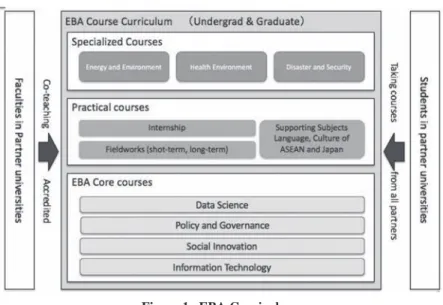
A group of professors, led by Prof. Jun Murai, Prof. Keiko Okawa and Prof. Shinnosuke Obi, at Keio University, being aware of the need of supervised practice for students, launched the EBA program in 2012, under the auspices of Ministry of Education, Culture, Sports, Science and Technology, Japan through the mega project of Re-inventing Japan for the academic period 2012-2016[20]. Together with other 6 institutions from 5 countries (as of 2012) in Asia[21], Keio created a “University consortium for Evidence Based Approach” to emerging policy issues in Asia. EBA concentrated on the 3 specific areas: “Energy and Environment”, “Health and Environment” and “Disaster and Security.” Member universities within the Consortium worked together, jointly designed a course curriculum for students of the participating universities, both undergrads and graduates. The uniqueness of the EBA program was the 3-dimensional training- 1) online training including cross-university online courses (Japanese and Specialization Subjects) and online sessions (Open Seminars scheduled on monthly basis), 2) conventional, or traditional “classroom” training, by making use of the available courses that have content fitting the requirement of EBA program (EBA core courses), and 3) practical courses including internship programs and fieldwork programs (Figure 1).
The bold step that EBA advocated is the inclusion of “supervised practice” through its intensive and extensive fieldwork programs (one of the two legs of EBA practical courses). Within the 5-year period (2012-2016), EBA has organized and managed 42 fieldworks (including 10 rounds of preliminary fieldworks in the first 2 years), of which 21 rounds were
Figure 1 EBA Curriculum
in ASEAN countries and 21 in Japan. The total of participants in EBA fieldwork programs is 488, in which 261 are from ASEAN and 227 from Keio University. No other programs have organized fieldwork programs of this scale within such a short period of time.
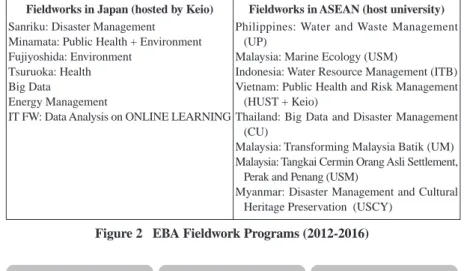
EBA fieldwork programs cover a great number of topics, too, within the three areas “Energy and Environment”, “Health and Environment” and “Disaster and Security” (Figure 2). There are fieldworks repeated every year like Minamata fieldwork, Fujiyoshida, Sanriku Fieldwork, Vietnam Fieldwork, Philippines and the like.
The framework of EBA fieldwork arm can be schematically summarized as follows (Figure 3):
EBA fieldwork programs are the result of the collaboration between the member universities of EBA Consortium by relying on the established research f ields of their respective faculty members. For each round of fieldwork, up to 30 students, across disciplines, both Japanese and ASEAN
students, are recruited for the program. During the 10-day framework (including moving days), students are always accompanied by local instructors and volunteers (assisting both in language and technical training), constantly receiving close instructions and supervision when needed in order for them to make the best of their experience in the field.
The interactions between teachers and students are intensive, and are more often than not like between “equal partners” as they can exchange the interpretations of their “experiencing” of the same reality in the field. Competing with each other regarding how they interpret what they observe in the fieldwork is also likely and encouraged to take place, but it is done in
Figure 2 EBA Fieldwork Programs (2012-2016)
Fieldworks in Japan (hosted by Keio) Fieldworks in ASEAN (host university)
Sanriku: Disaster Management Minamata: Public Health + Environment Fujiyoshida: Environment
Tsuruoka: Health Big Data
Energy Management
IT FW: Data Analysis on ONLINE LEARNING
Philippines: Water and Waste Management (UP)
Malaysia: Marine Ecology (USM)
Indonesia: Water Resource Management (ITB) Vietnam: Public Health and Risk Management
(HUST + Keio)
Thailand: Big Data and Disaster Management (CU)
Malaysia: Transforming Malaysia Batik (UM) Malaysia: Tangkai Cermin Orang Asli Settlement,
Perak and Penang (USM)
Myanmar: Disaster Management and Cultural Heritage Preservation (USCY)
a constructive and instructive fashion. This is where the idea of “learning by experiencing” is best applied.
The students do not simply go to the field to have a new experience (noun); more importantly, they are given the opportunities to experience (verb) what they see and do through verbalizing their thoughts and through exchanging them with their peers and instructors. Not only that, the students can also “experience” the “studied” knowledge and information that they have picked up and see if that knowledge still can hold and examine if that information helps them capture the reality better. Or conversely, they see if what they observe can enrich and/or refine implications of that knowledge with the new things they gather in the field.
This experiencing as a way of learning shows that learning may be just the matter of enriching what the learners already have (the memory). However, it entails more since the whole process of enrichment consists of refining the processing, the storing and also changing what is inside them. To borrow from William J. Clancey, an IT engineer, cognitive scientist, and philosopher of a sort all in one:
Speaking must be seen not as bringing out what is already inside, but as a way of changing what is inside. Speaking is not restating what
has already been posted subconsciously inside the brain, but is itself an activity of representing. Our names for things and what they mean, our theories, and our conceptions develop in our behavior as we interact with and perceive what we and others have previously said and done. This causal interaction is different from the linear “describing what I perceive” or “looking for what I conceive.” Instead, the processes of looking, perceiving, understanding, and describing are arising together and shaping each other[22].
4 EBA for higher education: Witness Accounts
What EBA entails goes receiving and ref ining knowledge coming from outside. The students have an excellent opportunity to have better understanding of the “self ” -- what they are, what they can do and what they want to do. By experiencing themselves in a different (from their familiar life) yet real context, the students do become more aware of themselves, to find out more what they know, what they may have never thought of, what they have taken for granted, and how they see things, among others. The process helps them become “surprised, to be stricken, and later to become curious about the world they (re)capture through their senses.” This, in return, plays an important step to bring out individual qualities of the citizens to confront the needs for a higher stage of a nation’s development, as stated earlier. That experiencing and the self-reflection upon that “experiencing” may be well illustrated in the three following accounts.
“My happiness. Whose happiness. Peaceful society. Vietnam Fieldwork has given me the precious experience to reconsider things I just took it for granted and think about things that I have never given a deep thought about. Also, being exposed to things with my own eyes, hearing stories from local people, I have felt I have found new values and nature to the problem for the first time. For that reason, although I haven’t changed the desire to become someone who can contribute to a Japan of peace and abundance, I have come to respect and cherish the desire to set my foot on a lot more places and help solve many intricate social problems.”
E. N., female, 22 years old, graduated from Faculty of Laws, Keio University, member of Vietnam Fieldwork in 2016. She will soon work for Japanese Ministry of Economy, Trade and Industry
“Joining Myanmar Fieldwork this time, for me, was to let myself be exposed to the problem at the local with my own eyes rather than to
f ind out what I can do regarding the problem. Although the illegal resettlement and illegal shop as research topic were already decided for the fieldwork, I kept wondering what actually is the problem regarding the issues during the fieldwork. Especially, when I was researching on the issue of child labor, looking at those kids who came to pagoda sites to work during school breaks and can learn English at the same time, it just occurred to me that, maybe to outside kids, this is also what they want to do. At the moment, I felt the need to raise the problem in a careful manner, and that should be based on the clues from visiting the sites, not with the biased images about child labors.”
H. I., female, 3rd year student at Faculty of Environment and Information, Keio University, member of Myanmar Fieldwork, 2017
“Through the fieldwork in August, I came to realize that I have never questioned the word “handicapped child.” What exactly is the problem facing the local people? And what is the problem that I want to deal with? Once I realized that, I became more curious about policies, institutions, education and working environments, things that are evolving around local people’s daily life. Also, not only at the field, I started wanting to apply the concept I learned from the f ield to approach things I see in my own daily life. I have become more curious about more things like my hometown, my family, relatives.”
M. N., female, graduated from Faculty of Policy and Management, Keio University, regular member of Vietnam Fieldwork 2015-2017. She will work soon for Nippon Foundation- Japan
Broadening students’ perspectives approaching reality, ref ining meanings in conventionally and casually used concepts like the “child labor,” or the “handicapped,” and boosting up the desire to link that reality in the field to the daily life, future work is already in the making in these students’
minds. It is the opportunity for them to think clearly about the need to define the problem, to understand clearly what they can do before they can start thinking of solving the problem. Professor Michio Umegaki (retired, Professor in Political Science at Faculty of Policy and Management, instructor for Vietnam Fieldwork), impressed with the products (poster session and other forms of the final presentations by the fieldwork participants, confessed: “A 10-day work in the fieldwork may be more productive than a couple of 15-week lecture courses for the students.”
In addition, the EBA supervised practice is beneficial to the teachers. Their positioning differs greatly from what they are in the classroom. The teachers-students distance created by the authority of the teachers in the classroom is reduced, opening more opportunities for interactions between them. Teachers are not the authority medium for “knowledge transferring,” but the partners in “sharing” interpretations now that they are standing before the same field, given the same materials for their mental activities. Teachers’ interpretations, thought instructive, can be competed or supplemented with that from the students. By so doing, teachers can also be the beneficiary in this interactive environment.
The concept behind EBA (Evidence Based Approach) is similar to the model of “situated learning,” in which learning is a social process and not solely in the learner’s head. It is rather than “the acquisition of propositional knowledge” but situated in “social engagements providing the proper context for learning to take place”- a process Lave and Wenger call legitimate peripheral participation[23]. This learning entails “negotiation and renegotiation of meaning in the world. This implies understanding and experience are constant interaction-indeed, are mutually constitutive… thus dissolving dichotomies between cerebral and embodied activity, between contemplation and involvement, between abstract and experience: persons, and the world are implicated in all though, speech, knowing, and learning”[24].
5 Conclusions
During the 5-year period, EBA program experienced a number of trials and errors, some of which stemmed from the inevitable difficulties accompanying the ambitious program, especially its “fieldwork” arm. These include: the funding for the activities in the field, as it involves a great deal of physical movements for all participants from one place to another. Part of its accompanying costs were burdened by MEXT but the financing the fieldwork should be considered among the top priority for a future expansion of the program. The physical movements by the participants also betray another problem: differences in the academic calendars of the participating institutions. Fine tuning of the timings of f ieldwork would have to be carefully prepared. Apart from these, we also witnessed the discrepancy between the architects of fieldwork and the local personnel arranging and supporting the activities, which turned the fieldwork not much more than a study “tour.”
None of these is insurmountable if a future EBA prepares thoroughly the above-mentioned three-dimensional training. Not only that, the preparation should be promoted with EBA’s expansion to more educational institutions in mind.
Notes
[1] Association of American Colleges and Universities (AACU), http://www.aacu.org/press/ press-releases/2015employerstudentsurveys, retrieved 2017, September 30.
[2] John Dewey, Democracy and Education- An Introduction to the Philosophy of Education, 1916.
[3] Steven M. Janosik, et al., Learning through Supervised Practice in Student Affairs, (2nd Edition), Routledge, 2015.
[4] Oxford Dictionary, https://en.oxforddictionaries.com/definition/learning, retrieved 2017 October 1st
.
[5] Chad Brooks, The Internet of Things: A seamless network of everyday objects, from www.livescience.com, retrieved at https://www.livescience.com/38562-internet-of-things. html, 2017 October 2nd
.
https://www.statista.com/statistics/471264/iot-number-of-connected-devices-worldwide/ retrieved on 2017, October 2nd
.
[7] Chad Brooks, The Internet of Things: A seamless network of everyday objects, from www.livescience.com, retrieved at https://www.livescience.com/38562-internet-of-things. html, 2017 October 2nd
.
[8] Betsy Sparrow, et. al, Science Magazine, Vol. 333, Issue 6043 (2011, August 05), Google Effects on Memory: Cognitive Consequence of Having Information at our Fingertips, retrieved at http://science.sciencemag.org/content/333/6043/776.full on September 30. [9] I am not here to walk into a vast area of sociology of knowledge. The distinction I make
between information and knowledge is based upon my own research experiences in various parts of Southeast Asia and Japan, including central Vietnam, Java, Indonesia, and Susono, Japan. Here, for the sake of convenience, I see knowledge as a set of selected and weighted information, an end product of a series of action process of finding (or rediscovering) a problem and its parameters, and finding a solution to it and the solution’s beneficiaries. I have benefited, though, from a pioneering work of “the grounded theorists” such as Barney G. Glaser and Anselm L. Strauss, Awareness of
Dying, Aldine Publishing, 1965, a work of narrative analysis through thorough in-depth
interviews and close observations of a ward for terminal cancer and other ailments. [10] James A. Bill, Robert L Hardgrave, Jr, Comparative Politics- The Quest for Theory,
University Press of America, 1981, p. 107. [11] ibid.
[12] Resilience of one’s critical thinking may be proportionate to how often or how broadly he or she is closely exposed to things or people that challenge what he or she has taken for granted. By the same token, one who is deprived of such exposure is deprived also of the key ingredient of critical thinking. On this point. I made a liberal use of how “self ” is shaped and reshaped in a dynamic, and social, interactions with others as developed by a social psychologist, Earvin Goffman, The Presentation of Self in Everyday Life (1959), Overlook Press, 1973.
[13] Tulving, E. (1972), “Episodic and semantic memory” In E. Tulving and W. Donaldson (Eds.), Organization of Memory (pp. 381- 402). New York: Academic Press. Tulving coined the terms episodic memory to make a distinction with semantic memory in which knowing (semantic) is more factual whereas remembering (episodic) is a feeling that is located in the past.
[14] The Atlantic, https://www.theatlantic.com/technology/archive/2012/07/tyler-cowen-everywhere-will-be-like-the-music-industry/259344/, retrieved in 2017 October 2nd
. [15] Steven M. Janosik, et al., Learning through Supervised Practice in Student Affairs, (2nd
Edition), Routledge, 2015, p. 6. [16] ibid., p. 4.
[17] ibid.
[18] Keio University, Shonan Fujisawa Campus Page, https://www.sfc.keio.ac.jp/en/pmei/ seminars.html.
[19] ibid.
[20] Ministry of Education, Culture, Sports, Science and Technology-Japan (MEXT): Re-inventing Japan Project is a funding project, promoting inter-university exchanges between Japanese universities and other universities in Asia countries and the US to “foster human resources capable of being globally active, and to assure the quality of mechanisms for the mutual recognition of credits and grade management through an international framework”, http://www.mext.go.jp/en/policy/education/highered/title02/
detail02/sdetail02/1373893.htm.
[21] Keio University (Japan); University of the Philippines Diliman (Philippines); University of Science, Malaysia (Malaysia); University of Malaya (Malaysia); Chulalongkorn University (Thailand); Institute of Technology Bangdung (Indonesia); and Hanoi University of Science and Technology (Vietnam.). Later on, Brawijaya University Indonesia) and University of Computer Studies, Yangon (Myanmar) joined in some selected activities.
[22] William J. Clancey, Situated Cognition on Human Knowledge and Computer
Representations, Cambridge University Press, 1997, p. 3.
[23] Jane Lave, Etienne Wenger, Situated Learning - Legitimate Peripheral Participation, Cambridge University Press, 1991, p. 14.
[24] ibid., pp. 51-52.
References
Association of American Colleges and Universities (AACU), http://www.aacu.org/press/ press-releases/2015employerstudentsurveys, retrieved 2017, September 30. The Atlantic,
https://www.theatlantic.com/technology/archive/2012/07/tyler-cowen-everywhere-will-be-like-the-music-industry/259344/, retrieved in 2017 October 2nd
. Bill, James A. and Robert L Hardgrave, Jr., Comparative Politics - The Quest for Theory,
University Press of America, 1981.
Brooks, Chad, The Internet of Things: A seamless network of everyday objects, from www.livescience.com, retrieved at https://www.livescience.com/38562-internet-of-things.html, 2017 October 2nd
.
C l a n c ey, Wi l l i a m J., S i t u at e d C og ni t i o n o n H u m a n K n ow l e d ge a n d C o m p u t e r
Representations, Cambridge University Press, 1997.
Dewey, John, Democracy and Education - An Introduction to the Philosophy o f
Education, 1916.
Glaser, Barney G. and Anselm L. Strauss, Awareness of Dying, Aldine Publishing, 1965. Goffman, Erving, The Presentation of Self in Everyday Life, (1959) Overlook Press, 1973. Janosik, Steven M. et al., Learning through Supervised Practice in Student Affairs, (2nd
Edition), Routledge, 2015.
Keio University, Shonan Fujisawa Campus Page, https://www.sfc.keio.ac.jp/en/pmei/ seminars.html.
Lave, Jane and Etienne Wenger, Situated Learning- Legitimate Peripheral Participation, Cambridge University Press, 1991.
Ministry of Education, Culture, Sports, Science and Technology-Japan(MEXT), http:// www.mext.go.jp/en/policy/education/highered/title02/detail02/sdetail02/1373893. htm.
Oxford Dictionary, https://en.oxforddictionaries.com/def inition/learning, retrieved 2017 October 1st
.
Sparrow, Betsy et. al, Science Magazine, Vol. 333, Issue 6043 (2011, August 05), Google Effects on Memory: Cognitive Consequence of Having Information at our Fingertips, retrieved at http://science.sciencemag.org/content/333/6043/776.full on September 30.
https://www.statista.com/statistics/471264/iot-number-of-connected-devices-worldwide/ retrieved on 2017, October 2nd
.
Tulving, Eldon, “Episodic and semantic memory,” in E. Tulving and W. Donaldson (Eds.),