
Device Collaboration for Ubiquitous Computing:Scenarios and Challenges
6
0
0
全文
(2) organizations can help exploit and expand the results of the Celadon project.. 2. RELATED WORK Although device symbiosis [1] is a relatively new concept, several technologies designed to support seamless collaboration between mo bile devices and between mobile and stationary devices already exist. This section provides a brief overview of the most popular ones. Sun’s Jini [9] is a Java-centered technology for federating computing devices into what appears to a user as a single system. The most important concept of the Jini architecture is that of a service, defined as an entity that can be used by a person, a program, or another service. Jini services communicate using Java Remote Invocations (RMI™s) and access to the services is leased-based. Jini includes a lookup service, across-services transactions, and distributed events. Typically, the components of a Jini system are divided into of the three categories: infrastructure, programming model, and services. The infrastructure consists of the components which represent a minimal Jini core: service discovery and lookup, and a distributed security system. The programming model consists of the Jini extensions to the Java programming language, and includes the leasing, event and notification, and transaction interfaces. Jini devices are assumed to have enough computing resources to implement the core Jini protocols and device-specific functionality. Alternatively, Jini allows devices to be accessed through a proxy, which must have enough computing resources for the proxy task and for controlling the proxied device. UPnP [6] is designed to support zero-configuration, “invisible” networking, and automatic discovery for a wide range of devices from different vendors. UPnP is defined by the Universal Plug and Play Forum, which is an association of more than 740 vendors in computing, networking, mobile devices, consumer electronics, and home automation, appliances, and security. The basic building blocks of an UPnP system are devices, services, and control points. A device is a container for services and nested devices. A service, which is the smallest unit of control in the UPnP architecture, exposes actions and models its state with state variables. A control point is a controller capable of discovering and controlling other devices; devices are expected to incorporate control point functionality. An UPnP service consists of a state table, a control server, and an event server. The state table includes all the service’s state variables. The control server receives action requests, executes them, and returns responses. The event server publishes events triggered by state changes. UPnP uses open standard protocols such as TCP/IP, HTTP, XML, and SOAP. In addition, UPnP uses HTTPU and HTTPMU, which are extensions of HTTP using UDP/IP, and introduces two new protocols. First, the Simple Service Discovery Protocol (SSDP) defines how services. can be discovered on the network. SSDP is built on HTTPU and HTTPMU. Second, the Generic Event Notification Architecture (GENA) defines how notifications can be sent and received using HTTP over TCP/IP and multicast UDP. These protocols support the lower layers of the UPnP stack. The UPnP stack specifies three additional layers, defined by the UPnP Device Architecture, the UPnP Forum Working Committee, and the UPnP vendor, respectively. The Digital Living Network Alliance (DLNA) [5] aims at providing a seamless interaction among consumer electronics, mobile and PC devices. This interaction is supported by the digital home network, which is based on IP networking and UPnP™ technology. For 2004, the DLNA Home Networked Device Interoperability Guidelines v1.0 focuses on interoperability between networked entertainment and media devices for personal media uses involving imaging, audio, and video. In the future, the guidelines may broaden to include new media formats and areas such as home control, communications and advanced entertainment scenarios. Apple’s Bonjour [2], formerly named Rendezvous, is an open, standards-based networking technology that delivers true zero-configuration networking over standard IP. Bonjour is designed for local and ad hoc networks that don’t have central DNS servers and aren’t managed by IT professionals. For name service, it uses a DNS variant called Multicast DNS-Service Discovery (mDNS-SD). Apple makes available free, source-code implementations of Bonjour for UNIX, Linux, VxWorks, Windows, Windows CE, and Pocket PC 2003 platforms.. 3. CELADON VISION The main objective of the Celadon project is to enable on-demand seamless collaboration between a wide range of heterogeneous mobile and environmental devices facilitated by middleware. Key advantages of mobile devices, such as portability, sole ownership, and privacy, are preserved. Celadon middleware helps overcome their inherent limitations, such as display size or battery life time, by enabling them to establish symbiotic relationships with environmental devices that do not suffer the same limitations. Furthermore, assigning additional roles to environmental devices improves their cost-benefit equation, which should further increase their availability. If we are to realize the vision of widely deployed ubiquitous collaborative environments, we need to create an ecosystem where the incremental benefits of deploying service-offering environmental devices far outweigh the incremental cost of deploying and maintaining them. If we are able to achieve this goal, we can establish a positive feedback loop that will result in a rapid proliferation of such collaborative environments, eventually leading to situations where symbiotic usage models become the norm as opposed to a mere proof of concept demonstration. There are several examples from history, such as telephones, fax machines as well as the Web, where technologies have reached the point. −8−.
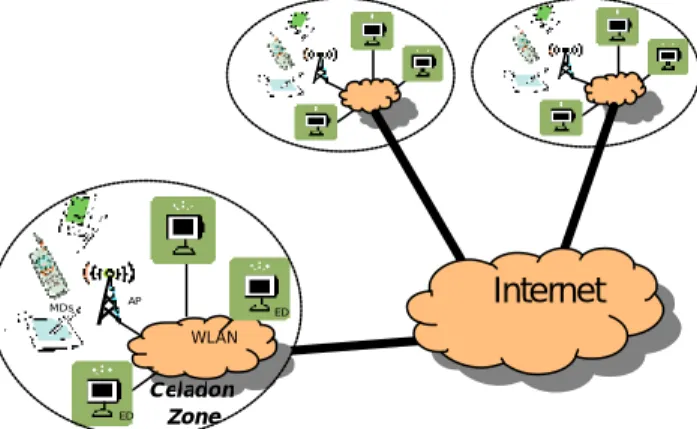
(3) of maturity and such a positive feedback loop has taken off. In fact, this phenomenon is often referred to as Metcalfe's law: when N devices are able to interoperate with each other, the usefulness of the system becomes proportional to N2 . We believe that if we are to eventually see Metcalfe's law establish itself in the domain of device symbiosis, we need to start with environmental devices that are extremely simple to create, easy to deploy and cost very little to operate and administer. Such simplicity will translate to low overall costs, making it easier to justify deploying such devices in the initial stages before the positive feedback loop has actually taken hold. After the benefits of the feedback loop begin to be felt, it may be possible to justify a gradual increase of their costs by moving to more capable environmental devices. We envision collaborative environments organized into Celadon zones, which are public areas equipped with wireless access points for technologies, such as Bluetooth [4] or 802.11 [1], and with environmental devices, such as displays, projectors, and printers. Bus and train stations, airport terminals, doctor/dentist waiting rooms are the most common examples of Celadon zones. Buses, trains, and airplanes can also be Celadon zones, provided they are equipped with the necessary environmental devices.. MDs. AP ED. Internet. WLAN. ED. C el ad o n Zone. Figure 1. Internet-connected Celadon zones Mobile users in a Celadon-enabled public area, i.e., a Celadon zone, join the system as soon as their mobile devices (MDs) get in the proximity of, and discover available environmental devices (EDs) through the wireless local area network (WLAN) (see Figure 1). Users join and leave Celadon zones seamlessly, based on their current profiles or subscriptions, therefore enabling multiple service offerings on top of the same ubiquitous infrastructure. Celadon zones do not overlap and they are typically connected to the Internet. Capabilities of both environmental and mobile devices are exposed to each other as Celadon services, similar to Jini and UPnP. The user’s mobile device requests for services available in the Celadon zone after the user enters the zone. The user profile and credentials , which are stored on the. mobile device, determine the services that the user has access to. Next, the mobile device attempts to establish a session, if enough services are available; the device becomes the session manager. In the Celadon architecture, sessions represent temporary symbiotic environments which allow mobile and environmental devices to collaborate seamlessly. Sessions are destroyed, and environmental resources freed, either explicitly, by the session manager, or implicitly, when the session manager device leaves the Celadon area. Resources, such as environmental displays, are allocated to sessions according to pre-established access rights. Resources are typically dedicated to a single session. Shared devices, such as large public displays, are represented as multiple resources. Resources are generally removed from a session only with the permission of the session manager. The user of the session manager device is charged for the resource usage during the session. Within a session, devices collaborate by invoking each others services. However, cross-session invocations are not permitted. To access a device outside of its session, the session manager must either add the device to its session, if available, or join the device’s session. In Celadon, device communication is based on TCP/IP, IP addresses are allocated dynamically using DHCP, and device discovery relies on DNS technology. Once the devices in the zone are found, they are queried for available services. Overall, Celadon service discovery is simpler than in UPnP, as Celadon doesn’t rely on HTTP extensions. Similar to DLNA, initial Celadon services are related to media presentation. However, Celadon targets public areas, which are more dynamic that DLNA’s digital home. Specific examples of Celadon services are given in the next section. Celadon services are accessed using existing web services technologies, such as SOAP over HTTP. Our previous experience with web services stacks on mobile devices [3] indicates that the performance penalty introduced by the use of web services is acceptable for a wide range of application scenarios. In the heterogeneous device environment that we wish to support, using SOAP as a messaging backbone solves significant issues raised by device heterogeneity, most of them at the syntactic level. However, remaining issues at the semantic level need to be addressed differently. To address these issues, the Celadon architecture uses OSGi, a dynamic code provisioning architecture, for both the mobile and the environmental devices. OSGi is a component-based architecture, which enables device-side applications to load required components from the management sever at the run time. In this sense, application components can be customized to be on-demand in order to meet the shortage in device storage. For the Celadon prototype, we use the Service Management Framework, which is an OSGi-compatible product by IBM. Celadon uses separate OSGi bundle servers for mobile and environmental devices. Bundles are downloaded on-. −9−.
(4) demand whenever the required functionality is absent on the mobile device, the environmental device, or both. For instance, an environmental device may need a special media renderer and/or transcoder to display the content supplied by a mobile device, or a mobile device may need to convert its key inputs before forwarding the commands to another device, or the client- and server-implementations of a simple network game may need to be downloaded on the mobile and environmental devices. Finally, to accommodate mobile devices with reduced capabilities, i.e. which cannot support an OSGi client environment, the Celadon architecture provides mobile device adapters. The adapters are bundles for the environmental devices, which allow them to interact with the mobile device using its native messaging protocol(s). We expect the inclusion of mobile device adapters in our architecture to speed up the proliferation of Celadon collaborative environments.. 4. BUSINESS MOTIVATION While the Celadon vision is compelling and challenging by itself technically, several business aspects need to be addressed before Celadon zones start appearing ubiquitously. Essentially, for rapid adoption, the whole chain of technology and service providers that are supporting or using device symbiosis needs to be able to profit from the deployment. Let us examine the remarkable growth in the deployment of 802.11, arguably a technology that has significantly changed the way people work, communicate, and entertain themselves. It started in the late nineties with deployment in corporate buildings to provide flexibility to employees which in turn increased their productivity. Around the same time, several companies rushed to provide broadband access to homes, thus increasing the areas where 802.11 could be utilized. Users who had experienced the benefit of 802.11 at work, found it compelling to deploy 802.11 access points at homes. This demand in turn drove down the price of 802.11 access points and network cards. The plummeting cost of 802.11 access points and the simplicity of the technology made it possible even for coffee shops to provide this function. At present, many airlines such as Lufthansa Airline, Korean Airline and Japan Airline offer or plan to offer 802.11 on their flights. Some of this momentum can be attributed to the fact that 802.11 was an open standard that coexisted and extended the reach of well established standards such as TCP/IP and other Internet protocols . Equally important, 802.11 deployments were driven by solid cost-benefit analyses in the office, home and retail environments. In contrast, Bluetooth has taken much longer to mature since the standard was much more complex. Bluetooth tried to define several complex profiles from scratch and also had interoperability problems in its early years. As a result, the positive feedback process has taken much longer to establish itself.. The device symbiosis supply chain includes manufacturers of mobile and stationary devices, software vendors, content providers, and Celadon zone operators,. At present device manufacturers are well on their way to incorporate capabilities necessary for device symbiosis in their devices. Already several public areas such as airports, hotel lobbies, and malls provide kiosks. Ubiquitous wire less connectivity is currently available in several countries. Software for seamless and fluid device symbiosis is the next big challenge. Once such applications and the supporting middleware become available, we will see an accelerated deployment of services that would lead to a rise in the number of Celadon zones. We now examine several scenarios where device symbiosis could take hold before it becomes as ubiquitous as 802.11.. 5. USAGE SCENARIOS A keen understanding of multiple usage domains will ensure that problems faced by users are addressed more effectively than what is possible by applying technology by brute force methods. Let us first examine a health care example. In a typical hospital visit, a patient may communicate with receptionists, nurses, technicians, doctors, pharmacists, insurance personnel, and either provide or receive data from them. In a health care system that has embraced device symbiosis, several tasks may be simplified and made more efficient, thus freeing busy personnel for more critical tasks. The patient may transfer his medical insurance data and past medical records, current medication list including dosages, securely to the health care system from his personal mobile device. The patient may specify a duration for which such data can be preserved. The doctors could carry a portable device and attach it a large TV/display in the patient’s room and discuss the patient’s x-ray or MRI scan. The patient’s mobile device can get a copy of the patient’s imaging results or laboratory tests that the patient could view after being discharged. The hospital staff can privately send information to the physician on his personal device or audio headset. Information such as the patient’s location and condition may be conveyed more easily instead of the current practice of relaying the information through a nurse since privacy concerns prohibit the broadcasting of patient names over the public address system. The nurse could transfer the patient’s pill regimen to his personal device that can them remind the patient to take the medication and also notify the nurse of non-compliance. The health care scenario is especially challenging since the personnel are specialized, mobile and busy; and the medical equipment is sophisticated and very expensive. Device symbiosis could improve the quality of health care and also reduce the cost by utilizing medical personnel and equipment more efficiently. We now discuss a retail scenario where device symbiosis can help improve customer experience. A customer wishing to renovate her kitchen might bring high resolution photographs of the kitchen to a home improvement store on. −10−.
(5) her cell phone camera. The store consultant and the customer can start the remodeling process by viewing the images of the current kitchen on a large display. The store consultant could then use additional tools to get the dimensions of the cabinets, etc., and look up replacement units and bring up their three dimensional graphical models and images on the shared display. More sophisticated systems could overlay the images of the new cabinets on the image of the present kitchen. Once the customer is satisfied, the cabinets can be ordered right away and a copy of the order and the overlaid images could be transferred to the user’s camera phone for sharing with other family members and for later review. The final installation appointment can be coordinated with email exchanges. The overall objective of this application is to simplify the complicated process used today, which starts with setting up an appointment for somebody to visit your house to take measurements, then looking either at printed brochures or ones on the internet, followed by placing an order after guessing how the renovated kitchen will appear and ending with an installation. Businesses can benefit with this approach since they can get the customer to sign the contract right away before the customer changes her mind. In addition, no technician needs to be dispatched to the user’s home for measurement. Finally, the order process is completely electronic and avoids printing and transcription costs. Several public transportation terminals such as trains stations and airports include large displays. Multiple people can use their cell phone to play collaborative games while waiting for their train. Transportation agencies can derive additional revenue from such use. Seats on some modern airplanes also include displays. Users could potentially bring several movies on their cell phone and view them on such a display without having to carry a separate DVD player or be limited to the movies shown on the plane. Visits to theme parks can also be made more enjoyable. Imagine being able to track your friends and family on large displays throughout the park that show a map of the theme park. Icons on the large display, flags of Argentina for example, can indicate the locations of friends and family. The key that translates the graphical icons on the large display to person names could be on the user’s personal device. This separation of data ensures that the location is revealed only to the user and not to other people near the display. Visitors to museums could receive additional information about exhibits on their personal devices. This is especially useful for viewing works of art where they are best viewed at a distance from which textual descriptions that accompany the art are difficult to read. Device symbiosis has several potential applications in automobiles. Imagine a user renting a car at the airport. The user’s personal device could transmit his arrival at the airport automatically to the rental car company. This can be done by looking at the position data of his cell phone and his calendar. This in turn triggers the rental car company to prepare his vehicle and associated documentation. Upon. entering the car several user preferences , such as seat height and position, mirror adjustments, temperature preferences, radio station settings, etc., can be transferred to the automobile from the user’s personal device. To preserve privacy, these settings can be erased when the user is returning the car. Automobile manufacturers would have to agree to a standard that can be used to transfer such settings. Suitable security mechanisms have to be devised so that unauthorized people cannot change your settings. One possible mechanism is to provide the user with a temporary credential when the car is picked up that is valid for the duration of the rental. Personal fitness enthusiasts could carry exercise regimens in wearable devices that attach to exercise equipment. The regimes could be provided by a personal trainer and could be further adjusted based on readings from biophysical sensors. The data from the workout could continuously be logged on the user’s personal device for later analysis and historical tracking. Thus data can be sent and received by both the user’s personal device and the exercise equipment to enhance the overall quality of the exercise. Movie theaters could leverage audio symbiosis by broadcasting the audio in multiple languages that can be received by the user’s personal audio device. The personal device could automatically select the channel on which a particular language can be heard by exchanging user profile information with movie theatre. This is especially useful in cosmopolitan environments such as international airports where people from many nations pass through. In summary, we have examined several scenarios where device symbiosis can significantly alter the current user experience and business efficiency. We considered healthcare, entertainment, travel, and business sectors. The organizations that can benefit are varied and the relative priority of the challenges could be different in each of these scenarios. Some involve public spaces and others do not, and therefore the privacy and security requirements vary in these applications. It is clear to us that several other domains can benefit from symbiosis as well.. 6. CHALLENGES Though the Celadon vision is simple to explain, the underlying machinery to make it work is complex. The interfaces to use Celadon however must be simple – similar to an automobile that is complex but exposes few simple controls that the user can master to drive. From a technical perspective one of the main challenges is the wide range of device types that need to be accommodated. Because of the rapid pace at which mobile device technology is evolving, it is common to see devices with widely different capabilities among a user population. It is also common to see devices being replaced relatively frequently. Even among the environmental devices one can expect to see a wide variation. As a result, the Celadon software infrastructure must not just enable interoperability. −11−.
(6) across heterogeneous systems, but also adapt to rapidly changing device capabilities. Our interfaces need to be flexible enough to be able to leverage the capabilities of newer devices that have not been invented yet, while at the same time be capable of providing services to devices that are on the verge of becoming obsolete. One of the critical success factors for such a system is ease of use. Establishing relationships between the mobile and environmental devices must be intuitive and effortless. It is also important to ensure that the steps can be executed quickly and efficiently with as much automation as possible. In addition to the above there are several other challenges such as, reliable access control mechanisms, information security, robustness, affordability, resiliency, fairness of resource allocation, metering and billing, and data integrity. From a business perspective, the main challenge is to enable a value chain where the different players, such as hardware manufacturers, software vendors, service providers, and the end customers, can all derive value from the enablement of such collaborative iterations between devices. Another business challenge is to create new service offerings that leverage the ecosystems where devices can collaborate with each other. In addition to the business and technical challenges, several social challenges, such as privacy, have to be addressed. For example, if a user is viewing private content on a public display, who decides what content types are acceptable? Devices in the environment may have to be ruggedized to prevent vandalism, withstand harsh weather and temperature variations. Since devices could be accessible to several people, how can denial of service attacks be prevented? While some of these challenges pertain to computer science and engineering, several others are multidisciplinary in nature. Impetus from both private and public sectors is probably necessary to accelerate the progress in this area.. It is not the intent of the Celadon project to address each of the scenarios we dis cussed in this paper. Rather, our goal is to build the platform technologies that accommodate the implementation of several scenarios that demonstrate the value of device symbiosis. Acknowledgements. Thanks to the Institute of Information Technology Assessment and Ministry of Information and Communications of Republic of Korea for providing an opportunity to participate in the IT839 project.. 8. REFERENCES [1] ANSI/IEEE Std. 802.11, “Part 11: Wireless LAN. [2] [3]. [4] [5] [6] [7] [8]. [9]. 7. CONCLUSIONS AND FUTURE DIRECTIONS We presented the Celadon vision and outlined the exciting business and technical challenges that need to be overcome to realize the full promise of device symbiosis. We have begun prototyping parts of our system and our current focus is on display symbiosis – where small private displays and large public displays can be exploited to their fullest potential. Our approach uses open standards and we realize that efficient field upgrades, dynamic provisioning, device heterogeneity, limited device life and rapid turnover, etc., are key issues in the adoption of device symbiosis. Once these basic building blocks have been built for one type of symbiosis, our model can be extended to other forms such as audio symbiosis, battery preservation symbiosis, etc.. −12−. medium Access Control (MAC) and Physical Layer (PHY) Specifications, March 1999. Apple Computer, “Bonjour,” Technology Brief, www.apple.com/macosx/features/bonjour, Apr. 2005. S. Berger, S. McFaddin, C. Narayanaswami, and M. T. Raghunath, “Web Services on Mobile Devices – Implementation and Experience,” Fifth IEEE Workshop on Mobile Computing Systems & Applications, Monterey CA, Oct. 2003. Bluetooth SIG, “Bluetooth Specification v2.0 + EDR,” www.bluetooth.org, Nov. 2004. Digital Living Network Alliance, “Overview & Vision White Paper,” www.dlna.org/resources , June 2004. Microsoft Corp., “Understanding UPnP™: A White Paper,” www.upnp.org/resources , June 2000. OSGi Alliance, “OSGi Specification Release 3,” www.osgi.org/osgi_technology, March 2003. M. T. Raghunath, C. Narayanaswami, and C. Pinhanez, “Fostering a Symbiotic Handheld Environment,” In IEEE Computer, Sept. 2003. Sun Microsystems, “Jini™ Architectural Overview,” www.sun.com/software/jini/whitepapers, Jan. 1999..
(7)
図
関連したドキュメント
Standard domino tableaux have already been considered by many authors [33], [6], [34], [8], [1], but, to the best of our knowledge, the expression of the
An example of a database state in the lextensive category of finite sets, for the EA sketch of our school data specification is provided by any database which models the
Lemma4.1.. This is not true if f is not positively homogeneous as the following example shows.. Let f be positively homogeneous. We shall give an example later to show that
Making use, from the preceding paper, of the affirmative solution of the Spectral Conjecture, it is shown here that the general boundaries, of the minimal Gerschgorin sets for
We show that a discrete fixed point theorem of Eilenberg is equivalent to the restriction of the contraction principle to the class of non-Archimedean bounded metric spaces.. We
Using an “energy approach” introduced by Bronsard and Kohn [11] to study slow motion for Allen-Cahn equation and improved by Grant [25] in the study of Cahn-Morral systems, we
In particular, we show that the q-heat polynomials and the q-associated functions are closely related to the discrete q-Hermite I polynomials and the discrete q-Hermite II
In [9] a free energy encoding marked length spectra of closed geodesics was introduced, thus our objective is to analyze facts of the free energy of herein comparing with the
