CIDE : A Comparative Study
journal or
publication title
福井医科大学一般教育紀要
volume
18
page range
41-67
year
1998-12
URL
http://hdl.handle.net/10098/5401
Bulletin of Liberal Arts, Fukui Medical University, No. 18 (1998)
The Defining Vocabularies of
LDOCE,
OALD, and CIDE: A
Comparative Study
Sadayuki NAKANE*
Department of English
(Received on October 22, 1998)Abstract:
This study is an analytical comparison of the defining vocabularies of three major learners' dictionaries of English, the third edition of the Longman Dictionary of Contemporary English, the fifth edition of the Oxford Advanced Learner's Dictionary of Current English, and the Cambridge International Dictionary of English (all 1995). It begins with a consideration of how the first Longman controlled vocabulary was born, comparing it with two celebrated word lists, A General Service List of English Words (1953) and The Teacher's Word Book of 30,000 Words (1944~ It analyses the arrangement and labelling of the items in the Longman list, and then investigates how it differs from its two subsequent revisions in terms of lexical constituents. Then the three defining vocabularies that appeared in 1995 are compared with each other and analysed in terms of the numbers and categories of the items contained. The use of several criteria of comparison produces a 'core' defining vocabulary of 1541 items used in common by WOCE3, OALD5, and CIDE. The 1541 items are then checked against the frequency bands of Cobuild2 and the two word-frequency lists of about 2200/2300 words obtained from The Ameri-can Heritage Word Frequency Book (1971) and The Educator's Word Frequency Guide (1995). A suggestion is offered that the 1541 words, the full list of which is printed at the end, should beincorporated into junior and senior high school English textbooks in Japan.
Key words: learner's dictionary, controlled vocabulary, definition, word frequency
1. Introduction
One of the distinctions between monolingual dictionaries of English for EFL learners and general-purpose ones for native users of English is that the former use a controlled vocabulary for defining words, while the latter presuppose a good command of a far
larger vocabulary. The use of a restricted defining vocabulary has long been a strategy instinctively developed and followed by editors of learners' dictionaries, but it was Procter (1978: viii-ix) who made a first explicit reference to it as a major principle of the first edition of the
Longman Dictionary of Contemporary English (WOCE1).
The dictionary was revised by Della Summers in 1987, who appended 'The Longman Defining Vocabulary', a list of around 2000 words that were 'carefully chosen after a thorough study of all the well-known frequency lists of English words' (1987: B15). The body of the dictionary was further revised and largely expanded by the same editor in 1995 with a somewhat changed defining vocabulary list printed at the end.The year 1995 was a fruitful one for learners' dictionaries of English. It saw the publication of the fifth edition of the
Oxford Advanced Learner's Dictionary of Current
English (OAmS) ,
the third edition of theLongman Dictionary of Contemporary English
(JIJOCE3),
and the newCollins Cobuild English Dictionary (Cobuild2),
a revised edition ofCollins Cobuild English Language Dictionary (Cobuildl),
which had been published in 1987 as a completely new type of learners' dictionary of English. Perhaps it was not a mere coincidence, either, that a newly designed dictionary for learners of English was published by Cambridge University Press in 1995 as theCambridge International
Dic-tionary of English (CIDE),
the editor-in-chief of which is Paul Procter who launchedWOCEl.
Significantly,OALDS
andCIDE
also provided their own defining vocabu-laries, thus following the three editions ofWOCE.
The present research begins from an account of the birth of the first restricted vocabulary used by
WOCEl
and proceeds to compare it with its two subsequent revi-sions. This is followed by a comparision of the defining vocabularies of the three major monolingual EFL dictionaries,LDOCE3, OALDS,
andCIDE.
Apparently these vocab-ularies are selected mainly on the basis of word-frequency lists, and this raises the question of how frequency lists have contributed to the establishment of defining vocab-ularies and also how far these particular defining vocabulary lists (DVLs) are different from or identicalto
the two major lists of high frequency words available from TheAmerican Heritage Word Frequency Book
(1971;AHWFB)
and the more recentEduca-tor's Word Frequency Guide
(1995;EWFG).
2. The Longman Controlled Vocabulary,
GSL, and TWB
The Defining Vocabularies of WOCE, OALD, and CIDE
illustrations of WOCE1? Procter (1978: viii-ix) explains the situation as follows: All the definitions and examples in the dictionary are written in a controlled vocabulary of approximately 2,000 words which were selected by a thorough study of a number of frequency and pedagogic lists of English, partiCUlar reference having been made to
A General Service List of English Words (Longman, 1953, reprinted 1977) by Michael West. Furthermore, a rigorous set of principles was established to ensure that only the most "central" meanings of these 2,000 words, and only easily understood derivatives, were used.
The controlled vocabulary actually consists of 2179 items (2126 words and 53 affixes, to be precise). The derived or inflected forms parenthesised after the entry item Cas in 'affair(s)', 'a1coholCic)', 'arrange, arrangement(s)', 'bacteria (-jum)'), and the associ-ated or inflected words printed after it (as in 'actor, actress', 'arch, archway', 'Christian, Christianity', 'child, children') have not been counted in the above statistics of the items. Indeed, the exact number of the items is hard to
fix,
for some items are indicated as belonging to more than one word class.After,
for instance, is shown to be used as an adverb, a preposition, and a conjunction, but it seems to be a principle to treat such a multi-functional word as one item. However, two word forms need special attention.Hold (n, v)
andhold (n)
are differentiated in use, but it is not clear in what sense the secondhold
can be used. It is very unlikely that the secondhold
is to be used in the dictionary in the sense of 'the part of a ship (below DECK) where goods are stored'(LDOCE1,
S.v. ho/(P). Popular
is printed twice with no word-class label, the secondpopular
being perhaps nothing but a careless duplicate, since WOCEl itself puts this word only under the category of an adjective. I have counted the secondhold
andpopular,
nevertheless, for the sake of objectivity.The number of 2000 words selected for defining and illustrating purposes is im-posed by the need of an intermediate-level learner to fully understand all the words and examples included
in
the dictionary. At the same time, however, the number must also be sufficient for describing almost everything that has to be explained. Speaking of a somewhat longer list used by Palmer, Howatt (1984: 257) says, 4Palmer reckoned [ ... ] that the items on his 3,OOO-word list would account for 95 per cent of running-text [ ... ]. Reducing the listto
a mere 1,000 items would still cover 85 per cent of running-text.'that the words in the top two bands (i.e. about 1900 words) 'account for approximately 75% of all English usage' and those in the five bands (i.e. about 14700 words) 'make up 95% of all spoken and written English'
(xiii).
If so, then, why should the defining vocabulary be limited to 2000 words, not 3000, as Palmer might have considered desirable and virtually sufficient? It may be because Procter's list was mainly indebted, as the editor admits, to West'sGeneral Service List of English Words (GSL),
which comprised around 2000 headwords (1860 items, to be exact, excluding 21 inflected or derived forms printed in boldface like main entries).GSL was compiled and edited by Michael West but it was Irving Lorge who 'did most of the research work on
GSL
after the London meeting [for drawing up a draft list of selected words, held in 1935] in order to provide frequency figures for the 2,000 headwords and for their semantic sub-categories' (Howatt 1984: 256). Lorge was then one of the leading word-frequency statisticians, and together with E. L. Thorndike pub-lishedThe
Teacher's Word Book of
30,000Words
(TWB) in 1944. The book marked 1069 'AA' and 952 'A'items, these two categories together constituting 2021 top-frequency words, i.e. words that occurred more than 50 times per million in their statistics. The total is quite close to the number of the words counted in a similar way in the Brown Corpus of about one million words, namely 2210 (see Francis and Kucera 1982). In spite of an easily imaginable influence of TIVB on the compilation ofGSL
and the numerical closeness of the main entry list of GSL and the list of AA- and A-marked words in TWB,there is a fairly large difference between the two in the words contained. The TWB list does not contain 555 words included in
GSL,
which is, as the name suggests, more than a frequency list. TWB contains any forms of high frequency: 90 inflected fonns, such asam, are, been, women, teeth;
27 contracted forms, such asain't, I'll, there's;
and even 58 proper names, such asBoston, Philadelphia, Peter, William.
On
the other hand,GSL
does not contain ordinal and cardinal numerals, the names of the days and months, and interjections, such as
ah,
0,oh,
which are all shown in TWB to occur very frequently.Before comparing the main entry list of GSL and the controlled vocabulary of
LDOCE1,
it should be noted that the way of arranging items in the latter is not always consistent. For example,actress
is printed in a line as a feminine form ofactor,
and it does not count as an independent item. The almost interchangeablealthough
andthough
are separate entries, but
until
andtill
are not, the latter being excluded in the Longman list, although included inGSL
and marked 'AA' inTWB.
Most of the derived forms areThe Defining Vocabularies of mOCE, OALD, and CIDE
given the status of an independent item, but some are only parenthesised after the words from which they derive.
Admire
andadmiration, examine
andexamination, explain
and
explanation, imagine
andimagination, inform
andin/ormation, invite
andinvitation
are all treated separately. However, in the case of the
-ment
suffix,arrange
andarrange-ment
are counted together, whilegovern
andgovernment, judge
andjudgement, treat
andtreatment
are separate.There are other inconsistencies, too, and some inconveniences, especially concern-ing the treatment of word-class labellconcern-ing. The items that belong to more than one word class are divided into no less than 34 types (parenthetical numbers below indicate the number
of
items belonging to each type):1. Type V, N: (5)
account, ache, address, advance, burn
2. Type V,N, ATTRIB: (1)telegraph
3. Type V, AD]: (12)
complete, direct, empty,/it,/ree, open,
etc. 4. Type V, AD], ADV: (2)close, last
5. Type V, AD], ADV, PREP: (1)
like
6. Type V, ADV: (1)please
7. Type N, V: (269)
aim, anger, answer, arm, armour, attack,
etc. 8. Type N, V, AD]: (4)equal,/ancy, waste, welcome
9. Type N, AD]: (52)
animal, blue, brown, chemical, chocolate,
etc. 10. Type N, AD], ADV: (12)east, enough,
half,home, level,
little, etc. 11. Type N, AD], ADV, PREP: (1)outside
12. Type N, AD], V: (2)
average,/at
13. Type N, AD], PREP: (1)
past
14. Type N, ADV: (6)
back, chief, today, tomorrow, tonight, yesterday
15. Type N, PREP, ADV: (1)insUk
16. Type N, V, AD]: (1)
light
17. Type AD], N: (1)
blind
18. Type AD], ADV: (22)
alike, all, best, better, early, even,far,
etc. 19. Type AD], ADV, PREP: (2)near, round
20. Type AD], ADV, V: (1)
double
21. Type AD]. DETERMINER: (1)
certain
22. Type AD], PREP: (1)
opposite
24. Type ADJ, PRON, INTERJ: (1)
what
25. Type ADV, CONJ: (3)
otherwise, when, where
26. Type ADV, INTERJ,
CON]:
(1)why
27. Type ADV, PREP: (2)
down, off
28. Type ADV, PREP, CONJ: (1)
after
29. Type PREP, ADV: (1)
around
30. Type PREP,
CON]:
(2)except, until
31: Type DETERMINER, PRON: (1)
each
32. Type DETERMINER,PRON,
CON]:
(1)that
33. Type PRON, N: (1)
mine
34. Type PRON, ADJ: (1)
heres)
This list of 34 types show that about 19.5% (415/2126) of all the items are provided with more than one word-class label. H these items are counted by mUltiplying them by the number of their word classes, the restricted vocabulary will increase by approximately 20 per cent. Most of these items are cognate and for practical purposes it is reasonable for each of them to be treated as one word. However, homonyms ought to be treated differently, as they are different in origin and sense.
In
fact,bear, row, lead,
andwind
are labelled differently as nouns and verbs (we have already discussedhold
andpopular
above).
Kind, last, second
andwell,
however, are not treated as they theoretically should be, i.e.,kind
as a noun and an adjective,last
as a verb and an adjective/adverb,second
as a noun and an adjective, andwell
as a noun and an adjective/adverb. There also seem to be some mistakes of word-class labelling:chief
should be labelled n,adj,
not In, adv';level
should perhaps be n, v,
adj,
not In, v,adv';ple,ase
should be v,interj,
not'v,
adv'. It is not clear why the compiler had to distinguish between Types V, Nand N. V, or Types ADV, PREP and PREP, ADV, the second member in each pair being mere inversions of the first. If the order of V. N or N, V indicates something definite, e.g. the historical order of first appearance, it is irregular, for example, to categoriseache
under Type V. N, because the noun is much older than the verb.On
the other hand,polish
(Type N, V) was originally a verb, the nominal use of it occurring very late.If we compare the
LDOCEI
vocabulary list with the main-category list ofGSL,
we will first find that the former has 236 items that are not contained in the latter, while the latter has 228 items not in the former (see List 1 and List 2, printed at the end of the present essay). A closer look at List 1 reveals that terms denoting things in severalThe Defining Vocabularies of LDOCE, OALD, and CIDE
specific fields have been added by Paul Procter:
(1) Scientific/technical terms:
acid*, alcohol*, (apparatus
*),atomic, (bacteria
*),bomb,
boot*, breed*, bullet*, (candle*), (cease*), cell*, (cement*), chemical*, chemistry*, (compass*),
(cord*), compound*, (decimal*), drug*, gunpowder, infect(ious)*, (jelly*), kilo, kilogram,
kilometre, metric*, microscope*, military, mineral, mirror*, mosquito*,
nava~navy, nerve*,
network, nylon, oxygen*, petrol*, (pillar*), plastic(s)*, (sensation*), (spear*), telegram,
television
*,tyre*,
and(vary*).
The asterisked terms are also contained in the 'Supple-mentary Scientific and Technical Vocabulary' of 425 words, compiled by W.E.
Flood and Michael West (see West, 1953: 583-88). Asterisked terms between parentheses are not to be foundin
the main-category list of GSL, but are included both in the Flood-West list and Procter's controlled vocabulary list. The same applies to (5) below.(2) Body-part terms:
ankle,
bowe~breast, cheek, chest, chin, elbow, forehead, heel,
muscle.
(3) Linguistic terms:
adjedive, adverb, alphabet, article
(?),consonant, participle,
phrase, singular.
The question mark indicates that the preceding word might be used generally as well.(4) Names of the days of the week and the months of the year.
(5) Names of familiar plants and animals:
(ant*), banana,
(bee *), .camel, chicken,
(coconut*), cricket, fox, (hen*), lamb, lion, mosquito, onion, ox (en), potato, tiger.
(6) Religious terms:
Bible, Buddhist, Christian, Christianity, Hindu(ism), !ew(ish),
mosque, Muslim.
In
addition, he also adds some further general everyday words:accordance, addition.
afternoon, afterwards, all right, altogether, anyone, area, beer, cardboard, certainty,
etc. (most of the words belong here, but one may wonder why such informal items as nastyand
all right
are necessary for definition), and inflected forms:could, eldest, him, us,
your(s).
3. The Controlled Vocabulary and Defining Vocabularies of
LDOCELDOCE2 (1987) has a main list comprising of 2172 words and a list of 48 affixes 'that can be used with words in the Defining Vocabulary' (B22). 145 of the words con-tained in the WOCEl controlled vocabulary list have been deleted in WOCE2 DVL, and 201 new words have been added. Names of religions, the days of the week, and the months of the year have been discarded in the WOCE2 list, and such titles as
Mr, Mrs,
Miss
have also been taken away. (There are two misprints:artifical
andpeacful.)
The total number of words in
WOCEJ
DVL (L3DVL) has been reduced to 2045, and that of prefixes and suffixes has been limited to 30. As compared with WOCEl DVL (L1DVL), there is a considerable change in content in L3nvL: 364 words have been deleted and 275 words/phrases have been added (see Tables 1 and 2 below). The per-sonal pronoun I is no longer listed. Perhaps it is a mistake on the part of the compiler that the indefinite articlea
has not been included in the list, sincean
does appear in the list.It is interesting to classify the newly added items into six groups according to the
Cobuild2
frequency bands. In L3DVL there are two no-diamond (Le. low-frequency) wordsabbreviation
andattitude,
13 one-diamond, 41 two-diamond, 82 three-diamond, 81 four-diamond, and 43 five-diamond (for which see List 3). This means that more than half of the added words are beyond the level of 1900 words. Another important feature is that L3DVL contains phrasal verbs(deal with, find out, let go of, lie down, look after, look
for, look sth up, make into, make up, pick uP),
complex prepositions(as opposed
to,
in spite
0/), and an adverbial phrase
(only just).
The only complex preposition in LIDVL and L2DVL wasaccording to,
in which the to was put between parentheses.Concerning prefixes and suffixes, the compiler of the
WOCE3
defining vocabulary notes that 'the forms which are common, or which change their meaning when a prefix or suffix is added, (such as acceptable and agreement) are included in the full list' (BI2). The criteria of listing forms with a prefix or a suffix included in the affix list are thus (1) commonness and (2) change of meaning, but it is not always easy to determine whether a derivative is chosen because it is 'common' or because it has changed its meaning. Takeachievement,
for example. Does this choice imply that the word is to be usedin
the sense of 'something important that you succeed in doing by your own efforts' (s.v.achievement
1), not of 'the act of achieving something' (sov.achievement
2), a sense very closely associated with the verbal sense ofachieve?
Or has the word been listed because it is a common word (WOCE3 marks it S3/W2)? Some derivative words in the same range of frequency asachievement
(i.e., S3/W2 according toWOCEJ)
are entered in the main list, such ascombination, comparison, connection, criminal, daily, examination,
existence, explanation, insurance, painting, reduction, safety, scientific, signal, warning,
etc., but some others, such as
establishment, hearing, learning, previously, rapidly, reader,
recognition, representation, tension, trial, writer,
etc. are not included in the list evenThe Defining Vocabularies of
WOCE, OALD,
andCIDE
though they are shown to occur as frequently as
achievement,
and there are cases where both main words and their derivatives are in the list. Therefore, frequency is not a secure guide for determining the commonness of words.The following tables (Tables 1 and 2) show how many defining vocabulary items are shared by the three editions of
WOCE
and how many differ from one edition to another. For comparing purposes, all fonns originally parenthesised or put in the same line with a preceding item have been counted here, and this is why the numbers in the parentheses slightly differ from those given previously. The originalLDOCE
DVLs are not completely precise or trustworthy, as we have already seen, and each of the pairs of homonyms is counted as one item in these tables. This accounts for the minor dis-agreements between some of the totals. What can be said with certainty is that there are1770
items common to all three lists (this figure does not appear in the tables, which show only one-to-one relations).Table 1 Number of items shared by the three
DVLs
ofLDOCE
LlnVL
L2DVL
L3DVL
LIDVL
(2173)
2001
1774
L2DVL
L3DVL
2001
(2196)
1902
1774
1902
(2061)
Table 2 Number of items not shared by the three
DVLs
ofWOCE
LIDVL
L2DVL
L3DVL
LIDVL
L2DVL
L3DVL
198
292
4. LDOCE3, OALD5, and CIDE
172
399
294
161
It is important and helpful to make a similar numerical comparison of the defining vocabularies of
LDOCE3, OALD5,
andCIDE,
but their comparison is not an easy task and needs much care, for the compositions of these lists are not based on the same general principles. This explains the big difference in the total numbers of words contained in the lists. (Incidentally, there seem to be four duplicate items inOALD5:
exercise, extreme, near,
andsquare.
Two misprints are found inCIDE:
'severly' forseverely
and 'worsh' forworship.
It is interesting thatCIDE
DVL andWOCE3
DVL do not contain mad, perhaps because it is sometimes felt politically incorrect. However, Rees (1994: 89) concludes, 'The PC oracle has not come up with anything better [thanmad], and so it is quite in order to call mad people "mad".' In fact, the word should be included in the
CIDE
DVL, at least, for the dictionary uses one of its derivatives indefining the word
rabies,
for example, as 'a disease of the nervous system of dogs and other animals, which can also cause a type of madness and death in humans who are bitten by a diseased animal'.)Table 3 Number of items in
WOCE3, OALD5,
andCIDE
DVLsWOCE3
OALD5
CIDE
Main items Derived forms Total
2046 3482 1900 1858 2046 3482 3758
CIDE
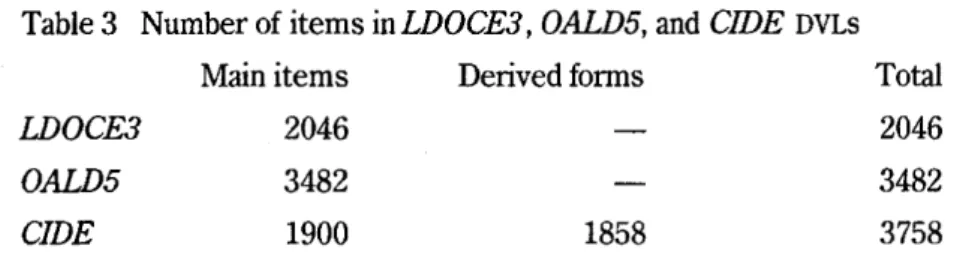
claims that the definitions in the dictionary are written 'using a list of UNDER 2000 words' (p. 1702), but this number refers only to words in the main-entry list (1900, to be exact).In
fact, there are 1858 more words, printed with indentation, in the com-plete list, almost as many again as the number of main items. This seemsto
mean that the user of the dictionary is expected to have a vocabulary almost double the size explicitly advertised in the dictionary as sufficient. We have already noted thatLDOCE3
has chosen 30 affixes to be used with the main-list words, and this means that the total number of words available to the definition writer is much larger than 2046. The numbers of words in L3DVL and that in the
CIDE's
list of main items (CmDVL) are fairly close, but much smaller than the number inOALD5
DVL (05DVL). It is therefore useful to see how many words are shared by the three defining vocabularies. Naturally, 05DVL is bound to have a large number of words that are not included in either of the two other lists.In
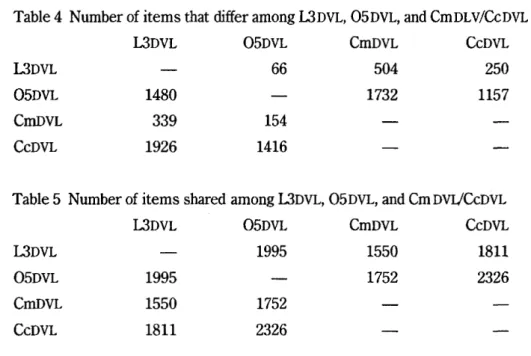
camparing the three lists I have expanded them by counting items that have parenthetical endings and suffixes. Thus, although 'her(s)' and 'hundred(th)' have not been counted as two items in Table 3, above, in making Tables 4 and 5, below, I have read them as two separate items, i.e. 'her', 'hers', and 'hundred', 'hundredth' respectively. This table shows that L3DVL has 66 items that are not in 05 DVL, that 05DVL has 1480The Defining Vocabularies of
LDOCE, OALD,
andCIDE
words not in L3nvL, etc. If we compare L3DVL with 05DVL, we see there are only
66
words not common to both, but
if
we compare L3DVL with CmDVL, which is close to itin
size, we find 250 words that are not shared. Comparing L3DVL with Cm DVL, also close in size, it turns out that L3DVL has 504 items not in CmDvL and that CmDVL has 339 items not
in
L3DVL. Since L3DVL and CmDVL also contain 1557 shared items, the learner needs to have a vocabulary of at least 2400 words in order to use both dictionaries. A comparison of 05DVL withCIDE
complete DVL (CcDVL) shows that they share 2326 items, in addition to which 05DVL has 1157 not in common with CcDVL, and CcDVL 1416 not in common with 05DVL. This means that a vocabulary of as many as 4899 words is needed for the learner to be able to read the definitions of both dictionaries to the full extent.Table 4 Number of items that differ among L3DVL, 05DVL, and CmDLV/CcDVL
L3DVL 05DVL CmDVL CcDVL L3DVL 05DVL CmDvL CcDVL 1480 339 1926 66 504 250 154 1416 1732 1157
Table 5 Number of items shared among L3DVL, 05DVL, and Cm DVI.)CcDVL
L3DVL 05DVL CmDVL CcDVL L3DVL 1995 1550 1811 05DVL CmDVL CcnVL 1995 1550 1811 1752 2326 1752 2326
According to these tables, a full use of WOCE3 and OALD5 would call for a vocabulary of 3541 words, but in
fact
this number is rather deceptive. Since 05DVL includes words in addition to the main words from which they derive, we should need to decide what main words there are in 05DVL and what affixed words are added to make the whole list. IT we take away from the list of 1995 items shared by 05DVL and 13DVL those items in 05DVL that begin or end in anyone of the 30 affixes listed in L3DVL, there still remain 1070 words which must be mastered by learners who wish to use bothdictionaries. They must after all have a vocabulary of about 2600 words.
Most of the 1858 derivatives in CcDVL
can
be formed by the use of the 30 affixes in L3DVL, and may seem negligible. But the items common to L3DVL, 05 DVL and CmDVL number 1541 and those common to L3DVL, 05DVL and CcDVL 1781, which means that 240 derived forms are also included in L3DVL and 05 DVL, and are hence probably essential for defining words. CmDVL contains 137 words that are neither in L3DVL nor 05DVL. An examination of this list will make its features distinct. They include (1) many scientific/technical terms, such asbiology, carbon, cone, cylinder, equator, mammal,
penis, vagina,
(2) linguistic terms, such asauxiliary, comma, comparative, conjunction,
determiner, infinitive, modal, predeterminer, preposition, reflexive, slang, superlative, taboo,
and (3) abbreviations, such as
E
(foreast), N (north), S (south), W (west),
andetc.
For more details see List 5.One would suppose that the 1541 items, common to L3DVL, 05DVL, and OmDvL, are all high-frequency words/phrases, and therefore expect them to lie in the high-frequency word range of, say, approximately 2000. I have checked the 1541 words against the five frequency bands of
Cobuild2
to find that 1005 of them lie in the range of five- or four-diamond bands (i.e. 1900 word range) and that the other 536 divide into three diamonds (355), two diamonds (162), one diamond (17), and no diamond (2).In
order to see how solid these figures are, I have prepared two further word lists against which they may be verified, one fromAHWFB
(1971) and another fromEWFG
(1995). It should be made clear that these two word-frequency counts are computer-based, their rank -order lists contain all variant fonns of words, counted as separate words, and also proper names. I have first made a list of about 3500 words from each rank -order list (up to U17.600 in the case of
AHWFB
and U20 in the case ofEWFG),
and then cut out almost all variant forms and proper names, thus reducing theAHWFB
list to 2183 words and theEWFG
list to 2311. I have compared the 1541-word list with these two lists, and found that theAHWFB
list contains 1270 and theEWFG
list 1292 words that are shared by the 1541-word list. Therefore, there seems to be no significantly large difference among the three counts, considering the different scales of the lists.5.
Concluding
RemarksThese research results show that the DLVs of
LDOCE3, OALDS,
andCIDE
display considerable differences, but that they have 1541 words in common. These words mayThe Defining Vocabularies of
LDOCE, OALD,
andCIDE
perhaps represent a core defining vocabulary, but they do not necessarily fall in the range of 2000 top-frequency words. High frequency alone does not account for the membership of the defining vocabulary. About three fourths of the items in L3DLV and CmDLV appear to have been chosen by other criteria than frequency. What these might be still remains to be investigated
in
detail, perhaps with reference to the semantic distribution of the items, since 'Coverage[.o.J
is an important criterion if a list is goingto be used to define the meanings of other words' (Nation, 1990: 24).
One pedagogical implication of our study is the 1541 items in teaching English to non-native learners.
In
Japan, junior high school English textbooks (I, II, and llI) are required to use about 1000 words, while senior high school textbooks should be designed to use some 1500 (English I) or 2000 (English II). Japanese high school students, therefore, are expected to learn 2000 words by the end of the second year of senior high school. H the 2000 words they learn by that time include most of the words within the common defining vocabulary and if they gain a good command of them, they should surely be able to use anyone of the major learners' dictionaries of English when they go up to university.ACKNOWLEDGEMENTS
I am grateful to Prof. D. Dykes for reading an earlier version of this essay and giving valuable comments on it, and to Prof. K. Tachi for allowing me to use two of his com-puter programs, which facilitated a great deal comparisons of word-list files.
REFERENCES
Carroll, J. B., Davies, P.,
&
Richman, B. 1971. TheAmerican heritage word frequency
book.
Boston,MA:
Houghton Mifflin; New York: American Heritage.[AHWFB]
Carter, R.
&
McCarthy, M. 1988.Vocabulary and language teaching.
London and New York: Longman.Francis, W. N. & Kucera, H. 1982.
Frequency analysis of English usage: Lexicon and
grammar.
Boston, MA: Houghton Mifflin.Hornby, A. S. 1995.
Oxford advanced learner's dictionary of current English.
5th edn. Ed. Jonathan Crowther. [OALD5]Howatt, A. P. R. (1984)
A history of English language teaching.
Oxford: Oxford University Press.Nation, I. S. P. 1990.
Teaching and learning vocabulary.
Boston, MA: Heinle & Heinle. Procter, P., ed.-in-chief. 1995.Cambridge international dictionary of English.
Cambridge:Cambridge University Press.
[CIDE]
- - . 1978.
Longman dictionary of contemporary English.
Harlow and London: Longman.[WOCE1]
Rees, N. 1994. The
politically correct phrasebook: What
they sayyou can and cannot say
in the 1990s.
London: Bloomsbury.Sinclair,
J.,
ed.-in-chief. 1995.Collins CobuildEnglish dictionary.
London: HarperCollins.[Cobuild2]
- - . 1987.
Collins Cobuild English language dictionary.
London and Glasgow: Collins.[Cobuildl]
Summers, D., dir. 1987.
Longman dictionary of con temporary English.
Newedn. Harlow, Essex: Longman.[WOCE2]
- - . 1995.
Longman dictionary of contemporary English.
3rd edn. Harlow, Essex: Longman.[WOCE3]
West, M., compo and ed. 1953.
A general service list of English words.
London and New York: Longmans, Green. [GSL]Thorndike, E. L.
&
Lorge, I. 1944. Theteacher's word book of 30,000 words.
New York: Teachers College, Columbia University. [TJiVB]Zeno, S. M., Ivens, S. H., Millard, R. T.,
&
Duvvuri, R. 1995. Theeducator's word
frequency guide.
N.p.: Touchstone Applied Science Associates (TASA).[EWFG]
The Defining Vocabularies of WOCE, OALD, and CIDE
LIST 1 236 items in LIDLV that are not found in GSL
accordance chest garment magic opponent
acid chicken gift magl.ctan oppose
addition chin grand March opposition
adjective chocolate grief May ox(en)
adverb choice grIeve method oxygen
afternoon Christian, gunpowder metre palace
afterwards Christianity habitual metric parliament
alcohol(ic) cigarette happiness microscope participle
all right cmema heel military partner
alphabet citizen him mineral pence
altogether compound Hindu(ism) mIrror pepper
ankle concert historical Miss period
anyone consist (of) hold mist petrol
April consonant horn Monday phrase
area contents humour, mosque piano
anns contract humorous mosquito plane
article could Image movement plastic(s)
atom(ic) cricket including Mr pole
August cycle income Mrs port
banana December infect(ious) muscle positive
beer descriptive inner mUSICIan potato
Bible desert instruct Muslim prick
bomb discourage January nasty prickle
boot doorway Jew(ish) naval prickly
bowel drug jewellery navy prince
breast drunk job nerve principle
breed elbow July nervous protective
British eldest June net provisional
BUddhist, -ism establish keen network range
bullet fairy kilo no one related
camel fame kilogram November remove
cardboard February kilometre now rose
cell flight labour nylon row
certainty forehead lamb obtain Saturday
chainnan fort lightning o'clock September
chase fox lion October sex(ual)
cheek Friday litre odd shot
chemical fro lodge offensive silly
song team timetable undo Wednesday
stitch telegram traffic uniform weep
structure television transparent upside-down whenever
student tennis tropic(s) upstairs worthy (of)
style tense trousers us yesterday
subtract terror trustworthy vegetable your(s)
sum third Tuesday vehicle
Sunday Thursday twice watchman
swift tiger tyre wedding
LIST 2 228 items not adopted into
LDOCEl
fromGSL
absolutely caution envy hullo nonsense
accord check especial hurrah noon
accuse colony essence ideal nUlsance
adopt commerce excess idle oar
aeroplane complicated expense imitate observe
agent compose experiment immediate omit
agriculture confess explore Immense opportunity
ambition confidence extend independent opposite
apologise congratulate extra -in-law organize
applaud convenience extraordinary instant ounce
apply cork extreme insult overcome
arrest cottage fun msure pad
artificial cousm farther interfere pardon
audience critic flavour liberty patriotic
bargain cushion forth loan paw
bay despair fright manage pearl
beast discipline fry manufacture permanent
being discuss funeral meanwhile pinch
bind disgust gallon mechanic pint
boast distinguish gap merchant plaster
border district grand- mere plough
boundary disturb grease mild postpone
bound dive greed miserable preach
bow dozen grind moderate prefer
bribe due guilty moreover prejUdice
bundle earnest harvest motion problem
business ease heal nephew prompt
canal entertain hinder nest punctual
The Defining Vocabularies ofWOCE, OALD, and CIDE
qualify resign sauce spit thorn
quart resist saucer staff threaten
rail, railing retire saw stain ton
rake revenge scent steer tough
ray review scorn stir towel
recommend ribbon scrape stock tray
refer rival scratch stove treasure
reflect roar screen strap trial
refresh roast seldom straw umbrella
regret rot shallow strip upward(s)
relieve rubbish shave stuff vam
remedy sacred shower suspect veil
replace sacrifice situation sweat virtue
reproduce saddle solve tailor weed
reputation sake sow tame widow
rescue salary spare tap
reserve sample spill tempt
LIST 3 275 items newly adopted in L3DVL as compared with LlnVL no + 15 items graceful decoration nonsense beginning abbreviation grandparent definite old-fashioned celebrate as opposed to greeting desirable punishment combination
attitude injure detennination restrict communicate
deal with insulting disappointing shiny
communica-find out poisonous educated socking tion
let go of relaxing embarrassing shy competitor
lie down tiring enjoyable toilet complicated
look after training enjoyment tropical confident
look for underwear frighten useless connection
look sth up frightening warmth coutryside
make into ++ 41 funeral crazy
makeup accidental glue +++ 82 criticize
only just advertisement harmful acceptable decorate
pick up
artificial
helpful achievement definitely(in spite 00 bored hopeful additional deliberate
boring insult advanced deliberately
+ 13 ceiling Insure apartment destruction
amusement confusing mathematics approval determined
careless container measurement arrival discovery
emotion romantic expensive realize hundred(th)
emphasize solve extremely relationship independent
employer suitable feature replace million(th)
employment surprising fifth safety national
engineer technical finally screen nine
entertain temporary freedom senes operate
entertainment tendency generally similar percent
everywhere threatening hole solution pressure
exactly tired 19nore specific probably
exciting typical immediately statement problem
existence unexpected injury success process
extreme valuable institution successful programme
fairly warning involve threaten really
friendly weekly legal traditional seven
guilty manage unit situation
hello •••• 81 manager unusual SIX
illegal achieve medical useful ten
illness affect natural thousand
impressive agreement nearly ••••• 43 three
improvement aircraft ninth actually two
infection airport normal adult whose
instruction argument noticeable announce without
intelligence basic opportunity authority
intelligent border organIse available
layer careful original building
lucky check owner business
married competition package central
mental computer painting completely
negative confidence payment decision
onto criticism performance design
opposite customer physical economic
painful dangerous possibly eight
partly discuss powerful election
peaceful discussion prefer everything
permanent document previous final
pleased education pnsoner financial
proper energy progress five
react environment proposal four
reasonable equipment protest herself
The Defining Vocabularies of WOCE, OALD, and CIDE
LIST 4 A Core Defining Vocabulary (1541 items)
ability allow article beat boil
able almost artificial beauty bomb
about alone as because bone
above along ashamed become book
absence alphabet ask bed boot
accept already at beer border
accident also atom before born
according to although attack begin borrow
account always attempt behave both
achieve among attention behaviour bottle
acid amount attract behind bottom
across amuse attractive belief bowl
act an authority believe box
action ancient autumn bell boy
active and available belong brain
add anger average below branch
address angle avoid belt brave
adjective animal awake bend bread
admire announce away beside break
admit annoy awkward between breast
adult another baby beyond breath
advantage answer back bicycle breed
adverb anxiety background big brick
advertise any backwards bird bridge
advice anyone bad birth bright
after anything bag bit bring
afternoon anywhere bake bite broadcast
agam apart balance bitter brother
against appear ball black brown
age apple bank blade brush
ago approve base blame build
agree area basic blind building
aIm argue bath block bullet
air arm be blood burn
aircraft army beach blow burst
airport around beak blue bury
alcohol arrange beam board bus
alive arnve bean boat bush
busy cheat come crop depth
but cheese comfort cross describe
butter chemical comfortable crowd desert
button chemistry common cruel deserve
buy chest communicate crush design
by chicken company cry desire
cake child compare cup destroy
calculate chocolate compete cupboard detail
call choice complain cure determined
calm choose complete curl develop
camera church computer current dictionary
can
cigarette condition curtain diecapital cinema confidence curve difficult
car
circle confuse custom digcard city connect customer direct
care claim conSClOUS cut direction
carriage class consider damage dirt
carry clay contain dance disappoint
case clean continue danger discover
castle clear control dark discuss
cat clever conversation date disease
catch cliff cook daughter dish
cattle climb copy day dismiss
cause clock comer dead distance
ceiling close correct deal with divide
celebrate doth cost death do
cell clothes cotton debt doctor
central clothing cough decay document
centre cloud could deceive dog
century coal count decide door
ceremony coast country decorate doubt
certain coat countryside deep down
chain coffee course defeat draw
chair coin court defend drawer
chance cold cover degree dream
change collar cow delay dress
character collect crack delicate drink
charge college cream deliver drive
chase colour creature demand drop
The Defining Vocabularies of WOCE, OALD, and CIDE
drum entertain fall flash furniture
drunk entrance false flat future
dry envelope familiar flesh game
during environment family flight garden
dust equal famous float gas
duty escape
far
flood gateeach especially farm floor gather
eager establish fashion flour general
ear even fast flow generous
early evemng fasten flower gentle
earn event fat fly get
earth ever father fold girl
east every fault follow gIve
easy everyone fear food glass
eat everything feather foot glue
edge everywhere feature football go
educate evil feed for goat
effect exact feel force god
effort examme female foreign gold
egg example fence forest good
eight excellent fever forget goodbye
either except few forgive goods
elect exchange field fork govern
electricity excite fifth form gradual
electronic excuse fight formal grain
else exercise fill forwards grammar
embarrass exist film four grandfather
emotion expect
final
frame grandmotheremphasize experience find free grass
employ explain finger freedom grateful
empty explode finish freeze great
enclose express fire frequent green
encourage expreSSIOn firm fresh greet
end extreme first friend grey
enemy eye fish from ground
energy face fit front group
engine fact five fruit grow
enJoy factory
fix
full guardenough
fail
flag funeral guessgun home inner knife line
habit honest insect knock lion
hair honour inside knot lip
half hook instead know liquid
hammer hope instrument knowledge list
hand hom insult lack listen
handle horse intelligence lake literature
hang hospital intend land litre
happen hot interest language little
happy hotel international large live
hard hour interrupt last load
harm house into late local
hat how introduce laugh lock
hate human invent law long
have humour invite lawyer look
he hunt involve layer loose
head hurry tron lead lose
health hurt island leaf lot
hear husband it lean loud
heart Ice jewel learn love
heat idea job least low
heaven if Jom leather loyal
heavy Ignore joint leave luck
heel ill joke left lung
height illegal Journey leg machine
help image judge legal magazme
her lmagme juice lend magic
here important Jump length main
hide improve just less make
high m justice let male
hill include keep letter man
him mcome key level manage
his mcrease kick lid manner
history independent kill lie many
hit industry kilogram life map
hold infect kind lift march
hole influence king light mark
holiday inform
kiss
like markethollow injure kitchen likely marnage
The Defining Vocabularies
ofLDOCE, OALD,and
CIDEmass
moral
nine
oppose
pay
match
more
no
opposite
peace
material
morning
nOIse
,or
pen
matter
most
none
orange
pencil
me
mother
nonsense
order
people
meal
motor
nor
ordinary
perfect
mean
mountain
north
organ
perform
measure
mouse
nose
organization
period
meat
mouth
not
origin
permanent
medical
move
note
other
person
medicine
much
nothing
our
persuade
meet
multiply
notice
out
pet
melt
murder
noun
outer
photograph
member
muscle
now
outside
phrase
memory
mUSIC
nowhere
over
physical
mental
must
number
owe
plano
mention
my
nurse
own
pick
message
mystery
nut
oxygen
picture
metal
nailobey
page
pIece
method
name
object
pain
plg
metre
narrow
obtain
paint
pile
middle
nation
occasion
parr
pin
might
nature
of
pale
pink
mile
navy
off
pan
pipe
military
near
offence
paper
place
milk
nearly
offer
parallel
plain
mind
necessary
office
parent
plan
mine
neck
often
park
plant
minute
need
oil
parliament
plastic
mirror
needle
old
part
plate
miss
negative
on
particular
play
mistake
neither
once
partner
pleasant
mIx
nerve
one
party
please
model
net
omon
pass
pleasure
modern
never
only
passage
moment
new
onto
passenger
poem
money·
news
open
past
point
monkey
newspaper
operate
path
poison
month
next
opinion
pattern
pole
polite pronounce recent room send politics proof recognize root sentence
pool property record rope separate
poor protect red rose series
popular proud reduce rough serious
port provide refuse round servant
position public regular row serve
positive pull relative royal set
possess punish relax rub seven
possible pure religion rubber several
post purple remark rude severe
potato purpose remember rule sex
pour push remove run shake
powder put rent sad shape
power quality repaIr safe share
practical quarter repeat sail sharp
practise queen replace sale she
praIse question report salt sheep
pray quick represent same sheet
prefer quiet request sand shelf
prepare quite respect satisfaction shell present rabbit responsible satisfactory shelter
preserve race rest satisfy shine
press radio restaurant save ship
pretend railway result say shirt
prevent ram return scatter shock
preVIOUS raise reward school shoe
price range nce SCIence shoot
priest rank rich screen shop
principle rare rid screw short
print rate ride sea should
pnson rather right search shoulder
private raw nng season shout
pnze reach nse seat show
problem react risk second shy
process read river secret side
produce ready road see sight
profit real rock seed Sign
programme reason roll seem signal
The Defining Vocabularies of
LDOCE, OALD,
andCIDE
silk some steel supply theatre
silly something steep support their
silver sometimes stem surlace them
similar somewhere step surpnse then
simple son stick surround there
smce song stiff swallow therefore
smcere
soon
still swear thesesmg sore sting sweet they
single sorry stitch swell thick
sink sound stomach swim thief
sister soup stone swing
thin
sit sour stop sword thing
SlX south store sympathy think
Size space storm system third
skill speak story table this
skin special straight tail those
skirt speech strange take thought
sky speed stream talk thread
sleep spell strength tall threat
slide spend stretch taste three
slight spm string tax throat
slope spirit strong tea through
slow spoil structure teach throw
small spoon student team thumb
smen sport study tear ticket
smile spot stupid technical tidy
smoke spnng style telephone tie
smooth square subject television tight
snake stage substance tell time
snow stair succeed temperature title
so stamp such temporary to
soap stand suck ten tobacco
social
standard sudden tend todaysociety star suffer tennis toe
sock start sugar tense together
soft state suggest tent toilet
soldier station suit test tongue
solid stay sum than too
solution steal summer that too]
top ugly visit west WIse
total under VOlce wet wish
touch understand vote what with
towards unexpected vowel whatever within
tower unifonn waist wheat without
town unit
wait
wheel womantoy unite wake when wood
track universe walk where wool
trade university wall whether word
traffic until want which work
train unusual war while world
transparent up warm whip worry
travel upper warn white worse
treat upset wash who worth
tree urgent waste whole would
trick us watch whose wrap
trouble use water why wrist
trousers usual wave wide write
true valley way width wrong
trust value we wife year
truth variety weak wild yellow
try vanous wealth will yes
tube vegetable weapon willing yet
tune vehicle wear wm you
turn verb weather wind young
twice very \\leave window zero
twist victory week WlTIe
two Vlew weigh wmg
type village welcome winter
tyre violence well WIre
LIST 5 137 words in CmDVL that are neither found in L3DVL nor in 05DLV abbreviate broken complicate diagonal exam approximate carbon cone digest exclaim arrow centimetre conjunction disobey excrete aunt chew consist of dissatisfied fibre auxiliary clap critic E (EAST) figurative bathroom comma cylinder equator finance biology comparative dense etc. fizz bore compass determiner evergreen fog
The Defining Vocabularies of LDOCE, OALD, and CIDE
forever loaf predeterminer superlative unpopular
fright lUxury preposition taboo unskilled
give Up magnet program throwaway unsuccessful
going to make-up rectangle trademark unsuitable
grace mammal refer to triangle unwanted
granddaughter misfortune reflexive tropic unne
grandson modal relate unattractive utensil
guitar motorcycle ridicule unclear vagina
hairstyle N (NORTH) romance uncontrollable vertical
herb nerves
S
(SOUTH) uncountable vinegarhobby obedient salad uneven VIruS
homosexual orgamsm savoury unfasten vomit
horizontal oval saymg unfriendly W (\VEST)
immoral passive self unhealthy waterproof
.
.pasta slang unintentional
mconveruence wavy
infinitive penis sneeze unlimited weekend
irregular petal sperm unload womb
Jazz physics sphere unlucky
keyboard pill stick out unnatural