The most widely distributed environmental pollution can be attributed to hydrocarbon contamination, caused by oil tanker accidents, storage tank ruptures, and transport acci-dents. The environment pollution by hydrocarbons at old petrol stations or factory sites is a serious problem as well, as not only does the pollution cause damages to the envi-ronment, but also the sales value of the land decreases sig-nifi cantly. Physical technologies, such as combustion and solidifi cation, have been carried out to remove hydrocar-bons from contaminated soils. Although physical techniques may shorten the work period with low costs, plants are not able to grow in these soils. It is well known that microbial degradation of spilled hydrocarbons is a major technique in the natural decontamination process8). Therefore, various bacteria degrading hydrocarbons have been isolated, and bioremediation technologies by those bacteria have been investigated3,4,6,9,11,12).
Fuels are classifi ed into three classes according to their physical and chemical properties (Table1). Petroleum, a complex of individual compounds, and its components are generally grouped into four classes according to their diff er-ential solubility in organic solvents; (i) the saturates (n- and branched-chain alkanes and cycloparaffi ns), (ii) the aromat-ics (mono-, di-, and polynuclear aromatic compounds con-taining alkyl side chains and/or fused cycloparaffi n rings), (iii) the resins (aggregates with a multitude of building blocks such as pyridines, quinolines, carbazoles, thiophens, sulfox-ides, and amides), and (iv) the asphartenes (aggregates of extended polyaromatics, naphthenic acids, sulfi des, polyhy-dric phenol, fatty acids, and metallopophyrins)5). Fuels also contain hundreds of complicated compounds (Table 1). An
analysis of the hydrocarbon class composition was carried out by thin layer chromatography with fl ame ionization detection (TLC/FID, IATRON MK-6, Iatron, Tokyo, Japan) 13).
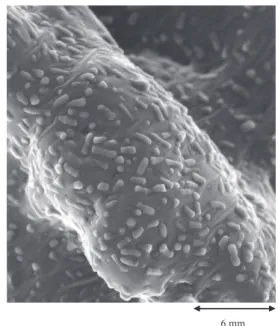
In our previous study, oil degradable bacteria (especially for fuels) were isolated from various places in Japan and assessed to their degradation characteristics for some types of fuel (Aoshima, H. et al., unpublished results). R. eryth-ropolis C2, from Nishinomiya, Hyogo Pref., was found the most eff ective for degradation of several types of mineral oil of all isolated bacteria (Fig. 1). The oil consumption ratio Journal of Environmental Biotechnology
Vol. 5, No. 2, 107–109, 2006
Original paper (regular paper)
Improvement of Heavy Oil Degradation by Rhodococcus erythropolis C2
H
ISAEA
OSHIMA1*, T
ATSUAKIH
IRASE1, T
AKAKIYOT
ADA1, N
AOYAI
CHIMURA1,
H
IDEUKIY
AMAGUCHI2, M
ITSURUT
AGUCHI2and T
AKESHIM
YOENZONO2,31 KRI Inc., Kyoto Research Park, 134, Chudoji-minami-machi, Shimogyo-ku, Kyoto, 600–8813, Japan
2 Kanto Natural Gas Development Co. Ltd., 3–1–20, Nihonbashi Muromachi Chuo-ku, Tokyo, 103–0022, Japan
3 Technoearth Co. Ltd., 661, Mobara, Mobara, Chiba, 297–0026, Japan
* TEL: +81–3–3288–1131 FAX: +81–3–3288–1132 * E-mail: [email protected]
(Received; 3 September, 2005/Accepted; 10 December, 2005)
Rhodococcus erythropolis C2, which is able to degrade several kinds of fossil fuel, was isolated from soil samples. Oil
consumption ratios of light oil, heavy oil (type-A), and heavy oil (type-C) of strain C2 were >80%, 80%, and 60%, respec-tively. The oil consumption ratio of the type-C oil increased by a maximum of 25% depending on the amount of light oil added. The oil consumption ratio of the heavy oil (type-C) was improved by decreasing the viscosity of the oil mixture. This indicated that the viscosity of the oil compound is an important factor to enhance fuel degradation.
Key words: bioremediation, oil degradation, Rhodococcus erythropolis, viscosity
AOSHIMAet al. 108
of strain C2 was almost 80% for both light and heavy oil (type-A). However, the oil consumption ratio for heavy oil (type-C) of R. erythropolis C2, had a maximum of 60%, and was lower than that for light oil and type-A oil. In order to improve the biodegradability of R. erythropolis C2 for heavy oil (type-C), we examined the eff ects of detergents such as food additives and light oil on the biodegradation of heavy oil (type-C).
R. erythropolis C2 was pre-cultured in 0.5% yeast extract at 35°C for 24 h. The pre-culture solution (0.2 ml) was added to 20 ml of W medium (2.0 g (NH4)2SO4, 0.2465 g MgSO4, 2.78 g FeSO4, 14.7 g, CaCl2, 0.5 g NaCl, 14.3 g Na2HPO4, 5.44 g KH2PO4, 2.01 g ZnSO4, 0.15 g (NH4) 6Mo7O24, 0.2 g CuSO4, 0.4 g CoCl2, 1.49 g MnSO4 per 1 L) containing 20,000 ppm heavy oil (type-C) and 0 to 20,000 ppm of light oil as sole carbon and energy source or 0.0005% to 0.05% of detergent, and cultured at 120 rpm, at 35°C for 72 h. In order to examine the eff ectiveness of the detergents, various types of Triton-X, sodium dodecyl sulphate (SDS), fatty acid esters, polymer detergents such as casein and carboxy-methyl cellulose were used to enhance the degradability of heavy oil (type-C) by R. erythropolis C2.
The oil consumption ratio by strain C2 was estimated by the weight measurement method after the chloroform-methanol (=3 : 1 v/v) extraction. Chloroform-chloroform-methanol (18 ml) was added to the culture (20 ml) to extract the remain-ing oil component, and the mixture of solvent and culture was stirred at 120 rpm for 15 min at room temperature. The mixture was transferred to a centrifuge tube and centri-fuged at 6,000×g for 10 min at room temperature. The weight of the extracted oil was measured after the lower-layer was collected and the solvent had volatilized for 3 days. Oil consumption ratio was calculated from residual
oil components.
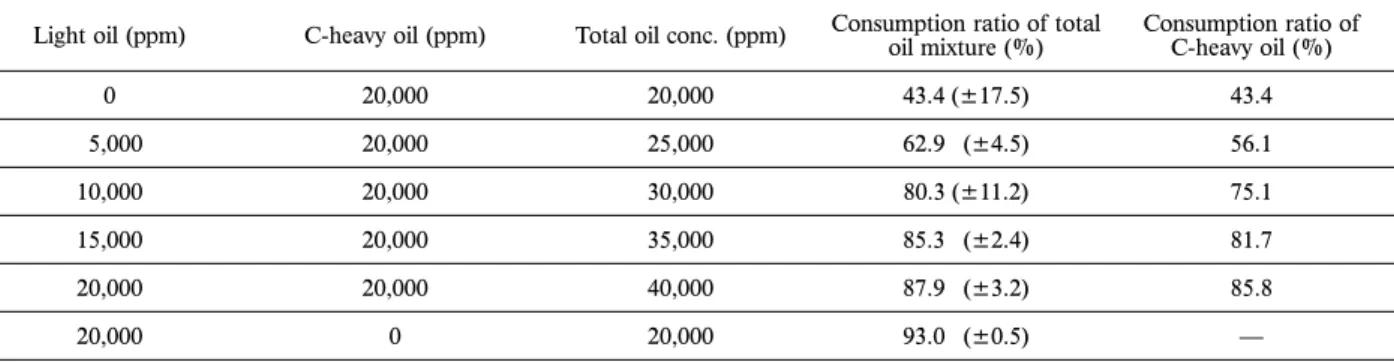
Most detergents did not signifi cantly improve oil degrada-tion. The growth of strain C2 was inhibited by the addition of Triton-X series and SDS. While strain C2 was able to grow in the fatty acid ester better than that in other deter-gents, fatty acid esters consisting of trehalose slightly im-proved oil degradation. This result suggest that strain C2 might be degrade the fatty acid as a carbon source before the heavy oil compound. The fatty acid ester is structurally similar to the biosurfactant such as trehalose 6, 6'-dimycolate secreted by Rhodococcus sp1). Therefore, the fatty acid es-ter may slightly contribute in forming stable oil-in-waes-ter emulsions of heavy oil to promote the indigenous biosurfac-tant of C2. In contrast to detergents, light oils enhanced the heavy oil consumption ratio according to the increased amount of light oil (Table 2). Most of the contents of light oil were saturates and aromatics, which are easily degraded by strain C2. Therefore, the amount of bacteria in a liquid culture containing light oil as a sole carbon source was more numerous than that containing heavy oil (type-C). As a result, light oil increased the production capacity of the biosurfactant. Simultaneously, the biosurfactant was secret-ed into the culture solution and was able to stabilize a heavy oil-in-water emulsion. In addition, this phenomenon can be ascribed to co-oxidation, in which persistent hydro-carbons are oxidized in the presence of hydrohydro-carbons which can serve as growth substrate such as light oil. Evidence for co-oxidation of recalcitrant substrates was provided by as-phaltenes and other aromatic hydrocarbons2,7). In addition, light oil could be helpful to reduce the viscosity of heavy oil, and increase the affi nity of heavy oil for the culture so-lution. Sugiura et al. have investigated the biodegradation of four diff erent crude oil samples, and demonstrated the Table 1. Chemical properties of Light oils and Heavy oils.
Class
Light oil Heavy oil
S1 1 2 3 S3 Type-A Type-B Type-C
1 2 1 2 3 Chemical Prop er ties Flash Point 50< 50< 50< 45< 45< 60< 70< Distilled Attribution (°C) (90% distilled Temp.) 360> 360> 350> 330> 330> — Pour Point (℃ ) +5 –2.5 –7.5 –20 –30 5> 10> — — — Setane Index 50< 50< 50< 45< 45< — Viscosity (mm2/s) 2.7< 2.7< 2.5< 2.0< 1.7< 20> 50> 250> 400> 400~ 1000 Sulfur (wt%) 0.20> 0.5> 2.0> 3.0> 3.5> — — Water (vol%) — 0.3> 0.4> 0.5> 0.6> 2.0> Ash (wt%) — 0.05> 0.5> TLC/FID Saturates — 68.5 — — — 62.2 — — 37.2 — — Aromatics — 27.5 — — — 34.9 — — 55.4 — — Resins — 3.6 — — — 2.6 — — 3.7 — — Asphartens — 0.4 — — — 0.4 — — 3.7 — —
109
Improvement of heavy oil degradation
biodegradability of crude oil was negatively proportional to viscosity10).
The viscosity of each oil sample was determined by a ro-tary viscometer (type; Programmable DV-III+ Rheometer, Brookfi eld, USA) at 22°C at a shearing rate of 2/sec2. The oil consumption ratio of heavy oil was improved by the de-crease in the viscosity of the oil mixture (Fig. 2). Oil viscosi-ty and the consumption of heavy oil had a negative propor-tional relationship. The equation of the calibration curve was Y=–164.03X+132.85 and the correlation coeffi cient (r2) was 0.9833. Hence, a reduction in oil viscosity accelerated the degradation ability of heavy oil by strain C2. However, in the case of soil contamination, it is diffi cult for bacteria to attach to the solidifi ed oil components after weathering. In order to improve the eff ectiveness of the contact between solidifi ed oil and bacteria, dissolution of solidifi ed oil by light oil will be the eff ective method to encourage the oil degradation in soil environment.
In this study, the relationship between fuel degradation and viscosity was demonstrated14). It is highly possible that the reduction of viscosity of polluted oils contributes to ac-celerate degradation of contaminated soil environments. To further elucidate the advantage of lower oil viscosity for bacteria, we started to analyze the amount of bacteria un-der various viscosities.
ACKNOWLEDGEMENTS
We thank Prof. Motoki Kubo for his many useful sugges-tions.
References
1) Finnerty, W.R. and Singer, M.E. 1988. A microbial biosurfac-tant: genetic engineering and application. Interfacial Phenom. Biotechnol. Mater Process 75–87.
2) Koma, D., Hasumi, F., Chung, S.Y., and Kubo, M. 2003. Bio-degradation of n-alkylcyclohexanes by co-oxidation via
multi-ple pathways in Acinetobacter sp. ODDK71. J. Biosci. Bioeng.
95: 641–644.
3) Koma, D., Hasumi, F., Yamamoto, E. Ohta, T., Chung, S.Y., and Kubo. M. 2001. Biodegradation of long-chain n-paraffi ns
from waste oil of car engine by Acinetobacter sp. J. Biosci.
Bioeng. 91: 94–96.
4) Koma, D., Sakashita, Y., Kubota, K., Fujii, Y., Hasumi, F., Chung, S.Y., and Kubo, M. 2003. Degradation of car engine base oil by Rhodococcus sp. NDKK48 and Gordonia sp.
NDKY76A. Biosci. Biotechnol. Biochem. 67: 15902–1593. 5) Leavy, J.G. and Colwell, R.R. 1990. Microdegradation of
hy-drocarbons in the environment. Microbiol. Rev. 54: 305–315.
6) Margesin, R. 2000. Potential of cold-adapted microorganisms for bioremediation of oil-polluted Alpine soils. International Biodeterioration & Biodegradation. 46: 3–10.
7) Perry, J.J. 1979. Microbial cooxidations involving hydrocar-bons. Microbiol. Rev. 43: 59–72.
8) Prince, R.C. 1993. Petroleum spill bioremediation in marine environments. Microbiol. Rev. 19: 217–242.
9) Saadoun, I. 2002. Isolation and characterization of bacteria from crude petroleum oil contaminated soil and their potential to degrade diesel fuel. J. Basic Microbiol. 42: 420–428. 10) Sugiura, K., Ishihara, M., Shimauchi, T., and Harayama, S.
1997. Physicochemical properties and biodegradability of crude oil. Environ. Sci. Technol. 31: 45–51.
11) Ward, O., Singh, A., and Van, H.J. 2003. Accelerated biodeg-radation of petroleum hydrocarbon waste. J. Ind. Microbiol. Biotechnol. 30: 260–270.
12) Whyte, L.G., Hawari, J., Zhou, E., Bourbonniere, L., Inniss, W. E., and Greer, C.W. 1998. Biodegradation of variable-chain-length alkanes at low temperatures by a psychotrophic
Rhodococcus sp. Appl. Environ. Microbiol. 64: 2578–2584.
13) Zhang, C., Li, A., Li, Y., and Zhang, L. 1999. Instrumental analysis and systematic investigation on heavy oils from coal. I. Analysis of hydrocarbon class composition. Se Pu 17: 372– 375. (in Chinese)
14) Japan Patent application 2004–288994, Clarifi cation of the pollutant.
Table 2. Consumption ratios of heavy oil (type-C) under various conditions.
Light oil (ppm) C-heavy oil (ppm) Total oil conc. (ppm) Consumption ratio of total oil mixture (%) Consumption ratio of C-heavy oil (%)
0 20,000 20,000 43.4 (±17.5) 43.4 5,000 20,000 25,000 62.9 (±4.5) 56.1 10,000 20,000 30,000 80.3 (±11.2) 75.1 15,000 20,000 35,000 85.3 (±2.4) 81.7 20,000 20,000 40,000 87.9 (±3.2) 85.8 20,000 0 20,000 93.0 (±0.5) —
Fig. 2. Relationship between the viscosity proportion of oil com-pounds and consumption ratio of heavy oil (type-C) consump-tion by R. erythropolis C2. Viscosity proportion showed values