乱流の減衰過程に及ぼす高分子の影響
名古屋工業大学大学院・創成シミュレーション工学専攻 渡邊 威 (Takeshi WATANABE) [email protected] 後藤俊幸 (Toshiyuki GOTOH) [email protected] Department of Scientific and Engineering Simulation, Nagoya Institute of Technology
Abstract
Nature of decaying turbulence of the dilutepolymer solutionisnumerically
investi-gated byusingthe hybridEulerian-Lagrangian simulations withmakingfulluseofthe
large-scale parallel computation. When the Weissenberg number $W_{i}$ wasincreased, we
observedthe power-law decayofthe kineticenergyandpressurespectraas$E(k)\sim k^{-\alpha}$
and$E_{p}(k)\sim k^{-\beta}$ in the range below the Kolmogorov length $l_{K}$ when the turbulence
adequately decayed. The exponents $\alpha$ and $\beta$ were respectively $\alpha=4.2-4.6$ and
$\beta=2.8-3.2$, and decreased with an increase of$W_{i}$
.
It was found that theprobabil-ity densprobabil-ity functions for the longitudinal velocity derivative and pressure fields were
respectively close to the Gaussian irrespective of $W_{i}$. We discuss the relationship
be-tween the present results and theprevious experimental and numerical studies for the
elastic turbulence which is characterized bythelarger $W_{i}$ and the Reynoldsnumberis
below unity.
Polymer solution flow characterized by both
a
Reynolds number $(Re)$ less than unity andhigher elasticity indicates irregular fluctuations in space and time. This phenomenon is referred to as elastic turbulence [1], and has been investigated with great interest [2, 3, 4, 5, 6, 7, 8, 9]. One of the remarkable natures of elastic turbulence is that the kinetic energy
spectrum $E(k)$ obeys the power-law form
as
$E(k)\sim k^{-\alpha}$ with $\alpha=3.5$ in experiment [1]and with $\alpha=3.8$ in the direct numerical simulation (DNS) ofthe Oldroyd-$B$ model under
a
two-dimensional Kolmogorov flow [6, 7]. Another interesting property of elastic turbulence is represented by non-Gaussian statistics of velocity derivatives field similar to the case
for high-Reynolds number Newtonian turbulent flow [8]. Recent experimental study also indicates that the pressure spectrum $E_{p}(k)$ also shows the power-law decay $E_{p}(k)\sim k^{-\beta}$
with a exponent $\beta$ being close to 3, and pressure fluctuations are strongly non-Gaussian [9].
All above results indicate that the polymer solution flow becomes turbulent state in spite of
$Re=O(1)$, and the statistical nature of it is similar to that obtained by the turbulent flows
for the Newtonian fluid.
In a previous study [10], we developed
a
simulation method for the dilute polymerso-lution flows by using hybrid approach, in which a Brownian dynamics simulation (BDS)
for
a
huge number of dumbbell model $(O(10^{10}))$ coupled witha
DNS of turbulent flowwas
performed usinglarge-scale parallel computations. We examined the modification of the
de-caying turbulence for various polymer concentration and Weissenberg number, $W_{i}=\tau/\tau_{K},$
which is the ratio of the polymer relaxation time $\tau$ to the Kolmogorov time $\tau_{K}\equiv(\nu_{s}/\epsilon)^{1/2}$
for the smallest eddy in turbulence $(v_{s}$ and $\epsilon$ are respectively the kinematic viscosity of the
solvent fluid and the average rate of the energy dissipation ofturbulence).
One of the most remarkable results reported in [10] is the fact that when the turbulence adequately decays and $W_{i}>1$ the kinetic energy spectrum obeys the power-law decay
$1/l_{K}\equiv(\epsilon/\nu_{s}^{3})^{1/4}$
.
The valueof$\alpha=4.7$isconsiderablylarger thanthe exponents obtainedforelastic turbulence
as
mentioned above, although this result is consistent with thetheoreticalprediction using the simplified viscoelastic model, where the scaling exponent $\alpha$ must be
greaterthan 3 [11]. We progressed
our
study by performing the additional simulations with larger $W_{i}$ values, and found that the value of $\alpha$ decreased when $W_{i}$was
increased [12].However the
case
by largest $W_{i}$ run in [12] (corresponding to Run D3 in this study) gavethe value $\alpha=4.19$, which remains slightly larger than those by previous studies. Thus the
understanding
on
the relationship betweenour
numerical results and the elastic turbulenceis insufficient at present.
In this study,
we
developthe previous study [12] byperformingthemore
detailed analyses. We examine the scaling behavior of the pressure spectrum, in addition to the kinetic energyspectrum, in isotropic decaying turbulence with polymer additives by computing the larger
$W_{i}$
case
thanthose in [12]. We focusour
intereston
the power-law behavior of these spectraand their $W_{i}$-dependences. Moreover
we
investigate the behavior of probability densityfunction (PDF) for velocity derivative and pressure field fluctuations when the power-law
spectrum is observed. Then the similarity and disparity between the present numerical results and those by elastic turbulence
are
discussed.The long-chain polymer is modeled by the two-beads connected by the nonlinear spring,
so
called dumbbell model [13]. The governing equations ofmotion for the n-th dumbbell is given by$\frac{dR^{(n)}}{dt}=u_{1}^{(n)}-u_{2}^{(n)}-\frac{1}{2\tau}f(\frac{|R^{(n)}|}{L_{\max}})R^{(n)}+\frac{r_{eq}}{\sqrt{2\tau}}(W_{1}^{(n)}-W_{2}^{(n)})$ , (1)
$\frac{dr_{g}^{(n)}}{dt}=\frac{1}{2}(u_{1}^{(n)}+u_{2}^{(n)})+\frac{r_{eq}}{\sqrt{8\tau}}(W_{1}^{(n)}+W_{2}^{(n)}) , u_{\alpha}^{(n)}\equiv u(x_{\alpha}^{(n)}(t), t)$, (2)
where $R^{(n)}(t)$ and $r_{g}^{(n)}(t)$ are, respectively, the end-to-end vector and the center-of-mass
vector of the n-th dumbbell. We adopt the finitely extensible nonlinear elastic (FENE) model $f(z)=1/(1-z^{2})$ for the elastic force of a dumbbell [13, 14]. In Eq.(l), $L_{\max}$ is the
maximum extension length of the dumbbell because $f(zarrow 1)=\infty$
.
The term $W_{1,2}^{(n)}(t)$indicates
a
random force representing the Brownian motion ofparticles in the solvent fluid, which obeys Gaussian statistics witha
white-in-time correlation of$\langle W_{\alpha,i}^{(n)}(t)\rangle=0$, (3)
$\langle W_{\alpha,i}^{(n)}(t)W_{\beta,j}^{(m)}(s)\rangle=\delta_{\alpha\beta}\delta_{ij}\delta_{nm}\delta(t-s)$, (4)
where $\langle\cdots\rangle$ denotesthe ensembleaverage. The subscripts $\alpha,$ $\beta,$ $i,$$j,$ $n$, and $m$take the values
$(\alpha, \beta)=1$ or 2, $(i, j)=1,2$, and 3, and $(n, m)=1,2,\cdots,$ $N_{t}$, respectively. Moreover, $\delta_{ij}$
denotes the Kronecker delta, and $\delta(t)$ is the Dirac delta function. The constants $\tau\equiv\zeta/4k$
and $r_{eq}\equiv\sqrt{k_{B}T/k}$ are, respectively, the relaxation time and the equilibrium length of the
dumbbell under $u(x, t)=0$. Here, $k$ is the spring constant, and $\zeta\equiv 6\pi\nu_{s}\rho_{s}a(\rho_{s}$ is the
density of the solvent fluid and $a$ is the bead radius). Also, $k_{B}$ and $T$ are the Boltzmann
The turbulent velocity field obeys the continuity equation for an incompressiblefluid and the Navier-Stokes ($NS$) equations
$\nabla\cdot u=0, \frac{\partial u}{\partial t}+u\cdot\nabla u=-\nabla p+\nu_{s}\nabla^{2}u+\nabla:T^{p}$, (5)
where$p(x, t)$ is the pressure field. Here, $\rho_{s}$ is set to unity and is equalto the density of bead
$\rho_{p}$ representing the polymer. The polymer stress tensor $T^{p}(x, t)$ due to the force acting
on
the fluid from the dispersed dumbbells is defined by
$T_{ij}^{p}(x, t)= \frac{\nu_{s}\eta}{\tau}(\frac{L_{box}^{3}}{N_{t}})\sum_{n=1}^{N_{t}}[\frac{R_{i}^{(n)}R_{j}^{(n)}}{r_{eq}^{2}}f(\frac{|R^{(n)}|}{L_{\max}})-\delta_{ij}]\delta(x-r_{g}^{(n)})$, (6)
where $N_{t}$ is the total number of polymers required to realize the experimental situation, $\eta\equiv(3r_{eq}/4a)^{2}\Phi_{V}$ is the zero-shear viscosity ratio of the polymer
$v_{p}$ to the solution viscosity
$(\eta=v_{p}/\nu_{s})$, and $\Phi_{V}\equiv(8\pi N_{t}/3)(a/L_{box})^{3}$ represents the volume fraction of the ensemble of
dumbbells.
The numericalsimulationsof Eqs.(1) through (6)
are
performed ina
periodic$box$withpe-riodicity$L_{box}=2\pi$ using the pseudo-spectral method in space and the second-order
Runge-Kutta method in time. $A$ total of 12$8^{}$ grid points
are
used to solve the $NS$ equations.The total number of dumbbells in computation is $N_{comp}=N_{t}/b=5.04\cross 10^{8}$ for all runs
pre-sented in this paper, where $b$ is the artificial parameter representing the number of replica
dumbbells. This reduces the computational cost of the computation of$N_{t}=O(10^{13})$
dumb-bells [10]. Here
we
set $b=9\cross 10^{4}$, giving the values $\Phi_{V}=1.01\cross 10^{-4}$ and $\eta=0.1045,$respectively.
The initial velocity field is given bythe random solenoidal field obeying Gaussian statis-tics, with an energy spectrum
$E(k, 0)=16 \sqrt{\frac{2}{\pi}}(\frac{u_{0}^{2}}{k_{0}})(\frac{k}{k_{0}})^{4}\exp(-2(\frac{k}{k_{0}})^{2})$ (7)
We set $u_{0}=1$ and $k_{0}=2$, yielding the initial value of the Taylor micro-scale Reynolds
number $R_{\lambda}(O)=52$. The dumbbells are uniformly and randomly distributed over the
computational domain. The initial configuration of each dumbbell is set according to
$R^{(n)}(0)=\sqrt{3}r_{eq}\hat{n}^{(n)}$, where $\hat{n}^{(n)}$ is a random unit vector, which is isotropically distributed.
Parallelcomputations
are
performed inorder to evaluate the convection and deformation of the dispersed dumbbells. The program is parallelized using Message Passing Interface (MPI). The detailson the parallelizedmethod can be found in [12]. The fluid velocity at the bead position is interpolated using the $TS$13 scheme [15]. Since the center-of-mass vector$r_{9}^{(n)}$ for each of the dumbbells is not onthe grid points for the DNS computation, weneed
an
approximate expression when computing the polymer stress term (6). The delta function in (6) is approximated by the weight function $\delta_{\triangle}(x-r_{g}^{(n)})$ used for the tri-linear interpolation
scheme [16]. The other parameter settings
are
described in detail in [10].We examine five
cases
of decaying turbulence for several values of $W_{i}$ while fixing theother parameters. One of them is performed without polymers (one-way coupling, named
as
Run A). The values ofthe typical numerical parametersare
listed in table 1.Table 1:
Parameters for
the hybrid simulations of decaying turbulence and Browniandy-namicsfor dispersed dumbbells. The values of$\tau$ listed below
are
determinedusing thevaluesof$W_{i}$ given in the table and the minimum value of$\tau_{K}(t)$ during the simulation without the
polymer additives (one-way coupling simulation).
Figure1: Comparison of the temporal
evo-lutionsof the kineticenergyof fluid motion$0$ 5 10 15 20 $E(t)$ and the potential
energy
for theen-{.
semble of dumbbells $U(t)$ for Runs Dl, D2,D3, and D4.
Figure 1 shows the temporal evolution of the average kinetic energy offluidmotion $E(t)$
and of the potentialenergyfor the ensemble of dumbbells $U(t)$, which
are
defined asfollows:$E(t)= \frac{1}{2}(u(x, t)^{2}\rangle_{V}$ (8)
and
$U(t)=- \frac{v_{s}\eta}{2\tau}(\frac{L_{\max}}{r_{eq}})^{2}\frac{1}{N_{comp}}\sum_{n=1}^{N_{comp}}\ln[1-(\frac{|R^{(n)}(t)|}{L_{\max}})^{2}]$ (9)
for all ofthe runs, respectively, where $\langle\cdots\rangle_{V}$ represents the volume average
over
thecom-putational domain $V=L_{box}^{3}$
.
Hereinafter, figures are plotted using non-dimensional time$t^{*}\equiv k_{0}u_{0}t$. The kinetic energy $E(t)$ decays monotonically with time, and the
curves
collapseonto a single curve irrespective of$W_{i}$. The values of$E(t)$ at the end of the simulations
are
much smaller than their initial values, meaning that the turbulence adequately decayed at
$t^{*}=20$
.
On the other hand, $U(t)$ increases with time for $t^{*}<7$, which indicates that theturbulence kineticenergy is transferred to the potentialenergy of the ensemble ofdumbbells in addition to the heat. Moreover, $U(t)$ starts to decay at around$t^{*}=7$, indicating that the
portion of restored potential energy is also back-transferred to turbulence and is dissipated due to the viscosity. Note that $U(t)$ is largerthan $E(t)$ in the range of$t^{*}>11$ for all of the
4 (a) 3 2 $0$ $\tilde{L}$ 1 $0$ $-1$ $0$ 5 10 15 20 $0$ 5 10 15 20
$t. t.$
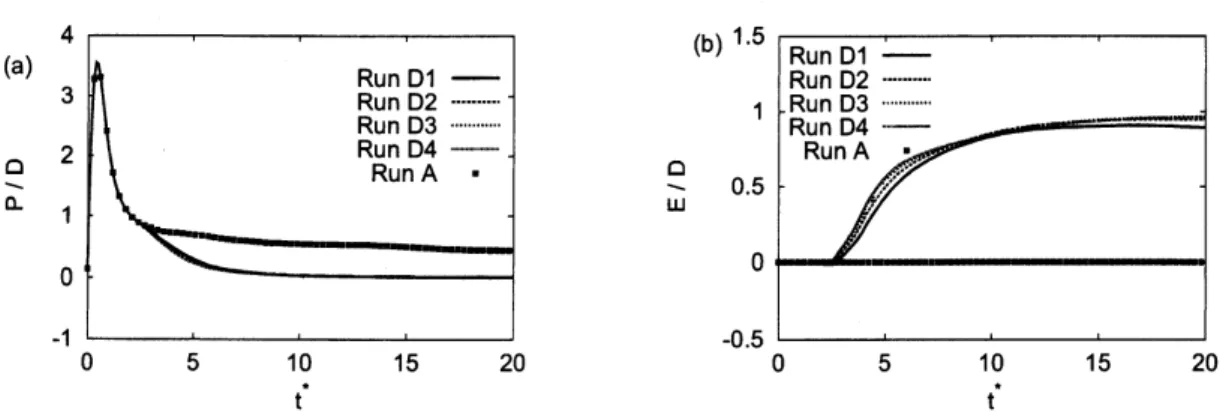
Figure 2: Comparison of the temporal evolutions of (a) the mean enstrophy produc-tion rate (S) dividedby the
mean
enstrophy dissipation rate (D) and of (b) themean
enstrophy production/inhibition rate due to polymer additives (P) divided by the mean enstrophy dissipation rate for Runs Dl,D2,$D3$, and D4. Run A is due to theone-way coupling
case.
Because the kinetic energy decays with time, the Reynolds number
$R_{\lambda}(t)=\sqrt{\frac{20}{3\nu_{s}\epsilon(t)}}E(t)$, (10)
where $\epsilon(t)=v_{s}\langle(\nabla u)^{2}\rangle_{V}$is the mean dissipationrate of the kineticenergy, also decays with
time [12]. Thetypicalvalues of$R_{\lambda}(t)$ at$t^{*}=20$ are listed in table 1. Weclearly confirm that
$R_{\lambda}$ is order unity when $t^{*}=20$
.
In contrast, the local Weissenberg number $W_{i}(t)=\tau/\tau_{K}(t)$becomes larger than unity for all of the runs when $t^{*}=20$ as shown in table 1, and increase
with $\tau$. Thus at the end of simulationastate characterized by$R_{\lambda}=O(1)$ and $W_{i}\gg 1$, close
to the situation of elastic turbulence, is achieved. Wenote that the coil-stretch transitionof long-chain polymers
occurs
when $W_{i}=3-4[17].$The enstrophy is defined by the mean squared vorticity
as
$E_{\omega}(t)=\langle\omega^{2}\rangle_{V}/2$ with $\omega=$$\nabla\cross u$. The transport equation of$E_{\omega}(t)$ is derived from the $NS$ equations
as
$\frac{d}{dt}E_{\omega}(t) = \langle\omega\cdot(\omega\cdot\nabla u)\rangle_{V}+\langle(\nabla\cross\omega)\cdot(\nabla:T^{p})\rangle_{V}-v\langle(\nabla\omega)^{2}\rangle_{V}$ . (11)
The terms on the right hand side (R.H.S.) of Eq.(ll) are the mean enstrophy production,
mean
enstrophy exchanges due to polymers, and themean
enstrophy dissipation rate,re-spectively $($named $P, E, and D in$ order). Figure2 shows the temporal evolutions of (a) the
mean
enstrophy production $(P)$ and of (b) themean
enstrophy exchanges due to polymers $(E)$, divided by the enstrophy dissipation rate $(D)$. These indicate that the contributionof term $P$ to the production of enstrophy is almost negligible for $t^{*}>10$, while the term
$E$ shows the positive finite values in this range. This clearly represents the fact that the
vorticity stretching term has
an
negligible influence onproducing the turbulent fluctuations, and the turbulent state is kept by the term $E$ which is originated from the strong couplingbetween the vorticity and stretching dumbbells. When
we
consider theNewtoniancase
(RunA$)$, the term $P$ balances to the enstrophy dissipation,
so
that the vorticity stretching is the$k|_{K}(t)$ $k|_{K}(t)$
Figure 3: Comparison of the kinetic energy spectra $E(k, t)$ by (a) normalized plot
of dissipation spectra using Kolmogorov scaling and by (b) compensated plot by multiplying $k^{a}$ obtained at $t^{*}=20$ for Runs Dl, D2, D3, and D4. Scaling exponent
$\alpha$ fOr eaCh
run
$S$i$S$ evaluated by the leaSt Square fitting in lhe range $2\leq$ 雇$K$$($オ$)$ $\leq 5$decay of polymer solution turbulent flow is maintained due to the stronger elasticity which
is originated from the elastic energy restored in the decay regime of turbulence $(t^{*}<10)$
.
Figures 1 and 2 suggest that the mechanism of turbulence decay for polymer laden flow is quite different from the
case
of turbulence for Newtonian fluid. Decaying process ofturbulence is categorized into three stages
as
follows:$s1)$ Turbulence develops from its initial value at the time that the
mean
energydissipationreaches its maximum value. Then the dumbbells are rapidly stretched by turbulence, increasing $U(t)$
.
$s2)$ Turbulencestarts to decay by theactions ofviscosity andenergy transfer to the
ensem-ble ofdumbbells, while the dumbbells remain stretching up to the time $E(t)\sim U(t)$.
$s3)$ The restored potential energy $U(t)$ decays with time with the rate slower than $E(t)$,
meaningthat the back transfer ofenergyfrom the ensemble of dumbbells to turbulence
occurs.
In the stage$s1$) theenergy transfer fromturbulence to ensemble ofdumbbellsis active, while
the flow field is maintained by the back energy transfer from the ensemble of dumbbells in the stage $s3$). The turbulence statistics in stage $s3$) is thus governed by the elastic nature
of polymers, meaning that the situation is quite similar to the
case
of elastic turbulence. Next we investigate the scaling behavior of kinetic energy spectrum $E(k, t)$ obtained at $t^{*}=20$.
The spectrum $E(k, t)$ is defined by$E(k, t)=2\pi k^{2}\langle|\hat{u}(k, t)|^{2}\rangle_{s}$ (12)
in terms of the Fourier amplitude$\hat{u}(k, t)$ where $\langle\cdots\rangle_{s}$ is the average taken
over
the sphericalshell within $k-\triangle k/2<|k|\leq k+\triangle k/2$ in the wavenumber space. Figure 3 (a) compares
the kinetic energy spectra obtained for all of the runs, where we plotthe dimensionless form
ofdissipation spectra $\hat{D}(kl_{K}(t), t)$ defined using the Kolmogorov scaling
as
$10^{rightarrow 1}$ $10^{0}$ $10^{1}$
$k|_{K}(t)$
$10^{-1}$ $10^{0}$
$k|_{K}(t)$
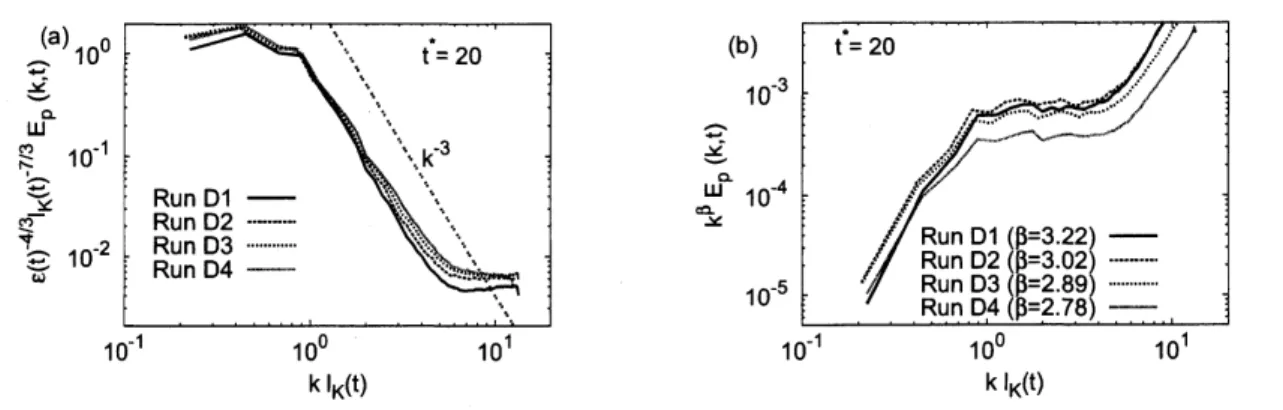
Figure 4: Comparison of the pressure spectra for (a) normalized plot using the
Kol-mogorov scaling obtained at $t^{*}=20$ and for (b) the compensated plot by
multiply-ing the factor $k^{\alpha}$, in which $\alpha$ is evaluated by the least square fitting in the range $2\leq kl_{K}(t)\leq 5.$
to stress the behavior in the range $kl_{K}(t)>1$. As shown in figure 3 (a), the normalized
spectra almost collapse in the range $kl_{K}(t)<1$, and they show the power-law decay for
$kl_{K}(t)>1$. The spectrumbecomes less steep and approaches to $k^{-2}$ with an increase of$W_{i},$
meaning that $E(k, t)$ is close to $E(k)\sim k^{-4}$
.
To see this point in more detail, we investigatethe compensated spectra $k^{\alpha}E(k, t)$ plotted infigure3 (b), where the exponent $\alpha$ is evaluated
bythe least square fit in the range$2\leq kl_{K}(t)\leq 5$
.
This figure clearly indicates that 1) thereis a clearscaling range for each curves of$W_{i},$ $2$) the value of$\alpha$ decreases with an increase of
$W_{i}$
.
The largest $W_{i}$ case shows $\alpha=4.14$ which isnear the values of3.5 and 3.8 obtained bythe elastic turbulence [1, 6, 7].
The power-law form of $E(k, t)$ observed in figure 3 implies that the pressure spectrum
$E_{p}(k, t)$ also obeys the power-law form. The pressure field$p(x, t)$ is determined by the $NS$
equations with
an
incompressible conditionas
$p(x, t)=\triangle^{-1}(-\nabla\cdot(u\cdot\nabla u)+\nabla\cdot(\nabla:T^{p}))$ . (14)
When the turbulence adequately decays while the dumbbells remain the fully stretched configurations, the first term of the R.H.S. ofEq.(14) is sufficientlysmallerthan the second one, leading to the relationship $p(x, t)\simeq\triangle^{-1}\nabla\cdot(\nabla : T^{p})$ for $W_{i}\gg 1[9]$. Thus the
statistics of pressure field is dominated by that of the polymer stress field. Figure 4 shows the comparison of the pressure spectra $E_{p}(k, t)=2\pi k^{2}\langle|\hat{p}(k, t)|^{2}\rangle_{s}$ obtained at $t^{*}=20$ for
all of the
runs.
The normalized plot by using the Kolmogorov scaling, shown in figure 4(a), clearly represents that the pressure spectraobey the power-law form close to $k^{-3}$ in the
range $kl_{K}(t)>1$
.
This is almost consistent with the experimental result by [9]. Spectrabecome less steep with
an
increase of $W_{i}$.
This is confirmed by figure 4 (b) representingthe compensated plot $k^{\beta}E_{p}(k, t)$ where the exponent $\beta$ is also evaluated by the least
square
fitting in the range same as $E(k, t)$. We confirm the existence of plateaus in figure 4 (b)
although there are some scatter of data when compared to the case of $k^{\alpha}E(k, t)$ (figure 3
$(b))$. Thevalue of$\beta$ decreases with
an
increase of$W_{i}$, where$\beta=3.22,3.02,2.89$, and2.78 forRuns Dl,D2,$D3$, and D4. This feature is similar to the case for the kinetic energy spectrum
$(z-<z>)/0_{z}$ $(z-<z>)/\sigma_{z}$
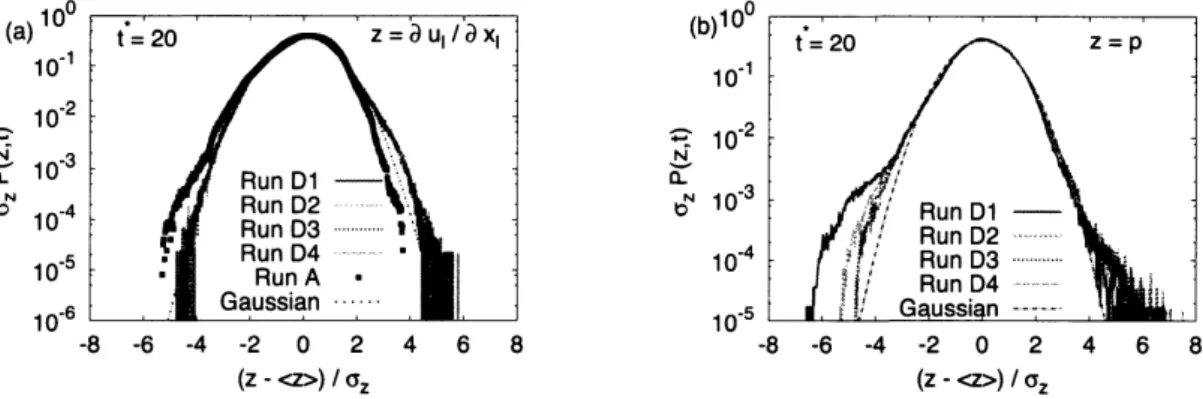
Figure 5: Comparison of the normalized PDFs for (a) longitudinal velocity derivative
$\partial_{L}u_{L}$ and for (b) pressure
$p$ obtained at $t^{*}=20$ for Runs Dl, D2, D3 and D4.
Similarities ofpower-law spectra ofboth $E(k)$ and $E_{p}(k)$ between the present numerical
results and the results by experimental observation suggest that the one-point statistics
of the velocity derivative and pressure fields may show the strong non-Gaussianity [8, 9]. We further investigate the PDF behaviors for both the longitudinal velocity derivativefield
$\partial_{L}u_{L}(x, t)$ and the pressure field$p(x, t)$. Figure 5 shows the resulting
curves
obtained by thedata at $t^{*}=20$for (a) $\partial_{L}u_{L}(x, t)$ and (b) $p(x, t)$, where we compare thecurves made by the
standardized plot. Weconfirm that the PDF formisalmostinsensitive tothevariationof$W_{i}$
for both cases, and slightlydeviatesfrom the Gaussian for $\partial_{L}u_{L}$
.
The PDF form of$\partial_{L}u_{L}$ byRuns $DI$-D4 becomes almost symmetric, meaning that the skewness factor of $\partial_{L}u_{L}$, which
is related to the
mean
vorticity production in isotropic turbulence, is almostzero.
This is in sharp contrast tothe one-way couplingcase
(Run A), and is alsoconsistent with the results of figure 2. While the curves for $p(x, t)$ show almost Gaussian although the eachcurves
areslightly skewed. Thus the velocity gradient and pressure field statistics manifest the less
intermittent fluctuations than those by experimental results [8, 9], and
are
approximatelyGaussian form. This suggests that the mechanism for producing thenon-Gaussian statistics
in experimentsmaynot beattributed to the effectsof polymers, perhaps is due to the nature
oflarge-scale properties like the forcing mechanism. This calls further studies in the
case
for steady flow by introducing appropriate forcing mechanism. Also the PDF tail behavior is sensitiveto the resolution condition [18],so
thatwe
mayneed further increaseofspatialgrid points to clarify the discrepancy between the present numerical and previous experimental results.We discuss the power-law form of thespectraobtained in this study. Figure3 (b) suggests thatthe scaling exponent $\alpha$for the kinetic energyspectrum approachesto the value of4when
$W_{i}$ is increased further. The spectral form $E(k)\sim k^{-4}$ reminds
us
that of two-dimensionalturbulence in the enstrophy inertial
range,
suggested by Saffman [19]. The key idea is theformation of the thin layer ofvorticityfield and leading to the largejump ofvorticity, yields
the power-law spectrum of vorticity spectrum $E_{\omega}(k)\sim k^{-2}$. Thus $E(k)\sim k^{-2}E_{\omega}(k)\sim k^{-4}.$
This raises the question of how the field structure of vorticity field is characterized when
$W_{i}\gg 1$. We expect to observe the large jump of vorticity, i.e. the regions having larger
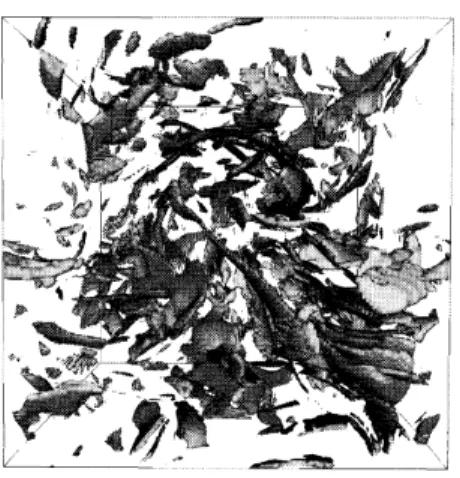
$|\nabla\omega|$ localize in space. Figure 6 shows the iso-surface of $|\nabla\overline{\omega}|$ obtained by Run D4 with
Figure6: Visualization of iso-surface of the absolute ofvorticity derivative field $|\nabla\overline{\omega}|$
obtained at $t^{*}=20$ of Run D4.
the zig-zag fluctuations
on
the objects. This figure indicates that $|\nabla\overline{\omega}|$ localizes in space asthesheet-like structures. This
seems
to support the idea bySaffman [19], althoughwe
donot know why such a sheet-like structure is formed due to the effect ofpolymers. Moreover weneed further examinations by performing the simulations with larger $W_{i}$ values than those
by present study to confirm the asymptotic value of$\alpha$ when $W_{i}arrow\infty.$
Finally we comment on the relationship between $E(k)$ and $E_{p}(k)$. In the final period of
decay, the elastic energy for the ensemble of dumbbells is larger than the kinetic energy of fluid motion, as shown in figure 1. Also the mean enstrophy is produced by the polymer stress field rather than the vorticity stretching term originated from the advection term in the $NS$ equations. These facts yield the evaluation of the order of velocity $u$ and pressure
$p$
as
$|u|\sim(\nu/l)|T^{p}|,$ $l$ being the characteristic scale in the scaling range, and$p\sim|T^{p}|$
from Eq.(14) with $W_{i}\gg 1$. This estimation leads to the relationship $E(k)\sim(\nu k)^{-2}E_{p}(k)$,
so that we have $\alpha-\beta=2$. On the other hand, the numerical results by figures 3 and 4
indicate$\alpha-\beta=1.38,1.29,1.30$, and 1.36 for Runs Dl,D2,$D3$, and D4, being smaller than 2,
although the values of$\alpha-\beta$ are insensitiveto the variation of$W_{i}$. This
means
that thesimpledimensional evaluation does not work well. We have no ideato explain this discrepancy at present, but this analysissuggests that the values of scaling exponent $\alpha$ and$\beta$
are
not simplyextracted from the arguments by the dimensional grounds.
In summary, we investigated the scaling behavior of both the kinetic energy and pressure
spectrum in decaying isotropic turbulence with polymer additives for various values of $W_{i}$
for $W_{i}\gg 1$. We obtained the power-law forms of $E(k)\sim k^{-\alpha}$ and $E_{p}(k)\sim k^{-\beta}$ in the
range $kl_{K}>1$ when turbulence adequately decayed and the elastic energy became larger
than the kinetic energy offluid motions. Exponents $\alpha$ and $\beta$ were approximately 4.2–4.6
and 2.8–3.2, and decreased with the increase in $W_{i}$. The value of $\beta$
was
similar to thevalues obtained in the recent experimental study of elastic turbulence $(\beta=3)$, while the
value of $\alpha$ obtained by the largest value of $W_{i}$ was slightly larger than those obtained by
experiments $(\alpha=3.5)[1]$ and by the DNS ofthe constitutive equations $(\alpha=3.8)[6,7])$.
Significant difference is observed in the PDF behavior of velocity derivative and pressure
fields, where
we
observed the behavior close to the Gaussian irrespective of$W_{i}$, in contrastto the non-Gaussian statistics by experimental results [8, 9].
T. W. and T. G. were supported in part by Grants-in-Aid for Scientific Research Nos.
Sci-ence, and Technology of Japan. T. W. would like to thank
S.
Uno and D. Sugimoto fortheir assistance in writingthe parallelized code. The authors would liketothank the Theory and Computer Simulation Center of the National Institute for Fusion Science and JHPCN
and HPC at the Information Technology Center of Nagoya University for providing the computational
resources.
References
[1] A. Groisman and V. Steinberg, Nature 405, 53-55, (2000) [2] A.
Groisman
and V. Steinberg, Nature 410, 905-908, (2001)[3] T. Burghelea, E. Segre, and V. Steinberg, Phys. Rev. Lett. 92, 164501 (2004).
[4] P. E. Arratia, C. C. Thomas, J. Diorio, and J. P. Gollub, Phys. Rev. Lett. 96, 144502
(2006).
[5] T. Burghelea, E. Segre, and V. Steinberg, Phys. Rev. Lett. 96, 214502 (2006).
[6] S. Berti, A. Bistagnino, G. Boffetta, A. Celani and S. Musacchio, Phys. Rev. $E77,$
055306 (2008).
[7] S. Berti and G. Boffetta, Phys. Rev. $E82$, 036314 (2010).
[8] A. Groisman and V. Steinberg, New J. Phys., 6, 29 (2004).
[9] Y. Jun and V. Steinberg, Phys. Rev. Lett. 102, 124503 (2009). [10] T. Watanabe and T. Gotoh, J. Fluid. Mech. 717, 535 (2013). [11] A. Fouxon and V. Lebedev, Phys. Fluids 15, 2060 (2003).
[12] T. Watanabe and T. Gotoh, accepted for publication in J. Phys.:
Conf.
Ser..[13] R. B. Bird, C. F. Curtiss, R. C. Amstrong, and O. Hassager, Dynamics
of
Polymetric Liquids, Vol.2 Kinetic Theory, 2nd ed. (Wiley, New York, 1987).[14] M. Doi and S. F. Edwards, The Theory
of
Polymer Dynamics, (OxfordUniversity Press,New York, 1986).
[15] P. K. Yeung and S. B. Pope, J. Comp. Phys. 79, 373-416 (1988).
[16] A. Prosperetti and G. Tryggvason (Eds.), Computational Methods
for
Multiphase Flow, (Cambridge University Press, Cambridge, 2007).[17] T. Watanabe and T. Gotoh, Phys. Rev. $E81$, 066301 (2010).
[18] T. Watanabe and T. Gotoh, J. Fluid Mech. 590, 117 (2007). [19] P. G. Saffman, Stud. Appl. Math. 50, 377 (1971).