37
Solutions
to
aNearly Simple
Harmonic Vibration
Equation
by
Means
of N.
Fractional Calculus
デカル
$|\backslash$出版
-酉本勝之
(Katsuyukl
Nishimoto)
Research
Institute for Applied Mathematics
Descartes
Press
$\mathrm{C}o$.
Abstract
In
this
paper, solutions
to anearly simple
harmonic
vibration
equation
are
discussed
by
means
of N-
fractional
calculus,
and
some
investigation
of the
solutions
are
reported.
Keywords
:
$\mathrm{N}$-Fractional Calculus, Simple Harmonic
Vibration
Equation.
Introduction
(Definition
of
Fractional
Calculus)
(I)
Definition.
(by
K.
Nishimoto)([1
]
Vol.
1)
Let
$D=\{D_{-}, D_{+}\}$
,
$C$
\approx$\{C_{-*}C_{+}\}$
,
$C$
-be acurve
along the cutjoining two
points
$z$
and
$-\infty+$
$\mathrm{i}\mathrm{l}\mathrm{m}(\mathrm{z})$,
$C_{*}$
be
acurve
along
the
cutjoining two points
$\mathrm{z}$and
$\infty+$ $\mathrm{i}$$\mathrm{f}(\mathrm{z})$
,
$D_{-}$be
adomain
surrounded by
$C_{-}$P
$D_{\star}$be adomain surrounded by
$C_{*}$(Here
$D$
contains
the
points
over
the
curve
$C$
).
Moreover,
let
$f\Leftrightarrow f(\mathrm{z})$be
aregular
function in
$D(z\in D)$
,
$f_{\mathrm{V}}=(f)_{v} \sim_{C}(f)_{\nu}arrow\frac{\Gamma(v+1)}{2\pi i}\int_{C}\frac{f(\zeta)}{(\zeta-z)^{v*1}}d\zeta$
$(v \not\in T)$
,
(1)
$(f)_{-m}\infty$
$\lim(f\mathrm{J}_{\nu} (m \in ff), (2)$
where
$-\pi$
\leq $\arg(\zeta-z)$
\leq \pi
for
$C_{-}$I
0\leq
$\arg$
(
$\zeta-$z)
$\mathrm{s}2\pi$for
$C_{*}$:
$\zeta {}^{t}\mathrm{Z}$,
$z$$\in C\eta$$v$
$\in R$
,
$\Gamma$; Gamma
function,
then
$(f)_{\mathrm{v}}$is
the
fractional
differintegration
of
arbitrary
order
$v$
(derlvatives
of
order
$v$
for
$v>0$
,
and
integrals
of order-v for
$v$
$<0$
),
with
respect
to
$\mathrm{z}$,
of
the
function
$f$
:
if
$|(f)_{v}|$
<
$\infty$.
(II)
On
the fractional calculus
operator
$N^{\mathrm{v}}[3]$Theorem
A. Let
fractional
calculus
operator(Nishimoto’s
Operator)
$N^{v}$be
$N^{\vee}$
-
$( \frac{\Gamma(v+1)}{2\pi i}\int_{\mathrm{c}}\frac{d\zeta}{(\zeta-z)^{\nu*1}})$$(v\not\in T)$
[Refer
to
(1)]
:
(3)
wirh
$N^{-m}-$
Jim
$N^{\mathrm{v}}$ $(m\in \mathrm{Z}^{*})$,
{4)
$\nuarrow-n|$
and
define
the binary
operation
$0$as
$N^{\beta}\circ N^{\alpha}f\approx N^{\beta}N^{\alpha}f$\approx $N^{\beta}(N^{\alpha}f)$
$(\alpha, \beta \in R)$
,
$(5)$
fhert
the set
$\{N^{\mathrm{v}}\}\Leftrightarrow\{N^{\nu}|v\in R\}$
(6)
is
an
Abelian
product
group
(having
continuous index
$v$)which
has
the inverse
fransform
operator
$(N^{\mathrm{v}})^{-1}$\sim
$N^{-v}$
to
the
fractional
calculus
operator
$N^{\nu}$for
the
function
$f$
such
that
$f\in F$
=
$\{/$
;
0\neq
$|f_{\nu}|<\infty$,
$v$
$\in R\}$
, where
$7\approx$$f(\mathrm{z})$and
$\mathrm{z}\in C$.
(vis.
$-\mathrm{Q}\mathrm{Q}<v$$<\mathrm{Q}\mathrm{Q}$).
(For
our
convenience,
we
call
$N^{\beta}\circ N$’as
product of
$N^{\beta}$and
$N^{\alpha}1$)
Theorem B. ”F.O.G.
$\{N^{v}\}$
”
is
an
”Action product
group
which
has continuous
index
$v$
\prime\prime for
the
set
of
$F1$
(
$F.O$
.G.
$j$Fractional calculus
operator
group
)[3].
\S
1.
General
solution to
nearly simple
harmonic
vibration equations
Theorem
1.
Let
$\varphi\in p^{\mathrm{o}}=\{\varphi :
0\neq|\varphi_{v}|<\infty, v\in R\}$
:
then
the
homogeneous
fractional
order
differintegral
equation
(nearly
simple
harmonic vibration
equation
for
I
$\epsilon 1$$<<1$
)
.
$j_{2*\epsilon}+f.\omega^{2}=0$
$(^{a)\neq 0,\varphi\simeq\varphi(t)}l,\epsilon\in R|\epsilon-- 2’)$(0)
has the following
general solutions
.
(i)
$\varphi$=
$\sum_{n\cdot 0}^{m}a_{n}e^{4}\mathrm{t}n,\epsilon$)
$\mathrm{c}\mathrm{o}1l11\cdot\iota$),
$\mathrm{x}[\cos B(n, \epsilon)\omega^{2l(2*\epsilon)}l+i\sin B(n, \epsilon)\omega^{2l(2*\epsilon)}t$
],
$(1)$
where
$A$
(n,
$\epsilon$)
$=\cos\beta(n,\epsilon)$
(2),
$B(n, \epsilon)=\sin\beta(n,\epsilon)$
(3)
and
/3
$(n,\epsilon)$\approx$\pi(1+2n)$
$/(2+\epsilon)$
(4)
for
$\epsilon\in R$.
$\mathrm{t}$$\mathrm{i}$$\mathrm{i})$ $\varphi$
=
$\sum_{n}’$”
$a_{n}e^{G(n_{1}\epsilon)\omega^{\prime(\not\subset)}l}$
$\mathrm{x}$
[
$\cos H(n,$
$\epsilon)\omega^{r(e)}t+i\sin H$
(n,
$\epsilon)a)^{r(e)}l$
],
(5)
where
$G$
(n,
$\epsilon$)-
$\cos\pi(_{2}^{[perp]}+n)r$
$(\epsilon)$(6),
$H(n, \epsilon)=\sin\pi(_{2}^{[perp]}+n)r(\epsilon)$
(7)
and
$r( \epsilon)=\sum_{k-0}^{\infty}(-\epsilon/2)^{k}$
(8)
for
I
$\epsilon \mathfrak{l}<2$.
$(\mathrm{i}\mathrm{i}1)$ $\varphi$\sim
$\sum_{n\cdot 0}^{1n}a_{\mathrm{t}},e^{P(}$’1.
$e$)
$\varpi^{1-(d1\}}$’
$\mathrm{x}[\cos Q(n, \epsilon)\omega^{1-(\epsilon}$
’
2)
$l+i\sin Q$
(n,
$\epsilon$)
$\omega^{1-(el2)}t]$
,
(9)
where
$P(n, \epsilon)$
=coe
$\pi(\frac{1}{2}+n)$ $(1-\mathrm{Z})2$:
$(1\mathrm{Q}$ $\mathrm{C}$$Q(n,\epsilon)=\sin\pi(\mathrm{J}_{2}+n$
$)(1-_{2}^{A})$
,
(11)
39
Where
$a_{n}$is
an
arbitrary
constant
correspond to
$\beta(n,\epsilon)$
and
$m$
is
finite
when
$\epsilon$is
a
rational
number,
and
$m$
is
infinite
when
$\epsilon$is
an
irrational number.
Note
1.
We
must call
(9)as
approximate
(or
almost)general
solution
to
equation
(0),
because it is not general solution in the strict
sense.
Proof
of
(i)
Set
$\varphi=e^{\lambda t}$,
(12)
then
operate
$N^{2+e}$
to
the
both
sides
of
(12
),
we
have then
$N^{2+\epsilon}p=\varphi_{2+\epsilon}=\lambda^{2+\epsilon}e^{\lambda/}$
[1
]
(13)
Therefore,
we
have
$\lambda^{2+\epsilon}+$
$0^{2}-0$
.
$(14)$
from
(13 ),
(12)and
(0).
Hence
$2=$
$(-\omega^{2})^{1l(2+\mathrm{r})}$ \approx $\mathrm{S}^{(1+2\mathrm{F}\mathrm{t})7(2+\epsilon)}\omega^{2l(2+\epsilon)}$$(15)$
$\equiv\gamma(n,\epsilon)$
$(n \approx 0, 1,2,\cdots, m)$
(16)
Then letting
$\beta(n,\epsilon)$ \approx
$\pi(1+2n)$
$/(2+\epsilon)$
(4)
we
have
$\gamma(\mathfrak{l}1, \epsilon)$
=
$e^{i\beta(\eta\epsilon)}\omega^{2l(2+\epsilon)}$
$(17)$
$-\{ A(n, \epsilon)+ iB(n, \epsilon)\}\omega^{2/(u\epsilon)}$
(18)
where
$A$
(n,
$\epsilon$)
and
$B(n, \epsilon)$
are
the
ones
shown
by
(2)and (3 ),
respectively.
We have then
aparticular
solution
$\varphi=e^{\gamma(\mathrm{u}\epsilon)}$
’
(19)
$\approx e^{\langle A(n,\epsilon)+lB(n,\epsilon)\rangle\omega^{2l(3*\iota)}}’\Xi\varphi|_{(n)}$(denote)
(20)
to equation
(0).
Inversely
(20)satisfies
equation
(0)clearly.
Therefore,
we
have
(1)from
$\varphi$
-
$\sum_{n-0}^{n}’ a_{n}\cdot\varphi|_{(n)}$(21)
as
the general solution
to equation
(0),
where
$a_{n}$is
an
arbitrary
constant
correspond
to
$\beta(n, \epsilon)$.
Proof of
$(\mathrm{i}\mathrm{i})$For
I
$\epsilon|<2$
,
we
have
$\frac{1}{5\overline{+\epsilon}}\approx_{2}^{1}r(\epsilon)$
,
(22)
We have then
$\beta(n.\epsilon)$ \vee
$\pi(\not\in+n)r(\epsilon)$
(23)
from
(22)
and
(4).
Therefore,
we
have
(5)from
(23)and
(1).
Proof
of
$(\mathrm{i}11)$For {
$\epsilon 1<<1$
,
we
have
$r(\epsilon)$
-
$\mathrm{E}^{(-\epsilon/2)^{\mathrm{A}}}\infty\approx$$1-\xi$
:
(24)
then
$\beta(n,\epsilon)-\pi(_{l^{1}} +n )$
$(1-\epsilon\tau)$(25)
Therefore,
we
have
(9)from (25)and
(5).
\S 2.
Investigation for
$\varphi|_{\mathrm{t}n)}$Here
wc
investigate
the
solutions
$\varphi|_{(n)}$of the
case
$(\mathrm{i}\mathrm{i}\mathrm{i})$in
\S
1,
Theorem 2. When
$\omega>0$
$\varphi|_{\mathrm{t}\prime)}$
\approx
$e^{(-1)’\{(2\prime*1)\epsilon\pi^{l}4\mu\iota}[\cos Q\iota$$+(-1)^{r}i\sin Q\iota]$
,
(26)
is
convergent
for
$(\begin{array}{lllll}0<-\epsilon <<\mathrm{l} for r-2k0<\epsilon <<\mathrm{l} for r -2k+1\end{array})$
$(27)$
where
$Q-\omega(1-\not\in\log\omega)-$
.
(28)
$\varphi|_{(n)}$
\sim
$e^{P(n.\iota)\omega^{1-(\cdot\prime 1)}}$
/
$[\cos Q(n, \epsilon)o$
”
$l2$
)
$t+i\sin Q(n, \epsilon)\omega^{1-(tl2)}t]r$
.
(29)
and
$k$$-0,1,2,\cdots$
Proof.
(I)
Investigation
for
$\varphi|_{(0)}$When
1
$\epsilon 1<<1$
,
we
have
(29)from
$\mathrm{s}1$.
(20)
having
fi 1.
(10)and
(11
),
since
$\varphi|_{(n)}$\sim
$e\{P(\mathrm{n}.\epsilon)+iQ(n, \epsilon)\}\omega^{1-(\epsilon\prime 2)}$
’
In
the
case
of
$n-0$
,
we
have
$P(0,\epsilon)\omega^{1-(e\prime 2)}$
\approx
$(\epsilon\pi/4)\omega$$(30)$
and
$Q(0, \epsilon)\omega^{1-(el2)}$
\sim
$a$)
$(1- \not\in \log\omega )=Q$
,
$\mathrm{t}$$311$
(32)
$\cos\frac{\pi}{2}(1-\frac{\epsilon}{2})=\sin\frac{\epsilon\pi}{4}=\sum_{k-0}^{\infty}(-1)^{k}\frac{(\epsilon\pi/4)^{2k+1}}{(2k+1)!}$ $( 1\epsilon\pi/4\mathrm{I}<\infty)$
,
(33)
$\sin\frac{\pi}{2}(1-\frac{\epsilon}{2}\rangle=\mathrm{o}\mathrm{s}\frac{\epsilon\pi}{4}=\sum_{k-0}^{\infty}(-1)^{k}\frac{(\epsilon\pi/4)^{2k}}{(2k)!}$ $(|\epsilon\pi/4\mathrm{I}<\infty)$
,
$(1\epsilon 3\pi /41 <\infty)$
,
(39)
and
$\omega^{1-(\epsilon\prime 2\rangle}$
\approx $\omega\cdot e^{\epsilon 1_{\mathfrak{B}}\omega^{-1l2}}=\omega$$\mathrm{a}\frac{(\epsilon\log\omega^{-1J2})^{k}}{k!}\infty$
(I
$\epsilon\log\omega^{-1/2}$I
$<\infty$).
(34)
Therefore,
we
have
$\varphi|_{(0)}$
\sim $e^{(\epsilon\pi/4)\omega t}[\cos Qt+i\sin Qt]$
,
$(1 \epsilon \mathrm{I} <<1)$(35)
The solution
(35)is
divergent
for
$\epsilon$\succ
$0$and
is
convergent
(damping
form)
for
$\epsilon<0$
when
$\omega>0$
.
And
we
have
$Q=a)$
$(1-_{2}^{\mathrm{B}}\log\omega)>a)$
$(\epsilon<0, \iota v >1)$
,
(36)
Then,
letting
$T_{Q}-2\pi/Q$
; period of the function
$\cos Qt$
,
and
$T_{\omega}arrow 2\pi/\omega j$
period
of
the function
$\cos\omega l$
we
have
$T_{Q}<T_{\mathcal{O}\mathrm{J}}$
$(Q>\omega)$
when
$\epsilon<0$That
is,
we
have that ”the
period
$T_{Q}$of
$\cos Qt$
-
$\cos\omega(1-\mathrm{z}\mathrm{l}\epsilon \mathrm{o}\mathrm{g}a))t$is
smaller
than
the
one
$T_{\omega}$of
$\cos wl\mathfrak{s}\iota$when
$\epsilon<0$,
$\omega>$$1$.
(II)
Investigation
for
$\varphi|_{(1)}$In the
case
of
$n$\simeq$1,$
we
have
$P(1,\epsilon)\mathrm{m}$
$-(\epsilon\pi/4)\omega$
$(37)$
’
and
$Q(1, \epsilon)$ $\approx-\omega(\mathrm{I}-\frac{\epsilon}{2}\log\omega)=-Q$
,
(38)
from
(10)and
(11)respectively,
$\mathrm{b}$ecaus
$\mathrm{e}$we
have
$\cos\frac{3\pi}{2}(1-\frac{\epsilon}{2})=-\sin\frac{\epsilon 3\pi}{4}--\sum_{k-0}^{\infty}(-1)^{k}\frac{(e3\pi/4)^{Lk+1}}{(2k+1)!}$
$(|\epsilon 3\pi/4 1 <\infty)$
,
(40)
$\sin\frac{3\pi}{2}(1-\frac{\epsilon}{2})$ $\approx-\cos\frac{\epsilon 3\pi}{4}--E^{(-1)^{k}\frac{(\epsilon 3\pi/4)^{2k}}{(2k)!}}\infty$and
(34
).
Therefore,
we
have
$\varphi|_{(1)}$
\sim
$e^{-(\epsilon 3}z’$)’
$l[\mathit{7}oo\mathrm{s} Ql-i\sin Qt]$
,
$(1 \epsilon 1 <<1)$
(41)
The solution
(41)is
convergent
(damping
form)for
$\epsilon>0$and
is
divergent
for
$\epsilon<0$
when
$\omega>0$
.
And
we
have
$Q$ $=\omega(1-^{\mathrm{B}_{2}}\log\omega)<\omega$
$( \epsilon >0, \omega\succ 1)$
(42)
Then, in
this
case we
have
$(1\epsilon 5\pi /4\mathrm{I}<\infty)$
,
(45)
than the
one
$T_{\omega}$of
$\cos\omega l$
”
when
$\epsilon>0$,
$\omega$$>1$
.
(III)
Investigation for
$\varphi|_{(2)}$In
the
case
of
$n=2$
,
we
have
$P(2,\epsilon)$
\approx
$(\epsilon 5\pi/4)\mathrm{c}\mathrm{o}$,
(43)
and
$Q(2,\epsilon)\approx\omega(1^{e}-2\log\omega )=Q$
,
(44)
from
(10)and
(11)respectively,
because
we
have
$\cos\frac{5\pi}{2}(1-\frac{\epsilon}{2})$ \approx $\sin\frac{e5\pi}{4}-\sum_{k-0}^{\infty}(-1)^{k}\frac{(\epsilon 5\pi/4)^{2k+1}}{(2k+1)!}$
(1
$\epsilon 5\pi$$/4$
I
$<\infty$),
(46)
$\sin$
$\frac{5\pi}{2}$$(\begin{array}{l}\mathrm{l}-\underline{\epsilon}2\end{array})$=
$\cos\frac{\epsilon 5\pi}{4}=\sum\infty(-1)^{k}\frac{(\epsilon 5\pi/4)^{2k}}{(2k)!}$(49)
and
$(34)$
.
Therefore,
we
have
$\varphi|_{(2)}$
\sim
$e^{(\epsilon 5\pi l4)atl}$[
$\cos Qt$
$+i\sin Qt]$
,
$(1 \epsilon|<<1)$
(47)
The
solution
(47)is
divergent
for
$\epsilon>0$and is
convergent
(damping
form
)
for
$\epsilon<0$
,
$\omega$$>0$
.
And
we
have
$Q=\omega$
$(1-\not\in\log\omega)>\omega$
$(\epsilon<0,\omega>1)$
.
(48)
Therefore
we
have
$T_{Q}<T_{g)}$
$(Q> \omega )$
when
$\epsilon<0$:
$\omega>1$
.
That
is,
we
have that
”the
period
$T_{Q}$of
$\cos Qt=co\mathrm{s}$
$\omega$$($1-\mbox{\boldmath$\xi$}
$\log\omega)t$
is
smaller
than the
one
$T_{w}$of
$\cos\omega t$
\prime\primewhen
$\epsilon<0$,
$\omega>1$
.
$(\mathrm{I})$
Repeating
the
same
procedure
as
$(\mathrm{I})\sim$(
I I
$\mathrm{I}$),
we
have this
theorem
clearly.
Note. Notice
that when
$0$ $>0,\mathrm{t}\mathrm{h}\mathrm{e}$solutions
$\varphi|_{(u\rangle}$
$(k \approx 0, 1, 2, \cdots )$
are
convergent
(damping
form)for
$\epsilon<0$,
and
$\varphi|_{(\mathrm{k}+1)}$are
convergent
(damping
form)for
$\epsilon>0$,
respectively.
Theorem
3. When
$\omega>0$
the
nearly simple
harmonic
vibration
equation
$\varphi_{2*\epsilon}+\varphi\cdot\omega^{2}$ \approx$0$
$(\omega-0t,$
$\epsilon$
-R\mbox{\boldmath$\varphi$}.
$\mathrm{I}\epsilon \mathrm{I}<<=\varphi(l)1$
$)$
has
converging
almost
general
solutions
$\varphi\approx\sum_{-}^{p}a_{2k}p|_{(2k)}$
$when$
$e<0$
(50)
and
$\varphi\sim\sum^{p}a_{2k*1}\varphi|_{(2k+1)}$
when
$\epsilon>0$:
(51)
where
$p$
is
$\beta nite$when
$\epsilon$is
a
rational
number,
and
$p$
is
irtfirtite
when
$\epsilon$is
an
irrational number.
Proof.
It
is
clear
from the
proof
of Theoem
2since
we
have
(9)as
solutions
to
43
\S 3.
Some
Graphs for
$\varphi|_{(n)}$To
equadon
$\varphi_{2*\epsilon}+\varphi\cdot\omega^{2}-0$$(0<e\mathrm{e}<1)$
we
have
a
convergent
(damping
form)solution
$\varphi|_{(1)}$
\sim
$e^{-(*3\pi/)\alpha;}‘$
[\mbox{\boldmath$\omega$}s
$Qt-i\sin Qt$
],
$(\omega>0)$
.
To
this
function
we
have
$T_{g}$$(> T. )$
as
its
period
for
$\epsilon>0$,
${\rm Re}\varphi$
slnce
$Q$
-
a
$(1-\not\in\log\omega)<\omega$
$(\epsilon> 0, \omega>1)$
.
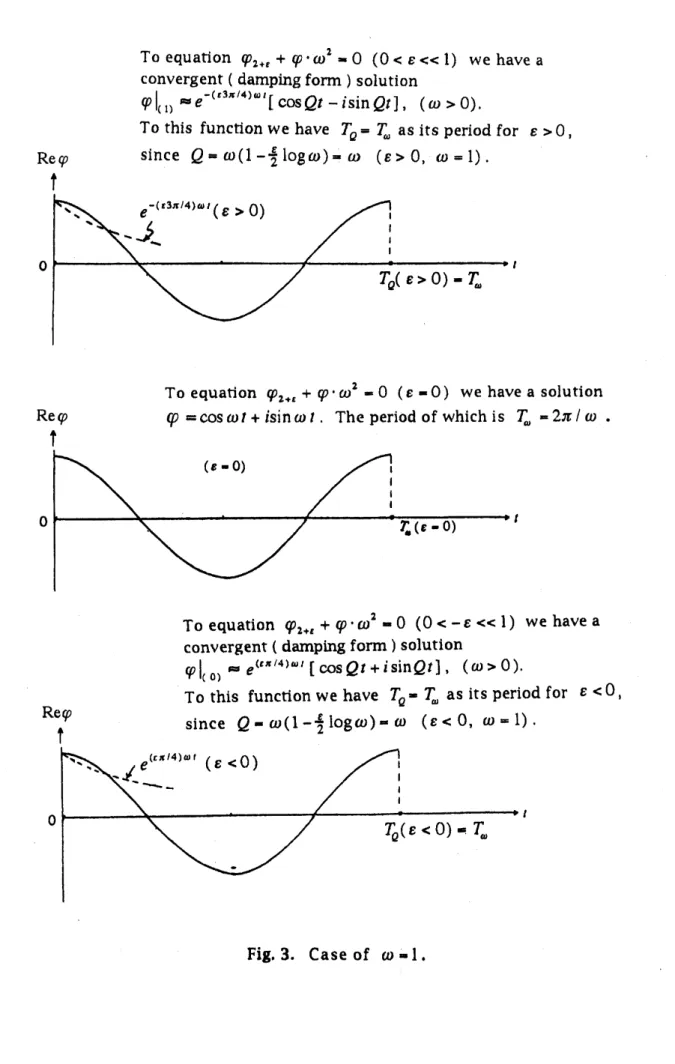
In Fig.
graphs of
and
which
the portion of amplltude
and the
one
of vibration
are
separated
When
$0<\omega<1,\mathrm{w}\mathrm{e}$
have
$T_{Q}$(of
${\rm Re}\varphi|_{(1)}$)
$<T_{pp}(\epsilon>0)$
and
$T_{Q}$(of
${\rm Re}\varphi|$$(0)$
)
$>7\omega$
$(\epsilon<0)$
.
When
$\omega=1$
,
we
$\mathrm{h}\mathrm{a}\mathrm{v}\mathrm{e}T_{Q}$(of
${\rm Re}\varphi|_{(1)}$)
$\approx$$T_{a\mathrm{J}}(\epsilon>0)$
and
$T_{Q}$(of
${\rm Re}\varphi|$$(0)$
)
$=7\omega$
$(\epsilon<0)$
since
we
have
$Q$
\approx\mbox{\boldmath$\omega$}
$(\epsilon> 0, \epsilon<0)$
.
(See
Fig.2
and
$\mathrm{F}\mathrm{i}\mathrm{g}.3$, respectively.)
(i)
For
example
the
nearly
simple
harmonic vibration equation
$t$ $d^{2}$
.
$01\varphi$ $\varphi_{2*0.01}+\varphi\cdot\omega$ $=+\overline{dt^{2\mathrm{D}1}}\varphi$ $\cdot\omega^{2}$-0
$(\epsilon \simeq 0.01>0)$
(52)
has
solution
$\varphi|_{(1)}\approx e^{-}$ $(0\mathrm{D}\mathrm{l}\mathrm{x}3\mathrm{x}/4)0$$t$$[\cos Qt-i\sin Qt]$
$(\omega>0)$
,
(53)
whose
mpUtude is
$e^{-(0.03\pi/4)a11}$
and the
period is
$T_{Q} arrow\frac{2\pi}{Q}-\frac{2\pi}{\omega(1-0.005\cdot\log\omega)}>^{\frac{2\pi}{\omega}\approx T_{\omega}}$
$(\omega>1)$
.
(54)
$(\mathrm{i}\mathrm{i})$
The equation
$\varphi_{2-0.01}+cp$
.
$\omega^{2}=^{\frac{d^{1S9}\varphi}{dt^{1\mathit{9}9}}+\varphi\cdot\omega^{2}}$ \simeq$0$$(\epsilon \approx -0.01<0)$
$(55)$
has
solution
$\varphi|_{(0)}$
\sim
$e^{(-0.0}$
”4)”
$[\cos Qt+i\sin Ql]$
,
$(\omega>0)$
,
(56)
whose
amplitude is
$e(-001\pi/4)wl$
and the period
is
$T_{Q}=^{\frac{2\pi}{Q}=} \frac{2\pi}{\omega(1+0.005\cdot\log\omega)}<\frac{2\pi}{a)}$
=
$T_{w}$$(\omega>1)$
.
(57)
$(\mathrm{i}\mathrm{i}\mathrm{i})$
The
equation
$\varphi_{2}+\varphi\cdot\omega^{\mathrm{z}}$
=
$0$
(58)
has solution
(59)
$\mathrm{P}$
$=\cos\omega$
$l+i\sin\omega l$
This
solution
is
produced
in
the
process
in
which
$\epsilon$changes its
sign
in the
equ-$\mathrm{s}\mathrm{i}\mathrm{n}$
$\varphi_{2*\epsilon}+\varphi\cdot\omega^{2}\mathrm{g}$$0$
(49)
Notice
that;
When
$\omega$$>0$
,
${\rm Re}\varphi|_{(n\rangle}$
, having
$n\fallingdotseq$even
number,
give
the
same
form damping
vibration
curves
as
the
one
of
${\rm Re}\varphi|_{(0)}$for
$\epsilon<0$,
and
${\rm Re}\varphi|_{(n)}$
,
having
$n$-odd
number,
give
the
same
form
damping
vibration
curves
45
To equation
$\varphi_{t*\epsilon}+{}^{\mathrm{t}}\mathrm{P}^{\cdot}\omega^{\mathrm{a}}-0(0<\epsilon<<1)$we
have
a
convergent
(damping
form)solution
$\varphi|_{(1)}$
\approx
$e^{-(\epsilon 3r\mathrm{r}\prime 4)\omega\iota}$[ $Co(l$
-isin
$Qt$
], (to
$>$ $0$).
$\epsilon>0$
,
To equation
$\mathrm{P},*\iota+{}^{\mathrm{t}}\mathrm{P}^{\cdot}\omega^{2}-0.$$(0< -\epsilon<<1)$
we
have
a
convergent
(damping
form)solution
$\varphi$$|_{(0)}$
\approx
$e^{(\iota\pi l4)\omega l}[\cos Qt+i\sin Qt]$
,
$(\omega>0)$
.
To equation
$\varphi_{2\star\epsilon}+\varphi\cdot$$\omega^{2}$
\sim $0$
$(0< \epsilon<<1)$
we
have
a
convergent
(damping
form)solution
$\varphi|_{(1)}$
\approx
$e^{-(t}$”14)
$\omega$
l[
$\cos Qt$
-isin
$Qt$
],
$(\omega>0)$
.
$\epsilon>0$