TOPOLOGICAL TYPES OF GEOMETRIC LIMIT MANIFOLDS
OF QUASI-FUCHSIAN GROUPS
TERUHIKO SOMA (Ibkyo Denki University)
相馬輝彦 (東京電機大学理工学部)
This note is asurvey of the author’s results given in [7].
Let $\Sigma$ be aclosed orientable surface of genus greater than
one.
We fixahyper-bolic structure
on
$\Sigma$ for convenience, and set II $=\mathrm{p}\mathrm{n}(\mathrm{Z})$.
In [3], $\mathrm{J}\phi \mathrm{r}\mathrm{g}\mathrm{e}\mathrm{n}\mathrm{s}\mathrm{e}\mathrm{n}$ andMarden gave an example offaithful representations $\rho_{n}$ : $\mathbb{Z}arrow \mathrm{P}\mathrm{S}\mathrm{L}2(\mathrm{C})$with $\rho_{n}(1)$
loxodromic such that the cyclic Kleinian groups $\mathrm{p}\mathrm{n}(\mathrm{Z})$ converge geometrically to a
rank two parabolic group. This is
one
of typical phenomena which appear in geometric limits. In fact, Kerckhoff and Thurston [4] considered the cyclic action on
the Bers slice $B_{\sigma}+\mathrm{a}\mathrm{t}$ $\sigma_{+}\in \mathrm{T}\mathrm{e}\mathrm{i}\mathrm{c}\mathrm{h}(\mathrm{E})$ generated by the Dehn twist $\varphi$
on
1along asimple closed geodesic $l$
.
Then, they showed that any geometric accumulation pointof the cyclic orbit $\{(\varphi_{*}^{n}(\sigma_{-}), \sigma_{+})\}\subset B_{\sigma}+\mathrm{i}\mathrm{s}$ aKleinian group $G$ such that $\mathbb{H}^{3}/G$ is
homeomorphic to $\Sigma \mathrm{x}(0,1)-l\mathrm{x}\{1/2\}$
.
Then, atubular neighborhoodof $l\mathrm{x}\{1/2\}$in $\Sigma \mathrm{x}(0,1)$ corresponds to a $\mathbb{Z}\mathrm{x}\mathbb{Z}$-cusp of$\mathbb{H}^{3}/G$ where $\mathrm{J}\phi \mathrm{r}\mathrm{g}\mathrm{e}\mathrm{n}\mathrm{s}\mathrm{e}\mathrm{n}$ Marden
phe-nomenon
occurs,see
Fig. 1(a). By using this method iteratively, it is also possible01
(b)
FIGURE 1. The dot in (a) represents $l\mathrm{x}\{1/2\}$ inthe model of$\mathbb{H}^{3}/G$
.
The vertical bold segment in (b) represents $H\mathrm{x}\{1/2\}$ in the model
of$\mathbb{H}^{3}/G’$
.
to construct
an
example ofageometric limit $G’$ ofquasi-Fuchsian groups such that$\mathbb{H}^{3}/G’$ has infinitely many $\mathbb{Z}\mathrm{x}\mathbb{Z}-$-cusps. In particular, $G’$ is infinitely generated.
Another important exampleofgeometriclimits of quasi-Fuchsian groups is given by
Brock [2]. He considered the cyclic action
on
aBers slice generated by a $\mathrm{h}\mathrm{o}\mathrm{m}\mathrm{e}\mathrm{o}\succ$morphism $\psi$ : $\Sigmaarrow\Sigma$ such that $\psi|\mathrm{h}\mathrm{t}H$ : $\mathrm{I}\mathrm{n}\mathrm{t}Harrow \mathrm{I}\mathrm{n}\mathrm{t}H$is pseudo Anosov for
a
proper subsurface $H$ of Iand $\psi|(\Sigma-\mathrm{I}\mathrm{n}\mathrm{t}H)$ is the identity. Then, any geometric
accumulation point of the cyclic orbit $\{(\psi_{*}^{n}(\sigma_{-}), \sigma_{+})\}\subset B_{\sigma}+\mathrm{i}\mathrm{s}$aKleinian group $G’$
such that $\mathbb{H}^{3}/G’$ ishomeomorphic to0$\mathrm{x}(0,1)-H\mathrm{x}\{1/2\}$, see Fig. 1(b). However,
all of these examples
are
very specialones.
In this talk,we
will present what kindsoftopological types appear generallyin geometric limits of quasi-Fuchsian groups.
Let $p$ : $\Sigma \mathrm{x}Iarrow\Sigma$ and $q$ : $\Sigma \mathrm{x}Iarrow I$ be the projections onto the first and
second factors, where I is the closed interval $[0, 1]$
.
For any $y\in I$, the preimag 数理解析研究所講究録 1329 巻 2003 年 95-101$\Sigma_{y}=q^{-1}(y)$ is supposed to have the hyperbolic structure so that $p|\Sigma_{y}$ : $\Sigma_{y}arrow\Sigma$
is isometric. Acompact connected subsurface $F$ of $\Sigma_{y}$ with geodesic boundary is
called anon-pant geodesic
subsurface
if $F$ is not homeomorphic to agenus-zerosurface with three boundary components, apair ofpants. Note that the interior of
anon-pant geodesic subsurface contains asimple closed geodesic.
For aclosed subset $A$ of $\Sigma_{y}$, if $\mathrm{A}(\mathrm{A})$ is aminimal disjoint union of ageodesic subsurface $F$ and simple closed geodesies $l_{1}$,
$\ldots$ ,
$l_{k}$ in $\Sigma_{y}$ with $\mathrm{A}(\mathrm{A})\supset A$, then the
frontier Fr($\Delta$(A ) of$\Delta(A)$ in
$\Sigma_{y}$ is the union $\partial F\cup l_{1}\cup\cdots\cup l_{k}$ ofmutually disjoint
simple geodesic loops in $\Sigma_{y}$
.
Let $\lambda(A)$ be the union of all simple closed geodesies 1in $\Delta(A)$ such that, for the $\delta$-neighborhood$N_{\delta}(l, \Sigma_{y})$ with asmall $\delta>0$, at least one
component$\mathrm{o}\mathrm{f}N_{\delta}(l, \Sigma_{y})-l$ is disjoint from$A$
.
Inparticular, $\mathrm{X}(\mathrm{A})$contains Fr(A(A)),see Fig. 2.
FIGURE 2. The
case
of$A=l_{1}\cup A_{1}\cup A_{2}$.
Then, $\Delta(A)=\mathrm{F}$Uli, where$F$ is the union of the shaded regions. Fr($\Delta$(A ) $=l_{1}\cup m_{1}\cup m_{3}$, and
$\mathrm{X}(\mathrm{A})=\mathrm{b}(\Delta(A))\cup m_{2}=l_{1}\cup m_{1}\cup m_{2}\cup m_{3}$
.
Let $\mathcal{X}$ be the closed subset of $\Sigma \mathrm{x}$ I given below. Then, we set $\mathcal{Y}=q(\mathcal{X})$,
$X_{y}=\Sigma_{y}\cap \mathcal{X}$ for $y\in \mathcal{Y}$, $\Lambda_{y}^{+}=\Sigma_{y}\cap\overline{\Sigma \mathrm{x}(y,1]\cap \mathcal{X}}$for$y<1$, $\Lambda_{y}^{-}=\Sigma_{y}\cap\overline{\Sigma \mathrm{x}[0,y)\cap \mathcal{X}}$
for $y>0$
.
Theorem 1. Let$\{\rho_{n} : \Piarrow \mathrm{P}\mathrm{S}\mathrm{L}_{2}(\mathbb{C})\}_{n=1}^{\infty}$ be any algebraically convergent sequence
of
quasi-Fhchsian representations such that $\{\rho_{n}(\Pi)\}_{n=1}^{\infty}$ converges geometrically toa Kleinian group G. Then, the hyperbolic
3-manifold
$\mathbb{H}^{3}/G$ is homeomorphic toI $\mathrm{x}I-\mathcal{X}$ such that$\mathcal{X}$ is
a
closedsubsetof
$\Sigma \mathrm{x}$I satisfying the following conditions$(\mathrm{i})-(\mathrm{i}\mathrm{i}\mathrm{i})$
.
(i) $\Sigma \mathrm{x}I-\mathcal{X}$ is connected, containing $\Sigma_{1/2}$, and disjoint
ffom
$\Sigma_{0}\cup\Sigma_{1}$.
(ii) For any $y\in \mathcal{Y}$, $X_{y}$ is a disjoint union
of
a geodesicsubsurface
and simplegeodesic loops in $\Sigma_{y}$
.
For $\epsilon$ $=\pm$, each non-peripheral componentof
$X_{y}-$$\Delta(\Lambda_{y}^{\epsilon})\cup \mathrm{F}\mathrm{r}(X_{y})$ is an open non-pantgeodesic
subsurface
of
$\Sigma_{y}$.
(iii) For any $y$,$z\in$ )) with $y<z$,
if
a
component $l_{y}$of
$\mathrm{R}(X_{y})\cup\lambda(\Lambda_{y}^{+})$ is parallel toa component$l_{z}$
of
$\mathrm{F}\mathrm{r}(X_{z})\cup\lambda(\Lambda_{z}^{-})$ in $\Sigma \mathrm{x}I-\mathcal{X}$, then $l_{y}$ and$l_{z}$ are horizontallyparallel in $\mathcal{X}$
.
The property $\Sigma_{0}\cup\Sigma_{1}\subset \mathcal{X}$ in the condition (i) is immediate from that $\mathbb{H}^{3}/G$ is
an open manifold. Asubsurface of $X_{y}$ is peripheralif it is horizontally parallel in
$\mathcal{X}$ to asubsurface of either
$\Sigma_{0}$ or $\Sigma_{1}$
.
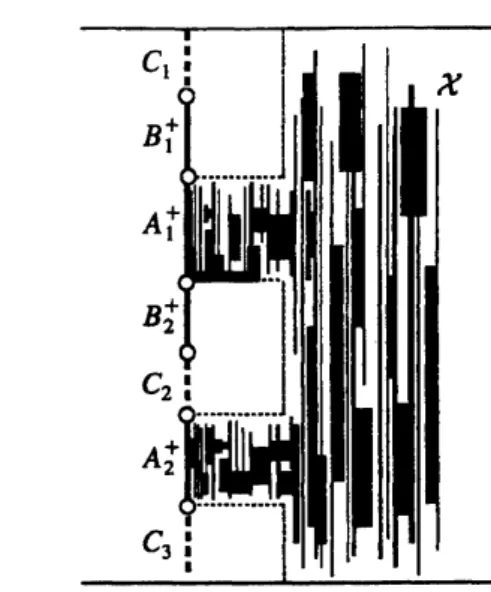
Any component of $X_{y}-\Delta(\Lambda_{y}^{\epsilon})\cup \mathrm{R}(X_{y})$ iscalled asubsurface of type Be,
see
Fig 3. Thus, the latter part of the condition(ii) is restated that any non-peripheral subsurface of type $\mathrm{B}^{\epsilon}$ is not
an
open pair ofpants. In fact, the ends of$\mathbb{H}^{3}/G$ corresponding to such subsurfaces
are
necessarilFIGURE 3.
A7,
$B_{j}^{+}$, $C_{k}$ represent respectively subsurfaces of $\Sigma_{y}$ of types $\mathrm{A}^{+}$, $\mathrm{B}^{+}$ and C.geometrically infinite tame. The condition (iii) isderived from the fact that any two
parabolic cusps in ahyperbolic 3-manifold $M$ is not parallel in $M$
.
According to Myers [6], there exists asimple loop $l$ in $\Sigma \mathrm{x}(0,1)$ which is not
parallel to aloop in $\Sigma_{0}\cup\Sigma_{1}$ and such that $N=\Sigma \mathrm{x}(0,1)-l$ admitsageometrically
finite hyperbolic metric $\sigma$. By Hyperbolic Dehn Surgery Theorem in [8], $N(\sigma)$ is
ageometric limit of geometrically finite hyperbolic 3-manifolds without parabolic
cusps. However, $N$ is not homeomorphic to $\mathbb{H}^{3}/G$ for any geometric limit $G$ of
quasi-Fuchsian groups. This fact is proved by Theorem 1or directly as an exercise without invoking the theorem.
In general, aclosed subset $\mathcal{X}$ in $\Sigma \mathrm{x}$ I satisfying the conditions $(\mathrm{i})-(\mathrm{i}\mathrm{i}\mathrm{i})$ is very
complicated. When $\mathcal{Y}$ is atotally disconnected subset of $I$, $\mathcal{Y}$ is not aperfect set
and each connected component of $\mathcal{X}$ is either ageodesic subsurface or ageodesic
loop. Even in this rather simple case, there may exist adoubly (or more multiply)
accumulation point $y$ in $\mathcal{Y}$
.
This means that$y$ is an accumulation point ofasubset $\{y_{n}\}$ of$\mathcal{Y}$ such that each
$y_{n}$ is also an accumulation point of $\mathcal{Y}$,
see
Fig. 4.01/2 1
FIGURE 4. ‘1/2’ is adoubly accumulation point of$\mathcal{Y}$
.
Remark 2. In particular, Theorem 1implies that, for any geometric limit $G$ ofan
algebraically convergent sequence $\{\mathrm{p}\mathrm{n}\}$ of quasi-Fuchsian representations, $\mathbb{H}^{3}/G$ is
homeomorphicto anopen subset of$\Sigma \mathrm{x}(0,1)$
.
Onemaysupposethat the assertionisobvious since each$\mathbb{H}^{3}/\rho_{n}(\Pi)$ is homeomorphic to $\Sigma \mathrm{x}(0,1)$, andsince
moreover
therexists a $K_{n}$-quasi-isometry $g_{n}$ : $N_{R_{n}}(x_{n}, \mathbb{H}^{3}/\rho_{n}(\Pi))arrow N_{R_{n}}(x_{\infty}, \mathbb{H}^{3}/G)$ between
the $R_{n}$-neighborhoods centered at suitable base points $x_{n}$ and $x_{\infty}$ with $R_{n}\nearrow \mathrm{o}\mathrm{o}$
and $K_{n}\backslash 1$
.
Though the $g_{n}^{-1}$ and $g_{n+1}^{-1}$-images of $N_{R_{n}}(x_{\infty}, \mathbb{H}^{3}/G)$are
mutuallyhomeomorphic, their complements in$\mathbb{H}^{3}/\rho_{n}(\Pi)$ and $\mathbb{H}^{3}/\rho_{n+1}(\Pi)$ do not necessarily
have the
same
topological type. Thus, the maps $g_{n}^{-1}$ would not offer directly anexpanding sequence of embeddings from $N_{R_{n}}(x_{\infty}, \mathbb{H}^{3}/G)(n=1,2, \ldots)$ into $\Sigma \mathrm{x}$
$(0,1)$
.
We will constructan
embedding of $\mathbb{H}^{3}/G$ into I $\mathrm{x}(0,1)$ by using the factthat $\mathbb{H}^{3}/G$ has the structure of ablock complex.
Theorem 3. Let $\mathcal{X}$ be any closed subset
of
$\Sigma \mathrm{x}$ I satisfying the conditions $(\mathrm{i})-(\mathrm{i}\mathrm{i}\mathrm{i})$ in Theorem 1. Then, there eists a geometric limit$G$of
an
algebraically convergentsequence
of
quasi-Fuchsian representations such that$\mathbb{H}^{3}/G$ ishomeomorphic to $\Sigma \mathrm{x}$$I-\mathcal{X}$.
Aclosed subset of$\Sigma \mathrm{x}$ I satisfying the conditions $(\mathrm{i})-(\mathrm{i}\mathrm{i}\mathrm{i})$ in Theorem 1is cffied
acrevasse
in $\Sigma \mathrm{x}I$.
We need to studycrevasses
from the topological point of view.This is not only necessaryto prove Theorems 1and 3, but also useful to understand topologicalpropertiesofgeometriclimitsofquasi-Fuchsiangroups. As aspecial case,
these theorems determine the topological types of$\mathbb{H}^{3}/G$ for geometriclimits ofany
sequence in the Bers slice $B_{\sigma}+$
’which
is naturally identified with the Teichmiiller space Teich(E). Then, $\mathbb{H}^{3}/G$ is homeomorphic to I $\mathrm{x}I-\mathcal{X}$ forsome crevasse
$\mathcal{X}$with $\mathcal{X}\cap\Sigma \mathrm{x}[1/2,1)=\emptyset$
.
Though the result does not imply dataon the geometricstructure on $\mathbb{H}^{3}/G$,
some
arguments used in the proofs of our theorems suggestimplicitly that the hyperbolic structure on $\mathbb{H}^{3}/G$ would be controlled by those on
the geometricallyinfinitetame ends$\mathcal{E}$of$\mathbb{H}^{3}/G$correspondingtothe subsurfacesin$\mathcal{X}$
oftypes $\mathrm{B}^{\pm}$
.
On the other hand, the hyperbolic structureson
$\mathcal{E}$ will be determinedonly by their ending data if Thurston’s Ending Lamination Conjecture [9] holds,
where the ending data
means
the element ofTeich(B) determined by the conformal structure on the front end if$\mathcal{E}$ is geometrically finite and the ending lamination if$\mathcal{E}$ is geometrically infinite. The conjecture is proved by Minsky [5] in the
case
whentheinfimum injectivity radius of ahyperbolic 3-manifold ispositive, and the project
toward the complete solution is making steady progress by
some
people includinghimself. Thus, it would not be in distant future when
we
know all the elements ofthe geometric Bers boundaryof Teich(E).
Problem 4. Let $G_{i}(i=1,2)$ be geometric limits of algebraically convergent
se-quences ofquasi-Fuchsian groups with homeomorphisms $h_{:}$ : $\mathbb{H}^{3}/G_{:}arrow\Sigma \mathrm{x}I-\mathcal{X}$
for agiven
crevasse
$\mathcal{X}$.
Is $h_{2}^{-1}\mathrm{o}h_{1}$ : $\mathbb{H}^{3}/G_{1}arrow \mathbb{H}^{3}/G_{2}$ properly homotopic toan
isometry if, for any subsurface $B$ in aof types $\mathrm{B}^{\pm}$, the
corresponding ends $\mathcal{E}_{i}(B)$
in $\mathbb{H}^{3}/G_{:}$ have the
same
ending data?Outline of the proof of Theorem 1. If
an
algebraically convergent sequenceof quasi-Fuchsian representations $\rho_{n}$ : II $arrow \mathrm{P}\mathrm{S}\mathrm{L}2(\mathrm{C})$ converges geometrically to
aKleinian group $G$, then there exists a $K_{n}$-quasi-isometry $g_{n}$ : $N_{R_{n}}(x_{n}, N_{n})arrow$ $N_{R_{\hslash}}(x_{\infty}, M_{\infty})$ with $R_{n}\nearrow \mathrm{o}\mathrm{o}$ and $K_{n}\backslash$ $1$ for the suitable choice of base points
$x_{n}\in N_{n}$ and $x_{\infty}\in M_{\infty}$, where $N_{n}=\mathbb{H}^{3}/\rho_{n}(\Pi)$ and $M_{\infty}=\mathbb{H}^{3}/G$
.
Since $N_{n}$ ishomeomorphic to $\Sigma \mathrm{x}(0,1)$, $N_{n}$ admits atopological fibration $\mathcal{G}_{n}$ with fiber X.
Then, the foliation $\hat{g}_{n}$
on
$N_{R_{n}}(x_{\infty}, M_{\infty})$ is induced from $\mathcal{G}_{n}|N_{R_{\mathfrak{n}}}(x_{n}, N_{n})$ via $g_{n}$
.
However, it would be difficult to define afoliation on $M_{\infty}$ from $\mathcal{G}\wedge n$’s since we
do
not have geometricdata to investigate relations between $\mathcal{G}_{n}$ and $\mathcal{G}_{n+1}$
.
In our proof,we will invoke a‘coarse fibration’ $S_{n}$ on the convex core $C_{n}$ of $N_{n}$ ‘fibers’ of which
are pleated surfaces between the two components of $\partial C_{n}$
.
Then, $N_{R_{n}}(x_{\infty}, M_{\infty})$ hasthe
coarse
foliation $\hat{S}_{n}$induced from $S_{n}|N_{R_{n}}(x_{n}, N_{n})$. Let $M_{\infty,\mathrm{p}- \mathrm{t}\mathrm{h}\mathrm{i}\mathrm{n}(\epsilon)}$ be the union
ofparabolic cusp components of the $\epsilon$-thin part $M_{\infty,\mathrm{t}\mathrm{h}\mathrm{i}\mathrm{n}(\epsilon)}$ of $M_{\infty}$ for a sufficiently
small $\epsilon$ $>0$
.
For any $x\in M_{\infty,\mathrm{p}- \mathrm{t}\mathrm{h}\mathrm{i}\mathrm{c}\mathrm{k}(\epsilon)}=M_{\infty}-M_{\infty,\mathrm{p}- \mathrm{t}\mathrm{h}\mathrm{i}\mathrm{n}(\epsilon)}$, there exists aconstant$R(x)$ independent of$n\in \mathrm{N}$, suchthat, for anyleaf$F^{(n)}$ of$\hat{S}_{n}$ passing through the
1-neighborhoodof$x$ in $M_{\infty}$, the diameter of thecomponent $F_{0}^{(n)}$ of$F^{(n)}\cap M_{\infty,\mathrm{p}-}$
-thick(r)
nearest to $x$ is less than $R(x)$
.
Thus, if necessary passing to asubsequence,we
may
assume
that $\{F_{0}^{(n)}\}$ converges uniformlyto asurface $F$, and hence in particular$F_{0}^{(n)}$’s
are
mutually properly homotopic in$M_{\infty,\mathrm{p}- \mathrm{t}\mathrm{h}\mathrm{i}\mathrm{c}\mathrm{k}(\epsilon)}$
.
This suggests that $\{\hat{S}_{n}\}$ isan
expandingsequence ofcoarse
foliations in $M_{\infty,\triangleright \mathrm{t}\mathrm{h}\mathrm{i}\mathrm{c}\mathrm{k}(\epsilon)}$ after slightly modifying$\hat{S}_{n}$
by proper homotopy in $M_{\infty,\mathrm{p}- \mathrm{t}\mathrm{h}\mathrm{i}\mathrm{c}\mathrm{k}(\epsilon)}$
.
Though the limit $F$ may not be an embeddedsurface,
one
can
replace it byan
embedded surface $S$ in the homotopy class of$F$ in $M_{\infty_{\mathrm{I}}\mathrm{p}- \mathrm{t}\mathrm{h}\mathrm{i}\mathrm{c}\mathrm{k}(\epsilon)}$ by using the least
area
surface theory. Amaximal set $\{Q_{b}\}$ ofthese embedded surfaces which are mutually disjoint and not properly homotopic
to each other in $M_{\infty,\mathrm{p}- \mathrm{t}\mathrm{h}\mathrm{i}\mathrm{c}\mathrm{k}(\epsilon)}$ divides $M_{\infty,r\mathrm{t}\mathrm{h}\mathrm{i}\mathrm{c}\mathrm{k}(\epsilon)}$ into (in general infinitely many)
blocks $B_{c}$
.
Here, $B_{c}$ being ablock means that $B_{c}$ is homeomorphic to $F\mathrm{x}(0,1)$for asubsurface $F$ of X. We note that this block decomposition misses points
$x\in M_{\infty,\mathrm{p}- \mathrm{t}\mathrm{h}\mathrm{i}\mathrm{c}\mathrm{k}(\in)}$ in asmall neighborhood of which does not meet the $g_{n}$ images of
pleated surfaces. This
occurs
when $g_{n}^{-1}(x)$ is $N_{n}-\mathrm{I}\mathrm{n}\mathrm{t}\mathrm{C}\mathrm{n}$ for all sufficiently large$n\in \mathrm{N}$
.
Each component of $N_{n}-\mathrm{I}\mathrm{n}\mathrm{t}C_{n}$ is ageometrically finite end and hencehomeomorphic to $\Sigma \mathrm{x}[0, \infty)$
.
Prom this fact,we
know that $x$ is in ageometricallyfiniteendof$M_{\infty}$homeomorphicto$F’\mathrm{x}[0, \infty)$ for
some
subsurface$F’$of C. Regardingsuch ends also as blocks, we have ablock decomposition of $\mathrm{I}\mathrm{n}\mathrm{t}M_{\infty,\mathrm{p}- \mathrm{t}\mathrm{h}\mathrm{i}\mathrm{c}\mathrm{k}(\epsilon)}$
.
Theinterior $\mathcal{K}_{k}$ ofthe union $\bigcup_{\dot{\iota}=1}^{k}\overline{B_{\mathrm{i}}}$ ofthe first $k$ blocks is contained in$N_{R_{n}}(x_{\infty}, M_{\infty})$ if
$n$ is sufficiently large, and hence it
can
be embedded in $\Sigma \mathrm{x}$ I via $g_{n}^{-1}$.
In general,such embeddings are not expanding sequence as was remarked above. So, we will
construct an expanding sequence by splitting blocks into sub-blocks if necessary
and by embedding them into $\Sigma \mathrm{x}$ Iat the sacrifice of aglobal continuity. Then, the
images $\mathcal{K}_{k}’$
are
expandingopen submanifolds, but not homeomorphic to the original$\mathcal{K}_{k}$
.
We will restore the originals by slit-sliding operations in $\Sigma \mathrm{x}I$.
This splittingt0-restoring process is not ameaningless round trip since the process enables
us
todeal with the embedding problem stepwise. We have an expanding sequence $\{F_{n}\}$
of unions of finitely many slits in $\Sigma \mathrm{x}$ I such that the 3-manifold $\mathrm{Y}_{n}$ obtained by
slidingalong $\mathcal{F}_{n}$ contains $\mathcal{K}_{n}$
as
an opensubmanifold. Moreover, $\mathrm{Y}_{n}-\mathcal{K}_{n}$ containsa
submanifold$W_{d(n)}$ such that thereexistsanembedding$\Phi_{n}$ : $\mathrm{Y}_{n}-W_{d(n)}arrow\Sigma \mathrm{x}I$with $\Phi_{n}(\mathcal{K}_{n})=\Phi_{n+1}(\mathcal{K}_{n})\subset\Phi_{n+1}(\mathcal{K}_{n+1})$.
Since $\kappa_{\infty}=\mathrm{I}\mathrm{n}\mathrm{t}M_{\infty,\mathrm{p}- \mathrm{t}\mathrm{h}\mathrm{i}\mathrm{c}\mathrm{k}(e)}$is homeomorphicto $M_{\infty}$,our
desired embedding of $M_{\infty}$ to $\Sigma \mathrm{x}$ I is defined by the expanding sequence $\{\Phi_{n}(\mathcal{K}_{n})\}$.
Once$M_{\infty}$ is realized
as
an
open subset of$\Sigma \mathrm{x}(0,1)$, the conditions $(\mathrm{i})-(\mathrm{i}\mathrm{i}\mathrm{i})$are
de-rived from fundamentalproperties ofhyperbolic 3-manifolds, e.g. any two parabolic cusps in ahyperbolic 3-manifold
are
not mutually parallel. In particular, we willshow by invoking
some
conditionson
athat each component of$\lambda(\Lambda_{y}^{\pm})$ correspondsto a‘hidden’ parabolic cusp of$M_{\infty}$.
Outline of the proof of Theorem 3. Consider any crevasse $\mathcal{X}$ in $\Sigma \mathrm{x}I$
.
For any$y\in \mathcal{Y}=q(\mathcal{X})$, the components of$\Delta(\Lambda_{y}^{\epsilon})-\lambda(\Lambda_{y}^{\epsilon})$ are called open subsurface oftype
$\mathrm{A}^{\epsilon}$ for $\epsilon=\pm$, and each component of $\Sigma_{y}-X_{y}$ is an open subsurface of type C.
Thus, $X_{y}$ consists of geodesic loops and open subsurfaces oftypes Ae, $\mathrm{B}^{\epsilon}$ and $\mathrm{C}$,
see Fig. 3again.
In general, $\Sigma \mathrm{x}I-\mathcal{X}$ is not offinite type, that is, $\pi_{1}(\Sigma \mathrm{x}I-\mathcal{X})$ is possibly of
infinitely generated. So, we will define as follows
an
expanding sequence $\{W_{n}\}$ ofsubmanifoldsof finite typein$\Sigma \mathrm{x}I-\mathcal{X}$with$\bigcup_{n=1}^{\infty}W_{n}=\Sigma \mathrm{x}I$-X. Forany$n\in \mathrm{N}$, let
$N_{\mathrm{A},n}$ be the unionofsmall collarneighborhoodsin $\Sigma \mathrm{x}$I ofsubsurfacesoftypes $\mathrm{A}^{\pm}$,
wherethe depthof each collar neighborhood in$N_{\mathrm{A},n}$ is the $1/n$times ofthat in$N_{\mathrm{A},1}$. The number ofsubsurfaces oftypes $\mathrm{B}^{\pm}$ and (saturated) geodesic loop components
in $\mathcal{X}$ disjoint from $N_{\mathrm{A},n}$ is finite. Let $B_{n}$ (resp. $P_{n}$) be the set of such subsurfaces
(resp. geodesic loops). Then, we have $B_{n}\subset \mathcal{B}_{n+1}$ and $\cup P_{n}\subset\cup P_{n+1}$
.
Let $M_{n}^{m}$ bea3-manifold obtained by cutting open $\Sigma \mathrm{x}I-\cup P_{n}$ along $B_{:}\in B_{n}$ and gluing back
the both side of$B_{i}$ by the $m$-th iteration $\varphi_{i}^{m}$ of apseudoAnosov homeomorphism $\varphi_{i}$ : $B_{:}arrow B_{\dot{\iota}}$
.
For all sufficiently large $m\in \mathrm{N}$,we
mayassume
that $M_{n}^{m}$ isacylindrical ifnecessary by adding some geodesic loops contained in subsurfaces of
type $\mathrm{A}^{\pm}$ to
$P_{n}$
.
The extended set is denoted by $’\hat{p}_{n}$.
By Thurston’s Uniformization
Theorem, $\mathrm{I}\mathrm{n}\mathrm{t}M_{n}^{m}$ admits ahyperbolic structure with two geometrically finite ends
correspondingto $\Sigma_{0}\cup\Sigma_{1}$ and$\mathbb{Z}\mathrm{x}\mathbb{Z}-$-cuspscorrespondingto elements of$\hat{P}_{n}$
.
Note that$\mathrm{I}\mathrm{n}\mathrm{t}M_{n}^{m}$ is homeomorphic to$\Sigma \mathrm{x}(0,1)$ minus finitely many geodesic loops infibers. By
Hyperbolic Dehn Surgery Theorem in [8], $\mathrm{I}\mathrm{n}\mathrm{t}M_{n}^{m}$ is ageometric limits ofhyperbolic
3-manifolds with quasi-Fuchsian holonomies. Let $\zeta_{n}^{m}$ : $\pi_{1}(Q_{n,0})arrow \mathrm{P}\mathrm{S}\mathrm{L}2(\mathrm{C})$ be
the restriction of the holonomy of$\mathrm{I}\mathrm{n}\mathrm{t}M_{n}^{m}$, where $Q_{n,0}$ is the component of $\Sigma \mathrm{x}I-$
$\cup(B_{n}\cup\hat{P}_{n})$ containing $\Sigma_{1/2}$
.
Then, for each $n\in \mathrm{N}$, one can show that $\{\zeta_{n}^{m}\}_{m=1}^{\infty}$ converges algebraically to arepresentation $\zeta_{n}^{\infty}$ such that $N_{n}^{\infty}=\mathbb{H}^{3}/\zeta_{n}^{\infty}(\pi_{1}(Q_{n,0}))$is homeomorphic to $Q_{n,0}$. In turn, we would like to show that $\{\zeta_{n}^{\infty}\}_{n=1}^{\infty}$ converges
‘algebraically’ in areasonable sense, though $Q_{n,0}$ is not asubmanifold of $Q_{n+1,0}$
.
Ifwe
use
the component $W_{n}$ of $Q_{n,0}-\overline{N_{\mathrm{A},n}}$ containing $\Sigma_{1/2}$ instead of $Q_{n,0}$, then$W_{n}$ is asubmanifold of $W_{n+1}$ and $\bigcup_{n=1}^{\infty}W_{n}=\Sigma \mathrm{x}I-\mathcal{X}$
.
Then, $\{\zeta_{n}^{\infty}|\pi_{1}(W_{n})\}$having asubsequence $\{\xi_{a}\}$ converging to $\xi_{\infty}$ : $\pi_{1}$(I $\mathrm{x}I-\mathcal{X}$) $arrow \mathrm{P}\mathrm{S}\mathrm{L}_{2}(\mathbb{C})$
means
that $\{\xi_{a}|\pi_{1}(W_{n})\}$ convergesalgebraically to$\xi_{\infty}|\pi_{1}(W_{n})$ for any$n\in \mathrm{N}$
.
Thealgebraic convergence of$\{\xi_{a}|\pi_{1}(W_{n})\}$ isreducedtothoseof$\{\xi_{a}|\pi_{1}(C)\}$ for open subsurfaces$C$oftype $\mathrm{C}$ by Relative Boundedness Theorem [11]. The convergence of$\{\xi_{a}|\pi_{1}(C)\}$ is
examined by test pleated surfaces $\overline{f}_{C_{j}n}$ : $\mathrm{C}(\mathrm{a}\mathrm{n})arrow N_{n}^{\infty}$ given in [10]. Usually, such
aconvergence theorem is proved by introducing acontradiction under the contrary
assumption such that $\{\sigma_{n}\}$ is unbounded in Teich(C). Then,
we
would havean
accumulation point $[\nu]$ of $\{\sigma_{n}\}$ in the Thurston boundary $\mathrm{V}\mathrm{C}\mathrm{o}(\mathrm{C})$
.
Intuitively, theprojectivelamination $[\nu]$ representsthepartof$\mathrm{C}(\mathrm{a}\mathrm{n})$whichis splitorcollapsedmost
rapidly as $narrow\infty$
.
However, in our argument, we will need to concern relativelyslowly split parts of $C(\sigma_{n})$
.
For example, let $l_{1}$ and $l_{2}$ be mutually disjoint simplegeodesies in $C$, where$C$is supposedto haveacomplete hyperbolic structureof finite
area.
Suppose that $\sigma_{n}\in \mathrm{T}\mathrm{e}\mathrm{i}\mathrm{c}\mathrm{h}(C)$ is obtained by the $n^{2}$-full Dehn twist along $l_{1}$and the $n$-full Dehn twist along $l_{2}$
.
Then,{an}
converges to $[l_{1}]\in \mathrm{V}\mathrm{C}\mathrm{o}\{\mathrm{C}$) whichcontains no data about $l_{2}$
.
For any simple geodesic loop $l\in C$ with $l\cap l_{2}\neq\emptyset$, wehave $\lim_{narrow\infty}1\mathrm{e}\mathrm{n}\mathrm{g}\mathrm{t}\mathrm{h}_{\sigma_{n}}(l)=\infty$ even if $\mathit{1}\cap l_{1}=\emptyset$
.
Such adivergence of the lengthsofcertain geodesic loops or measured laminations in $\mathrm{C}\{\mathrm{a}\mathrm{n}$) is crucial to obtain
our
desired contradiction.
Once the algebraic convergence of$\{\xi_{a}\}$ to $\xi_{\infty}$ is proved,
one
can
show that $H_{\infty}=$ $\mathbb{H}^{3}/G$ is homeomorphic to $\Sigma \mathrm{x}I-\mathcal{X}$ for $G=\xi_{\infty}(\Sigma \mathrm{x}I-\mathcal{X})$ by using the factthat$\mathbb{H}^{3}/G$ has an expanding sequence $\{H_{n}\}$ of submanifolds homeomorphicto $W_{n}$.
This fact can bealso proved by using results in Anderson-Canary-McCullogugh [1].
For any$t\in \mathrm{N}$, $\xi_{\infty}|\pi_{1}(W_{t})$ is algebraicallyapproximatedby$\xi_{a}|\pi_{1}(W_{t})=\zeta_{n(a)}^{\infty}|\pi_{1}(W_{t})$,
and the latterby $\zeta_{n(a)}^{m(a)}|\pi_{1}(W_{t})$
.
For aUsufficiently large$n(a)$, anyparabolic elementsof$\xi_{\infty}(\pi_{1}(W_{t}))$ corresponds to those of$\zeta_{n(a)}^{m(a)}|\pi_{1}(W_{t})$
.
It follows that $\xi_{\infty}(\pi_{1}(W_{t}))$ is ageometric limit of $\{\zeta_{n(a)}^{m(a)}(\pi_{1}(W_{t}))\}$
.
Note that the holonomy group $G_{a}$ of $\mathrm{I}\mathrm{n}\mathrm{t}M_{n(a)}^{m(a)}$contains $\zeta_{n(a)}^{m(a)}(\pi_{1}(W_{t}))$
.
From this fact, we will show that $G$ is ageometric limit of{Ga}.
In turn, each $G_{a}$ is the geometric limit of quasi-Fuchsian groupsas
we haveremarked above.
REFERENCES
[1] J. Anderson, R. Canary and D. McCullogugh, The topologyofdeformation spaces ofKleinian
groups, Ann. ofMath. 152 (2000), 693-74L
[2] F. Brock, Iteration ofmapping classes and limits of hyperbolic 3-manifolds, Invent. Math.
143 (2001), 523-570.
[3] T. $\mathrm{J}\phi \mathrm{r}\mathrm{g}\mathrm{e}\mathrm{n}\mathrm{s}\mathrm{e}\mathrm{n}$and A. Marden, Geometricandalgebraicconvergenceof Kleinian groups,Math.
Scand. 66 (1990),47-72.
[4] S. Kerckhoff and W. Thurston, Non-continuity ofthe action ofthe modular group at Bers’
boundary of Teichmiiller space, Invent. Math. 100 (1990), 25-47.
[5] Y.Minsky, Onrigidity, limitsetsand end invariants ofhyperbolic3-manifolds, J. Amer. Math.
Soc. 7(1994), 539-588.
[6] R. Myers, Simple knots in compact, orientable 3-manifolds, Trans. Amer. Math. Soc. 273
(1982), 75-91.
[7] T. Soma, Geometric limitsofquasi-Fuchsiangroups, preprint:
on line at http:$//\mathrm{w}\mathrm{w}\mathrm{w}$
.
r dendai.$\mathrm{a}\mathrm{c}.\mathrm{j}\mathrm{p}/\sim \mathrm{s}\mathrm{o}\mathrm{n}\mathrm{a}/\mathrm{g}\mathrm{e}\mathrm{o}\mathrm{m}\mathrm{l}\mathrm{i}\mathrm{n}$.ps.GZ.
[8] W. Thurston, The geometry and topology of 3-manifolds, Lecture Notes, Princeton Univ.,
Princeton (1978):
on line athttp:$//\mathrm{w}\mathrm{w}\mathrm{w}$.
.
$\mathrm{o}\mathrm{r}\mathrm{g}/\mathrm{p}\mathrm{u}\mathrm{b}\mathrm{l}\mathrm{i}\mathrm{c}\mathrm{a}\mathrm{t}\mathrm{i}\mathrm{o}\mathrm{n}\mathrm{s}/\mathrm{b}\mathrm{o}\mathrm{o}\mathrm{k}\mathrm{s}/\mathrm{g}\mathrm{t}3\mathrm{m}/$.[9] W. Thurston, Three dimensional manifolds, Kleinian groups and hyperbolic geometry, Bull.
Amer. Math. Soc. 6(1982), 357-381.
[10] W. Thurston, Hyperbolicstructureson3-manifolds, II:Surface groupsand -manifolds which
fiber over the circle, $\mathrm{E}$-print:math.$\mathrm{G}\mathrm{T}/9801045$
.
[11] W. Thurston, Hyperbolc structures on 3-manifolds, III: Deformations of 3-manifolds with
incompressibleboundary, $\mathrm{E}$-print:math.$\mathrm{G}\mathrm{T}/9801058$
.
DEpARTMENTOFMATHEMATICALSciences, SCHOOLOFSCIENCEANDENGINEERING, Tokyo
DENIG UNIVERSITY, HATOYAMA-MACHI, SAITAMA-KEN 350-0394, JApAN
$E$-rnail address: somaQr.dendai.$\mathrm{a}\mathrm{c}$.Jp