Asymptotic Behavior of Solutions for
an
Interface Equation– Interface Dynamics and Center-of-Mass
Motions
–広島大学大学院理学研究科 岡田 浩嗣 (Koji Okada)
Graduate School of Science, Hiroshima University
1 INTRODUCTION
In 1992, Rubinstein
&
Sternberg proposed in [9] the following scalar bistablereaction-diffusion equation with a nonlocal term:
(NL) $\{$
$u_{t}^{\epsilon}= \epsilon^{2}\triangle u^{\epsilon}+f(u^{\epsilon})-\frac{1}{|\Omega|}\int_{\Omega}f(u^{\epsilon})dx$,
$\partial u^{\epsilon}/\partial \mathrm{n}=0$,
$t>0$
,
$x\in\Omega$,t>0ラ $x\in\partial\Omega$
.
Here,
0
is a smooth boundeddomainin$\mathbb{R}^{N}(N\geq 2)$ with volume $|\Omega|$ and the outwardunit normal $\mathrm{n}$ on the boundary
$\partial\Omega$, $\epsilon>0$ is a small parameter, and $f$ is a function
derived from a double-wellpotential, a typical example being $f(u)=u-u^{3}$.
It is known that the dynamics of solutions for (NL) with $\epsilon<<1$ consists of several
stages, and is roughly summarized as follows.
(51) Generation of transition layers [9]:
The solution with an appropriate initial condition generates sharp transition
layer near an interface. Such a solution is referred to as a layer solution.
(52) Motion ofinterfaces (i) [9]:
Thelayer solution begins to evolve so that the corresponding interface is driven
according to a certain motion law, called an interface equation. The interface
equation is given by (2.15) in [9].
(53) Motion of interfaces (ii) [9]:
The layer solution then comes to evolve so that the corresponding interface is
governed by another interface equation, which is well-know$\mathrm{n}$ as the volume
preserving mean curvature flow (cf. [5, 6, 7]). The interface is driven in such
a way that the volume enclosed by the interface is preserved and the area of
the interface decreases. After a coarsening process, the interface evolves into a singlesphere. The layer solution withsphericalshape is referredto as the bubble
solution.
(54) Motion of bubbles (i) [1, 3, 11, 12]:
Thebubble solution drifts withexponentiallyslow speed without changing shape
toward the closest point on
an
from the center of the corresponding sphere.(55) Motion ofbubbles (ii) $[2, 12]$:
Oncethe bubblesolution attaches to
an,
it intersects perpendicularlytoan
andThe dynamics in $(\mathrm{S}1)-(\mathrm{S}3)$ was formally discussed in [9] by employing asymptotic
analysis. For (S4), the existence of such bubble motions was established by Alikakos
et al. [1]. Ward gave in [11] an explicit asymptotic ordinary differential equation for
the distance between the center ofthe bubble and the closest point on af (see also [12]$)$
.
Alikakos et al. derived in [3] such an equation for the Cahn-Hilliard equationand compared the bubble motions for the
Cahn-Hilliard
equation with those for thenonlocal equation (NL). The dynamics in (S5) was studied by Alikakos et al. [2].
Our concernin this paper is the dynamicsoccurringinthe intermediatestage (S2),
i.e.,
after
the formation of layers andbefore
the volume-preservingmean curvature
flow iseffective. The corresponding interfaceequation was earlier given byRubinstein
&
Sternberg as (2.15) in [9]. The form, however, was implicit and unsuitable forthe circumstantial examinationfrom interfacial approach. We will present below an
explicitformulationof theinterfaceequation, and discuss the dynamicsand asymptotic
behavior of solutions for the interface equation. Throughout the remaining of this
paper, an “interface” means a smooth, closed, $(N-1)$-dimensional hypersurface $\Gamma$
embeddedin$\Omega\subseteq \mathbb{R}^{N}$staying uniformly away from
an.
We denote by$\Omega^{\pm}$ subdomainsin $\Omega$ separated by an interface $\Gamma$ such as
$\Omega=\Omega^{-}\cup\Gamma\cup\Omega^{+}$,
an-
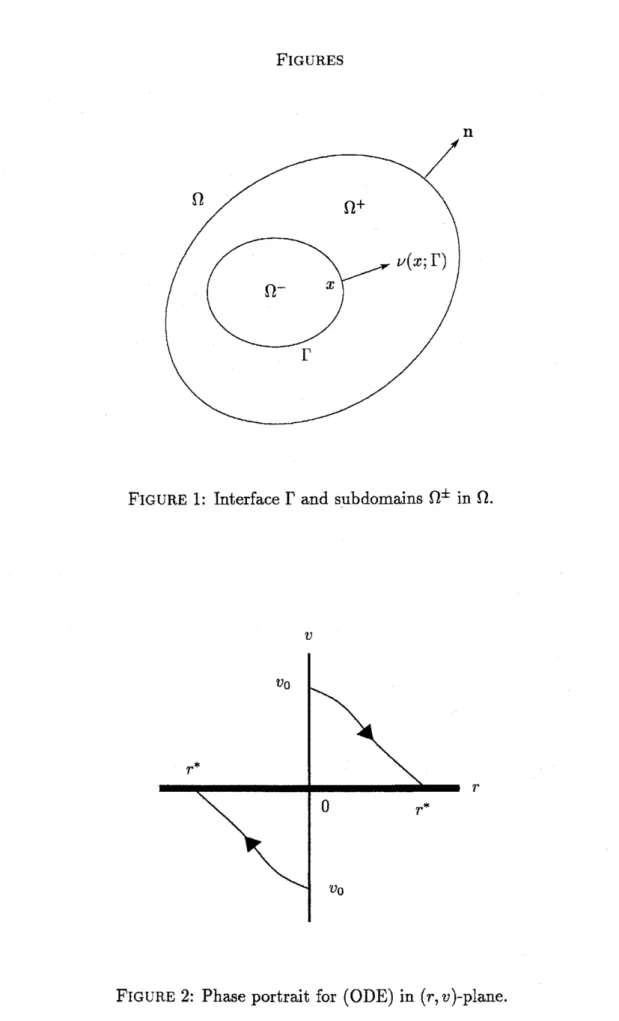
$=\Gamma$, $\partial\Omega^{+}=\partial\Omega\cup\Gamma$,and by $\nu(x;\Gamma)$ the unit normal vector on $\Gamma$ at $x\in\Gamma$ pointing toward the interior of
the subdomain $\Omega^{+}$
(cf. FIGURE 1).
Let $\{\Gamma(t)\}_{t\geq 0}$ be a family of interfaces parameterized by time $t\geq 0$
,
with eachinterface $\Gamma(t)$ satisfying the conditions above. The interface equation associated with
the intermediatestage (S2) is explicitly given as follows (cf. [8]):
(IE-a) $\mathrm{v}(x;\Gamma(t))=c(v(t))$, $t>0_{;}x\in\Gamma(t)$,
(IE-b) $\dot{v}(t)=\frac{h^{+}(v(t))-h^{-}(v(t))}{h_{\overline{v}}(v(t))|\Omega^{-}(t)|+h_{v}^{+}(v(t))|\Omega^{+}(t)|}c(v(t))|\Gamma(t)|$
,
t $>0$,(IE-c) $\Gamma(0)=\Gamma_{0}$
,
$v(0)=v_{0}$.Here, $\mathrm{v}(x;\Gamma(t))$ denotes the normal velocity of $\Gamma(t)$ at $x\in\Gamma(t)$ in $\nu$-direction, the
symbols $|\Gamma(t)|$ and $|\Omega^{\pm}(t)|$ stand forthesurfacearea of$\Gamma(t)$ and thevolumesof$\Omega^{\pm}(t)$
,
respectively, $c(v)$ and $h^{\pm}(v)$ are some functions defined in a neighborhood of $v=0$
satisfying
(1.1) $c(0)=0$, $c’(0)>0$; $h^{-}(v)<0<h^{+}(v)$, $h_{v}^{\pm}(v)<0$
.
The interface equaiton (IE) is derived in [8] as a singular limit of the following
problem
(RD) $\{$
$\epsilon u_{t}^{\epsilon}=e^{2}\Delta u^{\epsilon}+f(u^{\mathrm{e}})-v^{e}$
,
$t>0$,
$x\in\Omega$,$v^{\epsilon}=$ $\frac{1}{|\Omega|}\int_{\Omega}f(u^{\epsilon})dx$, $t\geq 0$
,
as $\epsilonarrow 0$, where the problem (RD) is obtained by rescaling the time $t$ in (NL) as
$t\vdasharrow\epsilon^{-1}t$and introducing an auxiliary variable for the nonlocal term. Inthissituation,
thefunctions$\mathrm{I}^{\pm}(v)$, $c(v)$in (IE) satisfying(1.1) aredetermined by thethenonlinearity
$f(u)-v$ in (RD). We should also mentionthat $\Gamma(t)$ and $v(t)$ in (IE) correspond to
limits ofthe level-set interface $\Gamma^{\epsilon}(t):=\{x\in\Omega|u^{\epsilon}(t, x)=0\}$ and the nonlocal term
$v^{\epsilon}(t)$ in (RD) as $\epsilonarrow 0$, respectively, and that $u^{\epsilon}$ with $\epsilon\ll 1$ has
a
sharp layerstructurenear $\Gamma(t)$ such as
$u^{\epsilon}(t, x)\approx h^{\pm}(v(t))$, $t>0$, $x\in\Omega^{\pm}(t)$.
By virtue of the precise formulations as (RD) and (IE), the unique existence of
time local and global solutions to (IE) and the convergence of solutions for (RD) to
those for (IE) have been successfully established in [8]. In paticular, the convergence
result
guarantees
that the dynamics of solutions for (IE) does approximate that for(NL) in the intermediate stage (S2). In this sense, it is of crucial importance to
ex amine thedynamics and asymptoticbehavior of solutions to (IE) for understanding
the dynamics occurring in (S2).
2 INTERFACE DYNAMICS
By the conditions in (1.1), it is easily verified that the dynamics of $(\Gamma(t), v(t))$ is
as follows:
(i) $v$ $>0$ $\Rightarrow$ $\mathrm{v}>0,\dot{v}<0$;
$\Gamma(t)$ evolvesin sucha waythat$\Omega^{-}(t)$ grows (or$\Omega^{+}(t)$ shrinks) and$v(t)$ decreases.
(ii) $v<0$ $\Rightarrow$ $\mathrm{v}<0,\dot{v}>0$;
$\Gamma(t)$ evolvesin sucha waythat $\Omega^{-}(t)$ shrinks (or$\Omega^{+}(t)$ grows) and $v(t)$ increases.
(iii) $v=0$ $\Rightarrow$ $\mathrm{v}=0,\dot{v}=0$;
$\Gamma(t)$ and $v(t)$ do not evolve.
The description above is the same as that in [9]. To examinethe asymptoticbehavior
ofsolutions for (IE), we will recast (IE) as an equivalent problem.
2.1
Preliminaries.
Beforemoving on, we prepareinthis subsectionnotations andtools neededlater.
For$t\geq 0$, we express$\Gamma(t)$ as a smooth embeddingfrom a fixed$(N-1)$-dimensional
reference manifold $\mathcal{M}$ to $\mathbb{R}^{N}$:
(2.1) $\gamma(t, \cdot)$ : $Marrow\Gamma(t)$, $M$ $\ni y\vdash\Rightarrow x=\gamma(t, y)\in\Gamma(t)$
.
Let $\nu(t, y)\in \mathbb{R}^{N}$ be theunit normal vector$\nu(x;\Gamma(t))$ on $\Gamma(t)=\gamma(t, M)$ at $x=\gamma(t, y)$.
We
normalize
theparametrization
(2.1) so that $\gamma_{t}$ is always parallel to$\nu$
.
This yieldsthat $\gamma_{t}=\mathrm{v}\mathrm{v}$. We simply denote by
$\varphi(y)$ and $n(y)$ instead of $\gamma(0, y)$ and $\nu(0, y)$,
respectively. For sufficient small $|r|$
,
we define the embedding$F(r$,$\cdot$$)$ : $M$ $arrow\Omega$ asThen the hypersurface defined by
(2.2) $\Gamma_{r}:=F(r, M)=\{x\in\Omega|x=\varphi(y)+rn(y), y\in.M\}$
is smoothforsmall $|r|$. Let $dS_{y}^{f}$ be thevolumeelement on $M$ inducedfrom thesurface
element on $\Gamma_{f}=F$($r$,A4) at $x=F(r, y)$ by the embedding$F(r$,$\cdot$$)$
.
Note that $dS_{y}^{r}$ hasthe following expressions:
$dS_{y}^{r}$ $=$ $\prod_{j=1}^{N-1}(1+r\kappa_{j}(y))dS_{y}^{0}$
$=$: $\sum_{j=0}^{N-1}H_{j}(y)r^{j}dS_{y}^{0}$.
Here, $\kappa_{j}(y)(j=1, \cdots : N-1)$ stand for the principal cuvatures of $\Gamma_{0}=\varphi(M)$ at
$x=\varphi(y)$ and $H_{j}(y)(j=0, \cdots : N-1)$ are the fundamental symmetric functions of
$\kappa_{1}(y)$,$\cdot$.. ,$\kappa_{N-1}(y)$:
$H_{0}(y)$ $\equiv$ 1, $H_{1}(y)$ $=$ $\kappa_{1}(y)+\cdots+\kappa_{N-1}(y)$,
.
$\cdot$.
$H_{N-1}(y)$ $=$ $\kappa_{1}(y)\cdots\kappa_{N-1}(y)$.
The surface area $|\Gamma,|$ is denotedby $g(r)$
.
Then $g(r)$ is explicitly givenby(2.3) $g(r)= \sum_{i=0}^{N-1}(\oint_{\mathcal{M}}H_{i}(y)dS_{y}^{0})r^{j}$.
2.2 Asymptoticbehavior of solutions. Let
us
nowrecast
(IE) as an equivalentproblem.
For a given initial interface $\Gamma_{0}$, we express the interface $\Gamma(t)$ as the graph of a
function $r(t,$y) over $\Gamma_{0}$:
(2.4) $\Gamma(t)=$
{x
$\in\Omega|x=\gamma(t, y)=\varphi(y)+r(t, y)n(y),$y $\in M\}$.
A simple computation implies that $\nu(t,$y) is independent oft $>0$:
(2.5) $\nu(t, y)\equiv n(y)$
.
From (2.4), (2.5) and
v
$=\gamma_{\mathrm{t}}\cdot$$\nu$, the equation in (IE-a) now turns out to be expressedas $r_{t}(t, y)=c(v(t))$
.
The initial condition for $\mathrm{T}(\mathrm{t})$ in (IE-c) is recast in terms of r as$r(0, y)=0$. Then the equation for $a(t,y):=\nabla_{y}r(t,$y) becomes $a_{t}(t, y)=0$
,
$a(0, y)=0$,from which it follows $a(t, y)\equiv 0$, i.e., $r(t,$y) is independent ofy $\in \mathcal{M}$:
Therefore, the equation in (IE-a) with the initial condition in (IE-c) is recast as
$\dot{r}(t)=c(v(t))$
,
$r(0)=0$.By (2.4) and (2.6), the interface $\Gamma(t)$ is expressed as
$\Gamma(t)=\{x\in\Omega|x=\varphi(y)+r(t)n(y), y\in\Lambda \mathit{4}\}$$=\Gamma_{f(t)}$,
while thesurface
area
$|\Gamma_{r}|$ is given by (2.3), Thus wehave $|\Gamma(t)|=g(r(t))$.
On the other hand, thefollowing identities are valid:
$\frac{d}{dt}|\Omega^{-}(t)|=-\frac{d}{dt}|\Omega^{+}(t)|=\int_{\Gamma(t)}\mathrm{v}(x;\Gamma(t))dS_{x}^{\Gamma(t)}$
,
where $dS_{x}^{\Gamma(t)}$ stands for the surface element on $\Gamma(t)$ at $x\in\Gamma(t)$
.
Thanks to therelations above, it is easy to verify that the problem (IE) gives rise to
$\frac{d}{dt}[h^{-}(v(t))\frac{|\Omega^{-}(t)|}{|\Omega|}+h^{+}(v(t))\frac{|\Omega^{+}(t)|}{|\Omega|}]\equiv 0$
.
Therefore, we obtain the conservation property
$h^{-}(v(t)) \frac{|\Omega^{-}(t)|}{|\Omega|}+h^{+}(v(t))\frac{|\Omega^{+}(t)|}{|\Omega|}\equiv m$, $t>0$
.
This, together with $|\Omega^{-}(t)|+|\Omega^{+}(t)|\equiv|\Omega|$, implies that the first term on the right
hand side of (IE-b) is rewritten as a function of $v(t)$ alone, say $h(v(t))$. Thus the
problem (IE) is recast as
(ODE) $\{$
$\dot{r}(t)$ $=$ $c(v(t))$, $t>0$
,
$\dot{v}(t)$ $=$ $h(v(t))c(v(t))g(r(t))$
,
$t>0$,
$r(0)$ $=$ $0$
,
$v(0)=v_{0}$,
in which the functions $c(v)$
,
$h(v)$ and $g(r)$ satisfy thefollowing in aneighborhood
of$(r, v)=(0, 0)$:
(2.7) $c(0)=0$
,
$c’(0)=0$,
$h(v)<0$, $g(r)>0$.
By using (2.7), it is proved [8] that the problem (ODE) has a time global solution
$(r(t), v(t))$ which converges to $(r^{*}, 0)$ monotonously as $tarrow$ $\infty$
,
where $r^{*}$ is a constant(the phaseportrait for (ODE) is as FIGURE 2). This immediatelyyields that (IE) has
a time global solution $(\Gamma(t), v(t))$ such that $v(t)arrow 0$ and $\Gamma(t)=\mathrm{r}(\mathrm{t})$ aproaches
an
3 CENTER-OF-MASS follows
Using the
ODE
expression (ODE) for (IE), we can discuss the center-of-massmotion for the interfaces governed by (IE). For each interface $\Gamma$
,
its center of mass$p\in \mathbb{R}^{N}$i$\mathrm{s}$ defined by
(3.1) $p:= \frac{1}{|\Gamma|}\int_{\Gamma}xdS_{x}^{\Gamma}$
.
Our question is:
How does the center ofmass $p(t)$ evolve when the interface $\Gamma(t)$ is driven
by the interface equation (IE)?
We work under the following convention for theinitial interface $\Gamma_{0}$:
Whenever an initial interface $\Gamma_{0}$ is given, we identify its center ofmass $p\mathrm{O}$
as the origin $0\in \mathbb{R}^{N}$ by an appropriate translation.
We examine the center of mass $p_{r}$ for the interface $\Gamma_{r}$ instead of$p(t)$ for $\Gamma(t)$ since
the interface $\Gamma(t)$ driven by (IE) is characterized as $\Gamma(t)=\Gamma_{f(\ell\}}$
.
The center of mass$p_{r}$ is computed, by employing the symbols in
\S 2.1,
as$p$, $=$ $\frac{1}{|\Gamma_{r}|}\oint_{\Gamma_{f}}xdS_{x^{r}}^{\Gamma}$ $=$ $\frac{1}{g(r)}\int_{\mathrm{A}l}(\varphi(y)+rn(y))dS_{y}^{t}$ $=$ $\frac{1}{g(r)}\int_{\mathcal{M}}(\varphi(y)+rn(y))\sum_{j=0}^{N-1}Hj(y)r^{j}dS_{y}^{0}$ $=$ $\frac{1}{g(r)}\sum_{j=0}^{N-1}[r^{j}\int_{\lambda^{l}\mathrm{t}}Hj(y)\varphi(y)dS_{y}^{0}+r^{j+1}\int_{\lambda 4}Hj(y)n(y)dS_{y}^{0}]$ $=$ $\frac{1}{g(r)}[\int_{\lambda 4}H_{0}(y)\varphi(y)dS_{J}^{0}y+r\int_{\mathcal{M}}H_{0}(y)n(y)dS_{y}^{0}]$ $+ \frac{1}{g(r)}\sum_{\mathrm{i}=1}^{N-1}[r^{j}\int_{\mathrm{A}I}Hj(y)\varphi(y)dS_{y}^{0}+r^{j+1}\oint_{A4}Hj(y)n(y)dS_{y}^{0}]$ $=$ $\frac{1}{g(r)}\sum_{j=1}^{N-1}[r^{j}\int_{\mathrm{A}\mathrm{f}}Hj(y)\varphi(y)dS_{y}^{0}+r^{j+1}\oint_{u}.Hj(y)n(y)dS_{y}^{0}]$
.
The last equality follows from $H_{0}(y)\equiv 1$ (by definition), $\int_{\lambda 4}\mathrm{p}(\mathrm{t})dS_{y}^{0}=p_{0}|\Gamma_{0}|=0$
(by our convention) and $f_{\Lambda 4}n(y)dS_{y}^{0}=0$ (by the Gauss divergence theorem).
Since
$\Gamma(t)$ is expressed as $\Gamma(t)=\Gamma_{\tau(t)}$, we have$p(t)=\mathrm{p}\mathrm{r}(\mathrm{t})$, i.e.,
This expression, however, israther involvedand the dynamics of$p(t)$ is not clear.
Sowenow examine it undertherestriction $N=2$. In this case, the expression of$p(t)$
above becomes quite simple. Indeed, by employing
$H_{1}(y)=\kappa(y)$ (the curvature ofthe initial curve $\Gamma_{0}$ at $\varphi(y)$),
$g(r)=|\Gamma_{0}|+2\pi r$,
$\int_{\Lambda\Lambda}\kappa(y)n(y)dS_{y}^{0}=0$ (by Frenet’sformula),
we find from (3.2) that the center of mass $p(t)$ for (IE) with $N=2$ is givenby
(3.3) $p(t)=\tau_{0}(r(t))q_{0}$
with
$\tau_{0}(r):=\frac{r}{|\Gamma_{0}|+2\pi r}$,
(3.4)
$q_{0}:= \int_{\mathrm{A}l}\kappa(y)\varphi(y)dS_{y}^{0}\in \mathbb{R}^{2}$
.
Note that $\tau_{0}(0)=0$ and $\tau_{0}’(0)>0$
.
By virtue of the expression as in (3.3) andthe monotonousness of$\tau_{0}(r)$ and $r(t)$-dynamics for (ODE),
we
immediately find thefollowing:
(i) The initial curve $\Gamma_{0}$ uniquely determines a direction
of center-of-mass
motionas $q_{0}$ in (3.4).
(ii) Suppose that $v_{0}\neq 0$
.
If}
in addition, $\Gamma_{0}$ is an initial curve satisfying $q\mathit{0}\neq 0$, thenthe center
of
mass
$p(t)$ evolves monotonously in $\pm q_{0}$ direction when $\pm v\mathit{0}>0_{J}$respectively.
We note that the center of
mass
for $\Gamma(t)$ does not evolve in a situation wherean initial curve $\Gamma_{0}$ satisfies $q_{0}=0$. For instance, in the case where
$\Gamma_{0}$ is a circle
or an ellipse. Such examples
suggest
that the vector $q_{0}$ plays a role as an indicatormeasuring how muchthe
symmetry
ofthe initial curve$\Gamma_{0}$ is broken overthewhole of$\Gamma_{0}$
,
althoughno
precisegeometrical
characterization of$q_{0}$ have been obtained.We
now
illustratethis aspect by presenting a simple example.EXAMPLE
3.1
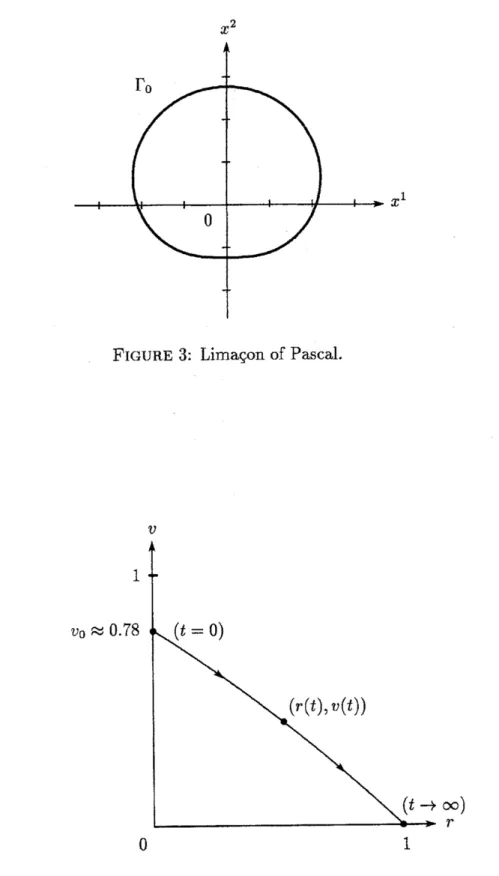
(limagon of Pascal). The curve defined by$\Gamma_{0}:=\{\varphi(y)=(x^{1}(y), x^{2}(y))|y\in \mathcal{M}=[0,2\pi]\}$
with
$\{$
$x^{1}(y):=\cos y\sin y+2\sin y$
,
is one ofthe curves calledlimagonof Pascal. The last termon the right hand side of
$x^{2}$-component is added so that $p_{0}=0$, $E$being the usual complete elliptic integralof
2nd kind defined by $E(k^{2}):= \int_{0}^{\pi/2}\sqrt{1-k^{2}\sin^{2}\theta}$dO. By the definition of $q_{0}$ in (3.4),
it yields after some computation that
$q_{0}=(0,$ $\frac{15\pi}{8}-\frac{\pi^{2}}{6E(8/9)})\approx(0, 4.41)$
.
One can see that $q_{0}$, parallel to the
$x^{2}$-axis, precisely coincides with the direction in
which the symmetry of $\Gamma_{0}$ is broken (cf. FIGURE 3). $\square$
Let us now choose $\Gamma_{0}$ above as initial curve and solve the interface equation (IE). To facilitate computation, we employ thefollowing linearfunctions for $h^{\pm}(v)$:
$h^{\pm}(v)=- \frac{1}{2}v\pm 1$,
$-1<v<1$
.
Sincethe center-of-mass motionfor (IE) does not dependon the shape of
an,
wemayassume, without loss ofgenerality, that $\Omega$ is a disk. We choose and fix the radius so
that $|\Omega|=27\pi\approx$ 84.82, which guarantees that $\Gamma_{0}$ stays uniformly away from
an.
Itturns out that $\Gamma_{0}$ satisfies the following properties:
$|\Gamma_{0}|=12E(8/9)\approx$ 13.36,
$|\Omega_{0}^{-}|=9\pi/2\approx$ 14.14,
$|\Omega_{0}^{+}|=|\Omega|-|\Omega_{0}^{-}|=45\pi/2\approx$
70.68.
We also note that the function $\tau_{0}(r)$ turns out to be
$\tau_{0}(r)=\frac{r}{12E(8/9)+2\pi r}$
.
As an initial value $v_{0}$ for (IE), we choose
(3.5) $v_{0}:= \frac{4(\pi+|\Gamma_{0}|)}{|\Omega|}\approx 0.78$
.
We now solve (ODE) which is equivalent to (IE). Note that $h(v)\equiv-4/|\Omega|$ and
$g(r)=|\Gamma_{0}|+27\mathrm{r}\mathrm{r}$. The relation $dv/dr=h(v)g(r)$ implies that the solution curve in
this situation is given by
$\{(r, v)|v=-\frac{4\pi}{|\Omega|}r^{2}-\frac{4|\Gamma_{0}|}{|\Omega|}r+\frac{4(\pi+|\Gamma_{0}|)}{|\Omega|}|$
.
$r\geq 0$,
$v>0\}$,
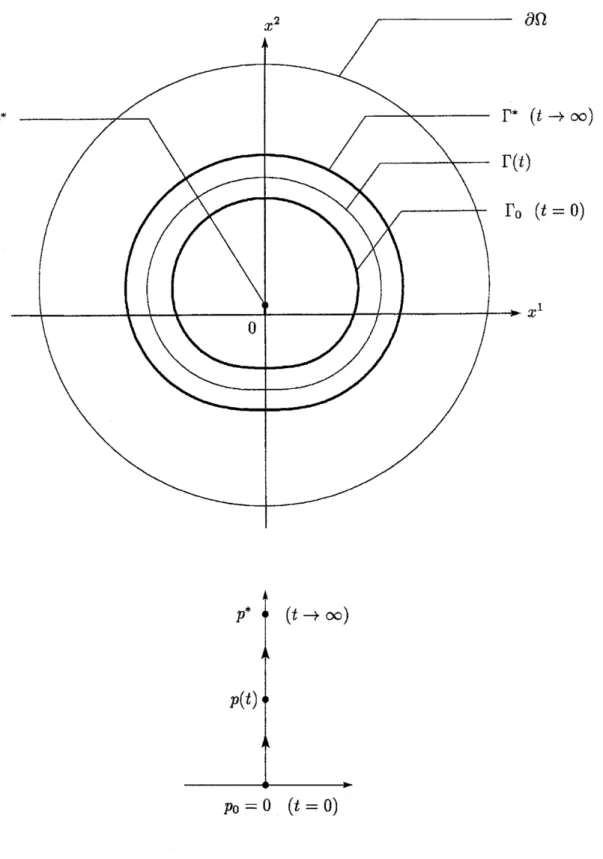
which implies the existence ofa globally-in-time solution $(r(t), v(t))$ which converges
to $(1, 0)$ as $tarrow$ oo (cf. FIGURE 4). The center of
mass
$p^{*}$ of thelimit
interface$\Gamma"=\Gamma_{f}|_{\mathrm{r}=1}$ is given by
$p^{*}=\tau_{0}(1)q_{0}\approx(0,0.22)$.
Therefore,the center of
mass
$p(t)$,
withtheinitialcurve
$\Gamma_{0}$ being the limagonof Pascalin EXAMPLE 3.1, evolvesmonotonouly from $(0, 0)$ along the $x^{2}$-axis to
$p^{*}\approx(0,0.22)$
REFERENCES
[1] N.D. Alikakos, L.Bronserd and G.Fusco, Slow motion in the gradient theory
of
phase rransitions via energy and spectrum, Calc. Var. Partial Differential
Equa-tions 6 (1998), 39-66.
[2] N. D. Alikakos, X.Chenand G.Fusco, Motion
of
a droplet bysurface
tension alongthe boundary, Calc. Var. Partial Differential Equations 11 (2000),
233-305.
[3] N. D. Alikakos,
G.
Fusco and G.Karali, Motionof
bubbles towards the boundaryfor
theGahn-Hilliard
equation, European J. Appl. Math. 15 (2004), 103-124.[4] L. Bronsard and B. Stoth, Volume-preserving mean curvature
flow
as a limitof
$a$nonlocal Ginzburg-Landau equation, SIAM J. Math. Anal. 28 (1997),
769-807.
[5] J. Escher and G.Simonett, The Volume preserving mean curvature
flow
nearspheres, Proc. Amer. Math. Soc. 126 (1998),
2789-2796.
[6] M.Gage, On an area-preserving evolution equation
for
plane curves, Contemp.Math. 51 (1986),
51-62.
[7] G.Huisken, The volume preserving
mean
curvature flow, J. Reine Angew. Math.382 (1987),
35-48.
[8] K. Okada, Intermediate dynamics
of
internal layersfor
a nonlocalreaction-diffusion
equation, preprint (2004), to appear in Hiroshima Math. J. 35 (2005).[9] J. Rubinstein and P.Sternberg, Nonlocal
reaction-diffusion
equations andnucle-ation, IMA J. Appl. Math. 48 (1992),
249-264.
[10] K.Sakamoto, Spatial homogenization and internal layers in a
reaction-diffusion
system, Hiroshima Math. J. 30 (2000),
377-402.
[11] M.J. Ward, Metastable bubble solutions
for
the Allen-Cahn equation with massconservation,
SIAM
J. Appl. Math. 56 (1996),1247-1279.
[12] M. J.Ward, The dynamics
of
localized solutionsof
nonlocalreaction-diffusion
FIGURE
FIGURE 1: Interface $\Gamma$ and subdomains $\Omega^{\pm}$ in $\Omega$.
$v$
$r$
$x^{2}$
$x^{1}$
FIGURE 3: Limac.on of Pascal.
$v$ 1 $v_{0}\approx 0.78$ $\infty)$ $r$
01
$p_{0}=0$ (t $=0)$