Discrete
Optimal
Testing/Maintenance Policy
in
a
Software
Development
Project
林坂弘一郎
,
土肥正Koichiro
Rinsaka and
Tadashi
Dohi
Department
of Information Engineering,
Graduate
School of Engineering,
Hiroshima
University,
Japan
1
Introduction
It is importantto determine the optimal timewhen software testing should be stopped and when the
systemshouldbedelivered to
a user or a
market. Thisproblem,called optimalsoftw
are
releaseproblem,plays
a
central role for thesuccess or
failure ofa
software development project. Okumoto and Goel [1]assumed thatthe number ofsoftware faults detected inthetestingphase isdescribed by
an
exponential software reliability model basedon
a
non-homogeneous Poisson process (NHPP) [2], and derivedan
optimal software release time which minimizes the total expected software cost. Koch and Kubat [3]
considered thesimilar problemfor the othersoftware reliabilitymodel byJelinski and Moranda [4]. Bai
and Yun [5] calculated the optimal number of faults detected before the releaseunder theJelinski and
Moranda model. Many authors formulated the optimal software release problems based on different
model assumptions$\mathrm{a}\mathrm{n}\mathrm{d}/\mathrm{o}\mathrm{r}$several software reliability models $[6, 7]$
.
It isdifficult to detect and
remove
allfaults remaining ina
software during the actual testing phase,because exhaustive testing of allexecutablepathsina generalprogramis impossible. Oncethesoftware
is released tousers, howeverthesoftware failures may
occur
even
intheoperational phase. It iscommon
for softwaredevelopers to provide maintenanceservice duringthe period when they
are
still responsiblefor fixing softwarefaults causing failures. In order tocarryout the maintenance in the operationalphase,
the software developer has to keep
a
software maintenance team. At thesame
time, the managementcost in the operationalphase should be reduced
as
much as possible, but at thesame
time the humanresources
should be utilized effectively. Although the problem which determines themaintenance periodis importantfromthe practical pointofview, onlya veryfew authors paid their attentionto thisproblem.
Kimura et al. [8] considered the optimal software release problem in the
case
where the softwarewarranty period is
a
random variable. Pham and Zhang [9] developeda
software cost model with bothwarranty and risk. They focused on the problem for determining when to stop the software testing
under
a
warrantycontract. However, it isnoted that the software developer has todesign the warrantycontract itself andoften provides the posterior service for
users
after software failures. Dohi et al. [10]formulated theproblemfor determining the optimalsoftwarewarranty period whichminimizes the total
expected softwarecostunder the assumption that the debugging processinthe testing phase isdescribed
by
an
NHPP. SandohandRinsaka [11] considered the design problem ofa
maintenanceservicecontractby regarding
as
the Stackelberg game betweena
software agent anda
softwareuser.
Since the user’soperational environment is not always
same as
thatassumed in the software development phase, however,theabove literature did not take account
of
the difference between two different phases.Several reliability assessment methods during the operational phase have been proposed by
some
authors $[12, 13]$
.
Rinsaka and Dohi [14] developeda
continuous time model for designing the optimaltestingandmaintenance periods, wherethedifference between the software testingenvironmentand the
operational environment
are
reflected.In thispaper,
we
focus onthe optimalsoftware $\mathrm{t}\mathrm{e}\mathrm{s}\mathrm{t}\mathrm{i}\mathrm{n}\mathrm{g}/\mathrm{m}\mathrm{a}\mathrm{i}\mathrm{n}\mathrm{t}\mathrm{e}\mathrm{n}\mathrm{a}\mathrm{n}\mathrm{c}\mathrm{e}$ problem considered in RinsakaandDohi [14], and developastochastic model in discretecircumstance,where the difference between the
software testing environment and the operational environmentcan be characterized by
an
environmentfactor (see Okamura et al. [13]). More precisely, the total expected software cost is formulated viathe discrete NHPP type of software reliability models [16, 17, 18]. In the special
case
with the geometric fault-detectiontime distribution,we
derive analytically the optimal testing period (release time) whichminimizesthetotal expected software costunder
a
milder condition. We call the time lengthto completethe operational maintenance
after
the releasea
planned maintenance limit, and also derive the optimalplannedmaintenance limit which minimizesthe total expectedsoftwarecost. Innumerical examples with
real data,
we
calculate numerically the joint optimal $\mathrm{t}\mathrm{e}\mathrm{s}\mathrm{t}\mathrm{i}\mathrm{n}\mathrm{g}/\mathrm{m}\mathrm{a}\mathrm{i}\mathrm{n}\mathrm{t}\mathrm{e}\mathrm{n}\mathrm{a}\mathrm{n}\mathrm{c}\mathrm{e}$ policy, combined by testingperiodand plannedmaintenance limit.
2
Model
Description
First,
we
$\mathrm{m}$ake the following assumptionson
the software fault-detection process:(a) In eachtime when
a
software failureoccurs, thesoftware fault causing the failurecan
be detectedand removed immediately.
(b) The number ofinitial faults contained in the software program, $N_{0}$, is given by the Poisson
dis-tributed random variable withmean $\mathrm{i}$ $(>0)$
.
(c) The timeto detect eachsoftware fault is independent and identicallydistributed nonnegative
dis-creterandom variable with probability
mass
function$p_{i}$ $(i= 0, 1, 2, \cdots)$and probability distributionfunction$P(i)= \sum_{k=1}^{i}p_{k}$, where$0\leq p_{l}\leq 1$ and$0\leq$ P(i) $\leq 1.$
Let $\{N_{i}, i=1,2, \cdots\}$
be
the cumulative number ofsoftware
faults detected up to time $i$.
From theaboveassumptions, the probability
mass
function of$N_{i}$ is given byPr$\{N_{i}=ml\}$ $=$ $\frac{\{\omega\sum_{k_{-}^{-}1}^{i}p_{k}\}^{m}}{m!}e^{-\omega\sum_{k=1}\mathrm{p}k}\dot{.}$
$=$ $\frac{\{\omega P(i)\}^{m}}{m!}e^{-\omega P(i)}$ $m=0,1,2$,$\cdots$
.
(1)Hence, thestochastic process $\{N_{i}, i=1,2, \cdots\}$is equivalent to
a
discrete time NHPPwithmean
valuefunction$\omega P(i)$
.
Suppose that
a
softwaretesting is started at time$i=0$ andterminated at time $i=n_{0}(\geq 0)$.
Aftercompleting the software testing, the software product is released toa
user or
the market. The time lengthofsoftware life cycle $n_{L}(>0)$ is a known constant in advance and is assumed to be sufficiently larger
than $n_{0}$. More precisely, the software life cycle is measured from the point of time $n_{0}$
.
The softwaredeveloper isresponsible tothe maintenance serviceforall thesoftware failuresthatmay
occur
duringthesoftware lifecycle under
a
maintenancecontract. We suppose thatthe projectmanager decides to break up the maintenance team at time $n_{0}+$ $tty$ for reduction of the operational costto keep it, btita
largeamount of debuggingcost during $(n_{0}+nW, n_{0}+n_{L}]$ may be needed if the software failure
occurs.
Let$n_{W}$ be the planned
maintenance
limit denoting thetime length to complete theoperationalmaintenanceafter the release aplanned maintenance limit. Further,
we
definethe following cost components$\mathrm{c}0$ $(>0)$: cost to
remove
each fault inthe testing phase,$cw(>0)$: cost to
remove
each fault before the planned maintenancelimit,$c_{L}(>0)$: cost to
remove
each fault afterthe plannedmaintenance limit,$k0(>0)$: testing cost per unit oftime,
$k_{W}(>0)$: operationalcost
to
keep themaintenance team per unit oftime.In thefollowingsection, weformulate the totalexpectedsoftware cost by introducing the above cost
factors
in testing and operational phases. We derive the discreteoptimal software testing period$n_{0}^{*}$or
the discrete optimal planned maintenancelimit $n_{W}^{*}$ whichminimizes thetotal expectedsoftware cost at
the end ofthe software life cycle. Then, we calculate the joint optimal policy $(n_{0}^{**}, n_{W}^{**})$ combined by
bothtesting period and planned maintenance limit.
3
Total Expected
Software Cost
We formulate the total expected software cost which
can
occur
inboth testingand operational phases.In theoperationalphase,
we
considertwo cost factors; the maintenancecost due to the software failureand the operationalcostto keep the maintenance team.
From Eq.(l), the probability
mass
function ofthe number of software faults detected during theIt should be noted that the operational environment after the release may differ from the
debug-ging environment in the testing phase. This difference is similar to that between the accelerated life
testing environment and the normal operating environment for hardware products. We introduce the
environment factor $a(>0)$ which represents the relative severity in the operational environment after
the release, andassumethat the timesinthe testingphaseand the operational phase have aproportional
relationship. Namely, the time length $n$ in the operational phase corresponds to $a\cross n$ in the testing
phase. Under the above assumption, $a=1$
means
the equivalence between the testing andoperationalenvironments.
On
the other hand,$a>1(a<1)$
implies that the operational environment isseverer
(looser)thanthe testingenvironment. Okamura et $al$ $[13]$ apply this techniquetomodel the operational
phase ofthe software, and
estimate
the software reliability throughan
example in the actual softwaredevelopment roject. The probability
mass
functionofthenumber of software faults detected beforetheplanned maintenance limit is given by
$\mathrm{P}\mathrm{r}\{N_{n\mathrm{o}+n_{W}}-N_{n_{0}}=m\}=\frac{\{\omega\{P(n_{0}+[an_{W}])-P(n_{0})\}\}^{m}}{m!}e^{-\omega\{P(n_{0}+[an_{W}])-P(n\mathrm{o})\}}$, (3)
where, $[\cdot]$ is the Gaussianinteger.
Similarly,thefault-detection process of the software after the planned maintenance limit is expressed
by
$\mathrm{P}\mathrm{r}\{N_{n_{0}+n_{L}}-N_{n_{0}+n_{W}}=m\}$
$=$ $\frac{\{\omega\{P(n_{0}+[an_{L}])-P(n_{0}+[an_{W}])\}\}^{m}}{m!}e^{-\mathfrak{l}d}\{P(\mathrm{y}\mathrm{r}_{0}+[a\mathrm{v}\mathrm{z}_{L}])-P(n\mathrm{o}+[an_{W}]\rangle\}$
.
(4)From Eqs.(2), (3) and (4), thetotal expected software cost isgiven by
$C(n_{0}, n_{W})$ $=$ $\mathrm{k}\mathrm{o}\mathrm{n}\mathrm{o}+$$cou)P(no)+kwnw$ $+c_{W}\omega$$\{P(n0+[anw])- P(\mathrm{n}\mathrm{o})\}$
1-$c_{L}\omega\{P(n_{0}1-[an_{L}])-P(n_{0}+[anw])\}$
.
(5)4
Determination of the
Optimal
Policies
In thissection
we
derive the optimal testing period $n_{0}^{*}$ orthe optimal planned maintenance limit $n_{W}^{*}$whichminimizesthetotal expected software cost incurred to thesoftwaredeveloper at the end of software
life cycle. Suppose thatthe time to detect each software fault obeysthe geometric distribution
$p_{i}=b(1-b)^{i-1}$ (6)
with parameter$b(0<b<1)$
.
In this case, the totalexpectedsoftware cost inEq.(5) becomes$C(n_{0}, n_{W})$ $=$ $k_{0}n_{0}+c_{0}\omega\{1-(1-b)^{n0}\}$$+kwnw$$+c_{W}\omega\{(1-b)^{n_{0}}-(1-b)^{n_{\mathrm{O}}+[an_{W}]}\}$
$+c_{L}\mathrm{u}$$\{(1-b)^{n_{0}+[an_{W}]}-(1-b)^{n_{\mathrm{O}}+[an_{L}]\}}$
.
(7)We makethe following assumptions:
(A-I) $a$ is positive and an integer value,
(A-II) $c_{L}>cw$ $>c_{0}$,
(A-III) $c_{W}\{1-(1-b)^{an_{L}}\}>c_{0}$,
(A-IV) $c_{W}\{1-(1-b)^{an_{W}}\}+c_{L}\{(1-b)^{an_{W}}-(1-b)^{an_{L}}\}>$ c0.
Define
$Q(nw)=k_{0}+\omega b\{c_{0}-c_{W}(1-(1-b)^{an_{W}})-c_{L}((1-b)^{anw}-(1-b)^{an_{L}})\}$
.
(8)Then the following result provides the optimalsoftwaretesting policywhich minimizesthe total expected
Theorem 1: When the $sof$ tware
fault-detection
time distributionfollows
the geometricdistribution
withparameter$b(0<b<1)$, under the assumptions (A-I) to (A-IV), the optimal$sof$rware testingperiod
(release time) which minimizes the total expected
software
cost is given asfollows:
(1)
If
$Q(nW)<0,$ then there exist (at least one, at most two)finite
optimalsoftware
testing periods(release times)$n_{0}^{*}(>0)$
.
(2)
If
$Q(n_{W})\geq 0,$ then the optimal policy is$n_{0}^{*}=0$ with$\mathrm{C}(\mathrm{n}0, n_{W})=kwnw$ $+c_{W}\omega\{1-(1-b)^{an_{W}}\}+cL\omega\{(1-b)^{an_{W}}-(1-b)^{an_{L}}\}$
.
(9)Furthermore, the following result provides the optimal planned maintenance limit which minimizes
the total expected software cost.
Theorem 2: When the
software fault-detection
time distributionfollows
the geometric distributionwith parameter$b(0<b<1)$
,
underthe assumptions (A-I) and (A-II); the optimal planned maintenancelirnit which minimizes the total expected
software
cost is givenas
follows:
(1)
If
$k_{W}\geq$ ($c_{L}-$cw)u{1--(1-b)a} $(1-b)^{n_{0}}$, then the optimalpolicy is$n_{W}^{*}=0$ with$\mathrm{C}(\mathrm{n}0, n_{W}^{*})=$konQ$+c_{0}\omega$
{
$1-(1-$
b)a}$+c_{W}\omega\{(1-b)^{n_{0}}-(1-b)^{n_{0}+an_{L}}\}$.
(10)(2)
If
$k_{W}<(\mathrm{c}_{L} \mathrm{c}\mathrm{w})\mathrm{u}${
$1-(1-$
b)a}$(1-b)^{n0}$ and$k_{W}>$ ($c_{L}-$cw)u{1--(1-b)a}$(1-b)^{n_{0}+a(n_{L}-1)}$,then thereexist (at least one,
at
most two) optimal plannedmaintenance limits$n_{W}^{*}(0<n_{W}^{*}<n_{L})$which minimizes the total expected
software
cost.(3)
If
$k_{W}\leq$ ($c_{L}-$cw)u{1--(1-b)a} $(1-b)^{n\mathrm{o}+a(n_{L}-1)}$, thenwe
have $n_{W}^{*}=nL$ with$\mathrm{C}(\mathrm{n}0, \mathrm{n}\mathrm{w})=\mathrm{k}\mathrm{o}\mathrm{n}\mathrm{Q}+c_{0}\omega$
{
$1-(1-$b)a}-lJcw
$n_{L}+cw\omega\{(1-b)^{n_{0}}-(1-b)^{n_{0}+an_{L}}\}$.
(11)5
Numerical
Examples
Basedon 351 softwarefault(41 week) data observed in the realsoftware testing process [19],wecalculate
numerically the optimal testing period$n_{0}^{*}$and the optimal planned maintenance limit$n_{W}^{*}$ whichminimize
the total expected software cost. Further, we compute the joint optimal policy $(n_{0}^{**}, n_{W}^{**})$ minimizing
$C(n_{0}, n_{W})$. Forthe software fault-detectiontime distribution,
we
apply three probability distributions;geometric, negative binomial and discrete Weibull distributions. The probability
mass functions
fornegative binomial and discrete Weibull
are
given by$p_{i}=($ $h+h$$\mathrm{z}$$-21$
)
$b^{h}(1-b)^{i-1}$, (12)
and
$p_{i}=b\dot{\cdot}h-b^{(\mathrm{z}+1)^{h}}$ (13)
respectively, where$h\geq 0.$ Fornegativebinomial and discrete Weibull distributions,
we
considerthecase
of$h=2.$
Suppose that the unknown parameters in thesoftwarereliability models
are
estimatedbythemethodof maximum likelihood. Then,
we
have the estimates $(\hat{\omega},\hat{b})=$ (413.305, 0.0451012) for the geometricmodel, $(\hat{\omega},\hat{b})=$ (364.234, 0.116255) for the negative binomial model and $(\hat{\omega},\hat{b})=$ (351.871, 0.996436)
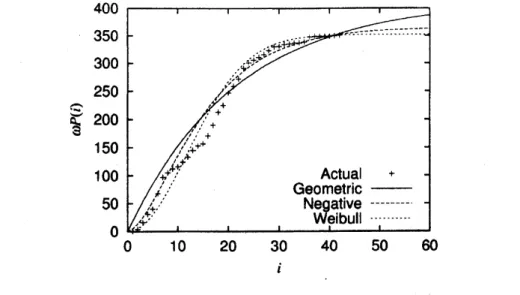
for the discrete Weibull model. Figure 1 shows the actual software fault data and the behavior of
estimated
mean
value functions.Since
the environment factor$a$ isa
subjective parameterwhichshouldbe estimated from thepast development track record,
we
assume
thatthe value of$a$ is known. For theother model parameters,
we assume:
$k_{0}=2.0,$ $k_{W}=1.0$, $c_{0}=5.0$, $c_{W}=10.0$,
$c_{L}=50.0$and $n_{L}=200.$Table 1 presents the dependence ofenvironment factor $a$
on
the optimal testing period $n_{0}^{*}$ when $nW=20.$ Asthe environment factor monotonically increases, $i.e$.,
the operational circumstance tendstobesevere,itisobserved that the optimal testing period$n_{0}^{*}$ and itsassociatedminimum total expected
software cost $C(n_{0}^{*}, 20)$ decrease for both geometric and negative binomial models. For the discrete
5
400
350
\sim .--.---.---,300
$.’\dotplus,\dotplus,,\cdot.\dotplus^{\dotplus,’},\sim$ $.j^{j’}$.250
$\vee\wedge-$’.’
$\ell+$200
$\mathrm{e}$ $\prime\prime\prime.’.\cdot+’+$150
$l^{J’}.\dotplus^{+}\cdot$ $!’$$\mathrm{i}00$ $,+.\cdot’$
.
Actual
$+$
Geometric
–50
Ne
ative
– $,.*\prime\prime,+.\cdot$.
eibull
$\ldots.----$00
$\mathrm{i}0$20
40
50
$i$Figure 1: Behavior ofactualsoftware fault data and estimated
mean
value functions.Table 1: Optimal software testing period for varyingenvironment factor.
Geometric Negative Weibull
a $n_{0}^{*}$ $C(n_{0}^{*}, 20)$ $n_{0}^{*}$ $C(n_{0}^{*}, 20)$ $n_{0}^{*}$ $C(n_{0}^{*}, 20)$ 0.50 122 2375 65 1990 41 1867 0.75 119 2367 62 1983 40 1865
1.00
115 2359 591977
39 1865 1.25 111 2352 571973
391865
1.50
$10\underline{8}$ 2345 561971
39 18652.00
101
2333
541967
391865
3.00
93
2315 531966
39
1865
Table 2: Optimal planned maintenance limit for varying environment factor.
Geometric Negative Weibull
a $nW$ $\mathrm{C}(41,\mathrm{n}\mathrm{f}\mathrm{c})$ $n_{W}^{*}-$ $C(41, n_{W}^{*})$ $n_{W}^{*}$ $C(41,n_{W}^{*})$ 0.50
176
2648 62 2050 121863
0.75
128
2615
48 202881859
1.00
103 $\overline{2584}$38
2016
81856
1.25 882564
322008
81855
1.50
74 2549 282003
61854
2.00
59
2530 22 199651852
3.00 42 2509 16 1988 41850Table 3: Optimaltesting$\mathrm{p}\mathrm{e}\mathrm{r}\mathrm{i}\mathrm{o}\mathrm{d}/\mathrm{p}\mathrm{l}\mathrm{a}\mathrm{n}\mathrm{n}\mathrm{e}\mathrm{d}$maintenancelimit for varyingenvironment factor.
Geometric Neg tive Weibull
a $n_{()}^{*}$ $n_{W}^{**}$ $C(\circ**,n_{W}^{**})$ $\overline{n_{0}^{**}}n_{lV}^{**}-$ $C(n_{0}^{**},n_{W}^{**})$ $0**$ $n_{W}^{**}$ $C(n_{0}^{**}, W**)$ $0$
.
0 131 0 2372 3 0 1986 47 0 18590.75
108 40 236 64 16 1983 42-8
1858 1.00 99 4 23 260-19
1977
42 7 1856 1.25 94 44 2343 57 201973
41 8 1855 1.5093
402335
57
161970
41 61854
2.00
90 34 232456
14 1966 41 5 18523.00
8827
2312 55 11 1960 40 4 1850in Fig.1, it is observed that the optimal testing period is strongly influenced byvarying environment factor.
Table2showsthedependenceof environment factor$a$on theoptimalplanned maintenance limit$n_{W}^{*}$
in
case
of$n_{0}=41.$ It is found that the optimal planned maintenance limit $n_{W}^{*}$ and the correspondingminimum total expected software cost $C(41, n_{W}^{*})$ decrease
as
the environment factor monotonicallyincreases. Thistendency
can
be explained as follows: The residual faults insoftwareare
detected andremovedatthe early stageintheoperational phase
as
theoperationalenvironment becomesmore severe.
Then, the possibility that the software failure
occurs
in the latter stage of the operational phasemay
become small. Hence, the implication in which the software developer keeps the maintenance team becomes smaller towardthe end of the life cycle.
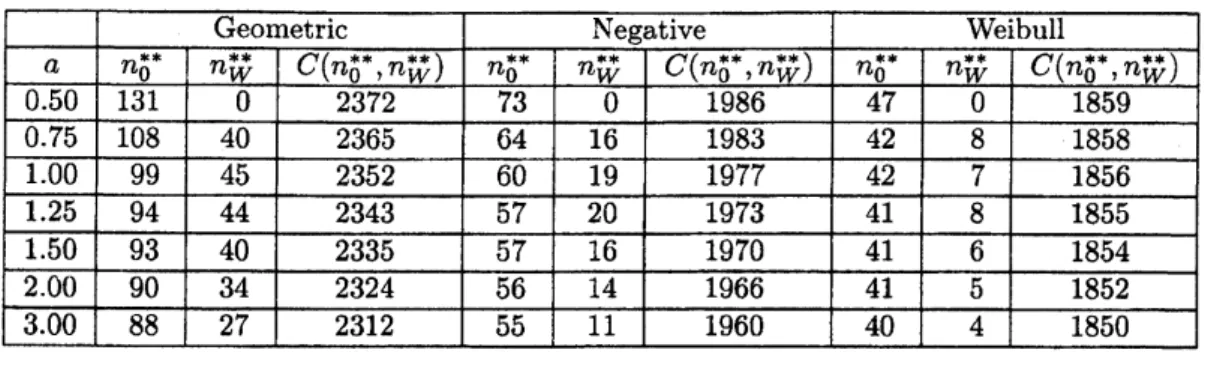
Table 3 examines the dependence of environment factor $a$
on
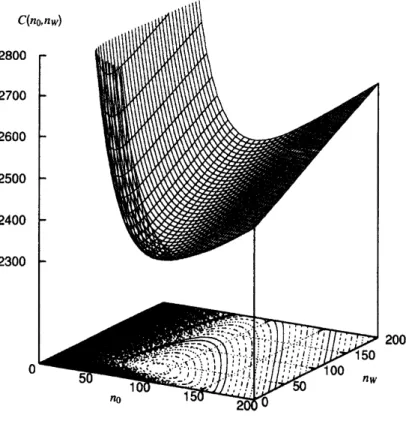
the joint optimal policy $(n_{0}^{**}, n_{W}^{**})$combined by testing period and planned maintenance limit. Figure 2 illustrates the behavior ofthe
expected cost for the geometric model when $a=$ 2.00. It is observed from Table 3 that the optimal
testing period $n_{0}^{**}$ decreases
as
theenvironment factor monotonically increases, but, the monotonicityofthe optimal planned maintenance limit $n_{W}^{**}$ is not observed. It is also
seen
that the minimum totalexpectedsoftware cost $C(n_{0}^{**}, n_{W}^{**})$ decreases
as
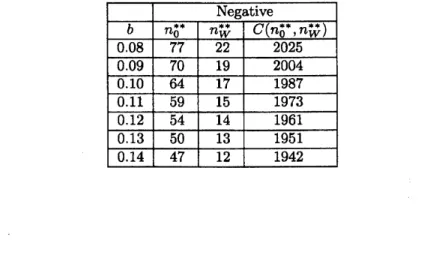
the environment factormonotonically increases.Tables 4, 5 and 6 present the dependence ofthe software reliability model parameter $b$
on
the jointoptimal policy $(n_{0}^{**}, n_{W}^{**})$
.
It is observed that the optimal testing time, optimal planned maintenancelimit and its associated minimum total expectedsoftware cost decrease asthe fault detection becomes easier.
6
Concluding Remarks
In this paper,
we
have assumed that the software developerwas
responsible tothemaintenance service
for all the software failures that
occur
during the software lifecycle under themaintenance
contract. In order to carry out the maintenance service in the operational phase, thesoftware developer has to keepa
software maintenance team. At thesame
time, themanagement cost in the operationalphase has tobe reducedas much
as
possible, but humanresources
should be utilized effectively. We have called the time length to complete the operational maintenance after the release the planned maintenance limit,and have controlled it in terms ofcost-benefit analysis. We have developed the discrete model which
represents the difference in the software execution environment during testing and operational phases,
using the
same
methodas
the continuous-time-based reliability assessment modeling in the operationalphase proposed by
Okamura
et $al$ $[13]$.
Basedon
the discrete NHPPwe
haveformulated
the totalexpected software cost incurred tothe software developer at the end of softwarelife cycle. The optimal
testingperiod (release time) andoptimal planned maintenance limit which minimize the totalexpected
software
cost have beenderived.
Then, throughout the numerical examples,we
have discussed the jointTable 4: Optimal testing period$/\mathrm{p}\mathrm{l}\mathrm{a}\mathrm{n}\mathrm{n}\mathrm{e}\mathrm{d}$ maintenance limit for geometricsoftwarereliability model with varying parameter b. $\mathrm{G}\overline{\mathrm{e}\mathrm{o}}\mathrm{m}\mathrm{e}\mathrm{t}\mathrm{r}\mathrm{i}\mathrm{c}$ $b$ $n_{0}^{**}$ $n_{W}^{**}$ $C(n_{0}^{**},n^{**})$
0.042
37
2340 0.043 362335
0.044 35 23300.045
35
2325
0.046 34 23200.047
33 2315 0.048 32 2311Table
5:
Optimal testing $\mathrm{p}\mathrm{e}\mathrm{r}\mathrm{i}\mathrm{o}\mathrm{d}/\mathrm{p}\mathrm{l}\mathrm{a}\mathrm{n}\mathrm{n}\mathrm{e}\mathrm{d}$maintenance limit for negative binomial software reliabilitymodel with varying parameter$b$
.
Negative $b$ $n_{0}^{**}$ $n_{W}^{**}$ $C(n_{0}^{**}, n_{W}^{**})$ 0.08
77
22 2025 0.09 70 19 2004 0.10 64 17 1987 0.11 59 15 1973 0.12 54 141961
0.13 50 13 1951 0.14 47 12 1942Table6: Optimal testing$\mathrm{p}\mathrm{e}\mathrm{r}\mathrm{i}\mathrm{o}\mathrm{d}/\mathrm{p}\mathrm{l}\mathrm{a}\mathrm{n}\mathrm{n}\mathrm{e}\mathrm{d}$maintenancelimitfordiscreteWeibull softwarereliabilitymodel
with varying parameter$b$
.
Weibull $b$ $n_{0}^{**}$ $n_{W}^{**}$ $C(n_{0}^{**}, n_{W}^{**})$ 0.999 10
1926
0.998
7 1880 0.997 6-1880
0.996
5
1847
0.996
41838
0.994 4 1832 0.998 41827
8
Figure2: Behavior of thetotalexpectedsoftwarecost forgeometric software reliability model$(a=2.00)$
.
References
[1] K. Okumoto andL. Goel, “Optimumrelease timefor softwaresystemsbased onreliability and cost
criteria,” J. Sys. Software, vol. 1, pp. 315-318, 1980.
[2] A.L. Goel and K. Okumoto, “Time-dependent error-detection rate model for software reliability andother performance measures,” IEEE Trans. Reliab., vol. R-28,
no.
3, pp. 206-211, 1979.[3] H.S. Kochand P. Kubat, “Optimal release time ofcomputersoftware,” IEEE Trans. Software Eng., vol.
SE
9,no.
3,pp.
323-327,1983.
[4] Z. Jelinski and P.B. Moranda, “Software reliability research,” Statistical Computer Performance
Evaluation, (W. Freiberger ed.), pp. $465\triangleleft 84$
,
Academic Press, New York,1972.
[5] D.S. Bai
and
W.Y. Yun, “Optimum number oferrors
corrected beforereleasinga
softwaresystem,”IEEETrans. Reliab., vol. R-37,
no.
1, pp. 41-44, 1988.[6] W.Y. Yun and D.S. Bai, “Optimum software release policy with random life cycle,” IEEE Trans.
Reliab.,vol. R-39,
no.
2, pp. 167-170, 1990.[7] T. Dohi, N. Kaioand S. Osaki, “Optimalsoftwarerelease policies withdebuggingtimelag,” Int. J.
Reliab., Quality and Safety Eng., vol. 4,
no.
3, pp. 241-255, 1997.[8] M. Kimura, T. Toyota and S. Yamada, “Economic analysisofsoftware release problems with
war-ranty costand reliability requirement,”
Reliab.
Eng.&
Sys. Safe., vol. 66,no.
1, pp. 49-55,1999.
[9] H. Pham and X. Zhang, “A
software
cost model withwarrantyand risk costs,” IEEE Trans.Com-put., vol.48,
no.
1,pp.
71-75,1999.
[10] T. Dohi, H. Okamura, N. Kaio and S. Osaki, “The age-dependent optimal warranty policy and
its
application to software maintenance contract,” Proc. 5th Int’l Conf. on Probab. Safe. Assess, and
9
[11] H. Sandoh and K. Rinsaka, “Maintenance service contract model for software,” Proc. of the First
Western Pacific and Third Australia-Japan Workshopon Stochastic Models in Engineering,
Tech-nology and Management, Christchurch, New Zealand, pp. 466-475, 1999.
[12] J. Musa, G. Fuoco, N. Irving, D. Kropfl and B. Juhlin, “The operational profile,” Handbook of
SoftwareReliability Engineering, (M.R. Lyu ed.), pp. 167-216, McGraw-Hill, New York, 1995.
[13] H. Okamura,T. Dohiand
S.
Osaki, “A reliabilityassessment method for software productsinoper-ational phase – proposalof
an
accelerated life testingmodel –,” Electronics and Communicationin Japan, Part 3, vol. 84, pp. 25-33,
2001.
[14] K. Rinsaka andT. Dohi, “Optimal$\mathrm{t}\mathrm{e}\mathrm{s}\mathrm{t}\mathrm{i}\mathrm{n}\mathrm{g}/\mathrm{m}\mathrm{a}\mathrm{i}\mathrm{n}\mathrm{t}\mathrm{e}\mathrm{n}\mathrm{a}\mathrm{n}\mathrm{c}\mathrm{e}$ design ina software developmentproject,”
Electronic Proc. of Fourth International Conference
on
Mathematical Methods in Reliability-Methodology and Practice, Santa Fe, New Mexico, USA, 2004.
[15] A.A. Abde-Ghaly, P.Y. Chan and B. Littlewood, “Evaluation of competing software reliability
predictions,” IEEE Trans. SoftwareEng., vol. SE-12,
no.
9, pp. 950-967, 1986.[16] S. Yamada and S. Osaki, “Discrete software reliabilitygrowth models,” Applied Stochastic Models
and Data Analysis, vol. 1, pp. 65-77, 1985.
[17] T. Kitaoka, S. Yamada and S. Osaki, “Adiscrete non-homogeneous
error
detection rate model forsoftware reliability,” Transactions of the Institute of Electronics and
Communication
Engineersof Japan, vol. E69, pp. 859-865,1986.
[18] H. Okamura, A. Murayama andT. Dohi, “EMAlgorithm for$\mathrm{d}\mathrm{i}\mathrm{s}$-crete softwarereliability models:
a
unifiedparameter estimation method,” Proceedingsof8th IEEE International Symposium
on
High Assurance Systems Engineering, pp. 219-228.IEEE CS Press, 2004.[19] A.P. Nikora and M. R. Lyu, “Softwarereliabilitymeasurement experience,” Handbook ofSoftware