Explicit
and
direct
representations of the
solutions
of
nonlinear
simultaneous equations
Masato
Yamada and
Saburou Saitoh
Abstract
In this paper we shall give practical, numerical and explicit
rep-resentations of inverse mappings of n-dimensional mappings (of the
solutions of n-nonlinear simultaneous equations) and show their
nu-merical experiments by using computers. We derive those concrete
formulas from very general ideas for the representation of the inverse
functions.
Keywords: Inverse function, inverse mapping, integral transform, integral representation, Green-Stokes formula, singular integral, fundamental
solu-tion, reproducing kernel, Sobolev space, non-linear mapping, general
non-linear equation.
MathematicsSubject
Classification
(2000): Primary$93B30,93C10,35A35$1
Introduction
The 2nd author of this paper considered that for any mapping $\phi$ from
an
arbitrary abstract set into
an
arbitrary set, he tried to consider therepresen-tation of the inversion $\phi^{-1}$ in terms of the direct mapping $\phi$ and he obtained
somesimpleconcrete formulas from
some
general ideas in ([1]). In this paper, from its general ideas, we shallgive practical representation formulasofsomegeneral functions. Here, weshallgive furthermoresome general methods and
ideas for the inversion formulas for
some
general non-linear mappings. Weshall first state the principles for
our
methods for the representations ofWe shall consider
some
representation of the inversion $\phi^{-1}$ in terms ofsome
integral form-at this moment,we
shall needa
natural assumption forthe mapping $\phi$ . Then, weshall transform the integral representation by the
mapping $\phi$ to the original space that is the defined domain of the mapping $\phi$. Then,
we
will be able to obtain the representation of the inverse $\phi^{-1}$in terms of the direct mapping $\phi$
.
In [1], we considered the representationof the inverse $\phi^{-1}$ in
some
reproducing kernel Hilbert spaces, and in [4],we
consideredthe representations of the inverse $\phi^{-1}$ for
a
very concretesituationand wegaveavery fundamentalrepresentation ofthe inversefor some general
functions
on
1 dimensional spaces.Indeed, note that
$K(y_{1}, y_{2})= \frac{1}{2}e^{-1y-y|}12$ $y_{1},$ $y_{2}\in[\mathcal{A}, B]$ (1)
is the reproducing kernel for the Sobolev Hilbert space $H_{K}$ whose members
arereal-valued andabsolutelycontinuous functionson $[A, B]$ andwhose inner
product is given by
$(f_{1}, f_{2})_{H_{K}}= \int_{A}^{B}(f_{1}’(y)f_{2}’(y)+f_{1}(y)f_{2}(y))dy+f_{1}(A)f_{2}(A)+f_{1}(B)f_{2}(B)(2)$
([2]).
For
a
function $y=f(x)$ that is of $C^{1}$ class anda
strictly increasingfunction and $f’(x)$ is not vanishing on $[a, b](f(a)=A, f(b)=B)$, of course,
the inverse function $f^{-1}(y)$ is a single-valued function and it belongs to the
space $H_{K}$ and from the reproducing property, we obtain the representation,
for any $y_{0}\in[f(a), f(b)]$
$f^{-1}(y_{0})=(f^{-1}(\cdot),$ $K(\cdot, y_{0}))_{H_{K}}$
$= \int_{(a)}^{f(b)}((f^{-1})’(y)K_{y}(y, y_{0})+f^{-1}(y)K(y, y_{0}))dy$
$+aK(f(a), y_{0})+bK(f(b), y_{0})$. (3)
From this representation, we obtained in $([4|)$ the very simple representation
Furthermore, by using the several reproducing kernel Hilbert spaces from [2] as in (3), we calculated similarly with the related assumptions, however, surprisingly enough,
we
obtain the same formula (4). For the formula (4),we note directly that we do not need any smoothness assumptions for the
function $f(x)$, indeed,
we
need only the strictly increasing assumption. Theassumption of integrability does not, even, need for the formula (4).
Now, we would like to obtain some multi-dimensional versions. At this moment, it seems that we can not find some simple representations
as
in (3) by some concrete known reproducing kernels for some general domains, andindeed,
we
know the reproducing kernels only for special domains and forspecial reproducing kernel Hilbert spaces.
In order to consider
some
general integral representations forsome
generalfunctions, we shall recall the fundamental facts:
We can represent afunction $f$ in termsofthe delta function $\delta$ in the form
$f(q)=/Df(p)\delta(p-q)dp$ (5)
in
some
domain, symbolically. Meanwhile, a fundamental solution $G(p-q)$ for some linear differential operator $L$ is given by the equation, symbolically$LG(p-q)=\delta(p-q)$. (6)
So, from (5)
we
obtain the representation$f(q)=/Df(p)LG(p-q)dp$
.
(7)Then, we can obtain the representation symbolically, by using the Green-Stokes formula, for
some
adjoint operator $L^{*}$ for $L$,$f(q)=/D^{L^{*}f(p)G(p-q)dp}+$
some
boundary integrals. (8)We shall firstly
use
this type representation. In this approach,we
will meetthesingular integral representation in thefirst termof(8), however, if$G(p-q)$
is integrable, then by a simple regularization for $G(p-q)$ we will be able to
realize the representation in numerical treatments. In the separate paper
[3]
we
discussed the natural regularization in the form, for example, for thesingularity
we
consider the regularization$\frac{1}{(|x-y|+\delta)^{\alpha}}$
for a small $\delta$ and
we
considered theirerror
estimates.We
are
interested insome
very concrete results that may be realized bycomputers. So,
we
considered veryconcretecases
in the 2 dimensionalspaces.It
seems
that the results will depend on dimensions, domains and functionsspaces dealing with.
In [6], we considered the following typical problem:
Let $D\subset R^{2}$ be a bounded domain with a finite number of piecewise $C^{1}$
class boundary components. Let $f$ be
a
one-to-one $C^{1}$ class mapping from$\overline{D}$
into $R^{2}$ and
we
assume
that its Jacobian $J(x)$ is positiveon
$D$. We shallrepresent $f$ as follows:
$y_{1}=f_{1}(x)=f_{1}(x_{1}, x_{2})$
$y_{2}=f_{2}(x)=f_{2}(x_{1}, x_{2})$ (9)
and the inverse mapping $f^{-1}$ of $f$
as
follows:$x_{1}=(f^{-1})_{1}(y)=(f^{-1})_{1}(y_{1}, y_{2})$
$x_{2}=(f^{-1})_{2}(y)=(f^{-1})_{2}(y_{1}, y_{2})$
.
(10)Then, we represented
$(\begin{array}{l}(f^{-1})_{1}(y^{*})(f^{-1})_{2}(y^{*})\end{array})$ (11)
in terms of the direct mapping (9).
Ofcourse, we are interested in some numerical and practical solutions of
the non-linear simultaneous equations (9) and
we
obtainedProposition 1 $([6J)$ For the mappings (9) and (10) with (11),
we
obtain therepresentation,
for
any $y^{*}=(y_{1}^{*}, y_{2}^{*})\in f(D)$,$(_{(f^{-1})_{2}(y^{*})}^{(f^{-1})_{1}(y^{*})})= \frac{1}{2\pi}\oint_{\partial D}(\begin{array}{l}x_{1}x_{2}\end{array})d$Arctan $\frac{f_{2}(x)-y_{2}^{*}}{f_{1}(x)-y_{1}^{*}}$
$- \frac{1}{2\pi}\int/D\frac{1}{|f(x)-y^{*}|^{2}}$adj$J(x)(\begin{array}{ll}f_{1}(x)- y_{1}^{*}f_{2}(x)-y_{2}^{*} \end{array})dx_{1}dx_{2}$
.
(12)In this paper, we shall first give the natural versionfor the 3 dimensional
case by using the well-known Poisson integral formula and in the last,
sur-prisingly enough we shall give
some
unified and natural inversion formulasfor the general dimensions that
are
better than the formula derived from thePoisson integral formula.
2
3-dimensional formula derived from
the
Pois-son
integral formula
Let $D$ be a bounded domain in $R^{3}$ with a finite number of $C^{1}$ boundary
components $\partial D$. Let $f$ be a
one
to one $C^{2}$ class mapping of $D$ onto $f(D)$ in$R^{3}$ with
sense
preserving and weassume
that its Jacobian is positive on $D$.We set
$y=f(x)=(f_{1}f_{3}f_{2}(((xxx))))=(\begin{array}{ll}x_{3}f_{1}(x_{1},x_{2},) f_{2}(x_{1},x_{2},x_{3}) f_{3}(x_{1},x_{2} x_{3})\end{array})$
and its inversion $f^{-1}$
as
follows:$x=(f^{-1})(y)=(\begin{array}{l}(f^{-1})_{1}(y)(f^{-1})_{2}(y)(f_{3}^{-1})_{3}(y)\end{array})=((((f^{-1}f^{-1}f^{-1})_{2})_{3})_{1}(((y_{1}y_{1}y_{1}’ y_{2}y_{2}y_{2},y_{3}y_{3}y_{3}\})$
.
Let $\Delta=\overline{\partial}y_{1}\partial^{2}T+\cdots+\frac{\partial^{2}}{\partial y_{n}^{2}}$ and $\frac{\partial}{\partial}ux(x)$ be the Jacobian of $y=(y_{1}, \cdots, y_{n})$
with respect to$x=(x_{1}, \cdots, x_{n})$
.
For a matrix $A$, let $(A)_{i}$ be the $i$ low vectorof $\mathcal{A}$ and
$(A)_{ij}$ the $i,j$ element of $A$
.
We set the vector fields
$S_{i}(x)= \sum_{j=1}^{3}\frac{adj({}^{t}(\partial_{x}\partial A(x))(\partial\partial Ax(x))_{ij}}{\det(g_{(X))}}\frac{\partial}{\partial x_{j}}$ (13)
$T_{i}(x)= \frac{x_{i}}{|y_{0}-f(x)|^{2}}$adj$( \frac{\partial y}{\partial x}(x))_{i}\cdot(y_{0}-f(x))\sum_{j=1}^{3}\frac{\partial}{\partial x_{j}}$
.
(14) Then,we
obtain the theorem:Theorem 1 For any point $y_{0}\in f(D)$,
we
obtain the representation $(f^{-1})_{i}(y_{0})=- \frac{1}{4\pi}/\int/D\frac{1}{|y_{0}-f(x)|}divS_{i}(x)dx_{1}dx_{2}dx_{3}$$+ \frac{1}{4\pi}/\int_{\partial D}\frac{1}{|y_{0}-f(x)|}(S_{i}-T_{i})(x)\cdot dA_{x}$ $i=1,2,3$.
(15)
Let $U$ and $V$ be bounded domains in $R^{n}$ and
we
writea
$C^{2}$ class andone
to
one
mapping from $U$ onto $V$as
follows: $y_{i}=y_{i}(x)$, $i=1,$$\cdots,$ $n$.
Wedenote its inversion by $x_{i}=x_{i}(y)$
.
Then, we obtain, directlyLemma 1 For the pull back $y^{*}$ of the mapping $y$, we have
$y^{*}( \Delta x_{i}(y)dy_{1}\wedge\cdots\wedge dy_{n})=div\frac{(adj\{\ell(\Phi_{(X))_{\partial x}^{g}(x)\})_{i}}}{\det_{\partial x}^{g}(x)}dx_{1}\wedge\cdots\wedge dx_{n}$
$i=1,$ $\cdots,$ $n$
.
(16)
Proof. We consider the differential $n-1$ form
on
$V$$\omega_{i}=\sum_{j=1}^{n}(-1)^{j-1}\frac{\partial x_{t}}{\partial y_{j}}(y)dy_{1}\wedge\cdots\wedge dy_{j-1}\wedge dy_{j+1}\wedge\cdots\wedge dy_{n}$, $i=1,$ $\cdots,$ $n$.
Then,
$d \omega_{i}=\sum_{j=1}^{n}(-1)^{2(j-1)}\frac{\partial^{2}x_{i}}{\partial y_{j}^{2}}(y)dy_{1}\wedge\cdots\wedge dy_{n}$,
that is the part in $()$ in the right hand side in (16). Meanwhile,
and by the inverse function theorem
$y^{*}( \frac{\partial x_{i}}{\partial y_{j}}(y))=(\frac{\partial y}{\partial x}(x)^{-1})_{ij}=\frac{1}{\det_{\partial x}^{A}\partial(x)}(adj\frac{\partial y}{\partial x}(x))_{ij}$
where
$( adj\frac{\partial y}{\partial x}(x))_{ij}=(-1)^{i+j}\det\frac{\partial y}{\partial x}(x)(\det\frac{\partial(y_{1},\cdot.\cdot,y_{j-1},y_{j+1},.\cdots,y_{n})}{\partial(x_{1},\cdot\cdot,x_{i-1},x_{i+1},\cdot\cdot.x_{n})}(x))$
.
Furthermore,$y^{*}(dy_{1}\wedge\cdots A dy_{j-1}\wedge dy_{j+1}\wedge\cdots\wedge dy_{n})$
$= \sum_{k=1}^{n}\det\frac{\partial(y_{1},.\cdot.\cdot.\cdot,y_{j-1},y_{j+1},\cdot.\cdot.\cdot.’ y_{n})}{\partial(x_{1},,x_{k-1},x_{k+1},,x_{n})}(x)dx_{1}\wedge\cdots\wedge dx_{k-1}\wedge dx_{k+1}\wedge\cdots\wedge dx_{n}$
$= \sum_{k=1}^{n}(-1)^{j+k}($adj$\frac{\partial y}{\partial x}(x))_{kj}dx_{1}\wedge\cdots\wedge dx_{k-1}\wedge dx_{k+1}\wedge\cdots\wedge dx_{n}$
.
Hence,
$y^{*} \omega_{i}=\frac{1}{\det_{\partial x}^{A}\partial(x)}\sum_{j,k=1}^{n}(-1)^{(j-1)+(j+k)}($adj $\frac{\partial y}{\partial x}(x))_{ij}($adj $\frac{\partial y}{\partial x}(x))_{kj}$
$xdx_{1}\wedge\cdots\wedge dx_{k-1}\wedge dx_{k+1}\wedge\cdots\wedge dx_{n}$
$= \frac{1}{\det_{\partial x}^{\Delta}\partial(x)}\sum_{k=1}^{n}(-1)^{k-1}(adj\frac{\partial y}{\partial x}(x)$ adj$t( \frac{\partial y}{\partial x}(x)))_{ik}$
$xdx_{1}\wedge\cdots$ $A$ $dx_{k-1}\wedge dx_{k+1}\wedge\cdots\wedge dx_{n}$
$= \frac{1}{\det_{\partial x}^{\Phi}(x)}\sum_{k=1}^{n}(-1)^{k-1}(adj\{t(\frac{\partial y}{\partial x}(x))\frac{\partial y}{\partial x}(x)\})_{ik}$
$xdx_{1}\wedge\cdots\wedge dx_{k-1}$ A$dx_{k+1}\wedge\cdots\wedge dx_{n}$.
Meanwhile,
which is the right hand side of (16). Therefore, from $y^{*}(dv_{i})=d(y^{*}\omega_{i})$,
we
have the desired result.
Example. $n=1$
$y^{*}( \Delta x(y)dy)=\frac{d}{dx}\frac{1}{\frac{d}{d}A,x(x)}dx$.
Example. $n=2$
$y^{*}( \Delta x_{1}(y)dy_{1}\wedge dy_{2})=(\frac{\partial}{\partial x_{1}}\frac{\ovalbox{\tt\small REJECT}_{(x)}.\mathscr{Q}_{L}\partial x_{2}\partial x2(x)}{\det_{\partial x}^{\Phi}(x)}-\frac{\partial}{\partial x_{2}}\frac{\ovalbox{\tt\small REJECT}_{(x)}.\ovalbox{\tt\small REJECT}_{(x)}\partial x_{1}\partial x_{2}}{\det\ovalbox{\tt\small REJECT}(x)})dx_{1}\wedge dx_{2}$
$y^{*}( \Delta x_{2}(y)dy_{1}\wedge dy_{2})=(-\frac{\partial}{\partial x_{1}}\frac{\ovalbox{\tt\small REJECT}_{(x)\cdot(x)}\partial x_{1}\overline{\partial}x_{2}\partial_{A}}{\det_{\partial x}^{\Delta}\partial(x)}+\frac{\partial}{\partial x_{2}}\frac{g_{x_{1}}(x)\cdot\ovalbox{\tt\small REJECT}_{1}(x)}{\det_{\partial x}^{\Delta}\partial(x)})dx_{1}\wedge dx_{2}$
.
Here, $\cdot$ denotes the inner product and
$\frac{\partial y}{\partial x_{l}}(x)=(E_{(x)}^{l}1)$ .
Proof of Theorem 1.
By the Poisson integral formula,
we
have, when $\Delta f^{-1}=0$ on $f(D)$$f^{-1}(y_{0})= \frac{1}{4\pi}/\int_{\partial f(D)}\{\frac{1\partial f^{-1}(y)}{|y_{0}-y|\partial\nu_{y}}-f^{-1}(y)\frac{\partial}{\partial\nu_{y}}\frac{1}{|y_{0}-y|}\}d\mathcal{A}_{y}$
(where $\nu$ denotes the inner normal derivative)
$= \frac{1}{4\pi}//\partial f(D)\{\frac{1}{|y_{0}-y|}gradf^{-1}(y)-f^{-1}(y)grad\frac{1}{|y_{0}-y|}\}\cdot\nu_{y}dA_{y}$
($*:A^{p}(\partial f(D))arrow A^{3-p}(\partial f(D)),p=1,2,3$ denotes the Hodge $*$ operator)
($\psi_{i}:V_{i}arrow\partial f(D)$ denotes the local coordinates)
$= \frac{1}{4\pi}\sum_{i}//V_{t}\psi_{i}^{*}*\{\frac{1}{|y_{0}-y|}df^{-1}(y)-f^{-1}(y)d(\frac{1}{|y_{0}-y|})\}$
$= \frac{1}{4\pi}\sum_{i}/\int_{V_{1}}\frac{1}{|y_{0}-\psi_{i}|}\{(f^{-1})’(\psi_{i})-f^{-1}(\psi_{i})\frac{y_{0}-\psi_{i}}{|y_{0}-\psi_{i}|^{2}}\}(\begin{array}{l}d\psi_{i2}\wedge d\psi_{i3}d\psi_{i3}\wedge d\psi_{i1}d\psi_{i1}\wedge d\psi_{i2}\end{array})$
$= \frac{1}{4\pi}\sum_{j}//_{U_{j}}\frac{1}{|y_{0}-f(\phi_{j})|}\{f’(\phi_{j})^{-1}-\phi_{j}\frac{y_{0}-f(\phi_{j})}{|y_{0}-f(\phi_{j})|^{2}}\}(ddff_{2}f_{1}f_{3}(((\phi_{j}\phi_{j}\phi_{j})))\wedge\wedge\wedge dddf_{2}f_{3}f_{1}(((\phi_{j}\phi_{j}\phi_{j}\})$
$= \frac{1}{4\pi}\sum_{j}\int\int_{U_{j}}\frac{1}{|y_{0}-f(\phi_{j})|}\{\frac{adjf’(\phi_{j})}{\det f^{l}(\phi_{j})}-\phi_{j}\frac{y_{0}-f(\phi_{j})}{|y_{0}-f(\phi_{j})|^{2}}\}adj{}^{t}f’(\phi_{j})(\begin{array}{l}d\phi_{j2}\wedge d\phi_{j3}d\phi_{j3}\wedge d\phi_{j1}d\phi_{j1}\wedge d\phi_{j2}\end{array})$
$= \frac{1}{4\pi}\sum_{j}//U_{j}\frac{1}{|y_{0}-f(\phi_{j})|}\{\frac{adj{}^{t}f’(\phi_{j})f’(\phi_{j})}{\det f^{l}(\phi_{j})}$
$- \frac{\phi_{j}}{|y_{0}-f(\phi_{j})|^{2}}t$$(($adj$f^{l}(\phi_{j}))(y_{0}-f(\phi_{j})))\}(\begin{array}{l}d\phi_{j2}\wedge d\phi_{j3}d\phi_{j3}\wedge d\phi_{j1}d\phi_{j1^{\wedge}}d\phi_{j2}\end{array})$
.
(17)Therefore by using $S_{i},$ $T_{i},$$i=1,2,3$ we have
$(f^{-1})_{t}(y_{0})= \frac{1}{4\pi}//\partial D\frac{1}{|y_{0}-f(x)|}(S_{i}-T_{i})(x)\cdot\nu_{x}dA_{x}$
$= \frac{1}{4\pi}/\int_{\partial D}\frac{1}{|y_{0}-f(x)|}(S_{i}-T_{i})(x)\cdot dA_{x}$ $i=1,2,3$.
In general, by using Lemma 1, we obtain the theorem.
3
n-dimensional formulas
We shall give the very beautiful representation
Theorem 2 Let$D$ be a bounded domain in $R^{n}$ withafinitenumber $\partial D$
of $C^{1}$ class boundary components. Let
$f$ be
a
$C^{1}$ class real-valued functionon
$\overline{D}$.
For any $\hat{x}\in D$ and for any $n\in N$ we have the representation
$operator,$$G_{n} thefundamenta1solutionoftheLap1acian\Delta_{n}=\sum_{i=1^{\frac{d}{\partial}\nabla}}^{n}^{Here,}x_{i}’ andforn\leq 2,c_{n}=1andforn\geq 3,c_{n}=n-2.*istheHo_{\partial}5^{estar}$
$($
.
$)$ the inner product of the vector space $A^{k}(D)$ comprising of the $k$ orderdifferential forms over $D$ with finite $L^{2}$ norms that is
$(\omega,$$\eta)=/D^{\omega\wedge*\eta=}/D^{\eta\wedge*\omega}$ $(\omega,$$\eta\in A^{k}(D))$
.
Lemma 2 Let $U_{\epsilon}(O)$ be an $\epsilon$ neighbourhood with centre $0$, then
$/\partial U_{e}(0)^{*dG_{n}(x)=\frac{1}{c_{n}}}$.
Proof. Let $\mathcal{A}_{n}$ be $\mathcal{A}_{n}=\frac{2\pi}{\Gamma(\frac{n2n}{2})}$
.
the surface measure of the $n$ dimensionalunit disk. Then,
$G_{n}(x)= \frac{1}{c_{n}\mathcal{A}_{n}}\{\begin{array}{ll}|x| (n=1)\log|x| (n=2) (logarithmic kernel)-\frac{1}{|x|^{n-2}} (n\geq 3) (Newton kernel).\end{array}$
Hence,
on
$R^{n}\backslash U_{\epsilon}(0)$we
have $dG_{n}(x)= \frac{\Sigma_{=1}^{n}x_{j}dx_{I}}{c_{n}A_{n}|x|^{n}}$ $(\forall n\in N)$.
Then, for $x=(x_{1}, \cdots, x_{n})$$*dG_{n}(x)= \frac{\sum_{i=1}^{n}(-1)^{i-1}x_{i}dx_{1}\wedge\cdots dx_{i-1}\wedge dx_{i+1}\wedge\cdots\wedge dx_{n}}{c_{n}\mathcal{A}_{n}|x|^{n}}$ $(\forall n\in N)$.
For a local coordinate $\phi$ : $U_{\epsilon}(0)arrow R^{n}$,
we
denote the pull back $\phi^{*}*$$dG_{n}(x)$ of $*dG_{n}(x)$ by the polar coordinate, by using $x=\phi(\theta)=\epsilon\tilde{\phi}(\theta),$ $\theta=$
$(\theta_{1}, \cdots, \theta_{n-1})\in[0, \pi]\cross\cdots\cross[0, \pi]x[0,2\pi]$,
$\tilde{\phi}(\theta)=(\cos\theta_{1},$ $\sin\theta_{1}\cos\theta_{2}$, $\cdot\cdot\cdot$ $\sin\theta_{1}\cdots\sin\theta_{n-2}\cos\theta_{n-1}$, $\sin\theta_{1}\cdots\sin\theta_{n-2}\sin\theta_{n-1})$ ,
we have $\phi^{*}*dG_{n}(x)=\frac{\sin^{\mathfrak{n}-2}\theta_{1}\cdot\sin\theta_{n-2}}{c_{n}A_{n}}d\theta_{1}\wedge\cdots\wedge d\theta_{n-1}$ . Hence,
Proof of Theorem 2.
Let $U_{c}(\hat{x})$ bea neighbourhoodcontained in $D$
.
Then, for$G_{n}(x-\hat{x})\in C^{\infty}(D\backslash$$U_{\epsilon}(x^{A}))$ and for $f\in C^{1}(D),$ $f(x)*dG.(x-x)\in A^{1}(D\backslash U_{\epsilon}(x))$ that is a $C^{1}$
class differential. Hence, on $D\backslash U_{\epsilon}(\hat{x})$, for $f(x)*dG_{n}(x-\hat{x})$
we
apply theGreen-Stokes formula and we have
$/D\backslash U_{\epsilon}(\hat{x})^{d\{f(x)*dG_{n}(x-\hat{x})\}}$
$=/\partial Df(x)*dG_{n}(x-\hat{x})-/\partial U_{\epsilon}(\hat{x})^{f(x)*dG_{n}(x-\hat{x})}$
.
Let $\delta$ be the Dirac distribution and
$\omega_{v}$ be $dx_{1}\wedge\cdots\wedge dx_{n}$
.
Then, by$d*dG_{n}(x-\hat{x})=\Delta_{n}G_{n}(x-\hat{x})\omega_{v}=\delta(x-\hat{x})\omega_{v}$, we have
$d\{f(x)*dG_{n}(x-\hat{x})\}=df(x)\wedge*dG_{n}(x-\hat{x})+(-1)^{0}f(x)d*dG_{n}(x-\hat{x})$
$=df(x)\wedge*dG_{n}(x-\hat{x})+\delta(x-xA)f(x)\omega_{v}$. Hence,
$\lim_{\epsilonarrow 0}/D\backslash U_{\epsilon}(\hat{x})^{d\{f(x)*dG_{n}(x-\hat{x})\}=}(df(x),$$dG_{n}(x-\hat{x}))$
.
As in the proofof Lemma2, fromthe polar coordinate representation $\phi^{*}(f(x)*$ $dG_{n}(x-\hat{x}))=\phi^{*}f(x)\phi^{*}*dG_{n}(x-\hat{x})=f(\hat{x}+\epsilon\tilde{\phi}(\theta))\phi^{*}*dG_{n}(x-\hat{x})$ and
from Lemma 2,
$/ \partial U_{\epsilon}(\hat{x})^{f(x)}*dG_{n}(x-\hat{x})=\int_{[0_{1}\pi]x\cdots x[0,\pi]x[0_{2}2\pi]}f(\hat{x}+\epsilon\tilde{\phi}(\theta))\phi^{*}dG_{n}(x-\hat{x})$
$= \frac{f(\hat{x})}{c_{n}}$ $(\epsilonarrow 0)$
.
We thus obtain the desired representation,
Theorem 3 In the situation of Theorem 2 and we
assume
furthermorethat $f$ is asensepreserving $C^{1}$ class function on $\overline{D}$ in$R^{n}$ witha single-valued
$f_{i}^{-1}(y_{0})=-/D^{dx_{i}\wedge f^{*}*dG_{n}(y-y_{0})+}/\partial D^{x_{i}f^{*}*}dG_{n}(y-y_{0})$.
Here, $f_{i}^{-1}$ denotes the $i$ component of $f^{-1}$
.
Proof. For the function $f^{-1}$
on
$f(\overline{D})$, we use the representation inThe-orem
2 and weuse
the transform of the representation by $f$. Then, by usingthe formulas $f^{*}df_{i}^{-1}(y)=dx_{i}$, and $f^{*}(\omega,$$\eta)=(f^{*}\omega,$$f^{*}\eta)$,
we
obtain thedesired representation.
In particular, for $n=1$, we obtain (4), directly.
For $n=2$, weobtain (13) and this formula may be represented
as
follows,from our general formula:
For any $\hat{y}\in f(D)$,
we
have$f_{i}^{-1}( \hat{y})=\frac{1}{2\pi}(\int_{\partial D}x_{i}d\theta_{i}-/D^{dx_{i}\wedge d\theta_{i})}$
$i=1,2$.
$whenDHere,$$\theta_{1}=Arc\tan\frac{f_{1}(x)-\hat{y}1}{f2(x)-\hat{\nu}2,dom},\theta_{2}=-Arc\tan_{f^{\lrcorner x\perp-\dot{L}^{2}}}\angle_{1(x)-\hat{y}1}2.Inpartisaconvexain,$ $wehavetherepresentation$
icular, furthermore,
$f_{i}^{-1}( \hat{y})=\frac{\hat{x}_{i}^{\min}+\hat{x}_{i}^{\max}}{2}+\frac{1}{2\pi}(/\partial D^{\theta_{i}dx_{j}}$
$-/D^{dx_{i}}\wedge d\theta_{i})$ $i=1,2$
.
Here, $\hat{x}_{i}^{\min}$ and
$\hat{x}_{i}^{\max}$
are
determined by $\hat{y}$as
the two points of $\partial D$ ([6]).4
Numerical experiments
We shall give some simple numerical examples. The integrations
are
com-puted by $Mathematica^{TM}$
.
Consider the mapping $f$on
$\overline{D}=|0,1]^{2}x[1,2]$as
$y_{1}=f_{1}(x)=x_{1}$, $y_{2}=f_{2}(x)=x_{2}$,
$y_{3}=f_{3}(x)=-x_{1}-x_{2}+x_{3}^{2}$
.
Since $\det f’(x)=2x_{3}>0$
on
$D$ and $f_{3}$ is subharmonic because of$\Delta f_{3}(x)=2>0$, Theoreml can be applied. Fig.1 (a), (b) and (c) shows
the graph of $f_{1}^{-1}|_{[0.1,0.9]^{2}x\{2\}},$ $f_{2}^{-2}|_{[0.1,0.9]^{2}x\{2\}}$ and $f_{3}^{-1}|_{[0.1,0.9]^{2}x\{2\}}$ computed
by (16), respectively.
$(a)f_{1}^{-1}|$[0.1,0.9]2
$x\{2\}$ $(b)f_{2}^{-1}|$[0.1,0.9]2$x\{2\}$ $(c)f_{3}^{-1}|$[0.1,0.9]2$x\{2\}$
Figure 1: the graph of $f^{-1}|_{[0.1,0.9]^{2}x\{2\}}$ computed by (16).
Next, regard the mapping
on
$[0,1]^{2}$$g(u, v)= \frac{1}{2}|\cos(40u)+\cos(40v)|+1$
as anoriginalimagedata and regard$\tilde{g}(u, v)=f_{3}(u, v, g(u, v))$
on
$[0,1]^{2}$as
thetransformed image data. Then $g\approx(u, v)=f_{3}^{-1}(u, v,\tilde{g}(u, v))$ on $[0,1|^{2}$ can be
considered to be the reconstructed image data because of $g\approx(u, v)=g(u, v)$.
Figure 2(a) and Figure 2(b) show $g(u, v)$ and $\tilde{g}(u, v)$, respectively. Figure
2(c) shows $g\approx(u, v)$ computed by (16).
Figure 2: Numerical image reconstruction computed by (16).
For the
case
of the identityon
$D=[0,1]^{3}$On
$D=[0,1]^{3}$,we
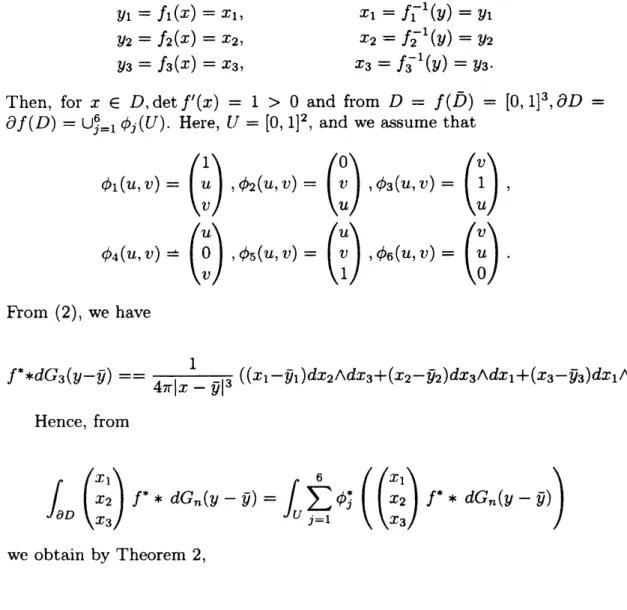
consider the identity mapping$y_{1}=f_{1}(x)=x_{1}$, $x_{1}=f_{1}^{-1}(y)=y_{1}$
$y_{2}=f_{2}(x)=x_{2}$, $x_{2}=f_{2}^{-1}(y)=y_{2}$
$y_{3}=f_{3}(x)=x_{3}$, $x_{3}=f_{3}^{-1}(y)=y_{3}$
.
Then, for $x\in D,$$\det f’(x)=1>0$ and from $D=f(\overline{D})=[0,1]^{3},$$\partial D=$ $\partial f(D)=\bigcup_{j=1}^{6}\phi_{j}(U)$. Here, $U=[0,1]^{2}$, and we
assume
that$\phi_{1}(u, v)=(\begin{array}{l}1uv\end{array}),$ $\phi_{2}(u, v)=(\begin{array}{l}0vu\end{array}),$$\phi_{3}(u, v)=(\begin{array}{l}v1u\end{array})$ ,
$\phi_{4}(u, v)\vec{-}(\begin{array}{l}u0v\end{array}),$ $\phi_{5}(u, v)=(\begin{array}{l}uv1\end{array}),$$\phi_{6}(u, v)=(\begin{array}{l}vu0\end{array})$ .
From (2),
we
have$f^{*}*dG_{3}(y- \overline{y})==\frac{1}{4\pi|x-\overline{y}|^{3}}((x_{1}-\overline{y}_{1})dx_{2}\wedge dx_{3}+(x_{2}-\overline{y}_{2})dx_{3}\wedge dx_{1}+(x_{3}-\overline{y}_{3})dx_{1}\wedge dx_{2})$
.
Hence, from
$/_{\partial D} (\begin{array}{l}x_{1}x_{2}x_{3}\end{array})f^{*}*dG_{n}(y-\overline{y})=\int_{U}\sum_{j=1}^{6}\phi_{j}^{*}((\begin{array}{l}x_{1}x_{2}x_{3}\end{array})f^{*}*dG_{n}(y-\overline{y}))$
$f^{-1}( \overline{y})=\frac{1}{4\pi}/_{0^{1}}/_{0^{1}}(\frac{1-\overline{y}_{1}}{|\phi_{1}-\overline{y}|^{3}}(\begin{array}{l}1uv\end{array})+\frac{\overline{y}_{1}}{|\phi_{2}-\overline{y}|^{3}}(\begin{array}{l}0vu\end{array})+\frac{1-\overline{y}_{2}}{|\phi_{3}-\overline{y}|^{3}}(\begin{array}{l}v1u\end{array})$
$+ \frac{\overline{y}_{2}}{|\phi_{4}-\overline{y}|^{3}}(\begin{array}{l}u0v\end{array})+\frac{1-\overline{y}_{3}}{|\phi_{5}-\overline{y}|^{3}}(\begin{array}{l}uv1\end{array})+\frac{\overline{y}3}{|\phi_{6}-\overline{y}|^{3}}(\begin{array}{l}vu0\end{array})$ $dudv$
$- \frac{1}{4\pi}\int_{0}^{1}\int_{0}^{1}\int_{0}^{1}\frac{1}{|x-\overline{y}|^{3}}(\begin{array}{l}x_{1}-\overline{y}_{1}x_{2}-\overline{y}_{2}x_{3}-\overline{y}_{3}\end{array})dx_{1}dx_{2}dx_{3}$
.
the graphs of $f^{-1}$ on $\{\overline{y}_{0}\in[0.1,0.9|^{3}|\overline{y}_{3}=0.5\}$.
Acknowledgements
S. Saitoh is supported in part by the Grant-in-Aid for Scientffic Research
(C)(2)(No. 19540164) from the Japan Society for the Promotion Science.
References
[1] S. Saitoh, Representations
of
inverse functions, Proc. Amer. Math.Soc., 125 (1997), 3633-3639.
[2] S. Saitoh, Integral Transforms, Reproducing Kemels and Their
Ap-plications, Pitman Res. Notes in Math. Series 369, Addison Wesley
Longman Ltd (1997), UK.
[3] Y. Sawano, M. Yamada and S. Saitoh, Singular integrals and natural
[4] M. Yamada, T. Matsuura and S. Saitoh, Representations
of
inversefunctions
by the integraltransform
with the sign kemel, Fract. Calc,Appl. Anal., 10(2007), 161-168.
[5] M. Yamada and
S.
Saitoh,Identifications of
non-linear systems, J.Comput. Math. Optim., 4(2008), 47-60.
[6] M. Yamada and S. Saitoh, 2-nonlinearsimultaneous equations, Appl,
Anal. (to appear).
Division of Electronics and Computing, Graduate School of Engineering,
Gunma University, Kiryu 376-8515, Japan,
Department ofMathematics, Graduate School of Engineering,
Gunma University, Kiryu 376-8515, Japan,
E-mail: [email protected],
![Figure 1: the graph of $f^{-1}|_{[0.1,0.9]^{2}x\{2\}}$ computed by (16).](https://thumb-ap.123doks.com/thumbv2/123deta/5990262.1060794/13.892.119.737.194.733/figure-graph-f-x-computed.webp)