Family of Julia
sets
as
Orbits of
Differential
Equations
Yi-Chiuan
Chen*\dagger \ddaggerInstitute
of Mathematics,
Academia Sinica
Key words: Julia set, Mandelbrot set, symbolic dynamics, anti-integrable limit
2000 Mathematics Subject Classification: 37F10, 37F45, 37F50
1
Introduction
This note is based on a talk the author gave at the RIMS conference.
Every complex quadratic polynomial map $z\mapsto az^{2}+bz+d(a, b, d\in \mathbb{C}, a\neq 0)$
can
be put into
a
normal form $q_{c}$ : $z\mapsto z^{2}+c$, with $z,$ $c\in \mathbb{C}$.
Another well-known normalform is the logistic map $f_{\mu}$ : $z\mapsto\mu z(1-z)$, with $z,$ $\mu\in \mathbb{C}$, which is conjugate to $q_{c}$ via
the conjugacy
$h:z\mapsto-\mu z+\mu/2$ (1)
with $c=\mu(2-\mu)/4$ and $\mu\neq 0$. Hence, we can freely employ either form $q_{c}$ or $f_{\mu}$ for
investigation of quadratic holomorphic maps.
By $K(q_{c})$ we denote the
filled
Julia set of the map $q_{c}$,$K(q_{c}):=$
{
$z|q_{c}^{n}(z),$ $n\geq 0$, isbounded},
then the Julia set $J(q_{c})$ of $q_{c}$ is the boundary of the filled Julia set,
$J(q_{c}):=\partial K(q_{c})$.
*Postal address: $6F$ of Astronomy-Mathematics Building, No. 1, Sec. 4, RooseveIt Road, Taipei
10617, Taiwan, ROC
\dagger Email: [email protected]
The famous Mandelbrot set for $q_{c}$ is defined to be
$M_{c}:=$
{
$c|q_{c}^{n}(0),$ $n\geq 0$, isbounded}.
Similarly,
we use
$K(f_{\mu}),$ $J(f_{\mu})$, and$M_{\mu}$ $:=$
{
$\mu|f_{\mu}^{n}(1\prime 2),$ $n\geq 0$, isbounded}
to denote the filled Julia set, the Julia set, and the Mandelbrot set of $f_{\mu}$, respectively.
The Julia set for $\mu$ not belonging to the Mandelbrot set is hyperbolic, thus varies
continuously when parameter $\mu$ changes (e.g. [12, 14]). It follows that
a
continuouscurve
in the exterior of the Mandelbrot set inducesa
continuous family of Julia sets. Inthis note,
we are
concerned with the fact that this family is governed byan
infinitelycoupled differential equations (see (3) below) that the author obtained recently in [6].
This approach may bring new insights into the study of dynamical systems.
The continuous family of Julia sets $J(f_{\mu})$ when parameter $\mu$ varies from infinity along
an
external ray ofthe Mandelbrot set $M_{\mu}$ to a Misiurewicz point hencecan
be realizedas
an
orbit of the infinitely coupled differential equations (3) integrated along the externalray. We
use
theOTIS
algorithm [11] to obtain numerical data of the external rays.2
Conjugacy via
the anti-integrability
Let $l_{\infty}$ $:=\{z|z=\{z_{i}\}, i\in \mathbb{N}\}$ endowed with the
$\sup$
norm
be the Banach space ofbounded sequences in $\mathbb{C}$. Rewrite the logistic map
$z_{i}\mapsto z_{i+1}=\epsilon^{-1}z_{i}(1-z_{i}),$ $i\geq 0$,
as
$F:l_{\infty}\cross \mathbb{C}$ $arrow$ $l_{\infty}$,
$(z, \epsilon)$ $\mapsto$ $F(z, \epsilon)=\{F_{0}(z, \epsilon), F_{1}(z, \epsilon), F_{2}(z, \epsilon), \ldots\}$
with $F_{i}(z, \epsilon)=-\epsilon z_{i+1}+z_{i}(1-z_{i})$, then the anti-integrability for the logistic map
can
beformulated by five steps [1, 3, 4, 13] which in the current context are described by the
following five propositions [4, 5]:
Proposition 1. (i) When $\epsilon\neq 0,$ $z$ is a bounded orbit
of
$f_{1/\epsilon}$if
and onlyif
$F(z, \epsilon)=0$.(ii) $F(z^{\uparrow}, 0)=0$
if
and onlyif
$z_{i}^{\dagger}=0$ or 1for
every $i\geq 0$.Proposition 2. Let $\Sigma\subset \mathbb{C}^{N}$ be the
set constituting all such $zs\dagger$, then $\Sigma$ with theproduct
The map $F$ is $C^{1}$, and $D_{z}F(z, \epsilon)$ is invertible if and only if
$-\epsilon\xi_{i+1}+(1-2z_{i})\xi_{i}=\eta_{i}$ (2)
possesses a unique bounded solution for any given $\eta=\{\eta_{i}\}_{i\geq 0}\in l_{\infty}$
.
The solution$\xi_{i}=\sum_{N\geq 0}\epsilon^{N}(\prod_{k=0}^{N}(1-2z_{i+k})^{-1})\eta_{i+N}$
is bounded for every $i\geq 0$ because it
can
be bounded bya
geometric series due to theexpanding property of the Julia set when $\epsilon\not\in M_{\mu}^{-1}$. (The “inside-out” Mandelbrot set
$M_{\mu}^{-1}$ is defined by
$M_{\mu}^{-1}:=\{1’\mu|\mu\in M_{\mu}\}.)$
The homogeneous solution of (2),
$\xi_{i+N}=\xi_{i}\epsilon^{-N}\prod_{k=0}^{N-1}(1-2z_{i+k})$ $\forall i\geq 0,$ $N\geq 1$,
by the
same
expanding property, is unbounded unless $\xi$ is identical to $0$.
Thismeans
thesolution above is the only bounded solution.
Proposition 3. The orbit$z^{*}$ is a solution
of
the followingfunctional differential
equation$Dz(\epsilon)=-D_{z}F(z(\epsilon), \epsilon)^{-1}D_{\epsilon}F(z(\epsilon), \epsilon)$ ,
and hence
satisfies
a systemof
infinitely coupleddifferential
equations$\frac{d}{d\epsilon}z_{n}=\sum_{N\geq 0}\epsilon^{N}(\prod_{k=0}^{N}(1-2z_{n+k})^{-1})z_{n+1+N}$. (3)
The crucial issue is how to solve (3). We shall treat it
as
the initial value problem,with initial values specified at $\epsilon=0$. As $\epsilon$ approaches zero, the set of bounded orbits
$\{z_{n}^{*}(\epsilon)\}_{n\geq 0}$ of the map $f_{1’\epsilon}$ converges to the set $\Sigma$. This indicates that for every $n\geq 0$
there are exactly two possibilities for the initial conditions of (3): $z_{n}^{*}(0)=0$ or $z_{n}^{*}(0)=1$
.
Proposition 4.
$J(f_{1\prime\epsilon})= \bigcup_{\dagger z\in\Sigma}\pi\circ g_{\epsilon}(z^{\dagger})$ ,
in which
$z^{\dagger}\mapsto^{g_{\epsilon}}z^{*}(\epsilon;z^{\dagger})\mapsto^{\pi}z_{0}^{*}(\epsilon;z^{\dagger})$ ,
Remark 5. With the product topology, the mapping $g_{\epsilon}$ : $z\dagger\mapsto z^{*}(\epsilon;z^{\uparrow})$ is continuous
[3, 4, 5].
Proposition 6. Providing $\epsilon\not\in M_{\mu}^{-1}$, the following diagram commutes:
$\pi og_{e}\downarrow J(f_{1\epsilon})\Sigma$
,
$arrow^{arrow f_{1/e}\sigma}$
$J(f_{1\prime\epsilon})\Sigma\downarrow\pi og_{e}$
Remark 7. The advantage of
our
approach is that the conjugacycomes
automaticallyand
can
be realized explicitlyas
$\pi\circ g_{\epsilon}$.
In fact, $g_{\epsilon}$ is realizedas
the solutions of the initialvalue problems for the infinitely coupled differential equations (3).
3
Continuation
from the anti-integrable limit
We can assign each point in the Julia set a symbolic code by virtue of the one-to-one
correspondence between $J(q_{c})$ and $\Sigma$. But, there is
no
unique way to assignthe code.
One example of such
a
coding is the itinemry sequence. Belowwe
recall the canonicalpotential function associated with the filled Julia set in order to
see
howan
itinerarysequence can be assigned and, at the
same
time, to introducesome
notations. (See, forexample, [2, 9, 10, 15, 16].$)$
Let $\beta=1c$
.
The dynamical behavior of $q_{c}$near
infinitycan
be understood by makingthe substitution $\zeta=1\prime z$ and considering the rational function
$Q_{\beta}( \zeta):=\frac{1}{q_{1\prime\beta}(1/\zeta)}$.
The associated B\"ottcher map $\phi_{\beta}$ defined by
$\phi_{\beta}(\zeta):=\lim_{narrow\infty}2\sqrt[n]{Q_{\beta}^{n}(\zeta)}$
carries
an
open subset of the immediate basin of the fixed point $0$ biholomorphically ontoan open disc $D_{r}$ of radius $r,$ $0<r\leq 1$, centred at the origin. If $\beta\not\in M_{c}^{-1}$, where
$M_{c}^{-1}:=\{1/c|c\in M_{c}\}$,
then $r= \lim_{\zetaarrow\infty}|\phi_{\beta}(\zeta)|<1$ and $\phi_{\beta}^{-1}(\mathbb{D}_{r})=\{\zeta||\phi_{\beta}(\zeta)|<r\}$. The map $\hat{\phi}_{c}$ defined
by the
reciprocal
maps biholomorphically from the open set $\{z|G_{c}(z)>G_{c}(0)\}\subseteq \mathbb{C}\backslash K(q_{c})$ to the region
$\mathbb{C}\backslash \overline{\mathbb{D}}_{\hat{r}}=\{w|\ln|w|>G_{c}(0)\}$, where $\hat{r}=|\hat{\phi}_{c}(0)|>1$ and $G_{c}:\mathbb{C}arrow[0, \infty)$, defined by
$G_{c}(z)$ $:= \ln^{+}|\hat{\phi}_{c}(z)|=\lim_{narrow\infty}\frac{1}{2^{n}}\ln^{+}|q_{c}^{n}(z)|$ , $( \ln^{+}|w|=\max\{\ln|w|, 0\})$
is the canonical potential
function
associated with the filled Julia set $K(q_{c})$. The map $\hat{\phi}_{c}$is
a
conjugacy between $q_{c}$on
$\{z|G_{c}(z)>G_{c}(0)\}$ and $w\mapsto w^{2}$on
$\{w|\ln|w|>G_{c}(0)\}$.For $\theta\in \mathbb{R}/\mathbb{Z}$, define the extemal ray $\mathcal{R}(\theta;K(q_{c}))$ of angle $\theta$ of the filled Juliaset $K(q_{c})$
by
$\mathcal{R}(\theta;K(q_{c})):=\{\hat{\phi}_{c}^{-1}(re^{i2\pi\theta})||\hat{\phi}_{c}(0)|<r\leq\infty\}$
.
(4)The critical value $c\in \mathbb{C}\backslash K(q_{c})$ has a well defined external angle when $c\not\in M_{c}$. Let it
be denoted by $l(c)\in \mathbb{R}/\mathbb{Z}$, given by $c=\hat{\phi}_{c}^{-1}(|\hat{\phi}_{c}(c)|e^{i2\pi l(c)})$. The ray $\mathcal{R}(l(c);K(q_{c}))$ has
two preimages, $\mathcal{R}(l(c)/2;K(q_{c}))$ and $\mathcal{R}((l(c)+1)2;K(q_{c}))$. These two together with the
origin separate $\overline{\mathbb{C}}$
into two disjoint open sets, say $V_{0}$ and $V_{1}$. These constitute a Markov
partition. That is to say, for any infinite sequence $(b_{0}, b_{1}, \ldots)\in\Sigma$, there exists
one
andonly
one
point $z\in K(q_{C})$ with $q_{c}^{i}(z)\in V_{b_{1}}$ for every $i\geq 0$.
However, there is ambiguity indeterminingwhich open set should be labeled by $V_{0}$ and which by $V_{1}$. In Definition 8, we
shall define the itinerary sequences used in this note for points in the Julia set $J(f_{\mu})$
.
Ourdefinition arises very naturally from the viewpoint of the system’s anti-integrable limit.
By using (1), define
$\mathcal{R}(\theta;K(f_{\mu})):=h^{-1}(\mathcal{R}(\theta;K(q_{c})))$
.
The two external rays $\mathcal{R}(l(c)/2;K(f_{1’\epsilon}))$ and $\mathcal{R}((l(c)+1)/2;K(f_{1\epsilon}))$, which land at the
point $z=1/2$, divide the complex plane into two partitions, one containing the fixed
point $0$, the other containing the other fixed point $1-\epsilon$.
Definition 8. Assume $z_{n+1}=f_{1/\epsilon}(z_{n})$ for all $n\geq 0$. Suppose $\{z_{n}\}_{n\geq 0}$ is bounded and is
bounded away from the two dynamic rays that land at 1/2. Define its itinerary sequence
$\{\alpha_{n}\}_{n\geq 0}$
as
follows: $\alpha_{n}=0$ if $z_{n}$ is located in the same open set as the fixed point $0$ is;$\alpha_{n}=1$ if $z_{n}$ is located in the same open set
as
the fixed point $1-\epsilon$ is.Theorem 9. Suppose $0\neq\hat{\epsilon}\not\in M_{A}^{-1}$ and suppose $\{z_{n}\}_{n\geq 0}$, with $z_{n}=f_{1’\hat{\epsilon}}^{n}(z_{0})\forall n\geq 0$, is
a bounded orbit
of
the logistic map $f_{1’\hat{\epsilon}}$ with itinerary sequence $\{\alpha_{n}\}_{n\geq 0}$. Assume $z_{n}^{*}(\epsilon)$is the solution
of
(3) integrated along an integral curve in $\overline{\mathbb{C}}\backslash M_{\mu}^{-1}$ connecting $\epsilon=0$ to$\epsilon=\hat{\epsilon}$ subject to initial condition $z_{n}^{*}(0)=\alpha_{n}$
for
every $n\geq 0$. Then the valueof
$z_{n}^{*}(\hat{\epsilon})$ isIf $\{z_{n}\},$ $n\geq 0$, is a $period-(p+1)$ orbit of $f_{1’\epsilon}$ with itinerary $\{\overline{\alpha_{0}\alpha_{1}\ldots\alpha_{p}}\}$, then $z_{n}^{*}(\epsilon)$
can be obtained by integrating a $(p+1)$-coupled ODEs of the form
$\frac{d}{d\epsilon}z_{n}=(1-\epsilon^{p+1}\prod_{k=0}^{p}(1-2z_{n+k})^{-1})^{-1}\sum_{N=0}^{p}\epsilon^{N}(\prod_{k=0}^{N}(1-2z_{n+k})^{-1})z_{n+1+N}$ (5)
with the periodicity $z_{n+1+p}=z_{n}$ and initial condition $z_{n}^{*}(0)=\alpha_{n}$ for every $0\leq n\leq p$ (see
[6]$)$
.
This provides a way for finding all roots of a class of polynomials. Supposewe are
interested in finding all periodic orbits of the map $z\mapsto\epsilon^{-1}z(1-z)$. What
we
usually dois to solve
a
polynomial of $2^{p+1}$-degree for$z_{0}$ arising from the following algebraic relation: $z_{1}=\epsilon^{-1}z_{0}(1-z_{0}),$ $z_{2}=\epsilon^{-1}z_{1}(1-z_{1}),$
$\ldots,$ $z_{p}=\epsilon^{-1}z_{p-1}(1-z_{p-1}),$ $z_{0}=\epsilon^{-1}z_{p}(1-z_{p})$
.
If $0\neq\epsilon\not\in M_{\mu}^{-1}$, we know that the polynomial for $z_{0}$ has $2^{p+1}$ distinct roots, correspondingto $2^{p+1}$ distinct initial points for all of $period- 2^{p+1}$ orbits (not all
are
of least period).Even ifwe find all roots ofthe polynomial, another question that concems distinguishing
the combinatorics of these roots is the itinerary of their corresponding orbits.
Corollary 10. Let $0\neq\hat{\epsilon}\not\in M_{\mu}^{-1}$. Assume $\tilde{z}_{0}$ is
one
rootof
theaforementioned
$2^{p+1}$-degreepolynomial
for
$z_{0}$ with $\epsilon=\hat{\epsilon}$ and the itinemryof
its orbit is $\alpha=\{\alpha_{n}\}_{n\geq 0}$. Then $\tilde{z}_{0}$can
beobtained by integrating the $(p+1)$-coupled ODEs, namely $\tilde{z}_{0}=z_{0}^{*}(\hat{\epsilon};\alpha)$.
Because for every $n\geq 0$ the solution $z_{n}^{*}(\epsilon)$ of (3) depends continuously on $\epsilon$ and has
to be bounded away from the two dynamic rays, the itinerary sequence of $\{z_{n}^{*}(\epsilon)\}_{n\geq 0}$ is
equal to $\{z_{n}^{*}(0)\}_{n\geq 0}$.
Once initial conditions $z_{n}^{*}(\epsilon=0)$ for all $n\geq 0$ are given, the value of the solution $z_{n}^{*}(\epsilon)$
of (3) at $\epsilon=\hat{\epsilon}\in\overline{\mathbb{C}}\backslash M_{\mu}^{-1}$ depends only
on
$\hat{C^{\sim}}$. Because $\hat{c-}$ may locate arbitrarilyclose to
$\partial M_{\mu}^{-1}$, we have to specify an integral curve that can approach as close as possible to the
boundary $\partial M_{\mu}^{-1}$. This can be done if the integral
curve
we employ is an external ray.Define
$\hat{\Phi}_{n}(c):=2\sqrt[n]{q_{c}^{n}(c)}$ (6)
in $\overline{\mathbb{C}}\backslash M_{c}$ by the branch $(\hat{\mathfrak{D}}_{n}(c)=c+O(1)$ as $carrow\infty$. The sequence $(\hat{I})n$ converges
as
$narrow\infty$ uniformly on compact subsets of $\overline{\mathbb{C}}\backslash M_{c}$ to the function $\hat{\Phi}$with $\hat{\Phi}(c)\equiv\hat{\phi}_{c}(c)$,
which is biholomorphic from $\overline{\mathbb{C}}\backslash M_{c}$ to $\overline{\mathbb{C}}\backslash \overline{\mathbb{D}}_{1}$, and the inverse $\hat{\Phi}_{n}^{-1}$ converges to $\hat{\Phi}^{-1}$
uniformly
on
compact subsets of $\overline{\mathbb{C}}\backslash$IDl.
For $\theta\in \mathbb{R}\mathbb{Z}$, the setis called the extemal my of angle $\theta$ of the Mandelbrot sets
$M_{c}$. In contrast to $\hat{\Phi}^{-1}$, the
map $\Phi^{-1}$ defined by
$\Phi^{-}.(w):=\frac{1}{(\hat{B}^{-1}(1/w)}$ (7)
is
a
biholomorphism of $\mathbb{D}_{1}$ onto $\overline{\mathbb{C}}\backslash M_{c}^{-1}$.Suppose $\beta\not\in M_{c}^{-1}$ and $\Phi(\beta)=w\in \mathbb{D}_{1}$. The relation between $\beta$ and $\epsilon$ is
$\beta=\frac{4\epsilon^{2}}{2\epsilon-1}$,
in particular, $\beta=-4\epsilon^{2}+O(\epsilon^{3})$ when $\epsilon$ is small. By the Riemann Mapping Theorem,
there exists
a
unique biholomorphic map$\Psi:\overline{\mathbb{C}}\backslash M_{\mu}^{-1}arrow \mathbb{D}_{1}$
satisfying $\Psi(0)=0$ and $\Psi(\epsilon)=-2i\epsilon+O(\epsilon^{2})$ when $\epsilon$ is small. Consequently, the following
diagram commutes
$\epsilon\in\overline{\mathbb{C}}\backslash M_{\mu}^{-1}arrow^{\Psi}\mathbb{D}_{1}$ $\overline{\mathbb{C}}\backslash M_{\mu}\ni\mu$
$|$
$\sim^{r}$
$|$ $\Psi(\epsilon)\mapsto(\Psi(\epsilon))^{2}$$\beta\in\overline{\mathbb{C}}\backslash M_{c}^{-1}arrow^{\Phi}\mathbb{D}$
$1arrow^{\Phi^{-1}\hat(1’\cdot\cdot)}\overline{\mathbb{C}}\backslash M_{c}\ni c\downarrow$
. In the diagram the map $\wedge f:\overline{\mathbb{C}}\backslash M_{J^{J}}^{-1}arrow \mathbb{D}_{1},$ $\epsilon\mapsto w$, is defined by
$T(\epsilon)=(\Psi(\epsilon))^{2}=w$.
Using $w=re^{i2\pi\theta},$ $0\leq r<1,0\leq\theta<1$, we specify the two branches $\prime r_{\pm}^{-1}$ of the inverse
of $\prime r$
as
the following:$er_{\pm}^{-1}(re^{i2\pi\theta}):=\Psi^{-1}(\pm\sqrt{r}e^{i\pi\theta})$. (8)
Our integral
curves
for (3)are
external rays of $M_{\mu}^{-1}$. For $\theta\in \mathbb{R}/\mathbb{Z}$, define the twoextemal $mys\mathcal{R}^{+}(\theta;M_{\mu}^{-1})$ and $\mathcal{R}^{-}(\theta;M_{\mu}^{-1})$ of angle $\theta$ of
$M_{\mu}^{-1}$ by
$\mathcal{R}^{+}(\theta;M_{l^{A}}^{-1})$ $:=$ $\{’\Gamma_{+}^{-1}(re^{-i2\pi\theta})|0\leq r<1\}$, $\mathcal{R}^{-}(\theta;M_{l^{A}}^{-1})$ $:=$ $\{’r_{-}^{-1}(re^{-i2\pi\theta})|0\leq r<1\}$.
4
Two examples
We use finitely many points that constitute an invariant subset to approximate the Julia
set. Consequently the infinitely coupled differential equations (3) become a finitely
cou-pled ODEs. In this section, examples of a periodic orbit and an eventually periodic orbit
4.1
External angle 1/6
We choose the initial conditions $\{z_{0}^{*}(0), z_{1}^{*}(0), \ldots, z_{m}^{*}(0), 1,\overline{10}\}$ with $z_{n}^{*}(0)\in\{0,1\}$ for all
$0\leq n\leq m$ to deal with (3). The initial condition in this
case
indicates that, after $m+2$times iterations, orbits will become periodic with period 2. That is, $z_{n}=z_{n+2}$ for all
$n\geq m+2$
.
It turns out that the orbit points $z_{n}$’s for $n\geq m+2$ satisfy two coupledequations which read
$\frac{d}{d\epsilon}z_{n}=(1-\epsilon^{2}\prod_{k=0}^{1}(1-2z_{n+k})^{-1})^{-1}\sum_{N=0}^{1}\epsilon^{N}(\prod_{k=0}^{N}(1-2z_{n+k})^{-1})z_{n+1+N}$
.
When $0\leq n\leq m+1$, orbit points $z_{n}$’s
are
govemed by the following differential equations(see [6]):
$\frac{d}{d\epsilon}z_{n}$
$=$ $\sum_{N=0}^{m+1-n}\epsilon^{N}(\prod_{k=0}^{N}(1-2z_{n+k})^{-1})z_{n+1+N}$
$+$ $(1- \epsilon^{2}\prod_{k=0}^{1}(1-2z_{m+2+k})^{-1})^{-1}\sum_{N=0}^{1}\epsilon^{m+2-n+N}(\prod_{k=0}^{m+2-n+N}(1-2z_{n+k})^{-1})z_{m+3+N}$
.
Hence, with the initial condition taken in this subsection, (3) reduces to a system of
$(m+4)$-coupled ODEs.
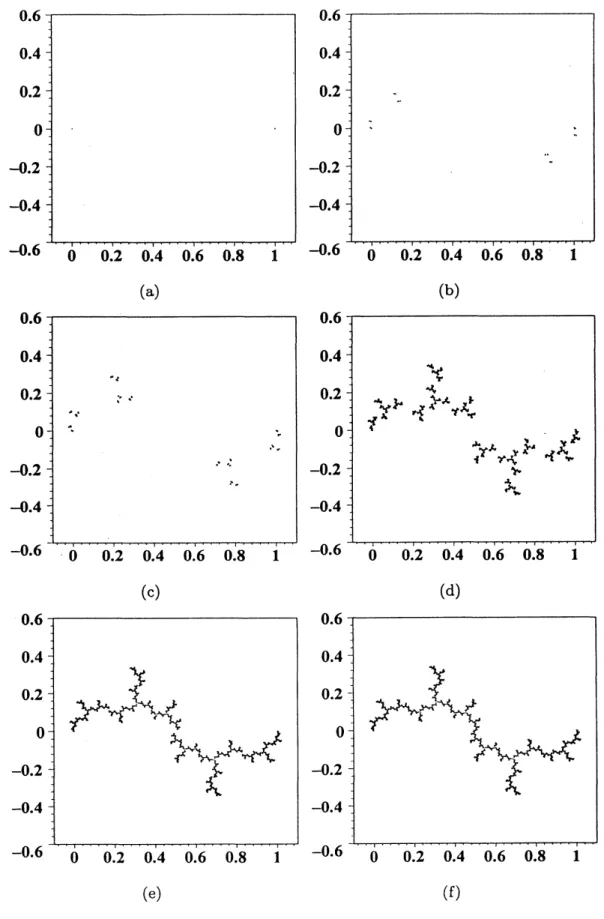
We set $m=12$. Figures 1 $(a)\sim(g)$ show approximations of the Julia set $J(f_{1/\epsilon})$ by
plotting the union of solutions $\bigcup_{n=0}^{15}z_{n}^{*}(\epsilon)$ for six different values of $\epsilon$ integrated along
the ray $\mathcal{R}^{+}(16;M_{\mu}^{-1})$. The six values of $\epsilon$ are (a) $0,$ $(b)0.129889641+0.141065491i,$ $(c)$
$0.233392345+0.176828347i,$ $(d)0.312689831+0.154912018i,$ $(e)0.312597233+0.150118104i$ , (f) $\frac{-i+i\sqrt{1-4i}}{4}$.
4.2
External angle
1/128Here, we demonstrate how (3) can be employed to obtain periodic orbits for one of the
Misiurewicz points of angle 1/128, $\epsilon\approx 0.567999678+0.348835133i$. We choose our initial
condition for (5) to be $\{z_{0}^{*}(0), z_{1}^{*}(0), \ldots, z_{97}^{*}(0)\}=$
{
$0,1,0,0,0,1,1,0,1,1,0,0,0,0,0,1,0,1,0,0,1,1,1,0,0,1,0,1,1,1$
,$0,1,1,1,0,0,0,0,0,0,0,1,0,0,1,0,0,0,1,1,0,1,0,0,0,1,0,1,0,1$
, 1,$0,0,1,1,1,1,0,0,0,1,0,0,1,1,0,1,0,1,0,1,1,1,1,0,0,1,1,0,1$
, 1, 1, 1,$0,1,1,1,1\}$,and perform the numerical integration along the parameter ray $\mathcal{R}^{+}(1\prime 128;M_{\mu}^{-1})$.
Table 1 displays the orbit points together with the numerical
errors
for the obtainedperiod-98 orbit. It is clear that the errors are within the order of $10^{-5}$.
References
[1] S. AUBRY AND G. ABRAMOVICI, Chaotic trajectories in the standard map: the
concept
of
anti-integrability, Physica $D,$ $43$ (1990), pp. 199-219.[2] L.
CARLESON
AND T. W. GAMELIN, Complex Dynamics, Springer-Verlag, NewYork, 1993.
[3] Y.-C. CHEN, Bemoulli
shift for
second orderrecurrence
relationsnear
theanti-integmble limit, Discrete Contin. Dyn. Syst. $B,$ $5$ (2005), pp.
587-598.
[4] Y.-C. CHEN, Smale horseshoe via the anti-integrability, Chaos Solitons&Fractals,
28, (2006), pp. 377-385.
[5] Y.-C. CHEN, Anti-integmbility
for
the logistic maps, Chinese Ann. Math. $B,$ $28$(2007), pp. 219-224.
[6] Y.-C. CHEN, Family
of
invariant Cantor sets as orbitsof differential
equations, Int.J. Bifurcat. Chaos,
18
(2008), pp.1825-1843.
[7] Y.-C. CHEN, T. KAWAHIRA, H.-L. LI, AND J.-M. YUAN, (2009) $2D$ and $3D$
animations available online at http:$//www$.math.sinica.edu.tw$/ycchen/Animations/$.
[8] Y.-C. CHEN, T. KAWAHIRA, H.-L. LI, AND J.-M. YUAN, Family
of
invariantCantor sets as orbits
of differential
equaitons. $\Pi$; Julia sets, (2010), Preprint.[9] A. DOUADY AND J. H. HUBBARD, Iteration des polynomes quadmtiques complexes,
C. R. Acad. Sci. Paris Ser. I Math., 294 (1982), pp. 123-126.
[10] A. DOUADY AND J. H. HUBBARD, Etude dynamique des polynomes complexes.
Partie $I$, Publications Mathematiques d’Orsay, 84-2, 1984.
[11] T. KAWAHIRA, OTIS, (2008), Java applet, available online at
[12] M. LYUBICH, Some typical properties
of
the dynamicsof
mtional mappings, RussianMath. Surveys, 38 (1983), pp. 154-155.
[13] R. S. MACKAY AND J. D. MEISS, Cantori
for
symplectic mapsnear
theanti-integmble limit, Nonlinearity, 5 (1992), pp. 149-160.
[14] R. $MA\tilde{N}E’$, P. SAD, AND D. SULLIVAN, On the dynamics
of
mtional maps, Ann.Sci. Ecole Norm. Sup., (4) 16 (1983), pp. 193-217.
[15] J. MILNOR, Dynamics in One Complex Variable, 3rd ed., Annals of Mathematics
Studies, 160, Princeton University Press, Princeton, NJ,
2006.
[16] S. MOROSAWA, Y. NISHIMURA, M. TANIGUCHI AND T. UEDA, Holomorphic
(a) (b)
(c) (d)
(e) (f)
Figure 1: The Julia set $J(f_{1/\epsilon})$ for six different values of $\epsilon$ along $\mathcal{R}^{+}(1/6;M_{\mu}^{-1})$. See also