GRUSIN OPERATOR AND HEAT KERNEL
ON NILPOTENT LIE GROUPS
東京理科大学理工学部古谷賢朗 (KENRO FURUTANI)
DEAPRTMENT OF MATHEMATICS FACULTY OF SCIENCE AND TECHNOLOGY
SCIENCE UNIVERSITY OF TOKYO
兵庫県立大学大学院物質理学研究科岩崎千里 (CHISATO IWASAKI)
DEPARTEMNT OF MATHEMATICS
SCHOOL OF SCIENCE HYOGO UNIVERSITY
ABSTRACT. Thepurposeof this noteis to overviewhowwe canconstructtheheat kernel
for (sub)-Laplacian inariexplicit (integral) form with specialfunctions. Ofcoursesuch
cases will be highlylimited. Nevertheless therewill be lots ofoperators interesting on
nilpotentLie groups. Wewillconcentratefor theoperatorsonnilpotentLie groupsand
their quotient spaces. Here weonly treat with typical low-dimensionalcases. So first
we discussthe heat kernel forGrusin operator in relation with the Mehler formulaand Hamilton-Jacobi thoory and explain a general integral form of heat kernelonnilpotent
Liegroupsfrom this point of view. And thenwestatearelation between the heat kernel
on Heisenberggroupand that forGrusinoperator. Alsoweconstruct anclassical action integral forahigher stepGrusinoperator.
CONTENTS
1. Introduction 1
2. Grusin operator 3
3. Heat kernel
on
nilpotentgroups
5
4. Heisenberg group and Grusinoperator 6
5. Higher step Grusin operator 7
References 11
1. INTRODUCTION
It is known in the statistical mechanics that the heat kernel $K_{t}(x,y)$ is expressed
as
apath integral
$K(t,$x,$y)= \int_{P_{t}(x,y)}e^{-s_{t(\gamma)}}d\mu(\gamma)$,
2000 Mathematics Subject Classification. 35K05,22E25.
hopefully with a suitable
ltinfinite
dimensionalmeasure”$d\mu(\gamma)$, where$P_{t}(x, y)$ denote thepath space connecting $x$ to $y$ at a time $t$ and the function $S_{t}(\gamma)$ is called the classical
action and is given by
$S_{t}( \gamma)=1/2\int_{0}^{t}||\dot{\gamma}(s)||^{2}ds$.
By normalizing the time parameter $t=1$, this is also written as
$\frac{1}{t^{N}}\int_{P_{1}(x,y)}e^{-\frac{S(\gamma)}{2t}}d\mu(\gamma),$ $(\gamma_{t}(\sigma)=\gamma(\sigma t))$
and in theLaplacian
case
it hasan
asymptotic expansion$K(t, x, y) \sim\frac{1}{(2\pi t)^{n/2}}e^{-\mathrm{A}^{x_{\#^{\mathrm{L}^{2}}}}}u_{0}(x, y)(1++O(t))$
.
Here $d(x, y)$ denotesthe Riemanian distance of the point $x$and $y$
.
Forthe sub-Laplaciancases the small time asymptotic expansion is morecomplicated (cf. [2]). There
are
inter-estingargumentswhich will give
us
areductionof thephysicsformula toamathematicallyfixed formula in a certain
case
(cf. [13]). Especially, if the spacewe are
working on isEuclidean, then wehave only
one
segment (geodesics) which connects $x$ and $y$, and thepath integral will reduce tojust a
function
$\frac{1}{(2\pi t)^{n/2}}e^{-\rfloor 1_{A}^{x}\rfloor \mathrm{L}^{2}}\sim$,
the heat kernel of the Laplacian $\Delta=-\frac{1}{2}\sum_{i=1}^{n}\frac{\partial^{2}}{\partial x_{i}^{2}}$
.
It
was
the first in the paper [12] that by a probabilistic argument the heat kernel ofthe sub-Laplacian
on
threedimensional Heisenberggroupwas
given inanexplicit integralformula, and then many papers were published to express the heat kernel for Laplacians
and sub-LaplaciansonnilpotentLiegroups(see [1], [2], [3], [15] and also recent papers [13],
[5]
or
[6] for dealing with similar subject and calculations). Incase
of the sub-Laplacianwe
will necessarily havean
integral expression for the heat kernel,even
if it reduces toa
fixed finitedimensional integral expressionsince there
are many
geodesics connecting twopoints even locally. The first step ofthis is how
we can
suppose that the formula looks like?So in
\S 2
we explain the case of Grusin operator $\mathcal{G}=-\frac{1}{2}(\frac{\partial^{2}}{\partial x^{2}}+x^{2}\frac{\partial^{2}}{\partial y^{2}})$ following astandard way ofthespectral decomposition ofselfadjoint operators and arrive at a form
as a
natural conclusion. Then we discuss the functions in the formula fromHamilton-Jacobi theory. In
\S 3
we state apossible formula for the heat kernel on general nilpotentLie groups and explain an action integral and transport equation which will be satisfied
by the functions appearing inthe formula. In
\S 4 we
givea
relation between heat kernelson
Heisenberg group and Grusin operator in terms of fiber integration. Finally in\S 5
we
solvea
Hamilton system fora
higher step Grusin operator and constructan
action2. GRUSIN OPERATOR
Let $\mathcal{G}=-\frac{1}{2}(\frac{\partial^{2}}{\partial x^{2}}+x^{2}\frac{\partial^{2}}{\partial y^{2}})$ be Grusin operator and denote by $F:L_{2}(\mathbb{R}^{2}, dxdy)arrow L_{2}(\mathbb{R}^{2}, dxd\eta)$
$\mathcal{F}(\varphi)(x, \eta)=\int_{\mathrm{R}^{2}}e^{-\sqrt{-1}y\eta}\varphi(x,y)dy$
apartial Fouriertransformation.
Through thispartial Fourier transformation, Grusin operator $\mathcal{G}$ is
seen as
$\mathcal{L}=-\frac{1}{2}(\frac{\partial^{2}}{\partial x^{2}}-x^{2}\eta^{2})$ ,
acting
on
$L_{2}(\mathbb{R}^{2}, dxd\eta)$. Whenwe
regard the variable$\eta$
as
a constant, the heat kernel $\mathcal{L}_{\eta}(t, x,x)\wedge$ of the operator$L_{\eta}=- \frac{1}{2}(\frac{\partial^{2}}{\partial x^{2}}-x^{2}\eta^{2})$
for $\eta\neq 0$is expressed asthe
sum
of eigenfunctions $V_{n}(x)$ $(L_{\eta}V_{n})(x)= \frac{(2n+1)|\eta|}{2}V_{n}(x)$,where
$V_{n}(x)=e^{-1/2|\eta|x^{2}}H_{n}(\sqrt{|\eta|}x)$
and
$H_{n}(x)=(-1)^{n}e^{x^{2}} \frac{d^{n}e^{-x^{2}}}{dx^{n}}$
isthe n-th Hermite polynomial:
$\mathcal{K}_{\eta}(t, x, x)\wedge=\sum_{n=1}^{\infty}e^{-\frac{2n\neq 1}{2}|\eta|t_{\frac{\sqrt{|\eta|}V_{n}(x)V_{n}(_{X}^{\wedge})}{\sqrt{\pi}2^{n}n!}}}$
(2.1) $= \sqrt{|\eta|}^{-\frac{1}{2}|\eta|\ell(x^{2}+x^{2})}ee^{-\mathrm{M}_{2}\wedge}\sum\frac{H_{n}(\sqrt{|\eta|}x)H_{n}(\sqrt{|\eta|}x)\wedge}{\sqrt{\pi}2^{n}n!}e^{-nt|\eta|}$
.
Then by the Mehler formula (cf. [17])
we
know that (2.1) equals to(2.2) $\frac{1}{\sqrt{\pi}}\sqrt{\frac{\eta}{e^{t\eta}-e^{-t\eta}}}e^{-_{4}}\mathrm{n}\{(x+x)^{2}\wedge\tanh_{2}^{x^{t}-}+(x-x)^{2}\coth_{2}^{1^{t}}\cdot\}$
.
Note that $|\eta|\tanh|\eta|=\eta\tanh\eta$ (and so on).
Also we have
$\lim_{\etaarrow 0}\mathcal{K}_{\eta}(t, x, x)\wedge$
$= \lim_{\etaarrow 0}\frac{1}{\sqrt{2\pi}}\sqrt{\frac{\eta}{\sinh t\eta}}e^{-f}4\{(x+x)^{2}\wedge\tanh\doteqdot t+(x-x)^{2}\wedge\coth_{2}^{\mathrm{L}^{\ell}\}_{=\frac{1}{\sqrt{2\pi t}}e^{-\frac{|*-\epsilon_{\mathrm{I}^{2}}}{2t}}}}$
is theheat kernel for the $\mathrm{o}\mathrm{p}\mathrm{e}\mathrm{r}\mathrm{a}\mathrm{t}\mathrm{o}\mathrm{r}-\frac{1}{2}\frac{d^{2}}{dx^{2}}$
.
Now we have the heat kernel $K^{Q}=K\sigma(t, x, y,x, y)\wedge\wedge$ ofthe Grusin operator $\mathcal{G}=F^{-1}\circ$
$\mathcal{L}\circ F$;
$(e^{-t\mathcal{G}}f)(x, y)= \int K^{g}(t, x, y,xy)\wedge,$$\wedge f(xy)\wedge,$$\wedge d_{X}^{\wedge}dy;\wedge$
$K\sigma(t, x, y,xy)\wedge,\wedge$
(2.3) $= \frac{1}{(2\pi)^{3/2}}I^{e^{\sqrt{-1}\eta}e^{-f}}(v-y)\wedge\{4(x+^{\wedge}x)^{2}\tanh_{2}^{\Delta}t+(x-x)^{2}\wedge\coth_{2}^{\Delta}\}t\sqrt{\frac{\eta}{\sinh t\eta}}d\eta$
.
In the above expression, ifwe still change the variable $t\eta$to $\eta$ (
$=\mathrm{t}\mathrm{i}\mathrm{m}\mathrm{e}$ rescaling), then
it becomes the following form:
$K(t, x,y,xy)\wedge,\wedge$
(2.4) $= \frac{1}{(2\pi t)^{3/2}}\int e^{\frac{\sqrt{-1}(y-y)\wedge\eta}{t}}e^{-L\{(x)^{2}\tanh_{2}^{f}+(x-x\rangle^{2}\coth_{2}^{f}\}}4tx+^{\wedge}\wedge\sqrt{\frac{\eta}{\sinh\eta}}d\eta$.
Put
$S(x, x, \eta)\wedge=\frac{\eta}{4}\{(x+x)^{2}\wedge\tanh\frac{\eta}{2}+(x-x)^{2}\wedge\coth\frac{\eta}{2}\}$
and $V(\eta)=\sqrt{\frac{\eta}{\sinh\eta}}$, and then
we
write this integral form (2.4)as
(2.5) $\frac{1}{(2\pi t)^{3/2}}\int e\iota\sqrt{-1}^{1L^{-}\text{\^{u}}\ln}e^{-\frac{s(x,x_{j}\eta)\wedge}{t}}V(\eta)d\eta$
.
Now
we
construct the function $S=S(x,x;\eta)\wedge$ by solving aHamilton system with theHamiltonian $2H^{\eta}=2H^{\eta}(x, \xi)=\xi^{2}-x^{2}\eta^{2}$:
(2.6) $\{$
$\xi(s)=\frac{\frac{\partial}{-}\partial H^{\eta}j_{H^{\eta}}}{\partial x}=x\eta^{2}x:(s)==\xi,$
,
boundary condition:$x(\mathrm{O})=x,$ $x(t)=x\wedge$.
In fact this system is solved explicitly with the solutionthat
$x(s)=x(s;t, x, x, \eta)\wedge=\frac{\wedge x\sinh s\eta+x\sinh\eta(t-s)}{\sinh t\eta}$
$\xi(s)=\xi(s;t, x,x\eta)\wedge,=\dot{x}(s)=\eta\frac{x\cosh\wedge s\eta-x\cosh(t-s)\eta}{\sinh t\eta}$,
for any $t,$$x,$$x\wedge\in \mathbb{R}$
.
With this solution, let $\varphi=\varphi(x,x,t;\eta)\wedge$ be the integral (2.7) $\varphi(x,xt;\eta)\wedge,=\int_{0}^{t}\dot{x}(s)\xi(s)-H^{\eta}(x(s),\xi(s))ds$.Thisintegral is called
a
classical action and is equal to$\varphi(x,xt;\eta)\wedge,=\eta^{2}\int_{0}^{\ell}x^{2}(s)ds+\frac{t}{2}E$
where the constant
$E\equiv\xi^{2}(s)-x^{2}(s)\eta^{2}=\xi^{2}(0)-x^{2}\eta^{2}$
$= \frac{\eta^{2}\{4(x^{2}+x^{2})\wedge 4xx(\wedge e^{t\eta}+e^{-t\eta})\}}{(e^{t\eta}e^{-t\eta})^{2}}=$
is an invariant of the Hamilton system (2.6).
Here
we
know that the function $\varphi(x, x, 1\wedge;\eta)$ coincides with the function $S$ and it isa
solution of the Hamilton-Jacobiequation:
(2.9) $\frac{\partial}{\partial t}\varphi(x, x, t;\eta)\wedge+H^{\eta}(x\frac{\partial}{\partial_{X}^{\wedge}}\wedge,\varphi(x, x, t;\eta)\wedge)=0$
.
The function $\varphi$ has aproperty that $\varphi(x,x, 1\wedge;t\eta)=t\varphi(x,xt;\eta)\wedge,$, and this implies that
thefunction $S$satisfies the equation, called generalized Hamilton-Jacobi equation:
(2.10) $H^{\eta}(x, \frac{\partial}{\partial_{X}^{\wedge}}\wedge S(x,x\eta)\wedge,)+\eta\frac{\partial}{\partial\eta}S(x, x, \eta)\wedge=S(x,x, \eta)\wedge$
.
For each fixed $t,$ $x$ and $\eta$ let
$\mathcal{V}$ $:\wedge x->\xi(0;t, x, x, \eta)\wedge$, then by the explicit expression of
thesolution of the Hamilton system
we
have(2.11) $\mathcal{V}(x)\wedge=\frac{\eta}{\sinh t\eta}(x-\wedge x\cosh t\eta)$,
and
(2.12) $\sqrt{\frac{\partial \mathcal{V}}{\partial_{X}^{\wedge}}(x)\wedge}=\sqrt{\frac{\eta}{\sinh t\eta}}$
.
This function $\sqrt{\frac{\partial \mathcal{V}}{\partial_{X}^{\wedge}}}$
, as a function of the parameter $\eta$ (with $t=1$), is a solution of the
transport equation (3.6)(see
\S 3).
Summing up,
we
know that the functions in the integral form (2.3) coincide with thefunctions (2.8) and (2.12)
we
constructed by solving the Hamilton system (2.6). In factby putting $t=1$ (time rescaling) wehave the functions$S=S(x,x, \eta)\wedge=\varphi(x_{0}, x, 1;\eta)$and
$\sqrt{\frac{\partial \mathcal{V}}{\partial_{X}^{\wedge}}(x)\wedge}=V(\eta)(\mathrm{c}\mathrm{f}. [18], [10])$
.
3. HBAT KERNEL ON NILPOTENT GROUPS
Onthe Liegroup$G$theheat kernelfor the(left)invariant (sub)-Laplacian$\Delta=-\frac{1}{2}\sum\tilde{X}_{i}^{2}$
takes theform $k(t, g^{-1}\cdot h)$ with
a
smoothfunction $k(t, g)\in C^{\infty}(\mathbb{R}_{+}\cross G)$satisfying(3.1) $( \frac{\partial}{\partial t}+\Delta)k(t,g)=0$
(3.2) $\lim_{t\downarrow 0}k(t, g)=\delta_{\mathrm{e}},$
$\delta_{e}$ isthe
6
function at the identity element $e\in G$.
So, ifthe heat kernelwould be given by a function$k(t,g)$ ofan integral form
(3.3) $\frac{1}{t^{N}}\int e^{-\underline{X}\mathrm{t}1}V(g, \eta)\mathit{4}_{\ell}\Delta d\eta$
witha function$f=f(g, \eta)\in C^{\infty}(G\mathrm{x}\mathbb{R}^{t})$ which wetake
a
functiondefinedbythe integralsimilar to (2.7) with
a
modification of the term $\sqrt{-1}(y-y)\wedge\eta$ (we call $f$a
complex actionfunction), then the function $V=V(g,\eta)$ (we call it a volume element) will satisfy
an
equation (called transport equation).
Now
we
shall statetheseequations. Let $H$be theHamiltonianof the (sub)-Laplacian$\Delta$and the function $f$ satisfies the equation, called generalized Hamilton-Jacobi
equa-tion:
(3.4) $H(x, \nabla f)+\sum\eta_{i}\frac{\partial}{\partial\eta_{i}}f(x, \eta)=f(x, \eta)$
.
And then with one solution of this equation
we assume
that the function $V$ satisfy theequation, called transport equation:
(3.5) $\sum\eta_{i^{\frac{\partial V}{\partial\eta_{i}}+}}(\sum_{i}\tilde{X}_{i}(f)\tilde{X}_{\dot{*}}(V)-(\Delta(f)+N-\ell)\cdot V)=0$
.
Especially, if the function $V$ does not depend
on
the space variables then, this equationreduces to
(3.6) $\sum\eta_{i^{\frac{\partial V}{\partial\eta_{1}}-}}(\Delta(f)+N-\ell)V=0$.
The function (2.12) is a solutionofthisequation.
If
we
have these two functions $f$ and $V$ satisfying the generalized Hamilton-Jacobiequation and transport equation then these will give the heat kernel. In the paper[1] it
wasprovedthatfor thesub-Laplacian
on
anytwo step nilpotent Lie groupthe heat kernel is given by the integral (3.3) with acomplex action $f$ and aavolume element $V$.
In factboth of them are explicitly given in terms of hyperbolic functions. The complex action
functionisconstructedbysolving
a
Hamilton system ($\sim \mathrm{b}i$-characteristicequation) underinitial-boundaryconditions and the volume element is constructed from the Jacobian of
the correspondence similar to the map (2.11) between boundary condition and initial
condition ofthe Hamilton system (see [8] for
an
aspect offunctional calculus).4. HEISENBERG GROUP AND GRUSIN OPERATOR
Inthe this section wejust describe the heat kernel of the three dimensional Heisenberg
group and discuss
a
relation with that for Grusin operator. Let$\mathrm{H}$be the three dimensional Heisenberggroupanddenoteits Lie algebra by$\mathfrak{h}$whose
basis wedenote by
{X,
$\mathrm{Y},$ $Z$}
with the bracket relation$[x_{-},\mathrm{Y}]_{-}=Z$
.
We identify $\mathrm{H}$ and$\mathfrak{h}$ throughthe exponentialmap$\mathrm{e}\mathrm{x}\mathrm{p}:\mathfrak{h}arrow \mathrm{H}$ anddenote by $X,$ $\mathrm{Y}$and $\overline{Z}$
theleft invariant
vector fields corresponding to $X,$ $\mathrm{Y}$ and $Z$ respectively. Then
$\Delta_{sub}=-\frac{1}{2}(\tilde{X}^{2}+\tilde{Y}^{2})$ is
a
sub-Laplacianon
H. Let $\mathrm{N}_{Y}=[\{t\mathrm{Y}\}_{t\in \mathrm{R}}]$ bea
subgroup generated by the element Y.The map$\rho:\mathrm{H}arrow \mathbb{R}^{2}$defined by
$\rho:\mathrm{H}\cong \mathfrak{y}\ni g=xX+y\mathrm{Y}+zZ=(x, y, z)\mapsto(u,v)\in \mathbb{R}^{2}$
$u=x,$ $v=z+ \frac{1}{2}xy$
realizesthe projection map
$\mathrm{H}\cong \mathbb{R}^{3}arrow \mathrm{N}_{Y}\backslash \mathrm{H}\cong \mathbb{R}^{2}$.
In fact, this is a principal bundle and the trivialization is given by the map
$\mathrm{N}_{Y}\cross(\mathrm{N}_{Y}\backslash \mathrm{H})\cong \mathbb{R}\cross \mathbb{R}^{2}\ni(a,\cdot u, v)\mapsto(x, y, z)\in \mathbb{R}^{3}\cong \mathrm{H}$
(4.1) $(a;u, v)->(u, a, v- \frac{1}{2}au)$.
Then the left invariant vector field$\tilde{X}=\frac{\partial}{\partial x}-\frac{y}{2}\frac{\partial}{\partial z}$descends to thevectorfield
$\frac{\partial}{\partial u}$ and
$\overline{Y}=\frac{\partial}{\partial y}+\frac{x}{2}\frac{\partial}{\partial z}$descends to
$u \frac{\partial}{\partial v}$. So the sub-Laplacian $\Delta_{\epsilon ub}$ on$\mathrm{H}$ and
Grusin
operatorcommutes eachother through the map $\rho$:
(4.2) $\Delta_{\epsilon ub}\circ\rho^{*}=\rho^{*}\circ \mathcal{G}$
.
By the left invariance of$\Delta_{sub}$, the heat kernel $K^{\mathrm{H}}(t;g, h)\in C^{\infty}(\mathbb{R}+\mathrm{x}\mathrm{H}\mathrm{x}\mathrm{H})$ of $\Delta_{sub}$
takestheform$K^{\mathrm{H}}(t;g, h)=k^{\mathrm{H}}(t;g^{-1}\cdot h)$with
a
smooth function$k^{\mathrm{H}}(t, g)\in C^{\infty}(\mathrm{R}_{+}\cross \mathrm{H})$.
This function is given
as
(cf. [1]):(4.3) $k^{1\mathrm{I}}(t,g)=k^{\mathrm{H}}(t, x,y, z)= \frac{1}{(2\pi t)^{2}}\int e^{-\frac{\sqrt{-1}\eta*\S rn\mathrm{t}\mathrm{h}\mathrm{g}.(ae^{2}+y^{2})}{\mathrm{t}}}\frac{\eta}{2\sinh_{2}^{f}}d\eta$
Now by (4.1) and (4.2)
we
have$\int_{-\infty}^{+\infty}K^{\mathrm{H}}(t, (x, y, z), (u, a, v-1/2ua))da$
$=K^{\mathcal{G}}(t, (x, z+1/2xy), (u, v))$
that is, thefiber integration of the function$K^{\mathrm{H}}(t;g, h)$ alongthe fiber of the map $\rho$gives
theheat kernel oftheGrusin operator.
5. HIGHER STEP GRUSIN OPERATOR
Higher step Grusin operator is defined
as
(5.1) $\mathcal{G}^{(k)}=-\frac{1}{2}(\frac{\partial^{2}}{\partial x^{2}}+x^{2k}\frac{\partial^{2}}{\partial y^{2}})$
.
All these
comes
fromasub-Laplacianon asuitable nilpotent Lie group$\mathrm{G}_{k+1}$, i.e.,let$\mathfrak{g}_{k+1}$be
a
Lie algebra with the basis $\{X_{0}, \cdots , X_{k}\}$ such that bracket relations are defined by$[X_{0},X_{1}]=X_{2},$ $[X_{0}, X_{2}]=X_{3},$$\cdots,$$[X_{0}, X_{k-1}]=X_{k},$ $[X_{0},$$X_{k}|=0$,
andall other
are
zero.
$\mathrm{G}_{k+1}$ is the corresponding simplyconnected group andwe
identifyit with $\mathrm{g}_{k+1}$ through the exponential map.
Let$N$be
a
subgroupof$\mathrm{G}_{k+1}$ generatedby$\{X_{1}, \cdots,X_{k-1}\}$, then$N\backslash \mathrm{G}_{k+1}$is isomorphicto$\mathbb{R}^{2}$ and the sub-Laplacian
on
$\mathrm{G}_{k+1}$$- \frac{1}{2}(\tilde{X}_{0}^{2}+\overline{X}_{1}^{2})$
descends to
$- \frac{1}{2}(\frac{\partial^{2}}{\partial x^{2}}+x^{2k}\frac{\partial^{2}}{\partial y^{2}})$
.
This group is aspecial class of
Carnot
group (cf. [5]), and Engelgroup is such anone
ofdimension 4 (we ignore
a
constant infront of$x^{2k}$).Until
now
we have no explicit expression for the heat kernelon
nilpotent Lie group ofstep greater than 3. In this final section we construct the classical action integral of a
higher step Grusin operator
$\mathcal{G}^{(2)}=-\frac{1}{2}(\frac{\partial^{2}}{\partial x^{2}}+x^{4}\frac{\partial^{2}}{\partial y^{2}})$.
Through the partial Fourier transformation,1‘
we
consider theoperator (cf. [19], [20])$L_{\eta}^{(2)}=- \frac{1}{2}(\frac{\partial^{2}}{\partial x^{2}}-x^{4}\eta^{2})$
.
As in
\S 1,
for each fixed $\eta\neq 0$the heat kernel$\mathcal{K}^{L_{\eta}^{(2)}}(t, x,x)\wedge$ of theoperator $L_{\eta}^{(2)}$ has a form $\mathcal{K}\iota_{\eta}^{(2)}(t,x,x)\wedge=\sqrt{|\eta|}\cdot\Sigma e^{-t(\nu\overline{|\eta|})^{\mathrm{z}_{\lambda_{k}}}}\varphi_{k}(\sqrt{|7||}x)\varphi_{k}(\sqrt{|\eta|}\overline{x})$
with the normalized eigenfunctions of$L_{1}^{(2)}$:
$(L_{1}^{(2)}\varphi_{k})(x)=\lambda_{k}\varphi_{k}(x),$ $0\leq\lambda_{1}\leq\lambda_{2},$ $\cdots$ , $\int|\varphi(x)|^{2}dx=1$
.
The heat kernel of
a
higher step Grusin operator.
$\mathrm{r}-1_{\circ \mathcal{G}_{2}\mathrm{o}F}=-\frac{1}{2}(\frac{\partial^{2}}{\partial x^{2}}+x^{4}\frac{\partial^{2}}{\partial y^{2}})$ willbe
$\frac{1}{2\pi}\int e^{\sqrt{-1}(y-y)\eta}\mathcal{K}^{L_{\eta}^{(2)}}(t, x, x)\wedge d\eta\wedge$.
It is not clear that this has
a
similarform
with (2.3)or
(2.4). We construct here anaction integral by solving
a
Hamilton system similar to (2.6), which solution is given interms
of
ellipticfunctions
andwe
will know that the action integralsatisfies
Hamilton-Jacobi equation.
Let $H^{\eta}=H^{\eta}(x, \xi)=\frac{1}{2}(\xi^{2}-x^{4}\eta^{2})$ be the Hamiltonian of the operator $L_{\eta}^{(2)}$, and $\mathrm{c}o$nsider the Hamilton system:
$\dot{x}(s)=\xi,\dot{\xi}(s)=-H_{x}^{\eta}(x, \xi)=2x^{3}\eta^{2}$
with the boundary condition
$x(\mathrm{O})=x_{0},$ $x(t)=x,$ ( $x_{0},$ $x$ and $t\neq 0$ should be taken arbitrary).
The system reduces to
a
single non-linear equation:(5.2) $\ddot{x}=2x^{3}\eta^{2}$, with the boundarycondition $x(\mathrm{O})=x_{0},$ $x(t)=x$
.
It is enough to consider the
cases
except $x_{0}=0=x$, for whichwe
have the trivialsolution $x(s)\equiv 0$
.
Then, by the transformations $srightarrow t-s$ and $x(s)rightarrow-x(s)$, it isenough to consider the two
cases
of the boundary data with $t>0$:(I) $x_{0}\leq 0<x$,
(II) $0<x_{0}\leq x$
.
We describe the solution:
Case I. Let $x_{0}\leq 0<x$
.
Let $F_{\lrcorner}>0$ and the function $h(y, E)$ be
$h(y, E)= \int_{x_{0}}^{y}\frac{du}{\sqrt{u^{4}\eta^{2}+E}}$ ,
then for each fixed $y$ the function $h(y, E)$ is monotone as a function of $E>0$, and for
each fixed $x>0\geq x_{0}$ it takes values from $0$ to
oo
when $E$moves
from oo to $0$.
So put$E=E(x_{0}, x, t;\eta)$ be the unique constant such that
$\int_{x_{0}}^{x}\frac{du}{\sqrt{u^{4}\eta^{2}+E}}=t>0$
.
Nowsincethefunction$h(y, E(x_{0}, x,t;\eta))(-\infty<y<+\infty)$ismonotone,let$x(s;E(x_{0},x,t;\eta))$
be its inverse function, i.e.,
$\int_{x\mathrm{o}}^{x(\epsilon;E(x\mathrm{o},x,t_{j}\eta))}u^{4}\eta^{2}+E=(x_{0}, x, t;\eta)du=s$,
then $x(s:E(\prime x_{0}, x, t;\eta))$ is the unique solution of the equation (5.2).
Case II. Let $0<x_{0}\leq x$
.
Then we need to divide into threecases.
II-1. Let $0<t \leq\frac{x_{0}^{-1}-x^{-1}}{|\eta|}=\int_{x_{0}}^{x}\frac{du}{\sqrt{u^{4}\eta^{2}}}$.
Then for such $t$ and $x>x_{0}$
we
havea
unique value$E=E(x_{0}, x, t;\eta)\geq 0$ such that$\int_{x_{0}}^{x}\frac{du}{\sqrt{u^{4}\eta^{2}+E}}=t$
.
The solution$x(s;E(x_{0}, x,t;\eta))$ of (5.2) is then given by the integral
$\int_{x_{0}}^{x(s,E(x_{0},x,\ell;\eta))}u^{4}\eta^{2}+E=(x_{0}, x,t;\eta)du=sdu$.
II-2.
We
aesume
$\frac{x_{0}^{-1}-x^{-1}}{|\eta|}<t\leq\int_{x_{0}}^{x}u^{4}\eta^{2}=^{du}-x_{0}^{4}\eta^{2}$ andfix theuniquevalue$E=E(x_{0}, x,t;\eta)$$(0>E\geq-x_{0}^{4}\eta^{2})$ such that $\int_{x0}^{x}u^{4}\eta^{2}+E=(x_{0}, x,t;\eta)du=t$, then the solution of (5.2) is
given by
$\int_{x\mathrm{o}}^{x(s;E(x0,x,t;\eta))}u^{4}\eta^{2}+E=(x_{0}, x,t;\eta)du=s$
.
II-3.
Then
we
take the unique value $a=a(x_{0}, x, t;\eta)(a(x_{0}, x, t;\eta)$can
be chosen uniquelyin $0<a(x_{0}, x, t;\eta)<x_{0})$ such that
(5.3) $- \int_{x_{0}}^{a}u^{4}\eta^{2}=^{du}-a^{4}\eta^{2^{+}}\int_{a}^{x}u^{4}\eta^{2}=^{du}-a^{4}\eta^{2}=t$.
The monotonicity of the
sum
of integral (5.3) with respect to the variable$a\in(\mathrm{O}, x_{0})$willbe
seen
by the coordinate change$u=va$ in the integral.Here put $E=E(x_{0}, x, t;\eta)=-a(x_{0}, x, t;\eta)^{4}\eta^{2}$, thenthe unique solution of(5.2) exists
and is described as follows:
Put $s_{1}=- \int_{x0}^{a(x\mathrm{o},x,t;\eta)}u^{4}\eta^{2}-a(=x_{0}, x, t;\eta)^{4}\eta^{2}du$, then for $s<s_{1}$ the solution $x(s)=$
$x(s;E(x_{0}, x,t;\eta))$is defined by the integral
$- \int_{x0}^{x(s)}u^{4}\eta^{2}+E=(x_{0}, x, t;\eta)du=s$
and for $s_{1}<s$the solution $x(s)=x(s;E(x_{0}, x,t;\eta))$ is defined by the integral
$\int_{a}^{x(s)}u^{4}\eta^{2}+E=(x_{0}, x, t;\eta)d\mathrm{u}=s-s_{1}$
.
Note that$\lim_{\epsilonarrow s_{1}\pm 0}x(s)=a(x_{0}, x, t;\eta)$ and$\lim_{\epsilonarrow s_{1}\pm 0}\dot{x}(s)=0$,
so
thissolutioncoincideswiththe solution of (5.2) under the initial condition $x(s_{1})=a(x_{0}, x,t)$ and $\dot{x}(s_{1})=0$
.
Thecase
$t\neq 0,0<x_{0}=x$should be understoodas
being included in thecase
II-3.The solution $x(s)$ satisfies
a
relation $x(st;E(x_{0}, x, t;\eta))=x(s;E(x_{0}, x, 1;t\eta))$, and$E(x_{0}, x, 1;t\eta)=t^{2}E(x_{0}, x, t;\eta)$
.
Hence we couldknow the existence ofthe solution of (5.2), $x(s;E(x_{0}, x, t;\eta))$, for
arbi-trary boundary data$x(\mathrm{O})=x_{0},$ $x(t)=x$ ($x_{0},$ $x,$ $t\neq 0$
can
be takenarbitrary). Althoughall these
are
expressed in terms of ellipticfunctions ($sn$-function, $\sigma n$-function andso
on,cf. [21] and [14]$)$, we do not hererewrite them in terms of elliptic functions.
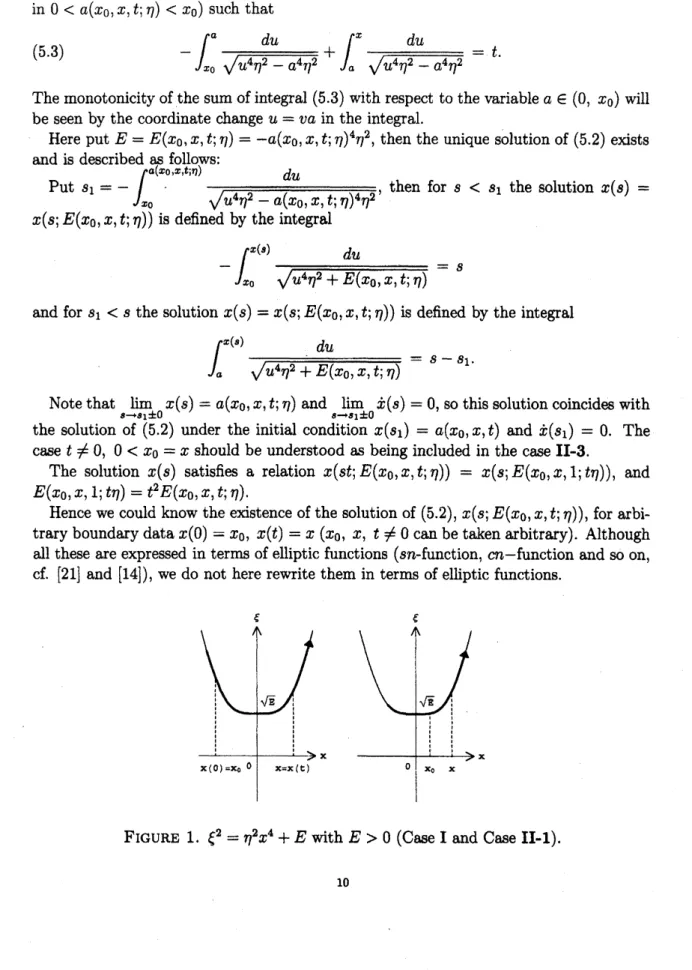
FIGURE 1. $\xi^{2}=\eta^{2}x^{4}+E$ with $E>0$ (Case I and Case II-1).
FIGURE 2. $\xi^{2}=\eta^{2}x^{4}+E$ with$E<0$ (Case II-2 and Case II-3).
Now based
on
the existence ofthe solutionof(5.2) wecan
define the (classical) actionintegral $f$:
(5.4) $f(x_{0},x,t; \eta)=\int_{0}^{t}\dot{x}(s)\xi(s)-H^{\eta}(x(s),\xi(s))ds$
.
By the relation$\dot{x}(s)^{2}=\eta^{2}x(s)^{4}+E(x_{0}, x, t;\eta)$, this integral equals to
$f(x_{0}, x, t; \eta)=\eta^{2}\int_{0}^{t}x(s)^{4}ds+\frac{t}{2}E(x_{0}, x,t;\eta)$
$= \eta^{2}\int_{x_{0}}^{x}y^{4}\eta^{2}+E=(x_{0}, x,t;\eta)dyy^{4}+\frac{t}{2}E(x_{0}, x, t;\eta)$
(5.5) $= \pm\frac{1}{3}\{x\sqrt{x^{4}\eta^{2}+E(x_{0},x,t;\eta)}-x_{0}\sqrt{x_{0^{4}}\eta^{2}+E(x_{0},x,t;\eta)}\}+\frac{t}{6}E(x_{0},x, t;\eta)$
$(\xi(s)=\dot{x}(s)=\pm\sqrt{x^{4}(s)r_{l^{2}}+E(x_{0},x,t;\eta)})$.
$f$ is
a
solution of Hamilton-Jacobi equation $\frac{\partial}{\alpha}f+H(x, \nabla f)=0$ and also satisfies thegeneralized Hamilton-Jacobi equation
$H(x, \nabla f)+\eta\frac{\partial}{\partial\eta}f(x_{0}, x, 1;\eta)=f(x_{0}, x, 1;\eta)$,
which is proved by making use of the relation: $tf(x_{0}, x, t;\eta)=f(x_{0}, x, 1;t7|)$
.
Finally
we
note that our arguments aboveare
also valid to show the existence of thesolution for the Hamilton system (5.2) of general higher step Grusin operator and so
we
have
an
action integral similar to (5.5).REFERENCES
[1] R. Beals, B. Gaveau and P. Grciner : The Green Ihnction ofModel Step two HwoelliPtic
Oper-ators and the Analysis ofCertain Tangential Cauchy Riemannian Complexes, Advances in Math.
121(1996).
[2] –, –, –: Hamilton-Jacobi Theory and the Heat Kemel on Heisenberg groups, J.
Math. PuresApPl. 79(2000).
[3] –, –, –: Complex Hamiltonian mechanics and parnmetrisesfor subelliptic
[4] –, –,–: On a geometnc
formula
for
thefundamentalsolution ofsubellipticLapla-cians,Math. Nachr. 181 (1996), 81-163.
[5] D. C.uChang and I. Markina : Geometric analysis and Greenfunction on anisotropic quatemion
Carnot groups, toappcar in AdvancesinAppliedMath.
[6] 0. Calin, D. C. Chang andJ. Tie: FundamentalsolutionsforHermite andsubelliptic operators to
appear in J. d’Analyse Math.
[7] K.Furutani: The heat kemel and the spectrum
of
aclass ofntlmanifolds,Comm. Partial DifferentialEquations, 21,No. 3&4 (1996),423-438.
[8] –: Heat Kemels ofthe sub-Laplacian and the Laplacian on Nilpotent Lie Groups, to appear
in Analysis, Geometry and Topology of Elliptic Operators, Papers in honour of KrzysztofP.
Woj-ciechowski,pp. 185-226,WorldScientific,London-Singapore(2006).
[9] B. Gaveau : Principe de moindre action,propagation de la chdeur et estimees sous-elliptiques sur
certainsgroupes nilpotents,ActaMath. 139 (1977),95-153
[10] M. de Gosson : The Principles
of
Newtonian and Quantum Mechanics, Imperial College Press,London, 2001.
[11] P.Greiner: On the heatkefnel volume element, 2000 (unpublished manuscript).
[12] A. Hulanicki: The distfibution
of
enem
intheBrownian motion in the Gaussianfieldandandytic-hypoellipticityofcertain subelliptic opemtors onthe Heisenberggroup, Studia Math. 56 (1976),
165-173.
[13] A. Klinger : New derivation
of
the Heisenberg kemel, Comm. Partial Differential Equations 22(1997), 2051-2060.
[14] D. F. Lawdcn : Elliptic R4nction and Applications, Applied MathematicalSciences 80,
Springer-Verlag (1989).
[15] L.P.Rothshild and E.M. Stein: HypoellipticDifferentialOperators and Nilpotent Lie Groups,Acta
Math. 137, No.3/4 (1976), 247-320.
[16] R. S. Strichartz : Sub-Riemannian Geometry,J. Differential Geom., 24, No 2 (1986),221-263.
[17] S. Thangavelu : Lectures on Hermite and Laguerre $Ex\mu nsions$, Mathematical Notes 42 (1993),
Princcton Universitypress
[18] J. H.vanVleck: The$\omega f+esponden$ceprinciPle inthe statistical interpretationofquantum mechanics,
Proc. Natl.Acad. Sci. U.S.A. 14, No. 176 (1928), 178-188.
[19] A. Voros : Zeta
functions
ofquartic (and homogeneous $anharmon\dot{l}C$) oscillators, LectureNotes inMath.,925,Springer (1982), 184-208.
[20] –: Theretumofthe quartic oscillator. The complex WKBmethodAnn.Inst. HenriPoincar6
39,No. 3 (1983), 211-338.
[21] E. T. Whittaker and G. N. Watson : A Course ofModem Analysis, Cambridge University Press